| Home |
ALLAN
SMALLMAN'S STAVERTON MEMORIES | |
|
|
| |
|
 | |
| | | |
| |
Positive feedback from previous articles is always
gratifying and in September 2012 I was pleased to be emailed by Allan Smallman with his memories of Staverton (now
Gloucestershire Airport ) and
especially Peter Thomas's
Skyfame Museum in the 1960s.
Allan has further kindly agreed to share these with
readers of Gloucestershire Transport History and if they spark any further
recollections then please feel free to
email me and share them here.
Allan himself spent 12 years in the Royal Air Force
including the years 1970 to 1972 as part of the ground crew for
The Red
Pelicans display team and 1976 to 1978 as ground crew and commentator for
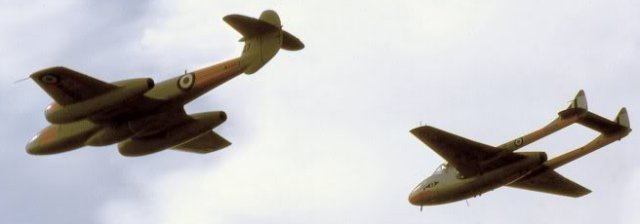
the Central Flying School's Vintage Pair of
Gloster Meteor T7
WF791 and
de
Havilland Vampire T11 XH304.
During this time Allan, now a motor racing commentator,
amassed 150 hours in the Jet Provost, 58 in the Meteor and 36 in the
Vampire.
| |
| |
| |
| |
 | |
| |
| |
| |
However, at the RAF Mildenhall Air Fete on Sunday 25 May 1986,
WA669 - which had been the reserve Meteor T7 for WF791 - was involved in a
fatal mid air collision with Vampire XH304 and WF791
was also sadly lost at the Warwickshire Air
Pageant at Baginton, Coventry
in 1988 after a "phantom dive" due to airbrakes being incorrectly
deployed during a solo display which the pilot did not survive.
Allan Smallman was born in 1951 into an RAF family with
his father being posted to RAF Innsworth (nowadays Imjin Barracks of the
Allied Rapid Reaction Corps) in 1960. Initially the Smallmans lived in
an RAF "hiring" in Park End Road and Allan attended Calton Road Junior
School.
Later living in Longlevens, he moved up to Chosen Hill Grammar School in Churchdown from 1962 to 1967, along with
Andrew Kay whose father was Chief Engineer at Smiths Industries at Staverton.
Allan also recalls that the Scottish family were later connected to the
Strathallan Museum - operational from 1969 to 1980 - located near Auchterader
although if anyone can confirm this they are welcome to
email me.
More directly, Allan soon discovered both Staverton and
Skyfame, although one of his earliest memories of this era was to be of an
infamous tragedy. | |
| | | |
| |
 | |
| | | |
| |
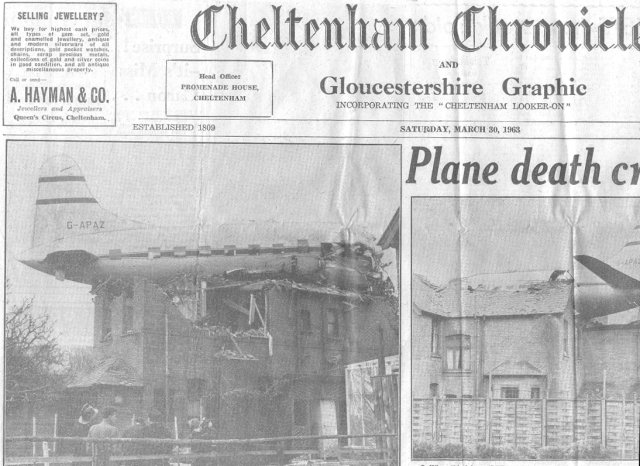
On 27 March 1963 a twin engined Vickers Varsity aircraft - with the
civilian registration G-APAZ - crashed on a house in Tuffley Avenue,
Gloucester. The three occupants of the house - Mrs Frances Drury, 85, Mrs
Ethel Hutchins, 69, and Bertha Franklin - survived unhurt apart from shock
and scratches. However, the house they were in and the neighbouring property
that the Drury family also owned were flooded with aviation fuel.
The Varsity - a descendent of the Vickers Wellington bomber of World War II
- had flown from Staverton airport where it was involved in a "controlled
overshoot" as part of research into
one-engined landings when the one good engine cut out. It appears that the
pilot was struggling with the controls of the aircraft and was trying to
crash land either at nearby school playing fields off Calton Road or a local
rugby ground. Unfortunately the tail of the Varsity hit the house and G-APAZ
ended up perched on top with its nose smashed and one wing ripped off.
The two men on board- Pilot Kelston Thomas, 26, and Co-Pilot Russell Palmer,
40 - worked for S. Smith & Sons, instrument makers, at Bishops Cleeve and
sadly both were killed. Kelston Thomas - a Salvation Army musician - was due
to have been married the weekend afterward at the Salvation Army Citadel in
Bristol. His fiancee, Margaret Clements, was a schoolmistress from Somerset.
The Drury family, however, had to wait five years before Commercial Union
settled their insurance claim for £ 6,000 - only for the same company to use
a picture of G-APAZ on their house in a 1993 advertising campaign in
Australia! After news of the campaign - with the slogan "Don't worry, we'll
always support you in a crisis" - reached Gloucester though it was quickly
withdrawn after a storm of protest!
Smiths Industries Aviation Division, meanwhile, actually operated Staverton
from 1956 (when Cambrian Airways moved out) until 1962 when the airport came
under the joint municipal control of Cheltenham and Gloucester. They
provided a manager, fire service and air traffic control for their fleet of
aircraft researching blind approach and other landing techniques. Alongside
the ill fated G-APAZ were a smaller de Havilland Dove and larger Hawker
Siddeley 748, G-ASJT. A fourth twin engined transport - replacement Varsity G-ARFP -
eventually returned to the RAF as WF387 in May 1968.
A newspaper of the time stated that the crew just had time to
send a "mayday" but it was too late as the Varsity was already out
of control and that the wreck was put under guard to stop souvenir hunters
and to protect the "secret" instruments that were fitted to G-APAZ.
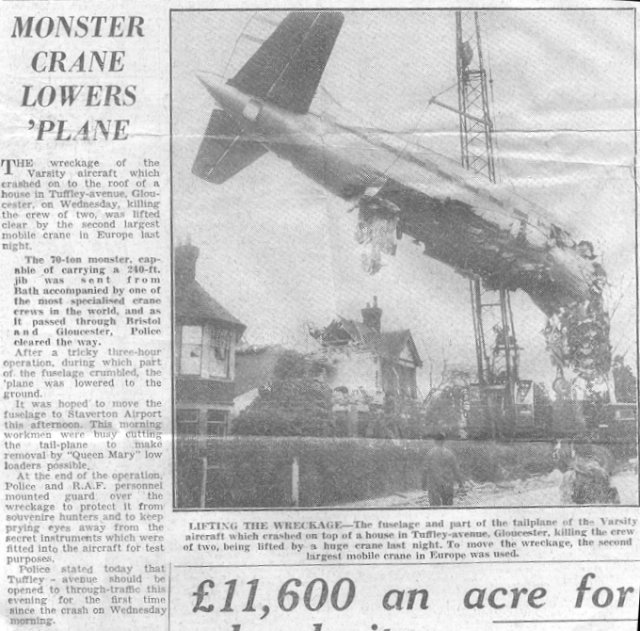
Recovery of G-APAZ eventually involved the second largest mobile crane in
Europe, based in Bath with a 240' long jib, and cutting the fuselage into
sections small enough to be loaded on to
Queen Mary
trailers ( immortalised by Airfix ) and returned to
Staverton. | |
| | | |
| |
 | |
| | | |
| |
Later that year, Allan became one one
of the volunteers helping Peter Thomas and his young family to run the newly
founded Skyfame Museum. In particular he remembers 27 July 1964
when Skyfame's prized de Havilland Mosquito TA719 "G for Georgie"
( pictured below) crash
landed. The former target tug had been painted with the serial HJ898
and the letters HT-G following its appearance in the film "633 Squadron"
although for the purposes of the UK Civil Register it was G-ASKC:
"I remember
standing next to Peter,
outside the famous black
hangar, watching the
display. The aircraft did a
single engined, low run,
down the main runway,
towards us and then climbed
and banked away to the left,
towards the Dowty factories.
I noticed the aircraft slow
and then bank in back
towards the airfield. The
air traffic controller came out and
yelled "the mossie's got
engine failure!" I watched
as the aircraft sank towards
the grass. It belly flopped
(obviously no time to lower
the gear) on the grass and
then ran across the main
runway and then disappeared
out of sight. I looked at
Peter and I saw the dismay
and disbelief on his face!
The crash crews went out and
found the pilot [ understood to have been Captain J.A.
Stone, employed by British European Airways to fly its Hawker Siddeley Tridents ] out of the
aircraft and inspecting the
damage. I remember going out
a day or two later, with a
crane and other people and
engineers from the museum.
The aircraft had hit a
haystack with its port wing
which had stopped it but had
taken the wing off just
outboard of the engine
nacelle. Our first attempt
at raising the aircraft to
enable lowering of the
undercarriage failed as the
strops were place around the
nose of the aircraft and the
wooden nose cracked! Strops
were then placed around the
2 engines and the aircraft
was raised. Somebody climbed
into the cockpit to prepare
to pump the gear down whilst
several of us got crowbars
into the gear doors to open
them. We eventually
succeeded and with the
handle in the cockpit being
pumped vigorously, the
wheels came down and locked.
We then towed the aircraft
back to the hangar, a very
sad walk for those of us who
walked beside her."
The June 1945 vintage
TA719 later appeared as a crashed aircraft in the 1968 film "Mosquito
Squadron" and ten years later was acquired by the Imperial War Museum.
It is has since been cosmetically restored to its TT35 guise and is on
display at Duxford.
More happily, on 9
October 1964, an Avro York - G-AGNV - flew into Staverton to join Skyfame
and Allan remembers bunking off school after it flew straight over his
classroom!. | |
| | | |
| |
 | |
| | | |
| |
Allan continues:
"Other fond memories
of Staverton were with the
Dowty Rotol flying club.
Chief Instructor was Jack Meaden and I got involved
with him as he was the pilot
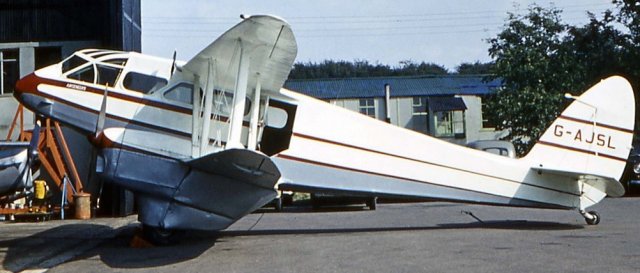
of the De Havilland DH89A Dragon Rapide, G-AJSL,
( constructors number 6801,owned by Airgeneers Ltd in 1965
and now under restoration in Australia) which was the aircraft used
for the parachute club at Staverton. There was also the
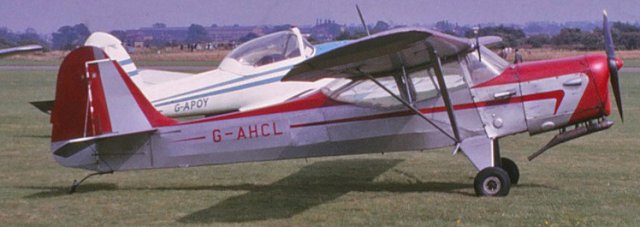
Auster J/1N Alpha aircraft
G-AHCL that belonged to the club,
in which I flew with Jack on
several occasions.
I used to
see the Rapide in and out,
Jack teaching me how to take
the chocks away and marshall:
a basic training that I
found very useful in my
initial career as an
engineer with the RAF. He
also let me watch him plan a flight and organise things, Jack was an
instrumental influence on my already inbuilt desire for aviation.
I
recollect another tragic day
at Staverton when a skydiver
failed to open his 'chute in
time and was killed. I
remember Jack landing the Rapide and the instructor
raced over to the incident.
Names escape me but I do
remember that the parachute
club was staffed by
Australians."
Jack Meaden's flying years are further recorded at
http://www.gloster.pwp.blueyonder.co.uk/archives/JM2.pdf | |
|
| | |
|
 | |
|
| | |
|
| In June 2013 I was
emailed by Jack Meaden's son Rex who added:
"From my own visits to Staverton I remember the Skyfame Museum, and even
managed to buy a Skyfame badge at a show recently. I particularly recall
the Flying Flea. Any visit to Jack involved a trip to the airfield 'to
see what was going on' and a spin in Charlie Lima. He got his Pilot's
Licence before his Driving Licence, gaining the latter so that he could
get to the airfield! He also gave up his Driving Licence well before
letting his Pilot's Licence run out. He was nothing like as good a
driver as he was a pilot, as to him the car was the tool that allowed
him to get maximum flying and aviation time. He was very proud of his
50-year assocaition with the Dowty Rotol Flying Club (mostly as
Chairman) which promoted affordable flying for the enthusiast. His
Monthly Newsletters were legendary, complete with their witty one-liners
straight out of Reveille at the bottom.
From the early 1980's he devoted himself to writing for Air Britain,
principally their Archive publication, for which his enormous knowledge
of the history of aviation (all countries, all years) and his picture
and cuttings collection was the mainstay (and has now been donated to
them as the basis for an Air Britain collection). He developed the same
friendly and knowledgeable reputation for his writings as he did for his
aviation." | |
|
| | |
|
|
 | |
|
| | |
|
|
Following this in July 2013 I was emailed by John
Putley, Learning and Outreach Officer at Gloucestershire Archives, who
further commented: "I knew Jack Meaden well, as my
father (Derek Putley) was for
many years the Treasurer of the
Dowty Rotol Flying Club. We were
always recipients of Jacks’
newsletters, but sadly only
saved a few. I not only flew in
the lovely old Auster G-AHCL (or
‘Charlie Lima’ as she was always
known) but also on the Rallye G-AZZF
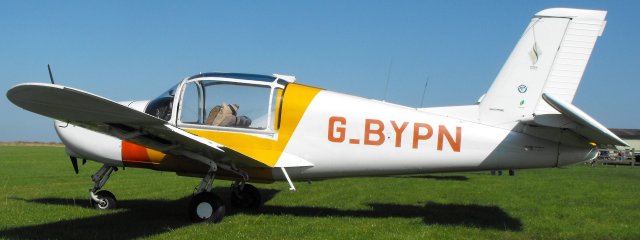
[1962 vintage Morane-Saulnier MS-880B Rallye Club C/N 174, similar to G-BYPN
pictured above] I remember once, when I was about 16, my mum & dad
went to an engineering conference in Bournemouth but I had to stay on at
home for an exam. My dad arranged for Jack to fly me down to Hurn airport in ‘Zulu Fox’
and so as soon as the exam
finished, I leapt on my
motorbike and drove from school
to Staverton, where I met Jack
and took off. As always, Jack
let me do the bulk of the actual
‘hands-on’ flying and handled
the radio and navigation. I
recall that as we were about to
pass through some RAF airspace,
Jack informed the RAF controller
and after the initial
pleasantries, the controller
asked “G-AZZF, are you Jack
Meaden?” Jack replied in the
positive and it turned out that
the controller’s father had
flown with Jack!
During those days we often
visited Jack at his flat in
Cheltenham and I always remember
one room that was full of model
aeroplane kits that Jack always
said he was going to build in
his retirement! Of course I
loved them – and imagined them
being added to the wonderful
Skyfame collection (I also knew
Peter Thomas as he used to live
near me – his Austin car used to
have a bonnet ornament of an
Airfix Mosquito!). More recently
– a few months before Jack died
in fact – I contacted him about
an ancient photograph that had
cropped up in the Forest of Dean
showing an old biplane on
display in Cinderford. I
contacted Jack and asked whether
he might know what it was and he
promptly replied with what
amounted to a ‘Pilots’ Notes’
sheet all about the aircraft (a
DH6 as it tuned out), it’s
characteristics and what it was
like to fly!!
As a kid I spent many happy
hours roaming feral around
Staverton in the 60’s 70’s &
early 80’s, especially on Monday
nights (the DRFC’s club night).
I would be playing in all the
hangers, getting onboard
aircraft (including the York and
the Hastings whenever I spotted
a ladder down) but I especially
loved making aircraft cockpits.
There was this old parts/rubbish
dump (where assorted bits of
broken aircraft and instruments
were thrown away) situated at
the back of the Bellman hanger
(the Skyfame / Dowty-Rotol one)
and I literally spent hours
there ferreting through and
digging up all the various
assorted bits and pieces and
then making up new cockpits to
play in. The smell of the whole
airfield was superb and whenever
I catch a similar smell these
days it’s sends shivers down my
spine.
| |
|
|
| |
| |
 | |
| | | |
| | Following Allan Smallman's memories going
online, I was emailed in October 2012 by Sidney Griffiths, now 81, who
added: " I started flying lessons at the
Gloucestershire Aero Club in 1965 in Auster G-ANHW.If
this Auster was out or service, for some reason, we borrowed G-AHCL or TO.
In 1966 the club purchased a brand new Bolkow Junior G-ATSX. I was the first
pupil to fly it solo. I had a number of instructors John Cole was the main
one."
Sid, who still lives in Stroud after
moving there in 1961, remembers John Cole as a:
"lovely
man but deaf as a post since the canopy flew off his Vampire at thirty
thousand feet and he had to descend rather quickly which burst his eardrum."
| |
| | | |
| |
 | |
| | | |
|
|
I can personally vouch for this as from
1973 John Cole was my woodwork teacher at Churchdown School and also a
colleague of my father George Drewett who taught metalwork in the classroom
next door.
In fact my life further merged with Sid's on 14 April 1975
when as a treat for my thirteenth birthday Dad persuaded John Cole to take
me up for a flight in Bolkow 208C Junior (constructor's number 608 of 1966)
G-ATSX.
As such I was very pleased when Dave
Haines kindly allowed me to use the
photo above by Steve Clark via
the splendid
www.flygloster.co.uk website.
Although taken just over a year later on 16 April 1976 it captures not only
G-ATSX itself but the unchanging outline of Churchdown Hill,
Skyfame's
Handley Page Hastings TG528 (now preserved at Duxford), some of Staverton's
buildings of the time and the infamous white line which spectators were
forbidden to cross.
To this day I can remember shouting "Starting Up" through the
little hatch in the perspex canopy of G-ATSX prior to the propeller turning and
looking down on Gloucestershire spread out like an N gauge model railway.
In fact I recall that we followed a train for a while between Cheltenham and
Gloucester before John let me fly the aircraft for a few minutes.
Sid further commented:
"I had an nineteen
inch model made of the Bolkow with G ATSX on each side of the fuselage. I went
to a Flight Simulation exhibition down at Bristol flying club about ten
years ago and SX was in the hanger but when I went down twelve months later
they had sold it."
Around 2003 the Swedish-developed
German-built monoplane
was registered to Little Bear Limited and G-ATSX was further noted at Exeter
Airport in February 2006 but after that my enquiries have dried up somewhat.
However, the December 2006 Bolkow Squadron Newsletter
http://bolkowsquadron.blogspot.co.uk/2006/12/bolkow-newsletter-december-2006.html
revealed that G-ATSX was now being kept
at Tatenhill airfield, near Burton-upon-Trent with Nigel Everett reporting:
"“I am one of
four group owners of G-ATSX. When we bought her about two years ago she had
a C of A and was in working order. However, in a regrettable fit of zeal, we
decided to strip her down and rebuild her. We disassembled her and stripped
the paint, finding the bodywork largely free of corrosion. We were then held
up, partly by the need of someone to repair the damaged trim tab and partly
by running out of steam. With the superb help of wonderful Gunther I managed
to arrange for him to get the trim tab fixed in Germany and we now have it
back, complete with paperwork. This winter, either I shall get the chaps to
work and finish the project or next summer we shall have a complete box of
bits for sale.
There were five of us in the group originally, but one has already died. I
did suggest a Tontine arrangement, whereby title to the Bolkow would
pass entirely to whoever outlived the rest, but they did not take to that. I
think that we may have to pass a rule that no one else may die until the
project is complete.”
Steve Whyatt of Oxfordshire further commented:
"...in 1971 I had my first flying lesson in none other
than G-ATSX ! It cost me £5."
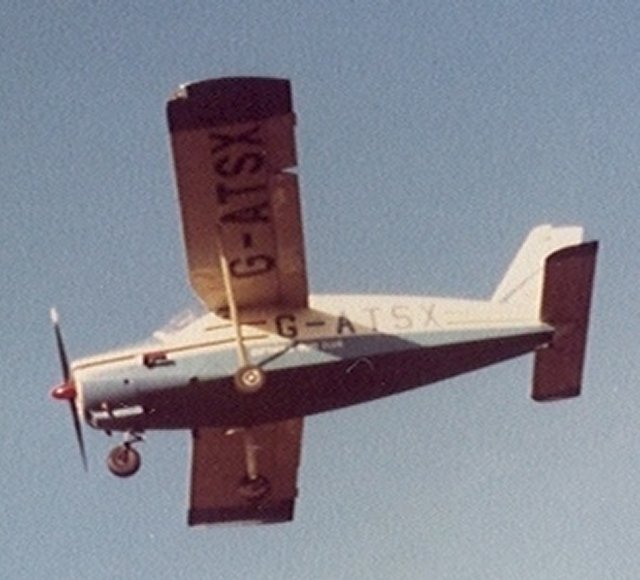
G-ATSX is pictured below approaching Staverton in 1981
but if anyone knows where it is now - please
email me! | |
|
| | |
|
|
 | |
|
| | |
|
| The 2 seat light tourer was in fact
designed in the United States by Bjorn Andreasson with the the prototype
BA-7 first flying on 10 October 1958. Development and production was
taken over by Swedish company A.B. Malmo Flygindustri who designated the
aircraft as the MFI-9 Junior and first flew their version on 17 May
1961.
Production rights were subsequently licenced to
Bolkow Apparatebau of Germany in 1962 and the licence built aircraft was
designated the BO208 Junior. Further development in 1964 saw the BO208B
with electric flaps, an improved undercarriage, and an optional longer
wing while the BO208C featured the longer wing as standard.
There was only ever one MFI-9 in the UK (G-AVEA) and one in Ireland, and
probably less than 50 ever produced, whereas the Bolkow 208s were fairly
common with over 200 produced.
In the
1970s the Cotswold Aero Club owned both G-ATSX and another Bolkow 208
-G-ATUI - which is still flying in north east England. Another
example - G-BOKW - appeared at Staverton in the 1980s but lost power on
a test flight on 29 June 1988 with John Cole at the controls and made a
forced landing near
Twigworth. Happily John, aged 70 at the time and with 10 000
flying hours to his credit, survived. | |
|
| | |
|
| Meanwhile, Michael J. Rawlings - a former
Calton Road School pupil and Gloucester resident, now living in Wales -
emailed in October 2013 to recall: "In the
early Seventies I embarked upon a course of Private Pilots Licence
flying lessons with the Cotswold Aero Club . The majority of my lessons
were in G-ATSX , although some were taken in G-ATUI , which was also
used at Cotswold . Most of my lessons were given by John Cole.
However some lessons were given by a John Morgan , who was , I
believe , a Hercules pilot and was basically "on his way out of the RAF
" and was doing this instruction part-time .
I recall having a lesson with John Morgan and we were circuiting
Staverton doing what was termed , "circuit and bumps " , i.e. making a
landing , continuing to take-off again , joining the circuit again and
repeating the procedure , the object being to perfect approach and
landings. After I don't know how many of these , John Morgan said to me,
don't take off again this time, go to the end of the runway and
full-stop , don't shut down engine " .
This I did , ( I can recall it was Runway 27 ) ,at the end of the runway
, having stopped , Morgan opened the canopy and climbed out saying ,
"OK, two circuits ,two landings, I'll see you back in the clubhouse " .
He then closed the canopy down, signalling to me to secure it on the
inside !!! .
You may imagine my thoughts for a moment or two!
At any rate , I did as instructed, slightly "fluffed" the first landing
but nothing serious , John Morgan spotted it nonetheless and commented
when I got back to the clubhouse !
Unfortunately at the time , circumstances and the arrival of a new baby
, prevented me from completing the course , but I am proud to say that ,
I did fly G-ATSX solo !!
Just as a footnote , I seem to recall that there were some slight
differences between
G-ATSX and G-ATUI , in terms of take-off speed if I remember , this
being due to a difference in the pitch of the propellors . I don't know
if anyone else can verify that.
| |
|
|
| |
| | |
| | |
| | |
| | |
| | |