
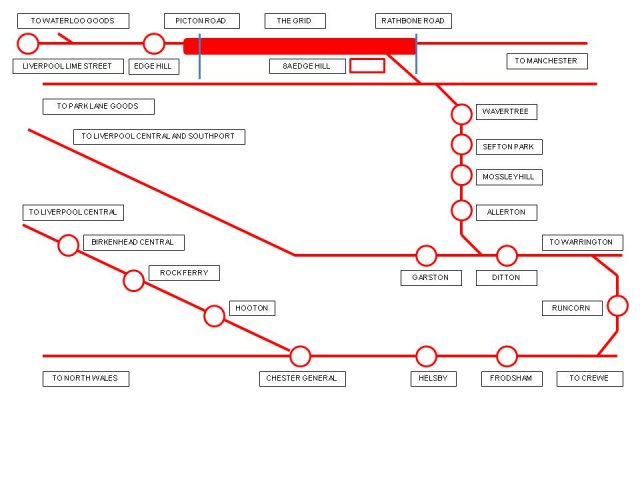
Feeding the grid were 2 lines. One, from Park Sidings leading to Park Lane Goods Depot, was to the west of The Grid and controlled by Edge Hill No 13 Exhibition Signal Box, on the South side of the Grid, which signalled trains from the North, South, West and East of the country.
Number 13 box was so called because on 11 May 1886 The International Exhibition of Navigation, Travelling, Commerce and Manufacture - a title understandably shortened by most to the ‘Shipperies Exhibition’ - was opened by Queen Victoria on land adjacent to Wavertree Botanic Park. This was held some years after the famous Great Exhibition at London’s Crystal Palace in 1851, which had created something of a fashion for shows of this type around the world. The Shipperies Exhibition could count a vast iron and glass pavilion, a full-size lighthouse, an ‘Indian Village’ and a Canadian toboggan ride amongst its attractions. It ran until 8 November 1886, attracting a staggering three million visitors. However, this wasn’t to be the last exhibition held in the area. In 1907 the same site was one of the key locations for Liverpool’s Grand Pageant.
Under Picton Road Bridge meanwhile was another signalbox dealing with arrivals from all the Liverpool docks, of which there where many every day as I recall being a fireman learning my trade on these trains during my apprenticeship.
Once on the brake van was back on the Western side of the Grid, the locomotive would also roll back and hook on to the western side of it, ready to attach both locomotive and brake van to the next train of exports bound for the docks.
The method of work on the Grid used gravity to shunt trains from the Top into the Middle Grid which I can only describe as being like a well made woman's corset - narrow at the top then bulging out in the middle then again narrowing after passing the hips and bottom. Once having been made up in the Middle Grid, complete trains then proceeded to the Foot of the Grid ready for departure.
Part of Middle Grid was dedicated to Civil Engineers trains, and in the distance to the North of the Grid, running parallel and making a 90 degree junction with Rathbone Road was Binns Road, long famous as the home of Meccano, whose works are just visible in the background of the picture below.

I started my railway career on 10 September 1962 at Edge Hill Motive Power Depot - a big, smelly, exciting place. I was issued with overalls, coats, a hat and a check number - 799.
I later found out the old hand driver Jack Herron’s check number was Number 1 and quickly deduced I was the minnow with 799 foot plate men in front of me There were also 200 artisans working at Edge Hill and perhaps a couple of hundred other workers.
After being issued with my new apparel it was time to see the Loco Shed Master for my Induction. Cap in hand, speak only when you are spoken to, shaking with nerves from my eye lashes to my toe nails. This man was God. What he said went. He was the Railway Law.
I remember his office was a big wood panelled room with a highly polished herring bone floor and a large fire place. The smell of floor polish filled the room.
The Loco Shed Master was a man of small stature, quite rotund but very nice with a calming voice and manner, wearing a pin stripe dark blue suit, white collar and a dark tie. A gold chain and pocket watch spread across his waistcoat.
He looked over his glasses as he asked:
"And your name is?"
"Arthur Kyle, Sir!"
"And tell me Mr Kyle what do you want to be on the Railway?"
"A Driver Sir!"
"Well you will have to work your way up through the line of promotion and may have to wait 15 years to get a driver’s job. Do you think you will wait that long?"
"Yes Sir as long as it takes!"
After this induction I was given a tour of the Depot, looking up at the enormous black, red and green locomotives. I came up to about their crossheads, staring up in total wonderment at their size and beauty. The smells of smoke, steam and hot oil filled me with excitement. Then I was introduced to the Foreman Cleaner who allocated me to the cleaning gang I was going to work with, and reality struck home.

Each cleaning gang had a senior cleaner which in today’s world would be a team leader. We called him the cock hand and he gave out the jobs. Cleaning was divided into wheels and motions, boiler and tender with as many as 15 cleaners in the gang and a fresh gang booking on every 2 hours around the clock except for 0200.
The cock hand and his mates got the easy jobs, often skiving off playing cards in a freshly cleaned out firebox where it was warm and comfortable, with an oil lamp, a pack of cards and plenty of tea and fags. They were set for the night whilst us young ones did all the dirtiest cleaning jobs.
In time the cleaning oil would run down your arm, soaking your filthy dirty body to the skin as if the gang had cleaned the loco with you instead of cleaning cloths. But a few months into the job you got to know everyone on all the shifts and your confidence built up to self-destruct mode as you started getting a little cocky, giving a bit of back chat to the cock hand.
He soon let you know who the boss was though, ordering his henchmen to grab your arms spread you outstanding like him on the cross and then pour a 2 gallon bucket of cleaning oil over your head, bucket and all, as punishment for being cocky.
You soon learn to shut up and get on with it. Well that’s what they thought! So, waiting my time on a night shift, the cock hand and his cronies disappeared to a nice warm fire box for the night's card game, leaving us to get on with the work. But not forgetting my baptism of oil, I waited till the gang was snug in the fire box and - hey presto - a lit and smouldering cleaning cloth went in to the ash pan, about a foot from the fire bars, with the firebox door suddenly shut with a piece of coal on the door runner and the back ash pan damper open.
The stinking smoke choked them and their eyes stung, but when the cock hand and his mates finally emerged, coughing screaming and swearing, baying for blood with tear marks down their black faces I knew nothing about it. "I have been here all night" I said, "cleaning this loco like you told me to do". They got over it!
1) The paths of promotion began with Engine Cleaner and then progressed to Passed Engine Cleaner - a cleaner passed in rules to act as a fireman, then Fireman, then Passed Fireman/ Second Man passed to act as a driver before the coveted title of Driver could be reached.
During the next month or so I learned the Rule Book in our breakdown train on the Cab Stand Road - and to this day I never did find out what that meant or where the name came from - prior to passing out for firing duties. But once I had sat my written exams as a passed cleaner there was the practical test of firing with the firing instructor - in my case Stan Walls. The train - hauled by a Class 8F 2-8-0 - was an empty coal working from Edge Hill to Old Fold Colliery - which I think it was Manchester way - and back loaded. Stan taught me well and I had no problems, even in the freezing the winter of 1962.
Stan then challenged me to fire an express passenger train, the 17.10 Liverpool Lime St to Holyhead.

In my short time at Edge Hill I used to stand by the bank head and watch all the expresses go by. The Red Rose and the Merseyside Express were sometimes steam hauled with a Duchess pacific heading the train. At the time Edge Hill had 46229 "Duchess of Hamilton", 46233 "Duchess of Sutherland" - since preserved - and 46243 "City of Lancaster" on its roster.
I had been on them all. God they were big! Well, to me they were! In fact in the early days on the bank head my mate and I where taking 46229 off the turn ready for a London job and as we were going up Rathbone Road Yard to go to Edge Hill - then main line to Wavertree Junction the 4-6-2 became derailed as the leading pony wheels hit a diamond crossing and went to the right. We thought she was slipping as both of us where sheltering in front of the fire from the snowy icy wind and it was only when I looked out that I found the leading bogies hanging in mid air. Had I not looked out at that particular time, the loco would have most certainly turned over and crashed down the embankment onto the shed.
But for the 17.10 we took a Black Five 4-6-0 tender first to Lime Street and backed up ready to start with 10 coaches on. We left in great clouds of steam and smoke up Lime Street cutting to Edge Hill then round by the shed over Wavertree Junction Fast Line.
Wow did that train fly! A well built fire made steam at 200 psi with a 3/4 full boiler and we picked up speed through Mossley Hill, West Allerton, Allerton, down Ditton bank at around 80 mph, then up to Runcorn to take the right hand signal for Frodsham Junction at 20 mph, around the corner then opening the regulator up again, heading towards Chester knocking on to 75 mph and finally down the bank stopping at Chester for train crew relief and coming home as passengers to Edge Hill via Birkenhead. It was a cracking day and I was now passed out for main line passenger work.
Perhaps this was an omen as at that time the Ford Motor Company had just opened at Halewood in Liverpool and a lot of drivers and firemen resigned to work there, which made for rapid promotion for me to the rank of Fireman.
Before then though, duties beyond mere cleaning crossheads awaited.
The first link was the disposal and preparation link - worked in shifts, 24 hours a day, 7 days a week - which consisted of cleaning the fires on locomotives which had finished off their trip, be it from London, Glasgow, Carlisle, Leeds or just a local working. Wherever they came from they were serviced.
The norm for this job was 1 hour per loco and 8 locos for a shift except for the Duchesses, for which you were allowed 1hour 30 minutes and no more than 2 a day plus all other class of engines. Our bank head accommodation was a brick building of about 18 feet by 6 feet and in there where you would find up to 10 sets of disposers - driver and fireman on each shift - 10 shifts all with characters telling their tales, men waiting for the next shift to come on. And in those days they were coming on and off every 30 minutes so everyone did the 8 for a day’s work.
That consisted of coaling, watering, fire cleaning, and finally cleaning the smoke box, which was the dirtiest job of all. Hot fine black dust - sometimes on fire with the intense heat - wafted from the smokebox door and went everywhere. With no gloves, dust mask or goggles I often ended up black from head to toe.
And then we had the Bootle Branch Link where you really learned your trade as a fireman. Every train going to the docks had a full load. 35 wagons of export goods there and 35 wagons of imports back. My regular driver was Arthur Stone an elderly man who had come off main line duties. He taught me to drive and we would take turns driving each way. Unfortunately Arthur died shortly after I left him to progress into the coal train link, which consisted of shunting coal around Liverpool, servicing collieries and returning with the loaded coal wagons.
From their I went into the Extra Link - a link of 56 weeks so that you never saw the same weeks work in the same year. This link was to provide cover for firemen who were on holiday or off for whatever reason and to cover special trains, both passenger and freight.
The Extra Link was where your training came in and further developed as you were expected to fire any class of loco on any class of train. One of our fast trains was the 1630 Lime Street to Llandudno booked for a 37 minutes to run to Chester via Runcorn and Frodsham.

Another job I remember well was the 1100 Liverpool to Newcastle, when I got the call at home asking me to book on early one Monday as we are allocated a steam engine due to our Class 46 diesel having been derailed in Edge Hill Carriage Shops. I dutifully arrived and found we have a Britannia - like 70013 "Oliver Cromwell" pictured above. On Mondays an Edge Hill crew only worked the 1100 as far as Leeds City, and the run turned out to be a fast job on a good uneventful day - apart from shifting some 5 tons of coal!
Another trip was a children’s outing to Edinburgh with Driver George Bernard Shaw. We came on duty at 0400 to prepare another Britannia - 70051 "Firth of Forth" - and take it off shed to Down Hill Sidings to prepare the train and when read propel the carriages to Edge Hill Station. We then picked up passengers at various stations to St Helens before making express speed to Carlisle.
What was wrong with this loco we never did find out, but I had great difficulty keeping the fire going. Although we had plenty of steam, trying to keep up with the firing was proving a struggle: firing as fast as humanly possible and just maintaining the fire level within the fire hole.
Every time we went over water troughs and dipped for water the fire was visibly dropping and at Hest Bank Troughs the platelayers working on the permanent way stood aside as we approached at 80 mph and I wound the scoop down to fill the tender tank. The trough water shot out like a wave on a fun park log flume and the platelayers stood wet through like Hawaiian surfers riding the Big One.
Of course at that speed we were away laughing at the sight, but meanwhile the fire dropped at an alarming rate which soon took the smile off my face and on arrival at Carlisle I hooked off and went Light Engine to Upperby Shed to book off for 6 hours. My mate George booked the loco for repairs and exam, thought no more of it and off we went to the Barracks.
Booking on again at 1600 for our return workings with the same loco and another possible dropping fire caused some concern, so as we were not due out for 45 minutes we stood first on the middle road of Carlisle Citadel station with just a low read fire producing very little heat. Panic was the order of the day, and with both dampers open and the injectors on I started shovelling coal into the firebox and did not stop until George had eased the train up the hard 32 mile climb to Shap Summit.
The firebox on a Britannia could hold 3 tons of coal no problem, but as we started the downhill run to Oxenholme the fire was dropping some 2 inches every 10 seconds or so. We looked over and under to see where the fire was dropping but no clues met out eyes - so that was me continuous shovelling until we got back to Liverpool, a total trip of 254 miles, the best part of 15 tons of coal and an 18 hour day.
Two weeks later on 5 June 1965, 70051 "Firth of Forth" was on the 1405 Crewe-Carlisle working when the fire exploded back into the cab at Winsford, seven miles from Crewe. Fireman Gwilym Roberts managed to escape the smoke and flames by climbing out of the cab window and rubbing his burning clothes on the plating but driver Wallace Arnold Oakes stayed at his post to close the regulator, open the blower and apply the brakes. As a result he received 80% burns and died a week later from his injuries aged 33 years. On 19 October 1965 Wallace Oakes was posthumously awarded the George Cross and on 19 February 1981 electric engine 86 260 was named "Driver Wallace Oakes GC". Wally Oakes was also commemorated in a plaque in the offices over Crewe station.
Back at Edge Hill on New Years Eve 1964 though, all the Drivers and Guards decided to have the night off. The boss at that time said that anyone not reporting for work will be disciplined so I turned in at 19:30, thinking I would be in the pub by 2200 as no drivers would come in. Wrong! A driver did turn in much to my surprise and disgust, so we were teamed up and told we would be working the 2030 Edge Hill to Healey Mills (Leeds) freight with a class 8F 2-8-0 : that is if a guard should turn in who signs the road. And sure as God made little apples one did, and what’s more he knew the route to Healey Mills so off we went.
We eventually approach Stalybridge at 2330 and the Refresh was heaving - a real party going on - so we stopped and I telephoned the signalman to advise him we where stopping for water to which I remember his answer all too well:
"Take your time Edge Hill, there is only you on the railway tonight"
"Ok bobby we will go and make a brew of tea whilst the tank is filling" I replied, and when I told my mate off we went to the Refresh along with the guard and spent the next hour in the bar having our New Year’s drink after all, eventually arriving at Healey Mills only to find there were no coal pullers on duty so it was up to me to pull my own coal down from the back of the tender - poetic justice perhaps!
And as you can guess a class 8F carried about 7 tons of coal and we used the lot by the time we got back to Edge Hill the following morning. And this job was regular 5 nights a week so you can imagine how many tons of coal a fireman shovelled in a full weeks work on that job.

When steam finally went in August 1968, it was all diesel and electric work - nice but quite boring. In January 1971 I passed as a driver and in 1973 I transferred to Birkenhead depot - 8H - working many class 6 petro chemical and coal trains and class 9 loose coupled iron ore trains mainly to Summers Steel Works in North Wales, Stoke and Shrewsbury.
I did however come to grief one morning at Chester when working the return train from Avonmouth to Shell Star ( Ellesmere Port/ Ince and Elton) when at about 0410 an axle snapped on the leading tank of Phosphoric Acid and caused the first two tanks to turn over spilling their contents of 45 tons each.
In 1986 I left the footplate to join the supervisory ranks and my first job was station supervisor at Liverpool Central on Mersey Rail and 4 weeks later after sitting another interview I ended up being promoted to Kirkdale depot Liverpool where I stayed until 1991 when I was asked by Transmark Paddington if I would consider being seconded to them for the Channel Tunnel Project, which I accepted.
That job was to represent a consortium of 5 International Companies and to get them up to speed hiring and training Drivers and Shunters for the construction trains as they were laying the concrete track bed, walkways and railway through the both North and South Tunnels which I did - and that really is another story which would literally take months to get down on paper.


In about 2001 I was asked by another railway training company if I would go to school and learn the Class 180 diesel hydraulic multiple unit and teach the Fist Great Western Driver Instructors all about this new train. I was there for some 18 months living in London and with that job done I retired in 2005.
