| Home | COTSWOLD MODEL RAILWAY SHOW 20 & 21 OCTOBER 2012 |
|
| |
||
| INTRODUCTION | ||
| |
||
|
|
||
|
|
||
|
|
||
|
|
||
|
|
||
|
|
||
|
|
||
|
|
||
|
|
||
| |
This was the sixth annual Cotswold Model Railway Show, organised by Phoenix Model Railway Club, Gloucester Model Railway Club and Eastcombe Scout and Guide Group and held at Thomas Keble School, Eastcombe, Gloucestershire, GL6 7DY. | |
|
|
||
|
|
||
|
|
||
|
It was also the third show to feature The Exhibitor's Cup, in memory of Bert Hawkins, the Gloucester Club President who sadly passed away late in 2009. Bert was an active member of the Gloucester Club, joining in the mid 1960s. His larger than life charisma rubbed off on the entire membership from day one. He was the fulcrum of the GMRC, holding every committee position over the years. When the GMRC President, the Reverend Wilbert Awdry, passed way, Bert was made President, a position he valued and held with great honour and distinction. An excellent modeller, his layout - Kingsgate - was popular on the exhibition circuit and appeared at the 2009 Cotswold Show. With the full support of Bert's son Nigel, The Exhibition Committee introduced The Exhibitor's Cup, to be voted for solely by the exhibitors, and awarded to the layout that they consider the best in show. The first winner of The Exhibitor's Cup was Cheltenham South and Leckhampton and the second was Chris Hopper's Pixash Lane. Both are pictured above. In 2012 the third winner of The Exhibitor's Cup was also the first foreign image layout and the first in N gauge - A Glimpse of the Algarve by John Cannons - pictured above. |
||
|
|
||
|
|
||
|
|
||
| In 2012 Richard Hewins' Rowington for Shrewley - pictured above
- became the fourth annual recipient of the
Pat Arnold Cup. Pat Arnold was a long standing stalwart of Gloucester MRC and the Cotswold Show and the winning layout is voted for by the visiting public to celebrate the very best of design, operation and presentation with particular attention to layouts which display the enthusiasm in modelling that Pat promoted for many years. |
||
|
|
||
| LAYOUT AND ATTRACTION REVIEW |
||
|
|
||
|
GRUMBLING
GOODS
by
Malcolm Smith GMRC G Gauge (45mm) |
||
|
|
||
|
|
||
|
|
||
| The children were queuing up to play with this little slice of the Island of Sodor, presented here in the G Gauge format pioneered by LGB in 1968. The simple track plan included a tunnel, station, level crossing, locomotive and goods facilities. | ||
|
|
||
|
|
||
| |
||
|
DINAS DDU
by Peter Booth 8mm Scale | ||
|
|
||
|
Adhering to 0-16.5 format - or 1/32 scale rolling
stock on 00 gauge track - to represent the Welsh two foot gauge, Dinas
Ddu was closely based on the approach to Dinas Junction station. Dinas
Junction was the northern terminus for the North Wales Narrow Gauge
Railway's main line to Rhyd Ddu - later known as South Snowdon. It was
modelled as it is thought to have been in the early part of the 20th
Century, based upon contemporary plans and photographs. This railway was
eventually incorporated into the ill-fated Welsh Highland Railway in
1922 and the site is now part of the newly completed Welsh Highland
Railway.
"Snowdon Ranger", pictured above, was named after a station on the line, opened high above Lake Cwellyn in 1878 but was itself built by Vulcan Foundry as works number 739 at Newton le Willows in 1875. The 0-6-4T Single Fairlie was scrapped in 1917 although its major components were used to repair Vulcan Foundry 738 "Moel Tryfan", eventually scrapped by the Festiniog Railway in 1954. The intention had always been to model virtually everything from scratch and this has largely been accomplished, the choice of the unusual scale of 8mm to the foot leaving little other option. The track was spiked to wooden sleepers in the prototypical fashion and the ballast had been produced from crushed slate. The locomotives were constructed from nickel silver and brass, information having been obtained where possible from the manufacturer's original drawings. Coaches and wagons were constructed from wood, nickel silver or plasticard on nickel silver and brass underframes. Additional stock is planned, a Cleminson six wheeled coal wagon having recently joined the fleet and some more large coal wagons are on the way. Stonework on the buildings had been produced by building up layers of Polyfilla onto a scribed plaster base, the resulting texture finish being painted with watercolours. The corrugated iron was obtained from Slater's sheet, which works out exactly right for the chosen scale. Grass was made from individual clumps of plumber's hemp while bushes and other scenery was made from a variety of materials. Dinas Ddu was first started in the mid 1980s and is now virtually complete, although there is scope for further scenic development. The layout will eventually be extended to include most of the narrow gauge station at Dinas, although it will not be practicable to include the large sidings complex. One of my favourite aspects was the illuminated workshop, complete with mechanic sawing away at a bench by a window. | ||
|
| ||
|
|
||
|
STOW
CREEK by
Delyth Eastabrook On30 Gauge 7mm Scale |
||
|
|
| |
|
|
||
|
| ||
| Set somewhere in the south west of Texas soon after the turn of the 20th Century the railway existed to haul block stone from the distant quarry to the rail head for transhipment on to barges for passage downstream when the creek was running wet (with real water I might add). This wasn’t very often and the loading derrick was a bit temperamental, needing nerves of steel and a manual dexterity lacking in most to operate. Activity was therefore erratic at best, but Stow Creek designed to unite with other compatible layouts and featured an impressive arched lighting gantry. | ||
|
| ||
|
|
||
| BROCKLEY ACRES
by Alan Postlethwaite 00 Gauge 4mm Scale |
||
| |
||
|
|
||
|
|
||
|
Brockley Acres for me is not so much a layout as an idea in action,
a table top railway capturing the spirit of Hornby Dublo and Trix Twin.
It has no defined shape but its track plan can be build and rebuilt to
suit any exhibition venue. Other recyclable features include an ex Trix
Twin truss bridge, town square, fire house, quay, and four stations - Green Lane, Ebley, Stroud and Brockley - all served by nearly six scale miles of
track.
Brockley Acres is set around 1950 with trains from the Big Four - GWR, LMS, LNER and SR - as well as some early BR and pre-Grouping items operating a fictitious secondary line between Oxfordshire and Gloucestershire. There can be as many as five electrical sections with analogue controllers requiring three operators to work the entirely manual points linking Peco and Hornby tracks. In his instance the base boards were 3mm MDF covered with old snooker cloth and supported by paste tables. The 22' x 7' layout took five hours to assemble and test with a Stationmaster controlling the Anticlockwise Main Line and the Terminus while the Yardmaster controlled the Clockwise Main Line and the Outer Goods Loop. Large Setrack layouts such as Brockley Acres are rare, although the points were somewhat crude and could not take all locomotives. Many bogies, pony trucks and freight wagons were also weighted to avoid derailment on frogs. At the buffer stops of Crantock station, above, was 46140 "The King's Royal Rifle Corps", one of the 1927 Fowler-designed Royal Scot class 4-6-0s as rebuilt by Stanier from 1943 with taper boiler, new cylinders and double chimney. Still in dark blue Somerset & Dorset Joint Railway livery was one of the 2P 4-4-0s built at Derby in 1914 and absorbed into LMS stock in 1930, the same year in which the S&DJR's own Highbridge locomotive works closed. They were later numbered 40322-40326 by British Railways. |
||
|
|
||
|
|
||
| |
||
|
DOVINGTON CAMP
by Paul Taylor 00 Gauge 4mm Scale | ||
|
| ||
|
|
||
|
| ||
|
Dovington Camp was developed during World War II
as an army stores and training depot with quite an extensive rail
network. This had been rationalised over time but still retained a
rail link for the movement of fuel, stores, munitions and a wide
variety of military vehicles. It retained several MOD diesel
locomotives - including Knightwing hydraulic type RK 20B seen above
- for shunting within the depot.
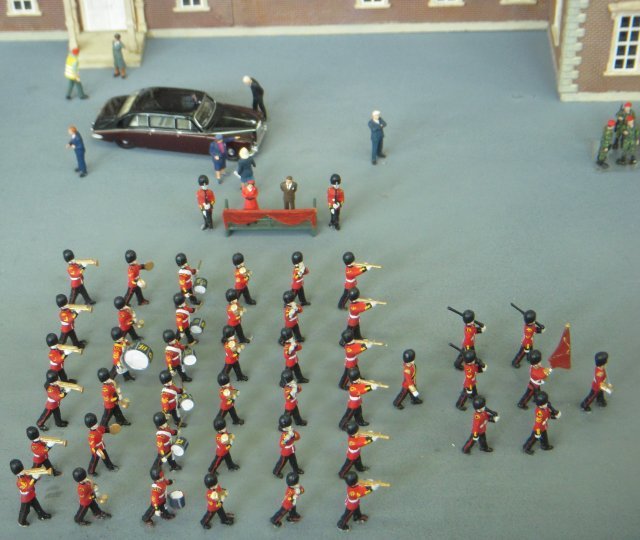
The main stores and office were constructed with the exteriors visible to exhibition visitors and on this occasion Dovington Camp was represented in the lead up to the Gulf War of 1990 with the local Guard's Brigade (made from classic Airfix Guards Colour Party and Guards Band soldiers adapted to carry SA80 rifles) parading to receive new Regimental Colours from the Preiser model of HM The Queen. You can just imagine what HRH Prince Phillip might have said! Dovington was previously seen at Cheltenham in October 2006 in its smallest modular form and nowadays could also connect with Paul Taylor's Anelian Road layout. |
||
|
| ||
|
|
||
|
| ||
|
ROKER BRIDGE
by Mike Briggs 00 Gauge 4mm Scale |
||
|
| ||
|
|
||
|
| ||
| Roker Bridge ( from the TV drama "All Quiet on the Preston Front" ) is fictitiously situated on the single track line to Fleetwood just outside Preston. The Beeching era saw the track plan rationalised to cope with commuter traffic whilst the goods avoiding line has now become a long siding from Preston that now remains to serve the privately owned wagon works which always seems busy. The old goods line to Fleetwood South via the Roker tunnel has now been taken over in part by the Diesel Shunter Preservation Society, the chairman of which coincidentally owns the wagon works who thereby make copious use of the preserved shunters. The time period is early 1970s so DMUs operate the commuter service. This part of the layout is automatic whilst the traffic to the wagon works is operator controlled: effectively 2 layouts in 1 in a space of 9 ' by 1'. | ||
|
| ||
|
|
||
|
ROWINGTON FOR SHREWLEY
by Richard Hewins 00 Gauge 4mm Scale |
||
| |
||
|
|
||
| |
||
| There is not, and never has been, a station
called Rowington for Shrewley. This was an imaginary station
situated between the real villages of Rowington and Shrewley but in true
Great Western style was nowhere near either village! Just north of
the imaginary Rowington for Shrewley was the real Rowington Junction
where there was a 3 mile 7 chain branch to Henley in Arden. Rowington for Shrewley was set in 1922 with one or two colourful pre-Grouping exceptions and a lot of the coaching stock was in the GWR 1912 Lake livery. Virtually all the locomotives and rolling stock - including GWR steam railmotor 79 seen below - were scratch built while the trackwork was made from SMP kits and the extensive signalling by Ratio, Model Signal Engineering, Scale Link, Colin Waite and Springside Components. Buildings and structures were modified kits or scratch built and all were GWR prototypes while trees were hand made and other scenery supplied by Panhaven and Woodland Scenics. A full article on Rowington for Shrewley was featured in the February 2010 edition of British Railway Modelling. |
||
| |
||
|
|
||
| WARTIME
by Bentley MRG 00 Gauge 4mm Scale |
||
|
|
||
|
As the evocatively written programme notes suggested,
Wartime was somewhere on the Southern Railway during 1939-1945 when
Careless Talk Cost Lives. As a giant time travellers were able to
see however, the period was nearer the start of World War II judging by
the machine gun rather than canon armed
Spitfires in brown and green rather than grey and green camouflage
and the abundance of Matilda tanks rather than the Shermans which
started arriving from 1942 when America made its practical entry into
the European conflict.
Due to its heavy armour the Type A12 Matilda II was the only British tank to serve throughout World War II, surviving into late 1945 with Australian forces due to the Japanese army's lack of anti-tank guns comparable to the German 75mm PAK 40 and 88mm which the Matilda had encountered in North Africa in 1940-1942. The first of 2 987 Matilda IIs built - armed with a QF 40mm 2 pounder gun but always lacking a suitable high explosive shell - were completed by the Vulcan Foundry from 1937, other examples being outshopped from such famous railway organisations as John Fowler of Leeds, Ruston & Hornsby, North British Locomotive in Glasgow and the Horwich works of the LMS as well as Harland & Wolff in Belfast. Just as British industry pulled together for the war effort, so trains from all of the "Big Four" companies worked over each other's lines for the common good, including in this case one of two ex LBSCR A1X "Terrier" 0-6-0Ts inherited by the Great Western Railway on the closure of the Weston, Clevedon & Portishead Railway in 1940. | ||
| |
||
|
|
||
| SERGARO VALLEY RAILROAD
by Terry Lee H0n 30 Gauge 3.5mm Scale |
||
| |
||
|
|
||
| |
||
| Sergaro Valley Railroad was a fictional layout
set somewhere along the Segaro River in the Chuska mountains of New
Mexico and based on a 2' 6" gauge railroad originally built to take
ore from the Rockford mine - dug in the 1860s - forty miles to the Smith
Brothers Gold Mill. Officially named in 1901, the Sergaro Valley
Railroad eventually linked the Union and Central Pacific Railroads over
a distance of 150 miles and was depicted on the layout with a small
fishing harbour and packing plant, depot and locomotive shed, where the
2-8-0s and 2-6-0s used to climb the 3% grade to the summit were
exchanged for smaller engines. The layout - set in the 1920s before the Great Depression and mass car ownership - was built some years ago with Peco 009 Crazy Track and hand held controllers by John Craig, who also scratch built some of the locomotives and rolling stock while Terry Lee - a member of The Slim Gauge Circle - rebuilt the trestle and added more locomotives and rolling stock. |
||
|
|
||
|
| ||
|
HOLLOW FOSSE
by John Thomas 3mm Gauge 3mm Scale |
||
|
|
||
|
Hollow Fosse was a fictitious location on the Midland
& South Western Junction Railway which used to run through Cirencester
from Andover to Andoversford. With connections to the LMS, Southern and
GWR, all three companies were represented on the model with mixed trains
hauled by both steam and diesel engines of the late 1950s/ early 1960s.
The Midland & South Western Junction Railway overcame the financial problems of its formative years and established itself as a viable and reliable service before being absorbed into the Great Western Railway, along with many other independent railway systems. During its independent years the MSWJR provided a useful link between the southern railway systems and the railway network in the Midlands and the North and also built branches to feed goods and passengers into its main artery. After Nationalisation Hollow Fosse settled down into the slow rhythm of the countryside with GWR locomotives hauling mixed trains of Southern or Midland passenger and goods stock and vice versa. 3 mm scale is mid-way between OO and N gauges and was once mass-produced by Triang. These days, it is supported by a dedicated band of modellers, the Three Millimetre Society, which hold an annual convention each September. The L shaped layout measured 5' x 3'. |
||
|
|
||
|
A GLIMPSE OF THE ALGARVE
by John Cannons N Gauge 2mm Scale |
||
|
|
||
|
|
||
| This layout represented a typical town on the Sotovento or leeward coast in the south of Portugal with the railway traversing the wetland between sea and mountains. Just as real Portugese rolling stock has been purchased from various international manufacturers, such as Alco and English Electric, so the models have been eclectically sourced, repainted or even scratch built using proprietary chassis and mechanisms. All the buildings were scratch built and based on prototypes drawn or photographed in the region. Some architectural drawings were supplied by the Camara Municipal do Faro. | ||
|
| ||
|
|
||
|
| ||
|
MALLINGFORD CENTRAL
by Jim Bryant N Gauge 2mm Scale |
||
|
|
||
|
|
||
|
| ||
|
Set in the early 1980s, Mallingford Central
represented a terminus station in a fictional large town south of
Birmingham close to the boundary between Western and London Midlands
of BR and connected to the Birmingham -Bristol main line by a
triangular junction near the real life station of Kings Norton.
The location was chosen because it seemed to give the maximum amount of interesting and varied passenger train workings together with justification for a small locomotive depot providing servicing facilities for freight locomotives allocated to Bescot shed, and passenger locomotives laying over from their duties. A revised version of the Domesday Book shows the hamlet of "Mellinge Forde" where there was not very much to record but during the Industrial Revolution useful clay, coal and iron ore deposits were discovered in the locality and attracted investment first in canals and then railways, both Midland and GWR companies competing for business. The Great Western line ran past the outskirts of Mallingford but the line depicted was based on the supposed Midland presence. The town was large enough to warrant regular calls by Inter City cross country trains together with locomotive hauled trains on provincial routes and DMU services between Worcester and Birmingham. The depot provided servicing facilities . Operation was based on the 1982 timetable with mainly blue diesels - such as classes 25, 40 and 50 - as well as light engine movements. A whole operating sequence would have taken 6 hours to complete and was based on over 460 cards shared between two operators, each card showing both the train movement and the necessary electrical set up among the 17 points and 28 switches. Buildings on Mallingford Central (such as the closely detailed representation of Bristol Temple Meads) were scratch built or modified from Kestrel and Peco kits, the track was standard PECO N gauge and the rolling stock mainly by Grafar. Among these assets, some of the carriages had TPM inlays and suitably modified roofs and underframes and were often weathered and renumbered from the vehicles as supplied. |
||
|
| ||
|
|
||
| | ||
|
PICK 'N' MIX SHUNTING PUZZLE
by Philip Bird GMRC 00 Gauge 4mm Scale |
||
|
|
||
|
Pick 'n' Mix was a small layout designed to test
visitor's ability to perform some shunting operations. The layout
consisted of thre sidings and a head shunt. Two of the sidings
could hold three wagons, the third could hold five wagons and the head
shunt could hold three wagons and a locomotive. The Pick 'n' Mix layout was populated by eight wagons in addition to the locomotive. Five wagons are selected at random and the puzzle is to assemble these wagons in a train, in the order selected, on the five wagon siding. It sounds simple and it can be, but a lot depends on the selection and the existing location of the wagons. |
||
|
| ||
|
|
||
|
GMRC DEMONSTRATION
by Ken Haines 00 Gauge 4mm Scale |
||
| |
||
|
|
||
| |
||
| It is always rewarding to see a skilled modeller
at work and among his completed vehicles Gloucester Model Railway Club's
Ken Haines displayed 3827 "County of Gloucester", one of the "County"
class 4-4-0s designed for the Great Western Railway by George Jackson
Churchward. Know to railwaymen as 'Churchwards rough riders', the 'County' class of locomotives looked very much like a shortened version of the "Saint" 4-6-0 class and were designed to work the cross country services on the Shrewsbury to Hereford line, jointly owned by the GWR and London and North Western Railway. The LNWR refused to allow 4-6-0 locomotives on this line and so Churchward designed an engine with enough power in reserve should the need arise for its use on other lines, but as Sir William Stanier noted: "Churchward was not going to be instructed by F.W. Webb, the Locomotive Superintendent of the LNWR, and designed an engine that had plenty of power to run the service but which had a front end too powerful for the wheelbase." Ironically, although the 'County' class were envisaged in 1901, the first member of the class was not built until 1904 - exactly one year after Webb had retired. A quarter of a century later Richard Maunsell was also to look back to the 4-4-0 wheel arrangement when faced with a need for small but powerful intermediate locomotives and introduced the Class V "Schools" engines for a number of Southern Railway lines which allowed high axle loading but could only offer small turntables. Similarly, it is interesting to compare Churchward's "Counties" with the 4-4-0 "Cities of 1903, introduced only one year after he had succeeded William Dean as GWR Chief Mechanical Engineer. Both 3827 "County of Gloucester" and 3440 "City of Truro" - pictured below - featured top-feed Swindon taper boilers but while the preserved locomotive's heavy double frames looked back towards the days of Dean, Armstrong and Gooch the 4-4-0 Counties would not have looked out of place next to the Castles and Kings built by Churchward's successor Charles Baker Collett.
|
||
| |
||
|
|
||
|
DIESEL AND ELECTRIC MODELLERS UNITED
DISPLAY | ||
|
|
||
| Diesel and Electric Modellers United (DEMU) was formed in 1994 as an independent society catering for all modellers of the railways of Britain and Ireland in the diesel and electric era, regardless of scale or modelling ability. DEMU are also working with various ready-to-run and component manufacturers to supplement their prototype information and provide market research on proposed new products. DEMU have an active website for members and guests and can be found at www.demu.org.uk where it includes a members only web forum. | ||
|
|
||
| |
DOLLS HOUSES & MINIATURE ROOMS by Cotswold Miniatures | |
| |
|
|
|
|
||
| On display were a number of "Room Boxes" - the equivalent of dioramas - depicting a wide variety of scenes such as Christmas in the round, a library in a time piece and other activities as well as two miniature houses. Historically, dolls houses were made to 1/12 scale but today they also appear in 1/24, 1/48 and even 1/144 scales complete with back story - just like model railway layouts. | ||
|
|
||
| RAILWAY ARTIST Barry Walding | ||
|
|
||
|
|
||
|
|
||
| Barrry Walding brought a selection of
railway, aviation and wildlife
art and was also busy continuing a superb panting of some traction
engines that I last saw at Eastcombe in 2011. He is pleased to
consider commissions, can be contacted on 01453 844551 and also offered
the following advice to artists: "Use a photograph by all means but use it as a tool. A photograph will only give you four tonal values but the naked eye can see twelve. Painting from life stays in your brain. It's instant recall. Observation not only trains your "eye" but teaches you to mix colours accurately. It is without doubt the best way to learn! Remember too, if you aren't making mistakes you aren't learning anything! David Shepherd once said to me when I was learning to paint, ".. bash it on and see what happens!" It's the the best piece of advice I could have wished for and it's exactly what you do when you PAINT FROM LIFE." |
||
|
|
||
|
|
||
|
|
||
| |
Also in attendance were displays by the Festiniog Railway, Freestone Model Accessories, Modelmania of Bristol (BTozer8649@aol.com), Brian's Trains (01932 568925) Keith Price and Rural Railways ( 01547 530016 ) purveyed model rolling stock and accessories while Stewart Blencowe offered books, photographs and transport ephemera. | |
| |
||
| |
||