Similarly, between 1873 and 1875,
Fielding and Platt converted a number of broad gauge
locomotives for stationary duties at Llanharon Colliery and
in 1880 built a bridge across the Severn at Gloucester
Docks, adjacent to the North Warehouse, which was not
replaced until 1962.
| Home | THE RIVETTING WORLD OF FIELDING AND PLATT |
|
|
|
||
|
||
|
|
||
|
In 1871 Gloucester's world-famous hydraulic engineering company Fielding & Platt was approached by a brilliant engineer named Ralph Hart Tweddell, who had invented a portable hydraulic riveter. Until then rivets had been closed with either massive stationary machines or manually with hot rivets being hammered into place. The latter practice was particularly popular in shipbuilding, and furnished many Govan shipyard workers with spare cold rivets to throw at any English comedian brave enough to appear on stage at the Glasgow Empire! Fielding & Platt realised the possibilities of Tweddell's invention and mass produced his machine, portable hydraulic riveters being eventually used to construct the Forth railway bridge (designed by Cheltenham Grammar School educated Sir Benjamin Baker) in 1890, sewage mains in Sydney in 1892 and install the gantries at Harland & Wolff's shipyard in Belfast in 1898. |
||
|
|
||
|
|
||
|
|
||
|
To celebrate the production of the 500th portable hydraulic riveter in November 1872, a special tea party was held at Fielding & Platt's St Luke Street offices with three of the machines being hung from beams in the room - decorated by Mrs Fielding and Mrs Tweddell - along with banners hailing the success of the Tweddell system. Four hundred men and boys crowded around six tables on which meat, bread, butter and tea were served before The Brunswick Handbell Ringers gave a performance of a "Gloria", "The Huntsman's Chorus" and a selection from Schumann. A grand piano had also been brought into the room so that songs could be performed, including a number from company founder Samuel Fielding himself. One song, performed by a Mr Hill, had for its chorus: "Oh it is jolly when masters and servants together thus meet, Oh it is jolly, yes it's a jolly good treat!" Such good relations between workers and management continued until Fielding & Platt closed in 2000, and more information on the firm can be found at www.fieldingandplatthistory.org.uk |
||
|
|
||
|
|
||
|
|
||
| Fielding and Platt had been founded in 1866 by two
Lancashire men, Samuel Fielding and James Platt, and when Samuel
Fielding died in 1874 his two sons, James and John, became joint junior
partners with James Platt - who was also a Director of the
Gloucester Railway Carriage
and Wagon Company Limited.
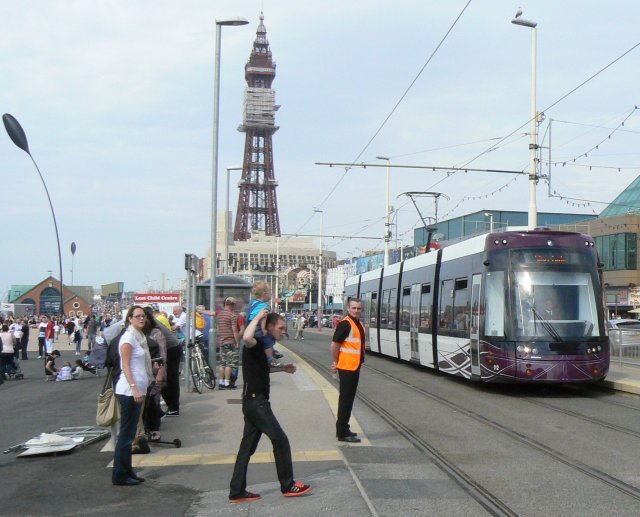
At this time the company was expanding rapidly, building new equipment and registering patents. Products included furnaces, hydraulic presses (including a 900 ton flanging press in 1874), travelling cranes, machinery for processing girders and a wide range of steam and oil engines. Apart from the wide range of items made, Fielding and Platt was particularly noted for the quality and long life of its products. Orders were received from locations as far afield as Philadelphia, Paris and London with Fielding and Platt also taking part in the construction of Blackpool Tower (pictured above) and the first vacuum cleaner, invented by Gloucester man Hubert Cecil Booth. |
||
|
|
||
|
|
||
|
|
||
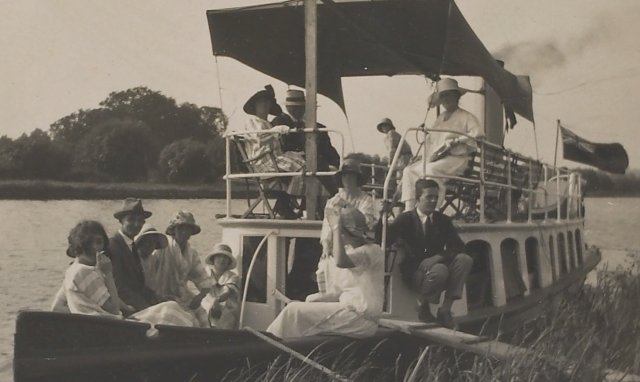
| Having built its first seagoing iron steamer in
1868, Fielding and Platt produced the steam boat "Sabrina" for use on
the Gloucester and Sharpness Canal in 1874. This vessel still
survives on the Thames and was reviewed by Her Majesty Queen Elizabeth
II as part of her Diamond Jubilee in 2012. Casting objects as large as a boat hull required skilled foundry work, which started with a wooden pattern - carved in a Pattern Shop - being carefully surrounded by sand. The original pattern was then removed and molten metal continuously poured into the remaining void and left to cool. If the metal was not poured continuously, air bubbles between the different batches of molten metal would weaken the structure - and large castings could sometimes take days to cool down enough before the fettlers ( responsible for removing "flash", or excess metal, could begin grinding and burnishing the cast component. The dark colour of the specialised casting sand gave Gloucester's Baker Street the nickname "Black Road" as Fielding and Platt's two iron and one brass foundries were located there. The larger of the two iron foundries was on the ground floor of the building could cast objects of up to 20 tons. However, these facilities were demolished and replaced with a smaller iron foundry in 1939, the same year in which Fielding and Platt were taken over by Heenan and Froude, by then based in Worcester. Due to the presence of such flammable items as paper drawings and light oils for lubricating machine tools, Fielding and Platt operated its own fire brigade in addition to the City of Gloucester service. This was particularly put to the test on 21 June 1913 when fire broke out in the general store room, storekeeper Alfred Roach himself being one of 14 well drilled firefighters who knew the layout of each building well and had access to their own fire engine. Although quickly brought under control, the fire caused £4 000 worth of damage - nearer £172 000 at 2013 prices. Apprenticeships at Fielding and Platt were highly prized despite lasting seven years and requiring a 56 hour working week - from 0730 to 1700 Monday to Friday and Saturday mornings - in return for a weekly wage of seven shillings and sixpence. Although apprentices eventually moved on to helping more senior colleagues on skilled tasks such as turning wood on lathes, initial jobs included running errands and making tea by placing billycans on red hot castings to boil the water. |
||
|
|
||
|
|
||
|
|
||
| During World War II a number of clerical and other jobs were taken over by women, freeing men for the armed forces. These included making small items in the Light Machine Shop, driving the electric carts used for internal transport and also cranes in the Heavy Machine Shop. Typical clothing for these working ladies was dungarees or overalls, headscarves to keep hair out of rotating machines and, if boots were hard to come by, wooden clogs with steel tips. Some men in the Fitting Shop also bought potatoes, cooked them under the big coke stoves there and took them to the machine shops for the girls they liked. | ||
|
|
||
|
|
||
|
|
||
| Among Fielding & Platt's later 20th Century projects were parts used in the HMS Ark Royal aircraft carrier that was eventually to be sunk during World War II and the 3 900 ton CEGEDUR aluminium plate-stretcher- designed by Chief Engineer Bob Madeley - that helped build parts for Concorde at Issoire, France, after installation in 1964. The aluminium had to be stretched in the jaws of such a machine to align the alloy's molecules and give it strength. | ||