Home

GLOUCESTER MODEL RAILWAY SHOW

HUCCLECOTE METHODIST CHURCH

  SATURDAY 29 JUNE 2013


The poster image for 2013 (above) was of some ex London Brighton and South Coast Railway stock departing Ryde St John's Road for Cowes, Isle of Wight, in April 1960.


  LAYOUT AND ATTRACTION REVIEW  


  Eleven layouts attended between 10 am to 5 pm in gauges Nm to O along with a static modelling demonstration by Gloucester Model Railway Club, trade support from Penduke Models & Scenics and Keith's Bits and Pieces and a buffet. Entry prices were £3 adult, £2.50 concessions and £2 children with proceeds being divided between Cancer Research, the church and local charities.

The poster image for 2013 (above) was of some ex London Brighton and South Coast Railway stock departing Ryde St John's Road for Cowes, Isle of Wight, in April 1960.


On  Saturday 9 July 2011 over 400 people visited the one-day exhibition at Hucclecote Methodist Church, publicised with organiser Alan Postlethwaite's own image of Bulleid Merchant Navy Pacific  35026 "Lamport & Holt Line" stopping at Axminster on a Waterloo bound express in August 1959.


  On  Saturday 9 July 2011 over 400 people visited the one-day exhibition at Hucclecote Methodist Church, publicised with organiser Alan Postlethwaite's own image of Bulleid Merchant Navy Pacific  35026 "Lamport & Holt Line" stopping at Axminster on a Waterloo bound express in August 1959.

Afterwards, the church donated a sizable sum to the East Africa relief fund and another,larger, exhibition was arranged for Saturday 30 June 2012. 


Publicised with Alan's January 1962 picture of GWR Large Prairie tank 6123 arriving at Littlemore on the Thame to Princes Risborough branch, the 2012 show made full use of the stage and the room at its rear, raising £ 800 for Hucclecote Methodist Church, Water Aid and two other local charities.


  Publicised with Alan's January 1962 picture of GWR Large Prairie tank 6123 arriving at Littlemore on the Thame to Princes Risborough branch, the 2012 show made full use of the stage and the room at its rear, raising £ 800 for Hucclecote Methodist Church, Water Aid and two other local charities.  


  MOTLEY SUB SHED by Rob Newman

0 Gauge 7mm Scale


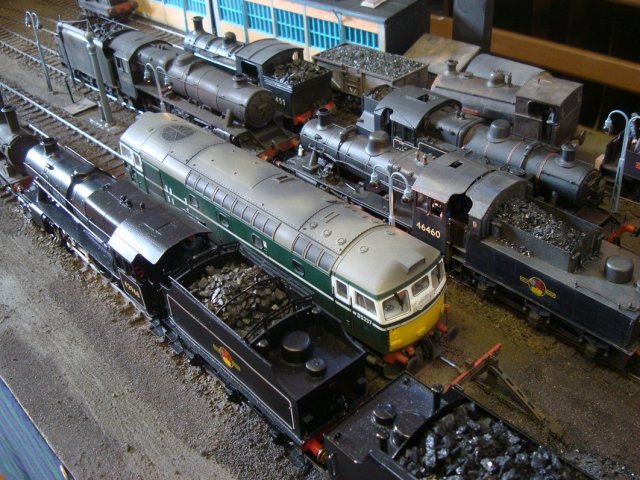
Motley Sub Shed, a minimum space 10' x 2' layout showcasing a "motley" collection of Rob's locomotives, assumes that the seaside town of Motley had a year-round passenger traffic  - including holiday trains from all over Britain in the summer - and freight trains to and from the harbour, which had its own private railway system worked by industrial locomotives.


  Motley Sub Shed, a minimum space 10' x 2' layout showcasing a "motley" collection of Rob's locomotives, assumes that the seaside town of Motley had a year-round passenger traffic  - including holiday trains from all over Britain in the summer - and freight trains to and from the harbour, which had its own private railway system worked by industrial locomotives.

Although not a large motive power depot, Motley Sub Shed provides somewhere for the laid-over main line locomotives to rest before their return workings, replenish their tenders and have clinker cleaned from their firebars alongside a similar facility for industrial engines.

Upwards of a dozen locomotives from British Railways Scottish, London Midland, Western and Southern Regions can be seen "on shed" at any one time, having been built from kits by Keith Blake, Aiden Houlders and Peter Whyborn and operated by Rob Newman and Andy Wilkie. 

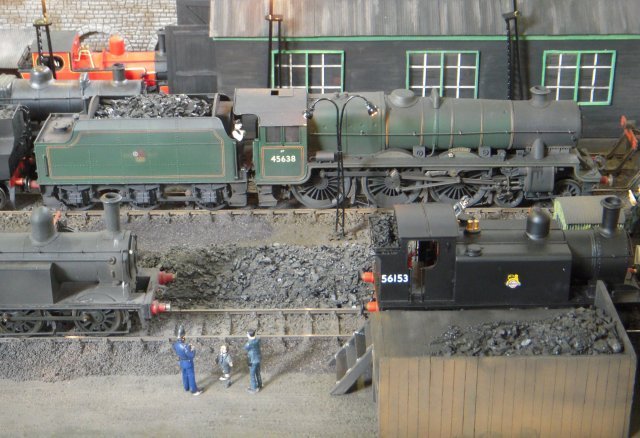
The group also supports the Stanier 8F Locomotive Society in its aim of restoring LMS 2-8-0 48773: a big sister to Stanier "Jubilee" 4-6-0 45638 "Zanzibar" seen below behind 1911 vintage McIntosh Caledonian "498" Class 0-6-0T 56153 - and a small trainspotter about to be ejected from the premises.


The group also supports the Stanier 8F Locomotive Society in its aim of restoring LMS 2-8-0 48773: a big sister to Stanier "Jubilee" 4-6-0 45638 "Zanzibar" seen below behind 1911 vintage McIntosh Caledonian "498" Class 0-6-0T 56153 - and a small trainspotter about to be ejected from the premises.


  HUDSON'S WHARF by Warren Lane

0 Gauge 7mm Scale


This layout was named after George Hudson, the Chairman of the Eastern Counties Railway Company - opened from Mile End to Romford in 1839 and originally built to a gauge of five feet - and evokes Wharf Road, off Burford Road, Stratford, East London which was built along the edge of the Channelsea River, later the dumping place of large parts of the Euston Arch.  Embedded railway lines extended across the site and through a gated brick wall to Stratford market and yards and via West Ham and Canning Town to the North Woolwich Line laid in 1847.


  This layout was named after George Hudson, the Chairman of the Eastern Counties Railway Company - opened from Mile End to Romford in 1839 and originally built to a gauge of five feet - and evokes Wharf Road, off Burford Road, Stratford, East London which was built along the edge of the Channelsea River, later the dumping place of large parts of the Euston Arch.  Embedded railway lines extended across the site and through a gated brick wall to Stratford market and yards and via West Ham and Canning Town to the North Woolwich Line laid in 1847.

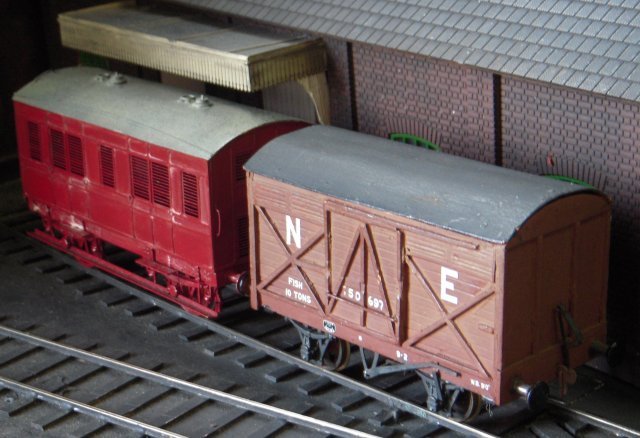
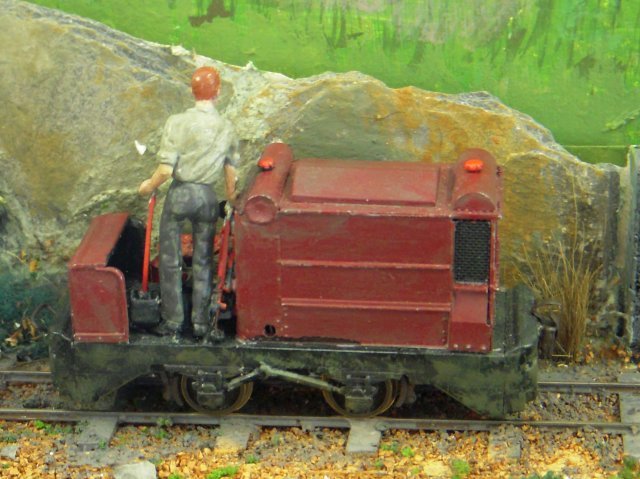
The buildings on the layout were freelance but based on the weatherboard and corrugated iron architecture of this part of London - much of which is now buried under the site of the 2012 Olympic Games.  The 10' x 2' layout however depicted the early British Railways austerity epoch of 1949 to 1955 with former North Eastern rolling stock and the odd private owner saddle tank or wagon.  In the picture above ex LNER Sentinel 0-4-0 8138 is passing an Andrew Barclay's fireless engine similar to the one used at the former Gloucester power station while LNER sundries and fish vans are seen below.


The buildings on the layout were freelance but based on the weatherboard and corrugated iron architecture of this part of London - much of which is now buried under the site of the 2012 Olympic Games.  The 10' x 2' layout however depicted the early British Railways austerity epoch of 1949 to 1955 with former North Eastern rolling stock and the odd private owner saddle tank or wagon.  In the picture above ex LNER Sentinel 0-4-0 8138 is passing an Andrew Barclay's fireless engine similar to the one used at the former Gloucester power station while LNER sundries and fish vans are seen below.


  TEIGL TRAMWAY by Roland Binns

0-14 Gauge 7mm Scale


O-14 gauge is 7mm scale with a track gauge of 14mm. The model depicts a Welsh narrow gauge railway carrying slate. There is a junction station on the ‘main line’ from which a tramway climbs steeply, following the road before entering a ledge on the steep hillside. Passing a slate quarry, it disappears into a tunnel to serve the higher part of the valley. The main line continues across a river and passes a slate works and a woollen mill before entering the fiddle yard.


  O-14 gauge is 7mm scale with a track gauge of 14mm. The model depicts a Welsh narrow gauge railway carrying slate. There is a junction station on the ‘main line’ from which a tramway climbs steeply, following the road before entering a ledge on the steep hillside. Passing a slate quarry, it disappears into a tunnel to serve the higher part of the valley. The main line continues across a river and passes a slate works and a woollen mill before entering the fiddle yard.  


O-14 gauge is 7mm scale with a track gauge of 14mm. The model depicts a Welsh narrow gauge railway carrying slate. There is a junction station on the ‘main line’ from which a tramway climbs steeply, following the road before entering a ledge on the steep hillside. Passing a slate quarry, it disappears into a tunnel to serve the higher part of the valley. The main line continues across a river and passes a slate works and a woollen mill before entering the fiddle yard.


  EASINGTON LANE by Ian Manderson

EM Gauge 4mm Scale


Set around 1976, Easington Lane was a fictional secondary line linking Hartlepool with the Ferryhill-Newcastle freight route.  This line was closed and the track was being lifted, the location only seeing local coal and Engineer's traffic on reclamation duties.  However, the line to Hartlepool was retained to serve local industries and saw a token passenger service worked by Metro-Cammell DMUs.  Motive power was provided by Thornaby or Gateshead for freight trains to a small factory complex, a cement distribution terminal ( on part of the former goods yard) and a nearby coal depot.  Buildings were loosely based on Wearside / Teeside examples and trackwork was SMP with C&L points.  Stock on the 15' x 2' 6" layout was a mixture of kit built and modified ready-to-run items.


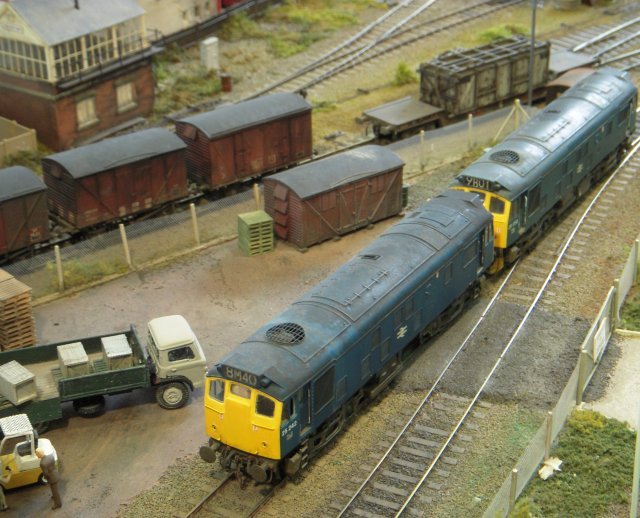
  Set around 1976, Easington Lane was a fictional secondary line linking Hartlepool with the Ferryhill-Newcastle freight route.  This line was closed and the track was being lifted, the location only seeing local coal and Engineer's traffic on reclamation duties.  However, the line to Hartlepool was retained to serve local industries and saw a token passenger service worked by Metro-Cammell DMUs.  Motive power - such as 25 242 and 25 052 -seen above- was provided by Thornaby or Gateshead for freight trains to a small factory complex, a cement distribution terminal (on part of the former goods yard) and a nearby coal depot.  Buildings were loosely based on Wearside / Teeside examples and trackwork was SMP with C&L points.  Stock on the 15' x 2' 6" layout was a mixture of kit built and modified ready-to-run items.  


Set around 1976, Easington Lane was a fictional secondary line linking Hartlepool with the Ferryhill-Newcastle freight route.  This line was closed and the track was being lifted, the location only seeing local coal and Engineer's traffic on reclamation duties.  However, the line to Hartlepool was retained to serve local industries and saw a token passenger service worked by Metro-Cammell DMUs.  Motive power was provided by Thornaby or Gateshead for freight trains to a small factory complex, a cement distribution terminal ( on part of the former goods yard) and a nearby coal depot.  Buildings were loosely based on Wearside / Teeside examples and trackwork was SMP with C&L points.  Stock on the 15' x 2' 6" layout was a mixture of kit built and modified ready-to-run items.


  PIXASH LANE by Chris Hopper

00 Gauge 4mm Scale


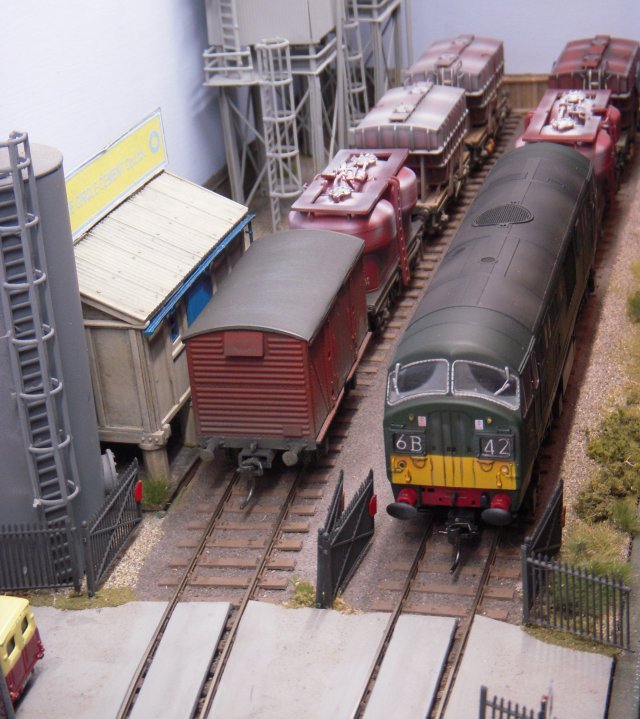
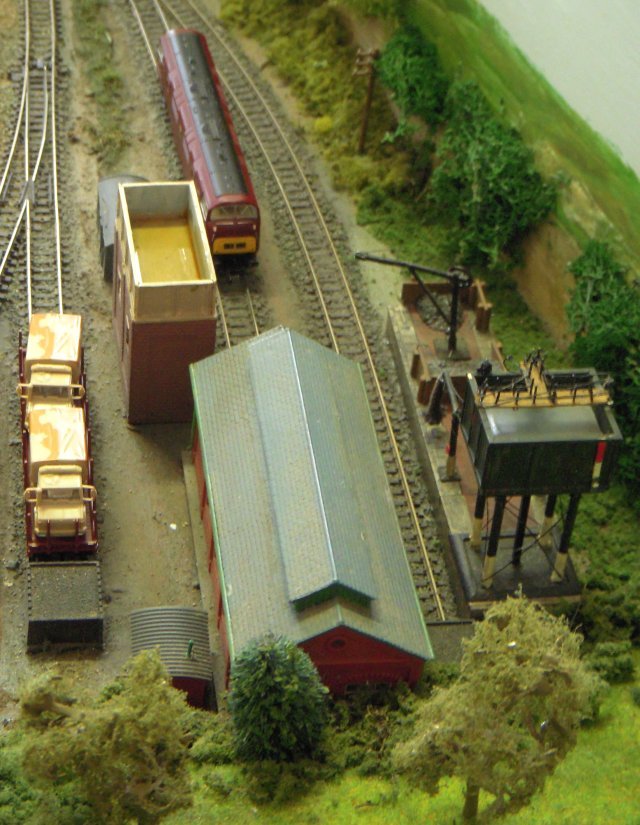
Chris Hopper is perhaps best known to exhibition patrons for his interest in US railroads but the DCC operated Pixash Lane was inspired partly by the announcement by Hattons of Liverpool of their special run of Class 14 locomotives by Heljan ( including D9500 pictured above ) and partly by an excellent day out on the West Somerset Railway hauled by two of the real life "Teddy Bears".


  Chris Hopper is perhaps best known to exhibition patrons for his interest in US railroads but the DCC operated Pixash Lane was inspired partly by the announcement by Hattons of Liverpool of their special run of Class 14 locomotives by Heljan ( including D9500 pictured above ) and partly by an excellent day out on the West Somerset Railway hauled by two of the real life "Teddy Bears".

Inspiration also came from the BR Western Region photo books of Laurence Walters and some of the RCTS and Oakwood Press books on the ex GWR Bristol to Bath route around Keynsham and adjacent to the former Somerset & Dorset Joint Railway joining this at Bath Green Park

Pixash Lane was based on the idea of a short branch line with a halt for occasional passenger services and freight workings to local industries. The Squaregrip Reinforcement building is still in use on an industrial estate and the paper mill with its landmark water tower is also still working. The small cement loading terminal was freelance but drew on inspiration from such Bristolian locations as Lawrence Hill and Avon Street.

Other 1960s rolling stock, such as North British Type 2 D6323 seen below, appeared from the Forest of Dean or South Wales and similarly modeller's licence permitted the odd blue diesel or 1950s British Railways vehicles.

Most of the buildings were scratch built, Kaydee couplings allowed some hands-off operation and track was a mixture of Marcway, SMP and Peco in the "off-stage" areas.


Other 1960s rolling stock, such as North British Type 2 D6323 seen below, appeared from the Forest of Dean or South Wales and similarly modeller's licence permitted the odd blue diesel or 1950s British Railways vehicles.


  UNIVERSAL WORKS DOES MCDONNELL DOUGLAS by Alan Drewett

00 Gauge 4mm Scale


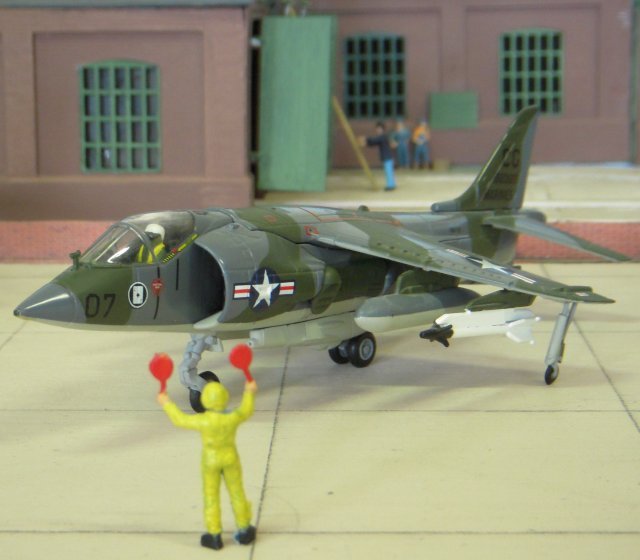
After its Cheltenham 2010 encounter with English Electric, Universal Works flew the Star Spangled Banner as a staging post for McDonnell Douglas aircraft - such as AV-8A Harrier pictured above - on their way from St Louis, Missouri, to home and overseas customers with typical American switchers moving boxcars and gondolas full of components and supplies in and out of the works.


After its Cheltenham 2010 encounter with English Electric, Universal Works flew the Star Spangled Banner as a staging post for McDonnell Douglas aircraft - such as AV-8A Harrier pictured above - on their way from St Louis, Missouri, to home and overseas customers with typical American switchers moving boxcars and gondolas full of components and supplies in and out of the works. 

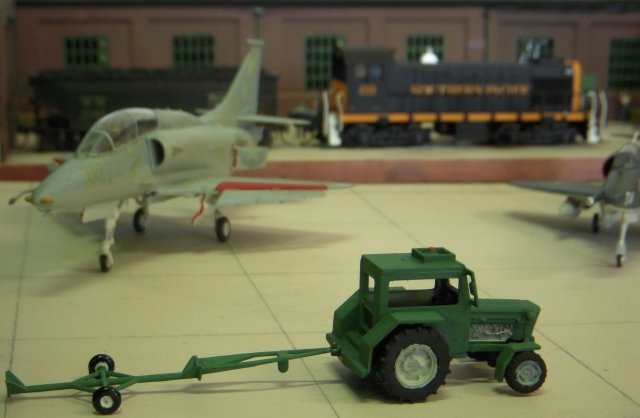
While the STOVL Harrier required the fitment of its Sylvanian VHF radio equipment at Universal, other hardware was added with the use of the MJ-1 Lift Truck, Ford tractor, trailers and personnel from the Hasegawa 1/72 scale X72:5 US Aircraft Weapon Loading Set.  This was inherited partly built from Ron Brooks and painted a smart green and light grey for use on the Universal Works ramp rather than for combat.  I am also greatly indebted to Simon Tester of Amerang Limited of Lancing, West Sussex (now sadly in administration) for supplying me with an instruction sheet and allowing the 370 gallon drop tank dolly, seen below in front of a A-4 Skyhawk, to enhance this layout.


While the STOVL Harrier required the fitment of its Sylvanian VHF radio equipment at Universal, other hardware was added with the use of the MJ-1 Lift Truck, Ford tractor, trailers and personnel from the Hasegawa 1/72 scale X72:5 US Aircraft Weapon Loading Set.  This was inherited partly built from Ron Brooks and painted a smart green and light grey for use on the Universal Works ramp rather than for combat.  I am also greatly indebted to Simon Tester of Amerang Limited of Lancing, West Sussex (now sadly in administration) for supplying me with an instruction sheet and allowing the 370 gallon drop tank dolly, seen below in front of a A-4 Skyhawk, to enhance this layout.


  TROUBLESOME TRUCKS by Alan Postlethwaite

00 Gauge 4mm Scale


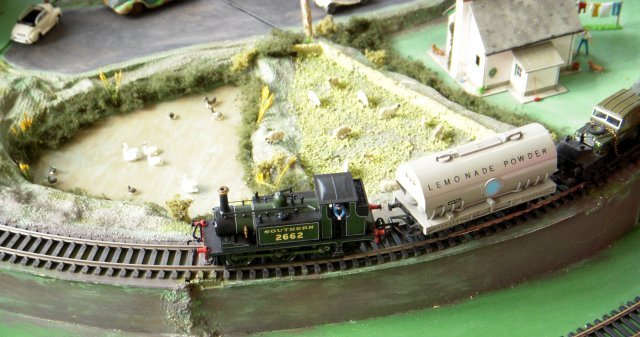
This is a fun railway for children to operate. It is a simple circuit of a double loop with passing sidings and a station. There are three scenic sections: minimalist at the front (for tiny fingers); finescale farmland in the middle; and a surreal dinosaur park at the back on a hill with three railway tunnels. The conundrum is to work out which tunnel mouth the train will emerge from next. The 4'x4' layout was built over six summer weeks using 4 mm MDF braced with timber. Card is used to support the elevated track. The hill has ply splines filled with crumpled newspaper and covered with Modroc (a thin gauze with plaster). Locomotives and track are mostly Hornby. Rolling stock is a mix of all makes, some repainted for added interest.


  This is a fun railway for children to operate. It is a simple circuit of a double loop with passing sidings and a station. There are three scenic sections: minimalist at the front (for tiny fingers); finescale farmland in the middle; and a surreal dinosaur park at the back on a hill with three railway tunnels. The conundrum is to work out which tunnel mouth the train will emerge from next. The 4'x4' layout was built over six summer weeks using 4 mm MDF braced with timber. Card is used to support the elevated track. The hill has ply splines filled with crumpled newspaper and covered with Modroc (a thin gauze with plaster). Locomotives and track are mostly Hornby. Rolling stock is a mix of all makes, some repainted for added interest.

The Southern Railway "Terrier" numbered 2662 and pictured above entered service on 27 October 1875 as 62 "Martello" of the London Brighton and South Coast Railway.  Rebuilt to A1X standard in December 1912, the 0-6-0T was later renumbered B662 and became British Railways 32662 in 1948.  Withdrawn in November 1963, "Martello" was first preserved at Butlin's holiday camp at Ayr before moving to Bressingham in February 1971.


The Southern Railway "Terrier" numbered 2662 and pictured above entered service on 27 October 1875 as 62 "Martello" of the London Brighton and South Coast Railway.  Rebuilt to A1X standard in December 1912, the 0-6-0T was later renumbered B662 and became British Railways 32662 in 1948.  Withdrawn in November 1963, "Martello" was first preserved at Butlin's holiday camp at Ayr before moving to Bressingham in February 1971.


  HILLSIDE WORKS by David Griffin & Sue Francis-Griffin

009 Gauge 4mm Scale


This fictional mineral line is set in around 1970 with a backscene painted to represent the Welsh borders. The trees are wire frame, hand soldiered and covered with a plaster mix to represent bare November branches. Buildings are a mix of kit- and scratch-built from Ratio, Wills, Woodland Scenics and Greenscene. Rolling stock is a mix of kit-built and converted ready-to-run, mostly ROCO and Parkside Dundas. Track is Peco. Point motors are the older SEEP type or more modern Peco with base mounting adaptors. It measures 5 ft 4 in x 4 ft 4 in.


  This fictional mineral line is set in around 1970 with a backscene painted to represent the Welsh borders. The trees are wire frame, hand soldiered and covered with a plaster mix to represent bare November branches. Buildings are a mix of kit- and scratch-built from Ratio, Wills, Woodland Scenics and Greenscene. Rolling stock is a mix of kit-built and converted ready-to-run, mostly ROCO and Parkside Dundas. Track is Peco. Point motors are the older SEEP type or more modern Peco with base mounting adaptors. It measures 5 ft 4 in x 4 ft 4 in.  


This fictional mineral line is set in around 1970 with a backscene painted to represent the Welsh borders. The trees are wire frame, hand soldiered and covered with a plaster mix to represent bare November branches. Buildings are a mix of kit- and scratch-built from Ratio, Wills, Woodland Scenics and Greenscene. Rolling stock is a mix of kit-built and converted ready-to-run, mostly ROCO and Parkside Dundas. Track is Peco. Point motors are the older SEEP type or more modern Peco with base mounting adaptors. It measures 5 ft 4 in x 4 ft 4 in.


  TYROLBAHN by Gary Ball

H0(N) Gauge 3.5mm Scale


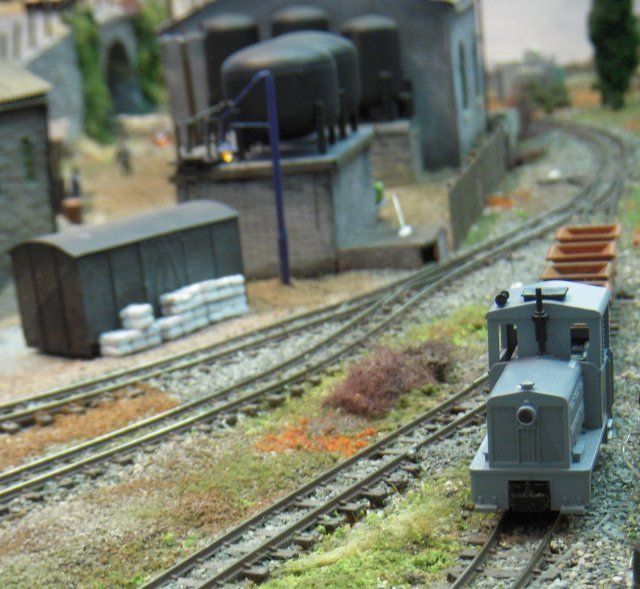
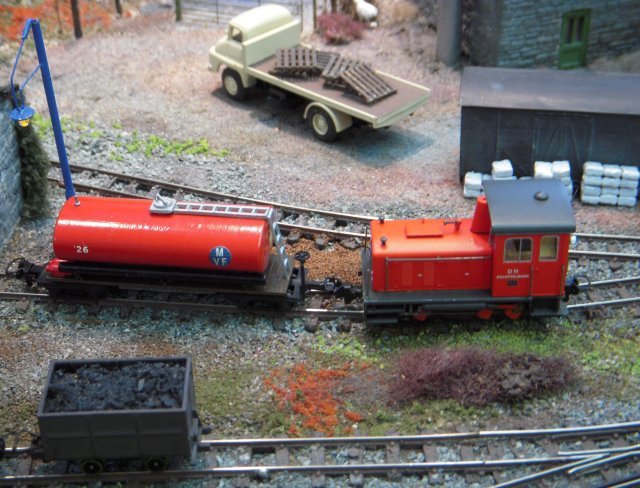
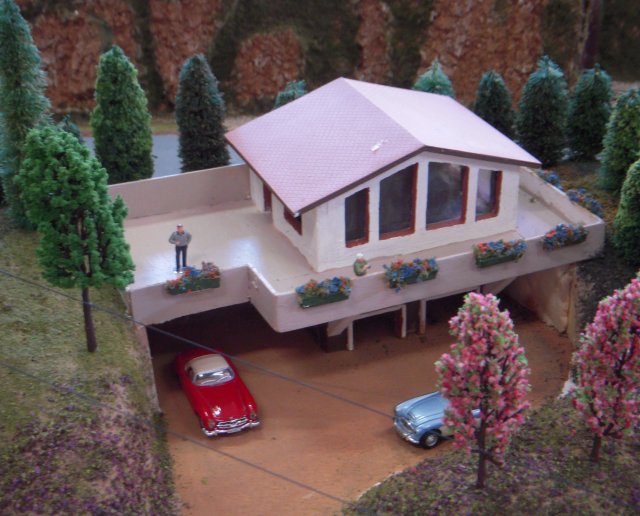
This layout operates both steam and diesel, representing rolling stock of the narrow gauge railways of Austria, including the Zillertalbahn, Murtalbahn and the state railway (OBB). A single track starts from a hidden yard to a front station and returns through a tunnel. A second track starts from the front over a viaduct to a high-level station from where it returns at 40-second intervals. Additional interests are a working chair lift and a working road coach with two bus stops. All buildings and trees are scratch built. The layout measures 9' x 4' 2".


  This layout operates both steam and diesel, representing rolling stock of the narrow gauge railways of Austria, including the Zillertalbahn, Murtalbahn and the state railway (OBB). A single track starts from a hidden yard to a front station and returns through a tunnel. A second track starts from the front over a viaduct to a high-level station from where it returns at 40-second intervals. Additional interests are a working chair lift and a working road coach with two bus stops. All buildings and trees are scratch built. The layout measures 9' x 4' 2".  


This layout operates both steam and diesel, representing rolling stock of the narrow gauge railways of Austria, including the Zillertalbahn, Murtalbahn and the state railway (OBB). A single track starts from a hidden yard to a front station and returns through a tunnel. A second track starts from the front over a viaduct to a high-level station from where it returns at 40-second intervals. Additional interests are a working chair lift and a working road coach with two bus stops. All buildings and trees are scratch built. The layout measures 9' x 4' 2".


  BOTTIT by Sodbury Vale MRC

N Gauge 2mm Scale


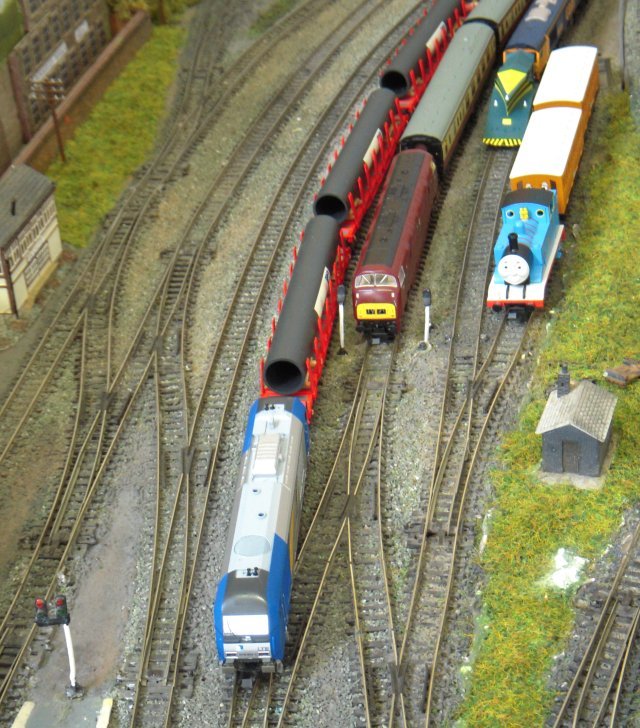
Bottit (“bought it”) is a fun layout, showing how a basic train set can evolve into a scenic model railway. It was purchased by the club in an unfinished state with only the boards, track and platforms in place. It has since been rewired with a new control panel and section switches. Set in the south Midlands, trains of all companies pass through, occasionally stopping. There is also a branch line which runs to Pincott, home of a well-known Heritage Farm Museum whose relics sometimes pass through on flat wagons. Operated by up to three people, the stock belongs to individual members. Thomas the Tank and overseas trains appear occasionally. Dimensions are 8' x 2'.


  Bottit (“bought it”) is a fun layout, showing how a basic train set can evolve into a scenic model railway. It was purchased by the club in an unfinished state with only the boards, track and platforms in place. It has since been rewired with a new control panel and section switches. Set in the south Midlands, trains of all companies pass through, occasionally stopping. There is also a branch line which runs to Pincott, home of a well-known Heritage Farm Museum whose relics sometimes pass through on flat wagons. Operated by up to three people, the stock belongs to individual members. Thomas the Tank and overseas trains appear occasionally. Dimensions are 8' x 2'.  


Bottit (“bought it”) is a fun layout, showing how a basic train set can evolve into a scenic model railway. It was purchased by the club in an unfinished state with only the boards, track and platforms in place. It has since been rewired with a new control panel and section switches. Set in the south Midlands, trains of all companies pass through, occasionally stopping. There is also a branch line which runs to Pincott, home of a well-known Heritage Farm Museum whose relics sometimes pass through on flat wagons. Operated by up to three people, the stock belongs to individual members. Thomas the Tank and overseas trains appear occasionally. Dimensions are 8' x 2'.


  ST FRAZALET DE VOLAVENT by Simon Newitt

Nm Gauge 2mm Scale


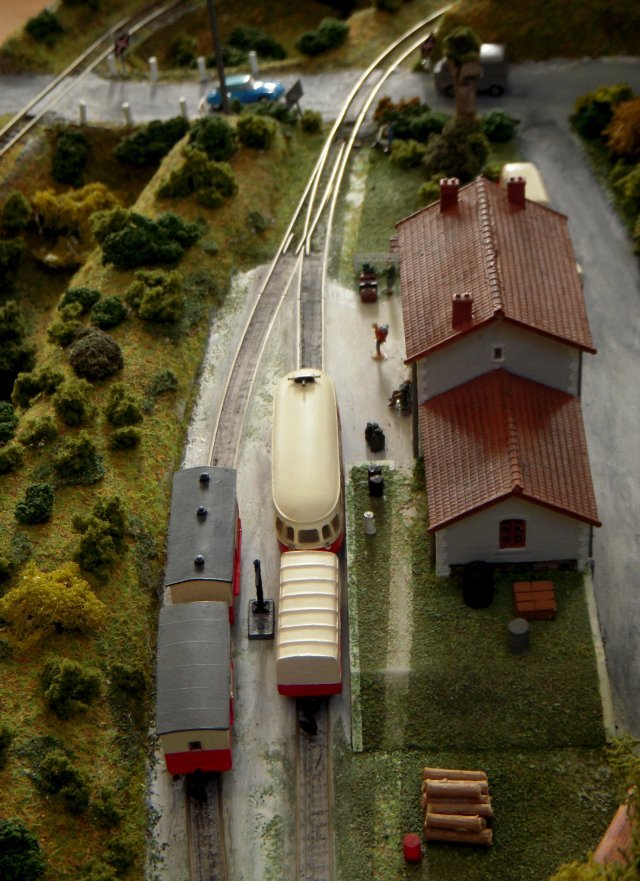
France once had over 12 500 km of metre gauge lines and Simon Newitt is exploring them with his series of St Frazal layouts.  In a change to the advertised attraction due to technical issues, St Frazalet De Volavent represented a narrow gauge system in the heavily forested  Massif Central - once again using 6.5mm Z gauge track to represent the metre gauge in N scale.  Waiting for the passenger railcar with its cargo trailer to negotiate the open level crossing was a blue example of the iconic Citroen DS, which once saved the life of President Charles De Galle.


France once had over 12 500 km of metre gauge lines and Simon Newitt is exploring them with his series of St Frazal layouts.  In a change to the advertised attraction due to technical issues, St Frazalet De Volavent represented the 30 mile long Cfd Lozere narrow gauge system in the heavily forested  Massif Central during the 1956-1967 era - once again using 6.5mm Z gauge track to represent the metre gauge in French N (1:160) scale.  Waiting for the passenger railcar with its cargo trailer to negotiate the open level crossing was a blue example of the iconic Citroen DS, which once saved the life of President Charles De Gaulle.


France once had over 12 500 km of metre gauge lines and Simon Newitt is exploring them with his series of St Frazal layouts.  In a change to the advertised attraction due to technical issues, St Frazalet De Volavent represented a narrow gauge system in the heavily forested  Massif Central - once again using 6.5mm Z gauge track to represent the metre gauge in N scale.  Waiting for the passenger railcar with its cargo trailer to negotiate the open level crossing was a blue example of the iconic Citroen DS, which once saved the life of President Charles De Galle.