Home
PRESENTS
ULTIMATE BOMBERS OF WORLD WAR II

With a new building at Staverton moving towards completion, the Jet Age Museum was keen to reach out with elements of its Reserve Model Collection to visitors to the 2013 exhibition of the Gloucester Branch of the International Plastic Modelling Society, held at Churchdown Community Centre on Sunday 12 May.
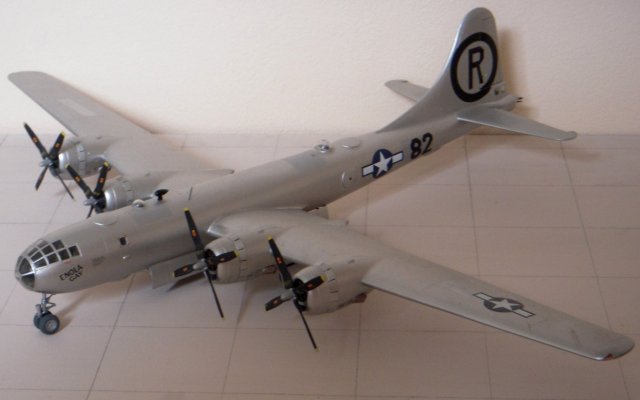
Happily, two spectacular 1/48 scale models of the ultimate British and American four engined bombers of World War II were to hand, Avro Lancaster BIII ED888 having recently been donated by Mr Meers of Gloucester while B-29 44-86292 was very kindly given to Jet Age by Mrs Joy Rudd, widow of long standing and well remembered Gloucester IPMS member Fred Rudd.
Here are the background stories to both these remarkable aircraft.

Of over 3 000 Avro Lancasters used by RAF Bomber Command only 24 were successful in flying 100 or more operational missions. Of these the most successful was ED888, which completed 140 "ops" and became known as "Mother Of Them All".
ED888 began its career at RAF Elsham Wolds, Lincolnshire, on 4 May 1943 with a raid to Dortmund while allocated to 103 Squadron, a unit which would later contribute 24 aircraft to the 600 used by Bomber Command in August 1943 to attack the German V-weapons experimental station at Peenemunde.
After 66 operations, ED888 was then transferred, along with thirteen 103 Squadron aircrew, to 576 Squadron which was formed at Elsham Wolds on 25 November 1943. 576 Squadron first went into action on 2 December 1943 with a raid by seven Lancasters on Berlin.

On 31 October 1944 and after 65 more raids on enemy targets, ED888 was returned to 103 Squadron for nine more operations, completing its 140th on 24 December 1944. In all, ED888 had spent 974 flying hours on active service.
After spending several months at a maintenance unit, the aircraft was struck off charge on 8 January 1947 and scrapped soon afterwards.
Although the PM and Mike Squared code letters are accurate to 103 Squadron, the Piccadilly Princess nose artwork applied to this Tamiya model are in fact from the decals supplied to depict 424 Squadron Lancaster BI NG347 with the code letters QB-P.

By then XXI Bomber Command in the Pacific was led by General Curtis E. LeMay who ordered his B-29s to area bomb Japanese cities at low altitude and at night with incendiaries. The resulting firestorms devastated wooden buildings and crippled the Empire's war effort, but with Japan's military leaders resolving to fight to the last man US President Harry S. Truman opted to use his nation's secretly developed atomic bomb, first tested in July 1945.
Although USAAF planners had approached the RAF with the idea of using the more reliable Avro Lancaster, seventeen B-29s were eventually built to "Silverplate" atomic bomber standard without turrets, gunner observation blisters or armour plating but featuring uprated Wright R-3350 engines fitted with reversible Curtiss Electric - rather than Hamilton Standard -propellers to reduce landing rollout. Propeller blade cuffs also improved engine cooling.

The Silverplate aircraft were delivered to the 509th Composite Wing which formed at Wendover, Utah before deploying to Tinian in the Marianas Islands for intensive training in dropping single large bombs, sometimes over Japan itself.
For the raid on 6 August 1945 to drop the "Little Boy" uranium-gun bomb on Hiroshima, unit commander Colonel Paul Tibbets chose the Silverplate B-29 coded Victor 82 that had already been allocated to Captain Robert Lewis (who flew as his co-pilot) and had Enola Gay - his mother's name - painted on the side. 44-86292 thus became the only Silverplate with nose artwork added before the end of the War. The 509th’s tail marking of a large forward facing arrowhead inside a circle was also replaced with the circle-R used by B-29s from the 313th Bomber Wing to confuse Japanese spotters.
Despite President Truman's public announcement of the atomic raid on Hiroshima, the Japanese Government did not accept the terms of surrender that were formulated by the Allied leaders at the Potsdam Conference via any official channels, and a second mission - initially to Kokura but finally to Nagasaki - was ordered three days later.
More Silverplate B-29s were constructed in 1946 while Enola Gay - the subject of the 1977 vintage Monogram kit - now rests in the Udvar-Hazy Center outside Washington DC.