|
Home |
FLIGHTLINE
AT
CHELTENHAM MODEL CENTRE | |
|
|
| |
|
 | |
|
| | |
|
In January 2012 I was fortunate enough to gain
employment with
Cheltenham Model Centre and, keen
to help Gloucestershire's premier purveyor of plastic kits, die cast
vehicles and model railways in any practical way possible, I volunteered
my otherwise idle
Flightline diorama box which had in fact begun life as a
shop window display.
This offer was, I am pleased to say, readily accepted in a welcoming
spirit of co-operation.
However, in describing my diorama, the models thereon
and their historic backgrounds I only express my own views and as such
this article should not be confused with - and is not endorsed by - the
official website of
Cheltenham Model Centre.
Already optimised for the display of 4mm scale
vehicles, the optional front "concrete" section of Flightline was removed and wall of
Metcalf brick paper added to create the impression of a split level
highway, reminiscent of the M5 in the Gordano Valley south of Bristol
and also parts of the M42 in terms of road surface.
As the lower carriageway was relatively narrow
compared to the one above, I closed most of this off using the Merit
Modelscene cones first purchased for use on
Universal
Works salutes English Electric and later visible
on
Toucan Park.
This drew the eyes of the viewer both upwards to
the procession of EFE lorries described in more detail below and left to
the Ruston Bucyrus 19 Drag Shovel from the Corgi Trackside range - fitted
with wide caterpillar tracks.
As is discussed in
The Road to Feltham, such
earthmoving and road building plant from the 1930s was still in use at
the start of the Motorway era and so would still be historically
appropriate next to lorries from the 1950s to the
early 1970s. Indeed, the Ruston Bucyrus 19 Drag Shovel was in
production from 1937 to 1967.
Similar consideration was given to the choice of
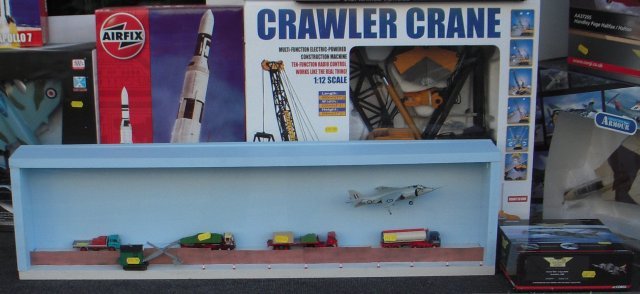
small aircraft to hang from the "roof" of Flightline, with a model of
Hawker P1127 XP836 being
first on display to highlight the availability of Harrier jump jets both
as Corgi Aviation die cast GR3s and later as Airfix and Revell kits in a
number of variants and scales. | |
|
| | |
|
 | |
|
|
| |
|
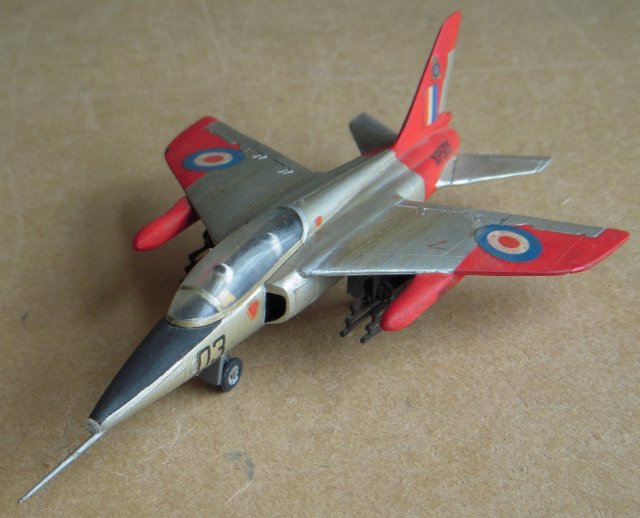
The P1127 was in turn replaced by
a 1/72 scale Folland Gnat, also from the
Jet Age Reserve Model
Collection, to celebrate the return of this
classic Airfix kit, both as a Red Arrows starter set and as the more
typical Flying Training School marked XP530 from the fourth production batch, later given the American
civil registration N4347N and flown by Jet Warbirds Inc of Coral
Springs, Florida, from 2005 to 2011. First flown in August
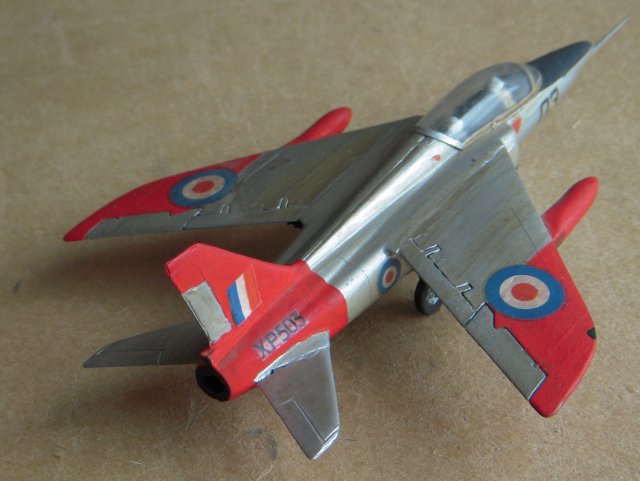
1962 meanwhile, XP503 - as represented in the assembled and customised model - spent most of its active career with 4 FTS before returning
to Hawker Siddeley for trials out of Bitteswell, Leicestershire, in 1969. Retired to
instructional use at RAF Halton by 1977, the aircraft was acquired by
Phoenix Aviation at Bruntingthorpe in the mid 1990s before sale to an
American owner in 2000. Registered as N503KC, there have been no
reported sightings of the aircraft since. | |
|
|
| |
|
 | |
|
| | |
| |
Although strongly associated with Gloucestershire through
RAF Little Rissington's Central Flying School and the RAF Kemble based Red
Arrows, the Folland Gnat was also the last design of
William Edward Willoughby
"Teddy" Petter CBE, born in 1908 as the son of Sir Ernest Petter, one of the
founders of
Westland Aircraft of which he later became Technical Director
in 1935. In this post he designed the
Whirlwind
and Welkin twin engined fighters as well as the single engined
Westland Lysander army
co-operation aircraft.
Petter left Westland in December 1944, after wanting
to take over aircraft production as well as design, and moved to
English Electric where he created the revolutionary
Canberra bomber based on an idea
by Westland's Chief Engineer, Arthur Davenport.
Petter also began work on the supersonic Lightning but
left English Electric in 1950 over both his desire to be in charge of design
as well as production and his increasing doubts over the size and cost of the next
generation of fighter aircraft.
With English Electric Lightning development continuing
under his former assistant Freddie Page, 1951 saw Petter joined Folland
Aircraft, founded from the remains of British Marine Aircraft in 1937 by
Henry P. Folland, former Chief Designer for the
Gloster Aircraft Company.
Still convinced that small, simple jet fighters would
offer the advantages of low purchase and operational costs and thus
availability in larger numbers, Petter designed the swept wing Folland Midge
around the new lightweight Bristol BE22 Saturn turbojet, and when this was
cancelled subsitituted the less powerful Armstrong Siddeley Viper which was
later to be found in the Hunting Percival Jet Provost.
First flight of the Folland Midge was made from Boscombe Down, Wiltshire on
the 11 August
1954 with 'B' condition registration G-39-1. 'B' condition registrations
were issued to manufacturers to enable company aircraft to be used abroad
with 'G' denoting British nationality, 39 representing Folland and '1'
indicating a first prototype.
The Midge had a number of advanced features,
such as hydraulically powered "flaperons", main gear that could
be used as airbrakes, and a one-piece canopy that hinged over an
inner armoured windscreen. Agile - and supersonic in a shallow
dive - the Midge was evaluated by pilots from Canada, India,
Jordan, New Zealand, and the US Air Force, and was almost
universally praised before it was destroyed in a fatal crash on
26 September 1955, with a Swiss pilot at the controls.
By then however G-39-2, the prototype Gnat
fighter, fitted with a more powerful Bristol Orpheus engine, had
flown for the first time on 18 July 1955. This was ordered
by Finland, where the Gnat was found to need a great deal of
ground maintenance, Yugoslavia, where two evaluation aircraft
were despatched by rail, and India - where Petter's single seat
fighter proved to be a formidable opponent for Pakistan's
Canadair Sabres in the wars of 1965 and 1971. Although
faster to altitude and harder to see than the Sabres, control
and hydraulic system issues were addressed before the Gnat began
licence built production by Hindustan Aircraft as the Ajeet
("Unconquerable").
| |
| |
| |
| |
 | |
| |
| |
| |
Although passed over in favour of further
development of the Hawker Hunter as a de Havilland Venom
replacement, the Folland Gnat was further investigated by the
RAF as a two seat trainer to bridge the gap between the de
Havilland Vampire T11 and the English Electric Lightning.
The resulting prototype, XM691, was thus built to Air Ministry
Specification T185 and first flown on 31 August 1959 and
featured thinner wings, Folland's own design of lightweight
ejector seats and a more conventional arrangement of outboard
ailerons and conventional flaps. The location of this
first flight was Chilbolton, Hampshire although the pilot for
both this and the first flight of the Midge five years earlier
was Squadron Leader E.A. "Teddy" Tennant.
However, as part of the consolidation
process of the British aviation industry following the Duncan
Sandys White Paper of 1957, Folland were only permitted to
continue Gnat production if they became part of Hawker Siddeley
Aviation which they did in 1959. Hawker Siddeley then
dropped the Folland name in 1963, after which the Hamble factory
was used to assemble Harrier and Hawk aircraft until its closure
under British Aerospace in 1986.
"Teddy" Petter had become Managing
Director of Folland Aircraft on the death of Henry Folland in
1954 but left both the company and the aviation industry in
1959, moving to Switzerland and dying there on 1 May 1968.
Meanwhile
Gnat XP501 first joined the RAF's inventory at Little Rissington
on 5 November 1962 with 4 Flying Training School based at RAF
Valley on Anglesey receiving XP502 two days later.
The first student to solo the type was Pilot Officer K. B. Latton from New Zealand training at 4
FTS in April 1963 although as a training aircraft the Folland Gnat was found
to have poor vision from the rear cockpit while unsolved pitch controls
problems made it a poor weapons training platform. Similarly, the Gnat
was difficult to maintain due to its cramped working space.
The last course on Gnats at 4FTS graduated on 24
November 1978 with the Red Arrows
surrendering their Gnats at the end of the 1979 display season in favour of
the
BAe Hawk.
Another connection between the Folland Gnat and
Gloucestershire via Dowty Marine and
Donald Campbell
was that in 1965 a Gnat tail fin was added to his
Bluebird K7 hydroplane - along
with a single tail mounted air-speed indicator - while a Gnat's 5 000lb
thrust Bristol Siddeley Orpheus jet engine
replaced the heavier and less powerful Metro-Vick Beryl, which had been
sourced from Saunders Roe SRA1 jet flying boat TG263 which in turn was
preserved at the
Skyfame Museum in Staverton.
| |
|
|
| |
|
 | |
|
| | |
|
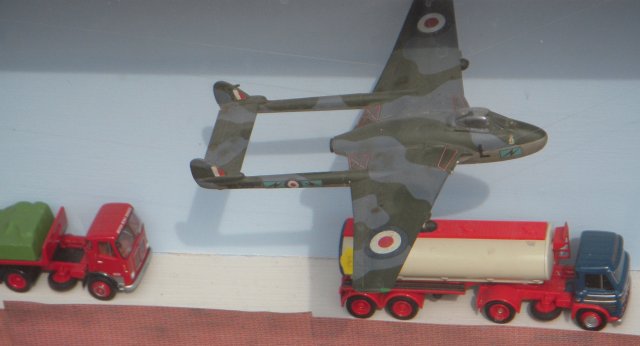
| Taking over Flightline in April 2012
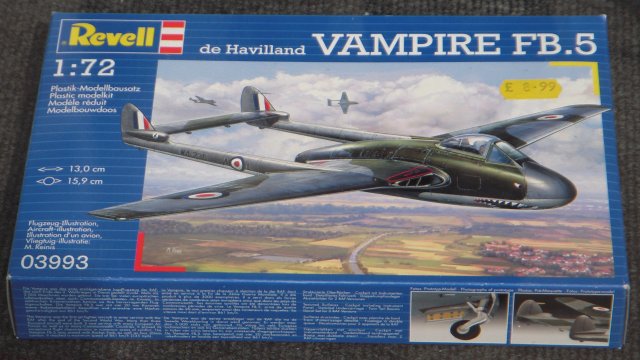
meanwhile was de Havilland Vampire WA309 from the Jet Age Reserve Model
Collection - built from a Frog kit - in support of Revell 1/72 scale kit
03993 which can be built into fellow de Havilland FB 5 Vampires WA235
and WA331.
Originally known as the Spider Crab and
designed to Air Ministry Specification E.6/41,
the de
Havilland Vampire first flew in first flew in
September 1943 and followed the equally notable Gloster Meteor to become
the second British jet aircraft to enter service.
The Royal Navy also took an early interest in the
type with a Sea Vampire becoming the first pure jet aircraft to land and
take off from an aircraft carrier - HMS Ocean - in December 1945.
The first RAF de Havilland
Vampires joined 247 Squadron early in 1946 and took part in the Victory
Fly Past on 8 June 1946. With 45 and 72 Squadrons receiving Vampires in
September 1946, the three units formed the first Vampire wing
based at Odiham in Hampshire.
In July 1948 six Vampires of 54 Squadron
made history by completing the first Transatlantic flight by jet
aircraft of the Royal Air Force. After preparation at
RAF Kemble
they crossed to the United States, refuelling at Iceland, Greenland and
Labrador on the way.
The De Havilland Vampire was built under licence by
Fairey Aviation in
Manchester,
English Electric
further north
in Lancashire and was more widely exported than any other British
aircraft type.
Indeed,
Vampires, including those created under local licensed production or
assembly, were delivered to air arms including Italy, Switzerland,
Sweden, Norway, Canada, India, Egypt and Venezuela amongst others. Sud
Aviation in France built 250 Vampires known as there as the Mistral with
Hispano Suiza copies of Rolls Royce Nene engines and other differences.
Capable of many roles, including day
fighter, ground attack fighter/bomber, night fighter and advanced
trainer, the Vampire was still in service with many air forces - such as
that of the unilaterally independent Rhodesia - as late as the 1970s
with the Swiss Air Force not relinquishing their Vampire trainers for
two decades after that!
Single seat Vampires equipped at least 39 Royal Air
Force Squadrons in Fighter Command, the Royal Auxiliary Air Force, RAF
Germany, the Middle and Far East: including 60 Squadron based at Tengah,
Singapore and used to attack Malayan terrorists.
Increased thrust available from later Rolls-Royce Gnome
engines, increased fuel capacity and changes to the tailplane, fins and
wing tips eventually resulted in the Vampire FB.5 and later the Vampire
FB.9 optimised for tropical climates.
The Vampire FB.5 was armed with four 20mm guns, and
could carry 2000 lbs of bombs or rockets under the wings at a maximum
speed of 535mph and a range of 1 170 miles.
WA309 is modelled in the markings of 502 (Ulster) Squadron
Royal Auxilliary Air Force based at Aldergrove, Northern
Ireland, in 1956 shortly before the entire Royal Auxilliary Air Force
was disbanded on cost grounds on 10 March 1957. Indeed, 502
Squadron - founded in 1925 - had spent most of its history as an
anti-submarine unit until the entire RAuxAF was converted to the day
fighter role in 1948 and the further transition from Mark 22 Spitfires
to de Havilland Vampire FB 5s began in 1951.
It was on 17 January of this year that WA309 was
delivered from English Electric and the twin boom single-engined fighter
was struck off charge at 19 Maintenance Unit, RAF St Athan, as soon as 6
May 1958 before being scrapped at Lowton Metals.
| |
|
| | |
|
|
 | |
|
| | |
|
|
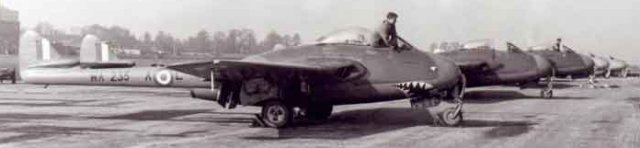
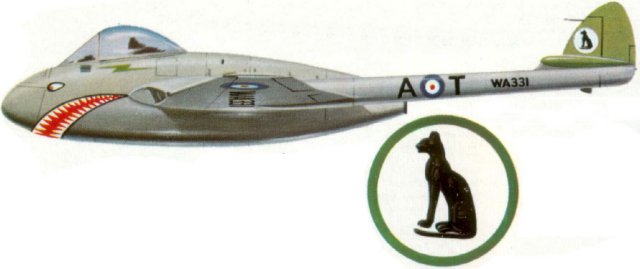
WA235, as depicted on the Revell kit box, wore the
shark's mouth markings of 2nd Tactical Air Force RAF Germany's 112
squadron, based at Bruggen in 1953, with the decal and painting guide
alternative being offered for the same Squadron's WA331 from its time at
Fassberg in 1951.112 Squadron was formed on
30 July 1917 as a home defence unit at Throwley for the defence of the
London area. Day and night interceptions were flown against
enemy bombers until the end of the war, the
Squadron being disbanded on 13 June 1919.
On 16 May 1939, 112 reformed aboard the aircraft carrier 'Argus' at
Southampton for transportation to the Middle East, arriving in Egypt ten
days later.
Gloster Gladiators were
received in June and when Italy joined the war a year later the Squadron
flew fighter patrols over the Western Desert.
In January 1941 112 Squadron moved to Greece to provide air
defence and fly offensive patrols over Albania. When the Germans invaded
Greece the Squadron provided fighter cover for the Athens area until
evacuated first to Crete and then back to Egypt.
In July 1941 112 was re-equipped with Curtiss P-40 Tomahawks for
fighter sweeps over the desert and then the Squadron received the same
manufacturer's P-40D Kittyhawks in December 1941 beginning
fighter-bomber missions in May 1942.
Inspired by the unusually large air inlet on the P-40, the squadron
began to emulate the "shark mouth" logo used on some Messerschmitt Bf
110s of Zerstörer Geschwader 76 earlier in the war. This practice was
later followed by P-40 units in other parts of the world (including the
Flying Tigers, American volunteers serving with the Chinese Nationalist
Air Force. 112 thus became known as the Shark Squadron despite already
having a black cat sejant as its badge above the motto "Swift in
Destruction".
Among the 112 Squadron personnel at this time was
Neville Duke, later to break the World Air Speed
Record in a
Hawker Hunter and then
become the personal pilot of
Sir George Dowty.
The Squadron provided support for the 8th Army during their campaign
in the Western Desert and after the Allied victory at El Alamein No. 112
was moved to Tunisia. In July 1943 the Squadron was moved to Sicily and
on to Italy in September receiving North American Mustangs in June 1944.
112 provided air support for the Allied armies in Italy for the rest
of the war and after a period of occupation duties in northern Italy,
the Squadron disbanded on 30 December 1946.
On 12 May 1951, 112 reformed at Fassberg as a Vampire fighter-bomber
unit, converting to Canadair Sabres in January 1954 which were flown
until Hawker Hunters arrived in May 1956.
On 31 May 1957, the Squadron disbanded but was reformed again on 1
August 1960 at Church Fenton as a
Bristol Bloodhound
ground-to-air missile unit. The Squadron later moved to its operational
base of Breighton but was disbanded on 31 March 1964 only to be reformed
on the 2 November 1964 with Bloodhound 2s, moving to Cyprus in October
1967 where it disbanded on 1 July 1975. | |
|
| | |
|
|
 | |
|
| | |
|
|
Like WA309, WA235 had a career of less than a
decade, being delivered to the Royal Air Force on 23 October 1950 and
scrapped by 19 MU at St Athan on 22 June 1960, parts then going to H H Bushell & Co
as did the remains of WA331, in this instance from 34 MU at Shrewsbury.
WA331, like WA309 and WA235, was built by English Electric at Samlesbury
and delivered on 9 February 1951, wearing the attractive silver markings
with green fins seen below before being scrapped on 29 November 1957
after less than seven years service. | |
|
| | |
|
|
 | |
|
| | |
|
|
 | |
|
| | |
|
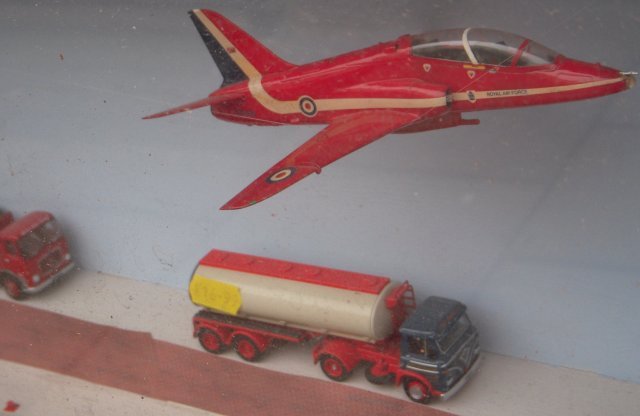
| Such was the interest generated by
Flightline that both the Revell kit of the de Havilland Vampire FB5 and
the Ruston Bucyrus 19 drag shovel sold out at the end of April 2012 and
were replaced in the first rain lashed days of May by a
British Aerospace
Hawk and a Coles crane (described below) from the Corgi Trackside range respectively.
Like the P1127 discussed above - but unlike the Gnat
and Vampire - Red Arrows liveried XX306 had horizontal tail surfaces set
markedly higher on the fuselage than the wings. In the context of
the two Flightline suspension filaments, this gives a pleasant nose-up
climbing attitude: not least because this 1/72 scale model has been
completed with the Hawk's optional fuselage centreline weapons training
gun pack and it would not be wise for the 30mm Aden canon to be pointing
at civilian road vehicles even if it did match the rest of the Rolls
Royce Adour powered trainer!
| |
|
| | |
|
|
 | |
|
| | |
|
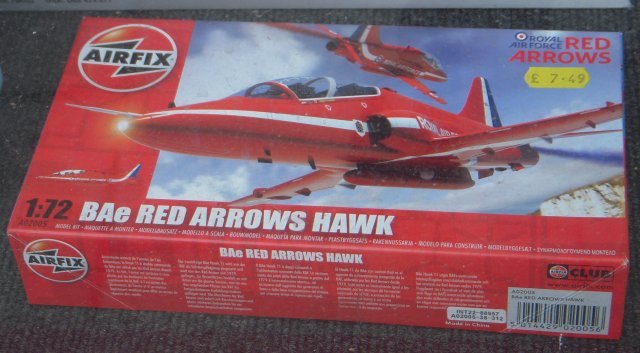
| XX306 was selected from the
Jet Age
Reserve Model Collection to publicise the available Red Arrow's Hawk
kits which from the Airfix range includes A02005 - pictured above and
allowing the completion of XX227, XX306 and other team members from the 2008
show season in 1/72 scale.
Alternatives too numerous - and sometimes too big
- to fit the window next to Flightline but for sale on Cheltenham Model Centre's shelves nearby
included:
| MODEL TYPE |
SCALE |
COMPANY |
REFERENCE |
MARKINGS |
IDENTITY |
| Plastic Kit |
1/72 |
Airfix |
A03073 |
Mk 120D demonstrator Mk 128 (RAF gloss
black)
Indian Air Force |
ZJ951 |
| ZK010 |
| A3488 |
| Plastic Kit |
1/72 |
Airfix |
A0385 |
Mk T 1A 100 Sqn RAF Finnish AF Midnight Hawks |
XX289 |
| |
| Plastic Kit |
1/72 |
Airfix |
A50114 gift set |
Mk T 1A 100 Sqn RAF |
XX289 |
| The Hawk 128 is the latest Advanced Jet Trainer
(AJT) for the RAF and Royal Navy using modern LCD displays
instead of conventional instrumentation to allow preparation for
flying the "glass cockpit" Typhoon. The Hawk Mk.132
trainer is being produced for the Indian Air Force with the
first delivery in 2007. Finnish Air Force display team The
Midnight Hawks comprises four aircraft. |
| Plastic Kit |
1/48 |
Airfix |
A05121 |
19 Squadron RAF Naval Flying Standards Flight
63 Squadron Chivenor 1990 grey scheme |
XX336 |
| XX170 |
| XX289 |
| Plastic Kit |
1/48 |
Airfix |
A50031A |
Red Arrows team members |
| Plastic Kit |
1/48 |
Italeri |
1148 |
Red Arrows team members |
| Plastic Kit |
1/32 |
Revell |
04284 |
Red Arrows team members |
| Die Cast |
1/72 |
Corgi |
AA36007 |
'Astra' QinetiQ Boscombe Down Wilts
2007 |
XX341 |
|
Hawk XX341 was manufactured as a Hawk T Mk1 by BAe at Dunsfold
in May 1981 and served at Boscombe Down since as an
Advanced Stability Training and Research Aircraft (ASTRA) for
the Empire Test Pilots' School. From January 1984 to June 1988
the aircraft underwent a modification programme at Cranfield to
embody a Variable Stability System (VSS). The system was
designed and developed by the Flight Systems and Measurements
Laboratories, Cranfield Institute of Technology (CIT) under
contract to MOD (PE) D Flying. The front cockpit is fitted with
force feedback central and side-stick controllers and HUD
integral Up Front Controller. Except for the parking brake, all
normal front seat controls have been moved to the rear cockpit.
The aircraft has full parameter on-board recording and
telemetry, is being continuously upgraded and is currently being
fitted with new colour MFDs, a Hawk 100 specification HUD, Ring
Laser Gyro unit, GPS, and a new Computer Symbol Generator |
| Die Cast |
1/72 |
Corgi |
AA36008 |
Red Arrows team members |
| Die Cast |
1/72 |
Corgi |
AA36004 |
McDonnell Douglas T-45
Goshawk |
| The T-45 Goshawk is a
development of the original BAe aircraft, and is used for carrier training by
the US Navy. The model represents the prototype identified as
BuAer 162787 |
| Die Cast |
1/48 |
Squadron Wings |
SW103 |
Red Arrows |
XX242 |
| Die Cast |
1/48 |
Squadron Wings |
SW105 |
151 Sqn RAF grey scheme |
XX335 |
| |
|
| | |
|
FOUR BEAUTIFUL LORRIES FROM EXCLUSIVE FIRST
EDITIONS | |
|
| | |
|
 | |
|
| | |
| |
Bedford's cab-ahead-of-engine TK design was introduced in
1960 as a replacement for the earlier S type and ranged in gross vehicle
weight from 4 to 22 tons with a rigid wheelbase similarly expanding from
115" to 193", powered by either a petrol or diesel inline six cylinder
engine. Bedford also made TK light articulated tractor units, normally
with Scammell couplings. While it vied with the
Ford D to be the best known British civilian light truck of the 1960s and
70s, the Bedford TK was also chosen by Britain's armed forces ahead of
Commer and Austin vehicles as the basis for the MK 4x4 chassis.
General Service and Tactical Refueller MK variants available in the Airfix
range and are discussed more deeply in terms of the
Joint Harrier Strike Force while
Toucan Park showcases the
British Rail crew van as modelled by Oxford Die Cast.
Staplehurst Transits began in 1973 with founder and
later Managing Director Colin Goldup driving his sole 35 cwt Ford Luton Van
under the name of Man & Van. The work undertaken varied from household
removals one day to shop delivery of food products the next.
A contract with a bakery company followed, involved
collecting product from north London each evening for delivery to their
depot in Hampshire and then on to a second depot in Kent. This workload
increased over the next few years and at one stage three rigid box vehicles
were used to service the bakery contract. Around that time too, Scaffolding
Great Britain hired two rigid flatbed vehicles from Staplehurst Transits
each day to transport equipment to & from their building trade customers.
Whilst the M26 motorway was under construction, Staplehurst Transit vehicles
were also often seen delivering to the many bridge building sites each day.
Being based in the Garden of England, another part of
the company's work was the collection of fruit from local farms for onward
transport to wholesale markets around the country and today Staplehurst
Transits is the only local company to provide a daily farm collection for
same night delivery to national markets.
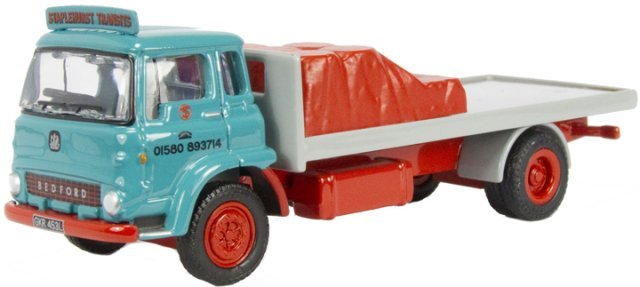
EFE model 23405 carries the registration
GKR 453 L
with GK being the letters representing South West London and the suffix L
indicating the 1972 / 1973 registration year. | |
|
| |
|
 | |
|
|
| |
| |
The origins of Edwin Richard Foden and his Foden
company were explored in
The Road to Feltham but by
the early 1930s his attention was moving from steam road vehicles to
diesel, and in particular a 6-8 ton chassis fitted with a new Gardner LW
(Light Weight) high speed oil-engine. At the depth of the Great
Depression, insurers were becoming increasingly reluctant to underwrite
steam boilers - but with the rest of the Foden boardroom clinging to the
past Edwin and his son Dennis resigned and started their own company -
ERF.
The very first 'E.R.Foden & Son Diesel'
lorry made its debut at the 1933 Motor Show in Olympia carrying the
chassis number 63 - Edwin's age at the time - and right from the
beginning the company only bought in the best components available -
engines from Gardner, gearboxes from David Brown and axles from
Kirkstall Forge - rather than making everything in house.
Similarly a new and striking cab was styled by Sandbach coachbuilder
John Henry Jennings, who also provided initial factory space to assemble
the new lorry.
The death of Edwin in 1950 at the age of 80 led to
his son Dennis becoming Managing Director at the tender age of 30 years
and the company went public in 1954. Dennis shared his father's flair
for design and sensed that a radical change was needed.
At this time, J H Jennings employed a young
designer by the name of Gerald Broadbent and between Gerald and the ERF
Chief Engineer Ernest Sherratt the striking new Kleer Vue cab was born.
The KV cab quickly became the epitome of futuristic, imaginative
1950s style with its use of curved glass, one of the very
first applications in a commercial vehicle and one which caused
manufacturer Triplex many production difficulties.
Operators fell in love with its distinct rounded
shape and the truck with its Gardner 6LW engine became a legend. A semi
forward control version of the KV cab became available with the benefit
of provision for three seats in the cab. These models proved popular
with the likes of brewery operators and quickly gained the nickname
'Sabrina' due to the busty television personality of that name.
The KV cab was available to buy from 1954 to 1966.
J&A Smith
of Maddiston, near Falkirk, began business in 1931 when
James and Alexander
purchased a second
hand lorry and
persuaded their father to enter coal haulage. Father and sons worked the
lorry continuously, in shifts, until they were able to purchase another
two used vehicles. Soon a contract was won with a foundry in Falkirk to
deliver gas cookers to Aberdeen and back
loads of fish were obtained from the local markets for delivery to
Glasgow.
In 1946 J & A Smith took over
two other haulage
companies, Smith of Avonbridge and Keir of Camelon, and added another
eight vehicles to their fleet prior to gaining the contract to haul
processed metal all over Britain from the British Aluminium Company’s
new rolling mills at Falkirk.
By 1953 there was
accommodation for 28 vehicles at the firm's Manualrigg headquarters with
a repair shop, traffic office, loading bays and storage space and in the
same year the company purchased coach builders Campbell Bros. of
Whitburn. Here they had a sawmill, woodworking machinery, a sheet
metal department and paint shops which could build eight complete
vehicle bodies per week and began building vehicle bodies to their own
design.
So much traffic was going to
England by 1954 that a
branch depot at Bryn, near
Wigan was acquired along with similar
facilities in London. Return
loads were collected from all parts of the
South
Coast for delivery to the
Midlands and
Scotland in a fleet
comprised mainly of Leyland and AEC multi
wheelers with some Albions,
Bedfords and
Thames, which were used for
both local and long-distance light
traffic.
Nightly trunk services were operated to the
South, with general goods from
Glasgow,
Edinburgh and
Falkirk. These were augmented by
daily services to London
and the Midlands and there was a regular run
with contract vehicles from the Bauxite
works at
Fort
William and
Kinlochleven. Another substantial customer
was the Alloa Glass Work Co. Ltd., whose
work was taken over after the liquidation of
London Scottish Transport. Smith’s acquired
the London Scottish depot at Alloa with 30
to 40 of their vehicles.
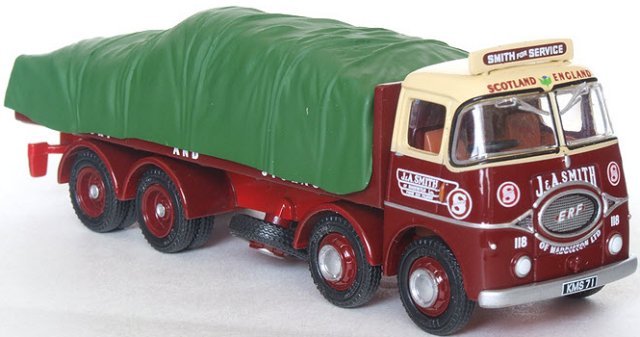
EFE model
31203 represents fleet number 118 with the pre 1963 Edinburgh (MS)
registration KMS 71
| |
| | |
|
 | |
|
| | |
|
From its earliest days AEC was an
engineering-led concern that maintained close relationships with its
customers. The original AEC Mandator lorry first appeared in 1931 to
fulfil the special requirements of hauliers that wanted low-height
chassis vehicles for carrying machinery or bodying as furniture vans.
By the 1960s the Mandator Mk V was at
the vanguard of AEC's successful assault on home and export commercial
vehicle markets. Later, the Ergomatic tilt-cabbed design consolidated
the success of AEC's heavyweight tractive units. Fast, powerful and with
excellent brakes, as well as looking the part, these lorries became
immensely popular. However, it was a great pity that the Mandator
development stagnated in a period of rapid advances and when production
ended in 1977 the model had become somewhat outdated.
British Road Services was created as
part of the British Transport Commission in 1948 following the
Nationalisation of Britain's road haulage industry under the 1947
Transport Act. By 1960 it comprised British Road Services Ltd, BRS
Parcels Ltd, Pickfords and Containerway & Roadferry Ltd and in 1969 the
organisation was renamed The National Freight Corporation.
In 1982 it became one of the first
state owned industries to be privatized when its employees bought what
became National Freight Consortium and then NFC plc, which was listed on
the London Stock Exchange. NFC plc merged with Ocean Group in 2000
to form Excel plc. BRS Parcels was rebranded as Roadline and after
a management buy out became Lynx Express in 1997 two years before
Pickfords was sold to Allied Van Lines.
Back in the 1960s however, the red
liveried British Road Services lorries had their own enthusiast
following much as Eddie Stobart has today, complete with spotters books
listing tractor and trailer numbers attached to each depot.
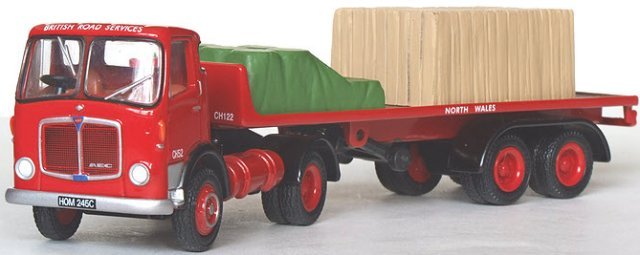
The combination of CH52 and CH122 as
depicted in EFE model 35001 would have belonged to the BRS depot at
Chester Road, Queensferry in North Wales with the licence plate HDM 245
C indicating a Chester (DM) registration in the year 1965. Traffic
handled by Chester Road based lorries would have included sugar, beer
and steel castings from Shotton to the Vauxhall works at Ellesmere Port
with scrap steel being back loaded | |
|
|
| |
|
 | |
|
| | |
|
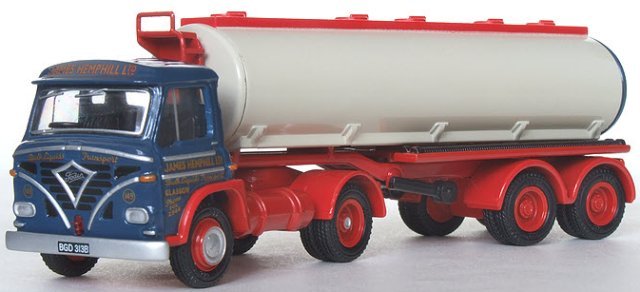
Foden were the first British manufacturer to offer tilt
cabs on heavy lorries in 1962, with the introduction of the S24,
identifiable by its oblong headlamps, single piece windscreen and the
absence of a removable front grille. For 1967, a revised version of the S24
was introduced known as the S34 (tilting cab) or S36 (fixed cab). Both had
slant mounted headlamps and a slightly deeper windscreen than the original
S24 model. EFE model 37001 represents Fleet
number 149 of James Hemphill of Glasgow with the registration BGD 313 B, GD
indicating Glasgow and B being the suffix letter for 1964. | |
| | | |
| |
RUSTON BUCYRUS 19 DRAG SHOVEL BY CORGI
TRACKSIDE | |
| | | |
| |
 | |
| | | |
|
|
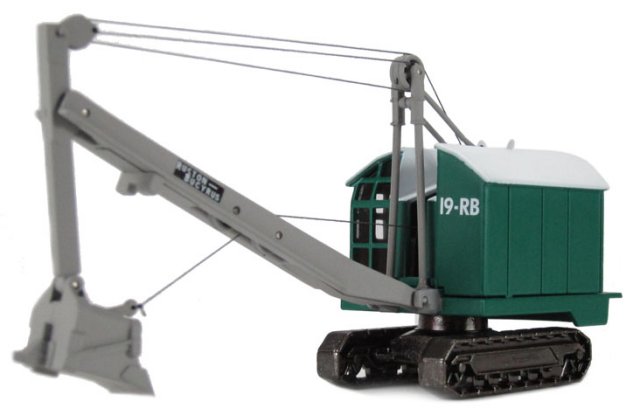
Ruston Bucyrus Limited was established in 1930 and
jointly owned by Ruston and Hornsby Ltd of Lincoln and the Bucyrus Erie
Company from Ohio who were the principal US manufacturer of excavation
machinery of the time. Ruston and Hornsby dated back to 1857 with a history
of manufacturing diesel locomotives and steam shovels. The partnership with
Bucyrus Erie meant Ruston had the finance and specialised knowledge to
develop new excavators, whilst giving their American partners a platform in
the European markets.
The RB19s were produced from 1937 until 1967 and would have been used across
various industries including; construction, mining, quarrying as well as
within the British Railways to move loose aggregates such as ballast and
coal. | |
|
| | |
|
|
COLES ARGOS 6 TON CRANE BY CORGI TRACKSIDE | |
|
| | |
|
|
 | |
|
| | |
|
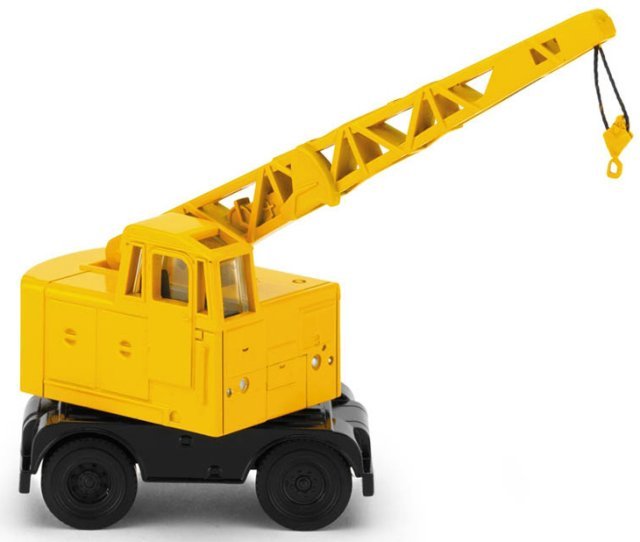
| Coles Cranes was
founded at the height of Britain's industrial revolution in 1878 by
sawmill machine manufacturer Henry James Coles and his younger brothers
Walter and Ernest. Having broadened their engineering experience
with other firms, they took over the existing crane making works of the
Appleby Brothers in Sumner Street, Southwark, London before moving to
more spacious premises at Slack Lane, Derby, in 1898.
Around this time their
products included a patented
single cable loading grab and water hydraulic cranes for use in areas
where coal or grain dust posed a fire risk when combined with more
conventional steam cranes pressurised from a vertical boiler.
Petrol driven direct drive rail mounted cranes first appeared in 1913
with petrol-electric cranes mounted on road bus chassis following after
the First World War.
However, it was not until the mid 1920s that Coles cranes were no longer
limited to lifting across the back and sides of the unit while the
vehicle itself was static. By 1930 Coles were offering a tracked
crawler crane which could rotate through 360 degrees and also featured a
cantilevered jib, allowing the cranes to move close to railway wagons
and other work areas before attempting to move loads.
Preceding a move to a new works in Sunderland in 1939, Coles was to
design and build two of its most famous products for the Air Ministry:
the EMA self propelled 2 ton crane - ancestor of the 1954 vintage
6 Ton Argus represented by
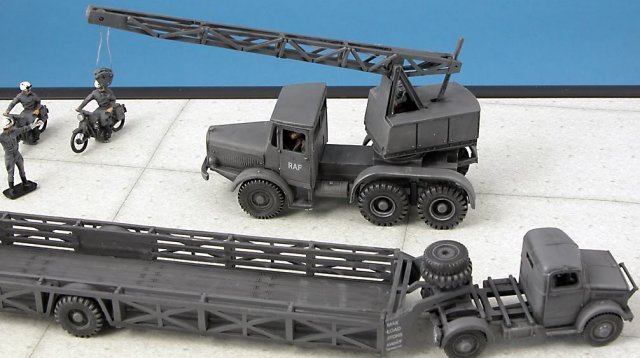
the Corgi Trackside model pictured above - and the 5 ton Coles Mark VII
crane mounted on the back of a 6x4 Thorneycroft Amazon lorry chassis.
About 2 000 of these were produced with 400 having a diesel rather than
petrol engine.
Although Coles Cranes
ceased trading in 1998 the Argus, strongest of all the firm's cantilever
cranes, can
still be found in working order in boat yards and on preserved railways
while the Coles Mark VII / Thorneycroft Amazon combination has been
immortalised in the 1/76 scale Airfix RAF Recovery Set
(A03305) pictured below. | |
|
| | |
|
|
 | |
|
| |