TERMINAL 1
AIRBUS, BOEING
(UND ALLES )
UBER DEUTSCHLAND

This break in appearances allowed the acquisition of new rolling stock and airside vehicles and further led me to the idea of the Airport Authority organising a "plandampf" style event where preserved trains would temporarily take over from some of their more modern equivalents and as this "planned steam" ( and vintage diesel too in this case ) concept was German in origin, who better to sponsor it than German airlines!
Initially the German airlines were represented by D-ABBA, a single Boeing 737-800 of Air Berlin - pictured above - although another "Britisher Plandampf" in the future may well feature some of Tony Neul's models as photographed and described below.

"For the purpose of strengthening European co-operation in the field of aviation technology and thereby promoting economic and technological progress in Europe, to take appropriate measures for the joint development and production of an airbus."
The airbus concept itself was first identified as far back as 1959 when Hawker Siddeley promoted a 126 passenger version of the Armstrong Whitworth Argosy twin-boom freighter optimised for ultra short hauls at low cost per passenger mile.
However, following the Duncan Sandys axe falling on British military aircraft projects in 1957 and during an era when France and Britain were beginning to consider co-operation on the supersonic airliner that would become Concorde, a British company developing such an aircraft speculatively alone would have been vulnerable to competition both from Europe and from the United States.
As Vickers were to discover with the VC-10, even a technologically advanced design would not always prevail in the face of lack of support from government and customers and the resulting small production runs would prove expensive compared to the high volume output American manufacturers, thriving after World War II in an unbombed land naturally suited to internal civil aviation.
From 1965 Hawker Siddeley began working with Nord and Bregut in France on their airbus concept as well as consulting major European airlines about their future requirements, which in turn led to other aircraft manufacturers and their governments becoming involved in the project, leading to the formation of Airbus Industrie as an Economic Interest Group.
By that time however the passenger Argosy format had been replaced by a twin engined jet airliner with 250 seats which first flew as the Airbus A300B in 1972 and was followed by the smaller but more technically advanced A310 in 1978.
While the A300B was a natural competitor for the Lockheed L 1011 Tristar and McDonnell Douglas DC-10 and the A310 rivalled the 757 and 767 designs of Boeing, the next logical move for Airbus Industrie was to challenge the McDonnell Douglas MD80 and Boeing 737-300 for the smaller short-range jetliner market. And although conventional in appearance, the 150 seat A320 was to be sold on its revolutionary technology which dramatically reduced operating costs.
In fact no aircraft in history simultaneously introduced more new technology than the A320. Containers could be loaded into the A320 through the widest underfloor doors of any single aisle aircraft, Ii featured a composite and aluminium alloy fuselage, supercritical wing with only 25 degrees of sweepback compared to the more normal 35, delta winglet and most importantly the A320 was the first airliner to introduce a fly-by-wire flight control system - where control inputs from the pilot are transmitted to the flying surfaces by electronic signals rather than mechanical means. Not only did this save weight over previous powered control systems but the quadruplex digital computer control protected the flight envelope from gust loads, stalls and maximum and minimum speeds. From a practical viewpoint, too, pilots used a sidestick rather than a traditional yoke to control the aircraft in a "glass cockpit" where video displays replaced dials and gauges.
The first A320 flew on 22 February 1987 with the first production A320-100 being delivered to Air France in March 1988. The definitive, heavier long range A320-200 was certificated in November 1988 and since then the A320 family has embraced the stretched A321 and the shortened A318 and A319.
Perhaps the greatest tribute to the A320 came in May 1994 when Boeing tried to acquire a second hand machine to display in Seattle to motivate its workforce and familiarise them with the opposition. Since then Airbus has consistently manufactured and sold more aircraft than Boeing.
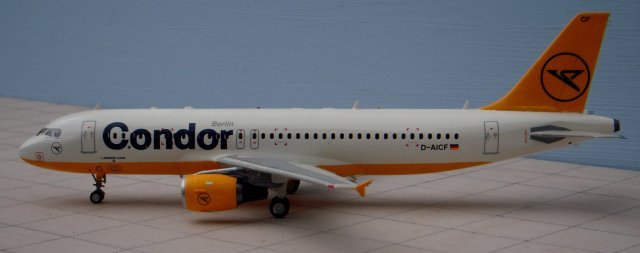
The A320-212 with the constructor's number 905 was registered for testing as F-WWDP for its first flight on 1 October 1998 but was then re registered as D-AICF, one of the A320s which replaced Boeing 737s in the fleet of Condor Berlin GmbH, itself a wholly owned subsidiary of Condor Flugdienst GmbH, one of the World's leading leisure airlines. Condor Berlin GmbH was founded at Berlin Tegel airport in 1998, taking advantage of the reunification of Germany in 1990, previous to which West German airlines had not been allowed to fly into West Berlin. Schonefeld in nearby Brandenburg became the new home of Condor Berlin GmbH in the early 21st Century before the organisation was rebranded as part of Thomas Cook and Lufthansa from 2004.
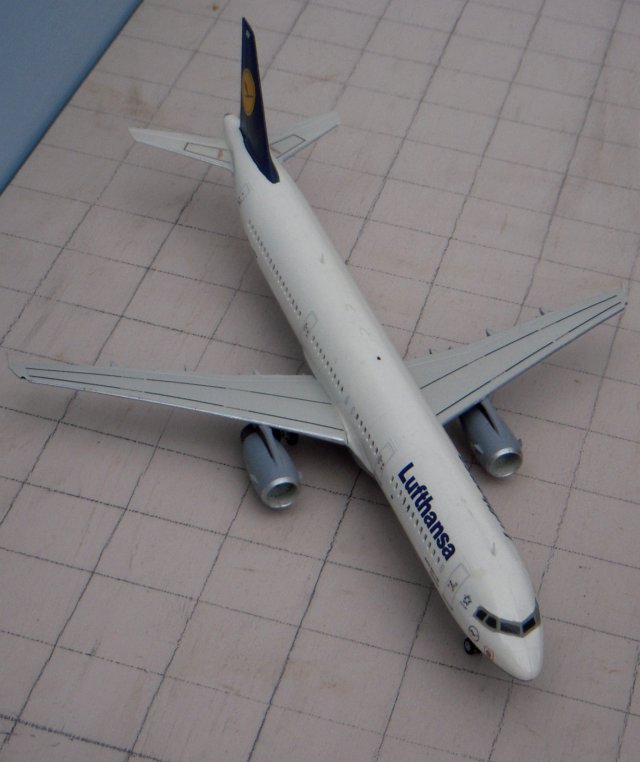
Compared with the A320 the A321's major change is the stretched fuselage, with forward and rear fuselage plugs totalling 6.93m (22 ft 9in) (front plug immediately forward of wing 4.27m/14 ft, rear plug directly behind the wing 2.67m/8 ft 9in).
Other differences include strengthening of the undercarriage to cope with the higher weights, more powerful engines, a simplified and refined fuel system and larger tyres for better braking. A slightly modified wing with double slotted flaps and modifications to the flight controls allows the A321's handling characteristics to closely resemble the A320's. The A321 features an identical flight deck to that on the A319 and A320, and shares the same type rating as the smaller two aircraft. The basic A321-100 features a reduction in range compared to the A320 as extra fuel tank capacity was not added to the initial design to compensate for the extra weight.
To overcome this Airbus launched the longer range, heavier A321-200 development in 1995 which has a full-passenger transcontinental US range. This is achieved through higher thrust engines (V2533-A5 or CFM56-5B3), minor structural strengthening, and greater fuel capacity with the installation of one, or optionally two 2,900 litre (766US gal/638Imp gal) additional centre fuel tanks. The A321-200 first flew from Daimler Benz (later DaimlerChrysler, now Daimler AG) Aerospace's Hamburg facilities in December 1996.
D-AIRY with the constructor's number 901 was delivered on 4 November 1998 and named Flensburg after the German town. In 1999 its construction process was televised by the popular German children's programme "Die Maus" and, after initial reluctance by Lufthansa, "Die Maus" artwork was added to the rear fuselage.

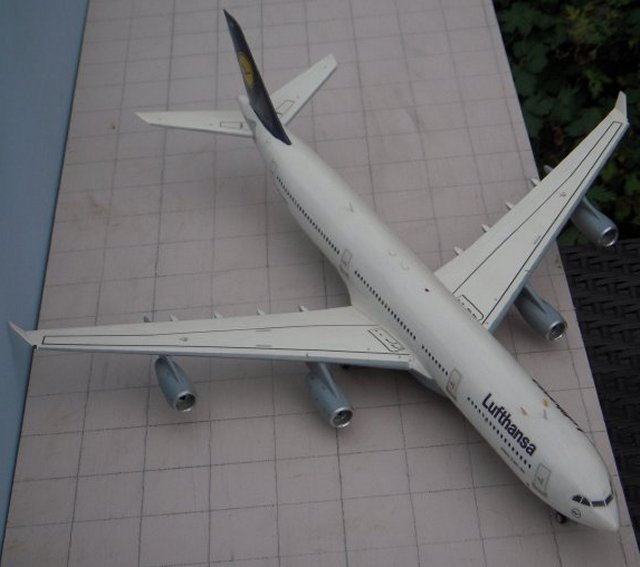
Again building on established strengths, a tri-jet format was rejected in favour of the twin engined A330 and the four engined A340, the four engine configuration being more efficient for long range flights (as twins need more power for a given weight to cope with a possible engine failure on takeoff ) and free from US Federal Aviation Authority Extended Operations (ETOPS) restrictions.
In fact the A340 is the World's longest range jet airliner with later A340-300E and A340-8000 models offering 7 100 and 8 100 nautical miles between landings respectively: the latter - as bought by the Sultan of Brunei - achieving its extraordinary range by being based on the shorter fuselage of the A340-200, first flown on 1 April 1992.
Both A330 and A340 retained the nose and rear fuselage of the A310 and the fly-by-wire glass cockpit of the A320 as well as sharing the same new 30 degree sweepback supercritical wing with outboard ailerons and winglets.
The first A340-300 flew on 25 October 1991 with the A330-300 following on 2 November 1992 while the A340 entered service with launch customer Lufthansa and Air France in March 1993, following CAA certification the previous December.
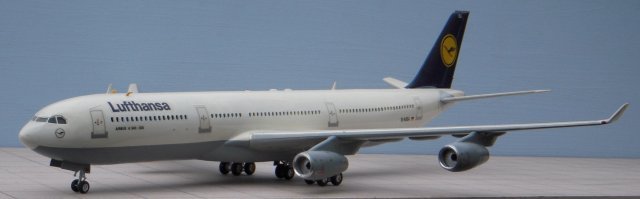
The A340-211 with the constructor's number 008 was first flown on 7 December 1992 with the test registration F-WWJA before entering Lufthansa service as D-AIBA "Nuernberg" on 29 January 1993. The six strong Lufthansa A340-200 fleet was withdrawn ten years later with D-AIBA being one of five aircraft transferring to South African Airways. Reregistered as ZS-SLA on 8 April 2003, it was withdrawn from use in June 2011.
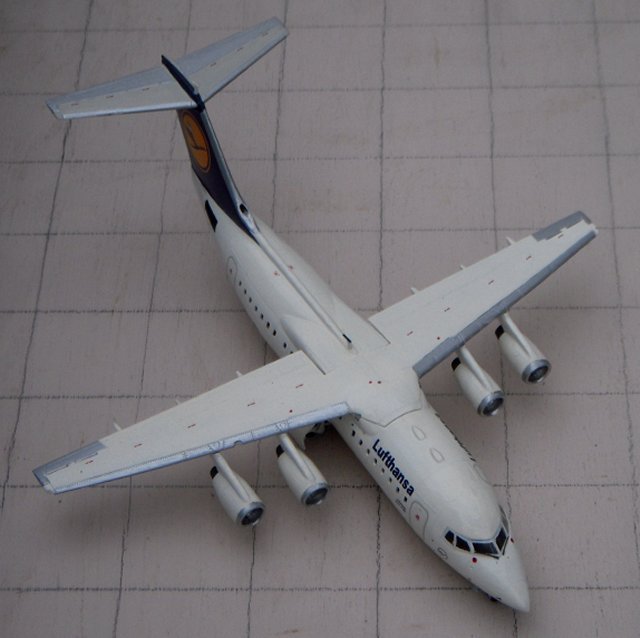
Certification was granted in early 1983 with first deliveries following in May. A VIP version was offered as the "Statesman" - which was ordered by the Royal Air Force as the BAe-146 CC2 for The Queen's Flight ( later 32 Squadron ) - with the standard transport version being the BAe-146 C1.
Stretched developments of the BAe 146 included the - 200 and - 300 series, both of which included a Quiet Trader cargo version while the - 200QC could quickly change from passenger to cargo format. In all cases, the use of four engines made steep approaches and short take offs safer - with 75% of thrust still being available if one engine was lost. At the same time, four engines running at lower power as opposed to two engines at maximum output reduced noise footprints.
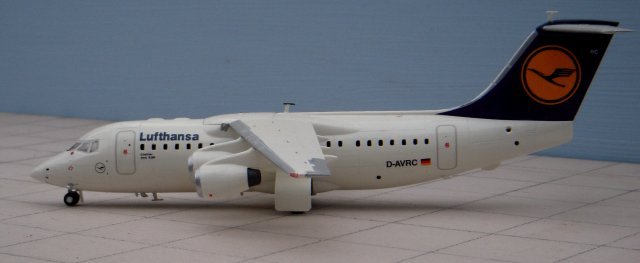
The last of the original BAe 146s was built in 1993, by which time the seventy seat -100 version had been marketed in the USA as the RJ (for Regional Jet) 70. In 1992 BAe further decided to modify, re-engine and rename the 146 family with the -200 series becoming the RJ85 and the - 300 series the RJ100. The first Textron-Lycoming powered RJ85 with digital electronics and engine control was flown from Hatfield on 23 March 1992 but was also the last 146 to be built on the former de Havilland site which was then closed and built on as production moved to the former Avro site at Woodford near Manchester. Despite having only tenuous links with such famous military aircraft as the Vulcan and Shackleton, the RJ85 thus gained the brand Avro.
The last Avro RJ was delivered in 2002 with the RJ85 carrying constructor's number E2251 flying for the first time on 22 February 1995 registered as G-6-251 before delivery to Lufthansa CityLine as D-AVRC on 3 March 1995 under lease from Trident Aviation. After a brief period of storage at Cotswolds Airport, Kemble, in December 2010, this aircraft was then operated by Airlink of South Africa as ZS-SSK.
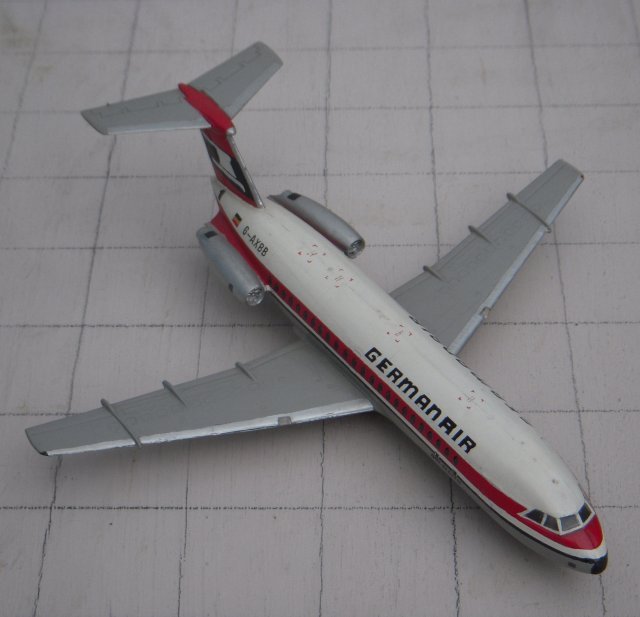
Based on the success of the earlier series 200 aircraft in the USA, the -400 was designed around gross weight restrictions to allow operation by a two man crew. The first of 69 series 400 machines was first flown on 13 July 1965 and six examples of these became the first British civil aircraft to be sold behind the Iron Curtain when they were delivered to TAROM of Romania. BAC One Eleven 400s also beat off competition from the McDonnell Douglas DC-9 to win Britain's biggest ever US Dollar order for civil aircraft from American Airlines, a long time Douglas customer, where they proved more efficient, cost effective and popular with passengers than either the DC-9 or American Airline's Boeing 727s.
First flown as G-16-6 on 14 February 1969, c/n BAC 162 was registered as G-AXBB and leased to Quebecair of Canada 13 March 1969 to 11 April 1969. From May to August it served with Taron of Romania as YR-BCP and was then leased as G-AXBB to Germanair from 14 August 1969 to November 1969 as one of five BAC One-Elevens in the fleet.
On 5 November 1969 c/n BAC 162 became TI-1055C of LACSA Costa Rica prior to spells with Cayman Airways and Gulf Air of Oman although one of its most stable periods in terms of ownership came between 1979 and 1989 - once again as G-AXBB - with British Island Airways.
c/n BAC 162 finally became 5N-AYR with Okada Airlines of Nigeria in October 1989 and last flew in 1997


To maximise rear fuselage space, two engines were used rather than three and these were moved back under the wings as was the case with Boeing's original jetliner, the 707. However, due to low ground clearance, the two gas turbines were installed tight against the underside of the aerofoils rather than on pylons.
The stretched 737-200 also featured quieter nacelles, reduced drag, redesigned thrust reversers and an optional gravel runway kit with a small forward projection tube below each nacelle blowing air forward to break up vortices that could suck gravel into the intakes.
In 1981 the -300 series incorporated aerodynamic, structural, cockpit and cabin features from Boeing's 757 and 767 as well as uprated CFM-56 engines. As these were larger than their predecessors, accessory drives had to be moved to the side of the nacelle from the bottom resulting in a flattened nacelle bottom and intake lip. The CFM-56 engines were also moved ahead of the wing and raised level with the upper surface, necessitating a balancing forward extension at the base of the fin.
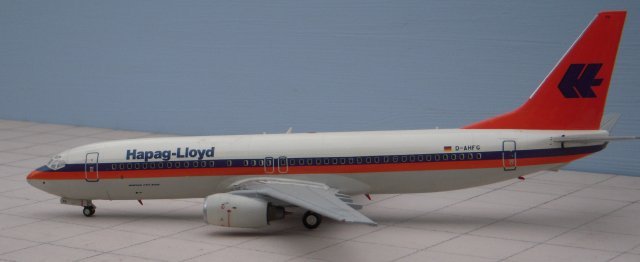
The first flight of the Boeing 737-800 was on 31 July 1997, and the first delivery to launch customer Hapag Lloyd was in April 1998. The -800 introduced a new longer fuselage, extending 737 single class seating to 189, compared with 100 in the original 737-100, as well as new larger wings and tailplanes and glass cockpits.
The Boeing 737-8K5 with the constructors number 27989/59 first flew on 9 June 1998 and served as Hapag Lloyd's D-AHFG from 24 June 1998 to 28 April 2005, keeping the same German registration as a Hapagfly and TUIfly asset until 15 January 2007. C/n 27989/59 was then re-registered as EI-EEA by Irish airline Transero on 8 June 2009.

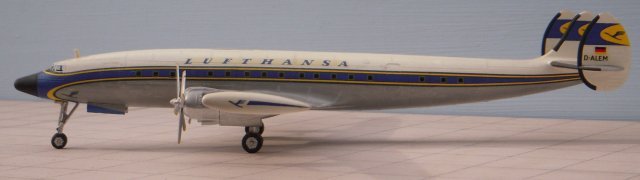
By the time that the first Super Connie in Europe was delivered to Hamburg on 15 January 1955, the company originally called Luftag on 6 January 1953 had changed its name to Lufthansa and the first practical job for the new 1049G was a special flight carrying Federal Chancellor Konrad Adenauer to Paris on 7 May 1955.
After D-ALEM's proving flight across the Atlantic, Hamburg-New York Idlewild services operated on three days a week and in 1956 services were extended to five times weekly and flights started from Dusseldorf to Chicago via Manchester.
The second batch of 1049Gs delivered during 1956 also enabled Lufthansa to offer nine weekly flights from Hamburg to New York, two via Dusseldorf and Paris, two via Dusseldorf and Shannon, and five via Frankfurt and Shannon, followed by services to South America with flights from Hamburg and Frankfurt to Rio de Janeiro, Sao Paulo and Buenos Aires via Paris and Dakar.
Services to Montreal and Chicago were then started and in September 1956 Istanbul, Beirut, Baghdad and Tehran flights began from Hamburg via Frankfurt, Dusseldorf, or Munich.
Meanwhile, in 1955, Pan American ordered the Douglas DC-7C Seven Seas, with the ability to fly the Atlantic non-stop in almost any weather. To counter this threat from his rival Juan Trippe, Howard Hughes asked Lockheed to develop a new version of the Constellation with increased range and capacity for his Trans World Airlines.
Lockheed initially returned with a design designated L-1449, including turboprop engines and a lengthened thin straight-taper wing but declined TWA's request for a further fuselage extension since the extra cost was not justified given the impending arrival of long-range jets. However, further research found that the proposed turboprops could not be fitted to the L-1449 without impractical containment structures and so Lockheed proposed a Constellation with more powerful R3350 piston engines instead.
As all DC-7C production had by this time been allocated to other airlines, TWA reluctantly agreed to buy the new piston engined L-1649A which, as the last major airliner designed and built for the US and international market before the Boeing 707 appeared, had the greatest range of any piston engined airliner at over 7 000 miles.
Indeed, one L-1649A holds the record for the longest-duration non-stop passenger flight when TWA's inaugural London to San Francisco service on 1-2 October 1957 stayed aloft for 23 hours and 19 minutes and covered approximately 5 350 miles at 229.4 mph.
However, the L-1649A was slightly slower than the DC-7C and proved to be less economical to operate than the earlier Connies such as the 749 and 1049G. As such the only other customers were Air France and Lufthansa, which already had large Lockheed Constellation fleets. Interestingly, only Air France applied the Lockheed name of Starliner to the ten L-1649As in its colours, TWA referring to its 29 new machines as Jetstreams and Lufthansa's four being dubbed Super Stars.
In 2012 four Starliners still exist, including a Lufthansa Super Star which is being returned to flying condition, but their arrival - and that of Vickers Viscount turboprops - moved the L-1049Gs to Lufthansa services to Bangkok and Singapore which were then usurped by Boeing 707s from 1961.
In 1962 however, Super Constellations were being flown from Hamburg to Frankfurt with a one way price initially costing less than an equivalent First Class railway ticket. However, the venerable piston engined airliners were supplanted by Boeing 727s in 1967 with the last 1049G flight landing in October that year.
The Super Constellations were then disposed of, D-ALEM being scrapped and the exhibit later displayed with this registration at Munich Airport being created from former Air France Super Constellation F-BHML.