STEAM SUPERPOWER
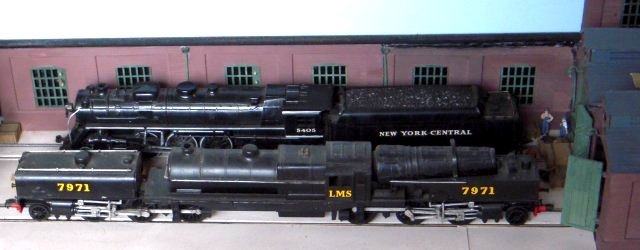
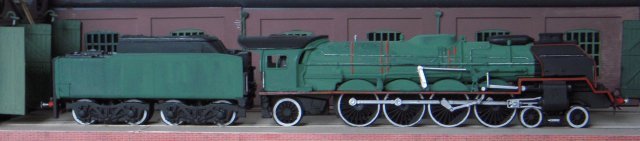
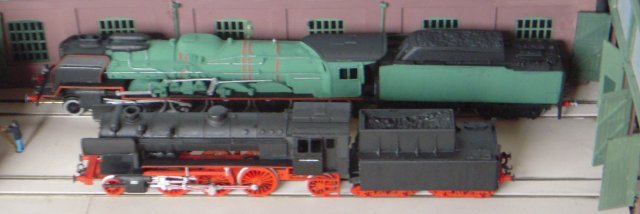
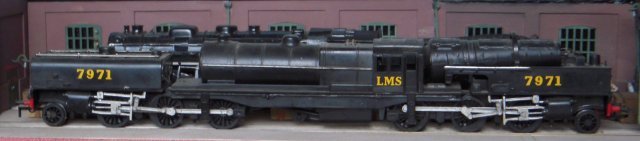
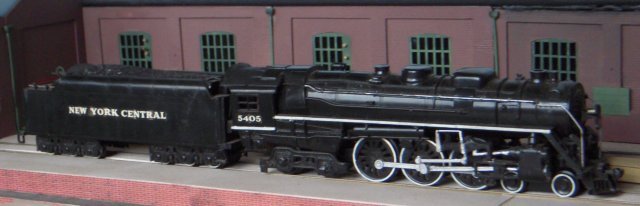
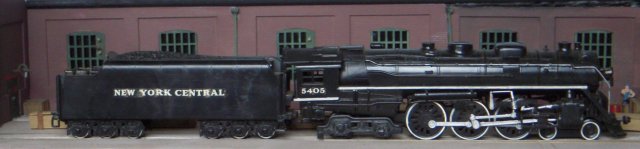
In addition to Mike's New York Central Hudson 5405 (Rosebud kit 34) Deutsche Bundesbahn Baureihe 23 (kit 19) and Societe National de Chemins de Fer Francais 241P (kit 23) I was also fortunate enough to be given a complete model of London Midland & Scottish Railway Beyer-Garratt 7971 (kit 25) by Jet Age Museum member Tony Wood which gave rise to the idea of comparing and contrasting these giant locomotives - that would never have all met in real life - in model form on Universal Works.
"The first engines of this type were built in 1927 to designs of Sir H. Fowler. For many years the most powerful engines in Britain, their duties were to haul coal and iron ore trains."
More specifically, London Midland & Scottish Railway ordered the 2-6-0 + 0-6-2 Beyer Garratts to replace double heading by smaller and conventional ex Midland Railway 0-6-0s on heavy coal trains working along the busy route from Toton in Nottinghamshire to Brent near London.
Like the unique LNER Garratt 2395 of 1925 - for which Great Central design studies had begun as far back as 1910 - such a locomotive format would not require turning at the end of a trip but would provide space and weight distribution for a more efficient firebox to be fitted even within the severe loading restrictions on the former Midland routes.
Herbert William Garratt's idea for an articulated locomotive had occurred to him in 1907 while watching the long barrel of a heavy gun leaving a factory. As the bogie wagon carrying it rounded a sharp curve, he realised that the gun could be replaced by a boiler with a high yet steady rate of steaming and the bogies powered by horizontal cylinders drawing steam through flexible connections.
The first articulated Class K1 0-4-0 + 0-4-0 left Beyer Peacock's Gorton, Manchester, factory for Tasmania in 1909 and it was in the same works in April 1927, that the first three 2-6-0+0-6-2 LMS Beyer-Garratts - numbered 4997 to 4999 and designed to provide a tractive effort of 45 620lb - were fitted with straight sided coal bunkers.
However, their reliability was compromised by the fitting of easily overheated Midland standard axle boxes and obsolescent short-lap valve gear rather than components scaled for the Garratt's 87' 10½" length and 155 ton 10cwt weight.
Indeed, although a Beyer-Garratt had first been proposed by George Hughes, the first Chief Mechanical Engineer of the LMS from 1923 to 1925, as an alternative to a rigid framed 2-8-2, his successor Sir Henry Fowler - LMS CME from 1925 to 1931 - was sidelined by former Midland Railway managers at Derby when they agreed specifications for the four cylinder articulated engines. Such was Derby's adherence to the old Midland "small engine" policy that locomotive crews were given no extra training to operate the Beyer-Garratts although grudgingly the hump at Toton marshalling yard was modified when the Beyer-Garratt's leading wheels were seen to lift off the rails when first using it.
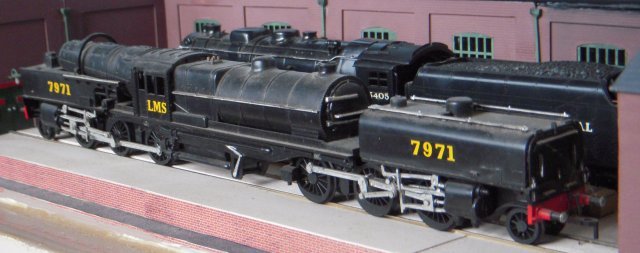
A further thirty of the locomotives were built between August and November 1930 to the same plans and numbered 4967- 4996 although in 1931 the entire class with the exception of the first two of the 1927 machines were rebuilt with 10 ton capacity conical rotary coal bunkers. These were revolved and oscillated by means of a small 2 cylinder steam engine, thus self-trimming the fuel load and preventing coal dust from entering the cab.
To allow their number block of 4967 - 4999 to be used by the "Black Five" 4-6-0s introduced by Sir William Stanier in 1934 the 33 LMS Beyer Garratts were renumbered 7967 - 7999, thus narrowing the Rosebud Kitmaster model of 7971 to a representation of a 1930 built locomotive operating from the mid 1930s until 1948. On Nationalisation in that year, the entire class entered British Railways ownership with the numbers 47967 - 47999.
The 33 LMS Beyer-Garratts were mainly allocated to Toton - where certain roundhouse roads were extended to accept them - but a few were based at Wellingborough and Hasland near Chesterfield.
However, as traffic conditions changed even before 1939 it was found that a 1935 vintage Stanier 8F's tractive effort of 32 440lb could cope with the Toton-Brent freights and that the 2-8-0s would require less coal and maintenance.
7967 - 7999 were also used on trains from Derbyshire to Manchester and even came as far south from Nottingham as Westerleigh and Over Sidings in Gloucestershire in the 1950s with 47975 being serviced on Gloucester Barnwood Depot on 22 June 1952 and 47994 similarly noted on 7 July 1956.
However, following the introduction of more powerful BR Standard Class 9F 2-10-0s in 1954 and all the ex LMS Garratts were withdrawn by March 1958. The Ian Allen ABC of 1957 recorded 47967, 47968, 47982 and 47994 as the final four examples.
Writing in the Daily Mail of 3 June 2013 S.A. Hardstaff of Nottinghamshire recalled:
"I fired a Beyer Garratt from Kettering to Westhouses, Derbyshire, pulling 42 wagons carrying 22 tons of iron ore for Sheffield, weighing 950 tons. I burned 9 tons of coal and turned 15 000 gallons of water into steam - and on arrival at Westhouses we had no coal or water left. The 9F was far better. I fired 92001 on its first run."
While Howard Green of St Albans noted:
"An interesting observation of the Beyer-Garratts was that the two independent engine units would synchronise under power with the locomotive, giving four exhaust beats per revolution of the driving wheels. But after cruising down a gradient the units would get out of sync. I remember a Garratt stopping in St Albans to change crews after cruising down from Sandridge summit. When the driver cracked open the regulator to move off, I could just about detect eight random exhausts per revolution."
None of the 33 LMS Beyer-Garratts were preserved and the moulds for the Rosebud Kitmaster model - first sold in March 1961 - were similarly scrapped, although only as late as 1982.
Meanwhile, the first K1 Garratt now runs on the Welsh Highland Railway which also boasts the last such locomotives built at Gorton.
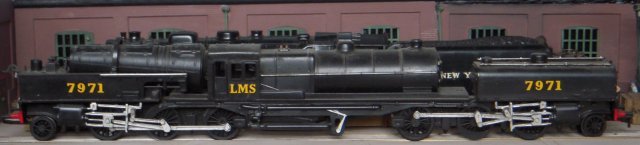
In the descriptive system devised by US engineer Frederic Whyte, wheels are counted and separated by dashes into front carrying, driving and rear carrying functions with a T being suffixed to indicate a tank engine and a + being used to identify an articulated locomotive such as a Garratt, Shay, Fairlie, Heisler etc.
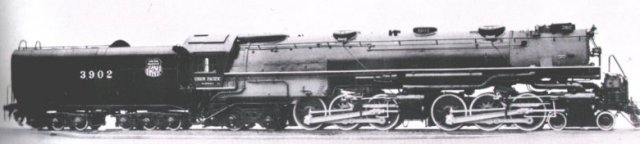
Variations on this theme include the 4-6-6-4 wheel arrangement - as used by the Union Pacific Railroad on its Challenger Class locomotives - which has two separate groups of six driving wheels between four wheeled carrying bogies. Although the front group of driving wheels on these locomotives are hinged relative to the rear group - which remain fixed to the chassis and boiler - to allow such a long vehicle to negotiate curves, both groups of driving wheels are powered by live steam rather than Anatole Mallet's original concept of the exhaust steam from the front cylinders being fed to low pressure cylinders at the rear. The Union Pacific Challengers (pictured above) must therefore be considered only as semi-Mallets.
Even more unusual were the rigid-chassis Class Q2 4-4-6-4 Duplex locomotives built by and for the Pennsylvania Railroad in 1944-5 with two 19 3/4" x 28" cylinders acting on the front four and two 23 3/4" x 29" cylinders acting on the rear six 5' 9" driving wheels.
The French system equivalent to Whyte notation uses numbers without dashes to count axles and the German substitutes letters for driving wheels. A Pacific wheel arrangement is thus 4-6-2 under Whyte but becomes 231 in France and 2C1 in Germany.
| Whyte | French | German |
Name |
| 0-4-0 | 020 | B | |
| 0-4-2 | 021 | B1 | |
| 2-4-0 | 120 | 1B | |
| 2-4-2 | 121 | 1B1 | |
| 4-4-0 | 220 | 2B | American |
| 0-4-4 | 022 | B2 | |
| 4-4-2 | 221 | 2B1 | Atlantic |
| 4-4-4 | 222 | 2B2 | |
| 0-6-0 | 030 | C | |
| 2-6-0 | 130 | 1C | Mogul |
| 2-6-2 | 131 | 1C1 | Prairie |
| 4-6-0 | 230 | 2C | Ten Wheeler |
| 0-6-4 | 032 | C2 | |
| 4-6-2 | 231 | 1C2 | Pacific |
| 2-6-4 | 132 | 1C2 | Adriatic |
| 4-6-4 | 232 | 1C1 | Hudson or Baltic |
| 0-8-0 | 040 | D | |
| 2-8-0 | 140 | 1D | Consolidation |
| 2-8-2 | 141 | 1D1 | Mikado |
| 2-8-4 | 142 | 1D2 | Berkshire or Austrian |
| 4-8-0 | 240 | 2D | |
| 0-8-4 | 042 | D2 | |
| 4-8-2 | 241 | 2D1 | Mountain |
| 4-8-4 | 242 | 2D2 | Northern |
| 2-10-0 | 150 | 1E | Decapod |
| 2-10-2 | 151 | 1E1 | Santa Fe |
| 4-10-0 | 250 | 2E | Mastodon |
| 2-10-4 | 152 | 1E2 | |
| 0-12-0 | 060 | F | |
| 2-12-0 | 160 | 1F | |
| 2-12-2 | 161 | 1F1 | Javanic |
| 2-12-4 | 162 | 1F2 | Balkan |
| 4-12-2 | 261 | 2F1 | Union Pacific |
| 4-14-4 | 272 | 2G2 | |
| 0-6-6-0 | 0330 | CC | Mallet |
| 4-6-6-4 | 2332 | 2CC2 |
Challenger |
| 2-8-8-2 | 1441 | 1DD1 | |
| 2-8-8-4 | 1442 | 1DD2 | Yellowstone |
| 2-10-10-2 | 1551 | 1JJ1 |
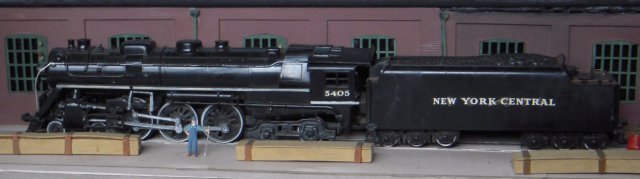
"These locomotives were designed by Paul W. Keifer, New York Central's former Chief Engineer of motive power and rolling stock, following experience with the J1 and J2 Hudsons. 50 were built by the American Locomotive Company in 1937-38, the last 10 had streamlined shrouds but in time the shrouds were later removed. Instead of a straight boiler as used on the J1s and J2s, a conical boiler was used. The smokebox was shortened by moving the front tube sheet forward, thus making room for a very large combustion chamber in front of the firebox. This increased the steaming capacity of the boiler. Baker valve gear was used on all the locomotives. This type of locomotive hauled the famous passenger train ""20TH CENTURY LIMITED" between New York and Chicago, covering the 961 miles in 960 minutes."
Leading particulars were then given as Cylinders 22 1/2" x 29", Boiler pressure 265 psi, driving wheel diameter 6' 7", Tractive effort 53 960 lb, Tractive effort [ of tender] booster 12 100 lb, Total engine weight 160.7 tons, Overall length 95' 11".
As well as being renowned for owning the longest continuous quadruple track in the World, stretching 474 miles between Castleton, New York, and Collinwood, Cleveland, the New York Central Railroad was also famous for operating the Twentieth Century Limited luxury express from Grand Central station in New York City along the Water Level Route of the Hudson and Mohawk valleys to Buffalo and Chicago.
When inaugurated in 1902, the Twentieth Century Limited took 20 hours to reach Chicago from New York as did its rival Pennsylvania ( later Broadway ) Limited running over the metals of the Pennsylvania Railroad. However, although the Pennsylvania's route was only 908 rather than 961 miles long it did climb up 1 in 40 gradients to a summit of 2 194 ' above sea level just west of Altoona in the Allegheny Mountains.
By the 1950s however, improvements in motive power had brought the journey time of the Twentieth Century Limited down to just 15 hours and 45 minutes from its passengers stepping off the red carpet at Grand Central station to rolling into La Salle Street, Chicago.
Achieving an average speed of just over 60 mph with 80 mph required over long distances was the result of expanding the 4-6-2 Pacific wheel arrangement into a 4-6-4, which the New York Central dubbed Hudson after its association with the River Hudson valley and also because the NYC had previously named its Class L 4-8-2s "Mohawks".
However, the 4-6-4 wheel arrangement had already been used in Europe where it was known as Baltic, the sole British example having been the London & North Eastern Railway's Class W1 10000 which first ran on 12 December 1929. More importantly, Mark De Caso's Nord Railway 4-6-4s vied with the PLM Mountain 4-8-2s - discussed below - in the 1950s for the crown of most powerful steam passenger locomotive on the continent.
Replacing a pair of pivoting trailing wheels with a four wheeled bogie (or truck, in American parlance) allowed the installation of a larger firebox with increased heating surfaces, just as the LMS Beyer-Garratt design had allowed a larger firebox than that of the preceding Midland Railway 0-6-0s.
The first locomotive exhibiting a radial outside-bearing four axle truck and an enlarged firebox was built by Lima for the New York Central in 1925 and used on the railroad's line between Boston and Albany, New York's State Capital, through the Berkshire Mountains: thus attaching the name "Berkshire" to its novel 2-8-4 wheel arrangement.
The parallel-boilered J1e Hudsons of the New York Central, built on similar principles by the American Locomotive Company (Alco) in 1927, could work long distances at 60 mph with a full regulator and 65% of the cylinder stroke cut off and at 75 mph with 1 000 ton trains on level tracks.
In all, the NYCRR would eventually own 275 4-6-4 locomotives with American steam superpower also advancing through such features as superheating, mechanical stokers, roller bearing axles and the kind of "boxpox" - rather than spoked - wheels championed by O.V.S. Bulleid for his Southern Railway Pacifics in Britain.
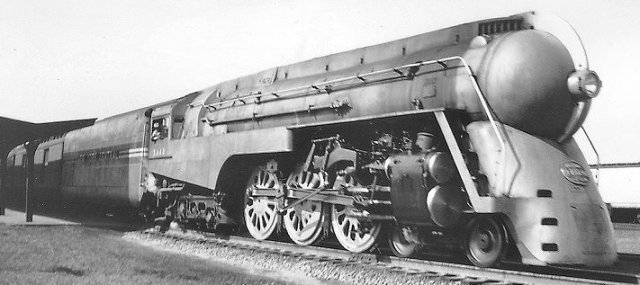
The 1937 vintage cone-boilered J3a "Super" Hudsons were a natural part of this progression and the final 10 examples (5445 - 5454, including 5446 pictured above) were originally built with streamlining styled by industrial design legend Henry Dreyfuss to match the new train sets that the NYC had also commissioned him to create.
The new Art Deco Twentieth Century Limited first ran on 15 June 1938, but 5445 - 5454 were not the only streamlined Hudsons to run on the New York Central. In 1934 J1e 5344 "Commodore Vanderbilt" became the World's first streamlined locomotive with a "bathtub" cover designed by the Case School of Science at Cleveland, Ohio while on 7 December 1941 J3as 5426 & 5429 were streamlined with a stainless steel cowling to match the Empire State Express.
Both 5344 and the Dreyfuss Hudsons were de-streamlined in 1945 and 5426 & 5429 were finally "uncovered" in 1949 and 1950.
In 1945 Paul Kiefer went on to produce his mighty Niagara Class with a 4-8-4 (or Northern) wheel arrangement for the New York Central, these magnificent and brutally functional machines being capable of running at 100mph on level track with 16-car trains on tight schedules between New York and Chicago, and clocking up 28 000 miles a month.
Indeed, the additional driving axle of the Niagaras compared to the J3a Hudsons was seen as a better alternative to the booster steam engine ( pioneered by the NYC in 1919 ) which could apply power to the wheels of the trailing truck and effectively turn the Hudson into a 4-6-4-0. However, such a complicated and potentially problematic booster was necessary to get the Hudson moving as the wheel arrangement was inherently less sure-footed than a 4-6-2 or 4-6-0 and thus worked best at delivering power at speed rather than torque through its 6' 7" driving wheels.
In contrast, the freight hauling LMS Beyer-Garratts had driving wheels of only 5' 3" diameter and the Hudson arrangement was only used by US Railroads with relatively flat routes. However, booster steam engines designed by The Superheater Company - based in New York - were also integral to Sir Nigel Gresley's pair of heavy freight Class P1 2-8-2 locomotives which ran from 1925 to 1945.
Exhaustive tests proved the Niagaras every bit as economical, and a great deal more powerful, than the latest diesels, but as air travel and increasing car ownership challenged railroads as the pre-eminent means of American inter-city travel after World War II the final journey of the 20th Century Limited, which had been used as a backdrop to the Alfred Hitchcock film "North by North West" in 1959, was on 3 December 1967.
The declining New York Central Railroad - which had scrapped all its Hudsons after dieselisation in the 1950s - merged with the Pennsylvania Railroad in 1968 but the resulting Penn Central was declared bankrupt in 1970 and became part of Conrail in 1976.
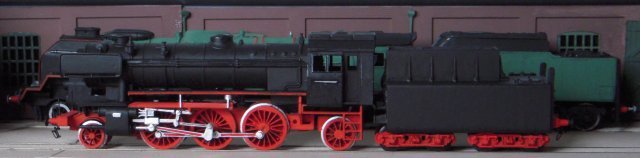
Further research however reveals that 105 examples were built during from 1950 to 1959 as Deutsche Bundesbahn's most numerous post-War replacement class, mainly with the intention of supplanting the old Prussian P8 ( later DB Class 38 ) 4-6-0s which, although built from 1908 to 1924, survived until the end of West German mainline steam in 1977.
In this respect the new 2-6-2s would have invited comparison with the British Standard six coupled steam locomotives being built across the English Channel at the same time although the DB Class 23s featured welded locomotive frames, boilers and tenders together with all the latest refinements of German practice including a superheated multiple-valve regulator and central lubrication of the least accessible parts of the running gear.
23 001 to 23 023 had Knorr surface preheaters and journal bearings. Locomotives with serial numbers 024 and 025, as well as those from 053 onwards, were equipped with roller bearings for the axles and drive as well as mixer-preheaters. A small number of vehicles were given Heinl preheaters and several were equipped for push-pull train operation in the Saarbrücken region in the late 1960s and 1970s.
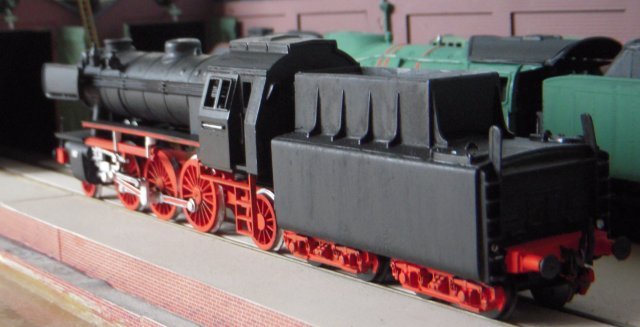
In this respect Baureihe 23 also has some common ground with some of the British Standard and Great Western Prairie tank engines described elsewhere on Gloucestershire Transport History although the only British 2-6-2 tender locomotives were the V2 and V4 of the London and North Eastern Railway.
A total of 184 V2s in eleven batches were built between 1936 and 1944 although without the larger firebox, Kylchap exhaust, streamlining, rotary cam poppet valve gear and ACFI feed water heater that had been considered during the design process.
The V2s were allocated to all regions of the LNER, although most were posted to sheds along the East Coast Main Line between Kings Cross and Aberdeen. The first V2, the now-preserved 4771 "Green Arrow" quickly became famous working the first leg of the King's Cross to Glasgow express goods service of the same name. Although they were designed for this kind of express goods work, the V2s proved adaptable and occasionally substituted for the A1, A3 and even A4 Gresley pacifics.
The cylinders, steam chests, and various passages were in one large monobloc casting, which offered streamlined steam passages, saved weight and reduced the number of potentially leaky flange joints used. By May 1956 however, maintenance of these monobloc castings was proving difficult and expensive because If only one cylinder had cracked, then the entire monobloc would need replacing. From this date, faulty monoblocs were replaced by three separate cylinder castings, just as the front and rear radial carrying wheels had had to be modified a decade earlier in response to their poor riding on track deprived of maintenance due to the War effort.
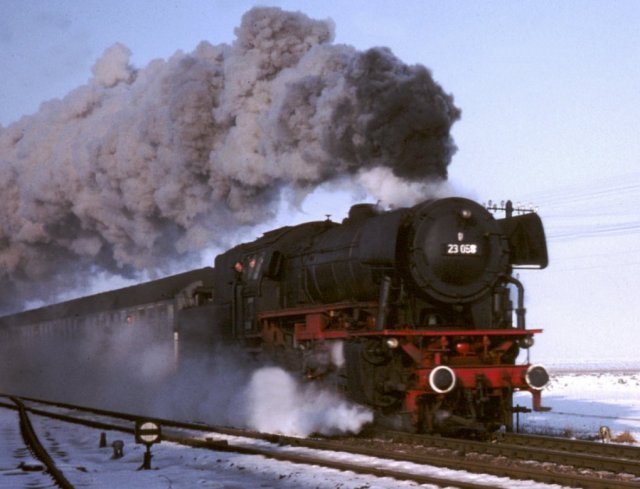
Also sharing a three cylinder monobloc casting and the same pony truck design was the much rarer V4, only two of which were built in 1940 before Sir Herbert Nigel Gresley was replaced as LNER Chief Mechanical Engineer by Edward Thompson, who ordered large numbers of his B1 4-6-0 design. However, 3401 "Bantam Cock" and sister engine 3402 both had many steel fabrications to replace traditional castings and also used light alloys and more modern construction methods to achieve a weight of 70 tons 8 cwt compared to the V2's 74 tons. The V4s thus had an availability of 5 000 out of the LNER's 6 414 route miles compared to just 2 752 for the V2s.
Both V4s were withdrawn and scrapped in 1957, just two years before 23 105 - built by Arnold Jung - became the last steam locomotive to enter Deutsche Bundesbahn service in December 1959; just four months before 92220 "Evening Star" (another Rosebud Kitmaster subject) claimed the same title for British Railways.
Similarly, 23 105 was preserved on retirement at Nuremburg Transport Museum although tragically the locomotive was severely damaged in the great fire there of 17 October 2005. However, seven other class members - the last of which were allocated to Crailsheim depot in 1976 - survive including 23 058 (pictured above) which is nominally based at Basel-Haltingen in Switzerland but during 2006 was rented to Friese Stoomtrein Maatschappij in the Netherlands.
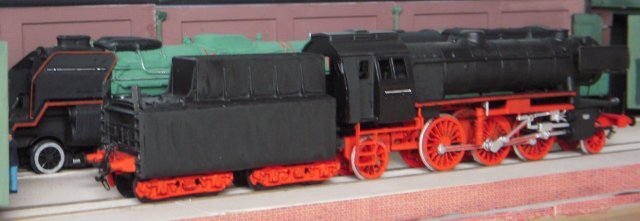
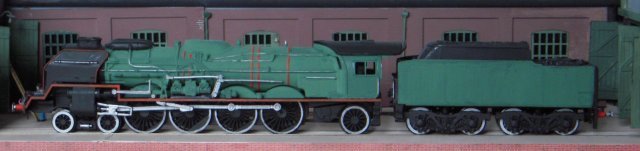
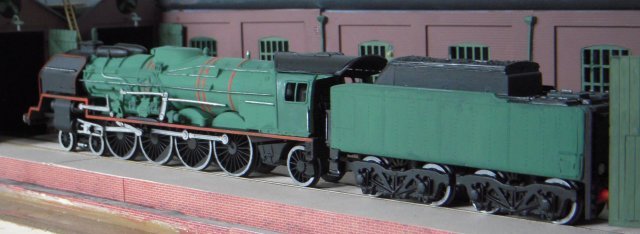
While most other models in the range offered markings for just one locomotive - even in the case of so prolific a class as the 350 bhp diesel electric shunter - the SNCF fourteen wheeler was years ahead of even contemporary aircraft kits in offering waterslide transfers for 241P26, 27 and 29. However, what also struck me was how minimalist these offerings were: comprising of just the nameplates for "Deltic" and - in this case - simply cab and tender side plates, buffer beam numbers, SNCF smokebox logo and overhead electrification warnings. Speed whiskers and orange boiler bands were to be applied in paint and strictly at the risk of the modeller's own skill!
While the LMS Beyer-Garratt came to me complete and the and NYC Hudson needed only a front grab rail to be fabricated, I embraced the concept of the two European locomotives being without decals to illustrate their respective classes and designs and also, at a later date, to place them in national diorama contexts as static locomotives receiving works attention.
For this reason the Baureihe 23 Prairie was finished as just having been given its main coats of black, red and silver - which would soon blur together with dirt as the picture of 23 058 shows - but without the boiler bands which conflicting sources show as red, silver or not there at all!
Similarly, as even after studying the online instruction sheet I was not sure that the 241P was complete, I only attempted to line out the boiler bands, footplate edge and smoke deflectors in orange and left the cylinders, cab sides and tender - with no guiding ridges - alone.
These concerns notwithstanding, the instruction sheet for this kit begins:
"Just after the Second World War, the SNCF ordered 35 engines of this type from the workshops of Le Creusot for working heavy, fast expresses on the Paris-Marseilles line of the South Eastern Region. These engines, delivered in 1948-1949, are the most powerful passenger engines in service in Europe and are the last steam engines built for the French railways. Due to the electrification programme on the South Eastern Region, some of these engines were given to other Regions still using steam traction and will soon disappear from the Paris-Marseilles line.
These loco are still used between Avignon and Marseilles for hauling the famous train "Le Mistral", the "Paris Cote d'Azur" and the "Blue Train", doing excellent work, being able to haul 1700 ton trains at speeds of 77 mph.
The main dimensions of the 241P are as follows:
Cylinders (High Pressure) 2 x 17.6" x 25.6" Cylinders (Low Pressure) 2 x 26.5" x 27.56" Boiler Pressure 290 psi, Driving Wheel Diameter 6' 7 1/2", Tractive effort at 85% boiler pressure 45 084 lb, Service weight of engine 130 tons, service weight of tender 80 tons, Coal capacity 8.5 tons, Water capacity 7 630 gallons, Overall length 90' 9".
Meanwhile, the last 60 years have also seen electrified French railways rise to well documented pre-eminence, first with engines CC7107 and BB9004 reaching 205 mph as early as 1955 and then with the TGV concept from 1981.
Indeed, with its railways largely destroyed by both German and Allied bombing and the activities of the Resistance - and with Marshall Aid later being available to finance reconstruction - the French Government decided on widespread electrification as early as 1943 with steam locomotion continuing as a stop-gap despite its highly evolved form.
This in advanced state of development had in turn come about through such factors as France's small reserves of coal ( compared to Great Britain ) and a decree made by the Emperor Napoleon III between 1852 and 1870 that no passenger train should exceed 75 mph without special permission. To also allow these trains to achieve the shortest possible journey times, French railways were often built with the most direct route - over high ground rather than around it.
Such straight lines with steep gradients are also a feature of today's Lignes a Grand Vitesse but without the limitless power of electricity and with coal at a premium, locomotive operators and designers were forced towards solutions more technologically advanced than were deemed necessary north of the English Channel.
Thus while post War Britain was economically crippled by debts to the USA and operated its exhausted but still functioning railways with austere but robust steam locomotives driven by crews who had learned their trade on the job, French Mechanicien learned both in the classroom and on the footplate about more complex - often compound - engines. Indeed, it was not unusual for a French locomotive crew to be allocated to one specific locomotive for years on end and to be paid bonuses for efficient running and making up lost time on late running services.
It is therefore no surprise that while British Railway's 92220 "Evening Star" was a simple expansion two cylinder freight engine and Deutsche Bundesbahn's 23 105 was a similarly unpretentious mixed traffic machine, the last steam locomotive of Societe Nationale Des Chemins De Fer Francais was a four cylinder compound with an eight coupled wheelbase designed to tackle the most severe gradients of the former Paris, Lyon and Mediterranee Railway.
In fact when the management of the PLM decided in 1921 that their Pacific locomotives did not have the power and adhesion to tackle the most demanding of inclines with the heaviest and fastest expresses they first of all looked towards their mixed traffic Mikado engines which, although having the tractive effort to accelerate from stops and speed restrictions, could not exceed 56 mph.
A similar solution also presented itself to Britain's LNER a decade later when faced with the challenge of operating express passenger trains on the steeply graded - if also tightly curved - route from Edinburgh to Aberdeen, leading to the introduction of the Class P2 2-8-2s in 1934. As was mentioned above, this was Gresley's second Mikado design but although the later five Class P2 engines were more mechanically conventional, 2001 "Cock O' The North" featured an ACFI feed water heater, double Kylchap blast pipe and chimney and Lentz rotary cam poppet valve gear.
Indeed, 2001 "Cock O' The North" - accompanied by Gresley's then personal assistant O.V.S. Bullied - travelled to Vitry-sur-Seine near Paris in December 1934 for two months of testing on the rolling road facility there. However, it was in later experiments that the ACFI feed water heater would only make best use of exhaust steam to do its job when the locomotive regulator was fully open - a rare occurrence on the Edinburgh-Aberdeen line.
The six P2s were eventually rebuilt as Pacifics from 1943 while back on the PLM the prototype compound Mountain 4-8-2 - numbered - 241A.1 - was delivered in February 1925. Distinguished by a bullet fairing on the smokebox rather than sheet metal smoke deflectors, 241A.1 used two low pressure outside cylinders to drive the leading coupled axle and two high pressure inside cylinders to drive the second axle.
However, although capable of producing 2 820 bhp at the cylinders - a 15% increase over the PLM's compound pacifics and at a lower rate of coal consumption that equivalent simple expansion engines - 241A.1 was also built to an 18 1/2 ton axle loading with frames and unsuitably balanced crank axles lightly constructed and inadequately braced.
By 1932 the PLM's Mountains had evolved into the D variant with correctly balanced crank axles, improved steam flow through larger piston valves and Kylchap inspired double blast pipes while the 1931 vintage 241C.1 also featured a boiler working at 290 psi - as opposed to the 232 psi previously attained - longer connecting rods driving the second and third axles and driving wheels enlarged from 5' 11" to 6' 7".
These developments fed into the design of the 241P (standing for Perfectionne, or improved) which was chosen ahead of Andre Chapelon's more advanced but delayed 242.A1 4-8-4. During construction from May 1946, the firebox of the 241P was made of steel rather than the copper used in the 241C design and the front two rings of the boiler made of nickel steel rather than mild steel. The weight savings thus made allowed the still inherently weak frame to be reinforced at highly stressed points while a mechanical stoker, Houlet annular superheater elements and Chapelon designed free flowing steam circuit allowed cylinder horsepower to rise from 3 500 to 4 300.
The result was a reliable locomotive, able to run over 111 000 miles between heavy overhauls given the right preventive maintenance, and a powerful one, with 241P.11 managing over a mile a minute along the 219 miles from Lyon to Marseilles despite two intermediate stops and a late start with an 800 ton train.
Fittingly, four examples have been preserved including 241P.16 at the French National Railway Museum at Mulhouse in Alsace.