| Home | RAILSPOT RELOADED |
|
| |
||
| If you lived in Gloucestershire
between 1990 and 1992 you might remember a weekly
newspaper called The Gloucester Journal. In The
Gloucester Journal was a feature called Railspot, which I
wrote. Each week, Railspot would include a picture, 500
words describing it, and often some pub quiz type
questions about railways. People have often asked me what happened to Railspot, and the good news is that it is - slowly - coming back. Even better news is that as I am no longer restrained by the limitations of a newspaper on the Internet, I can revisit some favourite topics, update them and add new pictures and web links. I can even do my own proof reading!
|
||
| |
||
AVONSIDE STANDARD GAUGE TANK LOCOMOTIVES |
||
| |
||
|
|
||
| |
||
| Thanks to the 30th Modern Olympiad being staged
nearby, Stratford station in east London will be one of the busiest in
Britain during the summer of 2012, giving visitors the chance to admire
the Avonside Engine Company of Bristol's locomotive 2068 built in 1933. This 0-6-0ST was originally ordered by the Lamport Ironstone Mines Railway near Brixworth in Northamptonshire before being preserved first at Quainton Road in Buckinghamshire and then moving on to the Foxfield Light Railway at Dilhorne in Staffordshire in October 1971. The saddle tank was then to relocate again to Peak Rail at Matlock, Derbyshire and then the Midland Railway at Butterley where it gained the number 8 and the name "Robert". The 38 tonne locomotive was then sold to London's Dockland Development Corporation in 1993 for the Kew Bridge Steam Museum, where cosmetic restoration work was undertaken to make "Robert" resemble a locomotive from the former Beckton Gas Works. In 1994, "Robert" was displayed on a section of track at the end of Windsor Terrace in Beckton, close to the former Beckton Gas Works entrance and close to the then new extension of the Docklands Light Railway. When the Docklands Development Corporation was disbanded in 1999, ownership passed to Newham Borough Council and as "Robert" had been vandalised it was decided to move the locomotive to a plinth in front of Stratford station. Due to later bridge construction work in the area, 2008 saw "Robert" was move to the East Anglia Railway Museum at Colchester and repainted at the expense of the Olympic Delivery Authority. Since April 2011 though, "Robert" has returned to Stratford station forecourt. |
||
| |
||
|
||
| |
||
| The Avonside Engine Company was based in Avon
Street, St Phillip's - close to Bristol Temple Meads station - from 1864
to 1934 although its roots can be traced back to an ironmongers in Bath
in 1785. In that year George Stothert senior took over the shop formerly belonging to Thomas Harris and became an agent for the domestic cast ironmongery produced by Abraham Darby's Coalbrookdale Iron Company. By 1815 however Abraham Darby had his own warehouse in Bristol so George Stothert senior started his own foundry and passed management of the business to his son George junior. Robert Pitt joined the company in 1844 which was then called Stothert and Pitt and continued as a renowned manufacturer of cranes and other engineering products independently until 1986. Meanwhile, in 1837, Henry Stothert, the other son of George Stothert senior, set up his own business, Henry Stothert and Company, in Bristol, to build two Firefly class broad gauge locomotives - similar to the illustration above - for the Great Western Railway. Named "Arrow" and "Dart", these 2-2-2s with 7' driving wheels were delivered for the opening of the Great Western between Bath and Bristol on 31 August 1841 and led to a further GWR order for Henry Stothert for eight smaller 2-2-2 Sun class locomotives. Edward Slaughter joined Henry Stothert and Company in 1841 prompting a name change to Stothert, Slaughter and Company while their premises on the banks of the River Avon was officially titled Avonside Ironworks in 1844.. From 1846 "Avalanche" became the first of five six-coupled saddle tank banking engines built for the GWR while passenger and goods locomotives were ordered for the broad gauge Bristol and Exeter Railway which began operations on 1 May 1849. In 1851 Henry Stothert took control of a shipbuilding yard that had been acquired by Stothert, Slaughter and Company as a separate undertaking while in 1856 Edward Slaughter took on Henry Gruning as a locomotive erecting partner and the company name changed to Slaughter, Gruning and Company. In 1864 Slaughter, Gruning and Company gained limited liability under the Companies Act and became The Avonside Engine Company Limited. The same year also saw the first order for some time from the Great Western Railway for twenty 2-4-0 Hawthorn class locomotives. However, with the development of Swindon Works, the GWR was increasingly self reliant in motive power provision, as were other British railway companies which in turn demanded ever larger locomotives to haul heavier loads. Given its limited manufacturing space - and financial difficulties following the death of Edward Slaughter - The Avonside Engine Company Limited thus decided to concentrate on building and selling smaller industrial locomotives from 1881. Edwin Walker of the Bristol engineering firm Fox, Walker & Co. then joined Avonside and endeavoured to turn the company round, but was forced to liquidate the old company and form a new company with the same name to carry on the same business at the same address. |
||
|
|
||
|
|
||
|
|
||
| Delivered in 1906, number 1498 was among the first of The Avonside Engine Company Limited's locomotives to be built at their new Fishponds works and by the time that the photograph above was taken on 28 March 1969 the 0-4-0ST was a spare engine at British Steel's Orb Works at Newport, Monmouthshire. Normally the Avonside worksplate and "Desmond" nameplate were kept safely away from the engine but could be re-attached for the benefit of visiting photographers, the nameplate being hooked on to the boiler handrail. 1498/1906 "Desmond" is now preserved on the Llangollen Railway. | ||
|
|
||
|
Shortly afterward Fox, Walker & Co was taken over by Thomas Peckett and the name Peckett & Sons was given to Bristol's other industrial locomotive builder while in 1905 Avonside left the River Avon and Avon Street behind for a new small-engine-building plant at Fishponds. However, after 29 years in their new Bristol premises, The Avonside Engine Company Limited entered voluntary liquidation in 1934 with the Hunslet Engine Company of Leeds taking over their goodwill and designs from 1935. |
||
| |
||
|
|
||
|
|
||
| Outside cylindered 0-6-0ST S2 "William" was built at Fishponds in 1915 as Avonside works number 1725 and ended its working life at Avonmouth Docks, Bristol, in April 1962, after which it was scrapped. | ||
| |
||
| Although this article focuses on Avonside's
standard gauge tank engines, the company also built on its initial
experience of Broad Gauge construction to become the largest British
builder of Fairlie
articulated locomotives. Among the first to be
erected at Bristol was the Festiniog Railway's "James Spooner" of 1872,
incorporating many detailed improvements over the preceding success of
"Little Wonder", built by George England of New Cross, London, in 1869.
As such, "James Spooner" became the template for future Festiniog Railway articulated 0-4-0+0-4-0 building at Boston Lodge and in 1872 Avonside also built two 42 ton 0-6-0 + 0-6-0 Fairlies on the recommendation of Sir Charles Fox and Sons, ordered by the Toronto, Grey and Bruce and Toronto and Nipissing Railways in Canada. The Avonside Works Manager at the time these locomotives were built was Alfred Sacré, the brother of Charles Sacré, Locomotive Engineer of the Manchester, Sheffield & Lincolnshire Railway. Alfred Sacré had trained under Archibald Sturrock at the Doncaster Plant of the Great Northern Railway and in 1872 moved from Avonside to the Yorkshire Engine Company, Meadowhall, Sheffield, where he built more Fairlie types. In 1874 New Zealand Railways, ordered two types of Double Fairlie locomotives from Avonside. Both the B class and E class Double Fairlies were fitted with Walschaerts valve gear, certainly the first use of this technology in New Zealand and is possibly the first time a British manufacturer had ever supplied it. The B class lasted in service until the late 1880s while the E class survived into the First World War despite having been officially written off in 1906. Avonside also built the unique 0-4-4T Single Fairlie introduced on the Swindon, Marlborough and Andover Railway in 1878 and for the fist time on a British based locomotive used Walschaerts valve gear to leave the space between the frames clear for the boiler. Similarly, on the recommendation of Robert Fairlie himself, Avonside were chosen to build the 21 R Class 0-6-4T Single Fairlies for New Zealand Government Railways in 1878-79, with 1878 vintage locomotive 28 surviving today at Reefton. |
||
| |
||
|
|
||
| |
||
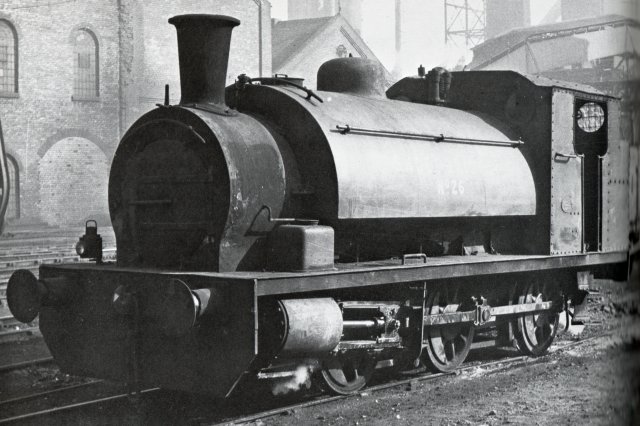
| Also sadly no longer with us is another Avonside 0-6-0ST - 1825/1929 named "Sheepbridge" after Sheepbridge Iron Works in Kent where it was photographed on 5 March 1961. | ||
| |
||
|
. |
||
| |
||
| Avonside Works 1917 of 1923 however does survive, although now named "The Earl Fitzwilliam". Originally named "Pitsford", the 28 ton B4 type worked at Pitsford Ironstone Quarries in Northampton before preservation first on the Fawley Hill Railway until 1972 and then on the Nene Valley Railway before renaming and a move to Elsecar Heritage Railway near Barnsley. 160 pounds per square inch of steam was raised intensively in South Yorkshire from 1992 to 2002 but 1917/1923 - named after a now extinct line of aristocrats - is currently awaiting overhaul. | ||
| |
||
|
|
||
| |
||
|
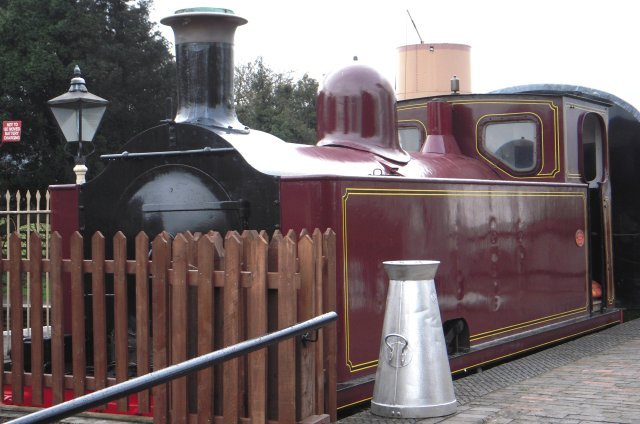
Perhaps the Avonside standard gauge tank locomotive most strongly associated with Gloucestershire in recent years however has been 1977 of 1925, more commonly identified by the legend "Cadbury Bournville No 1" painted in gold leaf on its side tanks during its working life. The 0-4-0T was one of four similar locomotives delivered to Bournville, Birmingham, for shunting cocoa in - and chocolate bars out - of the famous Cadbury works, which was rail served until 1976. Cadbury No. 1 left Bournville in 1963 when it was sold to the Dowty Railway Preservation Society based at Ashchurch, on a site owned by Dowty Mining which was also home to 6201 "Princess Elizabeth". In 1982 the DRPS was given notice to quit as the site was to be redeveloped and in 1983 its standard-gauge rolling stock, including Cadbury No. 1, was transported to the newly formed Gloucestershire Warwickshire Railway ten miles away at Toddington The steel two-road locomotive shed (known by GWR volunteer staff as 'the Dowty shed') was also moved and continues to stand at Toddington to this day. While the Dowty Railway Preservation Society started concentrating on laying the narrow gauge railway at Toddington and changed its name to the North Gloucestershire Railway Company, Cadbury No. 1 enjoyed its moment of glory when it operated the first public train on the Gloucestershire Warwickshire Railway on 22 April 1984. This comprised a single blue and grey carriage along 700 yards of track which had just been declared open by the then Minister of Transport, the Rt Hon. Nicholas Ridley MP - a run round loop only being installed after the Gloucestershire Warwickshire Railway reached Winchcombe in 1987. The little Avonside tank engine remained the only steam locomotive available at the GWR until the end of 1985 when its 10-year boiler certificate expired after a year-long extension and Peckett 0-4-0ST John took over. However, as the Gloucestershire Warwickshire Railway grew, small industrial locomotives were clearly becoming less appropriate and the North Gloucestershire Railway Company decided to sell engine to Birmingham Railway Museum at Tyseley. It was overhauled and spent a number of years operating there before, once again, its boiler certificate expired and it has since remained stored next to the Tyseley turntable. However, Cadbury No. 1 did return after a cosmetic overhaul for the GWR's 25th anniversary and the Cotswold Festival of Steam in May 2009. |
||
| |
||
|
|
||
| |
||
| |
||
OTHER RELOADED RAILSPOTS |
||
| |
||
| British Standard Steam | ||
| Brush Class 60 Type 5 Co-Cos | ||
| Coal | ||
| English Electric Type 3 Co-Cos | ||
| Great Western Railway Express Passenger 4-6-0s | ||
| Industrial Narrow Gauge Railways | ||
| LMS "Princess Royal" Class 4-6-2 6201 "Princess Elizabeth" | ||
| The Midland & South Western Junction Railway | ||
| National Waterways Museum Wagons | ||
| Southern Railway Class N15 "King Arthur" 4-6-0s |