MEETING REPORTS 2012
The Panama Canal officially opened on 15 August 1914 with the SS Ancon inaugurating the 50 nautical mile waterway which avoided the need for ships to round Cape Horn en route from the Atlantic to the Pacific and saving 6 500 miles on a journey from the eastern coast of the USA to Japan.
Although a sea level canal through the Isthmus of Panama had been attempted by Ferdinand De Lesseps of Suez fame in the 19th Century, it was not until 7 January 1914 that the floating crane "Alexander La Valley" made the first transit of a canal built by the United States of America and using Panama's rainfall to fill an artificial high level lake and giant locks along its length.
Indeed, water only flows downwards from Gatun Lake, 26 metres above sea level, and there are no pumps to reverse the flow. Approximately 197 million litres of fresh water are used for each lockage with lock chambers measuring 305m long x 33.5m wide and ships being thus limited to 294.13m (965') length, 32.2m (106') beam & 39.5' draft - dimensions also known as "Panamax".
Over half the ships using the Panama Canal are Panamax with 240 passenger and 70 warships making the 8-10 hour transit every year and 40% of the annual 200 million ton freight traffic comprising container ships. Also making up the 14 500 vessel transits per year (or 40 per day) are bulk freighters and tankers (20% and 15% of freight traffic respectively), all of which pay their part of an annual total of $ 1.4 billion in tolls. However, some container companies send their metal boxes via the Panama Canal Railroad from ships docked in the Atlantic to the Pacific and vice versa. In fact a railroad across what was then a part of Columbia was built as early as 1849 to speed the journeys of prospectors travelling from the east coast of the USA to the California Gold Rush.
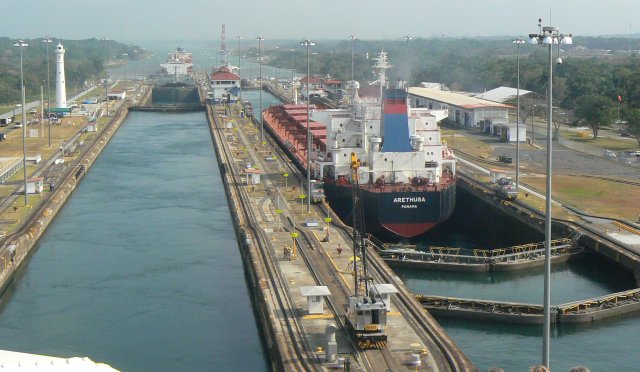
From the Atlantic Ocean, a ship transiting the Panama Canal first passes the port of Colon before entering the three Gatun Locks, each of which have two lanes. The passage of all ships through the locks is governed from the Control House located on the centre wall of three sets of locks, as pictured above looking north towards the Atlantic
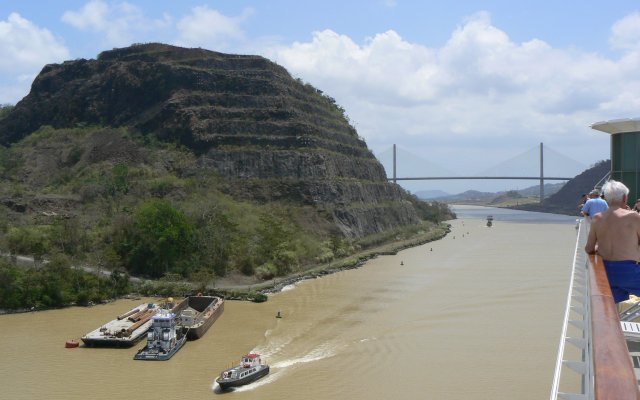
South of Gatun Lock, Gatun Lake is also used as an anchorage for some vessels as two Panamax vessels are not allowed to pass each other further south in the Gaillard (or Culebra) cut further south, although this narrowest section of the Panama Canal is currently being widened. Up to 1914 however, over half the 200 million cubic yards of material excavated to make the entire Panama Canal came from the Gaillard Cut.
As well as images of the Panama Canal itself, Ken's presentation included views of crocodiles and other local wildlife as well as his destinations on the Pacific coast of North America. These included San Francisco with its Golden Gate Bridge, Alcatraz Federal Penitentiary, cable cars, electric streetcars (President's Conference Car trams among them) and a number of ship related museums.

Exhibits at the San Francisco Maritime Museum included the Paddle Steamer Eppleton Hall which used to be based at Seaham in England while aircraft aboard the preserved USS Midway included McDonnell Douglas Phantom II (pictured above) and Grumman Tracker.
Thank you Ken for preparing an interesting and informative evening and thanks also to Ted Tedaldi for presenting the talk in Ken's unexpected absence.
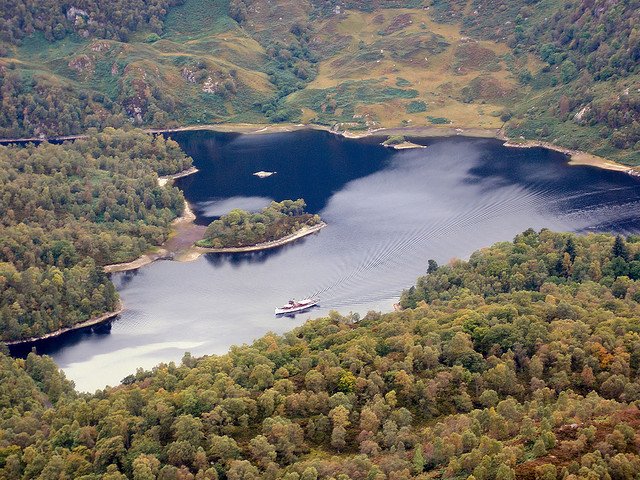
For our February meeting Committee Member Ted Tedaldi gave a Powerpoint presentation on "Shipping in Scotland", starting at Loch Lomond and moving on by car to Loch Katrine ( pictured above) where the 1899 vintage SS Sir Walter Scott. The 9 mile Crinan Canal - saving an 85 mile voyage around the Mull of Kintyre - meanwhile yielded the sight of Clyde puffer VIC 32.
Oban was next visited with sights of the ferry Hebridean Princess and RNLI Trent Class lifeboat 14-23 while Severn Class lifeboat 17-26 was noted at Mallaig.
Ted's excellent adventure then took in the Caledonian Canal, Invergordon and Leith - with interior and exterior views of the former Royal Yacht Britannia - before finishing on the Falkirk Wheel boat lift seen below. We thank Mr Tedaldi for a very enjoyable evening.


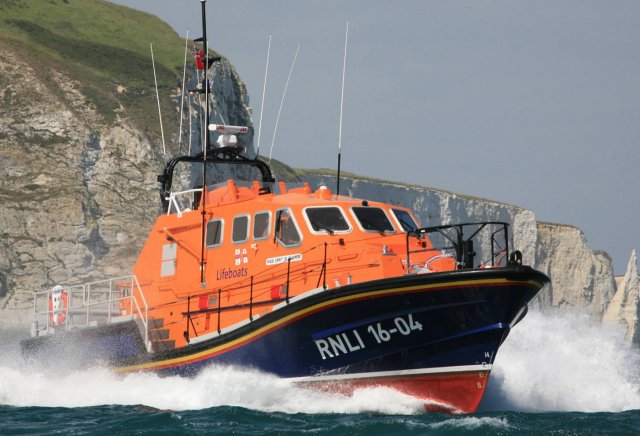
The presentation featured examples of the new Tamar Class lifeboats pictured below as well as vessels specially developed for use on the River Thames, rescues achieved jointly with HM Coastguard and flood rescue work by the RNLI in Cockermouth.
The valuable work of the RNLI Beach Lifeguard service was also explained, most notably as rip tides at a number of popular beach resorts can easily catch the bathing public unaware.
We thank Bruce and the RNLI for a very enjoyable evening.

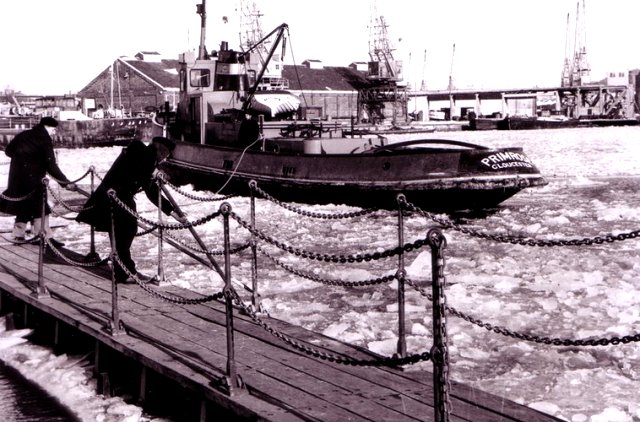
Since he gave us his presentation, Les Dalton passed away after a short illness on 6 June 2012 and he will be sadly missed by all his World Ship Society friends and everyone who knew him. Les was a co-founder of the Gloucester Branch and an active committee member, having served in the Royal Navy during World War II and survived the sinking of HMS Eagle on 11 August 1942 while taking part in Operation Pedestal. A photograph of Les also appeared on page 335 of the June 2012 edition of Marine News.
The World Ship Society Gloucester Branch Annual General Meeting was held in May with Alan Drewett being appointed as a new committee member and all other officials being returned. The annual dinner took place a few days later with 11 members and friends present but the model boat evening at Over had to be cancelled due to rain.
Thanks go to all members and friends who made the 2011/ 2012 season enjoyable, interesting and varied.

E. Finch & Son was effectively Nationalised towards the end of the First World War to create National Shipyard Number One, which built six N-type ships after the Armistice. Each of these ships had a name beginning with the word War but all were soon sold off to foreign operators. As a result these merchantmen served on both sides in World War Two, during which time Chepstow was engaged in building tank landing ships.
Although Dr Firth related that the Welsh border town was gradually turning its back on the "natural motorway" of the River Wye, one of the last major jobs undertaken by the Fairfield Shipbuilding and Engineering Company just east of the railway station was assembly of 88 deck sections for what would become the M4 ( and now M48) Severn Bridge opened in 1966. These were made from stiffened steel plates prefabricated as far away as Glasgow, Darlington and Middlesborough and welded together into 10' deep by 60' long by 104' 6" wide modules. Once given a special protective coating, these sections were launched, tugged out under the cables already linking the English and Welsh towers, manoeuvred into position by a special pusher barge and winched into position. On average only ten tides a month offered suitable condition for these winchings but overall bridge construction went according to schedule.
The meeting also heard about the Beachley shipyard which was developed to mass produce ships but eventually never built anything.
Thank you Naylor for a fascinating evening.


Our October meeting included an illustrated talk by Liz MacDonald who was a member of the crew of the yacht Nuclear Electric which took part in the Brazil-Australia leg of first ever Global Challenge round the World race in 1992/93.
In 1970/71 Chay Blyth - pictured above - became the first person to circumnavigate the World single handed heading west and in 1973/74 captained Great Britain II in the Whitbread Race with a crew from the Parachute Regiment who had no previous yachting experience.
Global Challenge was named after Challenge Business, the company set up by Sir Chay Blyth in 1989, and involved crews of ordinary fee-paying men and women competing in ten identical 67' long yachts - success thus being decided on skill and teamwork rather than technological advantage. The design of the ten yachts began with identifying the largest top-action production winch available, which would in turn dictate sail area, displacement and size.
Known as “The World’s Toughest Yacht Race”, the Global Challenge became the ultimate challenge for amateur sailors with its westabout route around Cape Horn in the face of prevailing winds and currents and the first event - sponsored by British Steel - was won by Nuclear Electric in a time of 151 days 11 hours 49 minutes 11seconds with its skipper John Chittenden later being named Yachtsman of the Year 2001.
The 1996/97 and 2000/2001 Global Challenges were sponsored by British Telecomm, with the first of these featuring fourteen 67' long vessels and the second being contested by twelve new 72' yachts - one of which is pictured below - which also raced again in 2004/2005.
However, after failing to attract a sponsor in 2006, Challenge Business went into administration and the fleets were sold off. As such we are very grateful to Liz for sharing her memories.

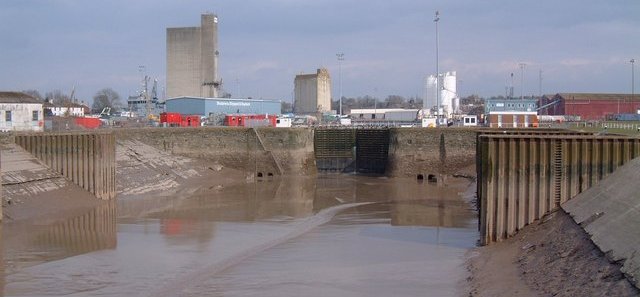
Sharpness Docks developed into its current configuration after a new dock was built in 1874 to accommodate the larger ships then coming into service that were too big to pass up the canal. Prior to this, the old entrance to the canal had no provision for cargo handling, and all ships continued up the canal to discharge at Gloucester.
Warehouses were built beside the New Dock, principally to accommodate imported grain, and new houses were built on the dock estate for key workers. Railway lines around the docks were linked with the Midland and Great Western main lines and provided an alternative to the canal for distributing imports and receiving exports. Sharpness Docks continues as a working port, but most of the old warehouses have been replaced by modern facilities.
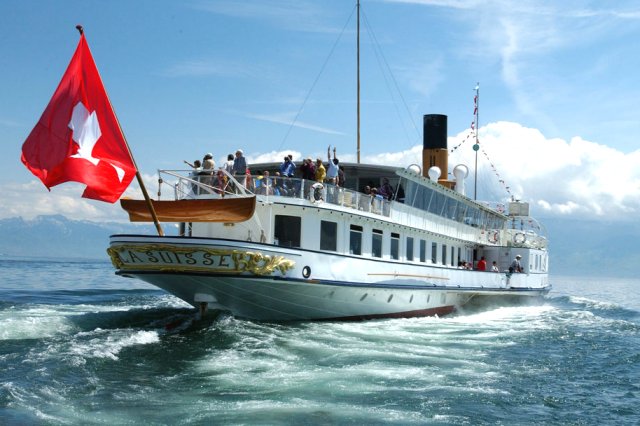
The photographic competition had ten diverse and interesting entries including ocean liners, Tamar lifeboats and the former Aust-Beachley ferry "Severn Princess", each with four prints, and our thanks go to everyone who entered as well as congratulations to Tony Beaman on claiming the Les Tibbetts Memorial Shield.
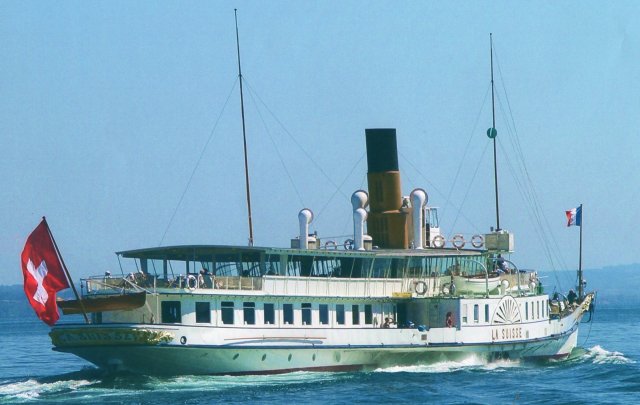
Tony's picture - below - was of La Suisse (also seen above) the side wheel paddle steamer built in 1910 for Compagnie Generale de Navigation by Sulzer Freres of Lausanne - later famous for their diesel engines used by British Railways - and displacing 518 tons with a length of 256' / 78.02m. La Suisse flies both Swiss and French national flags as she plies Lake Geneva.
Thanks go to all who made the evening enjoyable.