| Home | FAIREY DELTA 2 AND THE WINGS OF SPEED |
|
| |
||
 |
||
| |
||
| Fairey Delta 2 WG774 flashes over the top of some classic RAF refuelling vehicles as well as a Bristol Type 170 Mark 32 Superfreighter. | ||
| |
||
| In December 2008 a number of aircraft and other vehicles from the Jet Age Museum Reserve Model Collection and Railway Operating Department were invited to join the "Toys! Toys! Toys!" exhibition at Gloucester Folk Museum. Although these mainly represented the products of the Gloster, Bristol and Westland aircraft companies, the opportunity was also taken to display one aircraft - like some of those featured among the Lost Flying Boats displayed at Cheltenham in October 2008, with raised undercarriage - from a constituent of Westland. It was none other than the record breaking Fairey Delta 2. | ||
| |
||
| THE NEED FOR SPEED | ||
| |
||
| In the first seven decades of the Twentieth Century mankind progressed from stately Zeppelin airships to Moon rockets and following the first flight of the Wright Brothers at Kitty Hawk, North Carolina in 1903, men took to the air in heavier than air machines. Many pilots paid with their lives as they learned the secrets of flight, but soon enough data was available for the aeroplane to be more than a daredevil novelty. Designers could begin to plan for increased payload, range, altitude, agility and above all speed. | ||
| |
||
 |
||
| |
||
| At the World's first flying meeting at Rheims, from 22 to 29 August 1910, Louis Bleriots Type XI monoplane set up a new air speed record of just over 46 mph. Before this meeting, on 25 July 1909, Bleriot became the first man to fly a heavier than air machine across the English Channel. Bleriot took three flying machines to the Rheims meeting and four days later, in a Type XIII, he raised the record to 47.8 mph. The Type XI had a 25 bhp three cylinder Anzani engine. The total weight of the aircraft was 670 lb. | ||
| |
||
| The first aeroplane speed record
was set at 25.5 mph by French based Brazilian Alberto
Santos-Dumond in 1906. In 1910, Louis Bleriot - the first
man to pilot an aeroplane across the English Channel in 1909 -
had raised the figure to 46 mph at the World's first
Aviation Meeting at Rheims and on 29 September 1913 a
Deperdussin racing monoplane with Maurice Prevost at the
controls had reached 126.3 mph. Following the rapid development of fighter aircraft during the Great War, Brigadier General "Billy" Mitchell of the United States Army Air Force reached 223 mph in a Curtiss R-6 racing biplane on 13 October 1922 while in December 1924 Adjutant Bonnet reached 278.5 mph aboard his S.I.M.B. Bernard Ferbois V-2. This monoplane was covered in a highly finished wood veneer to maximise the power available from its 550 bhp Hispano-Suiza engine but was also to be the last French aircraft ever to hold a World Air Speed Record. It was also to be the last landplane to hold a World Air Speed Record until 1939 .The immediate future of the wings of speed was to be on water. |
||
| |
||
| THE SCHNEIDER TROPHY | ||
| |
||
 |
||
| |
||
| The Supermarine S-6B is best known as the outright winner of the Schneider Trophy for Britain in 1931. it was the culmination of a series of seaplanes built for the contest by Supermarine and employed a massive 2 600 bhp Rolls Royce R "sprint" engine, which enabled Flight Lieutenant Stainforth to set up a new World Record of 379 mph. On 29 September 1931, only 16 days after Stainforth's record, a second S-6B flown by Flight Lieutenant Bootham raised the record again, this time to 407.5 mph. | ||
| |
||
| The Schneider Trophy competition
for seaplanes and flying boats was inaugurated in 1913
with the condition that the trophy would be permanently
retained by the first team to gain three successive
victories. By 1931 Britain had won the competition twice
in succession but the British Government, reeling from
the Depression caused by the Wall Street Crash of 1929,
was reluctant to invest any further in the High Speed
Flight of the Royal Air Force. However, thanks to the £
100 000 donation of Lady Houston ( later to finance the
flight of two Westland Wallace aircraft over Mount Everest in 1933 )
Britain's Supermarine S-6B was able to win the Schneider
Trophy outright and go on to set a World Air Speed Record
of 407.5 mph with Flight Lieutenant Bootham at the
controls on 29 September 1931. While the S-6B with its 2 600 bhp Rolls Royce R engine was to evolve into the Supermarine Spitfire, a cousin of its famous opponent the Messerschmitt 109 was to win back the World Air Speed Record for both landplanes and Germany in April 1939 when Flug-kapitan Fritz Wendel took his Messerschmitt 209 to 469 mph. However, the 1000 bhp Daimler Benz powerplant of the Messerschmitt 209 could only carry just enough coolant for the record breaking run but the flight of another special German aircraft that August was to sow the seeds of a whole new chapter in high speed flight. |
||
| |
||
| THE JET AGE | ||
| |
||
 |
||
| |
||
| The Heinkel 178, the World's first jet propelled aeroplane, flew on 27 August 1939 at Marienehe, north Germany. It was a test bed for the He53B turbojet designed by Dr Hans Pabst von Ohain, based on original theories put forward by British inventor Group Captain Frank Whittle, who had been ground testing gas turbine engines since 1937. Britain's first jet propelled aeroplane - the Gloster-Whittle E28/39 - first flew at Hucclecote, Gloucester in April 1941 and could attain 350 mph in level flight. However, the relatively low thrust of early jet engines meant that the first operational combat types on each side of World War Two had twin powerplants. | ||
| |
||
 |
||
| |
||
| The Messerschmitt 262 was the World's first operational swept wing jet fighter. First flown in April 1941, its service career did not get under way until mid 1944. With its four heavy canon and speed of 540 mph, the twin engined Me 262s were truly formidable opponents. Initial German government disinterest resulted in slow development and production. Also, Hitler's personal directive that they were to be used only as bombers greatly softened the impact which even the few aeroplanes in service would otherwise have had on the Allied bomber offensive. Less than 1500 were built. | ||
| |
||
| The German Messerschmitt 262 first flew in the same month as the Gloster-Whittle E28/39, packed four heavy canon and could reach 540 mph, due in part to its revolutionary swept wings. High speed propeller aircraft as the Hawker Typhoon had already experienced the phenomenon of compressibility as shock waves formed over their wings as they approached the speed of sound ( 760 mph at sea level but varying with altitude and air temperature) This compression of air molecules - unable to pass over the wing aerofoils fast enough to escape the oncoming aircraft - caused the aircraft to buffet to such an extent that the pilot could lose control. However, German engineers discovered that compressibility could be postponed by sweeping the wings back and presenting a more streamlined profile to the airflow - effectively making the swept wing the equivalent of a thinner, deeper straight wing. | ||
| |
||
 |
||
| |
||
| Luckily for the Allies, Nazi disinterest in jet propulsion meant that the first Messerschmitt 262s did not reach squadron service until August 1944, just two weeks ahead of the first Gloster Meteors being issued to 616 Squadron Royal Air Force. By this time too, German industry was so desperately short of raw materials that the Junkers Jumo engines of the Me 262 were often unreliable. Thus it was that the first World Air Speed Record of the Jet Age went to a straight winged Gloster Meteor IV named "Britannia" flown by Group Captain H.J. Wilson AFC on 7 November 1945 at Herne Bay, Kent. His speed of 606 mph was also the first to exceed 600 mph and at the time the Gloster Meteor was only the second twin engined aircraft to set a World Air Speed Record, the other being the Schneider Trophy contending Macchi-Castoldi MC 72 monoplane of 1934. Single engined Gloster biplanes had also taken part in Schneider Trophy competitions in the 1920s and 30s. | ||
| |
||
| STAR SPANGLED SPEEDSTERS | ||
| |
||
 |
||
| |
||
| In 1945 the Douglas company designed a research aircraft to obtain high speed data. After completing only 14 hours flying time, the Skystreak piloted by Commander Turner F. Caldwell of the US Navy achieved 640.5 mph to win the World Record. Five days later, on 25 August 1947, Major Marion F. Carl, US Marine Corps, raised it again, this time to 650.5 mph. The aircraft shown is in the shape used for the first attempt. A modified canopy and windscreen was fitted for the second attempt. | ||
| |
||
| Meanwhile, the end of World War
Two found the aircraft industry of the United States of
America untouched by bombing and with access to a wealth
of new British and German aeronautical data as well as
the financial power to turn these ideas into reality. One
such result of this American good fortune was the Douglas
D-558-1 Skystreak which Major Marion F. Carl of the US
Marine Corps took to a new record of 650.5 mph on 25
August 1947. Then, on 14 October 1947 Captain Chuck
Yeager of the US Army Air Force became the first pilot to
break the Sound Barrier at a speed of 670 mph at 42 000
feet in his Bell X-1 "Glamorous Glennis". The high speed single-seat aircraft of both Douglas and Bell used thin, deep straight wings but while the D-558-1 Skystreak took off from a conventional runway powered by a jet engine, the X-1 was dropped from a high altitude B-29 bomber and was rocket powered. This latter approach to high speed research was to lead to on to the spacegoing X-15 programme and to NASA's Space Shuttle, but the next round of the World Air Speed Record in terms of jet aircraft taking off, flying and landing under their own power was to be a Transatlantic clash of fighters. |
||
| |
||
| COLD WAR, HOT EXHAUSTS | ||
| |
||
 |
||
| |
||
| On 15 September 1948, thirteen months after the record flight of the D-558-1 Skystreak, Major Richard L. Johnston of the United States Air Force flew a North American F-86 Sabre at a speed of almost 671 mph while on 16 July 1953 Lt Col William J. Barnes, USAF, took the later D model Sabre ( with air interception radar in a bullet fairing in the nose ) to 715.75 mph. Like the the Messerschmitt 262, the single engined Sabre had swept wings set low on its fuselage - a design format that was to unite many of the World Air Speed Record Holders of the early 1950s. | ||
| |
||
 |
||
| |
||
| On 17 September 1953 the World Air Speed Record was brought back to Britain by Squadron Leader Neville Duke who reached 727.5 mph in a unique Mark 3 variant of the Hawker Hunter designed by Sir Sidney Camm . The sharp-nosed overall red Hunter was powered by a Rolls Royce RA7 turbojet fitted with an afterburner, allowing jet fuel to be injected into the hot exhaust and so add a rocket-like thrust to the aircraft. | ||
| |
||
 |
||
| |
||
| However, Duke's Hunter record was beaten as soon as 28 September 1953 by a Mark 4 Swift, another swept wing fighter powered by a Rolls Royce RA7 turbojet fitted with an afterburner. The Swift, built by Supermarine, the company responsible for the Spitfire, had been ordered by the British Air Ministry as a back-up for the Hunter development programme but while the Hunter went on to a long RAF career, export success and private preservation the Swift only equipped a handful of RAF squadrons. It did however, along with the Supermarine 508, provide the basis for the Supermarine Scimitar naval bomber. Back in 1953 though, Lt Cdr Mike J. Lithgow's Mark 4 Swift reached 735.5 in the skies over Libya where temperature and calm air conditions were optimum for supersonic flight. | ||
| |
||
 |
||
| |
||
| After Britain's miracle month of September 1953, the World Air Speed Record was back in American hands on 30 October 1953 when Lt Cdr James B. Verdin reached 753.5 mph in the skies over the California desert at the controls of the prototype Douglas XF4D-1 Skyray. This naval fighter was also the first aircraft with delta wings ( a concept originally developed in Britain ) to hold the World Air Speed Record and for the attempt was specially fitted with an afterburning Westinghouse J40-WE-8 rather than the standard production Pratt and Whitney J-57. | ||
| |
||
 |
||
| |
||
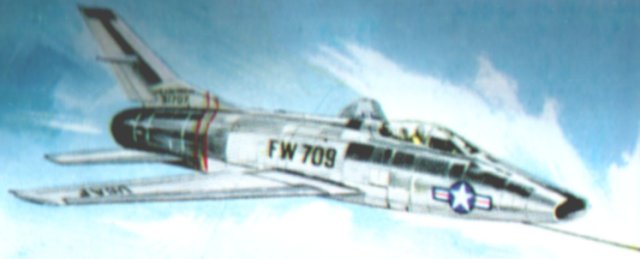
| The United States consolidated its grip on the World Air Speed Record with the North American F-100 Super Sabre, which exceeded the speed of sound on its first test flight. The successor to the F-86 Sabre then set the first official supersonic record of 822.26 mph on 20 August 1955 piloted by Colonel Horace A. "Dude" Hanes. However, Britain had one more speed ace up its sleeve. | ||
| |
||
| FAIREY DELTA 2 | ||
| |
||
 |
||
| |
||
| On 10 March 1956 Peter Twiss OBE, DSO and Bar, recaptured the World Record for Britain on the 15 / 23 km course between Ford and Chichester in the Fairey FD2. This was the first record set up at great height - 38 000 feet - which meant the use of accurate measuring and recording equipment. It was, in fact, the first time the record exceeded 1 000 mph under rigorously controlled conditions. | ||
| |
||
| In the late 1940s, with the Miles
M52 straight-wing jet cancelled by the Labour Government,
Britain was trailing far behind in supersonic aircraft
design. To try to retrieve matters the Ministry of Supply
issued specification ER 103 for a supersonic research
aircraft, and the Stockport based Fairey company set
about meeting this with a delta-winged aircraft designed
for investigation into flight and control at transonic
and supersonic speeds. The sole Fairey Delta 1 - VX350 - had begun life as a zero-feet-launch interceptor project and would have had a small but very powerful Rolls Royce turbojet to lift it off a ramp, efflux gases passing through steerable nozzles under the tail to provide control until the 19'6" span wings could generate aerodynamic lift. Once the ramp fighter idea had been abandoned however, VX350 spent a useful career testing different tail and control configurations for transonic speeds. The two much larger Fairey Delta 2s were powered by afterburning Rolls-Royce Avon RA.14R 200 series engines. Unlike the FD1, they had wing root air intakes either side of very long, sharp noses. To improve the pilot's forward view during landing, taxiing and take-off, the cockpit and nose section could be hinged downwards by ten degrees: a similar arrangement to that eventually used on Concorde. The contract, which was the last fixed-wing type to be designed and built by Fairey, was placed in October 1950 and allowed for the development of two aircraft, WG774 and WG777. There was also a static test airframe. However, as the relatively small company was committed to building Fairey Gannet anti-submarine turboprop aircraft for the Royal Navy, Faired Delta 2 production did not commence until 1952. Fairey Test-Pilot Peter Twiss first flew WG774 on 6 October 1954 although disaster nearly struck on the fourteenth of 400 proving flights, made in November 1954 from Boscombe Down in Wiltshire. Prior to take off, a loose rubber sealing strip had been removed from between one intake and the fuselage to prevent it being sucked into the engine. However, as Twiss climbed to 30 000' high pressure air entered the fuselage through the hole left by the removed rubber seal, collapsed a rubber expansion tank in the fuel system and jammed the valves, cutting off fuel to the engine. Without engine power to pressurise the system too, Twiss only had residual hydraulic power to move the controls but, like Gloster's Test Pilot Bill Waterton with Javelin WD804 at Boscombe Down on 29 June 1952, he resolved to save WG774 rather than eject. This he managed to do, but due to the main landing gear not extending damage to the Fairey FD2 took eleven months to repair. The effort was worthwhile however as Twiss, awarded the Queen's Commendation for Valuable Service in the Air, was to write in his 1963 book "Faster than the Sun": "If ever the Delta had to justify herself to me after the crash, this wonderful little aircraft did so that morning when she flew as gently as a bird into the hard supersonic October sky. From that moment, I knew we had a world-beater." The idea of a record attempt occurred to him after the Fairey Delta 2 effortlessly passed the sound barrier without using full power or reheat. The Ministry of Supply however only reluctantly allowed "their" aircraft to be used and only at the expense of Fairey - a very different reaction from the official support given to the RAF's High Speed Flight Meteors just ten years earlier. However the RAF co-operated and their south coast radar stations were used to guide the Boscombe Down based aircraft along the shortest route to the starting gate, this being essential as the colossal fuel consumption using the afterburner limited the endurance severely. Thus in early March 1956 several attempts were made on the World Air Speed Record, but although the aircraft flew amply fast enough in each, the telephoto cameras could not catch the high altitude aircraft over the start and end lines of the measured course at the right instant, such images being necessary for ratification. Only on the eighth attempt was all successful enough and Twiss officially broke the record by more than 300mph. The nine mile course was along and just inland of the English south coast at 38 000 feet, centred on Portsmouth and Chichester. This altitude was chosen for both optimum conditions for supersonic flight and to allow the contrail of the Fairey FD2 to be clearly visible. This new record at 1132mph was a significant achievement considering the old record had only been set the previous year and was so much slower. Fairey Delta 2 WG774 was also the first manned vehicle to exceed 1 000 mph, just 52 years after the first 100 mph record had been set by Great Western Railway steam locomotive "City of Truro" and just 13 years before Apollo 10 would set a so-far-unbeaten manned vehicle speed record of 24 791 mph returning from the Moon on 26 May 1969. Following the de Havilland Comet and DH 110 and Bristol Britannia airliner crashes just a few years earlier, Peter Twiss received much positive media coverage for his achievement - as well as an OBE in 1957 - and "Dude" Hanes cabled his congratulations following those of Prime Minister Anthony Eden and The Queen. The Ministry of Supply however did not want any further FD2 development because of their supersonic bangs ( which caused may broken windows and a threatened £ 16 000 lawsuit from one irate market gardener!) and also because - even before the publication of the 1957 Duncan Sandys Defence White Paper - the age of the fighter was considered by the Minister of Supply Reginald Maudling to be over. In October 1956 an FD2 went to Cazaux near Bordeaux for a month of low flying trials, hosted by Dassault and the French Air Force. This revealed that supersonic bangs were no more intense from 5000 feet and indeed were heard over a much smaller area. However, it was found that the hydraulic flying controls needed strengthening and after modifications back home, months of testing at slower speeds followed. The political situation in France prohibited a return for low level supersonic testing and the embargo continued at home. Thus it was not until July 1958 that the necessary tests were conducted in Norway, Twiss having flown an FD2 across from Newcastle to hand over to Sqdn. Leader J.O. Matthews to conduct the testing. Twiss was also employed on the development of both the Fairey Gannet and Rotodyne but in March 1959 when Fairey was taken over by Westlands the Yeovil based firm did not choose to develop FD2 and the aircraft was handed over to R.A.E. Farnborough. After flying careers that influenced the wing designs of both the Dassault Mirage series and Concorde both WG 774 and WG 777 were preserved - although not before they developed and contributed even more to the understanding of flight. |
||
| |
||
| FROM FAIREY DELTA 2 TO BAC 221 | ||
| |
||
 |
||
| |
||
| Under the terms of Experimental
Requirement ER193D WG774 was rebuilt by the Filton
Division of the newly formed British Aircraft Corporation
in support of the Concorde development programme. The
most noticeable modification was a new untried wine-glass
shaped "ogive" wing with a new engine inlet
configuration underneath it feeding air to a Rolls-Royce
Avon RA.28 power-plant. The vertical stabiliser was also
modified - including a fairing at the top of the tail for
a cine camera - the fuselage was extended by six feet
between the cockpit and the engine intakes, and a new
lengthened undercarriage simulated Concorde's attitude on
the ground. The original "droop snoot" was also
made fully controllable - rather than simply being
positioned up or down. Less visible new features included increased fuel tankage and redesigned electric and hydraulic systems as well as an Elliot autostabilisation system used to simulate certain unstable conditions during flight tests. The "new" aircraft was renamed the BAC 221 and was re-flown on 1 May 1964 from Filton by Bristol’s Chief Test Pilot Godfrey Auty. By this time the construction of Concorde was already well underway so the BAC 221 was too late to really give any input to the wing design process. However WG774 was used for other tests until retirement in 1973 after 273 flights is now preserved at the Fleet Air Arm Museum, Yeovilton. |
||
| |
||
| WG 777 - THE OTHER FAIREY DELTA 2 | ||
| |
||
 |
||
| |
||
| Always overshadowed by its more famous sister, the second Fairey Delta 2 WG777 first flew on the 15 February 1956 from the Aircraft & Armaments Experimental Establishment, Boscombe Down and during the 25 minute flight went supersonic. Through out its working life WG777 was mainly used for research and trails work and on 31 May 1957, during a low-level supersonic run at 10,000ft over the Wash, WG777 reached Mach 1.15. On 18 June 1957 WG777 reached Mach 1.25 at 10,000 ft and in the following November, while involved in flights for partial glides and associated airbrake angles, drag measurements and induced drag research, Mach 1.6 was reached. In February 1961 Mach 1.64 was attained at 32,000 ft. On 8 June 1966 WG777 flew as supersonic chase aircraft for WG774 (by then rebuilt as the BAC.221) before being released from trials use after 429 flights on the 27 June 1966 with a total of just over 198 hrs of flying time on the clock. The Avon engine was removed on the 29 November 1966, spares recovered and the airframe was then stored at R.A.E. Bedford until 8 September 1967 when WG777 was transported by road to the station museum at RAF Finningley before finally arriving at RAF Cosford in April 1973. | ||
| |
||
| AWAY WITH THE FAIREYS? | ||
| |
||
| Had the Duncan Sandys Defence
White Paper - insisting that manned fighter aircraft had
been supplanted by rocket propelled missiles - NOT been
heeded by the British Government of 1957, Fairey's might
have developed their record-breaking Delta 2 design. The Stockport based firm's ER.163B project would have seen the FD2 fuselage modified to accept a Bristol Siddeley Gyron turbojet or a Rolls Royce RB.122 while the more advanced ER.103C specification featured a yet more powerful engine ( with possible high altitude rocket boost ), airborne interception radar and two Firestreak air to air missiles on the tips of its increased area wings. This aircraft would have been able to reach 44 000 feet in less than 2 minutes with a top speed of Mach 2.26 On 15 January 1955 the Air Ministry F-155T specification was released for an interceptor capable of destroying enemy bombers approaching at Mach 1.3 at 58 000 feet. The new two-seat aircraft - to be in RAF service by January 1962 at the latest were to have no guns but AI.18 air interception radar and two types of missile capable of working at 71 000 feet: one an infra-red heat seeker and the other with radar guidance The infra red missile, developed by de Havilland, was to be named Blue Vista but the radar guided missile - developed by Vickers from its existing Red Dean and named Red Hebe - turned out the be too large and heavy for the proposed specification F-155 T. Among the contenders for
F-155 T were the Whitworth Armstrong Aw-169, De Havilland
DH-117, English Electric P.8, Hawker P.1103, Saro P.187,
Avro 729 and Vickers 559. Had the FD3 survived to the metal cutting stage however the fuselage centre section and the wings would have been made of stainless steel while other parts of the plane, where thermal resistance had a greatter importance than resistance and rigidity, were to have been manufactured out of titanium. |
||
| |
||
| THE NAME IS TWISS, PETER TWISS. | ||
| |
||
 |
||
| |
||
| Born on 23 July 1921 at Lindfield, Sussex, Lionel Peter Twiss was educated at Sherbourne School. As a boy he had
an interest in birds which later developed into an
interest in flight. After a brief career as a tea taster for Brooke Bond
and as a farmer he joined
the Fleet Air Arm as Naval Airman second class at the outbreak of War
1939. After training at 14 Elementary and Reserve Flying Training School at Castle Bromwich and Yeovilton, Peter Twiss initially flew target tugs in Orkney before being assigned to the Merchant Ship Fighter Unit piloting catapult launched Hawker Hurricanes to protect convoys. In 1942 however he flew Fairey Fulmars with 807 Squadron from HMS Argus on escort missions protecting the convoys to Malta during Operation Harpoon. When he was 21 Twiss received the DSC (Distinguished Service Cross) for these operations, during which he shot down an Italian fighter and damaged a Fascist bomber. During "Operation Torch", the Allied landings in Morocco and Algeria in late 1942, his bravery in Supermarine Seafires flown from HMS Furious was again recognised, and a bar to his DSC was awarded in March 1943. After completing his part in Operation Torch, Peter Twiss served with a British based night fighter interceptor unit and then from 1943 to 1944 was Night Fighter Representative with the British Air Commission in Washington DC. During this time he travelled all over the United States, flying various operational and prototype American fighter aircraft - including the jet propelled Bell Airacomet - and investigating night fighter radar equipment. He also served for a time at the US Naval Test Centre at Patuxent River, Maryland, either side of flying long range intruder raids over Germany from Ford Naval Air Station, Sussex, to help develop night fighter with the RAF's Fighter Interception Unit. By the end of hostilities he had reached the rank of Lieutenant Commander and had joined first Number 3 Empire Test Pilot's School and then the Naval Squadron at the Aeroplane and Armament Experimental Establishment at Boscombe Down, Wiltshire. In 1946, Peter Twiss joined Fairey Aviation eventually became company chief test pilot and was to fly such types as the Fairey Delta I, Primer, Gannet, Firefly and the Fairey Rotodyne compound helicopter, which in 1959 established a world speed record for rotorcraft at 305.93 mph. By this time, Peter Twiss had flown more than 140 different types of aircraft and had probably piloted more high performance examples than any other Englishman. He had also won the High Speed Handicap race in the International Air Races at Lympne, Kent, in 1947 flying a Fairey Firefly IV at a speed of 305.93 mph and took part in deck landing trials of all Fairey aircraft from 1949. In 1959 Fairey Aviation was sold to Westland Aircraft and in 1960 Peter Twiss joined Fairey Marine, where he was responsible for the development and sale of the companies fast day cruisers. As his wife Jane put it: "He decided after leaving the Navy that he didn't want to become a commercial pilot because that would be a bit boring for him: he said it would be like driving a bus, which is why he followed the marine side. He was definitely a man of speed." In 1969 Twiss also took part in the Round Britain Powerboat Race driving a Fairey Huntsman 707 Fordsport. He was a director from 1968 to 1978 and then director and General Manager of Hamble Point Marine until 1988. Peter Twiss also appeared in the Bond film "From Russia with Love" driving a Fairey Marine speedboat and also in the film "Sink the Bismark" where he flew a Fairey Swordfish torpedo bomber. During his flying career he had flown over 4 500 hours in 148 different aircraft types and in retirement spent many hours with Lasham Gliding Club. Lieutenant-Commander Peter Twiss died on 31 August 2011 aged 90. |
||
| |
||
| HIGHER AND FASTER | ||
| |
||
 |
||
| |
||
| The reign of Peter Twiss was the fastest jet pilot in the World ended on 12 December 1957 when USAF Major Adrian Drew took the twin engined McDonnell F-101A Voodoo to 1207.5 mph at Edwards Air Force Base, California. Apart from a brief journey to the USSR in the autumn of 1959, the World Air Speed Record would stay in America for the next half century. | ||
| |
||
 |
||
| |
||
| Then, on 16 May 1958, USAF
Captain Walter Irwin piloted a Lockheed F-104 Starfighter
to 1404 mph, just nine days after another Starfighter had
set up a World Altitude Record of 91 249 feet. Like the Douglas D-558-1 Skystreak of a decade earlier, the F-104 used thin, straight wings - a design that was to prove efficient at both low and high speeds for such a tubular "manned missile" fighter. A similar shape would also be used on the successor the the Bell X-1, the North American X-15. Once again dropped from a strategic bomber - this time the Boeing B-52 Stratofortress - the X-15 would eventually fly at Mach 6.72 ( 4 534 mph ) and reach an altitude of 67 miles ( earning "Astronaut Wings" for its pilot ) by 1967. |
||
| |
||
 |
||
| |
||
| However, the X-15 had to do more
than merely fly very fast and high. Above Mach 2,
aircraft encounter the so-called Heat Barrier - a
phenomenon caused by friction between the aircraft itself
and the particles of air it passes through. Even the
leading edges of the wings and tailplane of the
nickel-alloy steel built X-15 glowed red at maximum
velocity despite operating at the most rarefied edge of
the Earth's atmosphere. The Heat Barrier was one aspect of the development of larger supersonic aircraft that was scheduled to be investigated by the Bristol 188 research aircraft and also one of the stumbling blocks in the programme to develop an American Mach 2.7 supersonic passenger transport. Cost considerations apart, engineers working on the swing-wing Boeing 2707-300 could not overcome the challenge of keeping cabin temperatures down to acceptable levels. In the Anglo-French Concorde, tested at Fairford in Gloucestershire and based on information gained from the Fairy Delta 2 - in both original and BAC 221 guise - fuel was pumped around the cabin walls to exchange heat while the Lockheed SR-71 Blackbird - regularly flown at Mach 3 and reaching over 2 200 mph in 1976 - required a special high-flashpoint waxy fuel to perform in such extreme conditions. |
||
| |