2007
marks the centenary of helicopters - with some interesting
Gloucestershire connections!
THE
EARLY DAYS
Paul
Cornu's primitive helicopter makes an early tethered proving flight.
This image is from card 6 of the Brooke Bond tea "History of Aviation"
series of the early 1970s.
Russian-American
aircraft designer Igor Sikorsky once said that " the idea of a vehicle
that could lift itself vertically from the ground and hover motionless
in the air was probably born at the same time that man first dreamed of
flying."
Although a rotary winged
toy appears in a 14th Century Flemish document now preserved in
Copenhagen, it was in 1907 that two French teams - one led by Paul
Cornu and another jointly by Louis Bregut and Professor Richet - both
proved that helicopters were - just about - a practical reality.
Cornu's machine used two rotors belt-driven from a central 24 hp engine
to rise one foot in the air for 20 seconds near Liseux on 13 November
1907.
However, both these
machines were heavy, underpowered, unreliable and unstable and when the
Gloster Aircraft Company (GAC) tried to build a helicopter of their own
in the late 1920s they did not fare much better. In a 1955 edition of
the GAC staff magazine "Pinion" works engineer Mr A. K. Laverton
recalled the machine "as looking like a tin shed with horizontal paddle
wheels on top." The tin shed did actually heave itself into the air,
but was grossly underpowered. A more powerful engine was then installed
and then, according to an eye witness, the craft "Rose rather
unsteadily, finally rolling over on one side when one of the rotors
caught in an overhead roof girder; and the machine was left suspended
from a tangle of rotor and shafting".
Early helicopters faced
the twin problems of the fuselage spinning in the opposite direction to
a single rotor and of directing the craft up, down, forward and
backward. Russian designer Boris Yuriev first proposed a small vertical
rotor mounted on the tail to stop spinning in 1912 while Argentinian
designer Raul Pateras de Pescara discovered rotor blade pitch variation
and cyclic control.
PARNALLS
AND THE AUTOGIROS
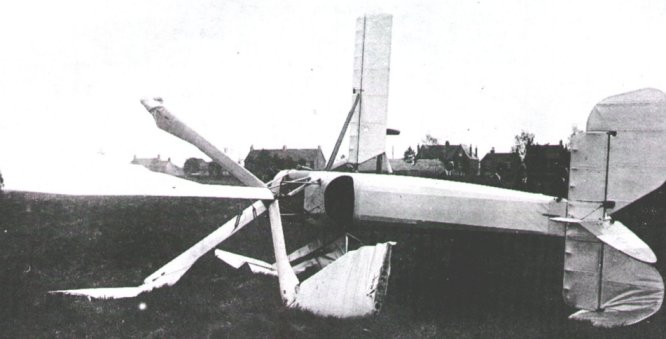
Parnall's experimental military C10 ( RAF serial J
9038) had a 30' diameter rotor.
Meanwhile,
the 1920s - when Gloucestershire stretched right down to Bristol - also
saw Parnalls of Yate more successfully involved with another kind of
rotary winged flying machine - the Cierva Autogiro. First flown at
Getafe, Spain, in 1923 after three years research into the various
problems involved, Don Juan de la Cierva's Autogiro C.4. became the
first rotary winged aircraft to find wide practical application.
Since the single
pylon-mounted rotor was not directly driven by the engine ( which was
mounted conventionally at the front to provide forward thrust ), but
needed wind blowing through its four blades, the C.4. could not take
off vertically but could land in a very small space. However, the
freewheeling rotor of the Spanish aviator's machine meant that it could
hover slowly and - unlike a single rotor helicopter - did not require a
tail rotor to balance the torque applied to the horizontal blades
through a driveshaft from an engine.
Juan De La Cierva himself wrote an article for the
U.S. Services magazine " Wings of Tomorrow" in which he described the
handling of his invention:
"The take off in itself is effected exactly like
that of an aeroplane. One may dive and climb at will, make vertical
turns, and so on. The autogiro flies exactly like any aeroplane. The real
sensation that I experienced was in landing. Cutting off the motor
1,000 feet directly over the field, I pulled the stick back and
proceeded to fly, on my first landing, about thirty miles an hour
coming into land. The descent was about an angle of 45 degrees and on
touching the ground I did not roll more than ten feet without any
application of the wheel brakes whatsoever. I took off again and landed
to become accustomed to this strange craft. It intrigued and thrilled
me. I now had enough experience to attempt a more vertical
descent.....it is quite a sensation for a pilot who has been flying a
fast aeroplane that lands between 60 and 70 miles an hour and that must
be manoeuvred carefully into a field, making sure his judgment is
accurately managed, to step into a machine and fly right over the
centre of the field, shut off his motor and then drop right straight
down into the circle which marks the centre of airport."
Juan De La Cierva had cured the tendency of the
Autogiro to roll over in flight in 1922 by incorporating a flapping
hinge for each blade. This produced greater lift as the advancing blade
automatically moved up with increasing airspeed, but movement of air
relative to the blade was changed, angle of attack reduced and lift
decreased. Simultaneously an opposite process was working on the
retreating blade, resulting in lift forces on all blades being
balanced, thus rendering the system stable.
Following Juan De
La Cierva's move to Britain in 1925 and the formation of the Cierva Autogira Company in
Britain during 1926 some early Cierva machines used an Avro 504
fuselage with the rotor replacing the upper wing of the biplane. These
were assembled at A.V. Roe's Hamble works, but two machines - the
Cierva C10 and C11 - were ordered from George Parnall & Co and
completed in 1927.
The experimental
military C10 ( RAF serial J 9038) had a 30' diameter rotor with four
paddle shaped blades, the outer portions of which were built up on a
ribbed aerofoil section. The fixed rotor head, supported by struts and
bracing wires, was located above the forward fuselage in front of the
open cockpit which had no windscreen. Braced 17' span stub wings were
fitted to the lower front fuselage with the aeroplane type tail unit
having a rounded fin and rudder with rectangular horn balanced
elevators. A cross axle type fixed main landing gear and long tailskid
were also provided, with power coming from a 70 hp Armstrong Siddeley
Genet I radial engine applied through a two bladed wooden propeller.
Taxiing trials began at
Yate in April 1928, but the autogiro was badly damaged after turning on
its side. Repairs were carried out and further test made at Andover,
but on 5 November 1928 J 9038 crashed on takeoff and was abandoned.
J9038 was badly damaged after turning on its side
during taxying trials at Yate in 1928.
Parnall's
C11( works number P1/5281) - also known as the Parnall Gyroplane - bore
the civilian identity G-EBQG and featured a Harold Bolas designed
airframe with twin open cockpits behind a neatly cowled 120 hp V8 ADC
Airdisco engine. At 1800 rpm the Airdisco engine could give the
Gyroplane a speed of over 100 mph and its 2:1 ratio gearing made a
highly efficient four bladed propeller rotate at 900 rpm. G-EBQG also
crashed at Yate - with Juan de la Cierva himself at the controls -
apparently because the rotors did not generate sufficient lift at
takeoff. Parnall designer Harold Bolas was convinced the problem lay in
ground resonance - a form of sympathetic vibration - but despite
rebuilding with a redesigned pylon and geared drive shaft - capable of
spinning the rotor before takeoff - G-EBQG finished life as an
instructional airframe with Air Service Training at Hamble.
JUAN
DE LA CIERVA'S LEGACY
Sadly
the time of the Autogiro had not yet come. For the same engine power a
conventional biplane of the day could offer significantly more speed
and payload while still landing in and taking off from a small meadow. Sadly
Don Juan De La Cierva was
killed at Croydon in the take off crash of a KLM DC-2 PH-AKL on 9
December 1936 and after this set back the development of the Autogiro
gradually came to an end. However, during 1933 he had successfully
geared an Autogiro engine to its rotor and made the first successful
"jump start" - paving the way for helicopter pioneers such as Louis
Breguet in France, Heinrich Focke in Germany and Russian émigré Igor
Sikorsky in the United States.
Cierva Autogiros C.24 ( G-ABLM ) and wingless C.30A ( G-ACWP ) - built
by Avro at Newton Heath, Manchester - are preserved within the Science
Museum collection.
AUTOGIROS
AT STAVERTON
G-ACIN
was one of the first C.30 Autogiros and had a simple design of
undercarriage. It was also the subject of Britain's set 1392 ( below ),
a good condition boxed example of which sold for £ 1 800 at Christies
in June 2006.
A. V. Roe built Cierva C30 Autogyro
G-ACIO was used by the Metropolitan Police to monitor the 1935 FA Cup Final in
which Sheffield Wednesday beat West Bromwich Albion 4-2 at Wembley Stadium.
A year earlier G-ACIN had also been used by the Metropolitan Police - under the
leadership of RAF founder Lord Trenchard from 1931 to 1935 - to monitor opposing
Communist and Fascist rallies in Hyde Park. Despite its radio equipment
not working properly, the mere presence of the autogyro above the mutually
hostile crowds on 9 September 1934 kept public order arrests to a minimum.
Sir
Alan Cobham, as part of his flying Circus, flew an Avro built Cierva
C.30 Autogiro - powered by a Genet Major 1A 140 bhp engine -registered
as G-ACYH at Down Hatherley in 1935.
The C.30 Autogiro was
also used by the Royal Air Force ( where it was known
as the Avro Rota 1 ) from
1936 and went to war in 1939 for use in calibrating British radar
stations on the east coast.
One of these machines,
HM580, formed part of the Skyfame Museum at Gloucestershire Airport, Staverton, from
1964 to 1978.
It had been built by the
RAF during 1941-2 using spare parts recovered from private civilian
owners of the type ( all civil flying having been banned and private
aircraft impressed into RAF service following the outbreak of
hostilities ) and from parts supplied direct by the manufacturers.
Much of the content of
HM580 came from C.30 Autogiro G-ACUU which had been registered to Air
Service Training at Hamble on 26 June 1934. On 2 May 1938 G-ACUU went
unserviceable and the Certificate of Airworthiness ( C of A ) expired.
It remained in storage until impressed into RAF service on 2 September
1942.
HM580 was taken on
charge with 74 Wing at Duxford on 9 September 1942 and gained the code
"KX-K" on joining 529 Squadron (formerly 1448 Flight) at RAF Halton on
23 June 1943. It then suffered what was at first considered a "Category
E" accident when Pilot Officer Fillies crashed on landing in bad
weather at Thornaby on 18 October 1943. The pilot was unhurt and later
examination found the damage to be repairable. HM 580 was in fact
repaired by Cunliffe-Owen aircraft of Eastleigh.
HM580 was back in
service with 529 Squadron on 24 January 1944 - staying with them after
the unit's move to Crazies Hill near Henley in August 1944 - and on 26
November 1945 became the last Avro Rota ever to fly with the RAF when
it arrived at 5 Maintenance Unit, Kemble, Gloucestershire, for storage
pending sale. All ex RAF Avro Rota / Cierva C.30A autogiros similarly
passed through 5 Maintenance Unit, Kemble en route to being "demobbed".
HM580 was restored to civilan ownership and
re-registered to the Cierva Autogiro Company Ltd of Swaythling,
Southampton, on 3 December 1946 as G-ACUU. This was despite an initial
allocation of the identity G-AIXE, the original G-ACUU having been
allocated to constructor's airframe number 726 between 1934 and 1938.
G-ACUU was sold to Mr Guy Spencer Baker of Ludlow,
Salop, on 29 April 1950, to replace his C.30 G-AIOC which had been
wrecked at Rearsby on 10 June 1949
After being displayed by him at the 50 years of
flying exhibition held at Hendon in 1951, Mr Baker moved G-ACUU to
Elmdon - now Birmingham International Airport - in 1956 before it
ceased flying there in April 1959.
In fact Elmdon was quite abuzz with Autogiros in
the 1950s. A
company by the name of Rota Towels Ltd operated at least two of them
including G-AHTZ which had a rather tragic demise when it turned over
and caught fire right in front of the then Lord Mayor of Birmingham on
4th March 1958. This aircraft was formerly G-ACUI of the Autogiro
Flying Club and served in the RAF as HM581.
G-ACUU - formerly
HM580 - poses with Skyfame's
Hawker Tempest
At Skyfame, G-ACUU
was displayed in an all over silver scheme with mid-blue undercarriage
legs, tail plane struts, rotor pylon, spinner and lettering. The rotors
were silver with yellow tips. This yellow was repeated on the bare
metal tips of the propeller.
Sadly the Skyfame Museum closed at the end of the
1970s and the preserved G-ACUU went to the Imperial War Museum at
Duxford where it remains to this day in the military guise of HM 580
with the code "KX-K".
Initially HM 850 was repainted in an early wartime
scheme with a yellow underside that would have applied to Duxford based
rotorcraft before it was created. In 2001 however a more correct
all-over camouflage livery was applied, although the squadron code KX-K
should have been in larger letters and coloured dark red instead of the
light grey used.
In contrast, the ex Shuttleworth C.30A G-AHMJ (RAF
serial K4235 with the code KX-B) was sold to Kermit Weeks of the United
States in November 1998 and will probably never be seen in Britain
again.
However, there was another
remarkable C.30A Autogiro connected with Staverton in the 1960s, 70s
and 80s that happily has remained not too far away from Gloucestershire.
The Cierva C30A with the
A.V. Roe Newton Heath construction number 715 was first registered as
G-ACWM on 24 July 1934. It was first sold to Mr Albert Batchelor on 18
February 1935 and based at Ramsgate Airport in Kent.
After a number of
changes of civilian ownership during 1939, G-AACWM as flown to RAF
Hendon on 1 December that year to become the first aircraft in the then
secret trials unit set up to calibrate the United Kingdom's coastal
radar defences. Fellow C.30As G-ACWP and G-ACWS arrived the next day
for similar attachment to 24 Squadron for "wireless calibration tests"
working with a Dr Kingsley. However, G-ACWM was not officially
impressed into RAF service - as AP 506 - until 31 December 1941
although on 2 February 1941 it suffered a taxiing accident on arrival
at RAF Hawkinge when the tail wheel strut fell into a pothole and
collapsed. Pilot Officer G.C. Turner had flown the rotorcraft to Kent
from RAF Duxford in Cambridgeshire and - once repaired - AP 506 joined
74 Wing, 1448 Flight and 529 Squadron before its final flight to 5 MU
at Kemble on 6 June 1945.
The erstwhile AP 506
reverted to the civil registration of G-ACWM on its sale to Mr H.R.
Philip of Herne Bay on 24 May 1946 and some 19 years later it arrived
at Staverton under the ownership of Mr D. Butcher, who had first
acquired the Autogiro in 1953. The plan of Mr Butcher and his partner
was to restore the machine with a new identity - G-AHMK. However, due
to damage in an arson attack, AP 506 was to spend the two decades from
1983 in the rafters of a private garage in Tewkesbury. Then, in 2003,
AP 506 was purchased by Elfan ap Rees and is now displayed as a
dismantled airframe at the British Rotorcraft Museum at Weston Super
Mare.
AN
AUTOGIRO AT WHITCHURCH
The
Cierva C30A with the A.V. Roe Newton Heath construction number 772 was
first registered as G-ACXP and received its first Certificate of
Airworthiness ( Number 4969 ) on 21 August 1934. It was first sold to
Henlys Ltd of Heston Airport, who then supplied the rotorcraft to fill
an order from the Bristol and Wessex Aeroplane Company Ltd - a flying
club based at Whitchurch near Bristol. The purchase price was provided
by an anonymous donation from - according to the media of the time - "a
well known Bristol gentleman". However, G-ACXP was soon replaced by
another Avro built C.30A as the manufacturers needed it to fulfill an
urgent order from Australia. G-ACXP was thus exported in December 1934
and re-registered as VH-USQ on 23 January 1935.
HELICOPTERS
GO TO WAR
Recognition silhouettes of the Westland Dragonfly -
based on the Sikorsky H-5
It
was not until 1944 that the first recognisably modern "whirlybird" -
the Sikorsky R-4 - went into production. The 130 examples built were
powered by a 180bhp Warner Super Scarab piston engine, but with the
application of gas turbine engines in the mid 1950s the helicopter
truly came of age and the types that we see in the skies over
Gloucestershire today developed.
Although the R-4 was
used to evacuate casualties during the closing stages of World War II,
the first extensive military use of helicopters came during the Korean
conflict of 1950-1953. While the Gloucestershire Regiment were earning
their United Nations Distinguished Unit Citation in the struggle against
Communism, aircraft such as the Sikorsky H-5 were busy taking wounded
soldiers to mobile army surgical hospitals, plucking downed airmen from
the sea or making daring rescues behind enemy lines.
SYCAMORES
AND BELVEDERES
Recognition silhouettes of the Bristol Type 171
Sycamore
Against
this background, a helicopter department was formed by the Bristol
Aeroplane Company at Filton - then in Gloucestershire - late in 1944.
With the addition of Austrian rotorcraft designer Raoul Hafner to the
new outfit, Bristol were able to respond to Ministry of Supply
Specification E20/45 which called for a small helicopter similar to the
American Sikorsky S-51. This iconic design first flew on 16 February
1946 and would be licence built by Westland of Yeovil as the Dragonfly
from 1948. Bristol's answer to this challenge was the Type 171
Sycamore, first flown on 27 July 1947 in Mark 1 form with a 450 hp
Pratt & Witney Wasp Junior engine. The light alloy cabin was
allied to a stressed skin tail boom and three wooden rotor blades.
From the Mark 2 version,
a 550 hp Alvis Leonides power plant was fitted while the Mark 3 saw
accommodation rise from three to five passengers. The main production
variant Mark 4 had taller landing gear, four doors and the pilot's seat
moved from port to starboard. Sycamores served with all three British
armed forces, many overseas air arms and British European Airways.
A
Bristol ( later Westland ) Belvedere of 26 Squadron Royal Air Force
evacuates British troops. 26 Squadron were based at Aden during the
Radfan crisis of the 1960s and also inserted Royal Marines from HMS
Centaur into Tanganyika during the 1963 rebellion
The
Bristol Type 173 was Britain's first tandem rotor helicopter. Built to
Ministry of Supply Specification E4/47 for a ten seat aircraft, it was
powered by two 575 hp Alvis Leonides piston engines driving two sets of
Sycamore rotors and control systems. Drive was via a freewheel clutch
and, with both rotor gearboxes interconnected by a shaft, in the event
of one engine failing the other could drive both rotors.
Despite being rolled out
of the construction hangar in 1951 the prototype G-ALBN - with its
steep dihedral tailplane, fixed four-wheel landing gear and large
windows - did not make its first proper flight until 24 August 1952.
This was due to ground resonance problems and the tendency of the
machine to take off at a steep nose-high angle and fly backwards.
After appearing at the
1952 SBAC Farnborough Air Show, G-ALBN was re-identified as XF785 for
RAF and Royal Navy trials. These led to the replacement of the original
three bladed rotors with four bladed versions and a new straight
tailplane with vertical oblong fins. Ironically though, a second
prototype ( G-AMJI / XH379 ) had the original upswept tail reinstated.
First flown on 31 August 1953, this machine was designated Type 173
Mark 2 and was built with castoring front wheels and stub wings fore
and aft.
A Mark 3 prototype -
XE286 - built at Weston Super Mare first flew on 9 November 1956. This
featured 850 hp Alvis Leonides engines, taller rear pylon, shorter
fuselage and longer stroke landing gear - anticipating a Royal Navy
order for what was to be known as the Bristol Type 191. However, the 65
production airframes powered by Napier Gazelle turboshaft engines were
cancelled when the Lords of the Admiralty plumped for the Sikorsky
S-58: later built under licence by Westland as the Wessex.
Bristol
Belvedere XG 461 lifts another Bristol product - a rocket/ ramjet
powered Bloodhound surface to air missile complete with trailer. Note
the vertical fins used on the Belvedere tailplane at this early stage
in the aircraft's career. These were to be immortalised in the 1/72
scale Airfix kit but later replaced with the version seen in the colour
image of the 26 Squadron Belvedere reproduced above.
However,
26 Napier Gazelle powered Bristol 192 variants for did go into
production for the RAF where they were known as Belvedere HC1s. These
machines - with 2600 shp available to lift a 5250b underslung load or
18 combat ready troops - later equipped 72, 26 and 66 Squadrons and
featured compound tails developed from those first fitted to XF785.
Although some Belvederes were built with vertical tailfins, these were
later modified to the "kinked" version pictured on the 26 Squadron
Belvedere pictured in colour near the top of this section. Other
production Belvedere innovations were powered flying controls, sliding
doors and larger low-pressure wheels. Seeing action from Aden to
Borneo, Belvederes were finally replaced by Westland Wessex in March
1969.
A
for ability! Bristol Belvedere XG 456 of 66 Squadron - based at
Seletar, Singapore - recovers Westland Wessex XS 117 of 845 Naval Air
Squadron. The Fleet Air Arm could so easily have had Belvederes of
their own - and The Royal Air Force would not have twin rotor lift
capacity from 1969 until the arrival of the Boeing Vertol Chinook in
1980. 66 Squadron had previously flown Gloster Gauntlets
and Meteors.
Looking
through some historic magazines from my old alma mater Churchdown
School ( where I spent 1973 to 1980 ) for example, I discovered two
chopper - related articles.
The first of these was
written by Penny Juckes of 4A in the 1962-3 issue.
"While I was on holiday
with my married sister who lives in Beverley, Yorkshire, I was invited
up to the RAF station by my brother-in-law, who is a Sergeant in the
Helicopter Air Crew. I had a look round several aeroplanes. They were
the Anson, Chipmunk, Hunter jets and Lightning jets. I then went round
to the Crew Room and met the pilot and navigator of the Air Sea Rescue
Crew. My brother-in-law is the winchman. The pilot then asked me if I
would like to go up in the helicopter, and I said "Yes please". I was
given a helmet with earphones and a microphone which fastens round your
throat. We went out for an hour and we went to Bridlington, a seaside
town near Beverley where we received an emergency call. We landed in a
field near the coastguard hut and the coastguard told us that two
fishermen were in difficulties but when we went to investigate we found
that they were only tangled up in their fishing nets!"
What an evocative list
of old RAF aircraft – although Lightnings would have been brand new
then!
A Westland Wessex V from RAF Chivenor in Search and
Rescue colours from 1980 ( above) and a model of Westland Wessex V XV730 from the
IPMS show at Churchdown in 2010, below.
By
1979 the Churchdown School magazine had a new name – Chant – and
Matthew Price of E1 had this to report about the previous autumn:
"In November, the Royal
Navy came to the school to give us a display. They were stationed on
the ground as well as in the air. They had a Landrover and a trailer.
First the helicopter landed on a rugby pitch, then flew off leaving a
man behind. The helicopter came back and picked up a trailer, putting
it down on the other side of the field. Then a man sat in a dinghy,
pretending to be at sea, to be rescued by the helicopter team. I
thought it was very exciting to watch, particularly when the helicopter
waltzed around the field. It was funny when the man sat in the dinghy
in the middle of the field and when later, dangling from the
helicopter, he looked like a spider!"
I personally remember
this event well, not least because the Royal Navy always seemed to have
the slickest careers presentations of the three services. The
rotorcraft in question was a blue Westland Wessex HU5 with the letters
P and T in white either side of the blue and red roundel on the rear
fuselage. Did this stand for Presentation Team perhaps? Perhaps someone
made a note of the number too. What I always regret is going home to
eat – as usual – that day. Apparently some of the Sixth Formers were
given a ride during the lunch hour!
I
also seem to remember
my late father – who taught metalwork at Churchdown School – once
mentioned that another helicopter had visited the playing field in the
1950s. Rather than a military machine though, this one was a spotter
for the British Antarctic Whaling Fleet – even less right-on nowadays,
although apparently whale meat combines the look of beef with the taste
of fish!
Aerospatiale
350BB Squirrel HT1 ZJ 274 - similar to the visitor at Cranham -
photographed at the Fairford International Air Tattoo in 2002. This
aircraft from the Defence Helicopter Flying School at RAF Shawbury has
the alternative civilian identity G-BXKR
Happily,
flying school visits have not stopped in the Twentieth Century and the
Gloucester Citizen of 11 March 2004 reported the arrival of a
Aerospatiale Squirrel single rotor helicopter to Cranham:
When head teacher Jane
Thompson's son said he would be dropping in to visit the school to chat
with the pupils about his job he wasn't kidding. Lieutenant Oliver
Stead, of the 2nd Regiment Army Air Corps - whose mum is head teacher
at Cranham Church of England Primary School - made the flying visit
this week in the Squirrel helicopter he is learning to fly. The former
Marling School pupil contacted his mum and asked if pupils at the
school would like to have a look at the aircraft as part of a route
planning exercise he was undertaking with colleague Andrew Higgins. Mrs
Thompson said: "Oliver and Andrew were given the opportunity of
planning a route which takes in the school, and he asked me if we would
like him to bring the helicopter in so that the children could have a
look." After gaining permission to land the craft on nearby playing
fields, all 51 of the school's pupils, aged between four and nine,
gathered to watch as the chopper landed against a backdrop of small
village houses. They were then taken, one year at a time, to have a
closer look at the craft, which is capable of travelling at almost 150
mph, and to sit in the pilot's seat. The aircraft travelled from its
base at Middle Wallop in Wiltshire, via London and Stoke on Trent to
the school. the journey was planned down to the minute and arrived on
time at 2.15pm to applause from the assembled school children and
parents. Pupils spent the morning coming up with questions they would
like to ask the pilots, who were happy to be quizzed by the youngsters.
Boeing Vertol CH-47 Chinook ZA682 of 7 Squadron RAF
similar to the one that visited Upton St Leonards
30
May 2005 meanwhile saw a helicopter type familiar to Gloucestrians -
the twin rotor Boeing Chinook - visit Upton St Leonards:
Children at Upton St
Leonards Primary School were delighted when an RAF Chinook helicopter
touched down on a visit. And it was all thenks to a high flying dad
whose children attend the school. The large helicopter arrived with
tremendous noise and caused a flurry as it landed. All 433 pupils got a
chance to go inside the helicopter - which took two hours in total -
thanks to a parent of children at the school. RAF Squadron leader Giles
Peeters, whose children Hannah and Toby go to the school, set down the
chopper on the grass after flying it from Salisbury Plain. "The
children thought it was absolutely fantastic - they got to go inside
and see it land and take off" said head teacher Stuart Campbell. "The
strength of the wind it created was incredible and it was very noisy.
The children were all given a demonstration and talks on what the
Chinook is and about the Royal Air Force. A lot of the children wanted
to go up in the helicopter as well - I know I certainly did. And some
of them have said they now want to be helicopter pilots in the future."
Officers from the RAF had come to the school in the morning to give a
talk and show a video, then the Chinook arrived in the afternoon.
The CH-47 Chinook was
designed for the US Army in 1959 and is the largest twin rotor
helicopter outside Russia. Weighing 46 000 lb it can fly at nearly 200
mph and carry either 44 fully armed troops or a 12 ton external load.
During the war in Vietnam, Chinooks recovered no less than 10 000
crashed aircraft and the type has also served with the Royal Air Force
in the Falkland Islands and Afghanistan. However, on 31 March 2007 the
Daily Mail reported:
A £ 260 million fleet of
RAF helicopters which has never flown because of technical hitches is
to be made operational - by being downgraded. The eight RAF Special
Forces Chinook Mark 3 aircraft were ordered 12 years ago. They cost £
32.5 million each. But the project ran into problems. Now the Ministry
of Defence is to spend £60 million and two years ripping out the
special equipment and fitting standard instruments, Defence Secretary
Des Browne announced yesterday.
In fact the Special Forces Chinooks were ordered with
extra fuel tanks to give them a 500 mile range so that SAS soldiers could be
inserted behind enemy lines without refuelling. However, civil servants
bought them without the computer codes needed to make them fly.
Meanwhile, the most
powerful twin rotor helicopter remains the Mil Mi-12
which, on 18 June
1967, lifted a 40 tonne load. The Mi-12 uses the same engines and many
components of the Mi-6 "Hook"- also designed by Mikhail Leontevich Mil
and the World's biggest single rotor helicopter. Mil is also
responsible for the load carrying Mi-26 "Halo" Mi-8 "Hip" and Mi-10
"Harke" as well as the Mi-24 "Hind" assault helicopter.
HELICOPTERS
GO TO FAIRFORD
For
quite a number of years now, RAF Fairford has played host to the Royal
International Air Tattoo - which means a sudden annual convergence of
all kinds of exotic aircraft to the south east corner of
Gloucestershire. These are some of the unusual helicopters visiting in
2002:
Bell
412EP Griffin HT1 ZJ236 of Shawbury based 60 Squadron Defence Helicopter Flying School is a
development of the Bell UH1 "Huey" famously used by the United States
armed forces in Vietnam. Its alternative civilian serial is G-BXBE.
Student pilots either join the Royal Air
Force directly or as graduate entrants and complete a 30 week officer training
course at Cranwell, Lincolnshire. This is followed by 60 hours of
Elementary Flying Training which leads to a Final Handling Test and streaming
into further traing specific to fast jets, mutli-engined aircraft or
helicopters. At the DHFS, rotary wing students spend around 70 hours on
the Eurocopter Squirrel before 65 hours learning to fly the multi engined
Griffin. Prospective Sea King pilots then spend a further 15 hours on the
Griffin.
Westland Gazelle AH1 XW851 represented 847 Squadron Fleet Air Arm
Aerospatiale
532UL Cougar 2318CYL of 1 RHC of the French Army Air Corps is a further
development of the Aerospatiale / Westland Puma more familiar in
Gloucestershire.
This
Sikorsky MH-53M of the United States Air Force Special Operations
Command 21st SOS / 352nd SOG bears the number 70-1625 and the name
"Deliverence".
The
Royal International Air Tattoo of 2007 also featured a Bell/ Boeing
V-22 Osprey convertiplane similar to 639122 pictured above. The
convertiplane lands and takes off like a twin rotor helicopter but in
forward flight the proprotors and engine pods at each wingtip tilt
forward, allowing the V-22 to behave like a turboprop tactical
transport aeroplane with speed and range greater than any conventional
helicopter. The first V-22 successfully transitioned from vertical to
horizontal flight in September 1989 and represents a step beyond the
helicopter just as the helicopter itself was a step up from the
autogiro.
HOWZAT!
Two
interesting features of the helicopter that rescued the cricket match
were the American registration - N600RN - and that it uses jet efflux
rather than a rotating tail rotor.
The
downdraft created by the thrust of a helicopter's rotors is often seen
as a disadvantage - as the opening credits of the film and TV show
M*A*S*H* emphatically demonstrated when casualties had to be unloaded
from a still-active Bell 47. But as the Gloucester Citizen reported on
11 May 2004 - after a particularly wet summer - this effect has its
practical uses too!
Frocester cricket club
went to extraordinary lengths to ensure their National Club Knockout
match against Harborne went ahead on Sunday - by using a helicopter to
dry the wicket at Pounds Close. And the efforts of Alan Smith, a club
sponsor from Smith's Gloucester Ltd, ensured skipper Nick Trainor
blasted a club record score in a crushing victory. "What Alan did was
fantastic" said Trainor, who was only 13 runs short of breaking his top
score of 191. "It goes to show what extremes we will go to at this club
to get a game of cricket on. It was a great gesture for him to do what
he did at such short notice." Smith hovered above a saturated ground
for 30 minutes in front of a throng of enthralled spectators and his
efforts, alongside those of groundsman Nev Gardner, one of the more
protective workhorses in the business, allowed the umpires to reduce
the game to 36 overs a side despite torrential weekend rain." And
Trainor led Frocester to 308 for six after pummelling the Harborne
attack.
ROTORS
OF MERCY
Bond
Air Services registered County Air Ambulance Eurocopter 135 T-1G-WMAS
hovers over its base at RAF Cosford. A preserved Gloster Javelin is
just visible in the background betwen the two hangars.
A
school visit by a helicopter is certainly a memorable occasion, but
helicopters are also there for life's more perilous moments. Rescue
rotorcraft - such as the single engined Eurocopter 135 ( G-HWAA )
acquired by Gloucestershire County Air Ambulance Sevice in September
2003 - can make all the difference between life and death in the
"golden hour" after a major accident: not least if they are allied to
the best possible ground infrastructure. As the Gloucester Citizen
reported on 28 May 2005:
This
dramatic shot of Gloucestershire Air Ambulance G-HWAA was taken by top
Gloucestershire photographer the late Kim Hibberd.
Gloucestershire
Royal Hospital has a helicopter paramedic service for the first time in
almost two and a half years with the opening of a new helipad. It means
that the County Air Ambulance Sevice can now take off and land at GRH
and cut the extra time it used to take to go to Cheltenham General
Hospital. Those vital minutes that will be saved could be potentially
lifesaving for the critically injured people who are carried to
hospital by helicopter each year. The new Class One helipad can also
pick up people from the hospital to take them to specialist burns and
spinal units such as Frenchay Hospital in Bristol or Stoke Mandeville
Hospital. Until now patients had the uncomfortable and potentially
dangerous journey to Staverton by road before being picked up by the
County Air Ambulance. The air ambulance touched down for only the
second time in over two years yesterday after a test landing was
carried out last week. The opening of the helipad comes just six weeks
after the County Air Ambulance - which is funded completely through
public donations - took delivery of a new helicopter which has an extra
space for a doctor, nurse, or a family member. "The minutes we save by
having this new helipad could be vital, " said pilot Pete Cummings,
"This new landing site is a good one and we will probably be coming in
here two or three times a week. It's been nearly two and a half years
without coming here, bu the people of Gloucestershire have been
fortunate enough to have another helipad just a few minutes away in
Cheltenham." Kevin Dickens, a spokesman for Gloucestershire Ambulance
Service, said "It's a great resource to have back within the city. This
is one of the best helipads in the country and ina great location. It's
right next door to our A&E department so doctors and nurses
will be able to come straight out to meet the patient."
Gloucestershire
photographer the late Kim Hibberd was once again in the right place at
the right time to catch G-HWAA hovering at Gloucestershire Royal
Hospital
Angela
Buxton has first hand experience of the importance of the air
ambulance. She was picked up by the helicopter and taken to Cheltenham
General hospital after she was involved in a serious road accident at
Birdlip. She was in a car that collided with a lorry in 2000 and
although she sustained only minor injuries, the helicopter was called
because of fears she would have a heart attack. Mrs Buxton, 58, says
the paramedics saved her life and is full of praise for the service -
which relies completely on public donations. yesterday at the helipad
launch, Mrs Buxton was reunited with the pilot who flew the helicopter,
Pete Cummings. "He saved my life," she said "I owe a great debt to the
whole service." Mrs Buxton, from Winchcombe, says the whole village has
rallied round to raise funds for the service. "We still have coffee
mornings and sell Christmas cards, and one villager who died recently
left a memorial fund."
Kim
Hibberd's lensmanship once again captured G-HWAA as it turned to land,
the fenestron - or integral tail rotor - now being visible
You
can donate to the County Air Ambulance service - which costs over £ 2
million a year to run - by calling 01384 241133 or visiting www.countyairambulance.org Staff and paramedics are also available to
give talks.
Now
safely landed, the late Kim Hibberd was able to capture G-HWAA next to
a more traditional ambulance
Since
its foundation in 1991 at Halfpenny Green Airport, the County Air
Ambulance service has clocked up more than 1 000 rescue missions. Since
1997 it has been based near the northbound service area at Strensham on
the M5 and its original Bolkow 105 DBS helicopter ( G-BTHV) - which
carried two stretcher cases loaded at the rear of the aircraft - could
be airbourne in under two minutes. Two paramedics could then be piloted
at up to 140 mph to any point in Gloucestershire, Herefordshire,
Warwickshire or Worcestershire. Sister aircraft based at RAF Cosford
near Wolverhampton and at East Midlands Airport also forms network
covering 10 counties and more than one helicopter may respond to any
one major incident.
County Air Ambulance Bolkow 105
DBS G-BTHV displays its rear loading capability
THE
GREAT WESTERN AIR AMBULANCE
From
The Citizen of Monday 2 June 2008:
Emergency
patients in Gloucestershire will benefit from the launch of a new air
ambulance. Great Western Air Ambulance charity's new service will be
operational this week and is ready to save lives. it will be crewed by
critical care paramedics and doctors and carries advanced life saving
equipment - bringing the emergency department to the scene of
life-threatening incidents. The helicopter is already based at Filton
in Avon and can reach the furthest parts of Gloucestershire in minutes.
The public is being encouraged to pledge their support to help run the
new air ambulance - the more money raised, the more flying time will be
available. the helicopter will initially fly five days a week, from
Tuesday to Saturday, up to eight hours a day. The first day of
operations is tomorrow.
When there are
sufficient public donations, the flying time will be extended to seven
days a week, up to 12 hours a day. This is expected to happen within
six months.
Fundraising to support
the new service is being undertaken by two new charities working
together. The Great Western Air Ambulance Charity is handling donations
and a new charity - the Melvyn's Trust - has been set up to raise funds
from its recycling scheme in support of the air ambulance. Together
they are looking to raise the £ 1.3 million needed each year to run the
service.
Tim Lynch, Chief
Executive of Great Western Air Ambulance Service (GWAS) said:
"The new air ambulance
will save lives - and complement the existing paramedic teams on the
ground."
Steve West, operations
director of GWAS, said:
"The new air ambulance
will enable time-critical patients to arrive at the right hospital for
their needs far quicker than a land ambulance."
The new air ambulance is
expected to attend up to 130 incidents a month during the summer and up
to 100 incidents a month in the winter. there will be a pool of 16 crew
members - six doctors and 10 critical care paramedics.
John Christensen,
chairman of the Great Western Air Ambulance Charity said:
"I would appeal to the
community to get behind our appeal to raise those vital funds for this
life saving service."
Donations should be made
payable to Great Western Air Ambulance Charity ( Charity Number 1121300
) Cheques and postal orders should be sent to :
Great Western Air
Ambulance, Air Operations Office, Bristol Filton Airport, Filton,
Bristol, BS99 7AR.
COPPER
NIGHT TRAITS
Western Counties Air Support Unit Aerospatiale
AS355 F2 Twin Squirrel G-OASP
Just
as medicine has taken to the skies on whirling wings, so has law
enforcement. The police helicopter with its spotlight is a common sight
around Gloucestershire and the Gloucester News of 29 September 2005 was
able to report:
The police helicopter is
celebrating its 10th anniversary after helping save almost 200 lives
and assisting in more than 3 000 arrests. The Western Counties Air
Support Unit had an immediate impact on crime when it was launched in
1995 and has spent 9 665 hours patrolling Avon and Somerset and
Gloucestershire. Marking its first decade by quashing ram raids
overnight, the police helicopter has helped to find 232 missing people
and recovered more than £ 1 million of stolen property. Inspector Nigel
Tinsley-Such said "During the last 10 years the helicopter has dealt
with more than 23 000 tasks and spent 9 665 hours airbourne. It is a
valuable resource which has proved itself both as a lifesaver and as a
crime fighter."
Based at
Filton the police helicopter, jointly owned by the Avon and Somerset
and Gloucestershire Constabularies, is an Aerospatiale AS355 F2 Twin
Squirrel. The crew normally consists of a two police observers and the
pilot. All have received specialist training for their respective
roles.
Built in
France in 1981 as an executive/VIP transport, the Twin Squirrel was
bought in May 1995 and underwent a major conversion for police use with
the installation of some of the latest high tech equipment. This
includes a thermal image (TI) camera: a highly sophisticated
surveillance device which detects temperature difference between
surfaces and displays this as a picture on a cockpit television
monitor. Used primarily at night, due to its ability to 'see in the
dark', this equipment can, in certain circumstances also be effective
in daylight and is capable of detecting creatures as small as a rabbit
and can easily identify human beings. Mounted with the TI camera is a
high definition colour video camera with zoom facility, used to monitor
incidents and events. Both cameras are contained in a chin-mounted gyro
stabilised pod, which is remotely controlled by the front observer and
produces broadcast quality pictures. All TI and video images can be
recorded by an on-board VCR and preserved for playback as required, eg
for evidential or briefing/debriefing purposes. A microwave downlink
transmitter is fitted, which enables the live transmission of TI or
video images from a scene directly back to any control room equipped
with a downlink receiver. A 30 million candlepower Nitesun searchlight
is carried for scene illumination. Remotely controlled from within the
cockpit, this light can be adjusted from spot to flood and is
invaluable at night for illuminating search and incident scenes for
ground units. A comprehensive VHF and UHF radio is installed which
holds all police national channels plus those of other agencies, such
as ambulance, fire and rescue services, coastguard etc. Linked to the
radio fit is an airborne public address (PA) system called skyshout,
which can be used by the crew to pass messages to persons on the ground
or, alternatively, can relay radio messages from officers on the ground
over the PA system for instance at public order incidents. The Tracker
stolen vehicle recovery system is carried to enable the tracing of
stolen vehicles in conjunction with similarly equipped police vehicles,
although the coverage from the aircraft is considerably greater due to
its operating height. A stretcher can be fitted in the aircraft to
assist in the rapid transport of casualties to hospital or to an
ambulance which cannot reach remote areas. Other equipment includes
gyro-stabilised binoculars, high quality stills camera and a moving map
global positioning system (GPS) which assists with enroute navigation.
Recently added to the helicopters avionics is a Traffic Collision and
Avoidance System generally referred to as 'TCAS', this will give the
crew vital seconds to react to another aircraft in the vicinity or on a
collision course. The £30,000 system partly funded by the Home Office
was installed following a mid-air collision near Wookey in 1997. All
the above equipment is necessary for the helicopter to be at its most
effective in its task of providing the best possible support to police
officers on the ground, whenever and wherever they may need it.
NOD
TO THE FUTURE
Three views of the Royal Navy version of the three
engined Westland Merlin seen at the Southport
Military and Air Show on Saturday 10 September 2005.
Believe
it or not, the pictures above and below are of a 1/72 scale model
Westland Merlin built by Tony Neuls! The two tone camouflage shows off
many more fine details than the Southport pictures - including torpedo
armament - although the distinctive wing mirrors and paddle ended rotor
blades are common to both model and full sized version.
Long
distance flights of the sort undertaken by Sir Alan
Cobham and Amy
Johnson may seem routine in the Twenty First Century - but not for
helicopters. These are usually taken from one continent to another
dismantled inside large fixed wing aircraft. Except for one particular
three engined Westland Merlin helicopter flown with a woman from
Painswick aboard. As the Gloucester Citizen reported on 5 April 2005:
"A state of the art RAF
helicopter flown by a Gloucestershire pilot has arrived in Iraq
following a 3 500 mile four day journey through snow and storms. Flight
Lieutenant Penny Grayson, from Painswick, was part of the crew on board
the Merlin troop carrier when it made the unprecedented journey from
the UK to the Middle East. Speaking from Basra in Iraq, Flt Lt Grayson,
32, said "It was hard work but enormously rewarding. The Merlin is a
very sophisticated and capable aircraft and has performed extremely
well in a whole range of conditions". The helicopter flew last week
from its base at RAF Benson in Oxfordshire for its first operational
tour in the Middle East. The Merlin's main role is as a troop carrier
capable of transporting soldiers anywhere in Iraq. its superior range
also makes it a good reconnaissance helicopter. The aircraft, which is
equipped with two general purpose machine guns, has a unique rotor
blade design which makes the aircraft less noisy. This, combined with
its infra-red heat imaging equipment, makes it ideal for surveillance
and low level night time flying. The former Archway School pupil has
been in touch with her family since she arrived in Iraq. Flt Lt
Grayson's father Robin said she seemed in good spirits when they last
spoke. "We always worry about Penny but we support her as this is the
job that she has chosen to do. During the journey they made several
stops as the helicopter does not have the capacity to fly such a
distance." Flying is a family tradition in the Grayson household. Mr
Grayson flew executive fixed wing aircraft for Rolls Royce during his
career as a commercial pilot, while Penny's mother Stephanie was a
ground steward for Air Canada during the 1960s.
LINKS
TO HELICOPTER FIRMS AT GLOUCESTERSHIRE AIRPORT
Gloucestershire
Airport is home to both helicopters and fixed wing aircraft. G-BKUE is
a SOCATA TB9 Tampico owned by Flying Web Ltd while black liveried
Robinson R-22B helicopter G-IHSB is owned by Patriot Aviation Ltd.
From
The Citizen of Monday 6 July 2009 by Jenny Forrester
Jobs
could be created after the merging of two Gloucestershire-based
aviation businesses. Heliflight Linited, based at
Gloucestershire
Airport at Staverton, has been bought for an undisclosed fee by Sir
Peter Rigby's Patriot Aviation, which is also at the airfield.
Sir
Peter is one of the UK's top entrepreneurs, and owns, founded and
chairs the SCH Group, the UK's fifth largest privately owned business.
He
said: " Undoubtedly, Patriot and Heliflight have seen some sound
trading in recent months with many UK aircraft owners realising the
value of their aircraft in the Eurozone, with the help of our sales
operation. Moving forward, Patriot's engineering
capability
in particular has the opportunity to grow into new regions, whilst
demand remains strong for Heliflight's flying training and helicopter
charter work."
He decided to purchase Heliflight after a long interest in helicopter
piloting.
A spokesperson for SCH Group said: "The merge is very positive, and
with the expansion, new jobs may be created."
Patriot
Aviation, which also has a base in Cranfield, manufactures helicopters
and fixed wings. It has been owned by Sir Peter since 2002,
and
is the UK and Northern Ireland agent for Cessna fixed wing, Schweizer
and other helicopter brands.
Heliflight, which has expanded from
Wolverhampton, charters helicopters as well as running flying training.
it was established in 1996 at Halfpenny Green Airport, near
Wolverhampton, and employs 11 flying instructors at the two airports.
Sir Peter's is to keep the two brands , but consolidate
aircraft sales under the Patriot banner. sales offices will be opened
in Wolverhampton and Gloucester , and Heliflight will extend its
operations to include Cranfield.
Earlier this year planners
approved improvements to the runways at the airport which will help
secure its future. The controversial scheme involves
extending
the clearance area at one end of the landing strip described as a
"major milestone" by airport director Mark Ryan.
The Citizen's Business Week supplement of Tuesday 19
January 2010 carried the following story:
Bond's £6m deal to create 10 new jobs.
Bond Aviation Group of Staverton has won a £6 million
deal to provide twin-engined helicopter services to the gas fields off
of the south coast of Ireland.
Staverton-based Bond Aviation Group has won a £6 million
deal to provide twin-engined helicopter services to the gas fields off
of the south coast of Ireland.
Bond, which employs 175 people in Gloucestershire, has
struck a three year contract with Irish energy firm, PSE Kinsale Energy
Limited - a wholly owned subsidiary of PETRONAS.
Bond will provide the helicopters to transfer crew to
the gas field from Cork Airport where the company is making a
significant investment in new passenger handling facilities.
Bond has introduced a new Eurocopter EC135T2i helicopter
for the operation and it is the first time that this aircraft type is
being used in European oil and gas offshore operations.
The contract, which was last held by Bond in the late
90's, has created ten new jobs including pilots, engineers and
operational staff.
Peter Bond, executive chairman of Bond Aviation Group,
said the company's operations in Ireland were growing.
"Our contract win with Kinsale Energy complements our
recent contract award to provide up to three air ambulances in Ireland
and provides a springboard for future business development in the
country, as part of our overall growth strategy," he said.
"Our choice of aircraft represents a highly economical
and innovative solution to Kinsale Energy's requirements, whilst
maintaining the high levels of safety and comfort expected from the oil
and gas industry's exacting standards."
He said Bond had 36 years of experience in the transfer
and movement of people and equipment in support of the offshore oil and
gas industry.
Mr Bond added: "Our success in this sector has been down
to the fact that we provide the total solution, including the provision
of the best aircraft and highly trained pilots and engineers, complete
with full maintenance support."
Bond Aviation Group is privately owned by brothers
Stephen and Peter Bond and currently turns over in excess of £100
million a year.
It has two main operations – Bond Offshore Helicopters
and Bond Air Services, which together transport personnel and equipment
for the offshore gas, oil and renewable energy industries as well as
providing air support for the emergency services, including air
ambulance services and trusts and the police.
The Citizen's Business Week supplement of Tuesday 3 May 2011 carried the following story:
STAVERTON-based helicopter
group Bond Aviation has been taken over by World
Helicopters in a £267 million deal.
Yesterday Bond said the acquisition would
mean more investment and a potential increase in
jobs for the county helicopter services
operator.
Bond, which employs 170 at Staverton and a
total of 480 throughout the UK, was taken over
by World Helicopters together with Inaer
Helicopter Company in Spain and Australian
Helicopters.
With more than 40 helicopters, Bond provides
onshore and offshore helicopter services to the
emergency services, police and oil and gas
operators.
Inaer has some 320 aircraft (273 rotary and
47 fixed wing) and is a world leader in the
provision of “mission critical” helicopter
services in Europe, Australia, North Africa and
South America.
Bond’s owners, brothers Peter and Stephen Bond,
will both have executive seats on the World
Helicopters board after making “substantial
financial investment” in the group.
Yesterday
Peter Bond, executive chairman of Bond
Helicopters, said: “Bond is a perfect fit with
Inaer. Both share the same entrepreneurial
spirit and are complementary on both a
geographical and fleet basis.
“We are excited about the prospects that
World Helicopters brings with its strong capital
base for the continued successful expansion and
operation of Bond Air Services and Bond Offshore
Helicopters.
“Furthermore, the resulting group will
leverage on its enlarged size to stay at the
forefront in terms of safety, technology
advances and fleet capabilities.”
Luis Minano, executive chairman of Inaer,
said the combined group would operate 360
aircraft worldwide.
“We are delighted to have completed this
integration which provides us with a strong
platform for growth in the fast growing
international emergency services market,” he
said.
“This acquisition provides us with access to
a strong management team and further
opportunities to extend our safety and training
investments to support our clients.”
Earlier this year Bond was named as the
fastest growing company in the South West. The
group saw profits soar from £2.3 million in 2006
to £15.6m in 2009.
In November last year Bond was awarded a
long-term £6.5m contract with the Northern
Lighthouse Board.
Last July Bond unveiled a new £1m design and
completions department at its base next to
Gloucestershire airport.