| Home | GLOUCESTER'S NEAR MISS : THE CRASH OF VICKERS VARSITY G-APAZ |
|
|
|
||
|
||
|
|
||
|
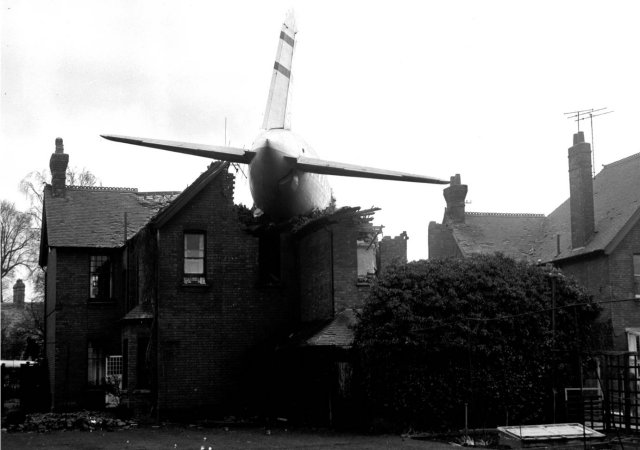
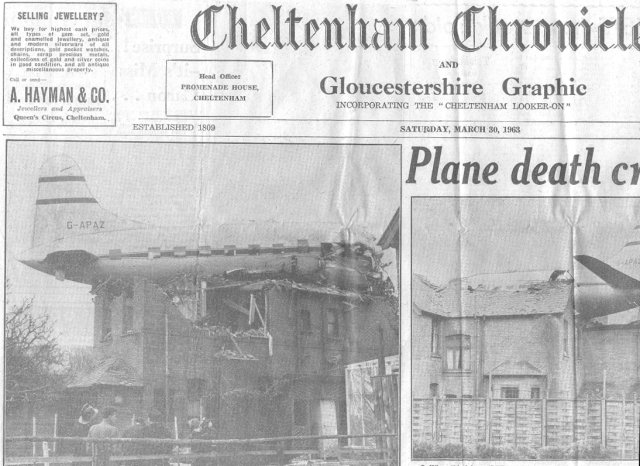
G-APAZ rests on top of Longmead, the house at 189 Tuffley Avenue. Note the complete destruction of the nose and cockpit area (Courtesy Gloucestershire Constabulary) |
||
|
|
||
| Following on from a number of reminiscences recently recorded in Alan Smallman's Staverton Memories on this website, John Putley - Learning and Outreach Officer of Gloucestershire Archives - has very kindly contributed this splendid article, first published in the Gloucestershire Rural Community Council’s "Gloucestershire History" magazine in 2006. I have updated some references to make the information current but John's work remains the best researched and most methodically constructed article ever to grace Gloucestershire Transport History. Please enjoy... | ||
|
|
||
| INTRODUCTION | ||
|
|
||
|
|
||
|
|
||
|
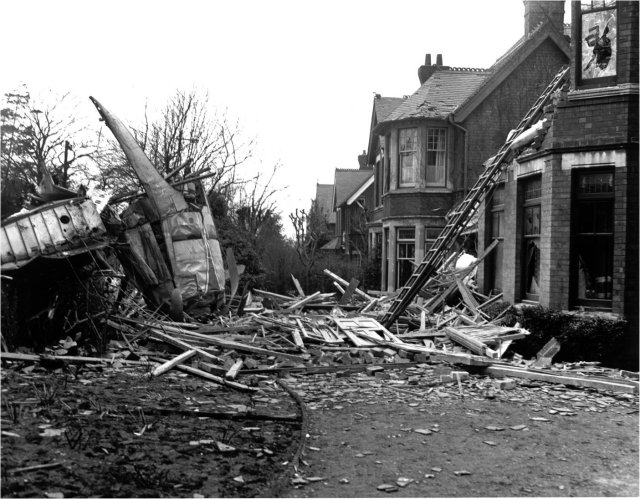
The crash site viewed from the Memorial Gardens. This view makes Mrs Hutchins escape seem all the more miraculous. Note the damage to next-door’s roof – but also the intact cold frame in the garden. (Courtesy Gloucestershire Constabulary) |
||
|
|
||
|
|
Just over 50 years ago on 27 March 1963 a twin
engined Vickers Varsity aircraft of Smiths Industries of Cheltenham
crashed less than two miles from the city centre of Gloucester. Although this was not Gloucestershire’s worst peacetime air crash – this dubious honour rests with Bristol Britannia G-ANCA, which crashed near Bristol on 6 November 1957 with the loss of 15 lives [i] - the fact that the crash of G-APAZ claimed only the lives of its two pilots was somewhat miraculous because as it came down, it passed directly over the city’s eastern suburbs and narrowly missed two city schools. This is a history of this famous, yet tragic incident, which for a time, made headline news all around the world thanks to photographs of the crash, which showed the aircraft resting on top of a house. |
|
|
|
||
| VICKERS VARSITY | ||
|
|
||
|
|
||
|
|
||
|
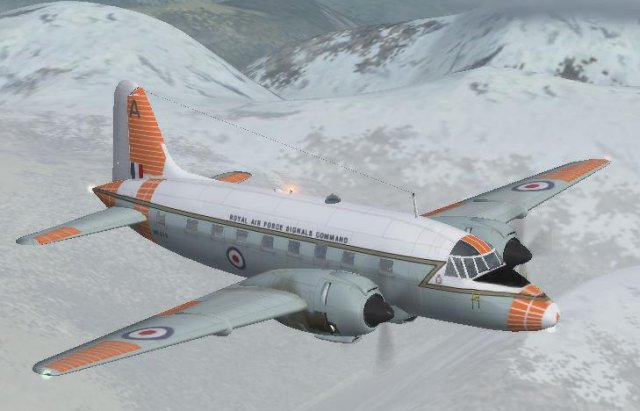
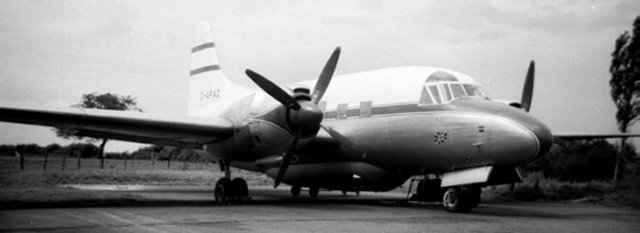
In 1948, the Air Ministry issued Specification T.13/48, inviting aircraft manufacturers to submit designs for a modern multi-engined training aircraft to replace the aircraft then used by the RAF (notably the Vickers Wellington T.10 trainers which were early marks of the wartime bomber modified for use as training aircraft). The firm that submitted the winning design was Vickers-Armstrongs Ltd, who proposed the Vickers Type 688, which was essentially a modernised version of the highly successful Vickers Type 607 Valetta multi-role transport aircraft. Over 250 Valettas were in use with the RAF and the type was itself a military version of the Vickers VC.1 (Vickers Commercial 1) Viking airliner. The Viking, which had first flown in June 1945, combined a stressed-skin fuselage (allowing a spacious cabin and under-floor holds), the proven wing design of the Wellington bomber and the reliability of the Bristol Hercules piston engine. It was a robust [ii] popular aircraft that had become a mainstay of British civil aviation, being used by British European Airways, BOAC and many others. The new aircraft, named the Varsity, had a wingspan of 29.17m and an all-up weight of 16,57kg (2m greater wingspan than the Valetta and 454kg heavier) but its two 1,950hp Bristol Hercules 264 14-cylinder radial piston engines gave it an improved cruising speed, a faster rate of climb, a longer range and a higher ceiling. The major difference between the Varsity and its forerunners however was the fact that the Viking and Valetta were ‘tail-draggers’ (i.e.they had a tail-wheel) while the Varsity had a nose-wheel tricycle undercarriage, giving it modern take-off and landing characteristics. The other main difference was that the Varsity had a ventral blister containing side-by-side bomb-aimer’s equipment in the forward part (for an instructor and student bomb-aimer lying prone) and a small bomb bay for 24 practice bombs in the rear part. The final design was designated the Varsity T.1 and two prototypes were ordered for evaluation. The first, serial number VX828, made its maiden test-flight on 17 July 1949 from the Vickers factory at Wisley Aerodrome, Surrey (close to the Vickers factory at Brooklands) with Vickers’ chief test pilot Mutt Summers and his deputy, Flight-Lieutenant G R Bryce at the controls. The subsequent test flights, undertaken by the RAF, were a success [iii] and the Air Ministry placed an order for 60 Varsity T.1s (serials WF324-335, WF369-394 and WF 408-429) with Vickers with further orders to follow. The first production Varsity, WF328, made its maiden flight on the 21 May 1951 and the first delivery to the RAF was made on t 31 August 1951. As with all new aircraft types, there then followed a period of trials - essentially when the various procedures to operate and maintain the aircraft were written (for aircrew, these were called ‘Pilot’s Notes‘) - after which the type was declared as having reached IOC (Initial Operating Capability). For the Varsity, IOC was achieved five months later on 1 October 1951, when Varsity T.1 WF328 was delivered to 201 Advanced Flying School at Swinderby. Subsequently, a total of 163 Varsity’s were built (17 at Vickers’ Weybridge factory and 146 at their plant at Hurn, Bournemouth), of which 160 served with the RAF before production ceased in 1954. In RAF service, Varsity’s were used by Flying Training Command as a conversion trainer for pilots proceeding from basic flying training onto heavy piston aircraft (such as Hastings, Washingtons, Shackletons and Britannias) and also for advanced instruction of navigators and bomb-aimers. They proved ideal training aircraft, being cheap to operate, simple to maintain and their long range (3,900km/2,600 miles) allowed long distance navigation training flights. They were also used during operational exercises, notably in the RAF’s annual home air defence exercises, where they generally played the role of attacking enemy bombers. Despite widespread use in Training Command (see Appendix 1), the Varsity only equipped one operational RAF unit, 115 Squadron of Signals Command. Most began to be phased out of service after 1966 (being replaced by Hawker Siddeley Dominies) but one Varsity was not retired until 27 July 1992 after 38 years of service [iv] Only four variants of the Varsity existed. The first was VX835, the second prototype, which after finishing its test flights was handed over to Rolls Royce for use as a flying engine test-bed. This aircraft had a Napier Eland NE16 turboprop engine installed in the starboard wing and was given a new designation, the Vickers Type 634 Napier-Varsity. The second variant was WF379, which was used by the Royal Radar Establishment for airborne radar trials and testing and necessitated the installation of a longer nose to house the radar equipment. The third variant was WF416, which was converted by Eagle Ltd. into King Hussein of Jordan’s personal air transport (a process that involved removing the ventral blister and upgrading of the cabin facilities), the aircraft being subsequently given the Jordanian registration VK-501. Finally, two other Varsitys, WF387 and WF415, were converted into civil versions of the Varsity, being re-designated Vickers Type 688s and being assigned civil registrations. Both of these conversions were created for flight development work undertaken by civil companies under contract to the Air Ministry. Varsity WF387 became G-ARFP and was initially used by the Decca Company for radar and navigation system trails before being handed over to Smith’s Industries’ Aviation Division for use in automatic landing (‘autoland’) research. Varsity WF415 became G-APAZ and from the outset was used by Smith’s for autoland research. |
||
|
|
||
| SMITHS INDUSTRIES – AVIATION DIVISION | ||
|
|
||
|
|
||
|
|
||
|
In 1851, Samuel Smith started a clock and watchmaker business in London. By 1904 the company was making speed indicators and spark plugs for the motor industry under the title, S. Smith & Sons (Motor Accessories) Ltd and in 1911, it entered the field of aviation by producing a revolution indicator for aircraft engines. Other aircraft instruments (such as air speed indicators, altimeters, fuel gauges, inclinometers, etc) soon followed and within eight years, Smiths were offering the first complete flight control system for aircraft. Such was the growth of its aviation business that in 1929 a new division of the company, Smiths Aircraft Instruments, was formed, which quickly established itself as the most profitable part of the company. When World War 2 broke out in 1939, Smiths had established new manufacturing facilities at Bishop’s Cleeve near Cheltenham and were one of the world’s leading aero-instrument manufacturers, marketing a range of instruments and products, including a pneumatically powered, mechanical autopilot, the Smiths Mk. IA. In 1935, the company’s Managing Director, Sir Allan Gordon-Smith, decided to purchase a de Havilland Dragon aircraft to use as a flying showroom and trials aircraft. This aircraft, registration G-ADOS, made a number of sales and demonstration tours to Italy, Yugoslavia, Turkey and Germany [v] and it proved a resounding success, bring in numerous orders. Other aircraft were subsequently acquired and in rough chronological order, the company owned and operated the following: a Percival Vega Gull G-AFIE (1938-1939), a Percival P34 Proctor P3 G-AHFK (1946-1958), an Avro 19 srs 2 G-AHKX (1947-1969, pictured above), a Miles M65 Gemini 1A G-AKHY (1951-1965), a Douglas DC-3 Dakota G-AMZE (1953-1964), a de Havilland DH104 Dove 6 G-AOSE (1956-1970) and an Avro 748 srs107 G-ASJT (1963-1970). The flying section of the company gradually became a distinct entity, being known as Smiths Development Flight and then as Smiths Aviation Division Flying Unit. In addition to its own aircraft, Smiths also operated aircraft that they did not own but which were used by the company on loan or under contract, generally for the government. Among these aircraft were a Vickers Valetta [vi] (used from 1948 to 1951), a four engined de Havilland DH Comet IIE G-AMXK (1959-1960) and, as noted above, two Vickers Type 688 Varsitys, G-ARFP (1962-1968) and G-APAZ (1958-1963). With the exception of the Comet (which was based at Hatfield) and the Valetta (based at RAF Moreton Valence), all of these aircraft were based at Staverton aerodrome, between Gloucester and Cheltenham. Smiths established a home for their development flight at Staverton in 1953, operating from Hanger SE3. The value of having its test flight facility close to its main manufacturing site was soon realised, especially with regards to rapid and flexible flight-testing and the ability for the aircrews to assist in the development of flight-testing programmes. Staverton was owned jointly by Cheltenham and Gloucester Borough Councils, but was managed on their behalf by Cambrian Airways Ltd. When this company went into liquidation in 1956, the airfield was threatened with closure but because of the importance of their flight test unit, Smiths took over the running of the airfield for the next 6 years in order to prevent its closure. Despite its value to the company, Smiths Development Flight was quite small, having just four pilots (a Chief Test-Pilot, a Deputy and two others), a Flight Test Engineer and a Chief Engineer, supported by a team of eight flight engineers. The latter were responsible for the maintenance and servicing of Smiths’ aircraft, which were all maintained to public operating standards as laid down by the Air Ministry. However because of their test-bed nature, several of the unit’s aircraft had special category Certificates of Airworthiness (a status that required a higher maintenance schedule). Flying was usually undertaken either at the request of the Aviation Division’s various research departments or, for demonstrations and sales, by Smiths’ Technical Sales department. Flight tests were generally organised by the Flight Test Engineer (W Monteith), who drew up the programme for each flight and supervised the necessary telemetry to record the results. Each flight was arranged under the general supervision of the Chief Test Pilot with the flying duties shared among the team of pilots. Training of new pilots was also undertaken, especially where they lacked experience in the various aircraft types that the company operated. This was done on an ad hoc basis, albeit to Air Ministry standards and all of the unit’s senior pilots were qualified instructors. |
||
|
|
||
| VICKERS VARSITY G-APAZ | ||
|
|
||
|
|
||
|
|
||
|
Vickers Varsity G-APAZ was originally a
Varsity T.1 that was built at Vickers-Armstrong’s factory at Weybridge,
being assigned the airframe number 4816 and receiving Bristol Hercules
264 engines numbers 210276 and 210234. It was one of the third group in
the first batch of 60 Varsity T.1’s and upon completion was given the
RAF serial number WF415. The aircraft was rolled out in mid-May 1952
and after a flight test (which took place from Wisley at Vickers
Armstrong’s expense) Vickers-Armstrong notified the Air Ministry in a
letter dated 29 May 1952 that WF415 was ready for
delivery. Within the week, Vickers-Armstrong had received instructions
from the Air Ministry and on 10 June 1952, WF415 took
off from Wisley on its delivery flight heading for RAF Swinderby in
Lincolnshire, the home of 201 Advanced Flying School (AFS).
This appears to have been an RAF acceptance flight. However for the following day, Flying Training Command assigned WF415 to the Central Navigation and Control School at RAF Shawbury [vii] near Shrewsbury. WF415 flew to Shawbury on 25 June 1952 and for the next 6 months was used to help train future RAF air traffic controllers. The next change for WF415 came on 10 December 1952 when it was transferred to 1 Air Navigation School (1 ANS) at RAF Hullavington in Wiltshire. For the next 2½ years, WF415 was used for aircrew-training duties but on 1 May 1954, 1 ANS was disbanded in a re-organisation of Flying Training Command’s assets. A month later, on 30 May, WF415 flew north to Scotland, where it was placed in storage by 44 Maintenance Unit (MU) at Edzell in Aberdeenshire. WF415 remained at this Scottish aircraft depot for the next 2 years and although it is doubtful whether it flew, it would have been serviced and maintained to keep it in a flight-worthy condition. On 12 July 1956, 44 MU relinquished control of WF415, which was transferred to 48 MU at Hawarden in Flintshire. The reason for this change from one aircraft storage unit to another is not known, but was probably a simple re-organisation of assets. After 9 more months of inactivity at Hawarden however, WF415 was suddenly reassigned to the Royal College of Aeronautics at Cranwell and on 21 March 1957, it made the short flight across the southern end of the Pennines to Lincolnshire The reason was that WF415 had been given to the Ministry of Supply (MoS) on a 3-year loan in connection with Air Ministry contract No.6/ACFT/14707/CB.6(a)[viii] which concerned the development of a new Mk.10 Military Autopilot. This contract had been awarded to Smiths Aircraft Instruments Ltd, who were to develop a military version of their new civilian autopilot, the Smith’s Electric Pilot Model 2 (SEP.2). Shortly after this contract had been signed, the Air Ministry awarded Smiths a second linked contract, No.6/ACFT/14966/CB.6(a), which was to extend the operation of the Mk.10 Autopilot and develop it into a fully automatic landing system. While the early stages of the autopilot flight trials had been undertaken by Smiths DC-3 Dakota G-AMZE (which Smith’s had purchased off the MoS the previous year) this aircraft was too limited for the subsequent autoland programme and Smith’s had approached the MoS with a view to procuring a more modern aircraft. The MoS already operated some Varsitys and after discussions with the Air Ministry, the latter offered the MoS the loan of Varsity WF415 in exchange for one of the other Ministry of Supply Varsitys, WF326 (which was an older airframe), which the MoS (and Smiths) accepted. The task that the Royal College of Aeronautics was to perform on WF415 was to ‘civilianise’ the aircraft and prepare it for its new role, which involved a fair amount of work, including some structural alterations. The most obvious alteration was that the external blister and the bomb-equipment were removed and then the fuselage was repaired (with reinforced steel spares being fitted to provide adequate fatigue life). As the removal of the blister also decreased drag, the aircraft’s brakes had to be modified with a dual-braking system being installed so that the aircraft’s landing characteristics remained the same. The internal RAF issue equipment (i.e. military radios, survival gear, etc) had to be stripped out and replaced with standard civilian equipment, a task that also necessitated stripping and re-building the interior cabin (special equipment racks being installed in the main cabin to accommodate research equipment). Whilst all of this work was ongoing, the starboard engine (Serial No. 210234) was also removed and replaced with an older one (Serial No. 210221). The reason for this engine change – which began on 12 May 1957 and was completed by 3 July [ix] - is not known but it was either due to the fact that a fault had shown up in the original or, that a spare older engine was available and the RAF wanted to keep the younger original one as a spare for one of the Varsity’s that they operated. Work on G-APAZ continued slowly and it was not finally mid April 1958 – a little over 13 months after it had arrived at Cranwell – that it was completed. On 1 May 1958, G-APAZ was officially handed over to Smith’s Aircraft Instruments Ltd but it wasn’t until 3 May that the aircraft was inspected by the Air Ministry and issued with a Special Category Certificate of Airworthiness (Sub-division (g) Research & Experimental). A final change was that WF415 was given a temporary civil registration, G-APAZ, as for the duration of the loan to the MoS it would be as a civilian aircraft, subject to civil aviation rules and regulations. A week later, on 8 May 1958, G-APAZ left Cranwell with an RAF crew at the controls and made the flight down across country to Staverton, where it joined the other aircraft of Smiths Development Flight in Hanger SE3. Once at Staverton, G-APAZ began operating in the research and development programme that was taking shape, flying various technical trials. Although the general design and operation of the autopilot development was by this date more or less complete, the workload for the autoland programme increased rapidly especially as Smith’s were working in close co-operation with the Royal Aircraft Establishment’s Blind Landing Experimental Unit (BLEU). BLEU had been set up to work on ‘blind approach and landing’ in 1946 and had demonstrated their first automatic ‘flareout’ landing in 1947 [x]. Whereas the aim of BLEU was to simply devise various autoland systems and techniques, Smiths had two goals. Firstly to produce a practical autoland system for the RAF to use as per their contract but secondly to refine the system into a civilian automatic landing system (known to the company as Smiths Automatic Landing Equipment). By October 1958, BLEU and Smith’s had made more than 2 000 landings in connection with the project and many of these had been under full automatic control. BLEU used a variety of aircraft in its trials, including three Varsitys (serials WF412, WF417 and WL665) and it was one of the latter that made headline news on 4 December 1962 when it made a fully automatic landing in dense fog at London Heathrow Airport – the first time in history that an aircraft had ever made a successful landing in zero visibility without human control. By this time, G-APAZ had made approximately 700 ‘hands-off’ landings under automatic control and had flown a total of 2,801 hours. Its time with Smiths had not been totally trouble free however and several incidents had been recorded in the log, notably on 19 September 1961 when the aircraft’s undercarriage had been accidentally retracted whilst the aircraft was on the ground, causing serious damage to the bottom of the fuselage [xi] Another serious event took place on the 16 August 1962 when, during its annual Certificate of Airworthiness certification flight, the port engine’s propeller failed to unfeather and then the starboard engine’s propeller feathering mechanism seized altogether. Such incidents were fairly unusual however and by and large, G-APAZ’s life with Smiths was more positive than negative. |
||
|
|
||
| THE CREW | ||
|
|
||
|
|
||
|
|
||
|
Born on 7 June 1924 in Southminster in Essex, Russell Arthur Palmer joined the RAF Volunteer Reserve on 10 July 1942, at the age of 18. He was sent to Canada for elementary flying training, after which he was appointed to active service as a Pilot Officer, flying Lancaster bombers with RAF bomber Command. Palmer remained in Bomber Command until 1947 when he transferred from the Volunteer Reserve into the RAF receiving the rank of Flying Officer. He was then assigned to 1 Air Navigation School (1 ANS), which was then based at Staverton. After two years with 1 ANS (during which he accrued 1,390 hours in the air), he became a test pilot with the RAF’s Blind Landing Experimental Unit (BLEU). During two years with BLEU, Palmer became a skilful test pilot, making approximately 700 experimental automatic approaches and 310 automatic and radio-altimeter landings in aircraft as diverse as Avro Lancasters, de Havilland Mosquitoes, Gloster Meteors, Vickers Vikings and Airspeed Oxfords and Avro Ansons - the latter two types later being represented in The Skyfame Collection at Staverton, as pictured above. On 21 April 1951, Palmer was promoted to the rank of Flight Lieutenant and left active service (although he remained in the RAF Reserve until 1956). Upon leaving the RAF, Palmer joined Air Service Training Ltd, becoming a staff pilot and instructor, gaining his commercial pilot’s licence in November 1951. Two years later,on 1 July 1953, Palmer joined Smiths Aircraft Instruments Ltd as a test pilot, subsequently working on a wide range of avionic research and testing. In April 1960 he was awarded his Master Pilots Certificate from the Guild of Air Pilots and Navigators. By March 1963 he had flown 6 400 hours (with 5 280 hours were in command) with over 600 hours as first pilot of Smith’s Vickers Varsity. As part of his job, Palmer was putting Kelston Guildford Thomas though a conversion course to enable him to fly the Varsity as pilot in command. Born on 11 April 1936 in Bedminster, Bristol, Kelston Thomas enlisted in the RAF on 29 June 1954. After completion of pilot training he was appointed Acting Pilot Officer in October 1954 and assigned to RAF Fighter Command, where he flew Hawker Hunter jets. Two years later he was promoted to Flying Officer and transferred to RAF Transport Command, where he mainly flew four-engined transport aircraft (such as Avro Hastings and Bristol Britannia). The most notable event in Thomas’ RAF career came in early January 1960, when he was posted to Cyprus as Officer-in-Command of the RAF Mountain Rescue Team on the island. Less than two weeks later, a US Navy Martin P4M Mercator of VQ1 Squadron from Morocco crashed on the 3077m (7,800ft) high Mount Karanfil in mountainous northern Turkey whilst on an ELINT (Electronic intelligence) training flight. Despite the US military having a base at Incirlik less than 70km (44 miles) away, the RAF was asked to help and Thomas commanded the 26-strong RAF Mountain Rescue Team that successfully reached the crash-site of the US spy plane at a height of 2576m (6,500ft). Although all 16 crew had been killed in the crash, the RAF team recovered all but two of the bodies, some secret material and also the aircraft’s black box. Conditions throughout the mission were atrocious, with all drinking fluids (including bottles of Coca-Cola from the wreck) and even medical plasma freezing solid as temperatures averaged -15ºC. Thomas noted that to keep warm at night on the mountain he wore one Balaclava helmet, two pullovers, one shirt, one string vest, one pair of short underpants, two pairs of PT shorts, one track suit bottom and three pairs of socks – all inside two sleeping bags! Thomas later received a bravery award from the US Navy, but more importantly, in April, was promoted to Flight Lieutenant, after which he spent the next two years flying co-pilot on Bristol Britannia aircraft out of RAF Lyneham with Transport Command. On 22 March 1962 he resigned from active service with the RAF and joined Smiths – which was then under the guise of S. Smith & Sons (England) Ltd (Aviation Division) as a test pilot. Already a holder of a commercial pilot’s licence, Thomas passed his Civil Instrument Rating Test in August 1962, after which he obtained his Airline Transport Pilots Licence. By March 1963 he had flown a total of 2 365 of which 70 hours were as second pilot on Smiths Vickers Varsity and was in the process of undergoing a conversion course to fly the Varsity as first pilot. |
||
|
|
||
| THE LAST FLIGHT OF VARSITY G-APAZ | ||
|
|
||
|
|
||
|
|
||
|
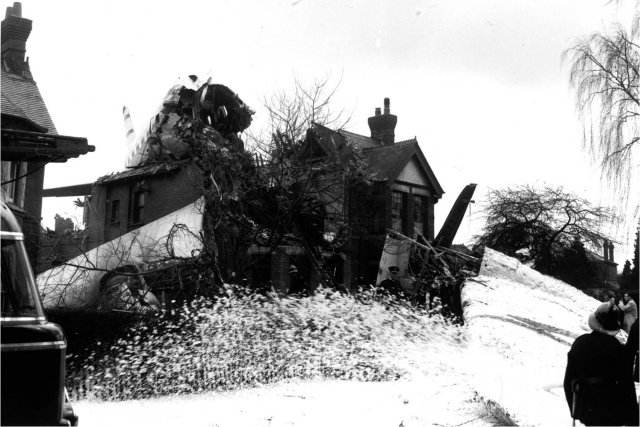
The crash site viewed from Tuffley Avenue. As fireman smother the area with foam, the damage sustained by both the house and G-APAZ are clear from this angle. (Courtesy Gloucestershire Constabulary) |
||
|
|
||
|
At 0845 hours GMT on Wednesday 27 March, Staverton Airfield’s Senior Air Traffic Controller, William Johnson, opened the watch in the Control Tower [xii]. The weather was reasonable for the time of year, with 60% cloud cover (5/8 or 5 oktas at 2 500ft) and a temperature of 8.7ºC, but as far as Johnson was concerned the most important factor was the wind, which was a light southerly breeze which dictated that Runway 22 [xiii] was to be the runway in use for the first flights of the day [xiv] At about 0900, Kelston Thomas visited the control tower and informed Johnson that he and Palmer wanted to make a training flight with the Varsity to Pershore aerodrome and back, which was to be the final check flight of the conversion course that Thomas was undergoing. The flight was an important one, aimed at establishing Thomas’ ability to fly and land the Varsity on one engine. As part of this flight, Palmer wanted Thomas to make to undertake an ‘asymmetric approach and landing’ at Pershore followed by an ‘asymmetric approach and overshoot’ at Staverton. In this instance, the term asymmetric referred to single-engine flight, with one of the Varsity’s two engines being shut down and its propeller blades being ‘feathered’. Feathering was a standard emergency technique where, if an engine was damaged or had otherwise stopped, the pitch of the propeller blades was altered so that they offered as little drag as possible. After receiving permission for the intended flight from Johnson and D. Close, the Pershore ATC (who had been telephoned by Johnson) [xv] Thomas then picked up a weather update after which he returned to Smith’s hanger, where he met with his instructor, Russell Palmer, who had been speaking to another of Smiths pilots, Keith Dougan, the Deputy Chief Test-pilot. While Thomas had been in ATC, Palmer had met with Smiths Chief Aircraft Engineer, Charles Kay, who had earlier made his own pre-flight inspection and had signed the Varsity off as airworthy. By this time, the Varsity had also been rolled out of the hangar onto the apron in front of the structure and it had been fuelled for the flight, with 1 548 litres (344 gallons) of fuel being pumped into the aircraft’s rear tanks. This was far more than was needed but for the purposes of the checkout flight, the aircraft was required to have a realistic fuel load. This was tempered somewhat because for operations at Staverton, the Varsity had a weight limit of 15 455kg (34 000lbs) imposed although even with full rear tanks, the weight of the aircraft was under this at 15 174kg (33 382lbs) - which in addition to the fuel, included 250 litres (55 gallons) of de-icing fluid and a flight trials recorder (which weighed a hefty 53kg / 116lb). Kay had passed this information to Palmer and when Thomas returned from ATC, the two men went into Smith’s flight offices to collect their gear prior to starting the Varsity’s pre-flight procedures. This began with a walk round of the aircraft, after which the two men went onboard to start the cockpit pre-flight checks, using the aircraft’s Pilot’s Notes. These are essentially the aircraft’s user handbook, which contain detailed instructions for the various actions both on the ground and in-flight to enable the crew to fly the aircraft safely. For the purpose of the flight, Thomas sat in the left hand (pilot’s) seat as if in command while Palmer, although officially the check-pilot, occupied the right (co-pilot’s) seat. After completing the final cockpit checks, the two men then started the Varsity’s engines. There were two sets of controls (one for each engine) located on overhead panels between the two seats and the engines were started one at a time. The start sequence required both men to operate the engine controls and once started, the engines were then put through a short test sequence to ensure that they were functioning correctly. As with all aircraft, this involved the engines being run at various extremes while fuel flow, power levels, and fluid pressures and various other systems (such as magneto and generator outputs) were checked. When this was completed, Thomas called Staverton ATC on the aircraft’s radio and requested permission to taxi. In ATC, Johnson granted permission, instructing Thomas to taxi to the holding point of Runway 22 and hold prior to receiving permission to take-off. In addition, he gave the Varsity crew a QFE (air pressure reading) and also figures for the wind strength and direction. While Thomas acknowledged the instructions, Palmer would have used the QFE reading to set the Varsity’s altimeter, essentially calibrating the instrument in order for it to provide an accurate height reading. Then Thomas taxied the Varsity to the marshalling and holding point, where he and Palmer performed a final take-off check, which involved putting the aircraft’s brakes on and then running both engines up to full power for around 30 seconds (simulating the time required for the aircraft to take off and gain enough altitude and speed to make an emergency landing). Thomas than contacted Staverton ATC and requested permission to take off, which was granted and, at 0945 hours, Varsity G-APAZ took off. Once airborne and safely climbing, the two pilots retracted the undercarriage and Thomas banked the aircraft to the left to enter the Staverton circuit [xvi]. He then radioed ATC and requested permission to make a ‘touch-and-go’ landing. This involved the Varsity making a normal descent and making a landing but, as soon as the wheels touched the ground, the pilot would open the engine throttles and take off again. Johnson gave permission for this and a few minutes later, the Varsity made its ‘touch-and-go’ landing then climbed up and out of the circuit, altering course towards Pershore. At around 1000, Thomas and Palmer were approaching Pershore when, according to the flight-plan, they shut down one of the Varsity’s engines. As part of this process one of the two men would have read the ‘engine shut down’ sequence from the Pilot’s Notes while the other carried out the required actions. The engine that they selected to shut down appears to have been the starboard engine and part of the shutdown process involved switching this engines’ ‘engine idle cut-off' (‘ICO’) switch to its cut-off position. This switch was on the central overhead panel to the left of the engine ignition switches and was covered by a U-shaped finger guard to prevent accidental activation (but which also hid the switch’s visual position). This particular switch was adjacent to an identical switch for the other engine and had two positions, ‘Run’ and ‘Cut-off’. Switching it to the ‘ICO’ position essentially stopped the fuel flow to the engine, so causing it to stop running. As soon as the engine power began to drop, the pilots activated the feathering motors for the starboard engine, so causing the engine’s propeller blades to rotate to a more edge-on aspect to the front and allowing the propeller to windmill freely with minimum drag. At 1010 hours, the Varsity arrived in the circuit at Pershore with one engine stopped and, as arranged, made a successful approach and landing, touching down on Runway 21. Later, D. Close, the Pershore ATC, couldn’t remember which of the Varsity’s engines had been stopped, but thought that it was the starboard one. After landing at Pershore, Thomas taxied the Varsity off the runway to a holding point, where he and Palmer restarted the stopped engine. After warming up the engine back up, Thomas requested permission to take off and at 1025, the Varsity again took to the skies, climbing up and heading back towards Staverton. Five minutes later, at 1030 hours, Thomas radioed Staverton ATC and requested permission to make a straight in asymmetric approach. Johnson acknowledged the request and granted permission, with the proviso that Thomas to call ATC when the Varsity was 2 miles away and on its finals (final approach). Not long afterwards, Thomas and Palmer again began the process of shutting down and feathering an engine. This time they selected the Varsity’s port engine and, by 1025, this had all been done successfully and the aircraft was closing on Staverton from the northeast. As the Varsity headed in toward Staverton, Thomas began reducing height following an imaginary glide path that terminated at the threshold of Runway 22. This was normal operating procedure and both Thomas and Palmer no doubt knew the characteristics of the flight path precisely, having landed the Varsity so many times. When the aircraft passed over Hayden, Thomas radioed Staverton ATC as requested and was given permission to make the approach and overshoot, at which point, observers along the aircraft’s flight path saw that the Varsity had its port engine stopped (i.e. it was fully feathered) and had its undercarriage lowered. At about a mile from the runway threshold with the aircraft at an altitude of 100m (300 ft), the pilots began the overshoot procedure, which involved raising the landing gear and the flaps. A few seconds later, the Varsity crossed the threshold of Runway 22 at an altitude of 78m (200 ft) with the landing gear and flaps retracted. The aircraft flew down the centreline of Runway 22 in a straight and level attitude and, when it had passed over the far threshold of the runway, it began climbing slowly upwards along the same heading. At this point, everything seemed normal to those on the ground who happened to be watching the Varsity. Foremost amongst these was Keith Dougan who at the time was sat in Smith’s Miles Gemini, G-AKHY, which was at the holding point of Runway 22 waiting to take off. As the Varsity climbed away, Dougan’s attention was drawn away as he received permission to take-off, but before he became totally engrossed in his own aircraft, he noticed that the Varsity – which he later estimated to be about 3-4 miles away and still climbing - had begun to turn to starboard, which he thought was unusual as one of the flight rules for Staverton was that aircraft had to turn to port after take-off in order not to fly over Churchdown and the centre of Gloucester. Forty seconds or so later, Dougan had taken off and was climbing through 135m (400 feet) when his radio crackled into life with a voice he knew was Thomas’, “Mayday. Total engine failure. Going down on outskirts of Gloucester” [xvii] Looking up from his own instruments, Dougan spotted the Varsity low over Gloucester, flying straight and level but very, very low and moments later he “lost sight of it and saw a cloud of smoke” [xviii] It is likely that upwards of several hundred people in Gloucester saw the Varsity during its last moments and most tell the same story. The aircraft had one engine stopped and was flying very low and slow - much lower and slower than was usual for aircraft flying close to the city (let alone over it) – and it was also losing height all the time. When the Varsity completed the overshoot and headed away from Staverton it was still climbing, but only by virtue of trading speed for altitude. By the time it passed over the Barnwood Road, when it began its 30-degree turn to starboard, it was at an altitude of about 230m (700 ft) but at this point, its starboard engine appeared to lose power suddenly and what little engine noise it was generating ceased. A few moments later the Varsity flew past the RAF Offices on Eastern Avenue (now the trading estate adjacent to the site of the Fire Station replaced in the early 21st Century) where it was seen by the base’s commanding officer, Wing Commander R. Stevenson, who instantly realised that it was going to crash. Accompanied by Squadron Leader Malloy and another (unnamed) officer, Stevenson ran out to a car and sped out of the complex to give chase. By this time, the Varsity had straightened up its starboard turn and was passing over Tredworth, flying almost parallel to the railway line down Hatherley Road. Passing over Stroud Road and then Linden Road, it just cleared the roof of Ribston Hall High School for Girls by only a matter of feet before flying over the school playing field at an altitude of less than 30m (90 ft), scaring some girls playing hockey. At this point, it seems likely that Palmer and Thomas were attempting to put the Varsity down on playing fields of the Crypt School, which lay a few hundred feet ahead of them beyond Tuffley Avenue. Some witnesses then saw the Varsity’s undercarriage start to come down but by this time the aircraft was only 15m (45 ft) off the ground and a split second later it slammed into the gable end of the roof of number 189 - named Longmead - the left-hand side of a twin house on the north side of Tuffley Avenue. The impact was devastating, completely smashing the nose and cockpit, and killing both pilots instantly. It also tore off both wings, sending the port wing scything away to land half in the front garden and half in Tuffley Avenue (blocking the road), while the starboard wing struck the south-east sidewall of 187, and then fell in between the two houses jamming into the gap between the walls. The fuselage ended up perched precariously on top of Longmead with its tail section overhanging the rear north wall. The crash had demolished most of the roof of the building and scattered bricks, slate and wood debris everywhere. It had also ruptured the aircraft’s fuel lines and aviation fuel was pouring out of the wreckage into the house, garden and road. Amazingly there was no explosion or fire and this was probably responsible for the miraculous escape of the three female occupants of the house – 85-year old Florence Drury, Mrs Bertha Franklin (Mrs Drury’s home-help) and Mrs Edith Hitchins (Mrs Drury’s companion) – all of whom survived the impact and managed to escape from the ruins [xix] Mrs Hutchins had a particularly lucky escape as she had been in an upstairs bedroom when the aircraft hit. Though all three women were subsequently taken to hospital, none were suffering from anything worse than slight cuts, bruising and shock. They were helped from the house by Mrs T Drury (Mrs Drury’s daughter-in-law who lived next door) and also by one of the RAF officers, who arrived in time to assist them. After helping the women, Wing Commander R Stevenson and Squadron Leader Malloy saw one of the pilots (Mr Palmer) slumped forward in his seat in the wreckage of the cockpit. Despite the fire risk the two men ran into the house and went upstairs, where they climbed into the wreckage to try and effect a rescue. Upon reaching the upstairs front bedroom, they then found the body of Mr Thomas on the floor and while Malloy checked for signs of life, Stevenson continued on into the aircraft until he reached Palmer. It was soon apparent that both men were dead however and due to the situation, the RAF officers decided to leave the bodies in place until more help arrived. The City’s emergency services were already on their way as they had been alerted to the crash by scaffolder John Mansfield. Mansfield was working on the (new) Bon Marché in King’s Square and saw the Varsity start its terminal dive towards the ground. Being an ex-member of the Parachute Regiment, Mansfield not only recognised the aircraft type but also realised that the Varsity was going to crash. He immediately climbed down the scaffolding and alerted a Police motorcyclist in King’s Square, who contacted his control room at Police headquarters. As a result, the Police were already reacting when ATC Johnson made his 999 call from Staverton but whereas Mansfield could only offer a rough guess as to where the Varsity had come down, Johnson was able to provide an accurate location of the crash thanks to Smith’s pilot Keith Dougan. Dougan, in Smith’s Gemini G-AKHY, had flown straight to the scene and circled overhead as soon as he had taken off from Staverton . As a result the first fire engine, a pump escape from Eastern Avenue fire station with Sub-Officer L Jones in charge, was reached the scene at 1042, only a minute or so after the crash had taken place. Seeing aviation fuel leaking all around and fearing an explosion, Jones detailed his crew to start spraying the wreck with foam. As the firemen were setting up their equipment, more help arrived in the form of two off-duty Police officers, PC Roy Curley and PC Williams, and Jones asked them to go from house-to-house to ensure that the inhabitants refrained from using any cookers or naked lights. Then Jones and another fireman, Fireman J Moon, took two extension ladders from the pump and erected them against the ruined front of the house in order to try and reach the cockpit and the trapped pilot. They were joined by Wing Commander Stevenson who returned upstairs and released the harness of Mr Palmer, allowing the fireman to lower him to a stretcher onto the floor. Both men were subsequently pronounced dead by a Dr Neill who had arrived at the scene and had gone upstairs to try and help. The bodies were then lowered to the ground on stretchers where waiting ambulance men collected them and then took them to the City mortuary. By this time, a crowd of onlookers had formed and was growing steadily. PCs Curley and Williams began to try and push them back due to the fire risk and before long more police officers arrived and some sort of order began to be imposed. Soon afterwards, soldiers from the Royal Corps of Signals stationed at Robinswood Barracks also arrived and with their help, the Police were able to establish barricades at the Stroud Road and Calton Road junctions. Roadblocks and diversions were also put in place (with Linden Road replacing Tuffley Avenue) to isolate the whole area from vehicle traffic. As well as the emergency service heads – the Chief Fire Officer, Mr H Corless, the Police Chief Inspector D Baker and the Ambulance Acting Chief Officer, Mr L Rust - the Gloucester City Surveyor, Mr Pollan, also visited the site and subsequently contacted Netheridge Pumping Station to warn them of the possibility of aviation fuel being washed down the sewers [xx] By early afternoon, the fire brigade had secured parts of the wreck with ropes, as the breeze was increasing and it had begun to rock to and fro alarmingly. Somewhat preposterously the main restraint was a thick rope that had been passed through the fuselage and then around the rest of the house, being tied through the windows! Overnight a guard of police and soldiers were put in place to guard the aircraft and the crash site, which remained cordoned off. One reason for this was not just because of the possible risk of explosion, but also because the autoland avionics that the Varsity was equipped with were still classified. |
||
|
|
||
| RECOVERY AND INVESTIGATION | ||
|
|
||
|
|
||
|
|
||
|
Early on the morning of Thursday 28 March 1963,
moves to recover the aircraft commenced. The first element to arrive
was an RAF salvage team from 71 Maintenance Unit of Aston Down,
although this unit (having travelled without their heavy equipment) had
first called into 7 Maintenance Unit at Quedgeley who collected a
crane and recovery vehicles - which included two ‘Queen Mary’
transporters. Not long afterwards another RAF team from RAF Bicester
arrived to assist but before any salvage work could begin, the RAF had
to wait for the inspectors from the Air Ministry’s Accident
Investigation Branch (AIB).
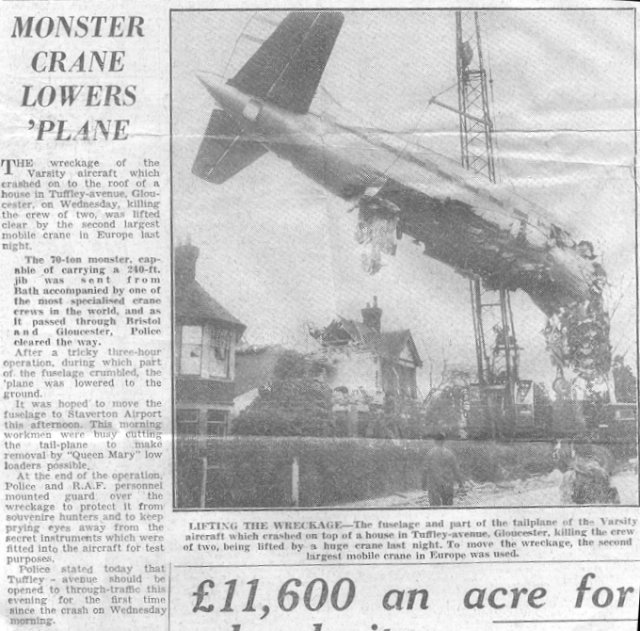
The Air Ministry had been alerted to the crash at 1115 on Wednesday when Air Traffic Controller Johnson had telephoned the Ministry in London from Staverton control tower [xxi]The duty inspector, Mr R C Warren left London with a colleague but did not reach Gloucester until after dark and so waited until morning before visiting the crash scene at around 0900. After checking with the fire crew still on the scene that it was safe to do so, Warren and his assistant climbed up into the house and undertook a brief survey of the wreckage, concentrating on the remains of the cockpit and its instruments. During this inspection they noted that the fuel cock-levers were both in the ON position and that the fuel cross-feeds were also ON. Importantly both engine idle cut-off (ICO) switches were in the cut-off position while the magneto and generator switches were ON. The throttle levers and propeller pitch levers were found to be in the fully forward positions. He also checked the flap controls (which had been selected to 15˚) and the undercarriage levers (selected to DOWN) then compared these with the actual mechanisms, finding that they matched. With this initial inspection completed, work was able to start on salvaging the aircraft. The first large piece of wreckage to be removed was the port wing (not the starboard wing as reported in The Citizen), which was craned onto a transporter around 1000 and taken away. This was followed by the port engine, which had been wrenched free from its mounting and had ended up in the front garden. The starboard engine was still partially attached to the starboard wing and this could not be moved because it was thought that the wing was actually propping the wall up and if it was removed there was a strong chance that the whole wall would collapse. All of the recovered wreckage was taken to Staverton, which was acting as a temporary storage facility. A little later on Thursday morning, the Gloucester City Coroner Brian Wellington, of Wellington & Clifford, solicitors, opened an inquest into the deaths of the two pilots at the firm’s offices at 57 Westgate Street. The initial responsibility was to take evidence to identify the dead pilots and Smith & Sons’ Chief Aeronautical Engineer, D Brown, identified the body of Russell Palmer while Kelston Thomas was identified by his father, Mr Gifford Thomas, who had travelled up from the family home at Bristol overnight. The Coroner also took evidence of the two pilot’s personal details, employment and general background before adjourning the inquest until Thursday 18 April 1963 in order to collect witness statements, empower a jury and to await post-mortem reports – these were to be conducted by the Royal Hospital’s Consultant Pathologist, Mr Edgar Davey at the hospital later in the day. Throughout the day the salvage operation continued, until by mid-afternoon, most of the wreckage and other debris had been recovered with the exception of the starboard wing and the fuselage. The removal of the latter was problematic because of its size, weight and extraordinary position. As the RAF had nothing that was able to lift the wreck in-situ, the Air Ministry had to turn to civilian contractors to do the job and the only firm that had a suitable crane was G. W. Sparrow & Son Ltd of Bath (which, by coincidence, had a branch in Gloucester at Monkmeadow Dock). The crane in question was the largest mobile crane in Europe; a monstrous American Lorain model that could lift a weight of 70 tons using an 80m (240ft) long jib on a 9.7m (32ft) long, 12-wheel chassis. This left Sparrow’s depot in Bath with a three-man crew and a Police escort early on Thursday morning but its progress was delayed for over an hour by a minor car crash on the outskirts of the city. As the crane made its slow way up the A38, Mr D Moon of Sparrows’ Gloucester branch arrived at Tuffley Avenue to take charge of preparations for the lift. To enable lifting, the crane had to be placed as close as possible to the wreck (which Moon estimated weighed around 5 tons) and the most suitable place was the Memorial Gardens of Rest that lay adjacent to Longmead to the south-east. From here, the crane would be able to lift the aircraft’s fuselage and then swing it into Tuffley Avenue where it could be placed onto a low-loader. Access to the garden was to be gained via Ribston Hall School where the school fence was knocked down to enable the crane to reverse in. This was completed by late morning when the crane arrived in Gloucester. After reversing the crane into the garden, the three-man crew then began the task of assembling the huge jib boom and lowering the crane’s lifting legs. When this was completed and the crane was functional, a spa beam fitted with two thick webbing slings was attached to the jib hook and this was swung around into place above the top of the fuselage. With Moon in overall charge, the crane team then slipped one end of each sling and the help of the RAF crew, worked them around the fuselage. The forward sling was placed around the fuselage just forward of the wing root while the rear one was fitted around the fuselage just abaft the cabin door (which was located at the rear of the fuselage just in front of the tail section). Several guide ropes were also secured to the airframe to help control the fuselage during the lift. With everything in place, the recovery operation began. The slack was taken up extremely slowly but even so, when the aircraft finally lifted free of the house, a large amount of debris was disturbed and fell to the ground causing a mass intake of breath from the large crowd of onlookers. In all the lifting operation took some three hours and it was not until around 3.30pm that what was left of the Varsity’s fuselage was lowered onto a waiting ‘Queen Mary’ trailer. As soon as it had been secured, the RAF personnel started work on tidying up the fuselage and also on removing the tailplane (the two horizontal sections of the tail). This was not a quick task and as night fell, guards were once again posted around the aircraft to prevent any interference from souvenir hunters. Work recommenced on Friday morning and by early afternoon, the fuselage and tail section were driven away from Tuffley Avenue to Staverton. Clear up work continued for most of the rest of the day and by late afternoon, the starboard engine and wing were recovered after work to secure and stabilise the end wall of the house had been undertaken. An insurance assessor from the Air Ministry estimated that the damage caused to the house, garden and school by the salvage, which worked out at £80-£90 [xxii]. Also on Friday 29 March 1963, the Coroner received post-mortem reports on the two pilots from the Gloucester Pathologist. As the injuries were all consistent with having been caused by the crash, the Coroner released the bodies and issued Burial Orders. After the crash, Daphne Palmer had gone to stay with her mother in Felixstowe and, as she had decided that this was to be a permanent arrangement, this was where the body of her husband was sent. The following day, Saturday 30 March 1963, Russell Palmer was buried in the northwest corner of the churchyard at St Peter & St Paul’s Church, Felixstowe. His gravestone was inscribed with the following epitaph: PROUD AND TENDER MEMORIES OF RUSSELL A PALMER MASTER AIR PILOT WHO LOST HIS LIFE 27TH MARCH 1963 Unfortunately the author has been unable to locate where Kelston Thomas was buried. The most likely candidate is Arnos Vale Cemetery in Bristol, which was the nearest cemetery to his family home in the city. Although Bristol Record Office holds the registers for this cemetery, they are currently unavailable for public consultation due to legal reasons. |
||
|
|
||
| AIR MINISTRY & GLOUCESTER CITY CORONER INVESTIGATIONS | ||
|
|
||
|
|
||
|
|
||
|
A few days after its recovery from Tuffley Avenue, the remains of the Varsity were quietly removed from Staverton and taken by road to RAF Aston Down. Here, the Air Ministry’s inspectors were able to begin their work in earnest to try and determine the cause of the crash. As part of this all paperwork relating to the Varsity was checked to see whether any lack of maintenance or servicing on Smith’s part might have contributed to the crash [xxiii] Everything was in order however and this was all subsequently returned. However, one vital piece of evidence was determined quite early on from the examination of the aircraft’s fuel system. After checking the engine oil and fuel filters, both of which were clean, the fuel feed mechanisms were examined and here it was found that the electric actuators for the engine idle cut-offs for both engines were closed. This indicated that the position of the cockpit ICO switches noted in the initial examination at the crash scene was correct (i.e. were both in the cut-off position) and that the impact had not caused them to move [xxiv] A few days afterwards, both engines were crated up and shipped to Bristol Siddeley Engines Ltd where their engineers performed a full strip down inspection. This subsequently concluded that no mechanical fault had caused the engines to fail. It also revealed another fundamental piece of evidence in that the damage suffered by the engine reduction gears indicated that neither engine had been under power at the time of impact. Eight days after the crash, the Air Investigation Branch convened an afternoon hearing at the New Inn in Northgate Street, Gloucester to collect witness statements. A total of 17 were taken from witnesses whose occupations included housewives, schoolteachers, school children, engineers, policemen, RAF officers and pilots [xxv] Also present at this hearing was Mr Jones of the solicitors W C Davey Son & Jones of Cheltenham who represented the relatives of Kelston Thomas and Mr Littler, of the solicitors Cartwright, Taylor & Corps, representing Smiths and the Varsitys insurers. At 1430 on Thursday 18 April, the Gloucester City Coroner re-opened the inquest into the deaths of the pilots, this time at the Magistrate’s Courthouse in front of a seven man jury [xxvi] Since the adjournment in March, the Coroner had taken a large number of statements from witnesses, although only 17 witnesses [xxvii] were actually called to give evidence. Though the purpose of the Coroner’s inquest was to determine the cause of death of the pilots, one question that the Coroner wanted to know the answer to was how common single-engine overshoots and over-flights of built-up areas at Staverton were. He voiced these concerns on two occasions, once to Keith Dougan when he was giving evidence and once to William Johnson. Although Dougan - pilot of Smith’s Miles Gemini G-AKHY, pictured above, on the day of the crash - replied that “This was a special occasion. It is not usual” [xxviii], Johnson contradicted this by saying that he didn’t think overshoots on Runway 22 were unusual [xxix]. This was not discussed at length however and the inquest wound up the following day when the jury returned a verdict of accidental death on both of the pilots. |
||
|
|
||
| THE CAUSE OF THE CRASH | ||
|
|
||
|
|
||
|
|
||
|
The port engine and debris from the impact fill Longmead‘s front garden. (Courtesy Gloucestershire Constabulary) |
||
|
|
||
|
By late autumn 1963, the Accident Investigation Branch had finished the physical investigation of the crash and Inspector Warren had started writing his report. Warren had already formulated a working hypothesis of the events that caused the crash and one aspect of his work had already impinged on civil aviation in the UK for the Air Ministry had issued two Civil Aviation Circulars or NOTAMS (Notices to Airmen) concerning single-engine flying on twin-engine aircraft. The first of these, NOTAM No.53/1963, drew attention to the risk of errors during the unfeathering and restarting procedures when aircraft were being flown with one engine stopped. The second, NOTAM No.95/1963, advised that twin-engined aircraft should not carry out practice single-engine landings and overshoots at low altitude and recommended that the power on one engine should just be reduced to the point where it was equivalent to it being feathered. Warren finished his report (Civil Accident Report No. EW/C/014) in November and after it was approved by his superior, the Chief Inspector of Accidents, J Veal, it was sent to the Ministry of Aviation in December. From his investigations into the wreckage and the engines, Warren had concluded that the Varsity had been airworthy, properly maintained and correctly loaded. He was also able to determine that there had been no pre-crash defect that had resulted in the Varsity crashing. With all the evidence behind him, Warren concluded that the cause of the crash had been that the fuel to the starboard engine had been mistakenly shut off by the act of switching the starboard ICO switch to the cut-off position. This occurred when the two pilots were in the process of trying to restart the stopped port engine and it appears that instead of switching the port ICO switch to run, one or the other simply missed and moved the wrong switch. As soon as they had moved this switch, the outcome was assured because as the fuel left in the fuel lines was used up – a process that would have taken about two seconds - the engine simply died and, being at such a low altitude and with so little velocity, the pilots did not have enough time to try and determine the problem, rectify it and restart the one or other of the engines. Warren also concluded there was no way of knowing which of the two men made the inadvertent selection of the ICO switch. Though no information had been made available prior to the report being passed to the Air Ministry, some details were apparently passed to the relatives hinting as to the probable cause of the crash. On 28 September 1963, Kelston Thomas’ father, G Thomas, wrote a letter to the Air Investigations Branch stating that he could not “accept that experienced and efficient pilots such as Mr R Palmer and my Son were, would make such an elementary mistake." [xxx] Mr Thomas argued that the reason that the ICO switches were both in the cut-off positions was that they had moved as a result of the crash impact. Warren however had checked this possibility and found that the mechanisms of the ICO switches prevented such movement. He also gave consideration to the fact that the pilots had deliberately moved the ICO switches to the cut-off position as part of an emergency drill, but this action was not part of the Varsity’s standard crash landing drill. Warren also made a number of other observations that he wanted brought to the Ministry’s attention. Firstly he thought that the proximity of the cut-off switches and ignition switches might have been conducive to making errors, especially as these operated conversely (i.e. the ignition switches were On when up and Off when down, while the ICOs were the other way round). He also noted that the ICO switches were separated by a finger channel guard and covered by a spring-loaded U-shaped cover. Although this arrangement was supposed to guard against accidental operation of the switches, it also meant that if the switches were moved accidentally, then it would not be immediately obvious. This was of note because in March 1957, the Air Ministry had issued a order [xxxi] that ordered the fitting of ICO switch guards on all existing and new build Varsity aircraft due to a number of incidents when the switches had been accidentally moved. No further action was taken regarding this however and, satisfied by the report’s findings, the report into the crash of G-APAZ was published by HMSO on 14 February 1964. After the loss of G-APAZ, Smiths Flying Unit faced an escalating workload with one less aircraft. In order to rectify this, a replacement aircraft was procured and arrived at Staverton in October 1963. This aircraft was an Avro 748 srs107, registration G-ASJT, which had been selected as being typical of the current design of civilian aircraft at the time. Apart from test and development flying from Staverton and Hatfield, this aircraft also undertook sales and demonstration flights in Britain, USA, Canada, Scandinavia and Europe. The Avro however was first used to help develop the Smiths SEP6 Autopilot and control system and so it was the second Varsity, G-ARFP, which bore the brunt of the autoland programme work. This aircraft continued flying with Smiths until in January 1968 when it was withdrawn from service and returned to the RAF as WF387. Part of the reason was that the autoland programme was winding down but it was also a cost-cutting measure. By this time the escalating costs of running a flying unit was beginning to become a strain on Smith’s finances. In October 1969 the management decided it was an expense that the company could no longer afford and it was closed down. Over the next three months, the flying unit personal and the company’s three remaining aircraft were moved or sold to other establishments. The de Havilland DH104 Dove 6 G-AOSE was sold to Precise Surveys on 22 January 1970 and was eventually scrapped at Coventry four years later. The Avro 19 srs2 G-AHKX was acquired by British Aerospace and has been restored to flying status. The Avro 748 srs 107 G-ASJT was transferred to the RAF on 13 January 1970, dropping its civil registration and acquiring a military serial number, XW750 [xxxii] Initially based at Farnborough, in 1990 it was still flying as a part of the Royal Aircraft Establishment’s test fleet at Bedford. In 2007 however it was given the American civil registration N748D and flown to Robin Hood Airport near Doncaster to become an instructional airframe with Directions Finningley Aviation Academy. Among Smith's earlier aircraft Douglas Dakota G-AMZE was broken up for spares at Burnaston (Derby) aerodrome in March 1964, Miles Gemini G-AKHY was written off after a forced landing at Shebbear in Devon on 4 April 1965, Percival P34 Proctor P3 G-AHFK went on to win the 1959 King's Cup Air Race before being exported to Kenya and Percival Vega Gull G-AFIE, having been impressed into RAF service, was destroyed in an air raid on Hendon on the night of 7-8 October 1940. The other loaned Vickers Varsity, G-ARFP, continued with development flying but by 1978 was a haulk at the RN Firefighting School at Predannack, Cornwall. |
||
|
|
||
| THE TALE OF TWO ADVERTS | ||
|
|
||
|
|
||
|
|
||
|
When the verdict of the Coroner’s Inquest was reported on page ten of The Citizen on 19 April 1963, it wasn’t the only reference to the Varsity crash in the newspaper for by coincidence or design, Sparrow’s had placed an advert. This was a quarter page advert and showed a photograph of the Lorain crane lifting the wreck of the Varsity at the crash site with the caption “For all your lifting problems…consult Sparrows crane hire” [xxxiii] At the time, this caused little apparent fuss and none of The Citizen’s readers commented it on in the paper’s letter page. This was not the same 30 years later when the insurance company Commercial Union used a similar image - with the caption “Don’t worry. You’re with Commercial Union.“[xxxiv] The Citizen decided that this advert, which was only run in Australia, was in bad taste, which is somewhat hypocritical when it made no such inference with the Sparrow advert in 1963 and was also happy enough to charge the company for the advert. The Citizen justified its stance by bringing attention to the fact that the advert was misleading. This was because Commercial Union had been the insurers for 189 Tuffley Avenue in 1963 and the firm hadn’t settled the claim until 1968, five years after the crash. The newspaper also argued that the rest of the wording – that the company “settled claims quickly and fairly”[xxxv] was also deceptive, especially as the paper pointed out that the claim payment was made only after intervention by the then City M.P. Jack Diamond. The house itself lay derelict after the salvage of the Varsity and on 27 August 1964, it was announced that it was to be demolished. Although the Air Ministry had fairly promptly settled a claim with the Drury family for compensation, this had been based on the fact that the Longmead was to have been rebuilt, but in the space of 18 months it had deteriorated to the extent where the architect in charge had advised that both Longmead and 187 should be pulled down. This took place later in the year and the building was subsequently replaced by a modern, rather soulless three-storey structure, reminiscent of a decapitated tower block. |
||
|
|
||
| CONCLUSION | ||
|
|
||
|
|
||
|
|
||
|
There can be little doubt that the crash of G-APAZ was caused by pilot
error and that the Air Ministry’s investigation reached the correct
conclusion.
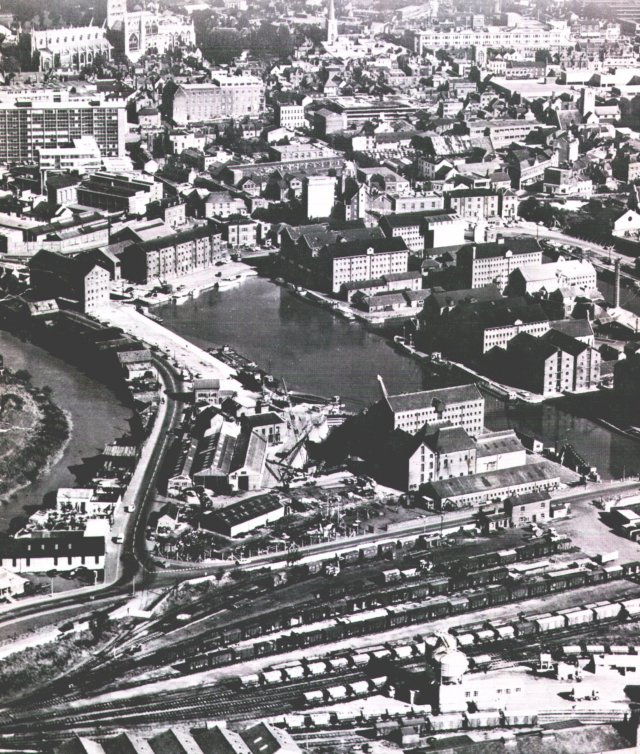
In general, the Varsity was a fairly safe aircraft and some are still flying today. Of the 163 built, only 17 have been lost through accidents and all except three of these losses were RAF aircraft. All of these crashes have been attributable to pilot error and given the nature of the RAF use of the type at the time, this is probably to be expected. The worst crash in terms of loss of life was the most recent, when Varsity G-BDFT of the Leicester Aircraft Preservation Trust crashed on 18 August 1984 with the loss of all 11 onboard [xxxvi] In the intervening years since the loss of G-APAZ, much speculation has taken place discussing whether Russell Palmer and Kelston Thomas were heroes in that they deliberately avoided hitting Ribston Hall School. This attitude is not surprising as both men were popular, well-respected members of the local aviation community and their deaths came as a great shock. Russell Palmer, especially, had a national reputation as a pilot and test pilot. In all probability however and without denigrating the memories of these two fine pilots, the fact that G-APAZ avoided crashing into the two schools was more a matter of luck than judgement. Given the situation they found themselves in, the pilots were not really in a position to do much about it and in all likelihood they were just concentrating their efforts on trying to reach the Crypt playing fields – which would have appeared as a splash of green in a sea of red brick and grey roof tiles below them. Despite this there is no doubt in the author’s mind that had the two men not been better pilots then the Varsity may have crashed earlier than it did or, continued its turn to starboard before it came down. The first scenario would have seen the impact occur in the streets of Tredworth, while the second would have resulted in a crash somewhere along Southgate Street, probably close to the Docks - pictured above in 1969. If either had been the case, the impact would probably have been far more devastating and the death toll would have been much greater. |
||
|
|
||
|
|
||
|
|
||
|
The merits of having an aerodrome so close to two major urban conurbations has often arisen and discussed by the authorities (not least by Gloucester City Council and Cheltenham Borough Council who now own and operate the facility on a joint basis). Despite the attendant risk, the author feels that Staverton – now officially known as Gloucestershire Airport – has much to offer and should remain as an active aerodrome (if only to prevent local planning authorities from building on the site!). At the time of writing the airport’s future, which was once in serious doubt now seems secure. Much rebuilding work has taken place and the facilities have changed beyond recognition since the days when Smiths took control. Although only one commercial airline - Citywing - operates out of the airport, Gloucestershire is still busy with a large number of aircraft movements and much commercial investment. As well as various private business jets there are several flight training schools based at the airfield together with two private flying clubs. Another frequent user is the RAF, who use Staverton as a refuelling facility for rotary wing operations (and pay for the privilege). AcknowledgementsI would like to thank the Staff at the following places for their help with this article: RAF Museum, the Civil Aviation Authority, the Gloucester Coroner, Gloucestershire Constabulary, US Navy Historical Centre, Air Historical Branch (RAF) MoD and the RAF Personnel Management Agency (formerly based at RAF Innsworth), MoD. I would also like to thank Bernard Seeley (Churchwarden of St Peter & Paul Church, Felixstowe) and my colleague Vicky Thorpe (for photographs of Russell Palmer’s grave). BibliographyCard, F., 1993 Whensoever: 50 years of the RAF Mountain Rescue Service 1943-1993, The Ernest Press, ISBN 0948153237 Ellis, C., 1990 Smiths Industries at Cheltenham: The story of fifty years at Bishops Cleeve 1940-1990, ISBN0904811182 Appendix 1: RAF Training Command Units Equipped with the Vickers VarsityThe units using the Varsity were: 1 Air Navigation School, 2 Air Navigation School, 5 Air Navigation School, Bomber Command Bombing School, Blind Landing Experimental Unit, Central Navigation and Control School, Empire Test Pilots School, 1 Electrical & Wireless School, 4 Flying Training School, 5 Flying Training School, 11 Flying Training School, the Airmen Aircrew Initial Training School, the School of Air Warfare and the Central Flying School.
References
[i] Denham, T, 1996, World Directory of Airliner Crashes, Patrick Stephens Ltd. [ii] Quite how robust is shown by the fact that on 13 April 1950, a saboteur’s bomb exploded onboard BEA’s Viking Vigilant over the English Channel. Despite severe damage to the rear fuselage, the plane’s Captain (I Harvey) was able to return to the nearest airport and make an emergency landing, saving the lives of the 31 passengers and crew, a feat of airmanship for which he was awarded the George Medal. [iii] Only one problem was found, which was that the bomb-aimers’ windows become dirty by dust/mud thrown up by the nose-wheel on take-off and landings. The problem was solved by new mudguards on the nose-wheel, which were tested on the second prototype, VX835 (which first flew on 29 January 1950). [iv] This aircraft, WL679, served its RAF life with the Royal Aircraft Establishment at Farnborough, is now preserved on public display at the RAF Museum at RAF Cosford. [v] One of the instruments on the Dragon was the Smiths Mk 1A Autopilot, which was demonstrated to the German company Siemens in Berlin in 1937. Siemens subsequently developed the guidance systems of Germany’s V-weapons and the V-1 autopilot closely resembled the Smiths Mk 1A device! [vi] The serial of this aircraft is not known, but it was owned by the Ministry of Supply and Smith’s shared usage with the Staverton-based airscrew manufacturer Rotol Ltd [vii] The movements of WF415 can be found on its Air Ministry Form AM78. [viii] MOS Air Fleet Record of Aircraft Movements card R. Form 43 [ix] Ibid, MOS Air Fleet Record of Aircraft Movements Card [x] The first ‘autoland’ (and auto take-off) was achieved in 1941 by the German firm Siemens using a radio-altimeter coupled to a Siemens autopilot fitted into a slow, light aircraft operating on a grass strip. German research was halted by the war effort however and it never subsequently caught up. [xi] Civil Aviation Accident Report Airframe History and Technical Log, National Archives, AVIA101/335 [xii] Watch Log Staverton Airport, GRO GBR/M32 [xiii] Runway notation is in degrees, rounded up to the nearest 10° with the last zero removed. Runway 22 therefore was aligned on a heading of 220°. The other end was designated Runway 04 (i.e. aligned on a heading of 40°) [xiv] Civil Aviation Accident Report Branch Investigation No.EW/C/014, National Archives AVIA 101/332 [xv] Civil Aviation Accident Report Witness Statements, National Archives AVIA101/336 [xvi] The ‘circuit’ is an imaginary aerial rectangle that aircraft follow when in the vicinity of an aerodrome. One of the rectangle’s long edges is superimposed on the runway in use at the time and marks the approach and take-off runs, while the other long edge (the ‘downwind’ leg) is parallel to it. The two ‘ends’ of the rectangle form two linking ‘cross-wind legs’. A circuit can be left or right handed, depending on local flight regulations, prevailing weather conditions and the general topography. Aircraft enter or leave the circuit at various points typically after gaining permission from the local air traffic control. [xvii] Coroner’s Inquest statement, Gloucestershire Archives CO6/1 March 1963 [xviii] Ibid [xix] The Citizen, City Final edition, 27 March 1963 [xx] Ibid [xxi] Op.cit Avia 101/332 [xxii] Op.cit Avia 101/335 This consisted of damage to the house’s rear fence £30, the front fence and hedge £20, the front pavement £20 and to the memorial gardens and Ribston Hall school fence £10-£20. [xxiii] These included: two engine log books, the aircraft logbook, two Journey logbooks, two propeller logbooks, the aircraft’s CofA form, radio licences, four insurance certificates, radio installation certificate, some miscellaneous letters and forms, a technical logbook, conversion handbook, electrical system installation manual, aerial charts, pilot’s notes for Varsity T1, a file of worksheets, both of the pilot’s personal logbooks and lastly an envelope containing a pilot’s check list, maps and miscellaneous papers (which had all been recovered from the cockpit). [xxiv] Op.cit Avia 101/332 [xxv] Op.cit Avia 101/336. The witnesses were: C Kay (Smith’s), K Dougan (Deputy Chief Pilot, Smith’s), W Johnson (Staverton ATC), D Close (Pershore ATC), D Rigby (housewife, Churchdown). R Curly (Gloucestershire Constabulary), Wing Commander R Stevenson (RAF Innsworth), G Davy (Fireman), M Rodway (School Mistress, Ribston Hall), R Wright (School Mistress, Ribston Hall), H Symonds (Estate agent), F Holyhead (Garage attendant), T Daniell (scholar), F Lawrence (Fireman), D Holbrow (Insurance agent), J Menher (Traveller) and J West (Engineer). [xxvi] Op.cit Coroner’s Inquest. The jury members were T Clark, H Richards, D Pollard, G Slatter, P Butler, G Pugh and N Gronk. Coroner’s Inquest, Gloucestershire Archives CO6/1 March 1963. [xxvii] Op.cit Coroner’s Inquest. The witnesses were: D Brown (Smith’s aero-engineer), Guildford Thomas (K Thomas’ father), Charles Kay (Smiths’ Head of Aircraft Maintenance), Keith Dougan (Smiths’ Pilot), William Johnson (ATC Staverton), PC R Curley, PC G Tunnicliffe, John Mansfield (scaffolder), F Lawrence (off-duty Fireman), F Holyhead (garage attendant), J Meaker (Gloucester), R Hodges (Stroud), B Holbrow (Stroud), Sgt R Selway (Innsworth), Sub Officer L Jones (Fireman), Fireman M Moon (Fireman) and Dr E Davey (Pathologist) [xxviii] The Citizen, 19 April 1963 [xxix] Op.cit Coroner’s Inquest [xxx] Op.cit Avia 101/332 [xxxi] Op.cit Avia 101/332. Air Ministry order AM A.999504/9/Air Eng.1g [xxxii] Ellis, p85 [xxxiii] Op.cit Citizen 19 April 1963 [xxxiv] The Citizen, 24 September 1993 [xxxv] Ibid [xxxvi] Aviation Safety Network Database (http://aviation-safety.net/database) |
||