
However, the LCDR main line was more lightly engineered and subject to more severe weight restrictions than that of the SER. At the same time the Board of Directors was anxious to reap some of the financial benefits of amalgamation by closing the LCDR's Longhedge Works.
During the first years of the SECR, express passenger services were well served by Wainwright's D and E Class 4-4-0s but - as on other railways - loads continued to increase and by 1912 the designer realised that he would soon need more powerful locomotives.
Unfortunately weight restrictions of the LCDR main line prevented the use of any significantly larger or more powerful locomotive and the cost of strengthening the bridges on this line was prohibitively expensive. The Board of Directors therefore ordered Wainwright to prepare a design for only for the SER main line services, which was criticised for using such outmoded features as slide rather than piston valves and saturated rather than superheated steam.
These criticisms of Wainwright coincided with an acute motive power crisis on the railway during the summer of 1913, (due in part to the Directors' insistence on the premature closure of Longhedge Works and the inability of Ashford to cope with the increased workload). As a result Wainwright was asked to retire on 30 November 1913, before the new locomotives could be ordered.
What would later become the SECR L Class retained Wainwright's choice of Belpaire firebox but after his departure his assistant Robert Surtees added a Robinson superheater and twelve examples with piston valves were ordered from Beyer Peacock of Gorton, Manchester for delivery by the end of June 1914.
After Richard Maunsell took over as SECR Chief Mechanical Engineer in January 1914 he ordered a further 10 L Class with minor detail differences and Schmidt superheaters from Borsig of Berlin, to be supplied in kit form and assembled at Ashford by Borsig employees who finished their work just before hostilities broke out.
The delayed Beyer Peacock series were delivered between August and November 1914 and numbered 760 - 771 while the Borsig locomotives were numbered 772-781.
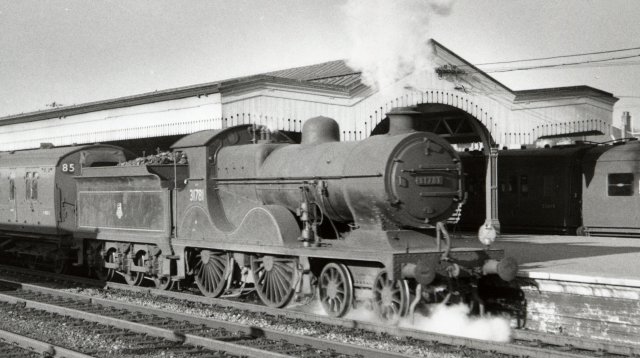
The L Class were used on express trains from London to Dover, Ramsgate and Hastings until the mid 1920s when they were replaced by the L1 4-4-0s (such as 31786, pictured above) that Maunsell developed from them.
From 1923 until 1931 the Southern Railway maintained the locomotive numbers from its constituents with prefixes denoting the main works of the former owning company. All ex-South Eastern and Chatham Railway engines were prefixed by "A" (for Ashford), ex-London Brighton and South Coast Railway by "B" (for Brighton) and ex-London & South Western Railway engines by "E" (for Eastleigh). New locomotives were also prefixed by the letter of the works where they were built.
In 1931 the fleet was re-numbered by dropping all prefixes and 1xxx to all SECR engines, 2xxx to all LBSCR engines, leaving LSWR engines with their original numbers.
During the 1930s the Class Ls were further eclipsed by King Arthur 4-6-0s and Schools Class 4-4-0s and by the 1950s they were displaced by Bulleid's Light Pacifics.
By then the railways had been Nationalised and in 1948 British Railways decided to retain GWR locomotive numbers displayed on cast plates while other constituent companies had extra digits added to their existing numbers so that 1781 - originally SECR 781 - became 31781.
Withdrawals of L Class engines - now relegated to Southern Region cross country workings - began in 1956 with the last going for scrap in December 1961. None of them were preserved. 31781 itself was withdrawn from 73G (Ramsgate) depot in June 1959.