Home 

MR GLADSTONE'S GHOST TRAINS  


  As is discussed in the Connecting Trains feature on the index page of this website, Arnold Ridley - perhaps best known to generations of viewers as Private Godfrey in BBC TV's "Dad's Army" - had a successful writing career and actually came up with the plot for "The Ghost Train"  - now a Fantom Films audio presentation - after being stuck on the triangular station at Mangotsfield - now in South Gloucestershire - on the former Midland route from Gloucester to Bristol.  


  As is discussed in the Connecting Trains feature on this website, Arnold Ridley - perhaps best known to generations of viewers as Private Godfrey in BBC TV's "Dad's Army" - had a successful writing career and actually came up with the plot for "The Ghost Train"  - now a Fantom Films audio presentation - after being stuck on the triangular station at Mangotsfield - now in South Gloucestershire - on the former Midland route from Gloucester to Bristol.  


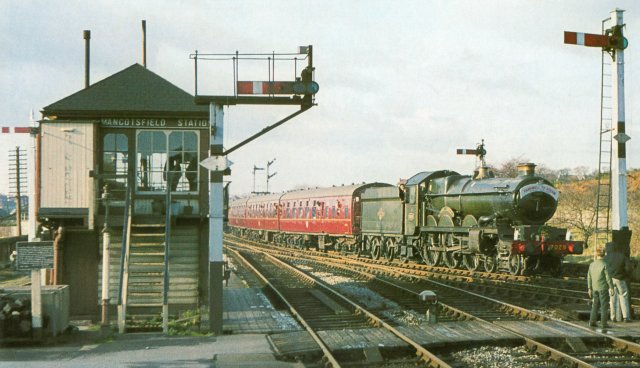
Mangotsfield is seen here on 27 November 1965 with its typical Midland style signal box and upper quadrant signals being passed by 7029 "Clun Castle" hauling the Western Region's "Farewell to Steam" railtour from Bristol to Gloucester.


Mangotsfield is seen here on 27 November 1965 with its typical Midland style signal box and upper quadrant signals being passed by 7029 "Clun Castle" hauling the Western Region's "Farewell to Steam" railtour from Bristol to Gloucester.

Today however, Mangotsfield forms a much calmer junction on the Bristol to Bath Cycle Path near to the busy A4174 but real ghost trains - made wilfully obscure and barely patronised rather than being ethereal entities - still exist thanks originally to an accident on the Great Western Railway further north and east.


  While the section of the former Midland Railway route from Gloucester to Bristol that diverged from today's Network Rail at Yate and proceeded south to the east of Bristol Parkway was built for the benefit of coal mines in the area, Isambard Kingdom Brunel's Great Western Railway - linking Bristol with London via Swindon - was designed for the Broad Gauge of 7' 0 1/4" with the intention of running much faster services.  


While the section of the former Midland Railway route from Gloucester to Bristol that diverged from today's Network Rail at Yate and proceeded south to the east of Bristol Parkway was built for the benefit of coal mines in the area, Isambard Kingdom Brunel's Great Western Railway - linking Bristol with London via Swindon - was designed for the Broad Gauge of 7' 0 1/4" with the intention of running much faster services.

Indeed, the so-called Badminton Route from Swindon to Bristol Parkway and beyond through Patchway and Pilning to the Severn Tunnel was opened in 1903 as a direct high speed alternative to the original Great Western Route of 1841, reaching Bristol Temple Meads through Chippenham and Keynsham.

However, east of Swindon, the Great Western Railway still followed the formation described in its establishing Parliamentary Act of 1835.  Known as "Brunel's Billiard Table", this section of track followed the Thames Valley and was deliberately kept as level as possible due to the inability of the early steam trains to climb hills at speed.  As a result "the finest work in England" faced a number of civil engineering challenges, most notably the still-impressive Sonning Cutting.


  Although later safely used by trains hauled by pannier tanks, Castle Class 4-6-0s such as 7005 "Sir Edward Elgar" seen above, and the Inter City 125s of today, the earliest Broad Gauge Great Western trains plying the chalk downland west of Reading had no continuous brakes and not all had sprung buffers.  As a result, the trains not only relied on the locomotive brakes and those applied by the guard on his vehicle if an emergency stop was required but in such a situation most of the kinetic force of the trailing vehicles would hit the back of the locomotive tender uncushioned by compressed springs or hydraulic reservoirs.  


Although later safely used by trains hauled by pannier tanks, Castle Class 4-6-0s such as 7005 "Sir Edward Elgar" seen above, and the Inter City 125s of today, the earliest Broad Gauge Great Western trains plying the chalk downland west of Reading had no continuous brakes and not all had sprung buffers.  As a result, the trains not only relied on the locomotive brakes and those applied by the guard on his vehicle if an emergency stop was required but in such a situation most of the kinetic force of the trailing vehicles would hit the back of the locomotive tender uncushioned by compressed springs or hydraulic reservoirs.

In addition, the Great Western Railway, like many pioneering British companies, were in the habit of running mixed trains of passenger and goods vehicles on their main lines and carrying the poorest - Third Class - passengers in open vehicles with sides and ends only  two feet above the floor and with transverse benches raised only 18 inches high - or two inches lower than a modern office chair.

Furthermore, at 0430 on the morning of 24 December 1841, the down goods for Bristol left Paddington with one four and one six wheeled open Third Class carriage coupled directly behind the Leo Class 2-4-0 "Hecla" and in front of a covered parcels van and seventeen goods wagons.  The Great Western Railway practice at the time was to place passengers in mixed trains next to the engine as placing them at the rear of the train would expose them to the risk of a collision from the rear.

Many of the 38 Third Class passengers were heading home for what was also the first Christmas of the fully opened Great Western Railway. 

Indeed, "Hecla" had only been delivered from Fenton, Murray and Jackson of Leeds in April 1841 and at the same time that the down goods for Bristol left Paddington the Up mail train passed eastbound through Sonning Cutting.

However, just before 0700 - two and a half hours into a nine and a half hour journey during which the Third Class passengers were exposed to the elements - "Hecla" hit a two feet deep mound of soil - which had slipped down Sonning Cutting's banks due to abnormally heavy rain - and derailed.  The first of the Third Class carriages was thrown against the locomotive tender sideways and was then crushed by the weight of vehicles rearing up unstoppably behind and falling down on it.  Eight passengers - many of them stonemasons who had been working on the new  Houses of Parliament - were killed outright and sixteen more were severely wounded.

Although Brunel himself and one hundred workmen were soon on the scene to clear the line, two inquests later condemned the Great Western for its unsafe practices. And while Third Class passengers continued to ride among goods wagons for a number of years they were in vehicles with sprung buffers and higher sides and never coupled next to the engine.


It was the Midland Railway that broke the mould by providing Third Class passengers with compartments featuring glazed windows and an oil lamp in the roof, despite causing much resentment amongst its competitors and fears that the working class would be given ideas above its station in life.


More importantly however, the fatal Sonning Cutting derailment of 1841 led to the Railway Regulation Act sponsored by Board of Trade President William Ewart Gladstone MP gaining Royal Assent in 1844.

This compelled British railway companies to operate at least one Third Class train daily in each direction over their lines.  These trains were to stop at all stations, to run at a speed of not less than twelve miles an hour inclusive of stops and carry passengers at a fare not exceeding a penny a mile in carriages protected from the weather. In return the railway operator was exempted from paying duty on third class passengers.

Even a penny a mile was not a cheap price for the ordinary British working people of the 1840s although the 1844 Railway Regulation Act also allowed Third Class passengers to take up to 56 lb (25 kg) of luggage with them, free of charge. This helped those who needed to move in search of work and so improved the labour supply in Victorian Britain.


The reaction of many railway companies was a grudging acceptance of the letter, if not the spirit of the legislation, and so they provided the minimum one "Parliamentary" train per day with facilities for Third Class passengers at a useless time of day such as very early in the morning or very late at night.

The reason for the reluctance was a fear of losing revenue if passengers who could afford to travel in Second Class switched to Third Class if facilities there became bearable and some companies continued to run more inferior Third or Fourth class trains in addition to the minimum standard Parliamentary train.

It was the Midland Railway that broke the mould by providing Third Class passengers with compartments featuring glazed windows and an oil lamp in the roof, despite causing much resentment amongst its competitors and fears that the working class would be given ideas above its station in life.

But as Sir James Allport, general manager of the Midland Railway, said in a speech "If there is one part of my public life on which I look back with more satisfaction, it is with reference to the boon we conferred on third-class travellers."


Other railways followed suit, with the anomaly of First and Third Classes but no Second — except on boat trains - persisting until Third Class was eventually rebranded as Second in 1956, and then further rebranded as 'Standard' in the 1980s.


Other railways followed suit, with the anomaly of First and Third Classes but no Second — except on boat trains - persisting until Third Class was eventually rebranded as Second in 1956, and then further rebranded as 'Standard' in the 1980s.

In the 21st Century however, "Parliamentary" trains have gained a new use on Network Rail. 

For the price of an occasional service with a clapped-out diesel, or in some cases even a bus, the franchised Train Operating Companies are able to duck the long and costly consultation, accompanied by inevitable howls of public protest, that the law stipulates when a railway line is to be closed. British Railways were happy to put forward a closure proposal. But since Privatisation, the railways have been controlled by the Department for Transport, which is a bit too close to government for anyone to dare raising the politically sensitive subject of axing trains.

These ethereal services thus operate in obscurity, almost unknown to the public and running mostly empty, since they operate at deliberately inconvenient times – often offering their passengers no prospect of getting home again - and helping to maintain a fiction that a railway line is still open when it has effectively been abandoned.
Examples of these modern ghost trains include the 1136 to Gerrard's Cross from the itself-obscure and unappealing Platform 14 of Paddington Station rather than Marylebone, the London terminus for most Gerrard's Cross trains.


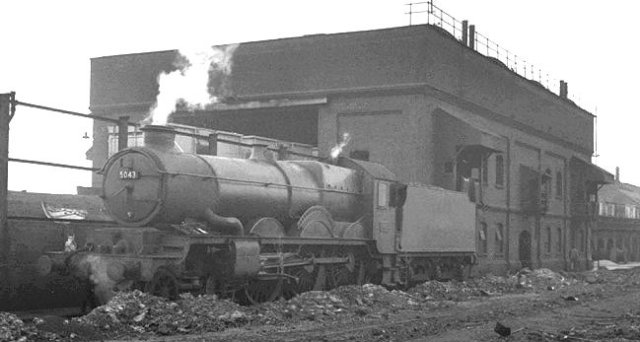
The 1136 from Paddington crunches along a rusted buddleia-ridden single track of the once mighty main line to Birmingham and Birkenhead, pride of the Great Western Railway until it was downgraded during the Beeching cuts of the 1960s.  It passes the back end of the industrial estates off the Great West Road and the bulldozed remains of the Old Oak Common Depot which housed the GWR's Kings and Castles ( including 5043 "Earl of Mount Edgcumbe", seen there above in 1961) but is currently being redeveloped as part of Crossrail.


The 1136 from Paddington crunches along a rusted buddleia-ridden single track of the once mighty main line to Birmingham and Birkenhead, pride of the Great Western Railway until it was downgraded during the Beeching cuts of the 1960s.  It passes the back end of the industrial estates off the Great West Road and the bulldozed remains of the Old Oak Common Depot which housed the GWR's Kings and Castles ( including 5043 "Earl of Mount Edgcumbe", seen there above in 1961) but is currently being redeveloped as part of Crossrail.

Also visible on the journey to Buckinghamshire is the old Art Deco Hoover factory, now a Tesco supermarket, a wooden signal box and even more antiquated semaphore signals sited incongruously near a gigantic modern waste transfer station.

However, the often passenger-less trains to Gerrard's Cross do allow crew training over the route in case of diversions if Marylebone was to shut.  Further north though, there are only four services a day between Helsby and Ellesmere Port in Cheshire. And at Styal, between Crewe and Manchester, just three services a day stop. This appears to be true lunacy, since local campaigners have proved that a stop would not add to overall train times. An even rarer service runs between Frodsham and Runcorn, which has only one train a week – on Saturdays in summer.

Meanwhile, Teesside Airport station - its two platforms a long walk from the terminals - on the Darlington to Middlesbrough line, has an average of one passenger train a week. Durham Tees Valley International Airport's website identifying Darlington as the nearest railhead.

Even more frustrating are the positions of Polesworth, Warwickshire and Norton Bridge, near Stafford, on Britain's busiest main line railway - the West Coast Main Line.

Polesworth, which had six weekday services as recently as the 1980s, now has one – the 07.26 to Crewe. Passengers cannot travel southbound, because the footbridge to the up platform was removed six years ago and no one bothered to put it back.

 And although Norton Bridge has a nameboard and appears in the National Rail Timetable, it has not been served since 2004, when the footbridge was taken down. Passengers would have to get there on a bus that trundles round the back roads of north Staffordshire. However, as darkness falls, Norton Bridge does offer a special spooky charms all of its own, since the platform lamps are said to light up from time to time spontaneously and inexplicably.

Paradoxically though, these obscure stations and lines have their own railway enthusiast following with "Ghosties" seeking them out.  A classic example of this is the Stalybridge Flyer, a two-coach DMU leaving Stockport at 0922 on Fridays only, for the short journey around south Manchester. There is no return service, which may be just as well, since many of the "Ghosties" who pack the services each week find themselves waylaid at Stalybridge by the legendary real ales and homemade black puddings at Britain's most famous railway buffet.