| Home |
EXHIBITION OF THE INTERNATIONAL PLASTIC MODELLING
SOCIETY GLOUCESTER BRANCH
CHURCHDOWN COMMUNITY CENTRE
SUNDAY 12 MAY 2013
|
|
| |
|
|
| |
|
|
|
|
|
| |
INTRODUCTION
|
|
|
|
|
| |
Occasional diversions
to Stratford Park Leisure Centre in Stroud notwithstanding, the annual
exhibition of the Gloucester Branch of the International Plastic
Modelling Society has long been a spring Sunday fixture at Churchdown
Community Centre, Parton Road, GL3 2JH.
As at the twice yearly
exhibitions of the
Cheltenham GWR Modeller's Group,
a small entry fee yields access to purveyors of refreshments, model
kits, accessories, paints, tools, books, artwork and other
media.
However, in place of
layouts defined in a programme the attendance of IPMS Gloucester Branch
members - and those of other plastic modelling societies from as far
afield as Salisbury and the Warrington - guarantees a smorgasbord
of aircraft, ships, road vehicles and other exhibits in a variety of
scales. Some of these truly stand alone while others are
grouped in themes.
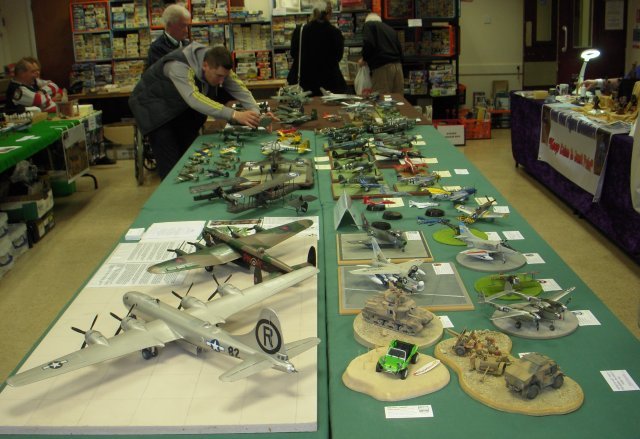
Indeed, this particular Gloucester IPMS exhibition was memorable as the first
time that I had fully participated as a representative of The Jet Age Museum -
with the 1/48 scale
Avro Lancaster and Boeing B-29 Superfortress
seen nearest the camera on the left above. This presentation reinforced
the already strong links between Jet Age and the IPMS and the two
organisations look forward to further creative co-operation in the future.
Although there were too
many other exhibits for each one to be individually described, this feature
focuses on some of the more remarkable items that caught both my
attention and my camera lens on Sunday 12 May 2013.
|
|
|
|
|
|
| |
MILITARY
VEHICLES |
|
| |
|
|
| |
 |
|
| |
|
|
| |
1/35 scale Soviet military vehicles and missile
systems were once again a popular subject at the show, the ancestor of them all
being the BM-13 Katyusha multiple rocket launcher seen above.
First developed and tested in 1938, the combat
vehicle for M-13 rockets was cheaper and easier to build - without precision
machine tools - than conventional artillery and could deliver a large
amount of high explosive to a target area quickly before rapidly moving location
to avoid counter fire - a tactic now known as "shoot and scoot". Against
these advantages however, Katyushas - also known as "Stalin's organs" because of
the noise the rockets made on launch - were relatively fragile, less accurate
than field guns and could take up to 50 minutes to reload.
A battery of four BM-13 launchers could fire a
salvo in 10 seconds that delivered 4.35 tons of high explosives over a
400,000-square-metre impact zone making its power roughly equivalent to that of
72 conventional gun batteries. Although only 40 BM-13s had been built by
the time that the Soviet Union was invaded by Germany in 1941, around 10 000 had
been built by 1945, many based on the successful Lend-Leased Studebaker US6 21/2
ton truck.
However, M-13 rockets were also launched en masse
from trains and boats and even singly from lengths of railway line during urban
warfare. |
|
| |
|
|
| |
 |
|
| |
|
|
| |
While the lorry based Katyusha could be cheaply mass
produced for the USSR, its tank design philosophy since the 1917 October
Revolution had been based on heavy armour and firepower at the expense of
mobility. The need for heavy armour was proved by the Soviet experience of
supporting the Republicans in the Spanish Civil War although the multi-turret
T-35 design had proved disappointing. Its
replacement - named with the initials of Defense Commissar and
politician Kliment Voroshilov - featured a smaller hull and single
turret with a 76mm gun which allowed the installation of heavy frontal and
turret armour while keeping the weight within manageable limits. This
proved highly resistant to Finnish anti-tank weapons during the Winter War of
1939 although to break into the concrete bunkers of the Scandinavian defence a
large-turret 152mm howitzer-fitted version of the KV-1 was rushed into
production.
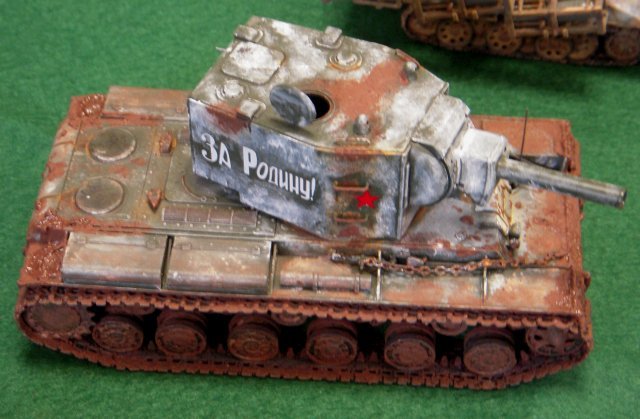
Like its antecedent, the KV-2 - as modelled above
- was so heavily armoured that only a point-blank shot to the rear from the 37mm
and 75mm of the German Panzer III and Panzer IV could defeat it. However,
despite being built with torsion bar suspension and wide tracks to cope with
snow, the KV-2 was difficult to steer, its turret did not traverse well away
from level ground and its 20 year old Caterpillar
transmission was unreliable.
Similarly, the Communist artillery tank now
weighed 45 tons - the same mass as the final versions of the British Churchill -
and was not fitted with a snorkel to allow it to ford rivers. As such,
KV-2s often had to detour miles en route to battle to find bridges strong enough
to withstand their crossing.
By 1942 as well, German 50 and 75mm guns had been
developed to penetrate the existing armour of the KV-2, large parts of which
were also vulnerable to the long barrelled guns of Henschel 129 tank-busting
aircraft. For this reason, as well as the fact that the equally lethal new
T-34 was faster and cheaper to produce, the KV-2 was gradually withdrawn towards
the end of World War II although not before it provided the basis for the
succeeding Joseph Stalin heavy tank.
|
|
| |
|
|
| |
 |
|
| |
|
|
| |
In response to the Soviet T-34, the German army
developed armoured fighting vehicle V - better known as the Panther tank - in
1941 to replace the lighter tanks with which had equipped its armoured divisions
since 1939. Many T-34 features such as the sloping frontal armour, low
profile hull and long barrelled 75mm gun were incorporated into the 690 bhp 29
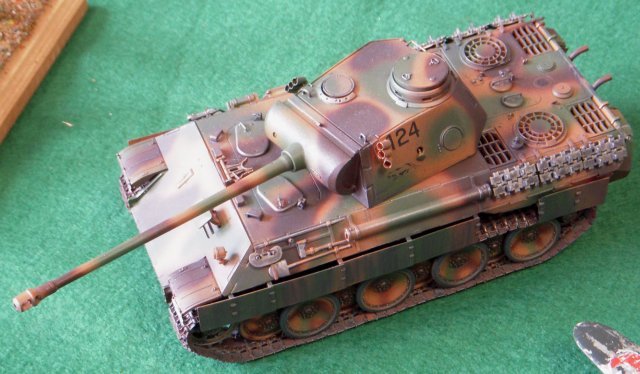
mph Panther. Panther type D - as created
here from the Revell kit - was used for the first time in 1943 and, as can be
seen below the number 4 painted on the turret, featured round ports so that
machine pistol fire from inside the tank could dislodge enemy troops clambering
on to it. The later types A and G, as modelled by Airfix and Matchbox in
1/76 scale, featured a fixed forward firing machine gun in the sloping glacis.
4 814 Panthers were built between November 1942
and February 1945 but although it was individually a match for the T-34 and
outclassed the American Sherman tank both the Panther's opponents were available
in greater numbers and the German tank also proved vulnerable to Hawker Typhoon
and Tempest aircraft. |
|
|
|
|
| |
 |
|
| |
|
|
| |
Following the use of Lockheed F-117A Nighthawk fighters by
the United States Air Force to overcome Iraq's Integrated Air Defence System
during the 1991 Desert Storm campaign, the by-then collapsing USSR launched an
effort to develop capabilities to detect these and other Very Low Observable
aircraft. As it turned out, the Soviets already had part of the answer in
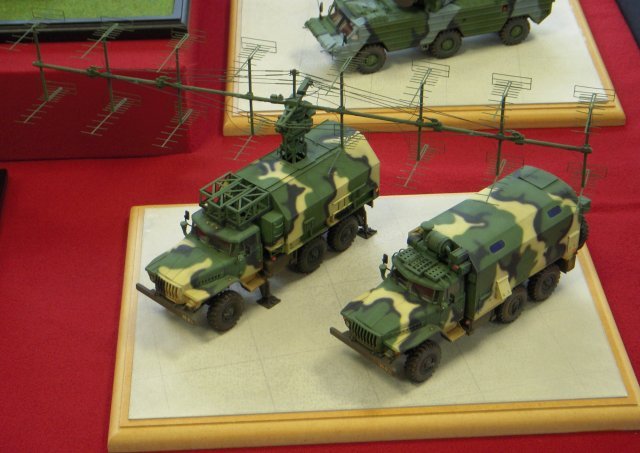
their P-18 mobile radar units as modelled in 1/35 scale above.
The F-117A had been carefully designed with edge alignment,
faceting and other geometrical shaping features to scatter or absorb enemy air
defence radar of a wavelength shorter than the dimensions of the aircraft's main
observable features. As such, to extremely accurate high frequency radars
with wavelengths of a centimetre or less, the F-117A did indeed have a very
small cross section.
However, the P-18 system - known to NATO as Spoon Rest -
worked on VHF or even lower frequencies with wavelengths of a metre or more and
so had the ability to detect smaller Stealth aircraft even if the size of the
Northrop B-2A would still allow its shaping to scatter any radiation aimed at
it.
It was this use of long wavelength radar, combined with
the fact that the F-117A increases in radar signature size when wet or with the bomb bay doors
open, that allowed the 3rd Battalion of the Serb 259th Missile Brigade to detect Nighthawk 82-0806 on 27 March 1999 during
the Kosovo crisis, the subsequent nearby detonation of an SA-3 "Goa" missile
forcing the pilot to eject. Although he was quickly rescued by NATO
forces, the F-117A wreckage fell into Serbian hands and information about its
properties was then transferred to Russian and Chinese aircraft designers, as
witnessed by the model of the
Chengdu Jian-20 Mighty Dragon
displayed at Churchdown in 2012. Apart from
relatively lucky strikes like the one in Kosovo - which also succeeded due to
the use of Serb thermal imaging equipment and laser range finders - low
band radars like the P-18 can still have an important early warning role in an
Integrated Air Defence System, alerting more precise high frequency ground based
and airborne interception radars to focus on the space where a VLO intruder is
likely to be found.
Although such air defence in depth can rob a stealth
intruder of the element of surprise, the angular accuracy of mobile low band
radars has been until recently poor, and the required antenna size results in
ungainly systems which are usually slow to deploy and stow, even if designed
from the outset for mobility. The size and high power emissions of these radars,
mounted on vehicles with limited mobility also makes them much easier to detect
and destroy than typical mobile systems operating in the decimetric and
centimetric bands, which can relocate rapidly after a Shrike or similar anti
radiation missile shot. As such, the US Air Force is
expected to deploy the F-22A Raptor armed with the glide wing equipped GBU-39/B SDB to destroy a defender's low band systems in the
opening minutes of any future engagement, relying on the standoff range of the
weapon and speed and altitude of the second generation VLO fighter |
|
| |
|
|
| |
|
|
|
|
|
| |
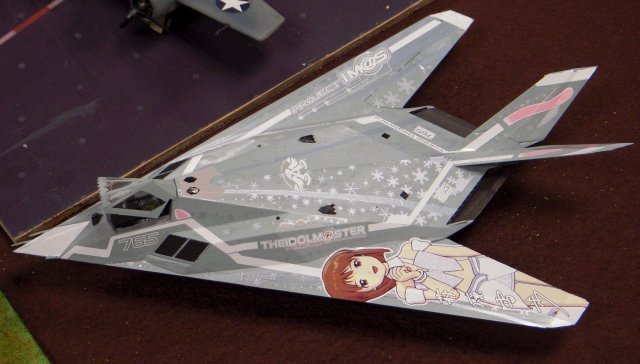
Although the real F-117 was retired in 2007 in favour of more
advanced Stealth aircraft, its iconic shape and legendary performance lives on
in popular culture, especially in Japanese computer games influenced by Manga
comics. Rather than the customary overall black, this particular 1/72
scale Nighthawk was painted in the markings featured in Ace Combat 6: Fires of
Liberation. |
|
|
|
|
| |
 |
|
|
|
|
| |

|
|
|
|
|
| |
The
Krug / SA-4 Ganef
- displayed at Churchdown in 2012 - was the first fully mobile Soviet
battlefield area defence SAM system. Its principal acquisition radar was the
P-40/1S12 Long Track with missile guidance and
target tracking performed by the 1S32 Pat Hand radar - seen above -
mounted on a tank-like chassis. Batteries could also
be integrated with the 9S44 Krab K-1 combat support system which was intended to
fuse data from multiple acquisition radars to facilitate target tracking and
battery control. These could be the P-10 Knife Rest, P-12/18 Spoon Rest, P-15/19
Flat Face, P-15M Squat Eye and P-40/1S12 Long Track.
The Pat Hand combined a cluster of four antennas, the largest of which was a
monopulse narrow beam target track antenna, to the right of which was the monopulse
wide angle missile track antenna. Missile capture and command uplink antennas
are mounted above the pair. |
|
|
|
|
| |
 |
|
| |
|
|
| |
Also joining the 1/35 scale Soviet cubed assets party was this
PPRU-1M Sborka mobile reconnaissance and command post. Based on MT-LBu tracked
AFV the "Dog Ear" - as NATO called it - was equipped with a radar for the
control of tactical air defence missile and artillery systems and was capable of
carrying out target designation on the move. |
|
| |
|
|
| |
 |
|
| |
|
|
| |
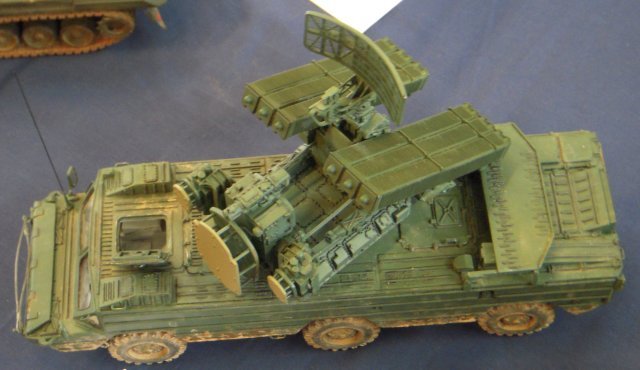
Back in the realm of missile carriers per se, Mick
Ellis of the Salisbury branch of the IPMS brought along launch vehicles for both
the SA-8B Gecko, above, and SA-6 Gainful on its 2P25 transporter erector
launcher below.
Officially designated 9KSS by Soviet Army Air
Defence (PVO-SV), the largely autonomous SA-8 Gecko system was introduced in
1971 and based on the amphibious 6 x 6 BAZ-5937
TELAR chassis to protect armoured divisions on the move from enemy
aircraft approaching at up to 500 metres a second at a distance of 10 Km and
altitudes of up to 5 Km.
The Soviets had been
impressed with the concept of the US Army XMIM-46A Mauler SAM of the 1950s, but
wanted a more capable system. The 9K33 / SA-8 was thus a contemporary of the
Franco-German Roland and the British Rapier Blindfire. All three missiles were
command link guided weapons using a combined search and track radar package
mounted on the launch vehicle.
The initial Soviet
design was by far the most ambitious with four elevating open missile launch
rails each carrying a 9K33A round, and the two radars, including an IFF system
and missile capture and uplink antennas.
The second variant -
designated 9K33M2 / SA-8B, introduced in 1975 and represented in the Dragon kit
- offered an increased payload of 6
folding fin missiles, carried in sealed launcher/container tubes. The improved
missile round had an increased engagement envelope and could engage targets
manoeuvring up to 8G. A key feature was a two channel proximity fuse designed to
compensate for ground clutter and permitting a much lower engagement altitudes.
The third variant,
the 9K33M3 Osa AK / SA-8C Gecko, was specifically designed to engage and destroy
anti-tank helicopters which had become a major concern following the success of
the TOW armed gunships in the 1972 Spring Offensive, in Vietnam. The design
involved further evolution of the proximity fuse design, improvements to the
radar to improve clutter rejection, a more lethal warhead, and refined control
laws for missile guidance.
Operationally, an
SA-8 battery would comprise four missile armed 6 x 6s teamed with a PU-12
command vehicle and a pair of 9T217BM replenishment vehicles combining
the functions of a transporter, loader and fuel tanker.
|
|
| |
|
|
| |
 |
|
| |
|
|
| |
The SA-6 Gainful was another system optimised
against low flying enemy aircraft and with a troublesome and protracted
development process due to ambitious specifications and the use of immature
technology such as the Continuous Wave (CW) semi-active homing missile seeker,
and solid propellant ramjet sustainer powerplant. Introduced in 1968 ten
years after it was first devised, production continued until 1983, when
the SA-6 was replaced by the 9K37 Buk / SA-11 Gadfly.
Once again, a battery of four 2P25 transporter
erector launchers would work with a self-propelled 1S91 multi-tasking engagement
radar system and several 2T7 transloader / transporters, carried on a ZiL-157
truck chassis.
Improvements to the system deployed from 1973
included a greater engagement envelope, a missile seeker with better ability to
defeat seduction countermeasures, the capability to interrupt radar emissions in
order to evade AGM-45 Shrike ARMs, and support for an ARM decoy.
During its combat debut during the Yom Kippur war
of 1973, the 2K12 / SA-6 offered impressive low altitude performance with its
new CW semi-active missile seeker resulting in a much higher success rate
compared to the earlier S-75 / SA-2 Guideline and S-125 / SA-3 Goa systems.
While exact losses continue to be disputed, around 40 aircraft are usually cited
as lost to SAM shots, and the 2K12 / SA-6 proved most effective of the three
weapons despite being used in revetments rather than taking advantage of its
"shoot and scoot" capability. However, captured SA-6 falling into American
hands resulted in the development of the ALQ-162 Compass Sail CW jammer
specifically to defeat it. |
|
|
|
|
| |
 |
|
|
|
|
| |
 |
|
|
|
|
|
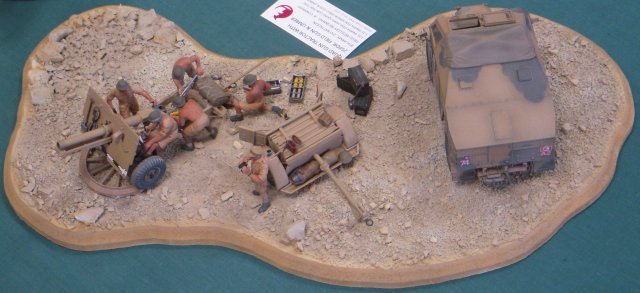
On more familiar ground, Martin Clark of the
Gloucester IPMS contributed this finely wrought diorama based on the 1/35 scale
Tamiya kits of the Morris "Quad" gun tractor and 25 pounder field gun and
limber, as used by A Company, 2nd Battalion Field Artillery Regiment when part
of the British 8th Army in North Africa.
First modelled by Airfix in 1/72 scale in 1963 and
later in the same scale by Esci, the distinctive beetle back of the four
wheel drive Morris Quad was later copied by Canadian military pattern artillery
tractors built on Ford and Chevrolet chassis. This model represents the
later Morris Quad variant with a 2' x 5' canvas covered opening as well as the
observation hatch over the front passenger seat.
First considered in 1918 as a replacement for both
existing 18 pounder guns and 4.3" howitzers, the 25 pounder field gun concept
was revived in 1928, entered production in 1935 and remained in service into the
1960s. With the ability to fire a 3.45" calibre 25lb shell over 13 400
yards, the gun on its wheeled carriage could be depressed by five degrees,
elevated to 40 degrees and traverse by eight degrees, although a 360 degree
traverse could be achieved by the use of the wheel-like firing platform, making
the 25 pounder an important anti-tank weapon until the introduction of more
specialised quick firing 57mm 6lb artillery. The 25 pounder also used separate shells and
explosive cartridges, allowing high explosive, armour piercing and smoke rounds
to be projected to different ranges. | |
| |
| |
| |
 | |
| |
| |
| |
And what should I find on another table but that
very 6lb gun along with a Universal Carrier to haul it!
This was designed as a replacement for the pre
World War II two pounder gun (also fitted to tanks such as the Matilda II) and a
bore of 57mm was chosen as this had been used by the Royal Navy since the 1800s
and manufacturing equipment was readily available. However, although the
new 6lb gun itself was ready by 1940, development of its wheeled carriage was
delayed until 1941 as, after Dunkirk, priority was given to building more of the
familiar two pounders to counter a possible German invasion.
The 6lb QF entered service in North Africa in May
1942 with a conventional two-wheeled split trail carriage and, due to a shortage
of suitable lathes, a short barrel. The version modelled above has the
longer L50 barrel typical of the Mark IV 6 pounder, which was itself supplanted
by the 17 pounder anti-tank gun from February 1943. However, as a smaller
and more agile gun, the 6 pounder stayed in British service until the 1960s.
Indeed, from its first action at Gazala, the six
pounder was found to be able to penetrate the armour of any German tank and even
accounted for the first Tiger disabled in North Africa, its projectile jamming
in the turret before the crew bailed out. The six pounder was subsequently
retrofitted or fitted as new to a range of British tanks and armoured cars and
became the basis of the Ordnance QF 75mm gun - designed to take American made
75mm shells - fitted to the Cromwell tank in 1944.
As it was, the 6 pounder was extensively used by
the US Army where it was referred to as the M1 and a similarly armed Churchill
was the first western tank to knock out a Tiger I in tank versus tank combat in April 1943.
Improved armour piercing shells and sabot rounds also helped keep the six
pounder competitive on the battlefield, although the combination of Panther
tanks - only vulnerable from the rear - and the bocage country of Normandy
brought self propelling rather than towed artillery into tactical favour.
The six pounder, fitted with Molins power loading
equipment, also proved an effective weapon when fitted to Royal Navy gun boats
and some six pounders with automatic loading equipment were also fitted to
"Tsetse" De Havilland Mosquitos for use against enemy shipping and surfaced
U-boats, although these were later replaced by rocket projectiles.
Like the six pounder gun, the Universal Carrier
was made famous to a post War generation by a 1/76 scale Airfix kit but could
already claim to be the most produced armoured fighting vehicle in history with
113 000 built in Britain and abroad from 1934 to 1960. The engine was
placed along the centre line of the vehicle ahead of a final drive to the
tracks, leaving room on either side for passengers or supplies.
In earlier versions, the commander's position
next to the driver jutted forward allowing him to fire a Bren light machine gun
through a slit in the armour - giving rise to the popular but incorrect
nomenclature of Bren Gun Carrier. Indeed, a number of varying versions
appeared before the standard "Universal" format was agreed in 1940.
Prior to 1940, the Carden Loyd tankette-derived
tracked carriers were built by Aveling and Porter, Bedford, Ford, Morris,
Sentinel Wagon Works and Thorneycroft with true Universal Carriers appearing
from Aveling-Barford, Ford, Sentinel and Wolseley Motors. | |
|
|
| |
| |
 | |
|
| |
| |
Bringing back memories of my last visit to the
Isle
of Man was this superb and recherche 1/35 scale Morris Commercial C9/B self propelled Bofors gun.
The Morris C8 had first been developed as a
carrier for machine guns and then a two pounder anti-tank gun, but in 1943 the
anti-tank version was upgunned with the new 17 pounder and the C9/B created to
self propel a 40mm Bofors anti-tank gun.
This 4x4 vehicle was powered by a 30 bhp eight
cylinder engine and along with a similar Canadian built Ford F60B the C/9B
became a familiar sight defending transport columns from enemy aircraft, every
light anti-aircraft regiment having a battery of six SP AA guns attached to it. Several variants existed, but the most common utilised the Bofors
40mm Mk 5 mounting. The frame had no footrests and the firing platform
was modified to take two ammunition boxes. A special seat was fitted to
the top of the back of the left-hand seat to give a higher sitting
position for use with the Mk 5 correctional sight. Four jacks were
fitted to the chassis for stability. |
| |
| |
|
| |
| |
 | |
| | |
| |
 |
|
| |
|
|
| |
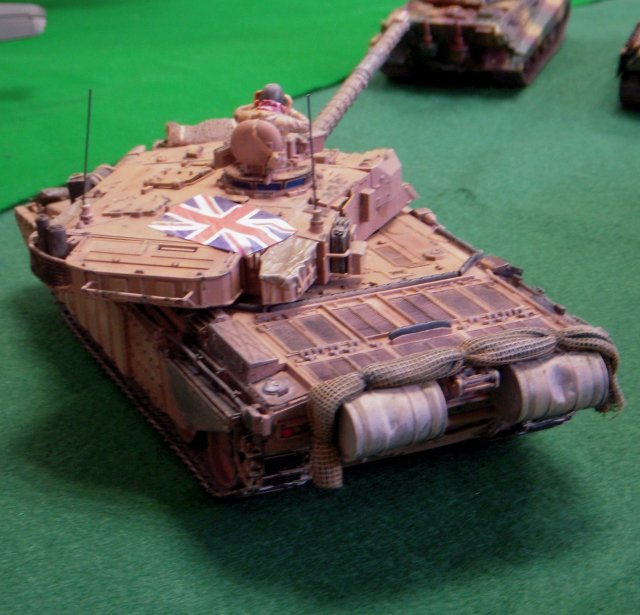
Finally among the 1/35 scale
exhibits was this desert liveried FV4030/4 Challenger 1, the main battle tank of
the British army from 1983 to the mid 1990s, replacing the Chieftain from the
1960s and itself being replaced by the Challenger II.
Indeed, the design began with Iranian interest in an
improved Chieftain Mark V, but after the fall of the Shah of Iran in 1979 the
Military Vehicles and Engineering Establishment completed the project for the
British army. At one time known as the Cheviot and eventually re-using the
name of a World War II cruiser tank, the most revolutionary parts of the
Challenger were its Chobham armour and smooth running hydrogas suspension.
During the First Gulf War in 1991, a combination
of Global Positioning System and Thermal Observation and Gunnery System (TOGS)
helped British Challengers destroy roughly 300 Iraqi tanks without loss in
combat while achieving greater fuel efficiency and serviceability that their US
Army's gas turbine powered M1 Abrams main battle tank. |
|
|
|
|
| |
|
|
|
|
|
| |
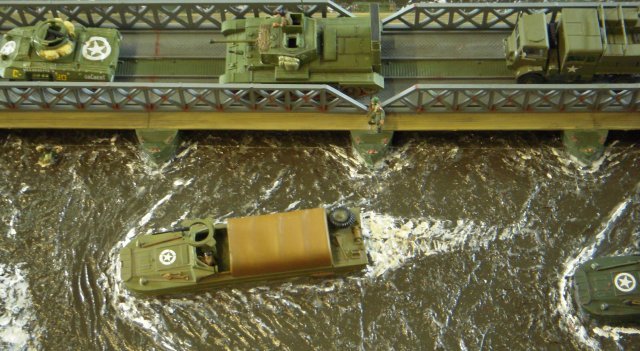
Meanwhile, the Avon Branch of the IPMS continued to prove
that modelling in 1/76 scale is no barrier to super detailing, craftsmanship
and sheer wow factor among fighting vehicles with this diorama of the 1945
Rhine Crossing. As
DUKWs took to the river itself, an Airfix pontoon bridge
was crossed by the same firm's Sherman and Cromwell IV tanks and Bedford QLT
troop carrying lorry.
The
Sherman
has been discussed elsewhere on this website
while the Cromwell represented a new generation of cruiser tanks, still fast
enough to exploit breakthroughs made by "heavies" like the Churchill but
with armour and guns better equipped to face opposing German artillery.
The box like shape of the Cromwell also made it easy to mass produce and the
Rolls Royce Merlin powered vehicle was fitted with Christie suspension like
the Soviet T-34. The resulting fast and agile Cromwell was modelled
here with its wading snorkel raised but without the Cullen hedge cutter
mounted on the front of the hull to create breakthroughs for infantry in the
thickly hedged Normandy countryside. | |
| |
| |
| |
 | |
|
| |
| |
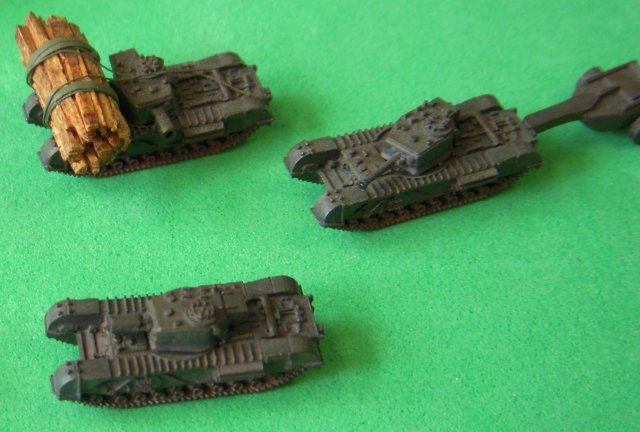
And having mentioned Churchill tanks - as built
by
Gloucester RCW - I could not help being drawn to these
Petard mortar versions (including one with a fascine bundle for spanning
trenches) as well as the flame throwing "Crocodile" - all made from resin in
1/285 scale by GHQ. | |
|
|
| |
|
HELICOPTERS | |
|
|
| |
|
 | |
|
|
|
| | Arthur M. Young
of the Bell Aircraft Company began development of Bell's first helicopter in
September 1941. The prototype (model 30) made its first free flight in June
1943 and improvements to the model 30 led to the development of the model 47
which made its first flight in December 1945.
In 1946, the Bell 47 became the first helicopter
to be certified for civilian use and the US Air Force announced a military
version, the YR-13, in 1947. The US Army placed their initial order in 1948
and designated them H-13B "Sioux" and thereafter all Army helicopters have
been named with American Indian Nation names.
During the Korean Conflict, fifteen H-13s
were converted for medical evacuation using two external litters. The
two-seat H-13D soon followed with a larger engine, the familiar Plexiglas
"goldfish bowl" canopy and twin-skids instead of the earlier four-wheeled
landing gear. The H-13D became famous in the motion picture and television
production "M*A*S*H" (Mobile Army Surgical Hospital) which portrayed its use
in the Korean War.
During the Vietnam War the H-13 was used for basic and instrument training
of helicopter pilots. More than 300 OH-13s served as part of 1300 training
aircraft at the U.S. Army Helicopter Primary Training Center at Fort Wolters
near Mineral Wells, Texas. It was also during the Vietnam War, that the US
Army Air Cavalry modified H-13s with twin .30 calibre, and others with twin
7.62mm machine guns, to test the effectiveness of armed scout helicopters in
combat.
During its 27 year production run, more than 5000 model 47s were produced in
more than 20 variants for civilian and military configurations, and used by
40 different countries. | |
|
| |
| |
 | |
|
| |
|
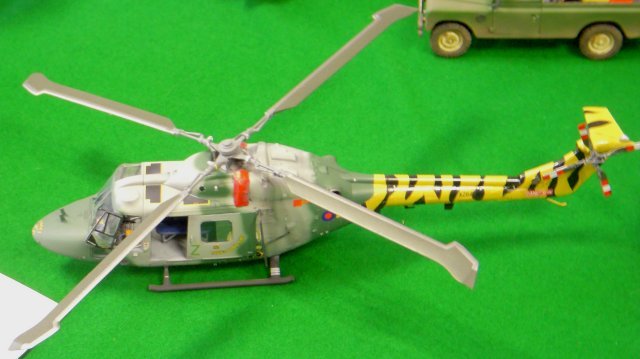
While an overview of the
Westland Lynx is included in the description of the
Joint Harrier Strike
Force elsewhere on this website, the Airfix based 1/48 scale representation
of a British army-format AH-7 made an interesting comparison to the 580
Modeller's 1/32 scale Revell kit of a similarly feline themed Mk 88 German
Navy machine. | |
| |
|
|
| |
 |
|
| |
|
|
| |
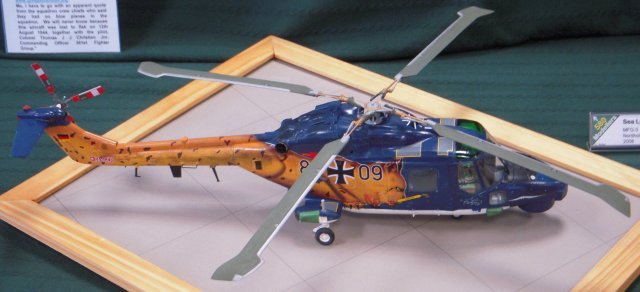
The reliable, agile and versatile
Naval variant of the Westland Lynx has seen it exported to 14 countries around
the World including, since 1981, MFG 3 (Naval Aviation Squadron) "Graf Zeppelin“
at Nordholz where in September 2006 83+09 was painted in a particularly
attractive livery to commemorate the anniversary of 25 years of the shipborne
Sea Lynx. As in the Royal Navy, the wheeled turboshaft helicopter is
optimised to aid a frigate's anti-submarine capability and equipment thus
includes torpedoes or Sea Skua missiles, a 12.7 mm machine gun and variable
depth sonar. More recently, Sea Lynxes of many nations have been used to
deter pirates around the Horn of Africa. |
|
| |
|
|
| |
 |
|
| |
|
|
| |
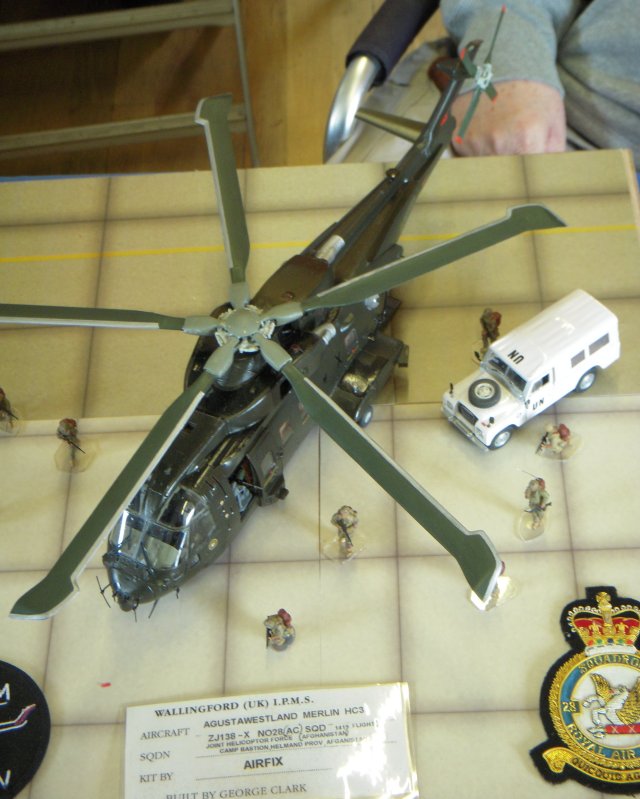
The
AgustaWestland Merlin HC3 is the RAF
version of the AW101 medium-lift
helicopter. Powered by three 2 312shp
RTM322-01 turboshaft engines, the Merlin
HC3 can lift a payload of up to 5 433kg,
including up to 24 troops or a variety
of vehicles and equipment. The Merlin
airframe incorporates many advanced
technologies, such as BERP composite
rotor blades for increased lift and
efficiency, and ACSR vibration control
systems to ensure a smooth ride and
reduced airframe stress.
Entering service in 2001, the Merlin HC3
first saw operational service in the
Balkans in 2003, and served in Iraq
during Operation Telic until July 2009. From 2009,
after being fitted with Kevlar ballistic
armour, Merlin HC3 helicopters operated
in Afghanistan supporting Operation
Herrick, transporting troops, ammunition
and other essential supplies to the
front line of the conflict.
Also used by the armed forces of Denmark and
Portugal, the Merlin is built both in Yeovil and Vergiate as well constructed
under licence in Japan and the United States.
ZJ138 is modelled here from the 1/48 scale Airfix
kit by George Clark of Wallingford UK IPMS and wears the markings of 28 Squadron
- the RAF's first Merlin unit - as operated at Camp Bastion in Helmand Province,
Afghanistan. Unfortunately ZJ138 made a heavy landing in Afghanistan on 23
June 2010 and
although returned to the UK it was written off as not being economically
repairable. The RAF's Merlin helicopter
fleet finished four years of operations
in the dusty conditions of Afghanistan
in June 2013 due to the increasing
handover of military activity from UK to
Afghan forces. During this time
the Merlins flew 18 000 hours and
transported 8 000 tonnes of stores and
equipment and over 130 000 personnel -
many missions involving flights to and
from Camp Bastion, nearly 3 000 feet
above sea level and experiencing summer
temperatures of over 40 degrees
centigrade. |
|
|
|
|
|
| |
PROPELLER AIRCRAFT |
|
| |
|
|
| |
 |
|
| |
|
|
| |
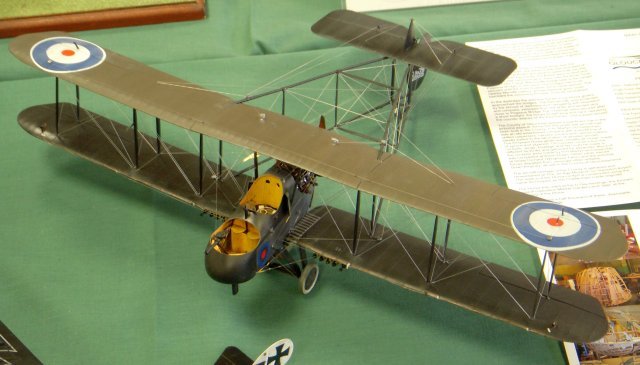
Looking superficially similar to the
single seat DH2 and sharing little more than its
configuration with the F.E.2 flown at Farnborough in 1913, the F.E.2a appeared
early in 1915 and was designed to provide the RFC with an armed reconnaissance
aircraft.
It was a large three-bay biplane, using a flat
centre section and outer panels that were identical with those of the B.E.2c,
and incorporating dihedral. A short nacelle carried the observer/gunner in the
nose ahead of the pilot, and the pusher engine. The tail unit was carried by
four booms extending aft from the wings and comprised a large tailplane with
elevators, a kidney-shaped rudder and small triangular fin above the tailplane.
A small nosewheel was provided ahead of the
oleo-strutted main wheels to help prevent nosing over, and the whole of the
upper wing centre section trailing-edge aft of the rear spar was hinged for use
as a flap-cum-airbrake. Armament normally comprised a 7.7mm Lewis machine gun in
the front cockpit on one of several alternative mounts.
The first F.E.2a flew on 26 January 1915 with a
100hp Green six-cylinder inline water-cooled engine but proved underpowered and
the 120hp Austro-Daimler built under licence by Beardmore became the standard
for 11 more F.E.2a's and early production examples of the F.E.2b.
The latter was the "productionised" version with
the Beardmore engine, trailing-edge flap deleted, simplified fuel system and
other changes to facilitate large-scale production by inexperienced companies.
These comprised, apart from the RAF itself (which built only 47 F.E.2b's):
Boulton & Paul (250); Barclay Curie (100); Garrett & Sons (60); Ransome, Sims &
Jefferies (350); Alex Stephen and Sons (150) and G & J Weir (600).
A 160hp Beardmore engine was adopted later, and
the oleo u/c with nose wheel gave way to a simplified form without the nosewheel
or, later, a non-oleo V-strut arrangement. All 12 F.E.2a's and almost a thousand
F.E.2b's went to RFC squadrons in France, where they engaged in offensive
patrols over the enemy lines in the role of fighter escort for unarmed
reconnaissance aircraft. Over 200 were issued to Home Defence units, some of
these flying as single-seaters, and service use of the F.E.2b continued until
the Armistice in November 1918. |
|
| |
|
|
| |
 |
|
|
|
|
| |
After a model of the
French submarine "Surcouf" was displayed at the
IPMS Gloucester exhibition in 2012
along with its Besson MN-411 floatplane I was most interested to see the
equivalent American Glenn Martin MS-1 - as produced by Esoteric Models - aboard
a section of the United States Submarine S-1.
Also known as
SS-105, the submersible was attached to Submarine Division Zero to investigate
the feasibility and mechanics of carrying aircraft and was modified with a steel
cylindrical storage compartment for the aircraft in disassembled condition.
The first aircraft to operate from S-1 was a German design, the Caspar U.1,
designed by Ernst Heinkel. The USN bought two from the short-lived firm for
initial trials while awaiting the production of two local types, the
wood-and-fabric Glenn Martin MS-1 biplane and the metal Cox-Klemin XS. Six of
each were built and tested in conjunction with the S-1, culminating in the first
complete cycle of surfacing, assembly, launch, recovery, disassembly and
stowing, and submergence, which took place on 28 July 1926 on the Thames
River at New London, Connecticut.
Although the trials leading up to that point were successful, as were further
tests that followed the first full cycle, the USN seemed to lose interest after
proving that it could be done; the twelve aircraft were scrapped and the S-1 was
reassigned to other duties.
One of the problems was that the submarine had to surface to deploy and recover
the aircraft, and another was that it had to partially submerge in order to
float the aircraft on and off the deck, which both took a fair amount of time
and was a safety hazard for the seamen on deck.
Ironically, in World War 2, the US came under attack from Japanese sub-launched
aircraft as the Imperial Japanese Navy had developed the concept while the USN had abandoned it.
|
|
| |
|
|
| |
 |
|
| |
|
|
| |
Arguably
the first homebuilt airplane, the "Flying Flea" - as modelled above from an
Aeroclub kit - was introduced in 1934. It was successfully demonstrated by its
designer/ builder, Henri Mignet, and with the publication in book form of the
plans and instructions soon hundreds of Flying Fleas were being built in homes
across Europe and the United States. A temporary set-back occurred when a number
of these homebuilt Fleas crashed but detailed investigation by the Royal
Aircraft Establishment in England and the French Air Ministry in France revealed
the problem and led to the necessary corrections for safe operation. By 1936
Fleas were again flying and have continued to do so ever since. Variations on
Mignet's original design can be found in many countries around the world.
The Flying Flea was designed to be an
exceptionally easy machine to fly, with no rudder pedals and a simple two-axis
control stick. The main forward wing, of the two tandem wings, pivots for ascent
and descent while the rudder (and the dihedral in the wings) takes care of
turns. Mignet claimed that anyone who could put together a packing-case could
build a Flying Flea and anyone who could drive a car could fly a Flying Flea.
The Flying Flea also had a local connection as one example -
with the registration G-ADXS - was displayed
at the
Skyfame Museum at Staverton Airport in the 1960s. |
|
| |
|
|
| |
 |
|
|
|
|
|
Like the Supermarine Spitfire, the de
Havilland Mosquito has been celebrated in countless books and
videos, although this 1/48 scale example with the civilian
registration G-AGGE was one of a rare few used from 1943 to 1945 to
fly across the North Sea from RAF Leuchars in Scotland to Stockholm
in neutral Sweden to bring back small but high value cargoes such as
precision ball bearings and machine tool steel.
Lockheed Hudsons and Lodestars were also used but these slower aircraft could only
fly this route at night or in bad weather to avoid the risk of being
shot down.
During the long daylight hours of the Northern summer, the Mosquito
- flown by aircrew who were nominally civilian BOAC employees - was the only safe alternative.
Occasionally, important passengers were
carried in an improvised cabin in the bomb bay, one notable
passenger being the Danish Nobel Prize winning physicist Niels Bohr who was evacuated from Stockholm in 1943. The flight
almost ended in tragedy as Bohr did not don his oxygen equipment as
instructed, and passed out. He would have died had not the pilot,
surmising from Bohr's lack of response to intercom communication
that he had lost consciousness, descended to a lower altitude for
the remainder of the flight. Bohr's comment was that he had slept
like a baby for the entire journey!
Once in Britain, Niels Bohrjoined the
British Tube Alloys nuclear weapons project, and was part of the
British team of physicists who worked on theManhattan Project to
develop America's atomic bomb - as dropped by the B-29 Enola Gay. |
|
| |
|
|
| |
 |
|
| |
|
|
| |
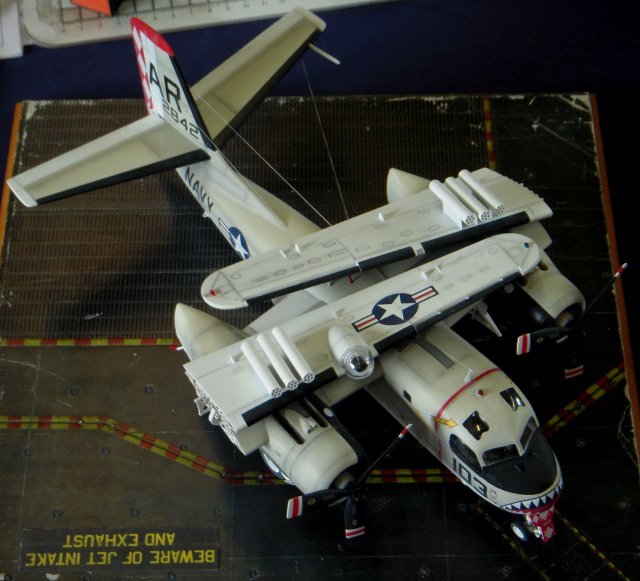
The original US Navy
requirement G-89 that gave rise to the
Grumman
Tracker was for a twin engine aircraft capable of carrying
weapons, sonobouys, a Magnetic Anomaly
Detector (MAD) and search radar from a
carrier flight deck. The contract to build the
new anti-submarine aircraft - originally
designated XS2F-1 - was signed on
30 June 1950.
Grumman’s 265
mph large high-wing monoplane powered by twin
Wright Cyclone radials first flew on 4 December
1952 with production aircraft entering service with VS-26 in
February 1954. Follow-on versions included the WF Tracer and TF
Trader, which became the E-1 Tracer and C-1
Trader in the American military re-numbering of
1962. The S-2 carried the nickname ‘Stoof’
(S-two-F) throughout its military career.
Grumman produced 1 185 Trackers
with export customers including Argentina,
Australia, Brazil, Japan, South Korea, Peru,
Taiwan and Turkey. Another 99
aircraft carrying the CS2F designation were
manufactured in Canada under license by de
Havilland Canada.
Unlike the
Fairey Gannet which it replaced in
Royal Australian Navy service, the Grumman Tracker was a somewhat
more conventional aircraft capable of both
detecting and attacking enemy submarines. As an
all-weather carrier borne aircraft, the Tracker
could also operate well beyond the range of the Royal Australian Air Force’s land-based
Lockheed Neptune and Orion maritime
patrol aircraft.
Trackers could also work in conjunction with
Naval helicopters like the Wessex that were
equipped with dipping sonars, capable of
detecting submarines. The Tracker’s ASW fit
included sonobuoy ejector tubes, with sixteen
built into the rear of each engine nacelle and
firing straight out the back; a 70 million
candlepower searchlight mounted on the right
wing; an APS-38 search radar in a retractable
ventral ‘dustbin’ radome, behind the weapons
bay; and a retractable ASQ-10 magnetic anomaly
detector (MAD) boom in the tail. Its long wings
and powerful engines allowed it to operate from
small carriers and short airfields.
The wings were folded hydraulically and a
small tail wheel was fitted at the rear to act
as a bumper on carrier landings. Flaps, slots
and spoilers further enhanced this short
take-off capability while the large rudder
allowed it to fly on one engine.
Land based Trackers, operating from Broome
(Western Australia) and Darwin (Northern
Territories) were also used for coastal
surveillance up to the mid 1980s to help detect illegal
immigrants and smuggling operations, after which
they were replaced by Sea Sprite
and Seahawk helicopters.
|
|
| |
|
|
| |
 |
|
| |
|
|
| |
Like its larger turboprop engined
successor
the MQ-9 Reaper,
also built by General Atomics, the
Rotax piston engined
MQ-1
Predator is a medium
altitude long endurance (MALE) Remotely Piloted Air System (RPAS) primarily used
as an Intelligence, Surveillance and Reconnaissance (ISR) asset, employing
sensors to provide real-time data to commanders and intelligence specialists at
all levels. The 1994 vintage Predator
can fly up to 400 nautical miles (740 km) to a target, loiter overhead for 14
hours, then return to its base.
Its secondary mission is to provide close air
support to units near its operational airspace and as such has been upgraded to
carry two AGM-114 Hellfire missiles and other munitions - making it the first
weaponised RPAS and, according to the Smithsonian's Air and Space magazine, one
of the ten aircraft that changed the World. The
MQ-1
Predator is currently operational with the USAF (owners of this Nellis
AFB example) US Navy, US Government, and the Italian Air Force. |
|
|
|
|
|
| |
 |
|
| |
|
|
| |
The first RAF General Atomics MQ-9 Reaper
was delivered to Afghanistan in October 2007 and the first armed mission flew in
May 2008. UK Reapers are normally armed with two GBU-12 500lb laser guided
bombs and four AGM-114 Hellfire missiles, although this number can be changed to
suit particular missions.
The Rules Of Engagement used for Reaper weapon release
are no different to those used for manned combat aircraft; the weapons are all
precision guided, and every effort is made to ensure the risk of collateral
damage and civilian casualties is minimised, this may include deciding not to
release a weapon. UK Reaper is not an autonomous system and does not have the
capability to employ weapons unless it is commanded to do so by the flight crew.
The majority of the weapons employed from Reaper have been Hellfire missiles.
Hellfire has a relatively small warhead which helps minimise any risk of
collateral damage. Regardless of the type of weapon system employed, a full
collateral damage assessment is conducted before any weapon release; this is
irrespective of whether that weapon is released by a manned or remotely piloted
aircraft.
The Reaper system consists of four Reaper Remotely Piloted Aircraft (RPA), two
Ground Control Station (GCS), communication equipment/links, spares, and
personnel from all 3 services and contractor ground crew. At present the UK has
5 aircraft with a further 5 on order with associated ground equipment, spares
and personnel. Each Reaper aircraft can be disassembled into main
components and loaded into a container for air deployment worldwide on aircraft
such as the C-17 and C-130J.
The 950 shp turboprop Reaper - distinguished by its upward facing tail surfaces
and three bladed propeller - is operated by 13 and 39 Squadrons,
Royal Air Force from RAF Waddington. The aircraft is operated by a pilot and a
sensor operator aided by a non-aircrew Mission Coordinator (MiC). In support of
current operations the Reaper RPA is launched and recovered from an airfield
within Afghanistan by crews deployed in theatre. The current aircrew of UK
Reapers have all been previously qualified as pilots on other military aircraft
such as Tornado, Harrier, Apache, Nimrod, Puma and C-130.
Some nice touches on this 1/72 scale model were the trolley
and "Danger Aircraft Armed" sign. |
|
|
|
|
| |
 | |
| |
| |
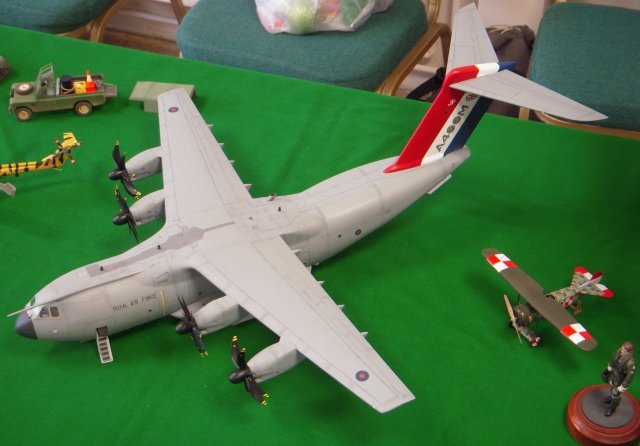
| | The A400M is
Airbus Military's first bespoke product and traces its roots to a European
Staff Requirement for a 21st Century airlifter more capable than the C160
Transall and C-130 Hercules of purchasing countries' air forces in both the
tactical and strategic role. The A400M was also designed from the outset to
provide an aerial refuelling capability, and the first development aircraft
rolled out from Airbus Military's Seville plant on 26 June 2008.
Featuring the largest Western turboprop engines
to date - built by Europrop International - turning massive
eight-bladed scimitar propellers, the first Grizzly, as the five
developmental aircraft became nicknamed, was flown on 11 December 2009.
When in RAF service, the aircraft will be
capable of carrying a load of 32 tonnes over a range of 2300nmls - without
refuelling - at speeds comparable with pure-jet military transports; The
A400M will also be capable of operating as low as 150 feet above ground
level or at altitudes to 37 000 feet and deploy troops and/or equipment
- including two Apache or Puma helicopters - between and within theatres of
operation either by parachute (up to 108 paratroopers), or by landing on
short, unprepared or semi-prepared strips.
The two-pilot flight deck crew will have the
benefit of an integrated, digital avionics system in the cockpit and a
fly-by-wire control system. Additional systems will provide a
night-vision-compatible glass cockpit complete with two head-up displays
supported by at least five multi-function displays that will allow
state-of-the-art avionics developments to be incorporated to the flight-deck
design, so greatly reducing crew workload. A modern Defensive Aids Suite
will be fitted, incorporating radio and infra-red frequency detectors,
electronic-countermeasure equipment and chaff/flare dispensers. | |
| |
|
|
|
JET AIRCRAFT |
|
| |
|
|
|
 |
|
| |
|
|
|
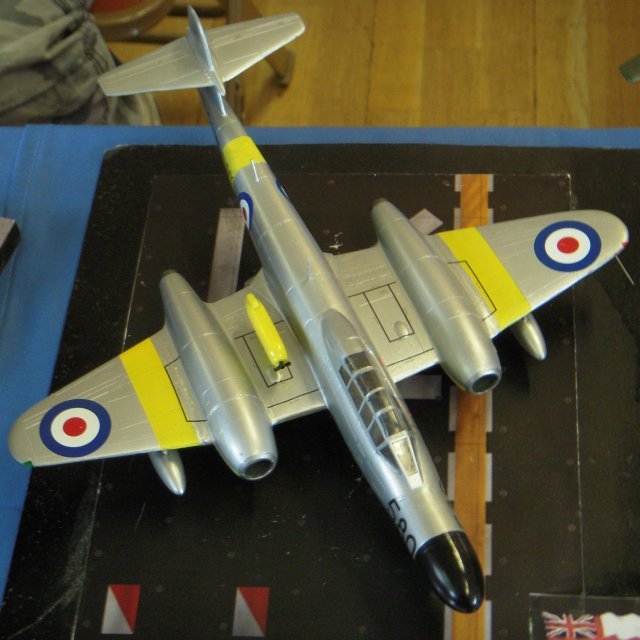
More evidence of the continuing
interest by modellers in Gloster Aircraft were these Royal Navy Meteors made by
George Clark of Wallingford (UK) IPMS from Classic Airframe kits.
Black and Dayglo
orange T7 WS103 / 709 VL was represented as part of the Station Flight at RNAS Yeovilton
in 1966 but had been built to contract 6/Aircraft/6410/cb7(b) issued on 28 April
1951. The twin engined two-seat trainer first joined 703 Naval Air
Squadron at RNAS Ford from 18 December 1953 before flying from such diverse
locations as Gosport, Lossiemouth, Hal Far and Brawdy. After first being
stored at RAF Kemble, WS103 is now preserved in the Fleet Air Arm Museum's
Cobham Hall in Yeovilton.
Armstrong Whitworth built Target Tug 20 WM147 /
580 - converted from an early marque of night fighter - meanwhile appeared
in the silver and yellow of 728 Squadron during 1957-58. |
|
| |
| |
| |
 | |
| |
| |
| |
 | |
|
|
|
|
Moving on a generation
in British jet design was this twin seat Hawker Hunter T7 in the markings of The
Black Arrows. 111 Squadron RAF first formed an unofficial display team
with four Gloster Meteor F8s in 1955 and after converting to the Hawker Hunter
in 1956 five of their F6s became the official achromatic aerobats of the service
- earning their nickname at the 1957 Paris Air Show. In 1958 the team
increased to nine aircraft and at that year's Farnborough show 111 Squadron
rolled and looped no less than 22 Hunters in formation. The Black Arrows
also pioneered the use of smoke generators in aerobatics before converting to
English Electric Lightning aircraft. |
|
|
|
|
| |
 | |
|
| |
| |
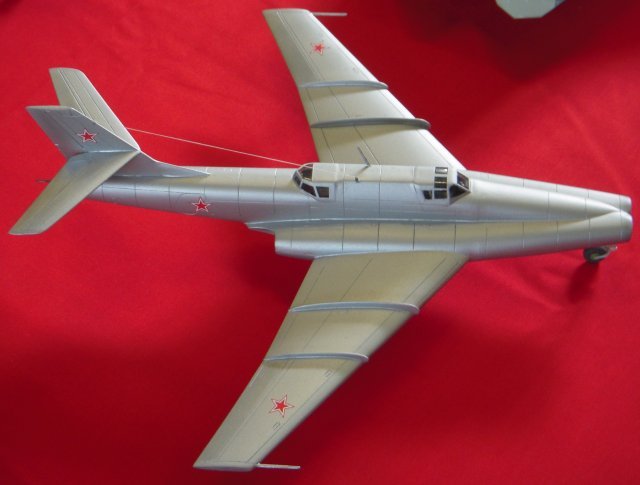
East of the Iron Curtain, the
first prototype of the Ilyushin design bureau's Il-40 ground attack
aircraft first flew in 1953. Envisaged as a jet propelled successor to
the Il-2 Sturmikov that had proved so effective a ground support aircraft in
World War II, the Il-40 (known by NATO as Brawny) was an aerodynamic success
but, like the early Hawker Hunters, suffered from a tendency for exhaust
gases from its forward firing guns to cause the gas turbines to flame out.
Ilyushin took a year to remedy this problem
which, as can be seen below, involved the two engine intakes being extended
to the very front of the aircraft with the guns being moved under the
fuselage just behind the nose wheel. However, despite being ordered
into production in 1955 the whole programme was cancelled in 1956 when only
five aircraft had been built as the Soviet Air Force discarded the concept
of close air support in favour of deploying tactical nuclear weapons. | |
| |
| |
| |
 | |
| |
| |
| |
In 1967 however, the Soviet Air Force once again
drew up a specification for a jet-powered shturmovik - or armoured ground attack
aircraft. While Sukhoi designed its ultimately successful single seat Su-25 "Frogfoot"
as an all-new aircraft, Ilyushin proposed a modified version of the Il-40 under
the designation Il-42. The design with the remotely controlled rear gun turret -
seen below - was rejected by the Soviet Air Force, but Ilyushin decided to
continue development as a private venture, renaming the programme Il-102.
The Il-102 prototype first flew on 25 September 1982
- with a second airframe built for static tests - and carried out 250 test
flights until it was grounded in 1984 when the life of its two Klimov RD-331
turbofans expired. Although development was abandoned in 1984, the
prototype Il-102 was publicly unveiled at the 1992 Mosaeroshow at Zhukovsky as
being available for export. As of 2005, the prototype was mounted on a pedestal
at the Gromov Flight Research Institute. | |
| |
| |
| |
 | |
| |
| |
| |
 | |
| |
| |
| |
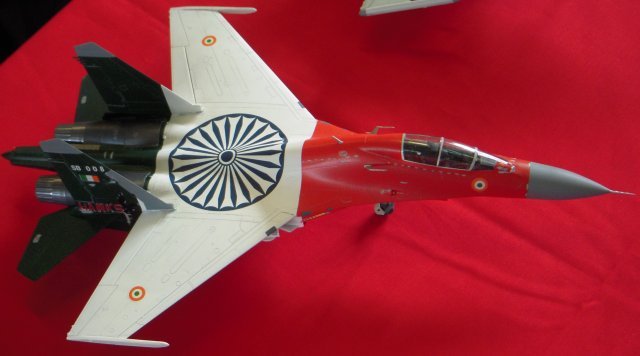
A much more successful design
powered by two Klimov RD-331 turbofans - albeit with afterburning - was the
Mikoyan-Gurevich MiG-29. First flown on 6 October 1977, in service
from July 1983 and known by the NATO reporting name of Fulcrum, the MiG-29
was designed, along with the larger Sukhoi Su-27, to counter the McDonnell
Douglas F-15 Eagle and General Dynamics F-16 Fighting Falcon. However,
more recent versions are also capable of ground attack missions with
precision weapons and have been upgraded with better engines, glass cockpits
and flight refuelling capability.
Mikoyan has been a subsidiary of United
Aircraft Corporation since 2006 and MiG-29s are or have been operated by 30
export customers, including Venezuela and most notably India where it is
known as the Baaz ( Hindi for "Hawk") | |
| |
| |
| |
 | |
| |
| |
| |
 | |
| |
| |
| |
During the early days of the
Vietnam War, the United States Air Force had almost full autonomy over the
skies. However, by 1965 the Soviet Union and China had armed the North
Vietnamese Army, with SA-2 Guideline radar guided surface to air missile
systems which were then challenged by "Wild Weasel" flights specifically
tasked with locating and destroying SAMs
Often the only way the Weasel pilots could
locate a SAM site camouflaged in thick jungle was by getting the NVA to fire
a missile at them, thus revealing their position. Losses in Weasel squadrons
flying the F-100F Super Sabre were among the highest of the war until the
U.S. Air Force deployed the Republic F-105G Thunderchief as a dedicated
Weasel aircraft in 1967.
The F-105 "Thud" had been introduced in the
1950s as a single engined strategic nuclear bomber but eventually conducted
over 75% of the USAF bombing strikes during the war. The F-105G was a
converted F-105F with upgraded Radar Homing and Warning capability and the
AGM-78 anti-radiation missile with four times the range of the Shrike it
replaced.
F-105Gs - as depicted in this model made from
a 1/32 scale Trumpeter kit - would either fly in front of a bomber force
"going downtown" into North Vietnam, clear any SAMs and keep them pinned
down for the duration of a raid or lead a group of hunter/killer aircraft
which would swoop on any SAM site locking on to them. However, during
these missions Weasel aircraft were also vulnerable to anti-aircraft
artillery and MiG-17 fighters.
Weasel flights continued in support of ground
troops and reconnaissance missions during the cessation of American bombing
from 1968 to 1972 but led the way again during Operations Linebacker and
Linebacker II after which the North Vietnamese entered into peace
negotiations. By this time the Wild Weasel role was beginning to be
taken over by the McDonnell Douglas F-4G Phantom II. | |
| |
| |
| |
 | |
| |
| |
| |
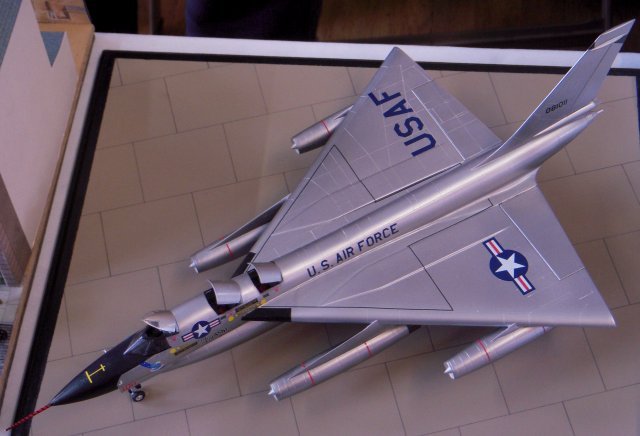
First flown on 11 November 1956, the Convair B-58
Hustler was the first operational jet bomber capable of Mach 2 flight.
Designed for the USAF's Strategic Air Command by Robert H. Widmer, the B-58 used
the same delta planform and slender fuselage as Convair's esrlier Dart and
Dagger fighters but featured four General Electric J79 engines in pods under the
wings and a nuclear weapon and fuel in a pod under the fuselage rather than in a
bomb bay.
Like the Bristol 188 research aircraft being
developed at the same time, the B-58 - flown by a pilot, navigator/bombadier and
defence systems operator - made extensive use of
heat-resistant honeycomb sandwich skin panels
Replacing the Boeing B-47 Stratojet, the Hustler
was designed as a high level medium bomber but developments in Soviet SAMs
forced it into low level penetration tactics which were compromised by its
range. Never used in anger as a conventional bomber, it was only in
service from 1960 to 1970 when it was replaced by the smaller swing-wing F-111A.
Before its retirement
however, the Hustler set 19 world speed and altitude records and five different
aviation trophies.
Interestingly, both B-58
and F-111 were equipped with escape capsules rather than conventional ejection
seats, the B-58s being retrofitted by the Stanley Aircraft Corporation in 1962.
Design to allow aircrew to eject safely at twice the speed of sound and from as
high as 70 000 feet, the capsule sealed the aircrew inside airtight clamshell
doors with an independent pressurised oxygen supply system. The occupant
could either continue the ejection by firing the rocket motor or remain secure
in the capsule until a lower altitude where he no longer needed a pressurized
cabin. The pilot's capsule also had the control stick and other controls needed
to fly the aircraft to a lower altitude. After ejection, a parachute lowered the
entire capsule to the ground, and shock absorbers eased the impact. If the
capsule landed in water, manually operated flotation cells turned it into a life
raft and provided stability. | |
| | | |
| |
 | |
| | | |
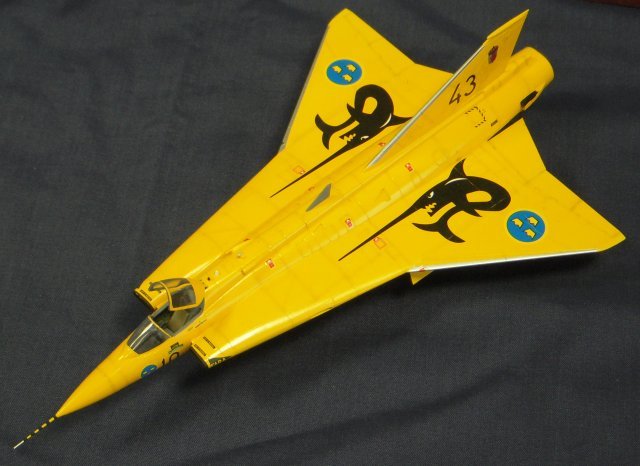
| | In September 1949
Sweden foresaw the need for a jet fighter that could intercept bombers at
high altitude and also successfully engage fighters. Other requirements were
the capability to operate from reinforced public roads and for refuelling
and rearming to be carried out in no more than ten minutes by conscripts
with minimal training.
Saab, already having built the J-29 Tunnan
and later J-32B Lansen warplanes, met this challenge with a
delta-within-delta planform, the inner 80 degree sweep allowing high speed
while the outer 60 degree section giving good low speed performance.
So radical was this idea that it required Sweden's only sub-scale test
aircraft, the Saab 210 "Lilldraken", first flown on 21 January 1952 and its
success led to the first true Saab 35 Draken flight on 25 October 1955.
Powered by a Swedish built afterburning copy of a Rolls Royce Avon turbojet,
the second Draken unintentionally broke the sound barrier while climbing.
In Swedish service from 1960 to 1998, the
Draken preceded the Saab 37 Viggen (with two separate delta wings) and the
current JAS 39 Gripen as well as being exported to Austria, Denmark and
Finland. Rather than pure interceptors, the Danish Drakens - retired
in 1993 - were ECM and strike aircraft, the latter carrying the American
AGM-12 Bullpup missile.
In contrast Austria kept its Drakens until
2005, the refurbished J-35D versions being the last Austrian Air Force
fighter with just two internal cannon rather than air-to-air missiles which
were banned under the 1955 Austrian State Treaty. However, these
restrictions were lifted in 1993 due to airspace violations from the nearby
Yugoslavian internal conflict on its southern border. AIM-9 Sidewinder
fitted Drakens were replaced by former Swiss Northrop Tiger IIs and
will themselves make way for Eurofighter Typhoons.
Six of the Danish Drakens were acquired by
the National Test Pilot School in the USA and three of these are still
operational at Mojave Spaceport.
This model, in special Swedish markings, was
made from the 1/72 scale Hasegawa kit. | |
| | |
| |
 |
|
| |
|
|
| |
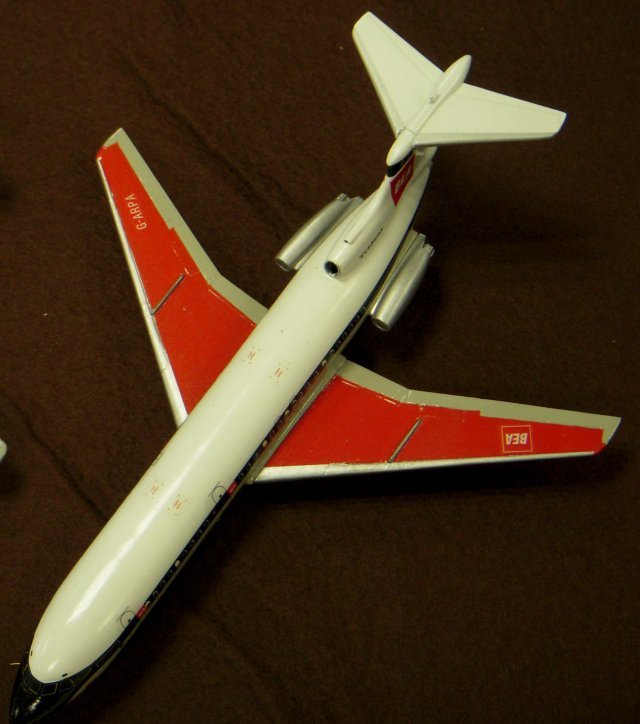
Two Airfix kits with alternative decals
represented Hawker Siddeley built airliners or developments thereof at the show,
starting with the 1/144 scale HS 121 Trident 1C with S&M markings by Robert
Hepple of the IPMS Gloucester branch.
The Trident was the World's first T-tailed
airliner with three rear mounted engines and also, thanks to Gloucestershire
based Smiths Industries, the first jet airliner to make a blind automatic
landing in revenue earning service. Its short to medium haul concept began
in the late 1950s as the De Havilland 121 but development was hampered by the
government-led consolidation of the British aircraft industry following the 1957
Duncan Sandys axe, changing requirements of British European Airways, a proposal
to share production with American companies and competition with the similar
format
Boeing 727 from 1964.
G-ARPA, as modelled here, was the prototype
Trident 1, first flown from Hatfield on 9 January 1962 and later modified to 1C
standard with a larger fuel tank in the centre section of the wing to give the
increased range that would appeal to airlines in America. G-ARPA
(constructor's number 2101) appeared at the 1962 Farnborough Air Show in the
colours of BEA, which took delivery in late 1963 before services began in March
1964.
The early Tridents were found to be underpowered
and the improved Trident 1E had more engine power and also had high lift slats
fitted and a bigger capacity. Improvements proposed by BEA eventually led to the
more successful Trident 2, with the more powerful Spey 512 and a much better
range. The first Trident 2 entered service in 1968.
The Trident 3, with a 16ft 5in stretched fuselage
and seating up to 180 was then chosen by BEA to replace its Vanguard and Comet
fleets although the limited engine power offered by the Spey meant that a small
booster had to be fitted in the base of the tail giving either the option of a
shorter take off run or an increase in capacity. The extra engine, coupled with
an overall reduction in fuel capacity, meant that the Trident 3 had a much
shorter range than the Trident 2 when it entered service in 1970.
117 Tridents were built up to March 1978 with 35
aircraft sold to the Chinese national airline CAAC as its first western built
short haul jet airliner. By this time BEA and BOAC had merged to form
British Airways and the Trident became one of the new flag carrier's longest
serving airliners before being retired in 1986.
|
|
| |
|
|
| |
 |
|
| |
|
|
| |
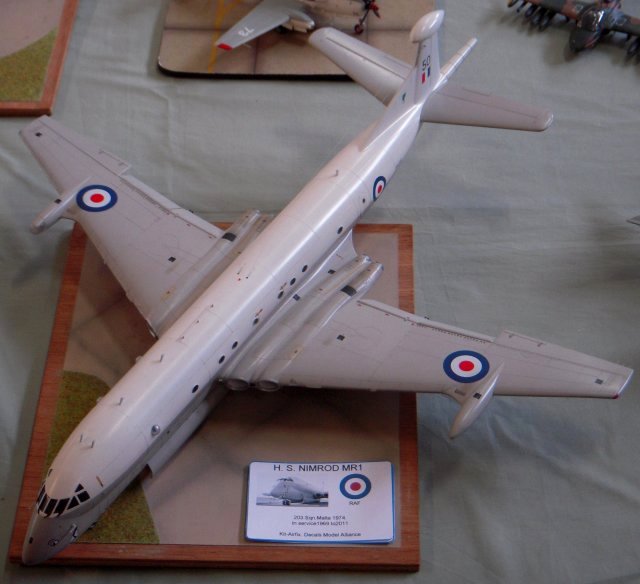
Although not the first of its type, XV250 -
built here from the 1/72 scale Airfix kit, was one of the first examples of a Hawker Siddeley Nimrod MR1,
built in response to Air Staff Requirement 381 issued on 4 June 1964 to replace
the Avro Shackleton, itself based on the Avro Lancaster bomber. Existing
maritime patrol aircraft considered to fulfil ASR 381 included the Bregut
Atlantic and Lockheed P-3 Orion while modified versions of Hawker Siddeley
Trident and BAC One-Eleven were also initially in the frame.
On 2 February 1965 however, British Prime Minister
Harold Wilson announced the intention to order Hawker Siddeley's HS.801 version
of the Comet IV which was by then nearing the end of its market life.In fact the
first two prototype Nimrods, XV148 and XV147, were built from two final
unfinished Comet 4C airframes.
The Comet's Rolls Royce Avon turbojet engines were
then replaced with Spey turbofans which were more efficient at lower altitudes
while fuselage modifications including an internal weapons bay, an extended nose
for radar, a new tail with electronic sensors mounted in a bulky fairing, and a
magnetic anomaly detector tail boom. After the first flight in May 1967, the RAF
ordered 46 Nimrod MR1s - the first example, XV230 entering service in October
1969.
Five squadrons were eventually equipped with the
Nimrod MR1 while three Nimrod aircraft - without tail booms - were adapted
to the signals intelligence R1 format, replacing the Comet C2s and Canberras of
No. 51 Squadron in May 1974.
Starting in 1975, 35 aircraft - including
XV250, now preserved at the Yorkshire Air Museum,
Elvington
- were upgraded to MR2 standard, being re-delivered from August 1979 with new
electronics and other equipment and distinguishable by the presence of wingtip
pods and vertical fences on the tailplane. These were further modified
with flight refuelling and AIM-9 Sidewinder missile capability for use in the
1982 Falklands War and given extra ECM capability for Operation Granby in 1991.
Eleven existing Nimrod MR1s were converted to AEW3
standard before the costly and over-running scheme to replace the Shackleton
Airborne Early Warning aircraft was cancelled in 1986 and Boeing E-3 Sentries
purchased off-the-shelf instead. Similarly, the plan to convert MR2
fuselages to MR4 standard with larger wings and new Rolls Royce BR710
turbofans also ran past its 2003 delivery date and all Nimrods were withdrawn
from RAF service in 2010. The R1s have been replaced by Boeing RC-135 Rivet
Joint aircraft, like the E-3s derived from the Comet's rival the Boeing 707. |
|
|
|
|
|
| |
 |
|
|
|
|
|
It was Joseph Stalin who once said that "Quantity has its own
quality" but even he would have been impressed by the table full of
beautifully assembled 1/72 scale Panavia Tornados on display at Churchdown
Community Centre.
First flown on 14 August 1974, main variants of the British/
German / Italian twin engined variable sweep combat aircraft in service from
1980 include the Interdictor / Strike (IDS), Electronic Combat /
Reconnaissance (ECR) and Air Defence Variant (ADV)
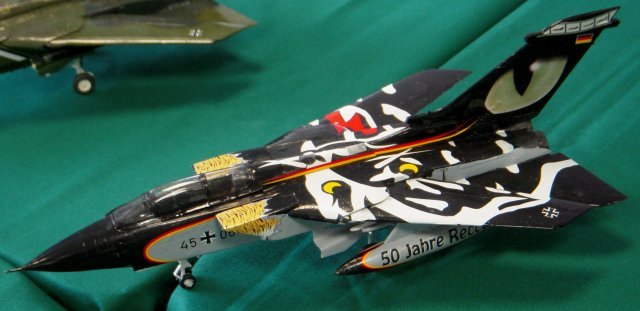
Among the IDS variants was 45+06 (constructor's number
518/GS159/4206) of the Luftwaffe's AG51 in a special "50 Years of
Reconnaissance" colour scheme worn to the 2009 NATO Tiger Meet (above) while
in RAF service the IDS has progressed from GR1A to GR4 standard, as
witnessed by ZD748 seen below in the 95th Anniversary markings of 2 (Army
Co-operation) Squadron.
Formed on 13 May 1912 along with 1 and 3 Squadrons in the
Royal Flying Corps, "Shiny Two" was later awarded the motto of "Hereward"
(Guardian of the Army) and the Wake Knot as its crest. Since
re-equipping with Tornado GR4s in 2003, Marham based 2 Squadron has taken
part in operations over Iraq, Afghanistan and Libya. | |
| |
| |
| |
 | |
| |
| |
| |
SHIPS
|
|
|
|
|
|
| |
 |
|
| |
|
|
| |
Evoking memories of the
still-available Airfix kit was this superbly wrought model of a 72' 6" Vosper
MTB moulded in 1/35 scale by Italeri. Motor Torpedo Boats were designed
for high speed, operating at night, low speed ambush (to keep noise low and to
produce no wake) and manoeuvrability on the water to enable them to get close
enough to launch their torpedoes at enemy vessels. With next to no armour, the
boats relied upon surprise and their agility at high speed to avoid being hit by
gunfire from bigger ships. The Vosper MTB carried 13 crew to operate two 21"
torpedo tubes and three petrol engines with a total output of 4 050 bhp and
yielding a maximum speed of 38 knots. |
|
| |
|
|
|
 | |
|
|
|
|
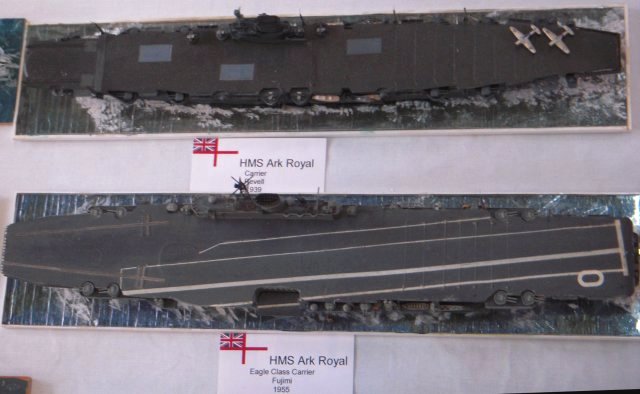
"And where is the Ark
Royal?" asked Lord Haw Haw in his radio propaganda broadcasts for Nazi Germany.
Had William Joyce not been hanged for treason, he might have found two
incarnations of the famous aircraft carrier at Churchdown!
The third HMS Ark Royal,
as represented by the Revell kit at the top of the picture above, was
commissioned in 1939 and was the first aircraft carrier on which the flight deck
and hangars were an integral part of the hull rather than added to the
superstructure. The Fairey Swordfish aircraft of most expensive ship
ordered by the Royal Navy at that time were instrumental in sinking the German
battleship Bismark in May 1941 before the "lucky" 91 was finally torpedoed near
Gibraltar and sunk on 14 November that year.
Work on the fourth HMS
Ark Royal - this time with the pennant number R09 - began in 1943 - again at the
Cammell Laird yard in Birkenhead. Launched in 1950 and commissioned on 25
February 1955, this was the world's first aircraft carrier to be commissioned
from new (as opposed to modified with) an angled flight deck preceding the first
American carrier commissioned with this feature, the USS Forrestal, by eight
months. When HMS Ark Royal - as represented by this Fujimi kit - was
decommissioned in 1978, the Royal Navy lost its final aircraft carrier with
conventional steam powered catapults and arrested-landing gear.
The fifth
HMS Ark
Royal - R07, launched in 1981 and decommissioned in
2011 - operated Sea Harrier aircraft from a deck fitted with a ski ramp: and
while we are waiting for a sixth Ark Royal, probably the smallest exhibit at the
show was this 1/700 scale tugboat! |
|
|
|
|
| |
 |
|
|
|
|
| |
SPACE |
|
|
|
|
|
 |
|
| |
|
|
| |
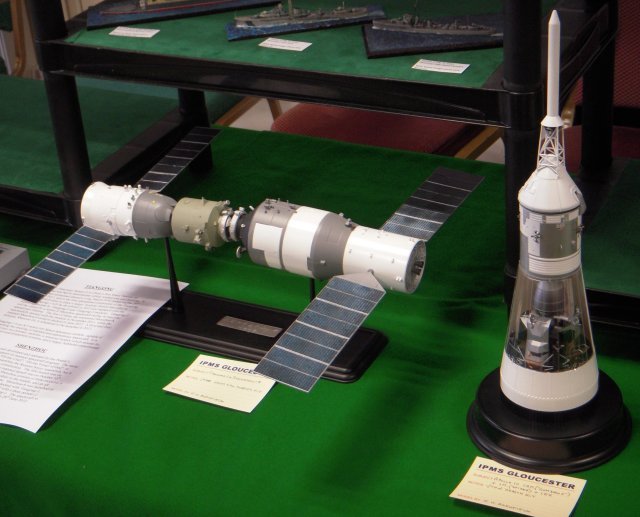
One of the most detailed captions
for any exhibit at the show was the one applying to the Chinese space vehicles
making a non-constant-scale comparison with the more familiar Apollo Command,
Service and Lunar Modules surrounded by the top portion and escape tower of a
Saturn V rocket. Despite following the
orbital-reentry-service module format of the Russian Soyuz, the three-seat
Shenzhou or "Divine Craft" on the left is larger and of all-new construction.
Its first unmanned launch was on 19 November 1999 and with taikonauts aboard on
15 October 2003. In November 2011 the unmanned Shenzhou-8 was first
to autonomously dock with China's experimental space station Tiangong-1, itself
launched by Long March 2F/G rocket on 29 September 2011, followed by Shenzhou-9
( launched on 16 June 2012 with two male and one female space traveller ) which
returned to Earth on 29 June 2012.
A third mission was launched on 11 June 2013 to
dock with the 8.5 tonne "Heavenly Palace" before it is de-orbited and replaced by more
advanced space stations. Until then its resource module will continue to
support its solar panels to provide power for the wider habitation module
attached to it. Following the success of Canadian astronaut Chris
Hadfield's video postings on YouTube from the International Space Station,
Shenzhou-10's commander Nie Haisheng and fellow taikonauts Zhang Xiaoguang and
Wang Yaping (China's second female in space) hoped to broadcast to students from
the space station. |
|
| |
|
|
| |
 |
|
| |
|
|
| |
The latest Chinese space voyages came 38 years
after the last Apollo Command and Service Module flew into Earth orbit with the
successfully realised aim of docking with a Russian Soyuz - the first time that
two manned spacecraft from different nations had joined together. To do
this, the American Saturn 1B rocket carried a docking module which was extracted
by the CSM just as the Lunar Module had been on Moon missions. This
featured an androgynous docking collar to fit the Soyuz spacecraft and also to
act as an airlock between the Apollo's low pressure pure oxygen system and the
Soviet nitrogen / oxygen atmosphere at sea level pressure.
The single flight of the Apollo Soyuz Test
Program in mid July 1975 helped pave the way for future practical and scientific
co-operation in space and the historic handshake through the Soyuz hatch between
mission commanders Tom Stafford and Alexei Leonov took place over Metz in
France, a town twinned with Gloucester. |
|
| |
|
|
| |
 |
|
| |
|
|
| |
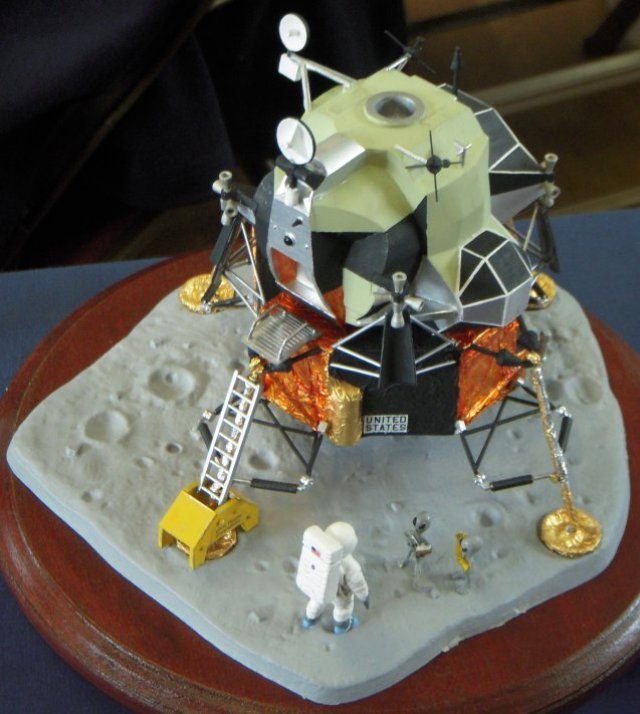
Space modelling can also veer from
the sublime to the ridiculous, with Mick Ellis from the Salisbury Branch of the
IPMS representing what might have happened had parking compliance aliens visited
the Moon's Sea of Tranquility in July 1969 - and clamped the Revell LEM kit -
while another model represented the man made objects that have travelled the
furthest from Earth. |
|
| |
|
|
| |
 |
|
| |
|
|
| |
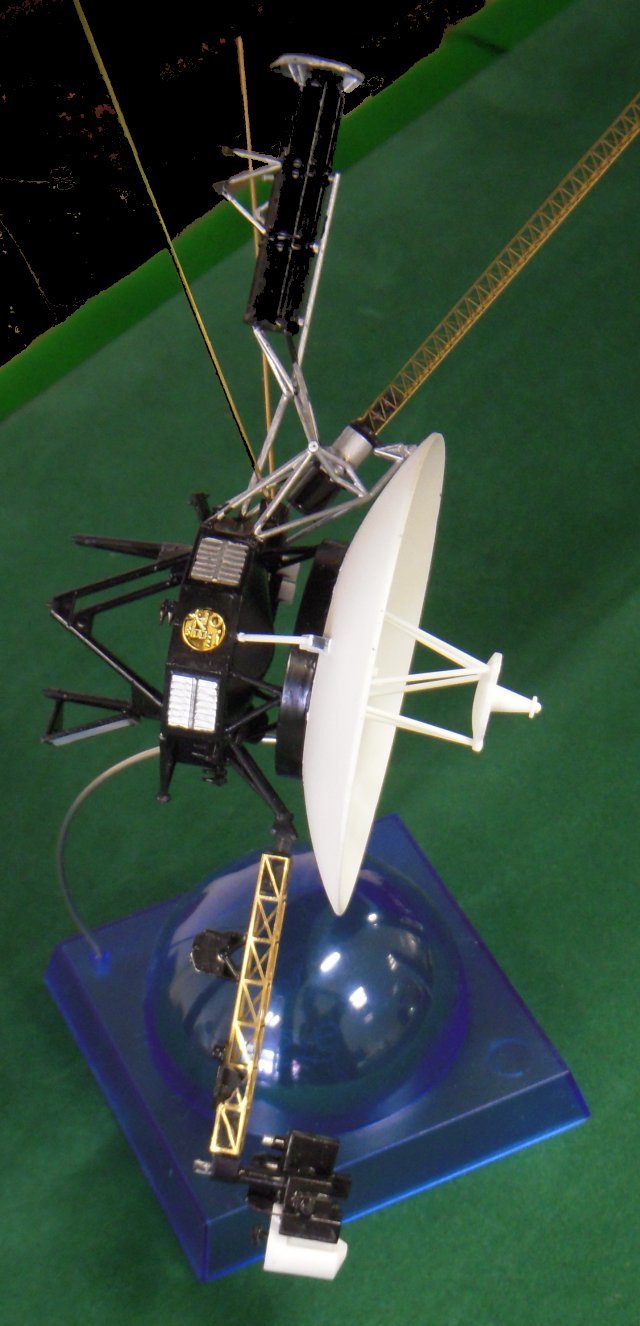
NASA's Voyager probes were devised
in the 1960s to exploit an alignment of the outer planets of the Solar System
that would not occur again for over 170 years. Voyager 2 was in fact
launched first, on 20 August 1977, and used the gravity of, in turn, Jupiter,
Saturn, Uranus and Neptune to reach the next planet and then proceed along the
same plane to the outer limits of the influence of the Sun and then into
interstellar space. As such, Jupiter was reached in 1979, Saturn in 1981,
Uranus in 1986, and Neptune in 1989.
Meanwhile, Voyager 1 - launched from Cape Canaveral on 5 September 1977 - took a
faster and more direct trajectory towards Jupiter (arriving four months ahead of
Voyager 2) and Saturn (in 1980) before moving above the plane of the planets.
Both Voyager probes are moving three times faster than a rifle bullet and are
also now the most separated man made objects, but despite this both craft
continue to send back useful scientific data despite being 17 light hours from
Earth with failing nuclear batteries.
It will be several thousands of years before
either Voyagers reach another star but in anticipation of them being discovered
by intelligent life forms both craft carry a golden disc - visible behind the
dish antenna on the model - containing sound recordings and pictures
representing human civilisation and life on earth. As well as music by
Beethoven, Mozart and Chuck Berry there is a message from US president Jimmy
Carter which says " This is a present from a small, distant world, a token of
our sounds, our science, our images, our music, our thoughts and our feelings.
We are attempting to survive our time so we may live into yours" |
|
| |
|
|
| |
 |
|
| |
|
|
| |
Of course, intelligent extraterrestrials may also
have encountered the sphere of artificial radiation which has been expanding
from the Earth at the speed of light for almost a century now - and those within
56 light years of our "pale blue dot" may even be enjoying radio if not
television coverage of Formula One Grand Prix containing the front engined
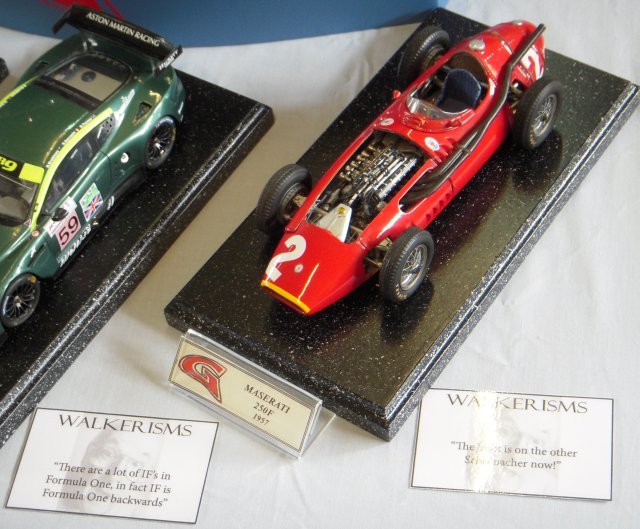
Maserati 250F modelled among a host of historic racing cars above. As
Murray Walker might have said: "Oh my goodness, the boot is on the other
Schumacher now. There are a lot of IFs in Formula One, in fact IF is
Formula One backwards." Live long and prosper! |
|
| |
|
|
| |
|
|
| |
|
|
| |
|
|
| |
|
|