AT CHELTENHAM MODEL CENTRE
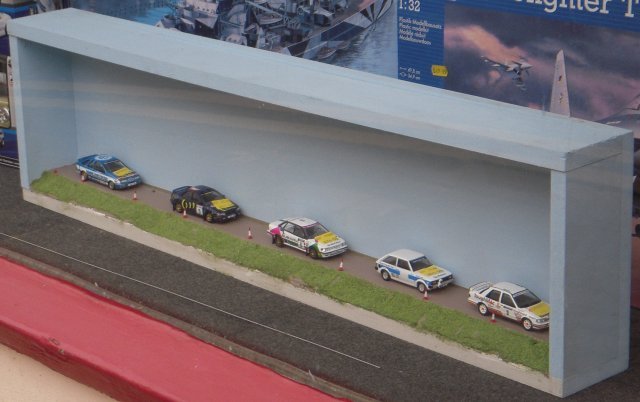
However, in describing my diorama, the models thereon and their historic backgrounds I only express my own views and as such this article should not be confused with - and is not endorsed by - the official website of Cheltenham Model Centre.
Originally optimised for the display of 4mm scale vehicles, Flightline was rebuilt in February 2013 to promote 1/43 scale die cast models of touring and rally cars from the Corgi Vanguards range. This involved the space at the front of the box being filled in to make an embankment and the whole "ground" section being given three coats of Dulux Intense Truffle emulsion before the plaster based slope was further treated with grass flock powder. The narrow "dirt track" section at the top was further defined with some of the larger cones from the Merit Modelscene set mentioned in the description of its earlier incarnation, providing a test of accurate driving for the cars, which dated from as far back as 1978 to as recently as 1993. Due to the increase in scale, no aircraft were hung from the ceiling of the box.

In 1896 the 8th Earl De La Warr had built a Bicycle Boulevard along the front at Bexhill on Sea and as part of a campaign to promote the Sussex resort he organised Britain's first motor sport event along it in May 1902 in conjunction with the Automobile Club of Great Britain and Ireland, subsequently the Royal Automobile Club (RAC).
As intrigued visitors filled hotels and guest houses and paraffin fumes and engine noise filled the air, straight-line drag races were run from East to West with cars returning en masse from West to East in the manner of a modern Formula One Grand Prix.
Distinguished names among the 200 competitors included Lord Northcliffe, founder of the Daily Mail, in his Mercedes - although the fastest car in the event at 54 mph was Monsieur Leon Serpollet in his steam powered "Easter Egg": the first Frenchman to win a motor sport competition on British soil.
Although the "Red Flag Act" had been repealed in 1896, motor cars were still limited to 12 mph on public roads and by 1906 plans were drawn up for a circuit almost reaching from Bexhill on Sea to Beachy Head, with garages, restaurants and hotel accommodation. However, the new Brooklands circuit became the new home of British Motor Racing in 1907 and the last Bexhill motor races were held in 1925 after which the Royal Automobile Club withdrew racing permits on public highways.
Despite this, the Royal Automobile Club continued to standardise motor sport formats and until the early 1970s such events were organised by affiliated clubs overseen by the RAC’s Competitions Committee – a body of volunteers who ensured that the sport was conducted safely and to a common set of rules. These rules were agreed between participating clubs and competitors and ensured that competition was fair while the Competitions Committee also acted as an appeals body in the case of disputes.
In 1975 the Competitions Committee was replaced by a new RAC Motor Sports Council and four years later the RAC Motor Sports Association was formed to look after the day-to-day running of the sport.
The Motor Sports Association (MSA) is recognised as the
sole motor sport governing body for the United Kingdom by the world
governing body, the Federation Internationale de L'Automobile (FIA), founded
in 1904.
As the governing body, the MSA is responsible for the governance and
administration of all major forms of motor sports in the UK, controlling the
technical and sporting rules - known as the General Regulations - across the various disciplines.
The General Regulations are made and amended by the Motor
Sports Council, which is the 'parliament' of motor sports, while the MSA
acts as the 'civil service'.
While The British Grand Prix and the Rally of Great Britain are the flagship
motor sports events in the UK, the MSA is also concerned with the 34 000
licence holders, 10 000 volunteers & officials and the 5 000 motor sport events taking
place in the UK each year.
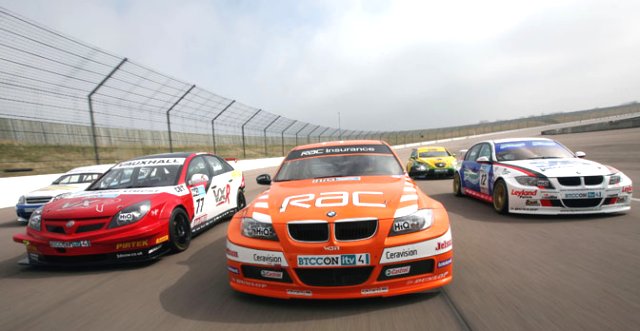
Conforming to a number of national and international regulations over the years, the British Touring Car Championship is contested at such circuits as Brands Hatch, Donington Park, Thruxton, Oulton, Snetterton, Silverstone and Rockingham Motor Speedway with practice and qualifying sessions taking place on the Saturday before the main race series on the Sunday of a BTCC event weekend.
Corgi Vanguards VA11304 1985 Ford Merkur XR4Ti
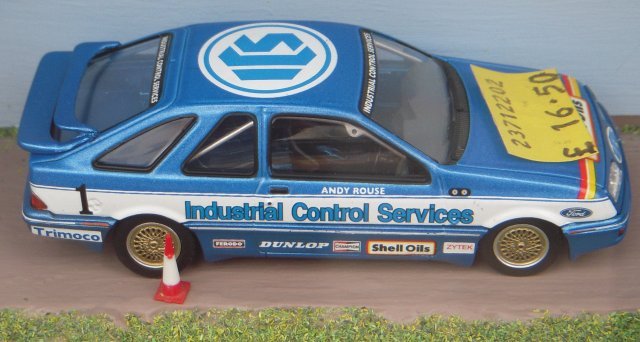
Engineer and driver Andy Rouse was engaged to develop the car, which was not homologated - that is, recognised and accepted - by the MSA until 1 April 1985. Andy duly drove the Merkur to its maiden victory just days later at Oulton Park in the Championship’s second round. He went on to dominate, winning 9 of the remaining 11 races.
Andy Rouse won the overall British Saloon Car title four times, his first victory coming in 1975 aboard a Triumph Dolomite Sprint. However, he is the only man to win the Championship three years in succession in three different cars. In 1983 he used an Alfa Romeo GTV6 and then switched to a Rover SD1 Vitesse for 1984 before winning his last overall crown in 1985 driving the Ford Merkur XR4Ti modelled here.
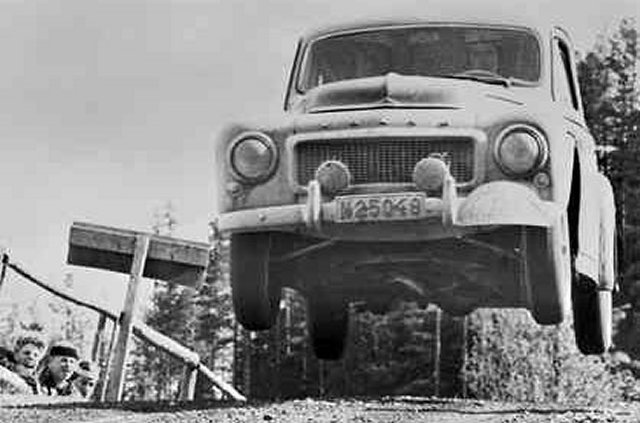
In the same way, most local motor clubs organise events limited to just twelve cars in which just about any make and model can participate while more competitive events restrict engine sizes. For example, Endurance Road-Rally Cars, are limited to 1 400cc petrol engines, or 2-litre non-turbo diesels, with virtually standard gearboxes.
When rallying on public roads, cars must observe all speed limits and other traffic rules and be taxed, tested and insured although the next level of rallying involves stages away from public roads, often on disused airfields or through forests. During these special stages, rally cars normally run at one-minute intervals, competing against the clock rather than directly against each other, with more emphasis upon car preparation, speed and driver ability rather than navigational skills.
What distinguishes rallying from other forms of motor sport, including the more widely publicised Formula One Grand Prix series, is that each rally car has both a driver and a co-driving navigator - usually equipped with a magnifying glass, maps and map light.
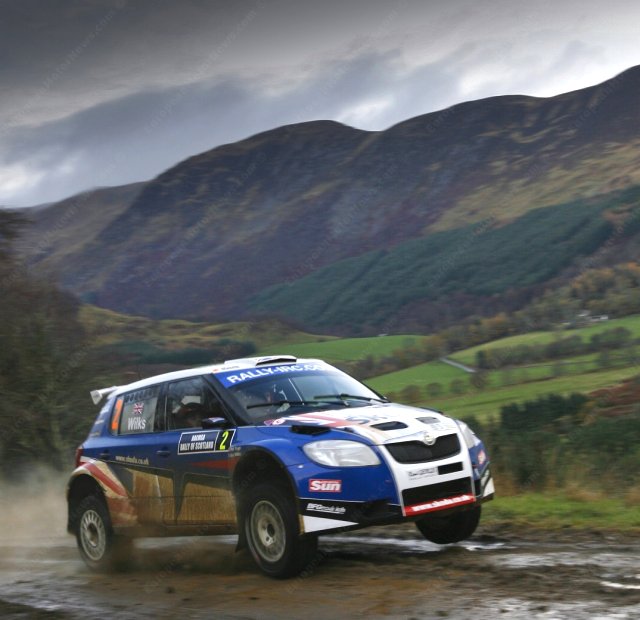
The Rally of Great Britain meanwhile is Britain's round of the FIA's World Rally Championship. The World Rally Championship (WRC) currently consists of 13 three-day events driven on surfaces ranging from gravel and tarmac to snow and ice. Each rally is split into 15 to 25 special stages which are run against the clock on closed roads.
A common points system determines the separate Drivers and Manufacturers World Rally Championship winners, which were first organised in their current form in 1973 from a range of established rallies held in Europe and further afield. These included the International Championship for Manufacturers held between 1970 and 1972 and in fact the first ever WRC event was the 42nd Monte Carlo Rally, starting on 19 January 1973.
In fact the first official WRC Driver's World Championship was not awarded until 1979 although an FIA Cup For Drivers was on offer in 1977 and 1978 - by which time Lancia had won the Manufacturer's Championship in 1974, 1975 and 1976 with the Ferrari V-6 powered Stratos HF, the first car built specifically for rallying. Ford won in 1979 with its Escort RS1800 and Talbot lifted the trophy in 1981 with its Sunbeam Lotus.
From 1982 rear wheel drive Group 2 cars were replaced by four wheel drive Group B cars of almost unlimited power, such as the Audi Quattro, Peugeot 205 T16, Lancia 037 and Ford RS200, but after a number of fatal accidents Group B was abolished from the 1987 season
Group A cars such as the Volkswagen Golf GT 16V, Toyota Celicia GT-4 and Lancia Delta Integrale then dominated the World Rally scene until 1997 when they were replaced with the nomenclature of World Rally Cars.
In 2013, World Rally Cars are all based on production 1.6-litre four-cylinder cars, but feature turbochargers with anti-lag systems, four wheel drive, sequential gearboxes, aerodynamic parts and other enhancements - bringing the cost of each car to around half a million pounds.
After the top tier World Rally Cars have raced through each stage, Junior World Rally Championship, World Rally Championship 2 (formerly Super 2000 WRC), World Rally Championship 3 (formerly Production WRC) take their turn to compete under their own regulations.

In 1925 a Sunbeam 3 litre Super Sports finished second at Le Mans, but partly due to not being paid for work done during the First World War the company went bankrupt in 1934 and its brand name was sold to Rootes, who shut the factory and dropped all existing Sunbeam cars.
However, just as Vanden Plas and Wolseley names were later to identify British Leyland's top of the range models, Sunbeam was applied to the most prestigious Rootes cars and after World War II two seat Sunbeam Alpines entered Le Mans from 1961 to 1963.
In 1964 a one third share of Rootes was bought by Chrysler - who had already bought the Simca name - and the American firm took over Rootes completely in 1967, thereby inheriting the names Sunbeam, Talbot, Darracq, Hillman, Humber, and Singer. The last Sunbeams and Humbers for the British market were rolled out in 1976 before the name Chrysler was applied to all former Rootes vehicles, by which time Sunbeam production had been moved from Ryton-on-Dunsmore near Coventry to Linwood in Scotland.
Chrysler UK’s competition manager Des O’Dell immediately saw that the Chrysler Sunbeam - a hatchback based on the 1970 vintage Hillman Avenger saloon but smaller and more nimble - had great potential as a competition car.Before the car had even been launched his department had built two prototypes, WRW 30S and WRW 29S. Whilst ‘30S developed into the first Chrysler Lotus engined rally car and eventually into a full Group 4 machine, ‘29S was intended to replace the Group 1 Avenger as an amateur or ‘clubman’ customer’s car.
It was fitted with a 2-litre Brazilian-blocked pushrod overhead-valve engine mated to a close ratio four-speed Avenger gearbox and was used to help chassis development as it entered many events during 1978.
Although the Sunbeam Lotus evolved into a very successful rally machine, 2-litre Group 1, Chrysler Sunbeams were successful in their class being driven by drivers as diverse as Henri Toivonen and Rosemary Smith.
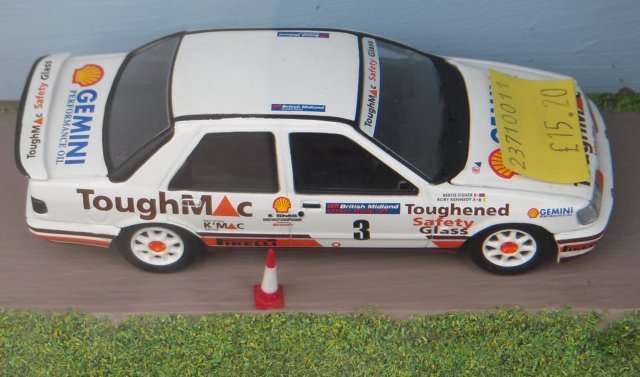
The reigning Irish Tarmac Rally Champion, Bertie Fisher from Fermanagh, started the 1991 Ulster Rally in the Ford Sierra Sapphire Cosworth 4x4 represented by the model pictured above - facing opposition from Russell Brooke’s Sierra Cosworth 4x4 and Colin McRae’s Subaru Legacy. Fisher ended Day One third behind McRae and Brookes while at stage 16 on Day 2 Bertie had nearly two minutes in hand. McRae tried to make up his deficit, but broke a wheel and eventually retired, leaving Fisher to take a well-deserved victory.
Sierra RS Cosworth 4x4 production continued until the end of 1992, when the Sierra was replaced by the Mondeo although the the Sierra RS Cosworth itself was replaced by the mechanically similar Escort RS Cosworth. Although larger, heavier and less sophisticated than the latter generations of the Lancia Delta and Toyota Celica in terms of transmission systems and electronics, the Sierra RS Cosworth 4x4 also finished second in the 1992 WRC Rally of Portugal.
It was was popular at lower levels of rallying, a consistent winner at national championship level and remains a popular car among amateur rally drivers - like its rear wheel drive antecedent which had done much to restore Ford's reputation for Touring Car and Rallying success in the mid 1980s.

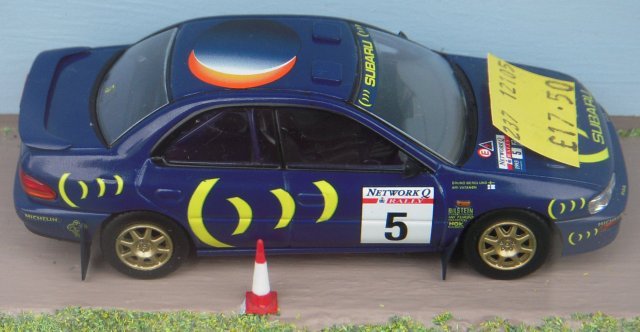
However, it was team-mates McRae and Ringer who led initially, whilst Vatanen and Berglund damaged their Impreza in two incidents and lost over ten minutes. Unfortunately, McRae and Ringer retired on day three with a damaged radiator but on the last day some Subaru honour was restored as, in treacherous arctic conditions, Vatanen and Berglund stormed back through the field and set three fastest stage times. They finished a well-deserved fifth, eight minutes behind the winning Toyota of Kankkunen and Grist.
Subaru were to take the World Rally Championship manufacturers title for three years in a row from 1995 to 1997 with the company - the automotive division of Fuji Heavy Industries - becoming internationally known since 1972 for combining a boxer engine layout with all wheel drive. In fact the company name derives from the Japanese for the celestial constellation known in the West as the Pleiades, the six stars on the logo alluding to the companies that formed Fuji Heavy Industries in 1953 and went on to produce their first car - the 1500 - in 1954. Fuji Heavy Industries also has historic roots in the Nakajima Aircraft Company which built many of Japan's most successful flying machines from 1932 to 1945.