Home
THE GREATEST LOCOMOTIVES OF ALL TIME?
AN ESSAY BY
WILLIAM LYON TUPMAN
ST DUNSTAN'S HOUSE AMPLEFORTH COLLEGE PRIZE ESSAY 2012

The railways of Great Britain have always been a remarkable network – in how they run, in how they were designed, and in their historical context. The first railway in the world, the Stockton and Darlington Railway, was built in Britain, as was the first railway locomotive, as designed in 1804 by Sir Richard Trevithick, who you may have already encountered on the back of a modern £2 coin!
Today, our successes as a country continue – the world’s fastest diesel powered train, the InterCity 125 High Speed Train, is a common sight across the whole network of Britain. Designed in 1976, in its home country it is a complete success, and is set to work into the early 2020s. This award-winning train is the successor of another British success story - the Class 55 Deltic. And now, what was once the world’s most powerful train is now the subject of enjoyment, for both rail enthusiasts and the nostalgic alike, and has become the subject of this essay, in which I will discuss the history of the Deltics, and compare them to other types of trains.
But why should we care about our railway network, when surely it is just a means of quickly getting from A to B? Our railways are neglected, with a large number of us taking the trains for granted and then complaining extensively when there may be a real reason as to why our train arrives ten minutes late, or gets cancelled. We often forget the intensive, meticulous craftsmanship and effort that is involved in creating our railways, that all count towards a sense of immense beauty and mystery about trains.

Britain’s railways were once flooded with the glorious, iconic steam locomotives that can easily bring a smile to anyone’s face – the Flying Scotsman, the record-breaking Mallard, the City of Truro (pictured above), and many more. While these were the images of railway glamour until the late 1960s, their reliability was often questionable, and their use of coal as a fuel was not effective – with less than 4% efficiency, this was not at all sustainable either for the environment, or for the finite supplies of the mineral itself.
An alternative had to be sought, as a long-term solution to the problem; however, a solution to replace the well-loved steam locomotives would have to prove itself to be very popular, so as to cause as little controversy as was possible. It was clearly going to be hard to find another train with such a loving, almost magical character that the steam trains possessed.
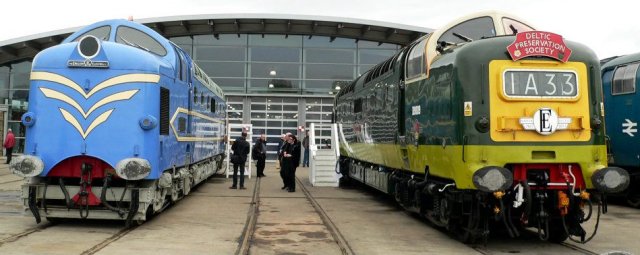
Many fascinating new ideas were considered and concepts were modelled around the 1950s. Once the best had been found, a few concepts became reality and were developed into ground-breaking modern prototypes. One such success was the prototype Deltic, which appeared in the striking, albeit somewhat controversial, powder blue American-style livery (illustrated above, left). Designed in the year 1955, by the English Electric Company, this diesel-powered locomotive immediately became a successful design, and was – at the time - the most powerful train in the whole world.
It was completely unique in the railway world, as nothing else had ever been built like it in the past. Rather than just the conventional one railway-designed engine that most locomotives run on, the Deltic had no fewer than two engines, both of which were derived from marine naval boat engines called Napier Deltics!
Not surprisingly, the fact that Deltic had double the number of engines of the usual meant that it would be much more powerful than its predecessor. In addition, if one of the engines were to malfunction while in service, the locomotive could simply run on one engine, allowing it to make it back to the depot for repairs without any assistance from other “rescue trains,” and when funds were short, some of the Deltics continued to operate on one engine only, in an effort to save money on repair costs. The trains’ power rating totalled 3,300 horsepower; that is 1,650 horsepower per engine, and the locomotive was capable of attaining a top speed of 100mph with ease – even with eight to fifteen loaded carriages of roughly forty passengers each.
Inevitably, this proved to be a great success, and so a further twenty-two production Deltics were ordered by British Rail, for use on the East Coast Main Line, and they operated many passenger express services connecting London Kings Cross and Edinburgh between the years of 1960 to1982.
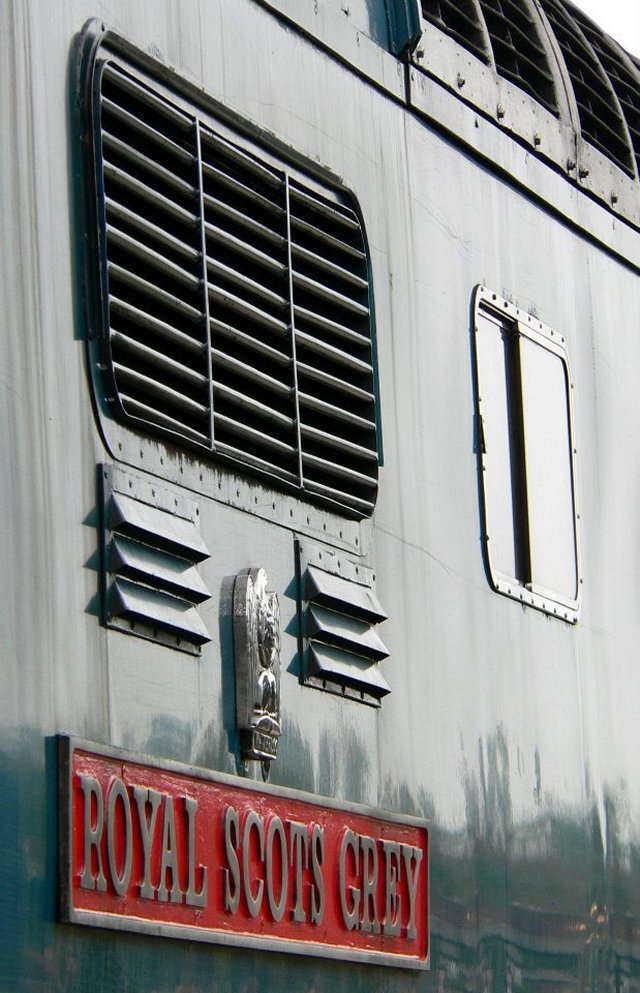
The production locomotives were all dedicated, and carried nameplates to symbolise this. They would either represent important army regiments; particularly those of Scotland, such as the Royal Highland Fusiliers and Royal Scots Grey (illustrated left), or famous racehorses that had raced at Grand National races or royal events, such as “Alycidon” and “Ballymoss”. These quirky names were soon a memorable feature of the Deltic fleet, and were easily identified by these iconic names. Another fascinating, unique aspect of the locomotives was the distinctive thundering noise that their engines made. This was especially apparent as they either pulled out of stations or accelerated past the bewildered, waiting passengers, at a speed of 100mph with around twelve carriages densely loaded with passengers, and this is one of the reasons as to why they are so popular with rail enthusiasts.
But there is a lot more to this train than just an impressive, thundering noise. The locomotive itself can be considered to be a work of art on wheels, be it considering its mechanical precision or the majestic, albeit imposing looks that clearly state “I am boss”.Moreover, the symmetry of the design is simply perfect; this is especially apparent by looking at the dynamic “speed lines” that are painted on the prototype. At the front of an express train, powering through the countryside, disappearing out and reappearing into view as it negotiates the trees at the line side, the Deltic is quite simply a beautiful sight that will turn the heads of even those who would not normally consider railways to be a hobby of theirs. In an interview with an ITV filming crew, in 1982, a driver who worked for British Rail commented on his personal experience of driving the Class 55 Deltics, as he commended the “extreme power at the end of your hands,” and remarked how “you know you’re going to get there” when he drove the Deltic, perhaps in comparison to other types of train at the time.


In their time, the powerful Deltic locomotives were the pride of Britain’s railways and ruled the East Coast Main Line, always running efficiently and creating excitement among both rail enthusiasts and other members of the general public; however, sadly, the Deltics are no longer in regular service on today’s national rail network; the last members of the Deltic fleet were taken out of service on January 4th, 1982, after a number of “farewell specials”. What was even sadder is that the locomotives were all taken to Doncaster Works, Yorkshire, and for sixteen of the fine locomotives this was a one-way journey (for it was at this site that they were scrapped and cut up).
But thankfully, six of the twenty-two locomotives have been saved, and are now in preservation, maintained in a fantastic condition with most in full working order, for all to enjoy. Furthermore, one of the locomotives – the locomotive dedicated to Royal Scots Grey is even able to run special services on the main line. This is a huge triumph for a fifty-year-old locomotive, not to mention how the sight of a Deltic locomotive like Royal Scots Grey suddenly appearing amidst many of today’s comparatively uninspiring trains is always one that is welcomed by many.

But are they really the very greatest locomotives? They may have been a real success, proved to be a scientific revolution and gained a substantial world record, but why did British Rail only order a small fleet of twenty-two Deltics when – at the same time – they ordered much larger fleets of other kinds of diesel locomotives?
Over two-hundred Class 31 locomotives, over five-hundred Class 47 locomotives and over three-hundred Class 37 locomotives (such as 37 261 pictured above) were ordered. And just why exactly were the majestic Deltics all withdrawn by the beginning of the year 1982, when several examples of the Class 31s, the Class 37s and the Class 47s are still operating in main line service today?
The answer is all in the money. As you might imagine, to purchase a locomotive with two engines would be much more expensive than a train with just one engine, and at a time when Britain was still recovering economically from the Second World War, the country could not afford to order or build large quantities of such advanced, powerful trains.
The Deltics were the only diesel electric locomotives of the time to use two engines rather than the conventional one and additionally, not only were the Deltics a great deal more expensive to purchase in the first place, but they were much more costly to run – being the large locomotives that they were, maintenance would always have been a heavy job, but with the second engine installed inside the Deltics more repair work would have to be periodically carried out.
On a more practical note, the engines of the Deltics could have been used to power forty-four conventional trains at a potentially lower, more economical cost. This could have resulted in more frequent rail services (and thus more revenue for British Rail and the Government!), rather than the twenty-two, twin engined, high maintenance express diesel locomotives that were the Deltics. In turn, this immediately limited the number of rail services that could be worked by the nature of such a small fleet of locomotives.
Possibly a very important issue regarding the Deltics was their practicality. Being such large, powerful (and impressive!) locomotives meant that they would need heavy work that was suited to them, like high speed passenger express services, and while this made the Deltics perfect for this role on the East Coast Main Line, they were not versatile; a Deltic would only seldom be seen working on a freight service. This meant that there was only a finite number of uses for the Deltic, and to have extraneous Deltics waiting for work in the depots would be pointless, and certainly a waste of money.
I would like to introduce you to a locomotive that is so similar – but yet so different – from the Deltic, and that is the Class 37 diesel locomotive (pictured above). Although perhaps not quite as glamorous as the Deltics, there were over three hundred of these engines built during the 1960s, again by English Electric, and they were – like the Deltics – a proven success, and while they did not even come close to achieving any world speed or power records, they are very reliable locomotives and are both versatile and practical.
The Class 37s can operate public passenger services, freight trains, smaller duties in depots, and even help contribute to the maintenance teams keeping the railways safe enough for other trains to use. In other words, they can be used for anything and everything, whereas this is certainly not the case with the Deltics. Several examples of the Class 37s are still in frequent use today on Britain’s modern railways, thirty years after the last Deltics were withdrawn from service. The Class 37 locomotives have now been in service for well over twice the length of time that the Deltics were.

But this was not the only train to rival the Deltics; there were several others. Another locomotive competing for heavy, regular use in Britain’s railway industry was the Class 47 diesel locomotive, which was (and still is) a spectacularly successful design of engineering. Built in the 1960s, shortly after the Deltics entered service, there were not just three hundred but over five hundred of these particular trains built, which is indicative of how well the locomotives suited work in the country.
While they may not be the most interesting engines on the railway network, the Class 47s (such as 47 818 pictured above) were so successful in terms of their reliability and versatility that when the engines inside the locomotives were clearly showing signs of wear that a very economical solution was sought to retain these diesels in service – some of the trains were re-engineered, and became known as Class 57 locomotives.
Furthermore, the Class 47
proved to be an engineering inspiration, and formed
the basis of some other modern diesel locomotives, such as the independently
built Class 56; this reiterates just how well a simple design proved to be the
most effective, using just one Sulzer diesel engine, rather than the perhaps
somewhat unnecessarily complicated design that the Deltics all possessed, with
their two re-configured boat engines. Again, the Class 47 engines, in whatever
format – like the Class 37 engines – have by far outlived the Deltics in
modern-day service, and many of these locomotives can be seen all over the
country on today’s modern railway network, operating freight and some passenger
services.
So, at the end of the day, it is evident that possibly the
main downfall of the Deltic diesel locomotives was their lack of versatility and
practicality, and the Deltics’ impressive appearance and distinctive presence
could not have saved it. But was this really the only reason as to why the
Deltics survived with British rail for just twenty-two years? Of course not.
There is another important reason as to why the iconic Deltics that so many
people loved all came to be replaced so long before their time was up.
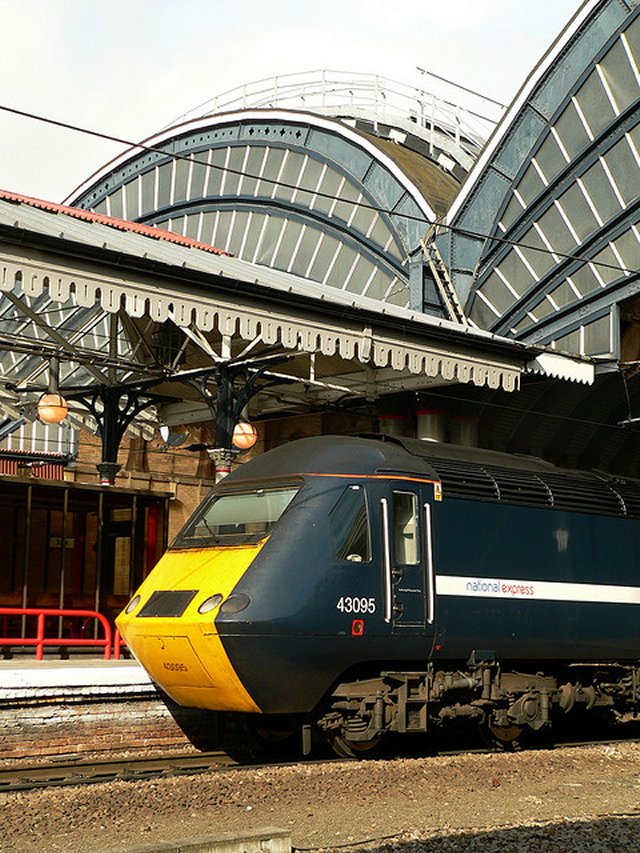
The High Speed Train: a revolutionary, exciting, all-new concept that became the shape of rail travel across not only Great Britain, but the whole world, for decades to come, and it is a machine that is still in front-line service today. Pictured above, this fascinating train, known by many as the InterCity 125, was the direct successor of the Deltics, as a purpose built high speed passenger train. It was not just a single locomotive, but the High Speed Train featured nine carriages that were purpose built, sandwiched between two streamlined Class 43 locomotives (power cars).
Moreover, the very fact that the power cars were streamlined allowed them to run without suffering so much from the effects of air resistance. This provides a contrast to the Deltics, and highlights another minor flaw that the Deltics had.
The High Speed Train entered service in the year 1976, and was launched to great acclaim – the train soon found fame, even before it officially entered service, when an artist’s impression of the new train design accompanied Her Majesty the Queen in many of the postal stamps of 1975, just before the train entered service. The High Speed Train was able to travel at a maximum speed of 125mph, which is 25mph faster than the Deltics could manage.
In addition, one of the new trains exceeded this top speed by far, and successfully reached 148mph – making the High Speed Train today’s fastest diesel powered train in the whole world, a record that remains unbeaten.
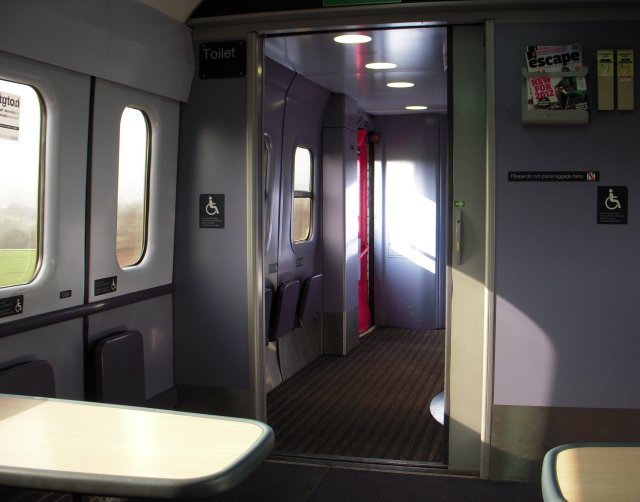
Inside, passenger comfort was improved significantly – the carriages of the InterCity 125 (pictured above) were smooth at all speeds, and were also almost totally soundproofed, so all passengers could enjoy a much quieter ride if desired, whereas the coaching stock that the Deltics used was noisy, unsteady at any speeds, and was in no way soundproofed.
Thus, the High Speed Train was a perfect place to enjoy a timeless journey. Rather than a small, high maintenance number of twenty-two locomotives (like the Deltics), nearly two hundred power cars were built, and these formed nearly one hundred complete trains, so high speed rail links came into use all over the country, and this was a vast improvement on what had gone before. If a trainset broke down, there would always be a reserve set or two available. The High Speed Trains were soon to become a true icon of our railways, and a complete British success story.
.jpg)
But are the High Speed Trains superior to the Deltics in all aspects? Well, no, they are not. They may run faster; they may be newer; they may have proved to be a bigger success, and they may also have attained (arguably!) a more respectable world record title, but the High Speed Trains still have their own problems that should not be overlooked.
While the Deltics maintained a completely clean, spotless safety record – perhaps due to their relatively short life in service compared to the High Speed Train - the InterCity 125 trains have been involved in no fewer than three accidents so far, resulting in the tragic loss of lives and the premature scrapping of some power cars and carriages.
Some of these accidents may have been prevented had the trains been travelling at a speed of 100mph, like the Deltics, rather than the High Speed Train’s standard 125mph, because the stopping distance of a train that has more momentum will be far greater than that of a train that has less momentum, in terms of its speed, especially.
On a slightly less severe note, the InterCity 125s are renowned for their excessive volumes of exhaust emissions (illustrated above), which is produced by the Paxman Valenta diesel engines, even when the train was fully stationary and with the engine just “ticking over” in idle.
While this is actually something that rail enthusiasts enjoy, this environmentally-harmful problem has now been rectified with the fitting of new engines. While this was beneficial to both the trains and the environment, however, the cost of re-engineering just under 200 diesel locomotives is not cheap. But the Deltics never required brand new engines during their time in service, so this saved a lot of money for British Rail.
And for anyone who is patriotic about Great Britain, the Deltics were designed, built and operated in Britain constantly, while the High Speed Trains – while originally being a fully British train – is now partially foreign, as the new engines are made by the German company MTU. And while the High Speed Trains still have very much character about them, they do not have nearly as much character as the proud, confident Class 55 Deltics; however, this may be more of a matter of personal opinion, rather than being statistical facts. It is purely your choice!

Interestingly, the Deltics also had some “cousin” locomotives that are not very well known; however, these infamous locomotives bear little similarity to their powerful counterparts that are the main subject of this essay.
These were called the Baby Deltics, and they looked quite cute – they were very small in size, but were not very successful at all. These mini Deltics entered service before the majority of the “proper” Deltics did, in 1959, and only a small fleet of ten were built.
Relating back to an earlier paragraph, perhaps this was a warning to the Deltics themselves: that a small fleet number would be one of their downfalls, because one of the reasons British Rail withdrew all ten of the Class 23 Baby Deltics by 1971 was because the size of the fleet was so small, so parts were very hard to source and the engineers at the time would not be used to working with such rare locomotives.
This was a further disadvantage, because the Baby Deltics frequently suffered from complete engine failures, overheating problems, and even the occasional exhaust fire! These and a great deal of other technical matters that emerged from the Baby Deltics made them a cause that was not economical, and only one example survived beyond 1971 – just over ten years after they had been built. The surviving example was finally scrapped six later, sadly, but thankfully the engine itself – a less powerful version of the Napier Deltic engine – was saved.

The Deltic design was reused just once, as a test bed for another design of diesel locomotive – and, once again, the Deltics proved themselves to be a great success.
A spare Deltic body and chassis was used, but it was given a completely new kind of diesel engine. The change in engine meant that it could no longer be really referred to as a “Deltic”, because the reason why the Class 55s were called the Deltics was because of the two Napier Deltic engines that they used.
This new, somewhat unusual hybrid locomotive - numbered DP2 and pictured above - entered service alongside the rest of the Deltics once it had passed several safety and speed tests and worked both local and express passenger services. This would have been an ideal locomotive to be preserved later on, because of how unique the train was and this would have most probably have happened.
However, the locomotive was involved in a crash while working a revenue-earning British Rail express service when the train ploughed into a rake of Cemflo wagons which had derailed into its the path.
Very sadly, some people were killed as a result of this, and the locomotive was completely written off. While a repair would have been possible, British Rail decided to cut up and scrap the locomotive, because the funds were needed to keep the Deltics running and also to seek a replacement of the Baby Deltics, which were performing very erratically.
Luckily, the power unit from the crippled locomotive was fine, and it was saved and transferred into a new locomotive, the Class 50, where it saw much further use. This, however, does not mar the idea of the Deltics being perfectly safe locomotives, because the train that crashed technically was not a Deltic, because of the different engine being used – thus, this is not in any way derogatory of the Deltic locomotives.
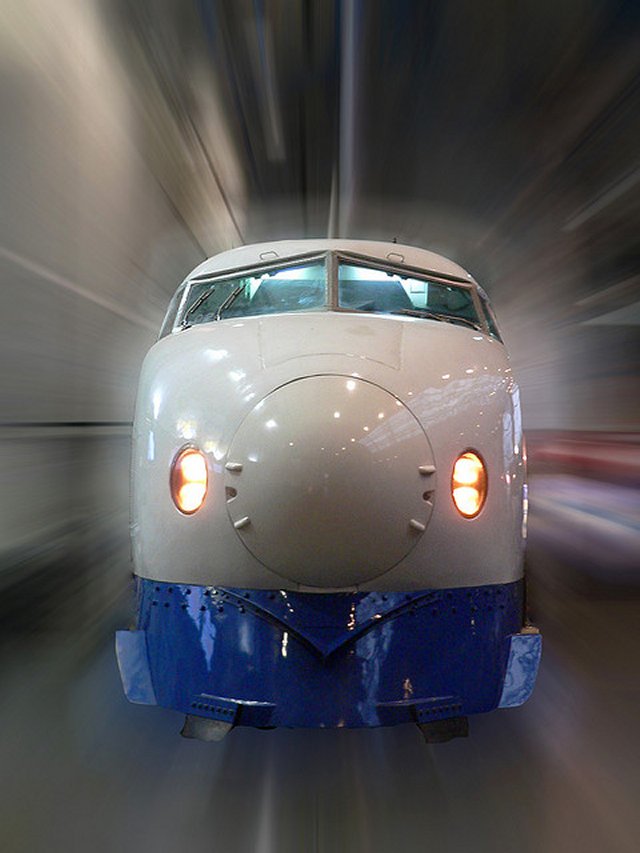
We have explored a wide variety of British trains that have rivalled the Deltics in the past, but just how well did the Deltics stand up to the developments and happenings going on in the rest of the world?
One very notable breakthrough occurred in Japan, and history was made when the Bullet Train - pictured above- was invented, which went on to attain some impressively high speeds of between 149mph to 186mph. Developed around the same time as the Deltics, in the 1960s, the Bullet Train – also known as the Shinkansen – was powered by electricity, and not diesel. Furthermore, the Bullet Train had a very streamlined design, which helped the air to flow straight over and around the train as it ran along the tracks, suffering from much less air resistance than many British designs – including the Deltics. Moreover, it soon became the world’s fastest train, and accompanied the Deltic in the world records until the French TGV was designed (and this, in turn, won the train world speed record).
The Bullet Trains were built to run either short, local services, or long, high-speed express services, and are to this day meticulously operated; if a Bullet Train arrives into a railway station just one minute late, the driver is taken away to face a full enquiry as to why his train was so late. This is because the sheer number of trains on the railways of Japan is so great, that one minor disruption is all that would be needed for a situation of absolute chaos to emerge. It is hard to imagine our railways here in Great Britain ever being run quite as reliably and punctually as that!
The concept of the Bullet Train has remained the same since it was first designed in the 1960s, and several updated versions of the train have been produced over the decades. All of the original Bullet Trains that were built in the 1960s continued working in revenue earning service until 2008, and even now, many of them are still working hard today, on Japan’s modern railway network. Again, this is another instance where a train has lasted for a much longer amount of time in service than the Class 55 Deltics did.
However, it should be noted that, while both the Deltics and the Shinkansen trains were both predominantly intended for use on express passenger services, the two trains each had very different kinds of working lifestyles to each other, possibly due to their originating cultures. Indeed, this is another very successful design of train, and is certainly to be admired.
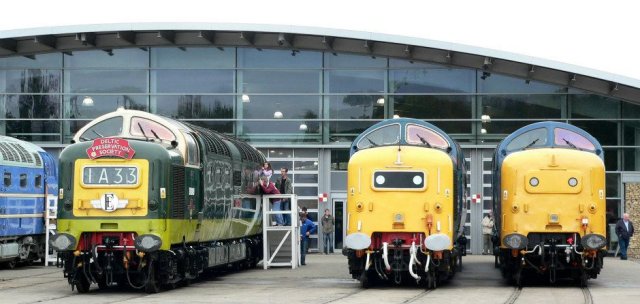
While today’s trains may not be quite as inspiring or exciting as the Deltics were, there is still a very wide variety of trains in action on today’s railways that we can enjoy. Perhaps the statistic that has most dramatically changed is how most of today’s trains are imported from other countries; Canada supply us with most of our new freight locomotives, while Germany now supply us with many of our new passenger trains.
While this does save money, importation may be considered to be somewhat dangerous, with regard to the shipping – it was only during Christmas 2011 that an accident occurred, when the crane of a cargo ship lifting a brand new train, that had been shipped across the Atlantic Ocean from Canada to England, broke and immediately wrote the locomotive off, it having never turned a wheel in service.
This was a great tragedy, and a waste of craftsmanship and, in addition, a waste of money. But thankfully, modern health and safety regulations do help to ensure that accidents like this are kept to an absolute minimum. Of course, there are still many examples of British craftsmanship still operational on the network, but it is uncertain as to how many new trains we will manufacture now in this country, because it is much more economical for us to import trains from other countries.
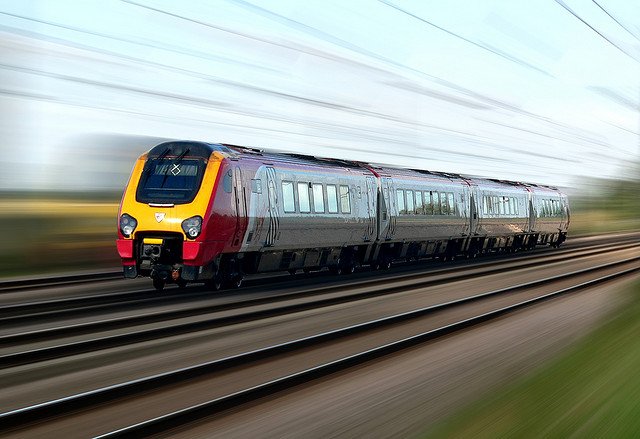
In addition, while the express passenger train services are still comprised of long trains – including the High Speed Trains – some of the passenger services are now much shorter than they used to be, in the sense that they have fewer carriages for each train service. Pictured above is an example of one short, imported kind of train, affectionately known as the Voyager, which has replaced some of the High Speed Trains. These trains also have a maximum service speed of 125mph; however, they certainly do not go quite as fast as my photographic editing and manipulation suggests!

Five of the seven Deltics in preservation are maintained in full running order, and one of the two locomotives that do not presently run is under a long-term restoration project, to return it to a fully operational condition. This, of course, is really excellent news for both the rail enthusiast and the passenger alike.
A society that was formed when the Deltics were initially withdrawn from service by British Rail, namely the Deltic Preservation Society, are instrumental in ensuring that all of the Deltics that are existent today are well looked after, and own three of the seven preserved Deltics; one of their locomotives is pictured above, arriving into Goathland, on the North Yorkshire Moors Railway.
This is a preserved railway that has now become a favourite haunt of the Deltic locomotives. For those who are both confident and keen enthusiasts, or even just for those who are seeking a new experience, the Deltic Preservation Society offers “driver experience days”, priced at £325 – and yes, you guessed it – this will allow you to control and drive what was once the most powerful diesel locomotive in the whole world.
With power at your fingertips, the world is your oyster! One locomotive has returned to the main line, namely the train dedicated to the Royal Scots Grey army regiment, and often works special excursions for the enjoyment of all, and especially for those who wish to see such a sight.

In conclusion, it really comes down to a matter of personal opinion when debating which train is the greatest of all time, and to what criteria you could grade each train on. Would you consider its looks? Or what it sounds like? Is it more important for a train to work efficiently for us, as passengers or customers? Or is it more important for the train to work efficiently for the environment? Is it better for a train to be built in the country it was made to operate in? Or is it better for trains to be imported, to save on costs? It really is up to you, because it largely depends on your personal interests and your opinions. My personal view and conclusion is that the Deltics are indeed the greatest locomotives of all time, but there are also many other fascinating trains that are of equal interest, because of their qualities. And some might say that it was Trevithik’s locomotive of 1804, the first steam train to ever be built, that was the greatest train of all – after all, without it, today’s railways might not have become what they are today, and we may never have created the masterpiece of the Deltic.

Examples of most of the trains that are featured in this essay, apart from the French TGV, can be seen at the National Railway Museum, at both their York and Shildon branches.
Bibliography
- All photographs are the work of William Lyon Tupman.
- https://www.preserved-diesels.co.uk/ - Correct as of April 22nd, 2012.
- http://en.wikipedia.org/wiki/British_Rail_Class_55 – Correct on 22nd April 2012.
- http://en.wikipedia.org/wiki/British_Rail_Class_43_(HST) ( April 23rd 2012)
- http://en.wikipedia.org/wiki/Shinkansen – Correct as of April 23rd, 2012.
- http://en.wikipedia.org/wiki/MTU_Friedrichshafen – Correct on April 23rd 2012.