FROM THE ABSTRACT TO THE CONCRETE :
GLOUCESTER’S CEMENT WAGONS

The Gloucester Railway Carriage & Wagon Company Limited (GRCW) had always been a pioneering firm. From its Bristol Road factory – known throughout the ancient Cathedral City as "The Wagon Works" – had come Britain’s first all-iron goods wagon in 1862. So had the first British all-steel welded carriages in 1933 and the World’s first dedicated Diesel Parcels Unit three years later.
Gloucestershire’s biggest employer in the century
from 1860 had also embraced such unusual jobs as an
amphibious railcar for Magnus Volk’s Brighton and
Rottingdean Seashore Railway Company in 1894, a 68 feet
long "Palace on Wheels" for an Indian Maharajah
in 1936 and even pivoting sections for the Mulberry
Harbour used on D-Day in 1944.
Post War Britain, though, faced the challenge of
reconstruction. Houses, factories, schools and hospitals
flattened by the Luftwaffe had to be replaced and plans
formed in wartime for new tunnels, roads and bridges
gradually became real.
All of these required concrete, but thanks to both the manufacturing skills and design flair to be found in Gloucester the necessary cement was to flow easily in bulk around the nation.

ONE ‘L’ OF A SOLUTION
Before Nationalisation, most cement was bagged and
transported in ordinary covered vans but in the 1950s
British Railways made the first major attempt at bulk
transit with its L-type container. Loaded at the top and
discharged from the bottom the cube-like L-types had a
tare (or unladen) weight of around 12 cwt each and could
carry 4 tons of cement within a 90 cubic foot capacity.
They were painted grey with white lettering on black
panels and travelled three at a time on dedicated four
wheeled vacuum braked wagons known as Conflat Ls. These
wagons – many built to Diagram 1/066 – had
holes in their floors to allow the L-type containers to
be gravity discharged without unloading.
ENTER THE PRESFLOS
Although able to be craned on and off the 10’ wheelbase Conflats and an improvement on previous schemes the L-type containers were still an inefficient use of a 6 ton 17 cwt underframe. The real answer to the problem of moving dry cement was to be designed and built by British Railway’s Shildon Works in 1954.
Ordered in January of that year, completed in June 1954 and officially known as a Pressure Discharge Bulk Powder
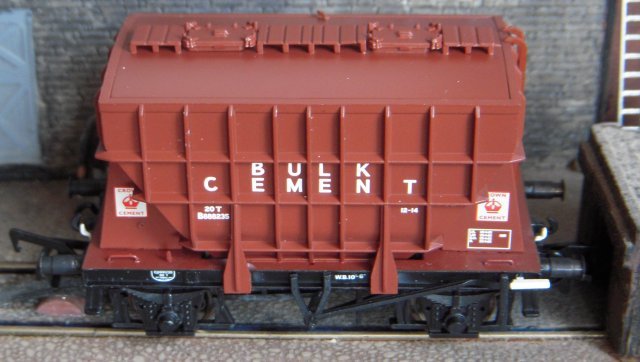
Wagon the 20 ton capacity "Presflo" ( pictured at the top of this
article ) was top loaded by gravity
but emptied by air pressure through a flexible pipe
– from valves on one side of the wagon - into either
a storage silo or road vehicle. The prototype Presflo - B888000 - was
built to BR Diagram 1/273 and Shildon Lot Number 2679 but all 1 891 production
vehicles – outshopped by five different builders between
1955 and 1963 – conforming to Diagram 1/272
Measuring 11’9" high and 19’11" over buffers ( when fitted
with the most common 24.5" self contained or hydraulic buffers ) the production 10’6" wheelbase
all-steel vehicle mainly boasted two vacuum cylinders
–located at one end of the underframe with a ladder
positioned at the opposite end of the central reinforced
hopper - actuating eight clasp brakes and roller bearing
axle boxes for high speed running. Most versions also featured
screw couplings.
A further thirty wagons were built by Metro-Cammell to Lot 3156 of 1958 and designated for ICI salt traffic, making a total build of 1 921 wagons.
In service B888003/17/22/25/38/51/84/94, B888111/8/21/28/29/48/50/55/60/62/63/64 and perhaps more of the Presflos were also allocated to salt traffic and received roof modifications including walkways. These went on to carry slate powder from Wadebridge (Delabole) and finally fly ash in the Peterborough area during the late 1980s and early 1990s.
When new and working with dry compressed air, Presflos would shoot out a stream of cement that looked just like milk. They could also carry fuller’s earth, slate powder, sand, silica, aluminia ( in Scotland where they replaced elderly unfitted wooden hoppers) and flour.
Indeed, British Rail’s own workshops later built a longer wheelbase version of the Presflo to carry talcum-like fly-ash from power stations. This began with a Diagram 1/272 Presflo being modified to Diagram 1/281 as an experiment with a reduced 17 ton load. A small production batch of Diagram 1/278 ASH 17VBs and three Diagrams of 21 ton fly ash Presflo - 1/279, 1/ 280 and 1/ 282) followed. Some examples of these wagons are pictured in monochrome below.

| Lot | From | To | Diagram 1/272 wagons built | Builder | Date |
| 2769 | B888001 | B888110 | 110 | Shildon | 1955 |
| 2863 | B888111 | B888180 | 70 | Shildon | 1956 |
|
Built with 18" self contained buffers, instanter couplings and a single vacuum brake cylinder |
|||||
| 3029 | B888181 | B888280 | 100 | Metro-Cammell | 1957 |
|
Built with 20.5" self contained buffers, screw couplings and a single vacuum brake cylinder |
|||||
| 3156 | B888281 | B888550 | 270 | Metro-Cammell | 1958 |
| 3156 | B888551 | B888580 | 30 (Bulk Salt) | Metro-Cammell | 1958 |
| 3175 | B888581 | B888880 | 300 | Central Wagon | 1958 |
| 3176 | B888881 | B888900 | 100 | Butterley Iron | 1958 |
| 3177 | B887800 | B887999 | 200 | Gloucester RCW | 1958 |
| 3323 | B873024 | B873193 | 170 | Gloucester RCW | 1958 |
| 3361 | B873200 | B873369 | 170 | Gloucester RCW | 1961 |
| 3406 | B873420 | B873569 | 150 | Gloucester RCW | 1961 |
| 3409 | B873570 | B873719 | 150 | Gloucester RCW | 1961 |
| 3497 | B873794 | B873893 | 100 (22 ton rated) | Central Wagon | 1961 |


ENTER THE MODEL PRESFLOS
Such was the iconic appeal of the Presflos that they
appeared as models in both ready-to-run and kit form in N
and 00 gauges. Indeed, on a scale of 4mm to one foot
Dapol continue to produce a former Airfix kit –
moulded in the early 1960s - of a 20 ton load 13 ton 3cwt
variant carrying the number private owner number PF 20.
One hundred such vehicles were built from 1958 to 1960 by
the Butterley Company Limited in Derbyshire for the
Associated Portland Cement Manufacturing Company (APCM)
a.k.a Cement Marketing Company, following the
latter’s experience with earlier British Railways
owned examples. In fact APCM’s "Blue
Circle" logo eventually appeared on a fleet of 130
Presflos with large rectangular advertising boards placed
high on the metal matrices. Like the suggested scheme for
the plastic kit, these were originally outshopped in
bright yellow but were later repainted in a more
practical grey.
Another type of "Blue Circle Bulk Cement" Presflo sported a blue yellow and white advertising board more like the London Transport circle and bar logo. Hoo Junction played host to one of these – B888765, built by Central Wagon Co. Ltd of Wigan in 1959 – in Spring 1968 when it was noted as having a tare indication of 13 tons 8 cwt.
In the end, APCM purchased over 200 Presflos between 1960 and 1963 which stayed in service into the 1980s, sometimes visiting the now –demolished Blue Circle terminal at the end of the Gloucester Docks Branch at the end of Llanthony Road, pictured at the top of this feature. Gloucester Central also witnessed Presflos, B888794 (Central Wagon Lot 3175 of 1958) passing through in July 1976.
Tunnel Cement also owned a small Presflo fleet, used on a special traffic flow from Aberthaw in Wales to Oakengates, Birmingham Curzon Street and Southampton. Under TOPS coding British Rail’s own Presflos were coded CPV while those in private ownership were coded PCV.

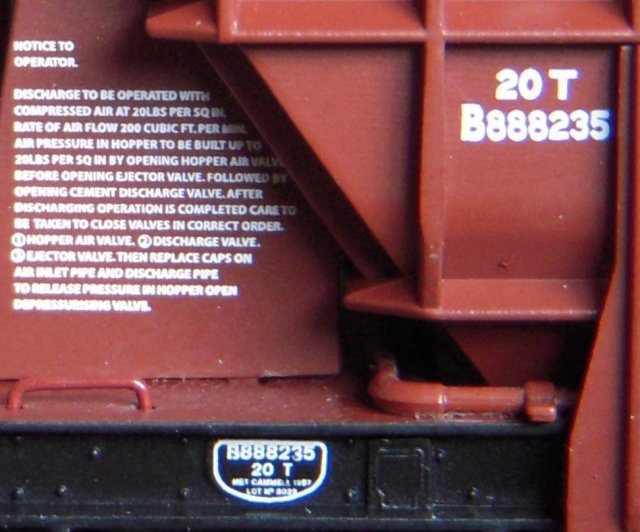
Discharge to be operated with compressed air at 20 pounds per square inch. Rate of air flow 200 cubic feet per minute. Air pressure in hopper to be built up to 20 pounds per square inch by opening hopper air valve before opening ejector valve followed by opening cement discharge valve. After discharging operation is completed care to be taken to close valves in correct order (1) hopper air valve (2) discharge valve (3) ejector valve. Then replace caps on air inlet pipe and discharge pipe. To release pressure in hopper open depressurising valve.
Other Presflos modelled by Bachmann in 2011 included Shildon built B888112 (Bulk Tunnel Cement livery ) Central Wagon's B888723 ( Blue Circle Bulk Cement ) and PF88, the Cement Marketing Company's own wagon built by the Butterley Iron Company.


MORE ABOUT CEMENT
Cement has been used from the time that ancient civilizations decided to progress beyond either dry stone walling or making structures from single massive blocks of stone. The mortar to hold bricks together is usually made from an inert substance such as sand, a binder (cement) and water. The Egyptians used a mortar containing gypsum to build their pyramids while the Greeks and Romans used slaked lime, although this tended to crumble.
Later however these Mediterranean empires used hydraulic cement, which reacts chemically with water to set and harden. However, the exact composition of this concrete - used to build such structures as the Pathenon and Colosseum as well as bridges, baths and aqueducts still standing today - is a mystery although it is known to have involved burned lime, crushed rocks and water. It is possible that this concrete also contained milk or bllod to create air bubbles that allowed it to expand with heat and contract with cold without damaging the structure.
The word cement comes from the Latin caementum which
originally meant the stone chippings used in mortar and
not the binding agent itself. The inert material used by the Romans was the volcanic ash mined near the city of
Pozzuoli near Naples, which was rich in aluminosilicate
materials, giving rise to the name pozzolina cement.
Today, pozzolana or pozzolan means either the cement
itself or any finely divided aluminosilicate that reacts
with lime in water to form cement. Water is used
sparingly, as the drier the mixture, the harder it sets.
The invention of the Portland cement used today is attributed to Joseph
Aspdin of Leeds who, in 1824, patented a material produced from a
synthetic mixture of limestone, clay and shale which ground to a powder
and baken in a kiln. The resulting clinkers were then ground again
and mixed with gypsum. Portland cement was so called because of the
similarity in colour, when set, to Portland stone.
An alternative hydraulic lime developed in 1856 by the civil engineer John Smeaton ( also born near Leeds ) when asked to build the third Eddystone Lighthouse, pictured above. Its novel design established his reputation and the lighthouse remained in use until 1877, later being re-erected as a memorial on Plymouth Hoe, where it is known today as Smeaton's Tower.
One of the earliest mass uses of Portland cement was by Sir Joseph Bazalgette in the construction of London's sewerage system, officially opened by Edward, Prince of Wales, in 1865. However, as the cement had to be prepared perfectly for the maximum strength required in building the sewers, Sir Joseph made sure that samples from each batch mixed was tested - thereby inventing the modern concept of quality control.
MORE ABOUT BLUE CIRCLE
In 1900 when 27 small, mainly Kent based, cement
manufacturers and their subsidiaries merged to form the
Associated Portland Cement Manufacturers (1900) Ltd.
These companies had produced cement using bottle, beehive
and chamber kilns over the previous 40-50 years. With the
introduction of the more efficient rotary kiln, however,
production methods became far more efficient, making
consolidation and mergers inevitable. In 1919, the
company dropped the "1900" from its name,
having begun a process of establishing interests
initially in Mexico, Canada and South Africa. The famous
Blue Circle brand was first introduced in 1928.
Throughout the first half of the 20th century, further operations were established in New Zealand, Australia, Nigeria, Chile, Indonesia, Malaysia, Spain, Rhodesia (Zimbabwe), Kenya, Tanzania and Brazil. As the company entered the second half of the 20th century, it became one of the first to make up the FT30 Index, being listed on the London Stock Exchange on 3 November 1953. The famous brand name was adopted as company name and Associated Portland Cement Manufacturers became Blue Circle Industries PLC in the late 1970s.
The 80's and 90's saw development of further worldwide interests, most notably in the United States. Cement operations in Kent continued throughout this period and plans were announced in 1995 for a new state of the art manufacturing facility at Holborough. Locally, Eurotunnel became another of the many prestigious construction projects throughout the world in which Blue Circle Industries PLC has been involved. In 2001 Blue Circle Industries was taken over by the Lafarge group to become part of the world's leading producer of cement and building materials. Indeed, Lafarge holds market leading positions worldwide in each of its four business divisions, Cement, Aggregates and Concrete, Roofing, and Gypsum. The UK cement making operations changed its company name to Lafarge Cement in early 2002, but retains the famous Blue Circle brand of cement which it makes and markets nationwide.

GLOUCESTER RCW ORDER 4559 LOT 3177 1958 B887800 TO B887999
200 special variant Presflos with screw couplings and
drawbars for running on Continental railways – it is
believed for taking Fuller’s Earth to Italy via
train ferries – were built as Gloucester Railway
Carriage & Wagon Company Lot 3177 of 1958.
From the British Transport Commission perspective, this was order number PRE/A/1013/250 - dated 19 August 1957 - procured by the Chief Supplies Officer at Euston and built to drawings and specifications supplied by the Carriage and Wagon Engineer at Doncaster Works. These wagons were painted bauxite and lettered in the san serif style of the time and delivery of the first 30 was slated for July 1958 with another 30 due the next month and 70 wagons apiece set to be handed over in September and October.
Design tare weight for what became GRCW Order Number 4559
was initially 13 tons – although this later rose in
service to 13 tons 6 cwt to allow the carriage of a 22
ton load. The compressed air system – monitored by a
circular Bourdon gauge and tested to 30 pounds per square
inch (psi) – worked at 20 psi allowing a 20 ton load
to discharge at 200 cubic feet per minute. Gloucester RCW
Presflos were also outshopped with a passenger/goods
braking system changeover lever located on the underframe
just above the main brake handle. No Presflos have ever
been recorded running in passenger trains but they were
sometimes used as part of a "fitted head" for
braking unfitted trains.
SKF axleboxes, oval solebar plates with the legend DUE
FOR PAINT 1963, isolating cocks, hydraulic buffers,
18" vacuum cylinders and hoses were all issued
"free" to the Wagon Works by British
Railway’s parent body, the British Transport
Commission (BTC). However the GRCW Order Book – now
preserved at Gloucester County Records Office –
records an interesting decision made on 18 August 1958 to
produce 240 standard drawbar hooks to Railway Clearing
House Drawing 1408, which were to be fitted from the 81st
wagon of the order.
These were to be made from steel bought for Works Order 4560, a previous 16 ton mineral wagon conversion programme for BTC involving International Standard drawhooks ("threads to be protected with thick machine oil" according to the records) and nuts threaded to BS 84. Four hundred such drawhooks were used on the Presflo job and wagons 81 onward of Lot 3177 were also fitted 20 ½ " Dowty hydraulic buffers. On example of this Lot was B887970, which by 1968 was allocated to traffic generated by Tunnel Cement – the company also owning eight Presflos outright. In the same way, B887899 was employed on Ribble Cement duties while B887811 was photographed at Hoo Junction, Kent, in 1969 carrying a large "Tunnel Cement " sticker – similar to the load allocation notices used for contemporary banana vans. B887875 was also seen in Tunnel Cement use in 1979 – by which it was also carrying the TOPS code CPV – while B887812 featured in the original 1958 Gloucester Works photograph.
GLOUCESTER RCW ORDER 5126 LOT 3323 1960 B873024 TO B873193
However, these were by no means the last
‘Presflos’ – or indeed the last cement
wagons – to be built at Bristol Road! A follow-up
deal for 170 more Presflos was clinched on 25 November
1959. These vehicles, procured by the BTC Chief Contracts
Officer based at 222 Marylebone Road London - and forming
GRCW Lot 3323 of Works Order 5126 – were however
supplied "free" with instanter rather than
screw couplings and an initial filling of axlebox grease
among the other items. BTC order reference 232-100-544
was also to be "supplied complete and ready for
service in accordance with their specification number
W154 and Arrangement Drawing number DN/22287 in [GRCWs]
possession"
Tight quality control was British Transport Commission
policy at the time and - under the watchful eye of a
Swindon-based Resident Inspector - a pattern wagon was to
be complete and ready for inspection four months from the
receipt of the order. This was despite the fact that GRCW
had already built more sophisticated machines! Delivery
of the balance of the order after approval of the sample
wagon was to run at 20 vehicles in the first month, 30 in
the second, 40 in the third and 40 a month thereafter
until all 170 units were complete.
The first delivery was made on 6 May 1960 with production
getting back on track as the 20th wagon was handed over
on 14 June, the 30th 10 days later and the 40th on 8
July. Delivery peaked on 5 September with 7 Presflos
being released to traffic and the last pair rolled away
over the High Orchard branch just 4 days before
Christmas.

GLOUCESTER RCW ORDER 5297 LOT 3361 1961 B873200 TO B873369
Slow starting or not, the British Transport Comission
must have been pleased with GRCWs produce as another 170
Presflos were commissioned as Lot 3361 on 4 May 1960.
Representing Order 5297 these wagons were delivered
between 24 February and 3 August 1961 with a productivity
peak of 7 wagons being handed over on 24 March.
Once again BTC supplied a range of components
"free", most of these reaching the Wagon Works
from Doncaster although the paint recall plate was made
at Swindon. In return, however, the Wagon Works was able
to requisition the parts for Order 5297 so quickly on the
basis of the preceding contract that Doncaster Works
Drawing Office was surprised when they wanted to redesign
some of the plumbing!
Lot 3361 was distinguished by 1’ 8 ½""
Oleo buffers and each axlebox required 4 ½lb of Shell
Alvania Number 3 grease for lubrication. This meant that
all 170 wagons needed 3060lb between them – more
than enough for all the Teddy Boy quiffs in Gloucester!
Of this Lot, B873239 was in Rugby cement traffic service
by 1969 and B873364 was still working for Blue Circle in
1978. B873287 was also wearing Blue Circle boards when
stopped for repairs at Brockenhurst on 24 April 1965.
From this batch B873368 is the last surviving Presflo, currently preserved at the National Railway Museum's Locomotion section at Shildon.
GLOUCESTER RCW ORDER 5617 LOT 3406 1961-2 B873420 TO B873569
However, the last Wagon Works Presflo of Lot 3406 was not to be
outshopped until 31 January 1962 with the fulfilment of
Order 5617. Placed by BTC on 9 January 1961 with their
order reference of 232-100-641, this was for 150 vehicles
numbered B873420 to B873569. GRCW records also reveal
that delivery of their Lot 3406 was to "..commence
in June at a rate of 10-15 wagons per week with
completion by the end of 1961." As it turned out,
the first six units only left Bristol Road on 16
September and were ultimately followed by another 150 Presflos built to
Lot 3409, numbered B873570 to B873719 and erected into 1963 alongside a new
Gloucester-designed cement wagon that was to change
railway history even more than the Presflo itself had
done seven years before.
Before examining the Cemflo however, the production records of the Gloucester Railway Carriage and Wagon Company for 30 January 1962 reveal an order for the repair of Associated Portland Cement wagon 34 with a note that British Railways Scottish Region were being held responsible for the accident damage and were to be charged for repairs. Similarly, Order Number 5968 dated 8 March 1962 was for the replacement of four new Oleo buffers to Lot 3406 Presflo B 873458, which would have been only a few months old at the time.

NEW CHALLENGES AND PRESTWINS
Indeed, even as the first Presflo cement wagons left
Gloucester RCW’s works in 1958 engineers across
Britain were working on their replacement against a
background of operational change.
Goods trains were now permitted to run at 50 mph –
some 20mph faster than during the Grouping Years. This
was partly due to the spread of continuous vacuum brakes
but also due to trains comprising of fewer wagons as
small loads were being lost to more flexible road
haulage.
Diesel and electric locomotives, too, were accelerating
faster and maintaining higher average speeds than ever
before, allowing freight to be pathed in with express
passenger workings – thus making slow lines
technically redundant.
Traditional British wagon design – still wedded to the concept of two axles 10 feet apart suspended on leaf springs – not suitable for such high speed running. If such suspension was not well maintained, wagons not coupled together tightly – or with loads not evenly positioned – would respond to even small variations in track quality with rolling and ‘hunting’ (a twisting side-to-side movement) which could lead to derailment.
Bulk cement wagons also had high centres of gravity – encouraging rolling at speed – despite their modest capacities: a result of cement’s characteristic steep angle of repose. The abrasive powder would simply not drop out of a shallow sided hopper unaided. Similarly, in spite of many detail improvements made on the basic design to yield faster and more complete unloading the square corners of the ribbed Presflo hopper still caused runny solids to collect and impair full discharge.
The "twin-tub" Prestwin design was an attempt to solve this problem. The first 31 bauxite-liveried wagons – adapted from Continental practice – were built by the Metropolitan Cammell Carriage & Wagon Company Ltd at their Old Park Works in Wednesbury, West Midlands, late in 1960 to 10’ wheelbase Diagram 1/274. A further fifty were outshopped in 1961 and production of a final 50 spread to other manufacturers. These last 100 Prestwins however adhered to 12’ wheelbase Diagram 1/277 which measured 22’ 11" over hydraulic buffers with a tare weight of just over 14 tons.
Prestwins were numbered from B873000 to B873770 using gaps in the serials not already occupied by Presflos.
Each cylindrical silo on the 11’11" tall
Prestwin was inherently stronger than the Presflo’s
hopper shape, which was strengthened by heavy ribs
against implosion during rapid unloading. Additionally,
each silo on featured a 2’ diameter perforated
aeration base plate, allowing air to be pumped into the
heart of the 515.5 cubic feet load, making the cement
behave like a liquid while keeping the fine particles out
of the air supply system. As such Prestwins were better
adapted to carrying finer grained runny solids such as
lime, hydrate of aluminium, soda ash, fertilizers and
chalk. Many of the 12’ wheelbase Prestwins ended
their days carrying sand. An example of this was B873748
built by Central Wagon Co Ltd of Wigan in 1962 as part of
their Lot 3469, although the contemporary Airfix ( now
Dapol) kit of a Prestwin ( seen below) depicts B873371. Like the
Presflos, Prestwins each had two vacuum cylinders
actuating two brake blocks per wheel.
Prestwin wagons - like the German example depicted above - were still operational in Europe in 2004.


CEMFLOS
Although no Prestwins were ever built at Bristol Road the
idea of the aerated baseplate was developed into a
complete aerated floor for a project that was brought to
GRCW by Associated Portland Cement. At this time, private
operators were aiming for maximum utilisation of their
assets by rapidly turning wagons round for high mileage
journeys - which were now being completed in days rather
than weeks. APCM thus formulated a requirement for a
lightweight 4-wheeled wagon with a low tare to weight
ratio with one particular working in mind: taking Blue
Circle cement from their works at Cliffe, Kent –
made accessible to rail vehicles late in 1961 – to
Uddingston near Glasgow for onward lorry transport. These
trains were to travel around the western edge of London
and take the East rather than West Coast Main Line. They
were also remarkable because Birmingham RCW Type 3 diesel
electric locomotives ( later Class 33) were to provide
traction as far as York – well away from their
normal Southern Region haunts!
As such a lightweight cement wagon would have to
incorporate BR standard running gear the only suitable
material it could be designed around was aluminium alloy.
Although featuring steel wheels, buffers, axles and
laminated leaf suspension the ‘Cemflo’ –
as it was known – is now believed to be the first
type of aluminium cement wagon built in Britain.
The 12’ 1 ¼" high round topped vehicle measured 27’1" over its buffers and combined a 15’ wheelbase with a load of 26 tons 13 cwt against a tare weight of just 8 tons 7 cwt – a ratio approaching 4:1. The almost entirely flat aerated floor - which could liquefy its whole load for discharge - also meant that the centre of gravity of the Cemflo was lower than that of its predecessors. However, although this increased stability at speed when loaded, the light tare weight of the new design was to be problematic when running empty.
As they were built from an aluminium alloy having only
1/3 the weight of steel (but three times the equivalent
deflection rate) for a given mass, the low tare weight of
the Cemflo meant that a variable tare/load suspension
system was required.
Unlike open vehicles, rigid box-type bodied wagons need
such flexible suspensions because their superstructures
will not twist in response to track irregularities. As a
wheel needs a certain amount of pressure to keep it on
the track it must, by both design and maintenance, be
allowed to rise and fall with the dips and bumps relative
to its body if it is not to ‘unload’ and
derail.
The bottom plates of the Cemflo’s laminated leaf
springs took the weight of the wagon itself when running
empty and combined with the upper plates to support the
full load. This tare/load system was also fitted with
helical auxilliary hangers to increase the movement in
suspension.
Wagon Works Order 5332 dated 27 May 1960 was for 100
Cemflos although this figure was increased to 190 units
on 28 August that year. The 8’ 2 ½" wide
Gloucester designed vehicles were fitted with screw
couplings, four-spoke handwheels for the application of
eight clasp brakes and Timken axleboxes marked with the
initials of the owner. They were also to be "
supplied complete in every respect and ready for service
in accordance with our specification and arrangement
drawing No. E 1396A."
Delivery of a pattern vehicle " complete and ready for inspection" was due by October 1960 with the balance of the order to be outshopped at the rate of 40 per month after approval of the sample wagon. In fact the first Cemflo was delivered on 3 February 1961 and the last on 28 January 1962. Also in the GRCW archive is an official photograph of a Cemflo numbered LA ( for Light Alloy) 1. Dated from the second month of that year, its solebar is plated "Registered 1961 BR (WR) 27T gross weight not to exceed 35 tons." – one of the many small details that were missing from the later Hornby model of the Cemflo.
Indeed, although this 00-gauge item was available in both
the bright yellow – and later grey -paintwork of
APCM, early versions appeared in a natural metalskin
finish. These so-called "Silver Queens" also
had solid-appearing solebars although later versions had
rows of holes – presumably to save even more tare
weight. Gloucester RCW Cemflos featured oval holes,
although the Hornby Cemflo has round holes like the batch
outshopped by Metropolitan Cammell in 1963. To the
knowledge of this author it is still the only example of
a ready-to-run model based on a vehicle both originally
designed and built in Bristol Road.
DISASTER AT THIRSK
However, this accolade was to count for little on the
last day of July in 1967. That fateful afternoon a train
of 26 Cemflos was heading North on the Down Slow East
Coast main Line en route from Cliffe – which it had
left at 02.40 - to Uddingston. Although designed for 60
mph running they had been derated to 45 mph the previous
year following a spate of freight train derailments.
Just over two miles south of Thirsk however the rear
wheels of the twelfth - Metropolitan Cammell built -
Cemflo derailed, causing all but the last wagon and brake
van behind it to follow suit. The coupling between
twelfth and eleventh Cemflos then broke, pulling apart
the vacuum brake connection. The first eleven Cemflos and
the train locomotive stopped safely a quarter of a mile
ahead. Of the remaining 14 wagons though, 13 had either
sprawled outside the Down Slow or had come to rest at the
bottom of the nearby embankment. That left the
twenty-third wagon slewed round, two feet of its length
fouling the Down Fast to the right. As soon as his brake
van had stopped rolling, the guard began running South
with red flag and detonators to protect the line, only to
be greeted by the sight of the Noon Kings Cross to
Edinburgh express bearing down on him.

English Electric Co-Co photographed at Marylebone in 1965 by Andy Peckham
In the event he could do no more than wave his red flag. Luckily though, the driver of the express – hauled by unique English Electric diesel DP2 – had already seen an unusual haze ahead of him, pulled back his power lever and started to brake from 75 mph. Then, realising what had happened, he made an emergency brake application, sanded the rails and shut down the 2700 bhp engine to reduce the risk of fire.
A collision though was inevitable. Miraculously the
driver and second man escaped as the left hand side of
their cab was crushed and the 105 ton locomotive lurched
to the right, derailing across the Up Fast and taking
seven of its thirteen carriages with it. The projecting
cement wagon tore into the body side of the first three
carriages but in the second and third carriages only
demolished the corridor. In the first carriage however
the compartment side was to the left. Seven passengers
died and 45 were seriously injured.
As fortune would have it, the pilot of a Royal Air Force
plane flying nearby witnessed the disaster and
immediately radioed for help. But with Colonel Dennis
McMullen of the Railway Inspectorate lay the harder task
of finding the cause of the cement train derailment.
Eventually some of the contributory factors were
identified as train operation and track and wagon
maintenance. Most interestingly paragraph 71 from the
Report read :
The lateral oscillation (hunting) of " Cemflo"
No. LA 233 was able to build up because wear in the
U.I.C. link type suspension with which the wagon was
fitted had eliminated the natural friction damping of
this type of suspension. This wear is rapid, and it was
particularly rapid on this wagon, and the reasons for it
are still not fully understood. The presence of cement
acting as an abrasive is probably an important factor,
because in other applications, notably on oil tank wagons
running on British Railways, the U.I.C. link type
suspension has been found to give a satisfactory
performance with an average life of 80,000 miles against
the 5,000 miles which is typical on " Cemflo "
wagons.
Colonel McMullen thus
blamed the suspension chosen by Metro-Cammell and fitted
only to their wagon batches, and specifically attributed
the suspension failure to excessive freedom and lack of
transverse damping control.
Subsequent research proved that the
slack coupling of Cemflos caused them to hunt dangerously
from side to side while at the point of the initial
derailment of the twelfth wagon of the doomed goods train
there had been a ¼" height variation between the
rails of the track. Tests at Doncaster also revealed that
the wheels on the first of this wagon’s axles to
derail differed in diameter by 1/32". This was
within specified limits, but the suspension on the
twelfth wagon was also found to be worn.
Wear and tear – possibly caused by the abrasive effects of cement dust – could cause such a damped leaf suspension to fail to stop induced rolling. Perhaps if the Cemflo design had not been modified by Metropolitan Cammell with UIC link type suspension - or if the original design had included more steel than aluminium and the tare weight had been higher a less vulnerable suspension could have been used and the Thirsk disaster avoided. Sadly the middle word of life is "if".

APCM Blue Circle PC009A wagons 9344, 9344 and 9345 as built by BREL Doncaster 1975-77 and modelled by Hornby. The "depressed centre" (DP) body design allowing cement to settle down toward a central discharge valve.
UPLIFT THROUGH DEPRESSION
Immediately after the Thirsk disaster, too, APCM hired a
small batch of tanker-like Swedish built pressure
discharge cement wagons coded PCF. But although the once
proud "Silver Queens" were to finish their days
quietly in Derbyshire, many of their best features
survived on the 31 operational cement designs built
between 1969 and 1987.
Underfloor aeration, like air brakes, had become standard while 22 of the types ran on suspensions designed at Gloucester RCW :– rubber chevron Metalastik Mark 3s on two of the three bogie variants built by Metro-Cammell and multi-helical sprung Floating Axle, Primary 2 Axle or Pedestal on four-wheelers erected by such august names as Procor, Powell Duffryn, Standard, BREL at Shildon, Doncaster and Ashford and even CFMF in France. Indeed, Gloucester Floating Axle suspension still supported the distinctive depressed centre body design – coded PC009A and operated by Associated Portland Cement Manufacturers – which still turned heads on its travels into the 1990s.
.An earlier version of the APCM "depressed
centre" (DP) concept – allowing cement to
settle down toward a central discharge valve – was
exemplified by DP 340, one of 50 such four wheeled wagons
outshopped by Metropolitan Cammell in 1967. Although
still featuring leaf rather than helical springing, they
were air brake fitted and vacuum brake piped and although
their 15’ wheelbase was identical to the Cemflo the
tare had gone up to just over 15 tons 5 cwt with an
exponential load increase to 32 tons 14 cwt.

An example of design code PC015D in the orange livery of Ready Mix Concrete Limited built by Procor of Wakefield in 1981. Like the PC009As depicted above, this Hornby model features Gloucester Floating Axle Suspension.
FORWARD TO THE PAST
Just as Blue Circle cement was travelling in bulk in some
of Britain’s newest wagon designs though, advances
in forklift truck technology had allowed bagged cement to
be carried on pallets in some new – but rather old
fashioned looking – vans. As mentioned above,
covered vans – some from the pre-Grouping era -had
carried bagged cement back in the late 1940s but APCM
ordered 96 new versions from the Standard Wagon Company
of Heywood, Lancashire between 1964 and 1966.
Although easily mistaken for Swindon products of the 1930s from the ends, these vacuum braked vehicles had sliding doors like contemporary BR "Vanwides". At a time when Barry Bucknell was being hailed as the "Elvis of DIY", grey liveried vans such as BV 089 were serving smaller APCM depots in Kent up to the mid 1980s. BV 007 was seen at Gloucester in 1976 and under the TOPS scheme the fleet was renumbered 6201-6296 before withdrawal in the 1980s.
Ironically, the last complete vehicle to be outshopped from Bristol Road – in 1968 - was another wagon for carrying bagged runny solids handled on pallets by fork lift trucks : in this case a sheet sided covered bogie van owned by Lloyd & Scottish and leased to Shell fertiliser for traffic from its works in Cheshire.
Starved of orders following the completion of BTCs Modernisation Plan in the early 1960s, GRCW was forced to diversify away from railway products in the years afterward and today little trace of the Wagon Works remains. Only the ghosts of wagons and their makers now rattle through the multiplex cinema and fast food restaurants that replaced them in Bristol Road, but their concrete progress lives on.