Home

CHELTENHAM GWR MODELLERS GROUP


MODEL RAILWAY EXHIBITION


SATURDAY 6 APRIL AND SUNDAY 7 APRIL 2013


  SPONSORED BY  


  Cheltenham Model Centre  


THE NEXT EXHIBITION WILL BE HELD ON

SATURDAY 25 AND SUNDAY 26 APRIL 2014


Click here for Introduction and future exhibition information


Click on picture for review of April 2005


Click on picture for review of April 2005


Click on picture for review of October 2005


Click on picture for review of October 2005


Click on picture for review of April 2006


Click on picture for review of April 2006


Click on picture for review of October 2006


Click on picture for review of October 2006


  Click on picture for review of April 2007  


Click on picture for review of April 2007


Click on picture for review of October 2007


Click on picture for review of October 2007


Click on picture for review of April 2008


Click on picture for review of April 2008


Click on picture for review of October 2008


Click on picture for review of October 2008


Click on picture for review of April 2009


Click on picture for review of April 2009


Click on picture for review of October 2009


   Click on picture for review of October 2009    


Click on picture for review of April 2010


  Click on picture for review of April 2010    


Click on picture for review of October 2010


Click on picture for review of October 2010


Click on picture for review of April 2011


Click on picture for review of April 2011


Click on picture for review of October 2011


Click on picture for review of October 2011


Click on picture for review of April 2012


Click on picture for review of April 2012


Click on picture for review of October 2012


Click on picture for review of October 2012


Click on picture for review of October 2013


Click on picture for review of October 2013


For review of  April 2014 click on the picture above


For review of  April 2014 click on the picture above


LAYOUT AND ATTRACTION REVIEW


ANDERSTAFF YARD by Brendan Walsh

EM Gauge 4mm Scale


Set in the EWS era of the early years of the 21st Century, the upper level of Anderstaff Yard was a truncated passenger line with a shuttle service of modern DMUs into the terminus at the left, while the lower level featured a yard handling steel goods and engineer's trains.  The layout was offered for sale at the end of the exhibition and has happily been bought by a pair of local enthusiasts - so we may be seeing it at St Margaret's Hall again in the future.


  Set in the EWS era of the early years of the 21st Century, the upper level of Anderstaff Yard was a truncated passenger line with a shuttle service of modern DMUs into the terminus at the left, while the lower level featured a yard handling steel goods and engineer's trains.  The layout was offered for sale at the end of the exhibition and has happily been bought by a pair of local enthusiasts - so we may be seeing it at St Margaret's Hall again in the future.  


Set in the EWS era of the early years of the 21st Century, the upper level of Anderstaff Yard was a truncated passenger line with a shuttle service of modern DMUs into the terminus at the left, while the lower level featured a yard handling steel goods and engineer's trains.  The layout was offered for sale at the end of the exhibition and has happily been bought by a pair of local enthusiasts - so we may be seeing it at St Margaret's Hall again in the future.


  ABBOTSWOOD JUNCTION by Phil and James Bullock

00 Gauge 4mm Scale


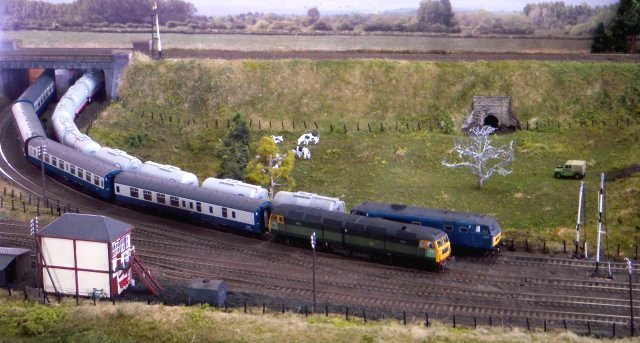
Abbotswood Junction was a father and son collaboration representing the site just south of Worcester where the ex LMS Gloucester to Birmingham line is joined by a chord from Norton Junction on the ex GWR Worcester to Oxford line. The layout featured DDC Sound and working semaphore signals appropriate for the 1967 - 1973 end of steam to start of TOPS period.


  Abbotswood Junction was a father and son collaboration representing the site just south of Worcester where the ex LMS Gloucester to Birmingham line is joined by a chord from Norton Junction on the ex GWR Worcester to Oxford line. The layout featured DDC Sound and working semaphore signals appropriate for the 1967 - 1973 end of steam to start of TOPS period.

The further premise was that the Stratford to Cheltenham line closed when through services closed in 1965 and so the layout at Abbotswood had to be expanded to accommodate extra traffic. An up loop with a direct connection to the Worcester chord ( only ever a kickback siding in reality ) was laid and suitably signalled before the advent of multiple aspect signalling controlled from Gloucester Horton Road power box. Unfortunately there had also recently been a derailment on the Worcester chord so all services were having to run via Bromsgrove - until phase two of the layout is built anyway!

Among the more interesting passenger trains were the Cornishman and Devonian passenger expresses alongside such freight workings as the Waterston to Albion tanks booked for a pair of Class 37s, the St Blazey to Etruria clays booked for a Class 52 Western and the Bristol Malago Vale to Worcester vans booked for a Warship.


Among the more interesting passenger trains were the Cornishman and Devonian passenger expresses alongside such freight workings as the Waterston to Albion tanks booked for a pair of Class 37s, the St Blazey to Etruria clays booked for a Class 52 Western and the Bristol Malago Vale to Worcester vans booked for a Warship.


BUCKSHEE by Redditch MRC

00 Gauge 4mm Scale


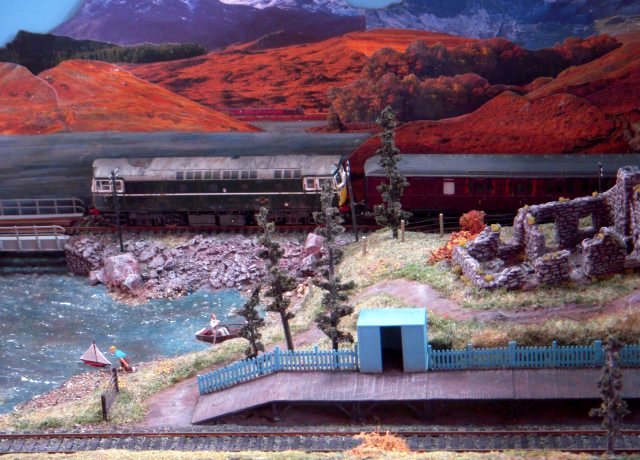
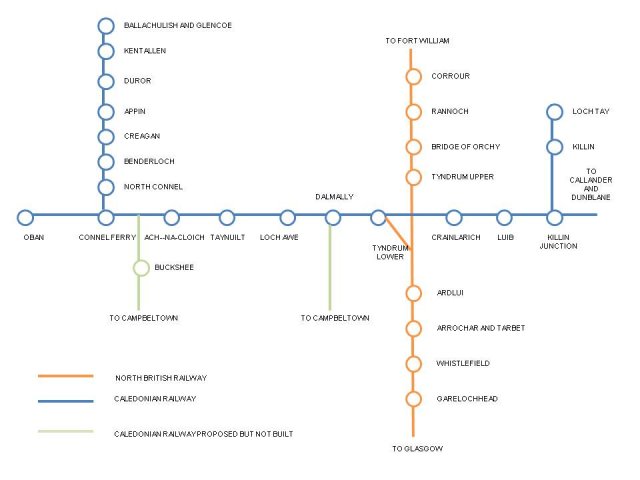
It was imagined that Buckshee was intended to be the first station on a projected line from Oban to Campbeltown promoted by the Caledonian Railway after the opening of the Callender to Oban Railway in 1880. A line was at one time proposed from Campbeltown to Dalmally.


  It was imagined that Buckshee was intended to be the first station on a projected line from Oban to Campbeltown promoted by the Caledonian Railway after the opening of the Callender to Oban Railway in 1880. A line was at one time proposed from Campbeltown to Dalmally.

The line to Buckshee would have come off the Callander to Oban Railway from a junction at Connel Ferry.  Unfortunately it was soon realised that the line would be too costly to build with little if any profit and was thus terminated at Buckshee, situated just slightly north of Kilninver on the shore of the sea Loch Feochan.  The village of Buckshee would have had a small harbour and a distillery with the fish and whisky being taken out by train as coal and other general merchandise arrived. 

Buckshee was first exhibited at the Redditch Model Railway Club Exhibition in 2004 as a work in progress but much has been added to the 15' x 18* layout since then.


The line to Buckshee would have come off the Callander to Oban Railway from a junction at Connel Ferry.  Unfortunately it was soon realised that the line would be too costly to build with little if any profit and was thus terminated at Buckshee, situated just slightly north of Kilninver on the shore of the sea Loch Feochan.  The village of Buckshee would have had a small harbour and a distillery with the fish and whisky being taken out by train as coal and other general merchandise arrived.


The line to Buckshee would have come off the Callander to Oban Railway from a junction at Connel Ferry.  Unfortunately it was soon realised that the line would be too costly to build with little if any profit and was thus terminated at Buckshee, situated just slightly north of Kilninver on the shore of the sea Loch Feochan.  The village of Buckshee would have had a small harbour and a distillery with the fish and whisky being taken out by train as coal and other general merchandise arrived.


  DOVINGTON CAMP by Paul Taylor

00 Gauge 4mm Scale


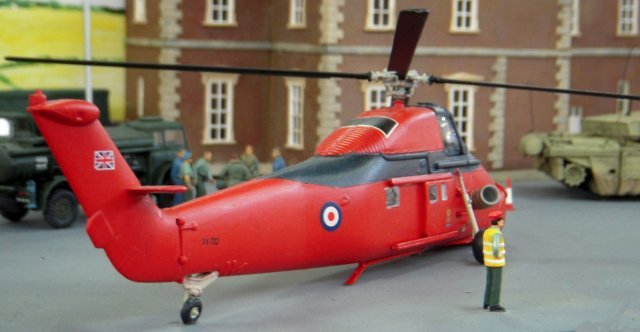
The main stores and office were constructed with the exteriors visible to exhibition visitors and on this occasion Dovington Camp was represented in the lead up to the Gulf War of 1990 with the local Guard's Brigade (made from classic Airfix Guards Colour Party and Guards Band soldiers adapted to carry SA80 rifles) parading to receive new Regimental Colours from the Preiser model of HM The Queen.  Whether HRH The Prince Phillip was allowed to fly Westland Wessex  XV732 of the Queen's Flight himself is not recorded.


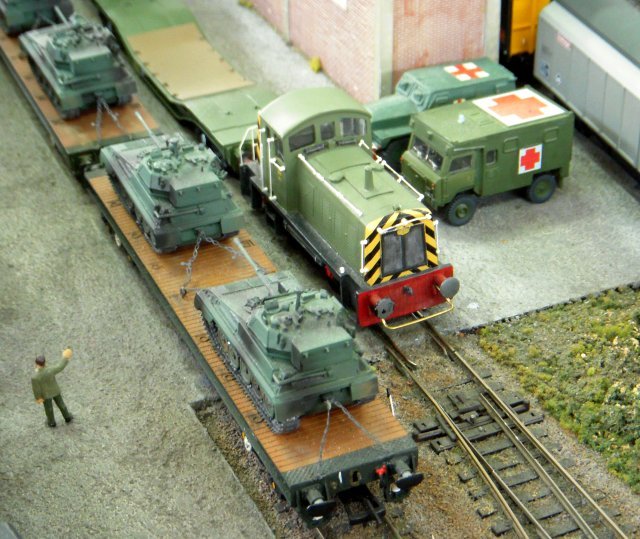
  Dovington Camp was developed during World War II as an army stores and training depot with quite an extensive rail network. This had been rationalised over time but still retained a rail link for the movement of fuel, stores, munitions and a wide variety of military vehicles. It retained several MOD diesel locomotives for shunting within the depot.

The main stores and office were constructed with the exteriors visible to exhibition visitors and on this occasion Dovington Camp was represented in the lead up to the Gulf War of 1990 with the local Guard's Brigade (made from classic Airfix Guards Colour Party and Guards Band soldiers adapted to carry SA80 rifles) parading to receive new Regimental Colours from the Preiser model of HM The Queen.  Whether HRH The Prince Phillip was allowed to fly Westland Wessex  XV732 of the Queen's Flight himself is not recorded.

Dovington was previously seen at Cheltenham in October 2006 in its smallest modular form and nowadays could also connect with Paul Taylor's Anelian Road layout. 


Dovington Camp was developed during World War II as an army stores and training depot with quite an extensive rail network. This had been rationalised over time but still retained a rail link for the movement of fuel, stores, munitions and a wide variety of military vehicles. It retained several MOD diesel locomotives for shunting within the depot.


  OXFORD ROAD by Richard Papper

00 Gauge 4mm Scale


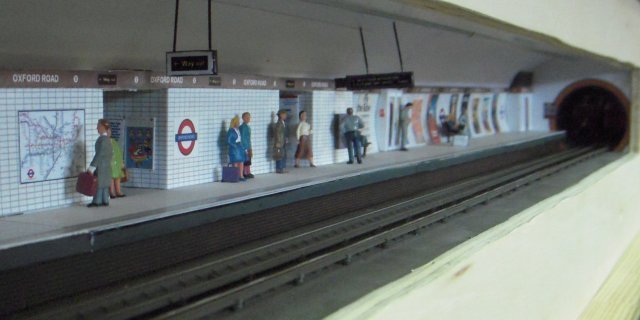
Oxford Road was a fictitious setting somewhere in West London in the mid 1980s to early 1990s.  The layout - DCC equipped using an NCE Powercab system and built with Peco Code 100 track - contained a small depot, fuelling point, engineers siding and small platform which saw a sporadic service of garishly painted first generation Network South East dmus.  The Bakerloo Line ran on a lower level beneath it and had its own separate station.  Structures were a mixture of card and plastic kits and scratchbuilt and rolling stock detailed ready to run vehicles from Bachmann, Hornby, Lima and Heljan.


  Oxford Road was a fictitious setting somewhere in West London in the mid 1980s to early 1990s.  The layout - DCC equipped using an NCE Powercab system and built with Peco Code 100 track - contained a small depot, fuelling point, engineers siding and small platform which saw a sporadic service of garishly painted first generation Network South East dmus.  The Bakerloo Line ran on a lower level beneath it and had its own separate station.  Structures were a mixture of card and plastic kits and scratchbuilt and rolling stock detailed ready to run vehicles from Bachmann, Hornby, Lima and Heljan.  


Oxford Road was a fictitious setting somewhere in West London in the mid 1980s to early 1990s.  The layout - DCC equipped using an NCE Powercab system and built with Peco Code 100 track - contained a small depot, fuelling point, engineers siding and small platform which saw a sporadic service of garishly painted first generation Network South East dmus.  The Bakerloo Line ran on a lower level beneath it and had its own separate station.  Structures were a mixture of card and plastic kits and scratchbuilt and rolling stock detailed ready to run vehicles from Bachmann, Hornby, Lima and Heljan.


  RAX LANE MPD by Ron Randall

00 Gauge 4mm Scale


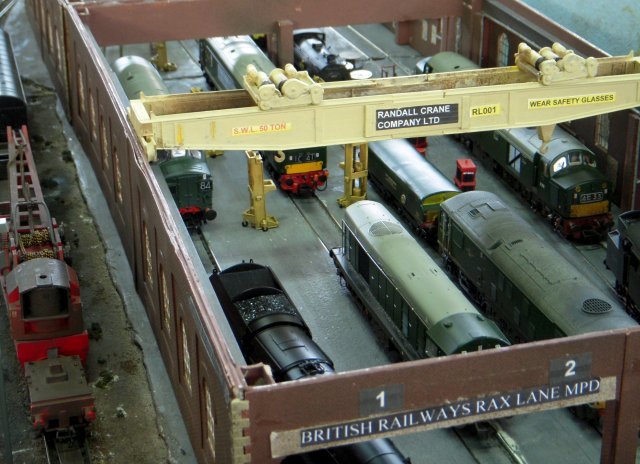
Rax Lane represented a weathered engine shed during the 1960 - 1967 transition from steam to diesel power and although loosely based on 1A Willesden hosted as many as 40 locomotives from all over Britain at any one time - some complete with sound chips.  The depot's own breakdown train was also visible as were wagons brining in supplies of solid and liquid fuel and spare parts.


  Rax Lane represented a weathered engine shed during the 1960 - 1967 transition from steam to diesel power and although loosely based on 1A Willesden hosted as many as 40 locomotives from all over Britain at any one time - some complete with sound chips.  The depot's own breakdown train was also visible as were wagons brining in supplies of solid and liquid fuel and spare parts.

Although built for simple DC operation, Rax Lane was rewired for DCC using a main and two slave ZTC controllers enabling up to three people to operate the layout together.  However the points were still controlled by a mimic panel.


Rax Lane represented a weathered engine shed during the 1960 - 1967 transition from steam to diesel power and although loosely based on 1A Willesden hosted as many as 40 locomotives from all over Britain at any one time - some complete with sound chips.  The depot's own breakdown train was also visible as were wagons brining in supplies of solid and liquid fuel and spare parts.


  THE COAL YARD by Ray Owens

00 Gauge 4mm Scale


The Coal Yard represented a small corner of a colliery with a working loader, allowing a train of empty wagons to arrive from the exchange sidings and for the railway company locomotive to be uncoupled before a colliery shunter propelled them under the loader.  The full wagons were then returned to the siding they had arrived on, the shunter retired to its own engine shed and the train engine re-attached to take them away.


  The Coal Yard represented a small corner of a colliery with a working loader, allowing a train of empty wagons to arrive from the exchange sidings and for the railway company locomotive to be uncoupled before a colliery shunter propelled them under the loader.  The full wagons were then returned to the siding they had arrived on, the shunter retired to its own engine shed and the train engine re-attached to take them away.  


The Coal Yard represented a small corner of a colliery with a working loader, allowing a train of empty wagons to arrive from the exchange sidings and for the railway company locomotive to be uncoupled before a colliery shunter propelled them under the loader.  The full wagons were then returned to the siding they had arrived on, the shunter retired to its own engine shed and the train engine re-attached to take them away.


  WINDRUSH by Harvey Whitmore

00 Gauge 4mm Scale


Remember the poem “Adlestrop” by Edward Thomas, where the GWR train stopped unexpectedly, the quiet of the Cotswolds descended and only the sounds of birds singing were heard?  Windrush has that same landscape and little has changed over the years.  During the early years on Nationalisation life still goes on peacefully and quietly, punctuated by trains and the occasional aeroplane drone from the nearby RAF training station a few miles away.


Remember the poem “Adlestrop” by Edward Thomas, where the GWR train stopped unexpectedly, the quiet of the Cotswolds descended and only the sounds of birds singing were heard?  Windrush had that same landscape and little had changed over the years.  During the early years on Nationalisation life still went on peacefully and quietly, punctuated by trains and the occasional aeroplane drone from the nearby RAF training station a few miles away.

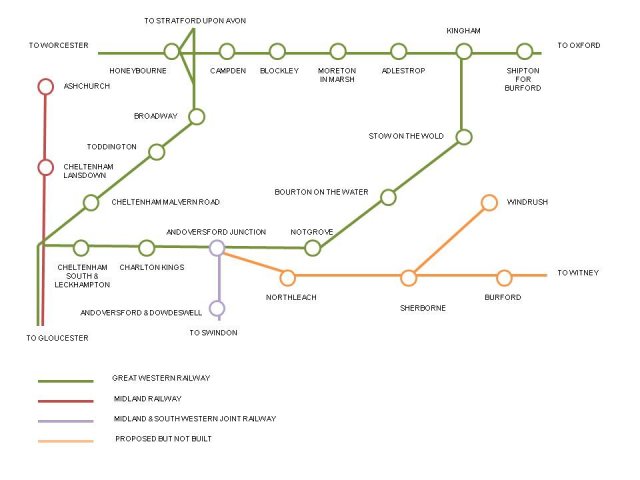
A plan once existed to connect the Cotswold town of Northleach by rail, with Andoversford to its west and Burford to its east.  Harvey imagined that this proposal had been realised, with Windrush becoming a small branch line from a junction at nearby Sherbourne.  Passenger services to Andoversford via Sherbourne Junction and to Northleach could be seen and the majority of general merchandise including livestock and parcels were still carried by rail in both easterly and westerly directions.

The locomotives and rolling stock typified the early aspirations of BR with motive power supplied mainly from Gloucester depots 22B (Barnwood, London Midland) and 85B (Horton Road, Western) on view with the occasional borrowed type.  Primarily this was a blue disc route, which allowed a reasonably large selection of pre war locos from these sources.


A plan once existed to connect the Cotswold town of Northleach by rail, with Andoversford to its west and Burford to its east.  Harvey imagined that this proposal had been realised, with Windrush becoming a small branch line from a junction at nearby Sherbourne.  Passenger services to Andoversford via Sherbourne Junction and to Northleach could be seen and the majority of general merchandise including livestock and parcels were still carried by rail in both easterly and westerly directions.


  THOMAS by Cheltenham GWR Modellers 00 Gauge 4mm Scale   


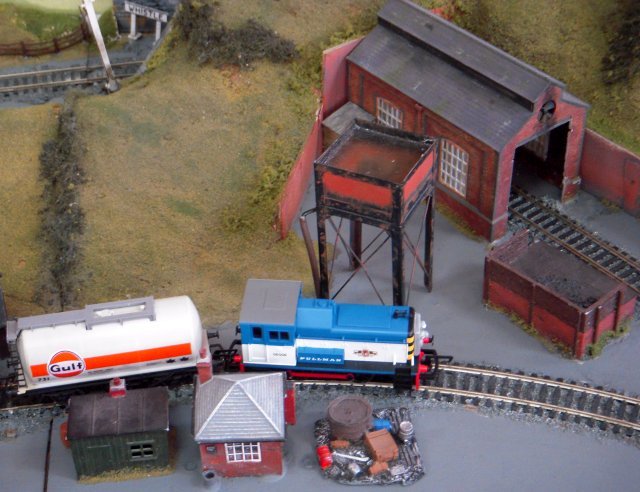
Tank wagons rather than tank engines were to the fore on this outing, marshalled behind a Pullman liveried Class 06 diesel next to a very neat pile of tools and components.  However, passenger traffic was still being drummed up by the display of nostalgic holiday posters visible from the station platform on the back of the signalbox.


  Tank wagons rather than tank engines were to the fore on this outing, marshalled behind a Pullman liveried Class 06 diesel next to a very neat pile of tools and components.  However, passenger traffic was still being drummed up by the display of nostalgic holiday posters visible from the station platform on the back of the signalbox.  


Tank wagons rather than tank engines were to the fore on this outing, marshalled behind a Pullman liveried Class 06 diesel next to a very neat pile of tools and components.  However, passenger traffic was still being drummed up by the display of nostalgic holiday posters visible from the station platform on the back of the signalbox.


  MANNIN MIDDLE by Peter Cullen

009 Gauge 4mm Scale


By the summer of 1964, the Isle of Man Steam Railway was a shadow of its former self.  Tourists had not returned to the Island after the Second World War and the halcyon days of the 1920s and 30s were now a distant memory.  After the boom years, short trains with few passengers were now the order of the day.


  By the summer of 1964, the Isle of Man Steam Railway was a shadow of its former self.  Tourists had not returned to the Island after the Second World War and the halcyon days of the 1920s and 30s were now a distant memory.  After the boom years, short trains with few passengers were now the order of the day.   


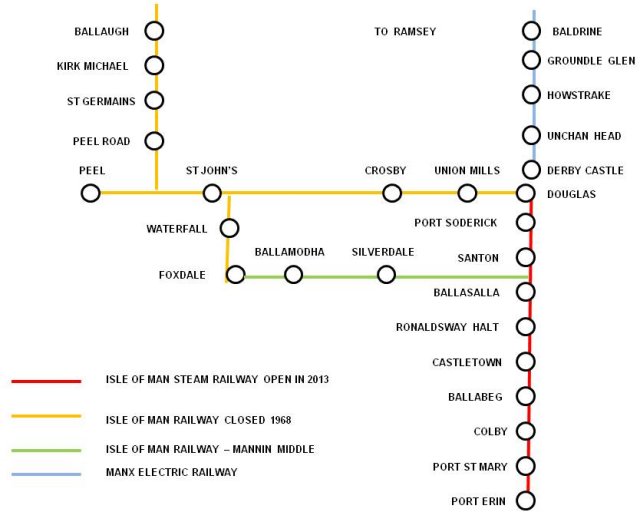
Mannin Middle assumes that the Foxdale Branch had been extended southwards to form a junction with the southern line at Ballasalla.  Although passing through a largely rural area which did not contribute much passenger traffic, the route would have been useful as a means of travelling from the south to the north of the island avoiding Douglas.


Mannin Middle assumes that the Foxdale Branch had been extended southwards to form a junction with the southern line at Ballasalla.  Although passing through a largely rural area which did not contribute much passenger traffic, the route would have been useful as a means of travelling from the south to the north of the island avoiding Douglas.

The northern routes from Douglas to Peel and Ramsey closed in 1968.  However, the southern line remains open and it is still possible to travel from Douglas to Port Erin through the beautiful rolling Manx countryside in a wooden bodied coach hauled by a 19th Century steam locomotive.

Mannin Middle was originally built by Hugh Freeman of Kenilworth and purchased by Peter Cullen in 1999.

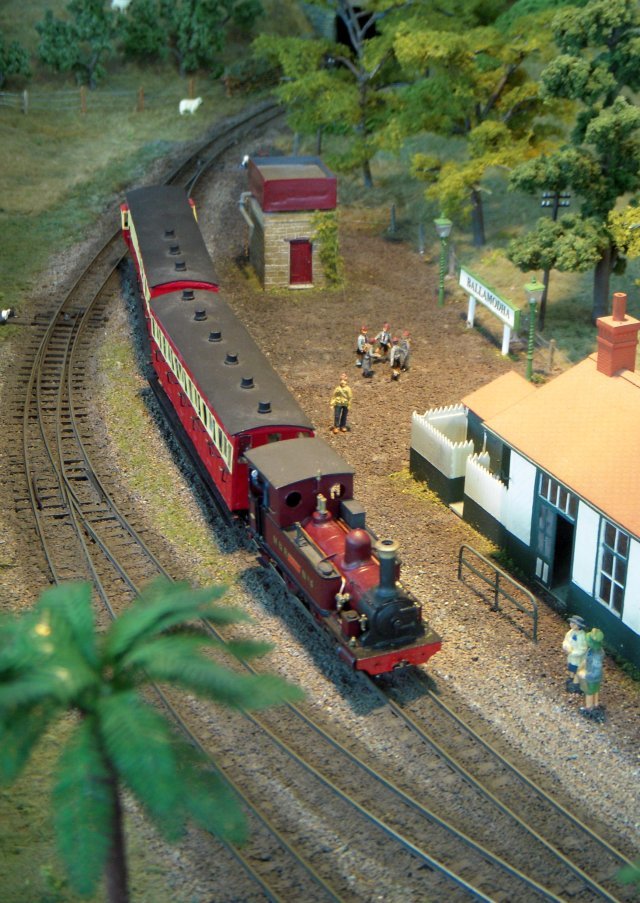
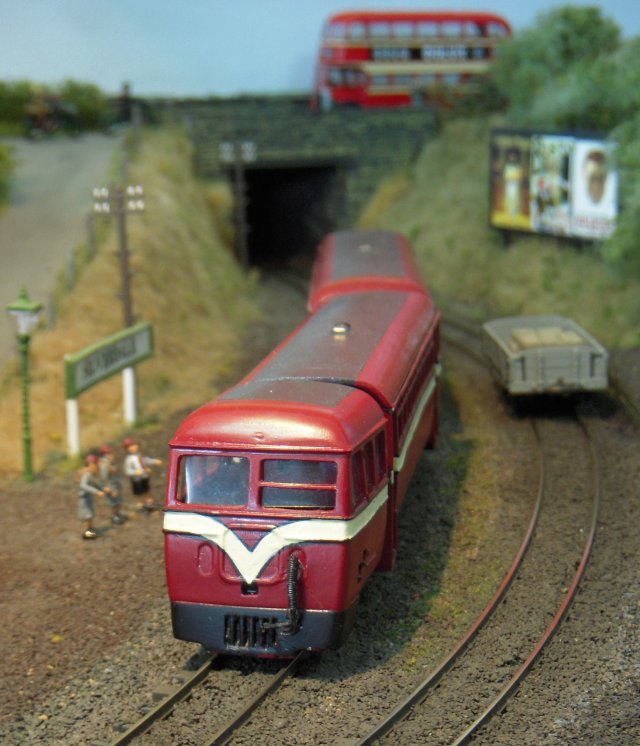
Arriving at under the palm trees at Ballamodha station above is Manx Northern Railway 0-6-0T Number 4 "Caledonia" built by Dubs and Company of Glasgow in 1885 while - below - one of the ex County Donegal railcars which arrived on the Isle of Man in 1960 passes through Silverdale with an Isle of Man Road Services Leyland PD1 double deck bus passes behind it.


Arriving at under the palm trees at Ballamodha station above is Manx Northern Railway 0-6-0T Number 4 "Caledonia" built by Dubs and Company of Glasgow in 1885 while - below - one of the ex County Donegal railcars which arrived on the Isle of Man in 1960 passes through Silverdale with an Isle of Man Road Services Leyland PD1 double deck bus passes behind it.


  YATE ROCKS TRAMWAY by Colin James

009 Gauge 4mm Scale


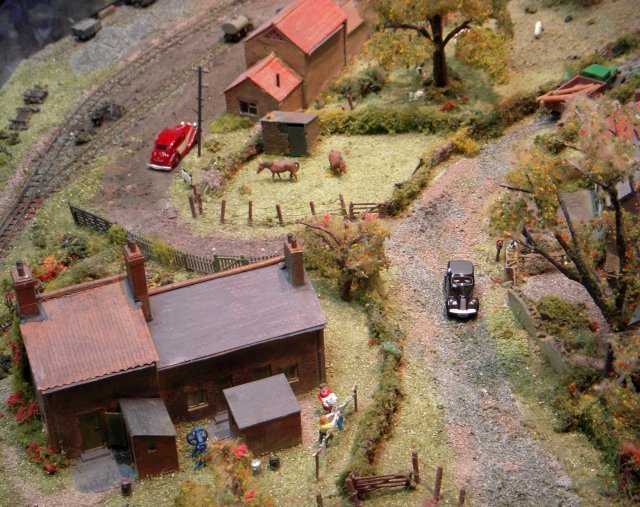
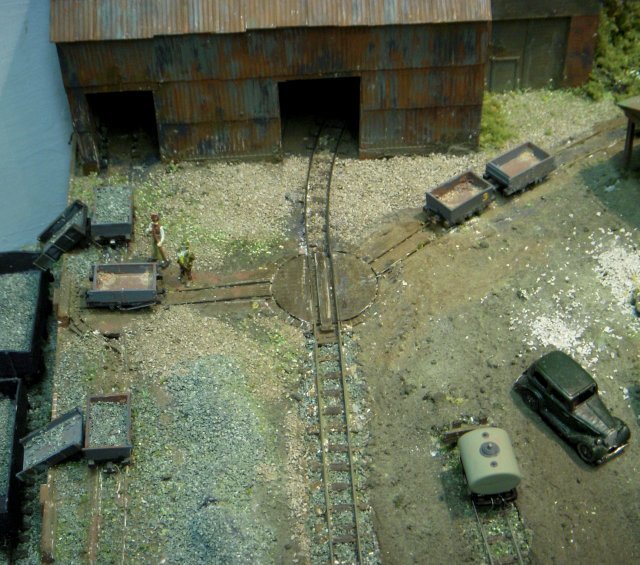
This 1300 x 950mm layout was based on a small - probably horse drawn -  late 19th Century 3' gauge tramway that connected limestone quarries just north of the east end of Tan House Lane near Wickwar with limekilns near Rangeworthy and alongside the Midland Railway main line north of Bristol - just south of where Limekiln Lane crosses the railway.  There was also another unconnected tramway along the quarry on the south side of Tan House Farm.  This quarry flooded when quarrymen hit a spring and is now a well known carp fishing lake.


  This 1300 x 950mm layout was based on a small - probably horse drawn -  late 19th Century 3' gauge tramway that connected limestone quarries just north of the east end of Tan House Lane near Wickwar with limekilns near Rangeworthy and alongside the Midland Railway main line north of Bristol - just south of where Limekiln Lane crosses the railway.   


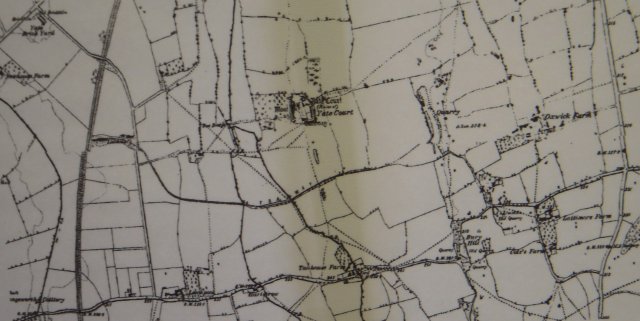
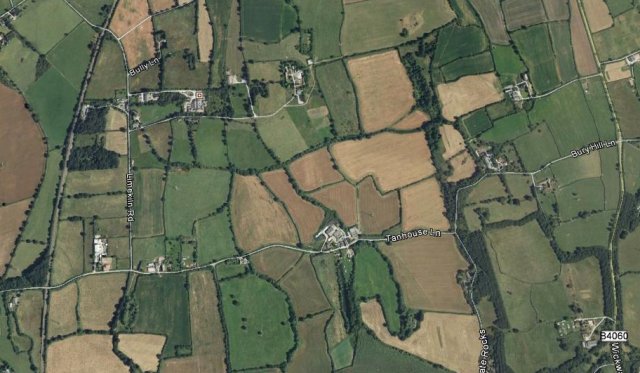
Although this tramway was marked on Ordnance Survey maps of 1890 it had been dismantled by 1900 although the route is still easily discernable due to a tree line in the 21st Century landscape.  There was also another unconnected tramway along the quarry on the south side of Tan House Farm.  This quarry flooded when quarrymen hit a spring and is now a well known carp fishing lake.  In both cases the B4060 road from Wickwar in the north to Chipping Sodbury in the south is visible on the right of the image.


Although this tramway was marked on Ordnance Survey maps of 1890 it had been dismantled by 1900 although the route is still easily discernable due to a tree line in the 21st Century landscape.  There was also another unconnected tramway along the quarry on the south side of Tan House Farm.  This quarry flooded when quarrymen hit a spring and is now a well known carp fishing lake.  In both cases the B4060 road from Wickwar in the north to Chipping Sodbury in the south is visible on the right of the image.


  Although this tramway was marked on Ordnance Survey maps of 1890 it had been dismantled by 1900 although the route is still easily discernable due to a tree line in the 21st Century landscape.  There was also another unconnected tramway along the quarry on the south side of Tan House Farm.  This quarry flooded when quarrymen hit a spring and is now a well known carp fishing lake.  In both cases the B4060 road from Wickwar in the north to Chipping Sodbury in the south is visible on the right of the image.

The layout was set around 1950 and featured both buildings recognisable in the local area as well as steam and diesel Paul Windle locomotives running on 2' 3" gauge and making a vertical connection with a spur from the Midland Railway.


The layout was set around 1950 and featured both steam and diesel Paul Windle locomotives running on 2' 3" gauge and making a vertical connection with the Midland Railway.


  DYDLEY JUNCTION by City of Canterbury MRS

N Gauge 2mm Scale


Dydley Junction was built as a club layout designed to allow the through running of realistic length trains, a station, goods yard and engine servicing facilities, the ability to justify two railway companies and two trains running at once - all in a space of 4' x 2' 6" courtesy of two PECO live frog double slips!  The layout was in fact set near the Welsh border somewhere south west of Birmingham with a single track secondary main line and branch, either of which could belong to the GWR or LMS.


  Dydley Junction was built as a club layout designed to allow the through running of realistic length trains, a station, goods yard and engine servicing facilities, the ability to justify two railway companies and two trains running at once - all in a space of 4' x 2' 6" courtesy of two PECO live frog double slips!  The layout was in fact set near the Welsh border somewhere south west of Birmingham with a single track secondary main line and branch, either of which could belong to the GWR or LMS.  


Dydley Junction was built as a club layout designed to allow the through running of realistic length trains, a station, goods yard and engine servicing facilities, the ability to justify two railway companies and two trains running at once - all in a space of 4' x 2' 6" courtesy of two PECO live frog double slips!  The layout was in fact set near the Welsh border somewhere south west of Birmingham with a single track secondary main line and branch, either of which could belong to the GWR or LMS.


  MODEL BUS FEDERATION represented by Paul Mellor 4mm Scale  
     
  NATIONAL ASSOCIATION OF ROAD TRANSPORT MODELLERS

represented by David Mellor 4mm Scale


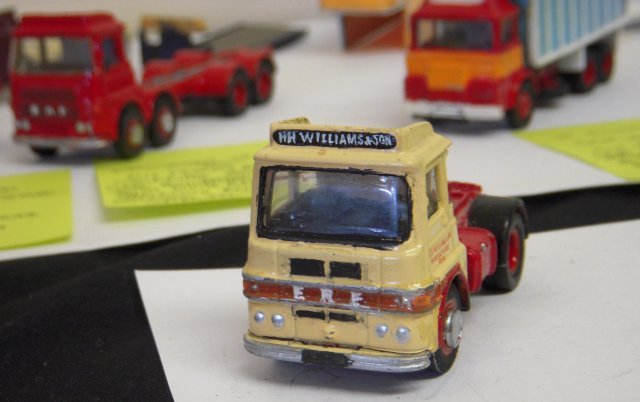
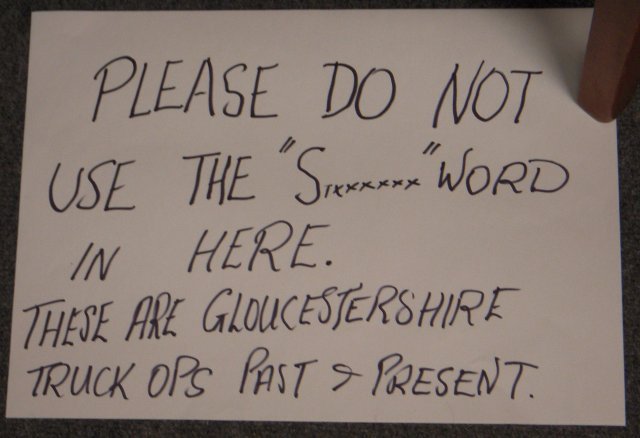
With Brocklecote Bus Station appearing on Saturday only, the Mellor Brothers focussed on displaying their recent prodigious output of trucks, including the ERF 2x4 tractor unit seen above in the cream and carmine markings of H.H. Williams and Son, livestock hauliers of Moreton Valence and the antecedents of today's Universal Training. Even more emphatic was a request for enthusiasts of a certain Carlisle-created company to shut the truck up and talk about Gloucestershire hauliers instead!


  With Brocklecote Bus Station appearing on Saturday only, the Mellor Brothers focussed on displaying their recent prodigious output of trucks, including the ERF 2x4 tractor unit seen above in the cream and carmine markings of H.H. Williams and Son, livestock hauliers of Moreton Valence and the antecedents of today's Universal Training. Even more emphatic was a request for enthusiasts of a certain Carlisle-created company to shut the truck up and talk about Gloucestershire hauliers instead!  


With Brocklecote Bus Station appearing on Saturday only, the Mellor Brothers focussed on displaying their recent prodigious output of trucks, including the ERF 2x4 tractor unit seen above in the cream and carmine markings of H.H. Williams and Son, livestock hauliers of Moreton Valence and the antecedents of today's Universal Training. Even more emphatic was a request for enthusiasts of a certain Carlisle-created company to shut the truck up and talk about Gloucestershire hauliers instead!


  TRAVEL 2000 LTD by Andy Peckham 4mm Scale ( Sunday only )  


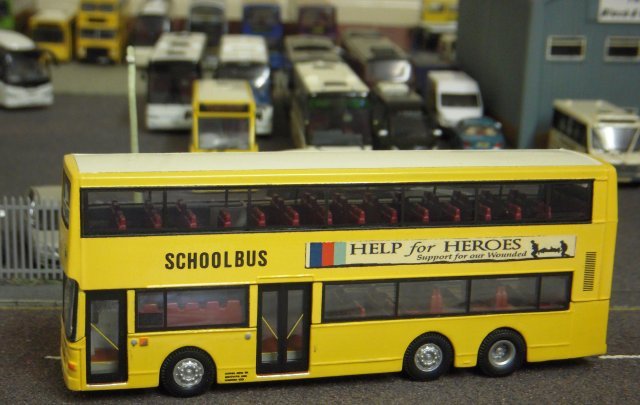
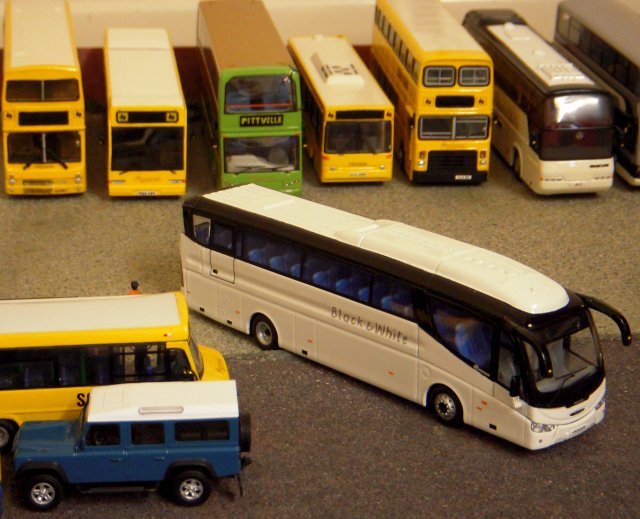
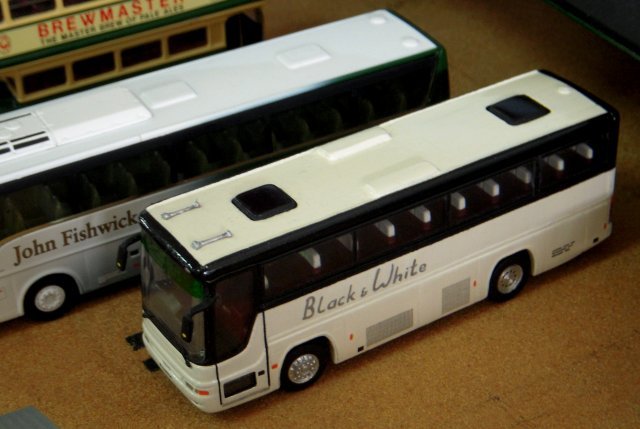
Out of the Travel 2000 depot on the school run in the meantime was one of Andy Peckham's three axle ex Hong Kong Alexander bodied Leyland Olympians while a former National Express Scania coach with Irizar bodywork remained in the yard, its Black and White livery contrasting with a blue and white Land Rover Defender.


  Out of the Travel 2000 depot on the school run in the meantime was one of Andy Peckham's three axle ex Hong Kong Alexander bodied Leyland Olympians while a former National Express Scania coach with Irizar bodywork remained in the yard, its Black and White livery contrasting with a blue and white Land Rover Defender.  


Out of the Travel 2000 depot on the school run in the meantime was one of Andy Peckham's three axle ex Hong Kong Alexander bodied Leyland Olympians while a former National Express Scania coach with Irizar bodywork remained in the yard, its Black and White livery contrasting with a blue and white Land Rover Defender.


  MODEL FAIRGROUND by Martin Nash  4mm scale  


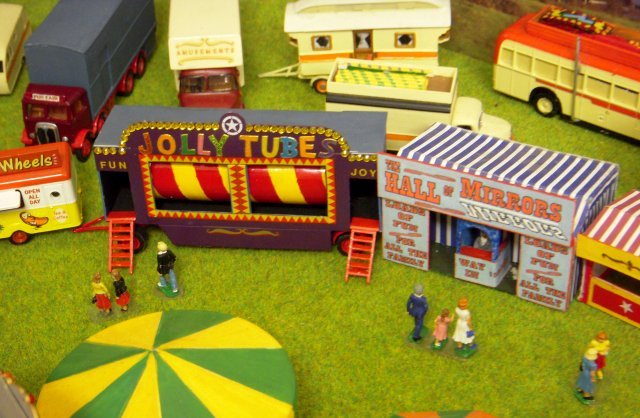
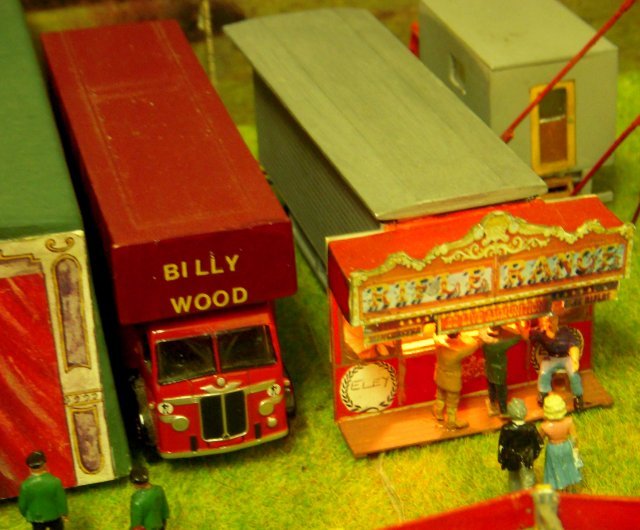
It is always good to catch up with the latest attractions on Martin Nash's travelling fairground, which on this occasion included a rare Jolly Tube - allowing punters to walk through a pair of contrarotating horizontal cylinders with the aim of remaining vertical.  The Rifle Range - always more fun than a smooth bore Berrabah - was also interesting not only because of its use of a box trailer with a tail lift but because the two customers were First World War soldiers with their knapsacks removed and painted to represent country gentlemen in their Norfolk jackets and gaiters.


  It is always good to catch up with the latest attractions on Martin Nash's travelling fairground, which on this occasion included a rare Jolly Tube - allowing punters to walk through a pair of contrarotating horizontal cylinders with the aim of remaining vertical.  The Rifle Range - always more fun than a smooth bore Berrabah - was also interesting not only because of its use of a box trailer with a tail lift but because the two customers were First World War soldiers with their knapsacks removed and painted to represent country gentlemen in their Norfolk jackets and gaiters.  


It is always good to catch up with the latest attractions on Martin Nash's travelling fairground, which on this occasion included a rare Jolly Tube - allowing punters to walk through a pair of contrarotating horizontal cylinders with the aim of remaining vertical.  The Rifle Range - always more fun than a smooth bore Berrabah - was also interesting not only because of its use of a box trailer with a tail lift but because the two customers were First World War soldiers with their knapsacks removed and painted to represent country gentlemen in their Norfolk jackets and gaiters.


  MING ING by Alan Drewett  4mm scale  


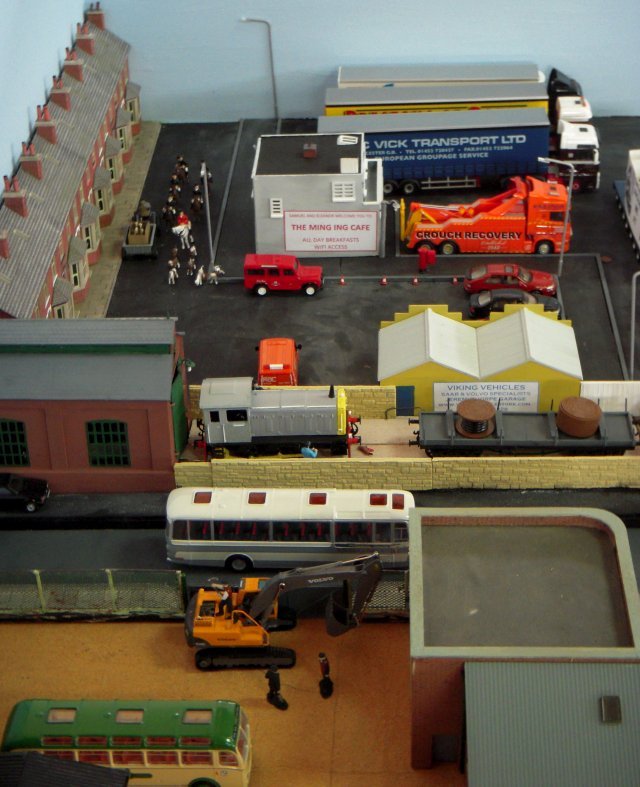
Inspired by the one time favourite adjective of glamour model Katie Price, "Ming Ing" - which splits into a Chinese dynasty and an old English word for low lying grassland prone to seasonal flooding - depicted York's fictional Chinatown district and included York's city walls, the canalised River Foss, a Derwent Valley Light Railway resurgent in the Twenty First Century, a terraced street, garage, lorry park and transport cafe and depot for cleaning repairing, refuelling coaches that have just brought tourists to York Minster, the National Railway Museum and Jorvik Viking Centre.  Also visible on Ming Ing's first outing was the York and Ainsty Hunt chasing a fox run over by a Class 04 shunter, a workman attempting to repair the engine of a Volvo excavator with an axe and, thanks to Andy Peckham, a Volvo B9M short-chassis coach with a Plaxton Premiere body from his Black and White fleet.


Inspired by the one time favourite adjective of glamour model Katie Price, "Ming Ing" - which splits into a Chinese dynasty and an old English word for low lying grassland prone to seasonal flooding - depicted York's fictional Chinatown district and included York's city walls, the canalised River Foss, a Derwent Valley Light Railway resurgent in the Twenty First Century, a terraced street, garage, lorry park and transport cafe and depot for cleaning repairing, refuelling coaches that have just brought tourists to York Minster, the National Railway Museum and Jorvik Viking Centre.  Also visible on Ming Ing's first outing was the York and Ainsty Hunt chasing a fox run over by a Class 04 shunter, a workman attempting to repair the engine of a Volvo excavator with an axe and, thanks to Andy Peckham, a Volvo B9M short-chassis coach with a Plaxton Premiere body from his Black and White fleet.


Inspired by the one time favourite adjective of glamour model Katie Price, "Ming Ing" - which splits into a Chinese dynasty and an old English word for low lying grassland prone to seasonal flooding - depicted York's fictional Chinatown district and included York's city walls, the canalised River Foss, a Derwent Valley Light Railway resurgent in the Twenty First Century, a terraced street, garage, lorry park and transport cafe and depot for cleaning repairing, refuelling coaches that have just brought tourists to York Minster, the National Railway Museum and Jorvik Viking Centre.  Also visible on Ming Ing's first outing was the York and Ainsty Hunt chasing a fox run over by a Class 04 shunter, a workman attempting to repair the engine of a Volvo excavator with an axe and, thanks to Andy Peckham, a Volvo B9M short-chassis coach with a Plaxton Premiere body from his Black and White fleet.


  MODELLING DISPLAYS

by Mark Begley, Trevor Hale and Steve Harrod (Richard Bucknall on Sunday)


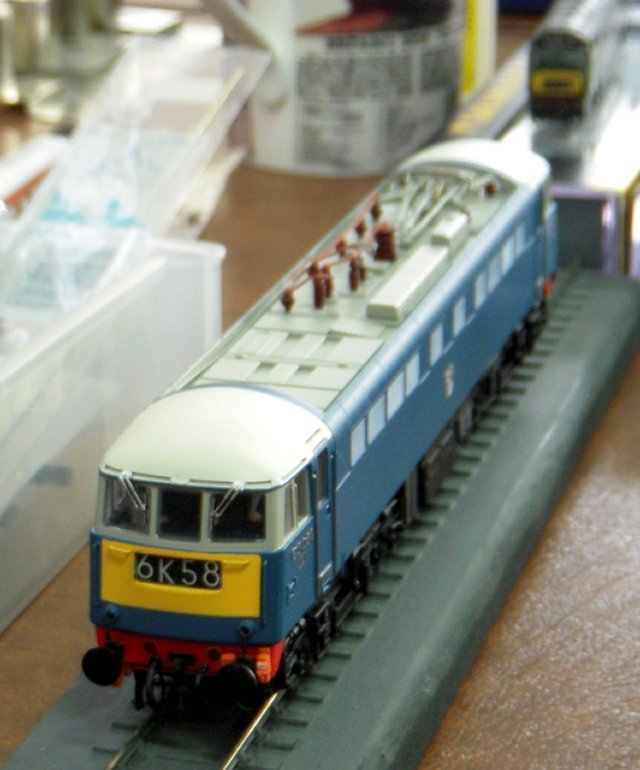
With a Western Region diesel hydraulic literally in the background for once, attention was drawn to E3058, originally a part of the forty strong Class AL5 built at Doncaster from 1961 to 1964 and later identified as 85 003 under TOPS.  Modelled wearing the original West Coast Main Line AC electric blue livery with aluminium lettering and cast bas-relief British Railways "ferret and dartboard" crest, the real 25 Kv overhead electric was to be withdrawn in 1991 and scrapped by MC Metals of Glasgow.


  With a Western Region diesel hydraulic literally in the background for once, attention was drawn to E3058, originally a part of the forty strong Class AL5 built at Doncaster from 1961 to 1964 and later identified as 85 003 under TOPS.  Modelled wearing the original West Coast Main Line AC electric blue livery with aluminium lettering and cast bas-relief British Railways "ferret and dartboard" crest, the real 25 Kv overhead electric was to be withdrawn in 1991 and scrapped by MC Metals of Glasgow.  


  Also in attendance were Cheltenham Model Centre (Saturday) , Castle Trains (Sunday) Clive Reid (RCSW Models), Iron Horse Videos( Saturday only), Penduke Models (Sunday only), Stewart Blencowe railway books, timetables and photographs and Robbie's Rolling Stock (Saturday).

DVDs of the Cheltenham GWR Modellers Exhibitions from 2006 onward are now available from Richard Pretious of Iron Horse Video Productions based at 77 Tilney Close, Alton, Hampshire, GU34 2BG.