Regrettably, due to the Coronavirus situation in Britain and the World in early 2020, the last two meetings of this season for the World Ship Society Gloucester Branch are now cancelled.
Sadly, by the start of 2022, we had lost our Treasurer John Mayer.
JOHN MAYER (1941-2021)
An always welcoming figure, along with his wife Margaret (who died in February 2021), John joined the Gloucester Branch of the World Ship Society in 1986 and served on the Branch Committee from 1993, with two spells as Chairman, plus the role of Treasurer since 2008.
His National Service saw him at the 10th anniversary of the D-Day landings as a wireless operator on the Type 15 anti submarine frigate HMS ROCKET.
John acted as liaison between the Branch and the Royal Navy when the Ships Crest (carved by member Tom Askew from seasoned wood found in the Gloucester Cathedral yard) for HMS GLOUCESTER (D96) was returned for permanent display in the Cathedral in July 2011. He was proud that his ‘reward’ was to experience being on board for the last leg of her career from Avonmouth to Portsmouth before being decommissioned. Our sympathies go to his daughter Louise.
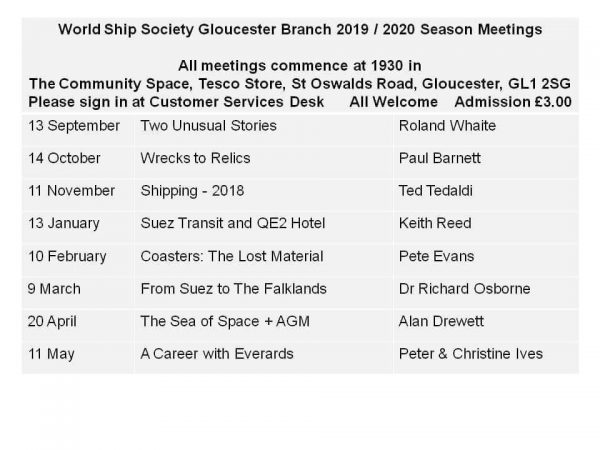

The 2019/2020 season of the World Ship Society Gloucester Branch began on Monday 9 September 2019 with a fascinating talk by Branch member, writer and historian Roland Whaite entitled Two Unusual Stories.
The first concerned a rare typed diary of a 1926 Pilgrimage Cruise from the Western Mediterranean to Salonika, Gallipoli (pictured) and Istanbul aboard Cosulich Lines STELLA D’ITALIA (5 530 grt) while the second followed the fortunes of HAIDA 1929 (693 grt IMO 8981652).
This Cox and Stevens designed motor yacht appeared in the “Money Money Money” sequence of the 2008 feature film Mama Mia. Previous owners had included the US Navy and Coast Guard, Lowell Guinness MP and impresario Robert Stigwood.
Pilgrimage Tours proved popular in the 1920s and 30s, allowing relatives of the fallen to visit Great War battlefields and cemeteries. Less affluent pilgrims had their journies subsidised by the charitable Saint Barnabas Society and the 1926 STELLA D’ITALIA cruise was personally led by its founder, the Reverend Matthew Mullineux MC, who had played Rugby Union for the British Lions in the 1890s.
The diary itself was the work of Nelly and George Summers. George sold typewriters for a living while Nelly taught typing at Rochester and Chatham College. Their involvement was prompted by the desire of George to visit the grave of his brother who had died of malaria in Salonika.
Highlights of the voyage aboard the 425′ long Trieste based vessel included running aground on a sandbank apparently covering the wreck of HMS TRIUMPH.
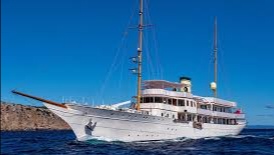
HAIDA meanwhile was built by American “Yeast King” and philanthropist Max Fleischmann who moved to Santa Barbara after World War I. In the late 1920s, Fleischmann financed the construction of the Santa Barbara breakwater with a $250,000 gift to the city. It enabled him to have a place to moor his 218-foot yacht.
Since then HAIDA has been known as DONA AMELIA, ROZENKAVALIER, USS ARGUS and USCGS PIONEER and at various times been fitted with an aquarium, photographic darkroom, jacuzzi, bow thruster and a 3.5″ gun. Roland commented that the long life of HAIDA was due in no small part to her robust steel construction, ordained by Max Fleischmann for prospective oceanographic expeditions to the polar regions. Also long lasting have been her Krupp diesel engines.
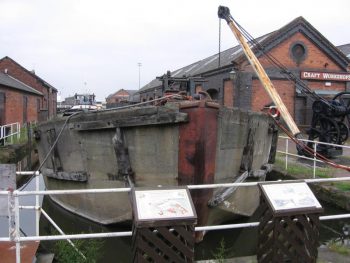
For our 14 October 2019 meeting Paul Barnett, Chairman of the Friends of Purton, made a PowerPoint presentation entitled “Wrecks to Relics” exploring the link between concrete barges and the Mulberry Harbours supplying Allied forces after the 1944 D-Day landings.
Although much larger concrete lighters were built in Bristol Road, Gloucester in 1919 and 1920, the eight strengthening the banks of the River Severn were assembled in Barrow in Furness in 1941.
In Gloucester, Ferro Concrete’s yard employed 380 workers who turned out the massive 800 ton CRETEROCK – commissioned by the Shipping Ministry. The latter, with a length of 180 feet and beam of 31 feet was launched into the Gloucester Ship Canal broadside on, drenching unprepared spectators on the far bank. She was followed by five further Gloucester vessels with The prefix CRETE: CRETEROAD, CRETE RIVER, CRETERIDGE, CRETERAVINE and CRETE RAMPART.
Designed initially to carry ammunition and other military supplies, they were launched too late to be used in the Great War.
Purton’s eight Ferro Concrete Barges (FCB) meanwhile were built under licence by Wates Building Group to replace wood and steel lighters destroyed by enemy bombing.
They were eventually issued to all of the UK’s major Port Authorities to assist the storage of oil, grain or other foodstuffs. One is seen in dry dock, above.
Despite being easily holed and sunk- and difficult to steer – such concrete vessels made ideal pontoons for the 16 kilometres of “Whale” roadway sections, capable of carrying 53 ton Sherman tanks.

For our 11 November 2019 meeting, Branch Member Ted Tedaldi made a PowerPoint presentation entitled “Shipping 2018 ”. Among the vessels featured were the tall ship KASKELOT.
KASKELOT was originally a traditional Baltic Trader built in 1948 by J. Ring-Andersen, one of the world’s most reputable shipyards, for the Royal Greenland Trading Company at the Svendborg shipyard in Denmark.
During the 1960s she worked as a support vessel for fisheries in the Faroe Islands and was then purchased by Square Sail, UK in 1981 and converted to replicate a traditional three masted barque double topsail. Her film and TV credits include, Return to Treasure Island, The Three Musketeers, David Copperfield and Shackleton.
Most classic ships enter Sharpness docks under their own power but in April 2018 the barge TERRA MARQUE (IMO 9281384, 2 786 grt) , owned by the famous heavy load company Wynn’s and pictured above, arrived with the Thames barge GLADYS. Built in Harwich in 1901, GLADYS arrived in Gloucester for a major overhaul in Tommi Nielsons yard.
More modern but much less swift was the 1978 vintage jack-up barge EXCALIBUR (IMO 8763282, 2 390 grt), seen by Ted at Falmouth. With an overall length of 130 metres and a 60 metre beam, her legs were 50 metres tall. However, she he has no propulsion and has to be towed. During another visit to Falmouth in April 2018, Ted noted HMS TYNE (IMO 9261322, 2 109 grt) and Royal Fleet Auxilliaries TIDE SURGE (IMO 9655559, 29324 grt) and ARGUS (IMO 7822550, 26 845 grt).
Bearing the pennant number P281, River Class off shore patrol vessel HMS TYNE was built by Vosper Thorneycroft in Southampton and commissioned into the Royal Navy in 2003. Powered by two Ruston 12RK 270 550 bhp diesel engines, HMS TYNE can reach 20 knots and has a complement of 30. South Korean built RFA TIDE SURGE had enough flight deck space for a Boeing Chinook twin rotor helicopter while RFA ARGUS began life as the Italian container ship CONTENDER BEZANT and is now a Primary Casualty Receiving Ship.
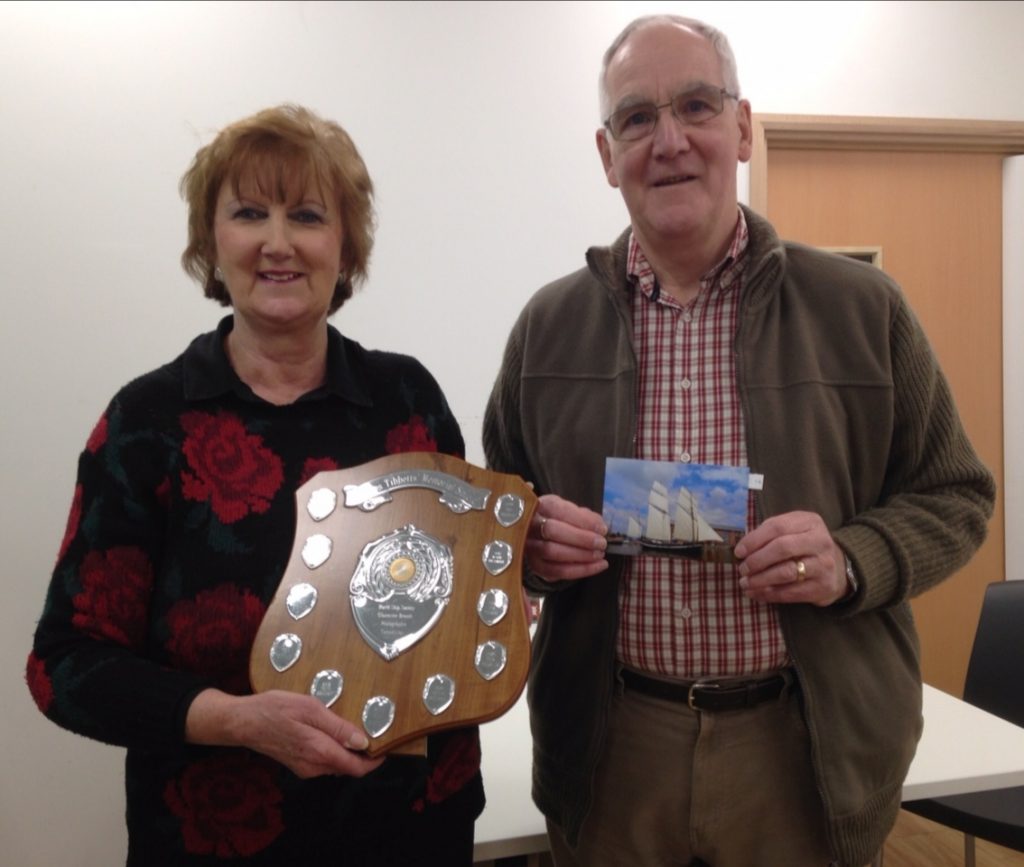
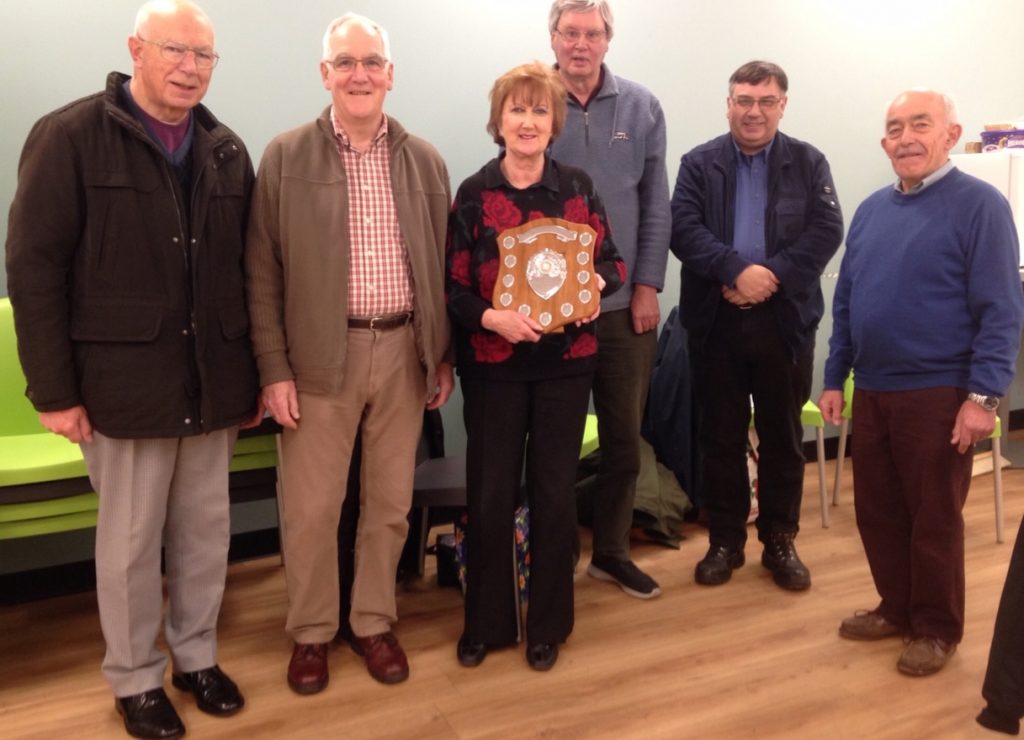
As well as the traditional yuletide social gathering and buffet, our Monday 9 December 2019 meeting featured a photographic competition which was won by member Penny Meenagh with a picture of TS ROYALIST ( IMO 1003530 83 grt) leaving Gloucester Docks after the 2019 Tall Ships Festival. Penny also took third place with a picture of the sailing vessel ANNE (MMSI 319132100) passing through Slimbridge on the Gloucester and Berkeley Canal. Second place went to Chairman Ken Guest with his picture of HMS BELFAST (11 550 tons displacement) taken from London’s Shard. Thanks are also due to member Terry Cruttenden for organising the raffle.
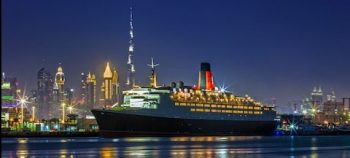
For our 13 January 2020 meeting, Branch Member Keith Reed made a presentation entitled “Suez Transit and QE2 Hotel” about his November 2018 voyage aboard MSC LIRICA (IMO 9246102 65 591 GRT) from Venice via Katakolon, Piraeus, Heraklion, Port Said, Aqaba, the Sultanate of Oman ports of Salalah, Muscat and Khasab to the destination Port Raschid in Dubai.
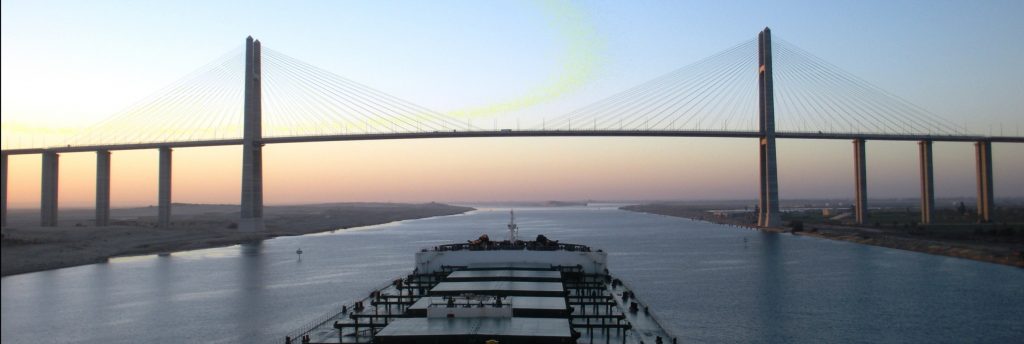
Highlights along the way included the sites of the original and 1886 Olympic Games, Mount Lycabettus funicular railway, Palace of Knossos, Egyptian – Japanese Friendship Bridge over the Suez Canal (pictured below) Nabatean city of Petra, Burj Khalifa, Atlantis Hotel and Mall of the Emirates – complete with penguins.
Engineered by Ferdinand de Lesseps and opened in 1869, The Suez Canal is considered to be the shortest link between the east and the west due to its unique geographic location linking the Mediterranean Sea at Port Said and the Red Sea at Suez. The unique geographical position of the Suez Canal makes it of special importance to the world and to Egypt as well. This importance is increasingly augmented with the evolution of maritime transport and world trade. Maritime transport is the cheapest means of transport, and more than 80 % of the world trade volume is transported via waterways.
Cunard’s QUEEN ELIZABETH 2 is now a floating hotel in Dubai. Its vital statistics are 70 327 tonnes weight, 963 feet long, 1 892 passengers and 1 040 crew during its sailing years and £29 million cost to build
It had five restaurants and two cafes, three swimming pools, a 481-seat cinema, a hospital and casino. A typical World cruise would take 80 days, 6,000,000 miles were sailed between 1969 and 2008 including 806 transatlantic crossings and 25 world navigations under 25 different captains and 70,000 bottles of champagne were drunk a year.
Key QE2 dates included
1969: maiden voyage from Southampton to New York
1982: the QE2 carried troops to the south Atlantic for the Falklands War
1987: converted from steam power to diesel
2004: becomes longest serving express liner
For our 10 February 2020 meeting Branch member Pete Evans treated us to an old fashioned evening of 35mm slides projected on a venerable screen. But this was not nostalgia for its own sake. Pete had only just been reunited with his slides of coasters in ports such as Gloucester, Sharpness, Bristol, Portishead, Teignmouth and Falmouth after lending them to branch member Les Tibbetts – sadly no longer with us – for 25 years.
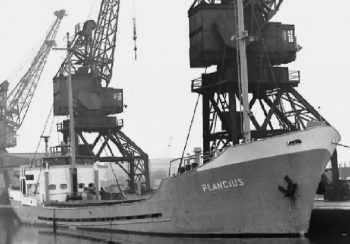
Among the featured vessels was PLANCIUS (IMO 5258456 399 grt) at Exmouth docks in June 1986. Pictured above, this was built in 1962 at Hoogezand, Groningen, Netherlands, by G.J. Van Der Werff as their yard number 288 and was about to proceed empty to Charlestown to load china clay for Ymuiden, north Holland. On 14 June 1997 PLANCIUS was boarded by robbers who shot the captain and three crew. The coaster was sunk to form an artificial reef off Miami, Florida, on 2 June 2003.
HMS UPTON (M1187) meanwhile was pictured by Pete at Gloucester Docks on 30 September 1984. Built by John Thorneycroft of Southampton in 1956, the Ton class mine countermeasures vessel was as close to its named town of Upton on Severn, Worcestershire, as the River Severn navigation would allow. It was finally broken up in Bruges, Belgium in 1991.


For our 9 March 2020 meeting the Gloucester Branch was delighted to welcome back our dear friend and World Ship Society President Doctor Richard Osborne who gave us his very detailed and insightful PowerPoint presentation “From Suez to the Falklands” subtitled “The Royal Navy during 1956 to 1982”.
This gave the geopolitical background to both the era-defining conflicts, the state of readiness of the Royal Navy at both times, the role of politicians both at home and abroad and importance of aircraft carriers and the need for an efficient Royal Fleet Auxiliary as a force multiplier.
Although the Royal Navy ended the Second World War as the second largest on the planet, its anti aircraft defences were inferior to those of the US Navy as were its fleet of home supplied aircraft. During the next decade too, British shipyards were busy replacing merchant vessels lost during the conflict while former colonies became independent. Despite these factors – and in the face of confusion about the role of naval warfare in the age of the atom bomb – a number of aircraft carriers laid down at the end of World War 2 were completed in the 1950s. Of these, only HMS EAGLE (R05, 47 000 tons displacement) was fully operational at the start of the Suez crisis although other flat tops including commando helicopter carriers steamed east later. Indeed, throughout the conflict, EAGLE could only use its port hydraulic catapult to launch aircraft such as the de Havilland Sea Venom, seen above after a belly landing, and other elements of Operation Musketeer were obsolete. In particular some destroyers still used dc rather than ac electricity to power their radar systems and World War 2 era landing ships proved painfully slow. Despite this, the army congratulated the Navy on “the effectiveness and accuracy of its air support” – only made possible by the use of aircraft carriers rather than land bases in Cyprus.
By the early 1980s, the Royal Navy had acquired more modern destroyers and faster and more advanced landing ships but had lost its fleet carriers. However, the Labour government of the 1960s and 1970s had permitted the procurement of “through deck cruisers” for convoy escort duties which were equipped with ski ramps (seen below) to launch Sea Harriers to neutralise the threat of Russian bombers.
Britain’s decision to withdraw HMS ENDURANCE (A171 3658 tons displacement) from the South Atlantic then gave Argentina’s General Galtieri the idea that Falkland Islands were ripe for invasion, only for Prime Minister Margaret Thatcher to respond with a task force to liberate the islands. As a result, Galtieri was eventually overthrown and Argentina became a democracy.
