
After being closed for many months, Jet Age Museum opened again on Saturday 12 July 2020.
Due to Covid 19 regulations, visitors were not allowed into the cockpit of the Avro Vulcan. However, models on show not only put the Vulcan in the context of its contempories but explored what could have replaced it.
The delta winged nuclear bomber first took to the air in 1952 and became operational with the RAF in 1957. It had been designed to fly long distances with a heavy load, and relied on speed and altitude to evade enemy anti aircraft fire and fighter aircraft.
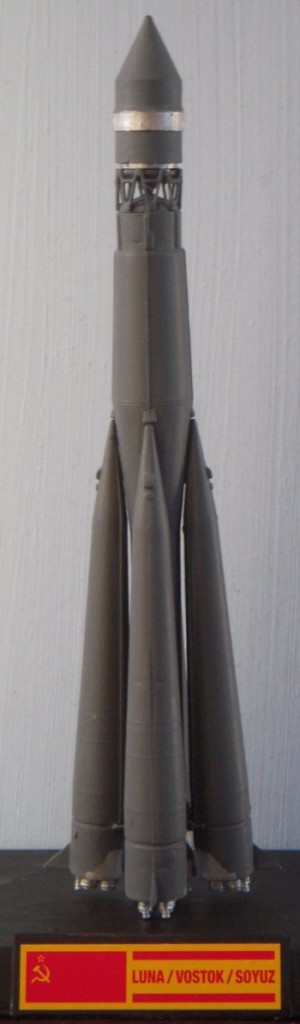
However, 1957 also saw the introduction of two Soviet missile systems : the R7 liquid fuelled ballistic rocket and the S-75 Dvina, better known in the west as the SAM-2 Guideline.
The R7 was essentially a bigger version of the Nazi V-2 of the Second World War but with four strap on boosters to give it intercontinental range. Like the V-2, this was unstoppable in flight but vulnerable on the launch pad during the 24 hours it took to fuel.
Within ten years, much more practical world spanning missiles were ready in silos across the USA and USSR as well as nuclear powered submarines and, between 1959 and 1963, in eastern England. A 1/72 scale model of an RAF Douglas Thor is in the same Jet Age cabinet as two 1/144 scale Vulcans and an R7 – also used to launch Sputnik into orbit – in the same scale.

On a higher shelf is a 1/72 scale model of a SAM-2 along with its launch trailer and ZIL transport lorry. The SAM-2 literally shot to fame on 1 May 1960 when a number of them downed an American U2 spy plane over Russia.
The U2, modelled here in 1/144 scale, had been flying at 70 000 feet: considerably higher than the V bombers of the RAF. As a result, Vulcan, Victors and Valiants exchanged their anti flash white livery for camouflage and were expected to attack at low level, where SAM-2s and Soviet fighters of the 1960s could not operate.

Many Vulcans and Victors also carried the Gloster built Blue Steel rocket powered stand off missile before Britain’s nuclear deterrent passed to the Polaris submarines of the Royal Navy.
In another cabinet nearby however are solutions to the SAM-2 threat produced by North American Aviation.
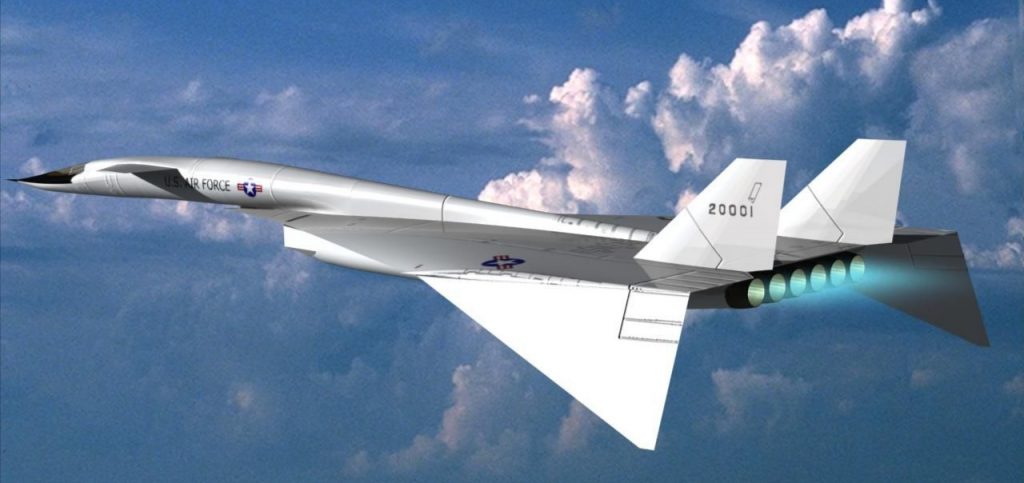
The XB-70A, portrayed in a 1/150 scale desk top model, was first suggested in 1954 and flew 10 years later. Designed to reach over 70 000 feet, it was much faster than the Vulcan at three times the speed of sound. However, still being vulnerable to the SAM – 2 and with strategic bombers being replaced by intercontinental missiles, only two XB-70s were built and only flew experimentally until 1969.
Designed for tree top penetration, weaving around radar sites and hiding behind hills was the B-1B Lancer, which mainly survived in USAF service due to delays in cruise missile and stealth bomber programmes. As can be seen from the 1/144 scale model, this has variable geometry wings like the General Dynamics F-111 and Panavia Tornado and can be used as a tactical bomber.
The A-5 Vigilante meanwhile was more comparable to the British Blackburn Buccaneer. Both were twin engined carrier borne aircraft designed to toss a nuclear bomb at a target and then escape at low level. The Buccaneer featured a rotary bomb bay while the Vigilante ejected its bombs – and spare fuel tanks – from a hole between its jet exhausts. It was soon adapted as a reconnaissance aircraft, like the Lockheed SR-71. But that’s a story for another time!