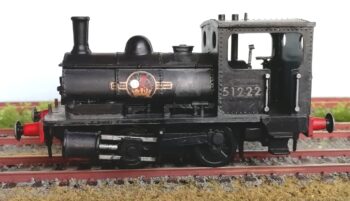
Following the successful presentation of a range of 4mm scale British Steam locomotives at Abbeydale on 18 September 2010, the opportunity of another Gloucester Film Maker’s railway evening at Brockworth on Monday 14 March 2011 gave me an extra incentive to re-examine, refurbish and research some more of the models – specifically the 0-4-0STs and derivatives- so kindly given to me by Ron Brooks.
A decade later, the time made available by the Covid 19 pandemic has allowed me to move the original Pug Sextet article to Gloucestershire Transport History’s current WordPress platform with further upgrades and amendments.
The Lancashire and Yorkshire Pugs
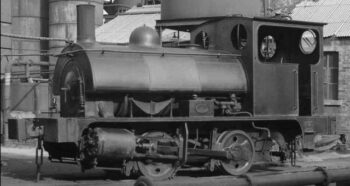
The Lancashire and Yorkshire Railway Class B7 0-4-0ST has gained a reputation literally far larger than its size or importance due to its portrayal in the series of plastic injection moulded kits that began with Rosebud Kitmaster and were then perpetuated by Airfix and Dapol.
The 21 ton 5cwt saddle tank was small enough to fit the same Series 1 box as the Presflo and Cattle Wagon but – as chassis, boiler/tank and cab were all assembled separately – it was to form the basis of many conversions to other small steam locomotives.
But the story of the real L&YR Pugs began with three saddle tank locomotives ordered from Vulcan Foundry, Newton Le Willows, Lancashire, in 1886, the same year in which John Audley Frederick Aspinall became the Locomotive Superintendent of the Lancashire and Yorkshire Railway.
They were built for shunting on sharply curved sidings and would eventually be allocated to the industrial areas and docks of Fleetwood, Goole, Salford and Liverpool. Eventually, some production Pugs had umbrella like smoke and spark deflectors attached to their chimneys to minimise damage to structures such as the Liverpool Overhead Railway.
The new 0-4-0STs had 3′ 3/8″ diameter wheels set 6′ apart and driven by a pair of 13″ x 18″ outside cylinders. Saturated steam at 140 psi was generated by an 8′ 10″ x 3′ boiler with a 475. 75 square feet evaporating surface. They carried the Vulcan Foundry works numbers 1176 to 1178 and the Lancashire and Yorkshire running numbers 916 to 918.
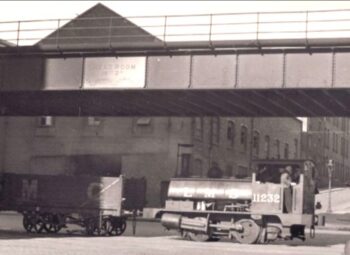
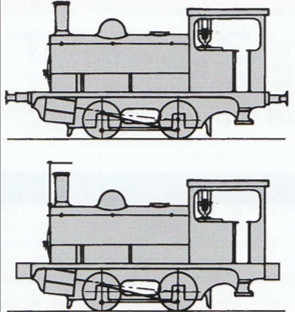
Aspinall then ordered more locomotives of a modified design with the water tank extended over the smokebox and wheelbase shortened to 5′ 9″ : making it more possible for them to be turned on a wagon turntable. The cab was also enlarged and the boiler pressure raised to 160 pounds per square inch, yielding 11 335 lb of tractive effort, delivered through Stephenson valve gear.
The seventeen locomotives conforming to Aspinall’s modified design were erected at the L&YR’s own Horwich Works in three batches. None of the Aspinall era Pugs received individual works numbers but Lot Numbers were allocated.
The first batch (Lot 10) of six locomotives were outshopped in 1891 with the running numbers 1153 – 56, 32 and 310.
The second batch (Lot 20) of six were built in 1893 to 1894 and carried the cabside numbers 504, 654, 729 and 1230 – 1232.
The third batch (Lot 26) of five were built in 1895 as numbers 1386 – 1290.
Aspinall’s successor Henry Hoy (from 1899 to 1904) ordered another batch of ten in 1901. Given Horwich Works numbers 811 – 820 and built to Lot 46, the running numbers were 68, 113, 139, 155, 377, 389, 399, 402, 403 and 476.
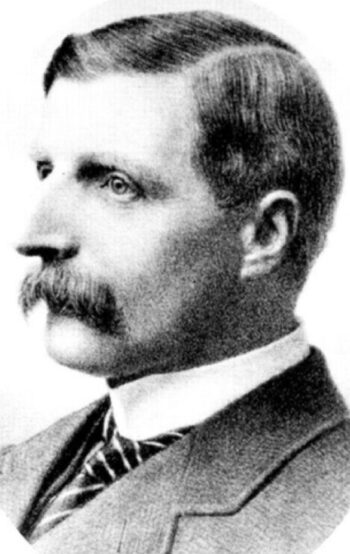
Hoy’s successor George Hughes (1904 – 1921) ordered 30 more in two batches. The first batch, of ten, to Lot 52, had the Horwich Works numbers 921 – 930 and were built in 1905 and 1906. Running numbers were 260, 813, 814, 821, 823, 825, 832, 840, 865 and 879.
The second and final Hughes batch of 20 locomotives was built in 1910 as Horwich Lot 65. The works numbers were 1092 to 1111 and the running numbers 2, 3, 8, 12, 17, 19, 28, 43, 56, 64, 71, 75, 118, 226, 271, 298, 481, 517, 613, 614.
In total sixty were made between 1886 and 1910.
The last Pug was delivered in July 1910, four months before the withdrawal of Vulcan locomotives 917 and 918 in November 1910. However these were not scrapped until November 1912 and 916 would survive into London, Midland and Scottish ownership as number 11200, but was withdrawn from capital stock in 1924. It became a service locomotive until scrapping in 1930.
‘Balloon’ type spark-arrestor chimneys were added to some Pugs for use at a munitions factory at Aintree during World War I.
The Lancashire and Yorkshire Railway amalgamated with the larger London and North Western Railway on 1 January 1922 before the LNWR became part of the London Midland and Scottish in 1923. George Hughes became the final Locomotive Superintendent of the LNWR in 1922 and the first Chief Mechanical Engineer of the LMS from 1923 to 1925.
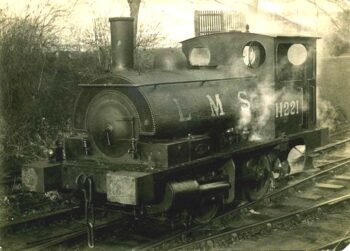
The LMS gave the Pugs the power classification 0F and renumbered the Horwich built engines as 11201–11206 (Lot 10) 11207–11212 (Lot 20) 11213–11217 (Lot 26) 11218–11227 (Lot 46) 11228–11237 (Lot 56) 11238–11257 (Lot 65).
Of these, 1153 and 654 never carried their LMS numbers and were withdrawn in 1926.
11204 (later British Railways 51204 as late as 1962) was sent to Maryport in 1929 and fitted with a shortened chimney and a cut-down flat-roofed cab to reduce its overall height.
1930 and a slump in railway freight traffic after the 1929 Wall Street Crash witnessed the withdrawal of numbers 11210/14/19/42 and 1931 numbers 11203/09/26/33/38/43/47–48/52
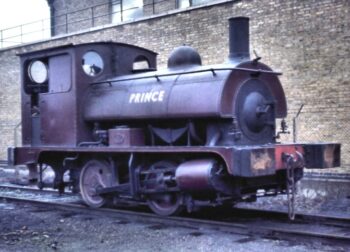
Of these, 11238 had been in service stock since 1924 while 11243 was sold to civil engineers Mowlem & Company for use in building the King George V graving dock at Southampton where she was named ‘Bassett’ (Well, it takes all sorts! ) ‘Bassett’ was sold to Cohen & Sons in 1933, and resold to United Glass Bottle Manufacturers in 1935. They painted it maroon and renamed it ‘Prince’, after which the Pug worked the sidings at their Charlton depot in South East London until 1966. As such it was the last working example of the class.
In 1932, the locomotives withdrawn were 11211/25/28/30 with 11225 sold to J. F. Wake of Doncaster.
The withdrawals of 1933 were 11223/45/51. Of these 11245, ex L&Y 43, had been in service stock since 1931 and was sold to North Wales Granite Co. 11245 eventually worked at the topmost level of Penmaenmawr granite quarry . It was transported up to the altitude of around 1500 ft on a special trolley running on the 3ft gauge inclines. 11245 had been sold on to Doughty-Goole Fertilisers at Lincoln by 1945, named ‘Fison’s Ltd’, and used at Lincoln and later Widnes until 1955.
11251 sold to R. Frazer and Sons of Hebburn on Tyne but was resold within a year to the North Wales Granite Co at Conwy, and withdrawn by them around 1948/9.
1934 saw 11213/24/36/55–56 leave LMS capital stock with 11224 being sold to A. R. Adams & Co of Newport in June. Overhauled and resold to ICI, it was used at their West Bank power station at Widnes. Named ‘Weston’, fitted with sprung buffers and a cut-down chimney, the Pug lasted until 1949.
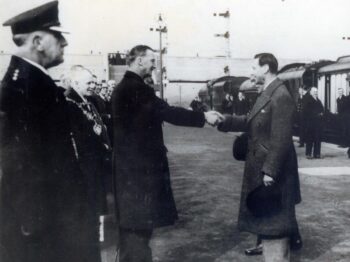
Meanwhile, 11255 sold to J. F. Wake: possibly with 11225 being used as a source of spare parts. 11255 was then sold to Pawson Bros of Woodkirk, Yorkshire in 1935 for quarry use, then requisitioned by the Ministry of Supply while under overhaul at Derby in 1940. Sent to the Royal Ordnance Depot at Euxton, Lancashire (visited by His Majesty King George VI in 1939) as No 8, ‘Hannah’, it was scrapped 1957.
11256 was sold to Turner’s Paper Mill at Rawcliffe Bridge, Goole, in January 1934. The Pug originally kept its LMS livery and after being damaged in a derailment in 1952 was overhauled and returned to service in a lined green livery. It lasted until 1954, after which the company apparently hired a BR example from Goole shed.
11212 was also loaned to the Northampton Borough Engineer’s Department in 1934.
While King George V celebrated his Silver Jubilee in 1935 11205 and 11239 left service, and during the Abdication Crisis of 1936, 11249 was sold to Cooke & Nuttall’s paper mill at Horwich. It was used there, close to its birthplace until cut up in December 1947.
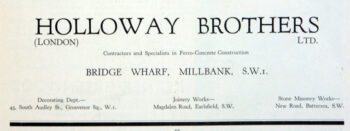
Similarly, 1937 marked both the Coronation of King George VI and the sale of 11257 to the Holloway Brothers of Westminster in October for the Dartford Power Station building contract of 1937-39. Loaned to the Ministry of Supply in 1942, the Pug was later used at Barking by the County of London Electric Supply Co, and during the construction of Calverton Colliery, Nottinghamshire. It was scrapped 1955.
As Prime Minister Neville Chamberlain flew back from Munich in 1938 and declared “Peace in Our Time” , 11215 became the last Horwich Pug to be withdrawn before World War 2.
When the LMS was merged into British Railways on 1 January 1948, 23 Pugs remained in service and 40,000 was added to their fleet numbers.
51217 spent most of 1948 in Tweedmouth shed rather than Burton on Trent as officially allocated because it was needed to deputise for the regular North Sunderland line loco while it was being repaired. 51217 was believed to have come and gone on a wagon.
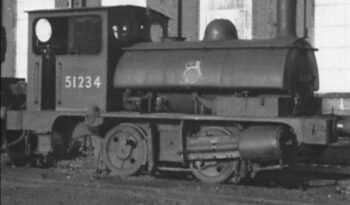
Indeed, no matter how far from home they roamed in LMS/BR ownership, the Pugs were always returned to Horwich for any major overhauls, often either being towed with the motion dismantled, or as a wagon load. 51235, for example, was loaded on a well wagon at Derby in August 1951 for the journey back to its birthplace.
Meanwhile, 51207 was one of two Pugs transferred to Devons Road shed in 1952 for a short period to work the nearby gasworks while the usual loco was undergoing overhaul.
By the time of the next withdrawal – of 51216 – in 1956 the Horwich built 0-4-0 STs had become more widely dispersed, reaching places such as Bristol, Bangor, Crewe, Derby, Widnes, York and Swansea.
Allocations in 1950 and 1959 were
| 51202 | 71G Bath S&D | Withdrawn |
| 51204 | 5B Crewe South | 26B Agecroft |
| 51206 | 27A Bank Hall | 27A Bank Hall |
| 51207 | 25C Goole | 26B Agecroft |
| 51212 | 22A Bristol Barrow Road | Withdrawn |
| 51216 | 27A Bank Hall | Withdrawn |
| 51217 | 17B Burton | 82E Bristol Barrow Road |
| 51218 | 10B Preston | 8D Widnes |
| 51221 | 5B Crewe South | 82E Bristol Barrow Road |
| 51222 | 25C Goole | 53E Goole |
| 51227 | 27A Bank Hall | 27A Bank Hall |
| 51229 | 27A Bank Hall | 27A Bank Hall |
| 51230 | 26B Agecroft | Withdrawn |
| 51231 | 27A Bank Hall | 27A Bank Hall |
| 51232 | 27A Bank Hall | 27A Bank Hall |
| 51234 | 27A Bank Hall | Withdrawn |
| 51235 | 17A Derby | Withdrawn |
| 51237 | 27A Bank Hall | 27A Bank Hall |
| 51240 | 27A Bank Hall | Withdrawn |
| 51241 | 25C Goole | 53E Goole |
| 51244 | 25C Goole | 53E Goole |
| 51246 | 27A Bank Hall | 27A Bank Hall |
| 51253 | 27A Bank Hall | 27A Bank Hall |
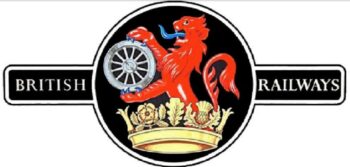
In 1956 too, British Railways also replaced its earlier “Lion on a Bike” logo with the “Ferret and Dartboard” supplied on the decal sheet of the 1957 vintage Rosebud Kitmaster model.
In fact the Rosebud Kitmaster model’s running number – 51212 – was withdrawn in August 1957 from 22A Bristol Barrow Road. Also selected for scrap were 51234 and 51240. 11234 had been in service stock between 1924 and 1933.
51231 departed capital stock in 1959 and in 1960 51221 and 51227 followed suit just as 92220 Evening Star became the last steam locomotive to be built by British Railways.

Similarly, 51217 51229 and 51246 bowed out as the first “Western” diesel hydraulics were being outshopped from Swindon works in 1961 and the next year, 1962, saw the first Class 47 diesel electrics emerge from Brush in Loughborough while 51204/06–07/22/41/44 steamed into history.
1963, the year of Gordon Cooper making the final Project Mercury orbital spaceflight, saw 51232, 51237 and 51253 also depart the Earth, with 51232 suffering a sheared off wheel at Salford, Lancashire on 5 July 1963.
This left 51218 as the last Pug standing after a varied working life. After being shedded at Preston by 1950 there were spells at Monument Lane, Crewe South, Bank Hall, Widnes, Bristol Barrow Road, Swansea East Dock and Neath, from where it was withdrawn in 1964.
To be precise, 51218 was transferred from Bristol Barrow Road to Swansea East Dock in December 1962, (although it apparently took several months to get there, via a couple of visits to Horwich Works) and remained there until June 1964, when East Docks shed closed and the loco was transferred to Neath for storage and eventual withdrawal.
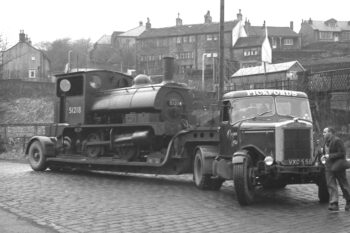
As The Beatles conquered America, the 1901 vintage former L&YR 68 and LMS 11218 was purchased directly from British Rail. A year later, in 1965, 51218 became the first locomotive moved to Keighley and Worth Valley Railway
Preservation
In fact 51218 might have been the first preserved railway locomotive to appear in a TV commercial. 1966 saw the late Ronnie Corbett ‘plastered’ against the smokebox steaming out of Mytholmes Tunnel to promote Symbol Biscuits. In fact the film was made going away from the camera and then reversed.
51218 was re-tubed in 1974 and took part in the Stockton & Darlington Railway cavalcade in 1975. However, as has been the case with many of the small pioneering locomotives of preservation, once lines became longer and train loads too great, the first preserved Pug became increasingly less useful.
An appeal was launched in 1996 to overhaul 51218 in time for her centenary in 2001 and proved so successful that the loco was overhauled by contractors and returned to steam in 1997. The loco then operated on the KWVR, the East Lancashire Railway, Southport Steam Centre, Cheddleton, Bristol Harbour, and the Middleton Railway. On the KWVR, 51218 regularly ran as “Percy” from the “Thomas” stories until its boiler tubes required replacement in 2006.
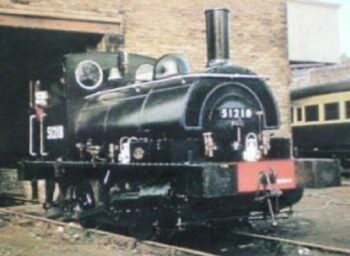
The locomotive carried its original identity of L&YR 68 from 2004 onwards, but was cosmetically restored in 2018 to 51218 for the K&WVR’s 50th Anniversary Gala.
The Lancashire and Yorkshire Railway Trust also own the other preserved Pug.
As described above, L&YR No. 19 (LMS No. 11243) of 1910, was sold by the LMS to Mowlem & Company in 1931 and was acquired by the Trust from the United Glass Bottle Manufacturers Ltd. at Charlton in 1967. It was found to be in poor mechanical condition and was later placed on static display pending overhaul, most recently at the Ribble Steam Railway although since early 2020 it has been at the East Lancashire Railway at Bury.
Ready to Run
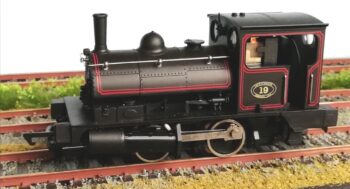
Following the long running success of the Airfix kit, a ready-to-run OO model was produced initially by Dapol in 1984 and from 1996 byHornby where the Pug was available until 2000. The Pug was reintroduced to Hornby’s range in 2010 as R2927 in early British Railways livery.
My own version of the Dapol powered model carries the number 19 in the centre of a plate which authentically reads “L&Y Ry Co Makers Horwich 1910” while the example of Hornby R2065A carries LMS lettering and the number 11250. The withdrawal and disposal of this 1910 Hughes era locomotive is currently unknown but it does not appear in the first Ian Allan ABC of 1944.
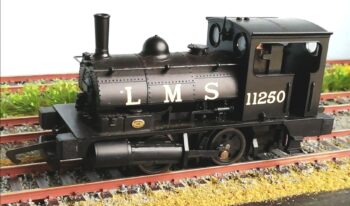
As discussed in Capital Works: Guest Motive Power, the arrival of the Dapol ready to run version of J.A.F. Aspinall’s Class B7 0-4-0ST meant that modellers were not obliged to find a way of motorising the Airfix/ Dapol kit to create a working 4mm scale locomotive.
However, the cheap and plentiful nature of the short wheelbase tank engine kit – originally moulded by Rosebud Kitmaster in Raunds, Northamptonshire – meant that it was often “kitbashed” into some very different models.
Punishing the plastic
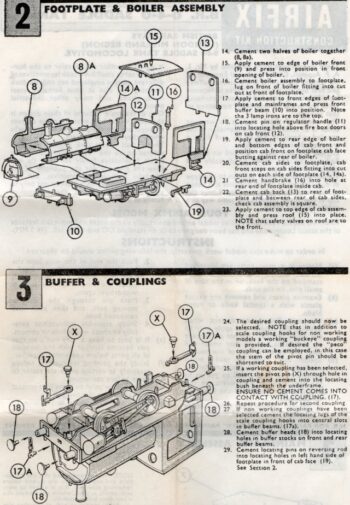
Looking at Ron’s own instruction sheet it is easy to see how the cab could be omitted and solebar, boiler dome and chimney cut down, or the boiler replaced by an alternative stored energy device, the chassis used as a bogie beneath a larger more ambitious superstructure or the solebar stretched: none perhaps harder than using the original 1950s “Perfecta” kit (priced 8/ 9d but not including the recommended Romford Terrier motor) to make 51212 capable of shunting wagons in a small space.
Indeed, although the injection moulded kit always included sprung round buffers, square dumb buffers were depicted in some early examples of box artwork and have in some instances been fitted depending on the actual prototype represented.
The Look of the Irish
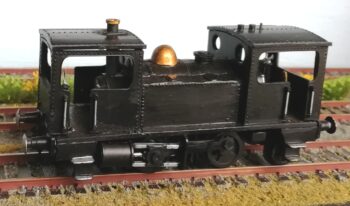
Among the most remarkable of Ron’s creations was the Dublin and Blessington Steam Tramway 0-4-2T illustrated above, which accompanied Mr Michael Clemens in Christchurch in September 2010 and drew much attention from the audience at break time.
The first railway 5′ 3″ gauge line from Dublin to then Kingstown (now Dun Laoghaire) opened in 1834 and many more soon spread across Ireland to serve the main towns. Dublin alone eventually had no fewer than five railway terminii as well as an extensive horse drawn tram network which reached south to the suburb of Terenure.
However, the 5′ 3″ gauge horse drawn trams still stopped some fifteen and a half miles from the town of Blessington which, despite being an important centre with monthly fairs, was isolated within a hinterland of remote and sparsely populated countryside.
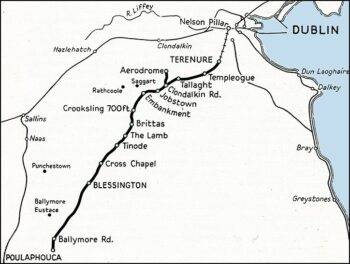
As a result the Dublin & Blessington Steam Tramway ( DBST) was built from Terenure south to Blessington via Templeogue, Tallaght, Embankment, Brittas and The Lamb and opened on Wednesday 1 August 1888 with the 0835 mail train from Terenure arriving at Blessingham at 1020.
The DBST was extended by four and a half miles with the addition of the Blessington and Poulaphouca Steam Tramway which as worked by a passenger vehicle hauled by two horses until DBST motive power took over in 1896. However, the Blessington and Poulaphouca Steam Tramway remained independent until its closure in 1927. A further extension to Rathdrum on the Dublin and South Eastern Railway was also proposed in 1897 but the mountainous landscape of the Wicklow Gap finally deterred its promotors.
In 1898 the Dublin United Tramway Company line to Terenure was electrified and although differences in rail specifications with the DBST prevented through passenger workings a physical connection was made between the two systems and at night a small DUTC electric locomotive would haul coal and cattle wagons off the DBST to destinations around Dublin.
Plans to upgrade and electrify the DBST itself however fell through in 1911 and the subsequent financial impact of the First World War, Irish Civil War and competition from road haulage and motor buses sealed the line’s fate, especially after the loss of tourist traffic to Poulaphouca in 1927. The final DBST train ran on Saturday 31 December 1932.
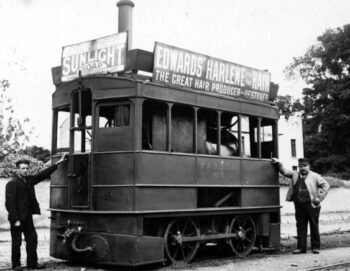
In its earliest days however, the DBST carried passengers in double decked bogie tram cars marshalled either in pairs or with one double deck car and some goods wagons forming a train. Initial motive power came from a fleet of six 0-4-0 tram engines delivered in 1887 from Falcon Works, Loughborough – which had already supplied “Sir Haydn” to the Talyllyn Railway in 1878 and would later build the Class 47 diesel electric locomotives of British Railways.
However, these “kettles” proved underpowered, especially when tackling the DBST’s steep Crooksling incline, and a 2-4-2T locomotive – DBST number 7 – was ordered from Thomas Green and Son of Leeds in 1892. This, like tram engines 1-6, had a cab at each end but was really too heavy for the rails and was not greatly used.
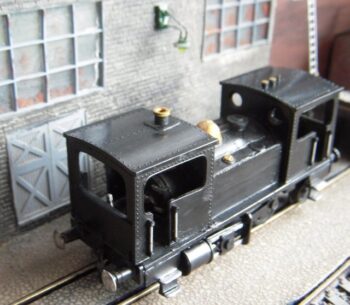
Nevertheless, another smaller locomotive was ordered from Thomas Green and Son of Leeds in 1896. This bore their works number 218 and was delivered as an 0-4-2T, again with a forward control cab as the DBST had no turntables. This was to become Number 8 in the DBST fleet and was rebuilt as a 2-4-2T in 1903 to resemble Number 9 – another 2-4-2T built by Brush Engineering in Loughborough in 1899. The final new DBST steam locomotive – introduced in 1906 – was another 2-4-2T built by Thomas Green and Son of Leeds
Ron Brook’s model would therefore seem to represent DBST locomotive 8 / Thomas Green and Son of Leeds works 218 in its as-delivered condition of 1896.
Like the Lancashire and Yorkshire B7 Pug, DBST 8 had cylinders of 13″ bore x 18″ stroke although the coupled wheels were slightly larger at 3′ 3″ compared to the Pug’s 3′ 3/8″. However, the Leeds built locomotive managed an even shorter coupled wheelbase than the Horwich product with 5′ 6″ beating 5’9″! Other dimensions for Thomas Green and Son of Leeds works number 218 included trailing wheels of 1′ 10″, 350 gallons water capacity,1¾ tons coal capacity, and full weight of 27 tons.
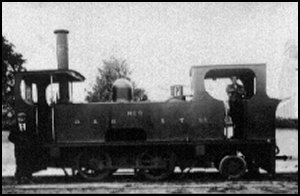
Looking at pictures of DBST 8 in service, it also appears to have been fitted with a taller steam dome, small rear coal bunker and a chimney tall enough to clear the top of a double deck tram.
In 1903 DBST 8 was rebuilt as a 2-4-2T at a cost of £100, and was then similar to the next engine, Number 9, with a weight of 29 tons
Ron Brook’s Pug conversion also pre-figured the railway modelling sub-genre of representing Irish motive power and rolling stock on 00 gauge track although purists might prefer the alternative approach of modelling in 3.5mm to the foot (1:87 ) and using 18.2mm EM gauge track to represent the Irish 5’3″.
Green for Go
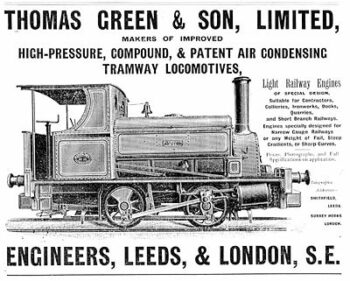
As well as being one of the more obscure engineering companies to operate in Leeds, the firm of Thomas Green and Son also has a fascinating history all of its own.
Thomas Green himself was born and raised in Newark, Nottinghamshire and his company – founded in 1835 – made small general engineering products but was noted for its wire work. The Smithfield Foundry in North Street, Leeds, was constructed from 1850 with a London office opening in 1863 and Green’s “Surrey Works” opening in Blackfriars in 1881.
The first Green patent lawnmower appeared in 1855 and by 1885 Green’s produced a Steam Tram locomotive to a Wilkinson Patent, a change to the law in 1879 having allowed the easier use of steam locomotives on tramways. Green saw ways to improve the Wilkinson patent and after making thirty nine tram engines under licence produced his own design. A total of one hundred and fifty seven were made with the last leaving Leeds in 1898. Most tram systems in the UK used Green’s tram engines and many were exported.
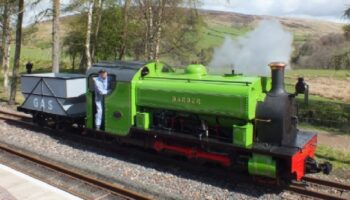
Green’s first conventional locomotive – an 0-4-0 well tank – was exported to Australia in 1888, followed by 39 more built to broad, standard gauge and narrow gauges up to 1920 From then on Green’s focused on petrol and diesel powered rollers and lawnmowers.
Thomas Green and Son made machine tools and munitions during both World Wars of the Twentieth Century and in the 1939-1945 conflict constructed components for Fairey Swordfish torpedo bombers being assembled by Blackburn Aircraft at Brough in East Yorkshire. As it turned out, the works manager during the Great War was George W. Blackburn whose son Robert founded the Blackburn Aeroplane Company and indeed some of Robert’s early efforts were constructed at Smithfield Foundry.
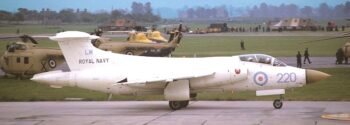
In 1951 Blackburn – soon to design its Buccaneer naval jet bomber – took over Greens, before they themselves became part of the Hawker Siddeley empire in 1960. Not being a core business to Hawker Siddeley, Thomas Green and Son was sold to Atkinson’s of Clitheroe in 1975 and the Leeds premises closed in 1976.
Life’s a Gas!
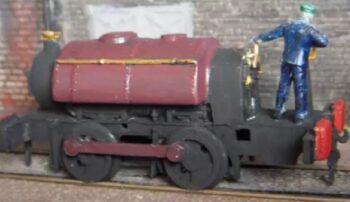
However, this Leeds built machine was just one of six models that Ron modified from the iconic Rosebud kit. His inside cylinder gasworks locomotive had no cab, dumb buffers, and boiler dome and chimney cut down to fit under retorts – used to make the old fashioned town gas from coal before methane from the North Sea and other sources replaced it in the 1970s.
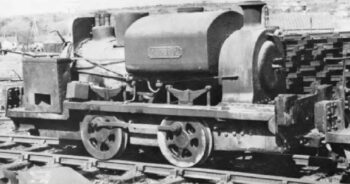
A very similar 0-4-0ST design was made by Andrew Barclay of Kilmarnock with 10″ inside cylinders for use in the smelting shops of Llanelly Steelworks in South Wales and is represented by “Nora” ( Works number 1276 of 1912 ) pictured below awaiting scrapping in April 1968.
Perhaps the best known gasworks with its own internal railway system was that at Beckton on the northern bank of the Thames in east London, located between the entrance to the Royal Victoria Dock – built in 1855 and now including London City Airport – and Barking Creek.
The Royal Assent to a Parliamentary Bill for construction of a gas works on an initial 100 acre marshland site was given in 1868 and the first gas flowed from the four retort houses in 1870, the Gas Light and Coke Company (GLCC) founded in 1812 having employed civil engineers F. J. Evans, J. Orwell Phillips and V. Wyatt to build both the complex and a new gas main to Westminster. Indeed, the area became known as Beckton as a shortened version of Beck’s Town – Simon Adams Beck being the Governor of the GLCC.
Town gas was produced by heating coal – brought in by ship from Northumberland and County Durham – to a very high temperature in large airtight cast iron cylinders known as retorts, the resulting gas then being cooled, washed, purified with lime and stored in telescopic cylindrical gasometers.
They by-products of the retorts were coke – used in iron production, coal tar used to make disinfectants by companies such as Burt, Boulton and Haywood and sulphur, which was turned into sulphuric acid for use in fertilizer and other products.
At Beckton, coal was brought to the retorts by a High Level railway system and a Ground Level system – with cut down locomotives – was used to take the solid products from underneath the retorts where only eight feet of headroom was available.
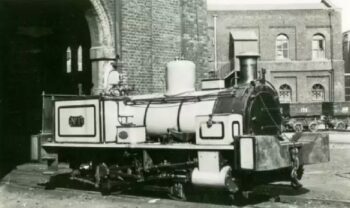
Beckton locomotive Number 1 was built in 1870 by Neilson & Company of Glasgow as their works number 1561 and the 0-4-0WT with its distinctive Stephenson outside valve gear later worked in a slate quarry near Bangor in North Wales. It is pictured above as preserved by the National Trust at Penrhyn Castle.
In 1872 a goods line was built from the works to the Great Eastern Railway’s Custom House station. This also saw passenger services – mainly for workmen – to a new station opened at Beckton in 1873 and in 1874 the “Beckton Branch” was formally taken over by the Great Eastern Railway.
By 1876 another six retort houses had become operational and a separate Tar and Liquor Works had been opened by GLCC to process its own tar and sulphur. Later known as the By-Products Works, this received its own fleet of locomotives from 1883 with the Gas Works and By Products railways being treated as separate concerns. The locomotives moving coal from the piers to the retorts and coke away for export were painted green and the motive power for tar and sulphur given a maroon livery.
In 1893 a second pier was built to handle incoming coal – with the original Number 1 pier being used for the export of coke – and by 1897 a maximum of fourteen retort houses were on line with Beckton producing 60 million cubic feet of gas per day by 1900. At this time there were 40 miles of railway track and three locomotive depots within the gasworks, and forty High Level locomotives and 14 more belonging to the By-Products Works collectively handling 10 000 tons of materials each day.
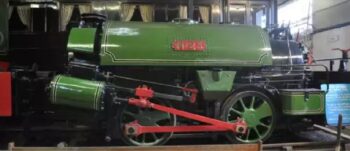
The GLCC was now the biggest private gas company in the World and turned again to Neilson and Company of Glasgow for what was to become the other Beckton locomotive to be preserved. Delivered in 1897, Beckton 25 – Neilson works number 5087 – was a “Jumbo” type 0-4-0ST tipping the scales at 25 tons and which is now preserved at Bressingham, Norfolk, thanks to the Industrial Locomotive Society.
In 1910 with changes to the methods of Gas production, five of the retort houses were converted to other uses and three Barclay 0-4-0Ts were purchased in 1921. In 1931 two batteries of coke ovens came in to operation and an 80 bhp battery electric locomotive was purchased to move the coke car. By this time too, some of Beckton Gas Work’s original semaphore signalling had been replaced by coloured lights, although to avoid confusing the shipping on the busy nearby Thames orange and blue aspects replaced the more usual red and green.
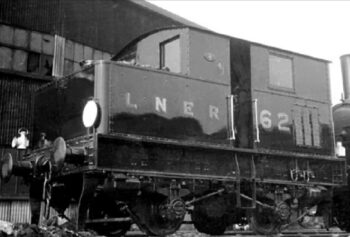
Two London North Eastern Y3 Sentinel Locomotives were loaned to Beckton in 1940 and during the war enemy bombing both disrupted the High Level system and destroyed the Royal carriage which had been built especially for the visit of Their Majesties King George V and Queen Mary in July 1926
In 1948 an extra coke oven brought an extra battery locomotive to Beckton, which became part of the North Thames Gas Board in 1949. Two fireless steam locomotives also arrived in 1951 to replace the last of the shunting horses although in 1956 changes to coal handling methods led to some of the retort houses being shut down and the remains of the High Level system closed. In 1958, as well, the arrival of two Planet diesels marked the phasing out of steam locomotion at Beckton.
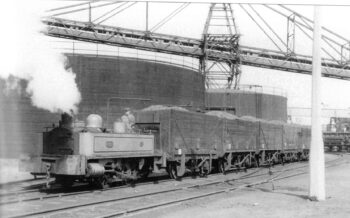
By 1963 – when the first Petroleum Feedstock Reforming Plant was bought into use, signalling the end of conventional Gas production – a new railway track had been laid on the south western side of Beckton Gas Works and coke trains from Beckton were now being sorted at British Rail’s Temple Mills yard at Stratford.
The last retort house was taken out of use in 1967 and in 1969 the last shipload of coal arrived, the last coke was discharged and Beckton Gas Works formally closed. The last train along the Beckton Branch – carrying Tar Pitch from the By-Products Works – ran in 1970 and the last of the Beckton railway system was demolished in 1973.
More recently however Custom House and Beckton have been linked by the Docklands Light Railway and the remains of Beckton Gas Works – including the “Beckton Alps” toxic waste tips have featured in such film productions as James Bond’s “For Your Eyes Only” and Stanley Kubrick’s “Full Metal Jacket”.
Crane Tank
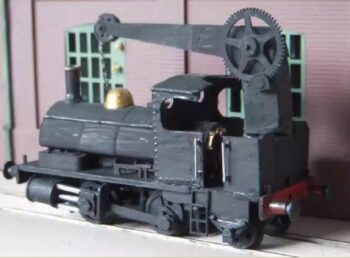
In the days before forklift trucks and lorries with HIAB lifting gear, crane fitted tank locomotives were an ideal way of lifting heavy objects around factories, workshops and shipyards, which would almost certainly have had their own railway systems.
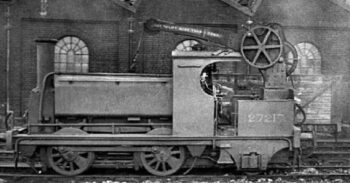
Indeed, Ron’s crane Pug is very similar in format to 58865, the oldest locomotive in the newly Nationalised British Railways fleet in 1948. Built by Sharp-Stewart of Glasgow in 1858 as an 0-4-0 for the North and South West Junction Railway, it was rebuilt as an 0-4-2CT at the Bow Works of the North London Railway in 1872 and simply known as “Steam Crane” until 1922. The London & North Western Railway then absorbed the North London and numbered the 32 ton 6cwt locomotive 2896 only for the LMS to renumber it again as 7217 in 1923. Indeed, the LMS later renumbered the crane tank – which could lift no more than three tons – as 27217 and added much rectangular sheeting to enclose the crane and match the flat topped saddle tank. 58865 was finally scrapped at Derby Works in 1951.
The image above is by kind permission of Mike Morant.
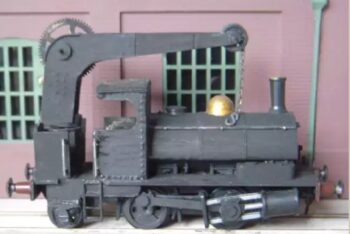
To modify the standard kit, the frames of the crane Pug were stretched to accommodate an 0-4-2ST wheel arrangement allowing the crane jib to stand over the carrying axle, allowing the weight of the boiler to counteract any load being swung from one side to the rear and over to the opposite side of the locomotive. Notice too that although the jib can slew through more than 300 degrees it is fixed in the vertical axis and can only lift objects by raising its hook through shortening the chain.
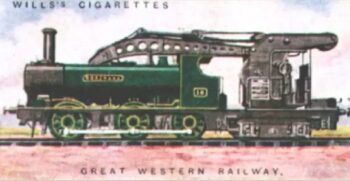
In contrast, the original caption for this Wills’s cigarette card read:
“Crane Engine 16 “Hercules” 0-6-4 Tank. A very useful and special type of locomotive with crane, built at Swindon, and intended for working in yards where heavy loads have to be lifted. The cylinders are placed inside the frames and water is carried in the “Pannier” tanks. The company possesses three of these engines named “Hercules”, “Cyclops” and “Steropes”. The total weight in working order is 63 1/2 tons and the crane is lifting anything from 6 to 9 tons. The crane is worked by a separate donkey engine.”
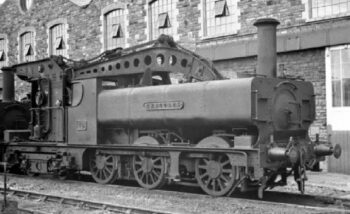
Indeed, 16 “Hercules” – pictured above in an image from the Michael A. Morant collection – seems to be almost a conventional pannier tank towing a four wheeled crane with its own prime mover, and how tight a radius curve it could cope with would have been interesting to see! However, once again the crane and locomotive boiler being mounted on the same chassis would have helped the whole vehicle remain stable while moving a load from side to side. Notice too that the crane jib can be raised and lowered and in the latter position stays within the Great Western loading gauge for ease of movement between operating locations.
An alternative crane tank format was to have the crane mounted above both the boiler and side tanks or even around the chimney. In the former case, the loading stresses were kept in the centre of the two axle wheelbase although in the latter instance a long rear overhang was needed to balance a load swung around the front of the locomotive. Although allied to a short wheelbase, this would still have created a greater outswing and kinetic envelope than otherwise. Similarly, a crane jib centred on top of the boiler would also raise its centre of gravity and increase the likelihood of derailment if too heavy a load was lifted at maximum reach. As with cranes mounted behind the cab too, these locomotives could be fitted with lifting or fixed jibs.
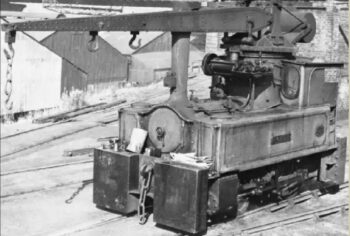
Illustrated above is Robert Stephenson & Hawthorns 0-4-0CT 7006 of 1940 outside the shed of the Pallion Shipyard of the Doxford & Sunderland Shipbuilding and Engineering Co Ltd. Named “Roker” it was one of a pair originally ordered by “The New Russia Company” from Hawthorn Leslie in 1918. However, as this order was not fulfilled the parts were stored until used by their successor Robert Stephenson & Hawthorns to create both “Roker” and sister crane tank 7007 named “Hendon”. Hawthorn Leslie had already built an 0-4-0CT named “Pallion” for William Doxford in 1902 and RSH would follow 1940 vintage “Roker” and “Hendon” with two more similar locomotives named “Southwick” (RSH 7069) and “Millfield” (RSH 7070) in 1942.
The crane tanks were designed for lifting steel plate and other materials as well as shunting wagons around the shipyard. The hooks on the steam crane jib were fixed and not attached to a rope; indeed the design used no cables or gearing at all.
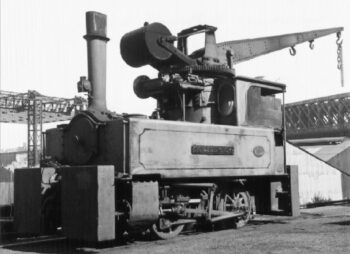
There were three hooks attached to the jib at different radii which allowed the crane to lift varying weights: 1 ton at 20′ radius, 1.5 tons at 15′ radius and 2 tons at 12′ radius. A vertical lifting cylinder was incorporated into the crane structure and its piston was connected to the end of the jib. Steam at full pressure was always maintained on the upper side of the piston, and pressure on the underside was controlled from the cab.
The jib was pivoted at a point on the forward end of the crane structure and, with full pressure on the underside, the piston was in equilibrium and the weight on the jib caused it to drop. When steam was exhausted from the underside, the full boiler pressure on the top of the piston caused the jib to rise.
A two-cylinder engine was provided to slew the jib through 360 degrees. The crane jib fitted neatly over the locomotives long tapered chimney when not in use, although it substantially overhung the front of the locomotive. Very large dumb buffers and a modified version of Joy’s valve gear were other characteristic features of the design. The choice of Joy valve gear was rather outdated by 1940 but probably stemmed from the use of the stored parts.
“Roker” and its stablemates were housed in a five road locomotive shed and all carried a mid green livery lined in black, edged in yellow with fluted corners. The buffer beams and valve gear were red.
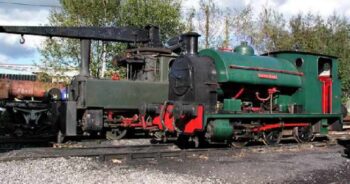
The five crane locomotives worked in the Sunderland yard until replaced by road cranes in 1971. “Roker” was withdrawn in January that year and then bought from a scrap merchant in Surrey for a private railway collection at the JCB works at Rocester in February 1974 in the company of “Pallion”. However, Rocester was not to be their new home for long and while “Roker” was sold on to the Foxfield Railway in mid July 1974, “Pallion” was unfortunately scrapped a few weeks later.
Roker” has been steamed at Foxfield and proved useful for small lifting jobs. It was particularly employed during a relaying of Cresswell Ford level crossing in 1976, but now awaits a major overhaul. “Roker” is on permanent static display in the museum building at Caverswall Road station but is occasionally hauled outside for special events. In summer 2004 “Roker” left the railway for a couple of weeks to take part in a filming assignment in Liverpool, returning to Foxfield on 24 August. The loco was repainted in lined maroon livery during winter 2004/05.
Roker’s sister engine “Hendon” is also now preserved on the Tanfield Railway while “Southwick” is on the Keighley and Worth Valley Railway and “Millfield” at Bressingham Steam Museum.
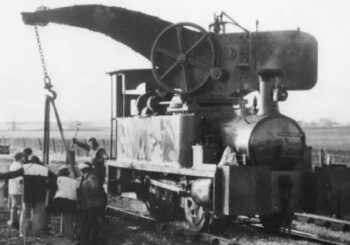
Mention crane tanks to most British railway enthusiasts and their minds will probably wander to the wonderful paintings by David Shepherd of Dubs &Company’s 0-4-0CT 4101 which was for so long resident on the East Somerset Railway. “Dubsy” was built in Glasgow in 1901 and spent 72 years at the Shelton Iron and Steel Works, Etruria, Stoke on Trent, lifting loads and re-railing other locomotives and wagons that had come off the track.
Unlike many Shelton locomotives which endured a hard life on a system of three continuous shifts per day, the crane tank was only required on a single daily shift. Compared to “Roker”, “Dubsy” has a more conventional lifting and slewing mechanism on the crane, which has a single hook and chain. The crane cylinders are 4.5″ x 6″, the jib radius is 14’6″ inches, and its maximum load is 6 tons. Large dumb buffers are fitted, and photographs show that the locomotive was often seen with an old flat wagon to avoid the overhanging crane jib fouling other stock.
Oil firing equipment replaced coal in 1961 but 4101 was replaced in everyday service in by diesel cranes in 1968 and was purchased in preservation in April 1970. After more than three years of storage, the 0-40CT moved by by road to Cranmore in September 1973 and once again found employment on lifting and re-railing duties as well as being shed pilot for the ESR after hydraulic boiler testing and the restoration of coal as a fuel in September 1977.
After helping build Cranmore West station platform and the Mendip Vale Extension of the East Somerset Railway, Dubsy was due for major repairs in 1986 but was instead sold to new owners at the Foxfield Light Railway near Stoke on Trent and was steamed again there on 18 July 2010.
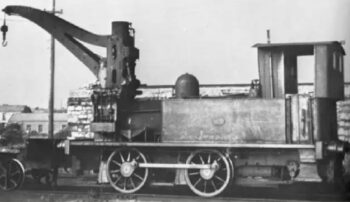
A third Glaswegian crane tank worthy of mention – not least because it completes the set of North British Locomotive constituents building these machines – was Neilson & Company’s 4004 which left Springburn Works in 1890 to become locomotive number 6 of the Hodbarrow hematite mines near Millom in Cumberland. Here it was known as “Snipey” – as the crane resembled the beak of a marshland dwelling snipe – and was first preserved at the former Lytham Motive Power Museum during the early 1970s. Apparently the locomotive remains privately owned and out of public view – but safe – on the same site in 2011.
Fireless
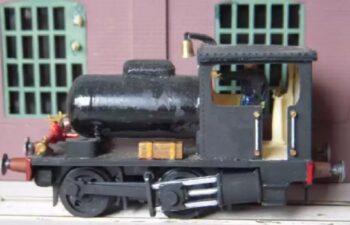
In contrast to the structural alterations of the crane tank, Ron’s Fireless Pug is essentially the kit as supplied with the boiler replaced by a cylindrical reservoir, and additional filling pipes, cab roof bell and wooden toolbox. Most distinctive of a fireless locomotive too are the cylinders grouped under the cab.
Unlike a conventional steam railway engine, the fireless supplies its cylinders with steam from a water filled reservoir which is in turn pressurised by a separate stationary boiler. As there is no fire inside the locomotive itself, it is able to work safely in such places as match factories, paper mills and jute, mustard and munitions works. Fireless engines were also popular prime movers in gas works, and power stations where supplies of high pressure steam were plentiful.
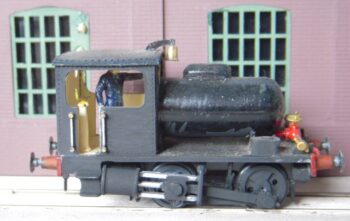
In addition they were quiet, convenient and cheap to run, required relatively little maintenance and were pleasant to drive and pollution free – something that could not always be said of the diesel shunters that came to supplant them. Fireless engines could not, however, work intensively for long periods without recharging: a drawback which was to bar them from more widespread use. In fact only 162 fireless locomotives were ever built in Britain.
On Britain’s industrial railways, fireless locomotives tended to follow a uniform style of design. Compared to their main line cousins they were small, lightweight and had either four or six wheels driven by a pair of outside cylinders mounted underneath the footplate, In the absence of a firetube boiler and smokebox all the steam pipework could be concentrated rearwards, including the chimney which usually ran from the cylinders up the outer back wall of the cab.
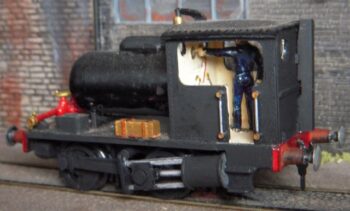
Not being able to generate its own heat meant that insulation was an important design feature of the fireless locomotive and while the reservoir was usually lagged with asbestos or magnesia four or five inches deep the cylinders had large diameters in relation to their piston strokes to minimise wasteful steam condensation on cool cylinder walls. During charging from a stationary boiler, it was customary to “blow down” the cylinders to keep them hot and remove any condensed water.
Depending on the individual locomotive, charging pressures of between 160 and 800 pounds per square inch (psi) could be used from the stationary boiler, compared with the 250 psi generated by the boiler of a mainline passenger locomotive. While the latter used hot gas to raise steam though, a fireless locomotive relied on the latent heat of water filling most of the reservoir.
As steam was used by the reciprocating cylinders, the reservoir pressure dropped, making the water generate more steam at a lower pressure. As the locomotive worked, the reservoir pressure continued to fall until a level of about 25 psi was reached and the reservoir had to be recharged.
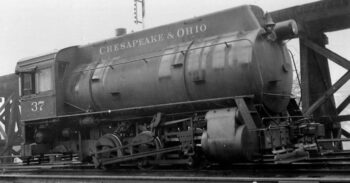
British fireless designs seldom rose above 30 tons in weight although 48 ton machines were to be found in Europe, and Turkey at one time boasted 60 ton engines with ten wheels apiece. Possibly the heaviest fireless locomotive was the 0-6-0 that shunted at the Eastman-Kodak film works in America in the 1940s. It tipped the scales at 66 tons! The example pictured above was built by the H. K. Porter Company in 1949 as one of the three strong Chesapeake & Ohio Railroad’s Class C-8.
Early domination of the fireless locomotive market was by Orenstein and Koppel of Berlin and their 0-4-0F 2499 of 1907 was one of the first to be imported into Britain for Reed’s Empire Paper Mills at Greenhithe on the Thames. Due to patent restrictions it was not until 1913 that the first British fireless locomotive was produced by Andrew Barclay and Company of Kilmarnock. it was destined for an explosives factory – a fateful order as it was the outbreak of World War One that signalled the heyday of fireless locomotives in Britain. Munition works multiplied, and with the Germans unable to enforce their patent rights, firms such as Andrew Barclay, Bagnall, Peckett and Hawthorn Leslie swung into production. Fireless locomotives continued to be built after the Armistice and the last one did not leave the builders until 1961. Andrew Barclay dominated the manufacture of these machines, their total of 114 more than equalling the output of all other British firms combined. Kilmarnock also saw the erection of both the smallest and largest fireless locomotives ever built in Britain.
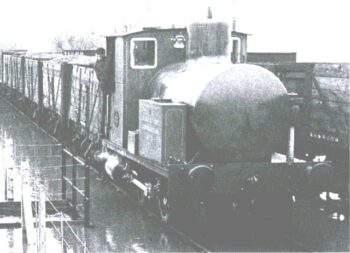
Indeed, Andrew Barclays 0-4-0F 2126 of 1942 has a long association with Gloucester. Leaving Kilmarnock on 2 January that year, it had been ordered by Yarrow & Company Limited for Gloucester Corporation Electricity Department’s Castle Meads Power Station, itself built only four months earlier by the Scotstoun, Glasgow based engineers and one of a number of new camouflaged power stations dispersed around the Britain during the Second World War.
The 21 ton locomotive was to spend its working life moving wagon loads of coal from either the power station’s own Severn wharf or the GWR Exchange Sidings at Over to the boiler furnaces.
When first commissioned, the power station’s coal arrived in Gloucester Docks and was brought round in lorries belonging to Tom Morris and Sons although the Severn Wharf -complete with crane – began use after dredging allowed coastal vessels such as the Empire Reaper from Barry to pass through the lock at the northern end of Gloucester Docks and into the Severn. A coaster would typically take a day and a half to unload with 2126 moving two of the four wagons built by Gloucester RCW for this task at a time. Once at the power station the steel wagons would have their coal loads tipped into a hopper.
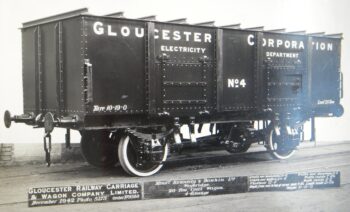
From 1947 the four original GRCW built wagons along with others worked between the power station and collieries in the Forest of Dean although after 1965 coal from Staffordshire came in by road and the four wagons were dumped at Sharpness.
Although similar to preceding four coupled designs with reducing valves, the specification for 2126 dated 6 December 1940 included “Feed water tank fitted on side of platform with water cock and injector globe valve and check valve, no steam brake.”
This tank was on the right hand side framing and it was possible by these means to top up the reservoir with water whilst the locomotive was in steam and away from the charging plant. It is possible that this was because 2126 was designed to be charged with highly superheated steam and that the amount of water that would condense in the reservoir while charging would be very small. As such, this was probably the only British fireless locomotive fitted with its own feedwater arrangements.
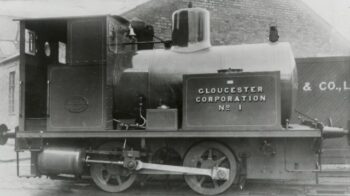
2126 was finished in dark battleship grey with yellow lining and the words “GLOUCESTER CORPORATION No 1” painted on the reservoir on one side and and on the side tank on the other. Other notable features were the bell in front of the cab and sand boxes on either side of the reservoir – just as can be seen on Ron’s fireless Pug.
Last used commercially in 1969, it was saved from the closed Castle Meads site on 10 November 1973 by the Dowty Railway Preservation Society. After moving 2126 to Ashchurch, the Society made some test runs with the locomotive powered by compressed air. This worked moderately well, but no attempt was made to steam 2126 either there or at their later Toddington location.
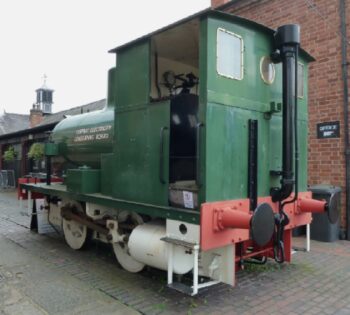
In September 1988 the Andrew Barclay 0-4-0F arrived at the National Waterways Museum in Gloucester for subsequent non-operational cosmetic restoration – including asbestos stripping – thanks to sponsorship from Barnwood based Nuclear Electric (later British Energy) and the Science Museum’s Prism Fund.
2126 remained on display in Gloucester Docks in the post -War green livery of the Central Electricity Generating Board into the 21st century before being relocated to the Vale of Berkeley Railway.
Long White Clouds of Steam
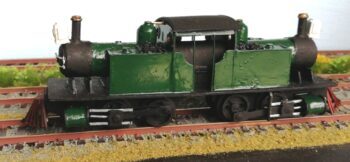
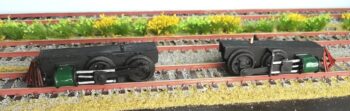
Ron’s next adaptation of the Rosebud Kitmaster Pug was to use two chassis as the bogies under a scratchbuilt body of an exported Double Fairlie locomotive.
The Double Fairlies used in Mexico, Canada and Russia had two six wheeled bogies and while 0-4-0+0-4-0 Fairlies operated on the Denver and Rio Grande Railroad in the USA in 1872 and also on the first Government railway line in Western Australia in 1879, Ron’s model was mainly inspired by the New Zealand Railways E Class. Although these Vulcan Foundry 0-4-0+0-4-0s were built to 3′ 6″ rather than 4′ 81/2″ gauge similarities can be seen with No 2 “Josephine”, preserved at the Otago Settler’s Museum and pictured below. In fact Ron’s model has the centre coupling lowering into the cowcatcher when not in use!
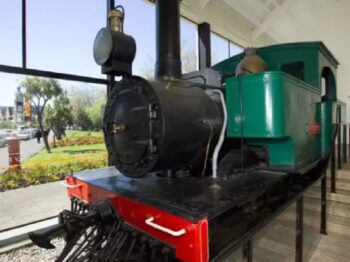
Josephine was one of two locomotives ordered in 1872 for the newly-completed Dunedin – Port Chalmers Railway built under the Great Public Works programme instigated by Prime Minister Julius Vogel in 1870 to open up the interior of New Zealand.
The Dunedin – Port Chalmers Railway was the first to be built to the New Zealand standard gauge of 3′ 6″ and Robert Francis Fairlie was its Consulting Engineer. New Zealand Railways were later to acquire R and S Class Single Fairlies as well as B Class Double Fairlies from 1874.
No 1 Rose and No 2 Josephine arrived at Port Chalmers in kit form and were assembled at the wharf with Josephine being the first of the Newton-Le-Willows built pair to raise steam, on 11 September 1872.
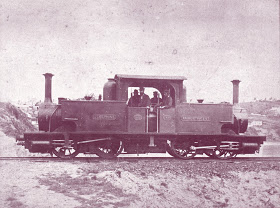
Rose hauled the official first train to Dunedin while in 1879 Josephine was used as a banking locomotive south of Oamaru on the first train of the newly completed Main South Line between Dunedin and Christchurch. However, Josephine had to be removed at Palmerston with mechanical problems as she had been taking too much of the strain from the train locomotive, the newly introduced American built 2-4-2 K88.
Although Rose was withdrawn after an accident in the late 1880s, Josephine was renumbered as E 175 in 1888-1890 and was transferred from NZR to Public Works Department ownership in 1900, becoming PWD 504. As a railway building rather than railway operating locomotive, Josephine was moved to North Island and helped construct the Main Trunk Railway there before returning south across the Cook Straits to make the Otago Central Railway a reality before sale in 1917 to the Otago Iron Rolling Mills Company as scrap.
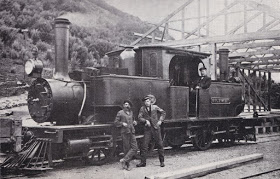
By this time six new and improved E Class Double Fairlie locomotives – built by Avonside – had been operating on North Island since both introduction in 1875 and official retirement in 1906. However, these Bristol-built engines were to continue in service until the New Zealand Government Railways Department realised what had happened and scrapped them in 1920. One cylinder-less Avonside bogie is however preserved at Ferrymead Heritage Park, Christchurch, New Zealand.
Luckily no one at Otago Rolling Mills was keen to demolish Josephine and when one of the company’s boilers failed PWD 504 was recommissioned as a temporary steam supply.
In 1925 Josephine was cosmetically restored with inaccurate balloon chimneys as an exhibit at the New Zealand and South Seas International Exhibition in Dunedin and afterwards was presented to the Otago Early Settlers Association.
In the 1960s, after decades exposed to the elements on the lawn outside the Association’s museum, Josephine was literally falling to pieces. In 1966 the Evening Star newspaper started an appeal to raise funds for Josephine to be restored and – largely thanks to school children donating small amounts of money – Josephine was restored – with correct chimneys – at Dunedin’s Hillside railway workshops and returned to indoor display at the museum in March 1968. Today she is the oldest preserved locomotive in New Zealand and the only provincial government example.
Festiniog Adventure
To see full sized Double Fairlie locomotives at work today it is necessary to visit the Festiniog Railway in North Wales where the type was first practically applied.
Opened in 1836 to take slate mined in Blaenau Ffestiniog to Porthmadog for export by sea, the 1′ 11 1/2″ gauge Festiniog Railway was originally worked by horse power and gravity until Charles Easton Spooner – son of James Spooner who had surveyed and built the line – took control in 1856 and introduced some of Britain’s first narrow gauge steam locomotives – “The Princess” and “Mountaineer” in 1863.
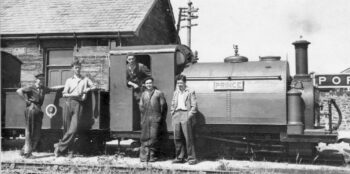
Two more 0-4-0STs built by George England of New Cross, London – named “The Prince” and “Palmerston” – arrived in 1864, the same year in which the Board of Trade permitted the Festiniog to become the first narrow gauge railway in Britain to carry passengers. Despite the arrival of two more four coupled saddle tank engines – “Welsh Pony” and “Little Giant” – in 1867 however passenger and slate traffic grew to such an extent that an Act of Parliament was passed in 1869 permitting the single main line to be doubled.
To avoid such costly civil engineering work however, the Festiniog Railway looked at ways of increasing the capacity of the single line by running longer trains hauled by more powerful locomotives. The key to doing this on steeply graded track with tight curves was the Double Fairlie, brainchild of Scottish engineer Robert Francis Fairlie ( 1831- 1885 ) and comprising two powered bogies swivelling under one long rigid boiler with two fireboxes under a central cab.
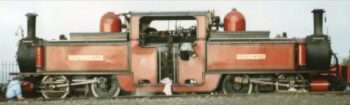
Two fireboxes were needed to avoid the exhausts from each powered bogie interfering with the other as they created draughts along the fire tubes of the boiler. But the central cab made turntables or tender-first running superfluous, a feature continued by modern diesel and electric bogie locomotives. Similarly, with all wheels being powered and couplings mounted on the swivelling bogies, the weight of fuel, water or machinery could yield maximum tractive effort while fireboxes and ashpans were only restricted to the width of the loading gauge – less room on the other side from the fireman for the driver – rather than by the width of track gauge or rigid wheeled frame.
The first Double Fairlie locomotive – “Little Wonder” – was demonstrated on the Festiniog Railway in 1870 and proved to have more than double the power of the earlier locomotives. The improved “James Spooner” built by Avonside of Bristol was introduced in 1872 and the first 0-4-4T Single Fairlie – with a rear cab and swivelling front bogie – was named “Taliesin” in 1876.
From 1873 the bogie principle was applied to passenger and freight vehicles with carriages 15 and 16 – which are still in service today – being the first two British bogie coaches.
In engineering however nobody gets anything for nothing and the Double Fairlie format had inherent flaws. The first was a limited capacity for fuel and water relative to the locomotive’s ability to consume these commodities. However, at the end of the 20th Century the conversion of Festiniog Railway Double Fairlies to oil burning meant that more energy could be stored for a given available mass.
Unlike the coal piled up on top of the Double Fairlie’s four water tanks, a Single Fairlie had the option of towing a conventional tender but this design defeated the object of maximising tractive effort and avoiding turntables.
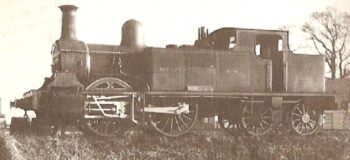
In fact an Avonside built 0-4-4T Single Fairlie was also used on the standard gauge Swindon, Marlborough and Andover Railway from 1878 which for the first time on a British based locomotive used Walschaerts valve gear to leave the space between the frames clear for the boiler.
Similarly, on the recommendation of Robert Fairlie himself, Avonside were chosen to build the 21 R Class 0-6-4T Single Fairlies for New Zealand Government Railways in 1878-79, with 1878 vintage locomotive 28 surviving today at Reefton.
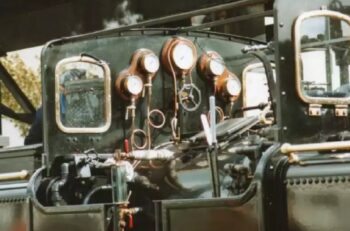
Unlike the Single Fairlie which had a conventional cab layout, the long boiler of the Double Fairlie separated the fireman and driver making co-operation in activities such as sighting signals more difficult. The driver’s side of the cab also required duplicate controls for running in each direction which added yet more components to an already complicated design. Furthermore, the spherical joints carrying the boiler steam to the bogie cylinders were a potential design weakness and the bogies required balancing to cancel both the weight of the cylinders and also the tendency of the reciprocating pistons to make the powered bogies “hunt” at speed.

In contrast, a bogie diesel-electric locomotive has all its reciprocating cylinders inside its body and transmits only electricity to the traction motors revolving in its bogies.
Despite its drawbacks however the Double Fairlie holds not just places in the annals of locomotive engineering and railway preservation but in the hearts of railway enthusiasts all over the World.
Under Pressure
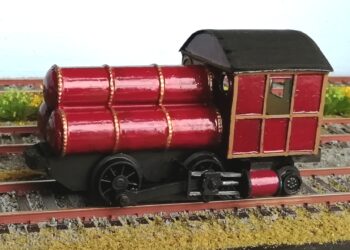
Like the Fireless, Ron’s final kitbashed Pug also featured a stored energy device rather than a prime mover and moves us out of the orbit of British Empire and industry to the United States of America.
Visitors to model engineering exhibitions such as the annual rally of the Model Steam Road Vehicle Society in Tewkesbury will often have seen stationary engines powered by a compressed air supply rather than using steam from a boiler. Both steam and compressed air can make these engines work because they offer the energy of a high pressure gas.
However, storing – rather than generating – high pressure gas is more difficult because the storage vessel has to be strong enough not to burst and yet, in the context of a locomotive, light enough to be carried. Pressurising such a vessel also results in it becoming hot – just as a bicycle pump heats up when used to inflate a tyre. This heat is ultimately lost from the compressed gas although compressing and cooling in stages can recover some of this energy.
Similarly, as the compressed gas is let out of the vessel to work the engine – even if depressurised in stages – it cools and unless perfectly dry can allow ice crystals to form and stop the pistons reciprocating in the cylinders.
As such, compressed air locomotives were only worth the effort of building and maintaining for locations where fire, steam and smoke would be unacceptable such as mines and crowded cities.
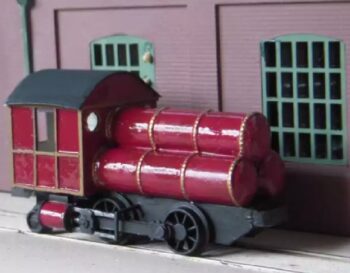
In 1848 Barin von Rathlen constructed a compressed air vehicle which was reported to have been driven from Putney to Wandsworth in London at 12 mph and a compressed air tram built by Louis Mekarski was displayed at the Paris Exhibition of 1878. This vehicle featured a bouillotte – literally a hot water bottle – to minimise the cooling effect of expanding the compressed gas. The bouillotte was three quarters filled with water heated to 180 degrees celsius and maintained at seven atmospheres which both warmed the incoming high pressure air and saturated it with water vapour, making it behave more like steam as could be used expansively to move the pistons in the cylinders. However, as the bouillotte rapidly cooled it needed to be heated by an external steam source at regular intervals or required its own solid fuel fire, thus defeating the object of removing smoke and fire from the environment.
In Britain compressed air trams were tried with little success in east London, the Vale of Clyde, Liverpool, Chester and Wantage – the last named first running on Thursday 5 August 1880. However, this system presented the tram with a 1 in 47 climb just before a return to the expensive, fixed charging station which consumed four times as much coal as using steam locomotives.
Meanwhile in 1878 the Second Avenue Railroad in New York City had begun testing compressed air trams designed by Robert Hardie which featured regenerative braking to re-compress the air in the reservoirs.
In 1882 the French journal La Nature also reported that compressed air locomotives were at work on the New York Elevated Railways although it did not make clear whether these engines were on trial or in more regular service.

Illustrating the report was this drawing of an 0-4-2 locomotive with cylinders under the wooden framed driving cab and what looked like three pressure vessels although the text mentioned four steel storage cylinders of 910mm diameter holding 13 square metres of air pressurised to 42 Kg/ Cm squared. The air apparently passed through a vertical bouillotte heated to 90 degrees celsius and thence to the cylinders through a reducing valve and throttle designed to maintain 9 atmospheres at the piston face. Meyer valve gear and regenerative braking were fitted and gave the locomotive a 13 Km range.
Little more is known about the compressed air locomotive of the New York Elevated Railways but later refinements to the idea included the Hoadley-Knight system of compounding – with the air heated between high pressure cylinder exhaust and low pressure admittance – and the similar Hodges-Porter system using a more efficient heat exchanger.
As I could not find any reference to the colours of the New York Elevated Railway compressed air locomotive I decided to give black and green a break and use some Tuscan red enamel with natural wood for the cab faming and brass for the chains holding the pressure vessels.