In April 2022 Jet Age Museum, Gloucestershire, paid tribute to one of the most revered names in British engineering history. This article is based on the research behind the exhibition ‘ Powered by Rolls Royce ‘.
INTRODUCTION

A marketing survey in 1987 found that only Coca-Cola was a more widely known brand than Rolls-Royce. As well as the illustrious cars with the Spirit of Ecstasy bonnet mascot, Rolls-Royce has, in over a century, manufactured civil and military aero engines, marine propulsion and power generation equipment and railway diesel engines.
Frederick Henry Royce was born in 1863. His father died when he was just nine years old and after just a year of formal schooling he went to work delivering telegrams and selling newspapers. In 1878 he started an apprenticeship with the Great Northern Railway at Peterborough. In 1884, with £20 of savings, he entered a partnership with Ernest Claremont called F.H. Royce and Company. They started a business making domestic electric fittings in a workshop in Manchester and in 1894 started making dynamos and electric cranes. Following a decline in trade after the Second Boer War and the arrival of increasing competition from Germany and the United States, Royce began considering the motor car as potential new product for the company. In 1901 he bought a small De Dion motor car although this did not meet his high technical standards. After trying to improve them, Royce decided to build his own in 1904.

The Honourable Charles Stewart Rolls was born in 1877,the third son of the First Baron Llangattock whose ancestral home was The Hendre, near Monmouth, Wales. At Eton College his developing interest in engines earned him the nickname ‘dirty Rolls’ while in 1894 he entered Trinity College,Cambridge to study mechanical and applied science. In 1896, at the age of 18, he travelled to Paris to buy his first car.
This was a Peugeot Phaeton and he joined the Automobile Club of France. His Peugeot is believed to have been the first car based in Cambridge. Rolls joined the Self-Propelled Traffic Association, which campaigned against the restrictions imposed on motor vehicles by the Locomotive Act. Rolls also became a founder member of the Automobile Club of Great Britain, with which the Association merged in 1897. Rolls graduated from Cambridge in 1898 followed by a position with the London and North Western Railway at Crewe. However his talents lay more in salesmanship and pioneer driving than practical engineering.

Meanwhile, Royce had built two more cars. Of the three, which were called Royce and had two cylinder engines, one was given to Ernest Claremont and another sold to one of the other directors, Henry Edmunds. Henry was a friend of Charles Rolls who had a showroom selling imported models.
Edmunds showed Royce his car and arranged the historic meeting between Rolls and Royce at the Midland Hotel in Manchester on 4 May 1904. In spite of his preference for three or four cylinder cars, Rolls was impressed with the two-cylinder Royce 10 and in a subsequent agreement of 23 December 1904 agreed to take all the cars Royce could make. These would be of two, three,four and six cylinders and would be badged to Rolls-Royce. The first Rolls-Royce car, a Rolls Royce 10 hp, was unveiled at the Paris Salon in December 1904.
In 1906, Rolls and Royce made their partnership official by creating Rolls-Royce Limited, with Royce appointed Chief Engineer and Works Director on a salary of £ 1 250 per annum plus 4% of the profits in excess of £ 10,000.
Rolls put much effort into publicising the quietness and smoothness of the Rolls-Royce, and at the end of 1906 travelled to the US to promote the new cars.

The Rolls-Royce bonnet ornament Spirit of Ecstasy was designed by Charles Robinson Sykes and was based on the secret love of Montagu, second Baron Montagu of Beaulieu after 1905, a pioneer of the automobile movement, and editor of The Car Illustrated magazine from 1902, and the model for the emblem Eleanor Velasco Thornton. Montagu had been married to Lady Cecil Victoria Constance Kerr since 1889. By 1910 personal mascots had become the fashion of the day. Rolls-Royce were concerned to note that some owners were affixing “inappropriate” ornaments to their cars. Claude Johnson,then managing director of Rolls-Royce Motor Cars, was asked to commission a more dignified and graceful mascot.
Eleanor died on 30 December 1915 when the SS Persia was torpedoed by a U-boat south of Crete. She had been accompanying Lord Montagu who had been directed to assume a command in India. He was thought to have been killed too, but survived and was saved after several days adrift in a life raft.

The company was winning awards for the quality and reliability of the cars in 1907. But by the end of 1909 Rolls resigned as technical managing director and became a non-executive director.
The greater interest in his life was now aviation, a subject that had held his imagination for some years. He had already made over 170 balloon ascents. In 1903 Rolls had won the Gordon Bennett Gold Medal for the longest single flight time. On 8 October 1908 Rolls became the second Briton to fly in an aeroplane. Piloted by Wilbur Wright, the flight at Camp d’Auvours, eleven kilometres east of Le Mans, France, lasted four minutes and twenty seconds.
Rolls then bought one of six Wright Flyer aircraft built by Short Brothers under licence and from early October 1909 made more than 200 flights. He was the second person licenced to fly an aeroplane by the Royal Aero Club (which he had helped found) and became the first man to make a non-stop double crossing of the English Channel by plane, taking 95 minutes on 2 June 1910. For this feat, which included the first eastbound aerial crossing of the English Channel, he was awarded the Gold Medal of the Royal Aero Club. On 12 July 1910, at the age of 32, Rolls was killed in an air crash at Bournemouth when the tail of his Wright Flyer broke off. He was the first Briton to be killed in an aeronautical accident with a powered aircraft, the eleventh person internationally and the first in the UK.

Royce provided the technical expertise to complement Rolls’ financial backing and business acumen.
In 1917, Henry Royce moved to West Wittering, West Sussex. In 1930 he was created a baronet of Seaton in the County of Rutland for his services to British Aviation. He had no children and the baronetcy became extinct on his death in 1933. Royce and Company had remained in business as a separate company making cranes until 1932 when it was bought by Herbert Morris of Loughborough. The last Royce-designed crane was built in 1964 but Sir Henry’s design philosophy of excellence continues today.
BENTLEY
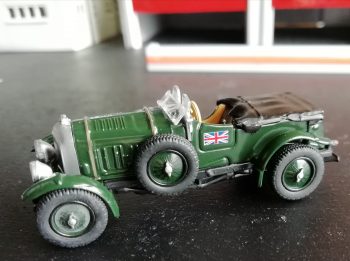
In 1931 Rolls-Royce Limited bought out the rival firm of W.O. Bentley, maker of the 4.5 litre ‘blower’ racer seen above. A Rolls-Royce engine was put into a chassis and a Bentley radiator fitted to an open four-seater body. The car was taken to West Wittering to get Royce’s approval. The baronet said that such a fast car should have a means of varying the stiffness of the springing. On 21 April 1933, the night before he died, Sir Henry Royce sat up in bed and drew a sketch of an adjustable shock-absorber on the back of an envelope which he gave to his nurse, telling her to see that the ‘boys’ in the factory. He died before it reached Derby. Thus, in 1933 the first Bentley made by Rolls-Royce Ltd appeared and another famous name carried on.
AERO ENGINES
The Rolls-Royce Eagle was the first aircraft engine to be developed by Rolls-Royce Limited. It was introduced in 1915 to meet British military requirements during the First World War and proved to be one of only two aero engines made by the Allies that was neither a production nor a technical failure.

Most famously, Rolls Royce Eagle engines powered the Vickers Vimy biplane bomber which, with Alcock and Brown at the controls, became the first aeroplane to fly the North Atlantic in 1919.
In 1925, Rolls-Royce began designing a radically new 12-cylinder engine in which each of the two banks of six cylinders were formed from a single aluminium-alloy block. Named the Kestrel, the engine was fitted with hand-starting gear and could achieve up to 745 hp at 14500 ft. in later models. Among the aircraft powered by the Kestrel were the Hawker Hart series of biplanes, the Gloster TC33 troop carrier and the Fairey Hendon, the first monoplane bomber of the Royal Air Force.

The 1933 vintage Goshawk was developed from the Kestrel I V prototype engine, to use evaporative (also known as “steam”) cooling. Rather than keep the cooling liquid below its boiling point in the cooling system, the coolant was allowed to boil; the phase change from liquid to vapour takes more heat from the engine, so less weight of coolant is needed. However, the radiator had to be bulkier to accommodate coolant in its gas phase, which increased drag.
Twenty engines were built, and flew only in prototypes as a few manufacturers’ private ventures and “one-offs”, including the flying wing Westland Pterodactyl V and Supermarine Type 224, the ancestor of the Spitfire.
Powers for individual installations are quoted between 650 and 700 hp (520 kW). Problems with coolant leaks, coolant pumping and the realisation that large wing-mounted condensing radiators would be vulnerable to combat damage caused the project to be cancelled, although valuable lessons had been learned and were put to good use with development of the later Merlin.


In October 1928, Henry Royce began design of the “R” engine while walking with some of his leading engineers on the beach at West Wittering, sketching ideas in the sand. Less than a year later, the “R” engine, designed in his studio in the village, set a new world air speed record of 357.7 miles per hour and won the Schneider Trophy of 1929.
When the Ramsay MacDonald government decided not to finance the next attempt in 1931, Lucy, Lady Houston, felt that Britain must not be left out of this contest and sent a telegram to the Prime Minister stating that she would guarantee £100,000, if necessary, towards the cost leading the Government to reverse their previous decision. The result was that Royce found that the “R” could be made to produce more power and the Supermarine S.6B seaplane won the Trophy at 340.08 mph (547.31 km/h) on 13 September 1931. Later that month on 29 September, the same aircraft with an improved engine flew at 407.5 mph (655.8 km/h), becoming the first craft to fly at over 400 mph (640 km/h) and breaking the world’s speed record.

Following the success of the “R” engine, it was clear that they had an engine that would be of use to the Royal Air Force. As no Government assistance was forthcoming at first, in the national interest they went ahead with development of what was called the “PV-12” engine (standing for Private Venture, 12-cylinder). The idea was to produce an engine of about the same performance as the “R”, albeit with a much longer life. Rolls-Royce launched the PV-12 in October 1933 it completed its first test in 1934. The PV-12 later became known as the Rolls-Royce Merlin engine.
The powerful supercharged V12 Merlin and was fitted into many World War II aircraft including the British Fairey Fulmar, Hawker Hurricane, Supermarine Spitfire, Westland Welkin, de Havilland Mosquito and Hornet, and four engine Avro Lancaster, a development of the Avro Manchester with its unreliable Rolls-Royce Vulture engine.

The V12 Merlin also transformed the American North American P-51 Mustang into a candidate for the best single engine fighter of its time. In 1940, a contract was signed with the Packard Motor Car Company in Detroit, Michigan, for the production of Merlin aero-engines for World War II in the USA.
Over 160,000 Merlin engines were produced, including over 30,000 by the Ford Motor Company at Trafford Park, Manchester. During the war most Rolls-Royce flight testing of engines was carried out from Hucknall Aerodrome.
The Merlin crossed over into military land-vehicle use as the Meteor, powering the Cromwell and Centurion tanks among others. Many Meteor engines used Merlin engine blocks and parts that failed requirements for high performance engines, but were suitable for use in the normally aspirated Meteor, derated to 480 kW (640 hp).
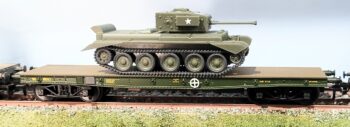
With the Meteor’s development completed in 1943 the same team at the Belper foundry restarted work on an eight-cylinder car engine which became the pattern for the British Army’s B range of petrol engines for post war combat vehicles. In particular these powered Alvis’s FV600 range and Daimler Ferret.
THE JET AGE
However, in December 1942 over a “five-shilling meal” at the Swan and Royal Hotel in Clitheroe, Stanley Hooker and Ernest Hives of Rolls-Royce agreed with Spencer Wilks of the Rover Car Company that Rolls-Royce would take over top secret work on the development of the jet engine in exchange for Rover taking over the development and production of the Cromwell tank.
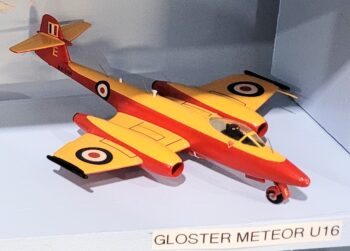
In the post-World War II period Rolls-Royce made significant advances in gas turbine engine design and manufacture, starting with the Welland and Derwent turbojet which powered the Gloster Meteor aircraft.
The Rolls-Royce RB.41 Nene was an enlarged version of the Derwent centrifugal compressor turbojet engine, delivering 5,000 lbf, making it the most powerful engine of its era. Built in an astonishingly short five-month period, the Nene first ran on 27 October 1944. It was named after the River Nene in keeping with the company’s tradition of naming its jet engines after rivers.
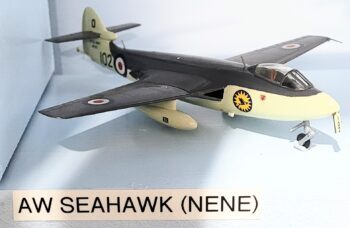
Although rapidly passed over with the advent of the axial-flow Avon, the Nene turbojet was selected for the Armstrong Whitworth Sea Hawk, Supermarine Attacker and Hawker P1052 and licence built in America as the Pratt & Whitney J42 it powered the Grumman Panther. The Rolls-Royce Tay, further developed from the Nene, was licensed to Pratt & Whitney J48 for the swept wing Grumman Cougar.
The mist widespread use of the Nene however was as the illegal back-engineered Klimov VK-1 which powered the Mikoyan-Gurevich MiG-15.
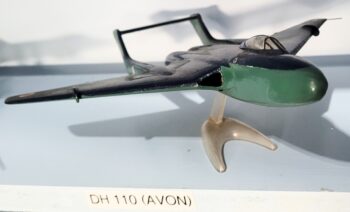
In 1945, Rolls-Royce started the development of the AJ.65 (axial jet, 28,912 N (6,500 lb) thrust) Avon to replace the Nene, going through several design and test iterations. The first 100-series (RA.3) production engines were delivered in June 1950. For the de Havilland Comet and Sud Aviation Caravelle, the civil RA.29 was produced at 45,592 N (10,250 lb) thrust. The RB.146 300-series was later produced at 76,105 N (17,110 lb) thrust with afterburning.
The Avon powered a variety of military and commercial aircraft including English Electric’s Canberra and Lightning, Hawker Hunter, Supermarine’s Swift and Scimitar, Fairey Delta 2, de Havilland DH 110 and Sea Vixen, Vickers-Armstrong Valiant and SAAB Draken.

This Rolls-Royce Phantom 5 with James Young body was registered EBY 148B in 1964, midway between introduction in 1959 and replacement in 1968. The four-door saloon featured a V8 engine, four speed automatic gearbox and optional silvered wing mirrors.

First run in 1964, the Rolls-Royce Spey was a low bypass turbofan intended for civilian airliners but later used in military aircraft and as a turboshaft engine for ships, known as the Marine Spey. The Spey was based on the larger Conway, which had been introduced in 1954 as the World’s first commercial bypass engine, and powered both the BAC 1-11 and Hawker Siddeley Trident T-tailed airliners. By 1966, all front line Royal Navy Buccaneer squadrons had converted to the S2 variant of the Blackburn designed strike aircraft, with the original underpowered de Havilland Gyron Junior replaced by more reliable Speys. With the withdrawal of Britain’s fleet carriers in the 1970s, ex Naval Buccaneers joined ex Naval McDonnell Douglas Phantom IIs in the Royal Air Force.
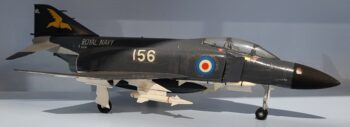
These F-4K Phantoms used Speys rather than less powerful General Electric J79 engines. The 201 series Speys provided extra thrust for operation from smaller British aircraft carriers, and provided additional bleed air for the boundary layer control system for slower landing speeds. The air intake area was increased by twenty per cent, while the aft fuselage under the engines had to be redesigned. Compared to the original turbojets, the afterburning turbofans produced a ten and fifteen per cent improvement in combat radius and ferry range, respectively, and improved take-off, initial climb, and acceleration, but at the cost of a reduction in top speed because compressor outlet temperatures would be exceeded in an essentially subsonic civil design.
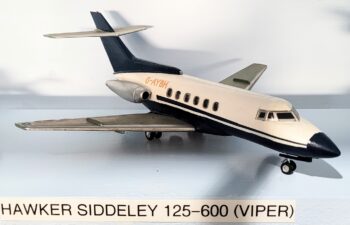
Just as Rolls-Royce took over Bentley in 1931, so the company took over other engine makers in the years that followed and developed the inherited designs. One example of this was the turbojet that entered service in 1953 as the Armstrong Siddeley Viper.
Armstrong Siddeley had been formed in 1919 when Armstrong Whitworth acquired the Siddeley-Deasy motor company. It then merged with Bristol Aero Engines in 1959 to form Bristol-Siddeley, bought de Havilland engines and the engine division of Blackburn Aircraft in 1961 before becoming a part of Rolls-Royce in 1966.
The Viper continued the snake name theme of Armstrong Siddeley engines and was originally designed as a disposable powerplant for the Jindivik target drone. It was later adapted for such manned aircraft as the Saunders Roe SR53, Hawker Siddeley 125, Hunting Jet Provost and BAC Strikemaster.
The acquisition of Bristol-Siddeley Engines also gave Rolls-Royce such famous brands as the Olympus used to power the Avro Vulcan and BAC/Aerospatiale Concorde and the Pegasus turbofan around which the Hawker Siddeley Harrier was built.

The two door, rear wheel drive Rolls-Royce Corniche Convertible was produced in conjunction with the famous bodybuilder Mulliner Park Ward between 1971 to 1995. The personalised number plate is CRN 2 and further customisation of the car extends to the addition of optional mirrors placed on the front wings and also front spotlights.

In an age of aircraft being built across international borders, Rolls-Royce worked with engine manufacturers in other countries. The 1968 vintage SEPECAT Jaguar for example used pairs of Adour engines jointly built by Turbomeca of France while the RB199 turbofan used in the Panavia Tornado was a product of Turbo Union: made up of Rolls-Royce, MTU of Germany and Aeritalia.
RAILWAY LOCOMOTIVES

The Sentinel Wagon Works Ltd was founded in Glasgow in 1875 as Ally & MacLellan and after a number of name and location changes it became part of the Rolls Royce family as Sentinel (Shrewsbury) Ltd in 1957. Production of steam locomotives and lorries ceased in 1958 and in 1959 a Sentinel prototype diesel shunter was trialled on the military controlled Shropshire and Montgomeryshire Railway – once a Colonel Holman F. Stephens line. 1963 saw the introduction of the 34 ton chain drive 4 wheel Rolls Royce diesel powered Sentinel shunter rated at 233 bhp. This engine was later uprated to 255 bhp and similar six and eight wheeled locomotives later found work in collieries, dockyards, quarries, foundries and even on Portuguese Railways.

The Yorkshire Engine Company’s own 0-6-0 diesel electric design became the subject of an Oxford Rail 00 gauge model locomotive in 2018. Named after the two faced Roman god of the past and future, the Janus class weighed 49 tonnes and had a maximum speed of 23 mph (37 km/h). Two Rolls-Royce C6SFL diesel engines gave a total power output of 400 hp (300 kW). Each engine had its cooling system at the outer end, and the its generator at the inner end. There were two traction motors, each being powered by one generator, thus simplifying the electrical system. Production began in 1956, and ended in 1965 Eventually, 102 Janus locomotives were built: mostly for the British steel industry, but other customers included Imperial Chemical Industries (12 locomotives), the Port of London Authority (10), and the National Coal Board (7). Three locomotives were exported. In 2008, 23 were still in industrial service, and seven had entered preservation.
The similarity in power and speed would indicate that this type of locomotive could have been use in a similar role to the British Rail Class 08 shunter. In recent years Class 08 shunters owned by EWS have replaced Janus locomotives on some industrial railways and one model was loaned to BR for tests.