Model railway enthusiasts from all over Gloucestershire travelled to the Cheltenham GWR Modellers October 2023 Exhibition in aid of St Margaret’s Hall, Coniston Road, Cheltenham, GL51 3NX on Saturday 28 and Sunday 29 October 2023 to raise money by enjoying the following attractions:
THURSLEY 0 Gauge (7mm Scale)
by Rob Mills
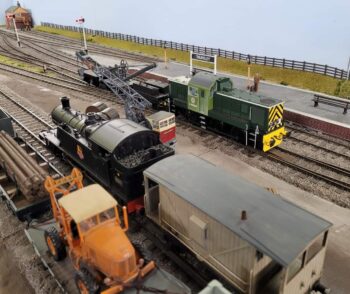
Thursley was a small branch terminus inspired by but not based on Dursley, which had a similar very constricted site.
The period modelled is the early years of Nationalisation when there was still a good deal of stock around which had not yet been through the British Railways paint shop so was still in pre Nationalisation Big Four liveries in various states of dilapidation.
Ex LMS and GWR locomotives prevail. There may well also be the occasional time travelling diesel to allow club member’s own stock to stretch its legs.
All trackwork was Peco with DCC control by NCE Power cabs. Couplings were electromagnetic Dinghams as member’s collective eyesight was no longer up to using three link couplings.
Of particular interest was the point rodding, working signals and goods shed with a fully modelled interior.
HARTBURN
EM (18.2mm) Gauge 4mm Scale
by Ian Manderson
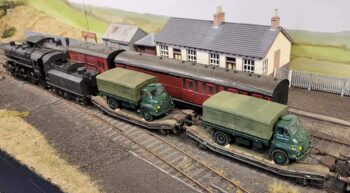
Hartburn was set in rural Northumberland at the end of steam.
The real village of Hartburn was never served directly by rail but lay just north of the old Wansbeck Valley Railway from Morpeth to Redesmouth with the nearest station being Angerton.
However, the plan put forward in 1855 to link Morpeth and Rothbury proposed a line running via Eldon, Hartburn and Longwitton. This proposition predated the Wansbeck Valley. A survey and report was produced by John Willet but nothing became of the project and Rothbury was eventually linked to Morpeth by the Northumberland Central Railway (NCR) that joined the Wansbeck Valley at Scot’s Gap.
Hartburn’s track plan is based upon an amalgamation of the 1862 and 1896 layouts for Angerton. The station buildings are based on those at Brinkburn on the NCR.
Hartburn is set around 1962/3 just prior to closure. Occasional freight trains still pass through on their way to Rothbury hauled mostly by ex LNER J27s. It is imagined a token passenger service is still in operation, being handled by one of the ubiquitous Metro Cammell DMUs. Occasionally a bit of modellers licence is used to run the passenger service with the ex LNER G5 tank engine with a single coach, a sight once common on the Wansbeck and Rothbury branches.
MORFA MAWR
EM (18.2mm) Gauge 4mm Scale
by Ian and Michelle Sandells
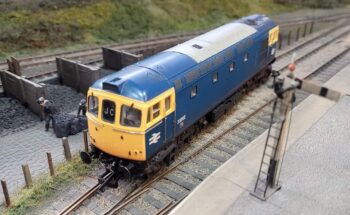
Morfa Mawr was originally planned as part of a narrow gauge line by the Vale of Rheidol Railway and despite later plans for a standard gauge railway submitted by the Lampeter, Aberayron & New Quay Light Railway (LA&NQLR) it would only be built by the Cambrian Railway – albeit with a few deviations including running the line into New Quay crossing the Lampeter to Aberaeron line at Crossways.
Work finally started in 1911 with completion just before the Great War and operations by the Great Western Railway. The layout was based circa 1970 on the coast of Cardigan Bay near Llanon between Aberystwyth and Aberaeron and consisted of a small single platform station with run round sidings for goods and coal. The later additional siding accommodated the provender shed.
Morfa Mawr measured 12′ x 18″ with an 8′ scenic section and a 4’sector plate fiddle yard at the southern end. Another northern fiddle yard would be a future possibility and the layout could be controlled either traditional DC or by DCC.
AIMFORD END 00 Gauge 4mm Scale
by Amelia Chamberlain
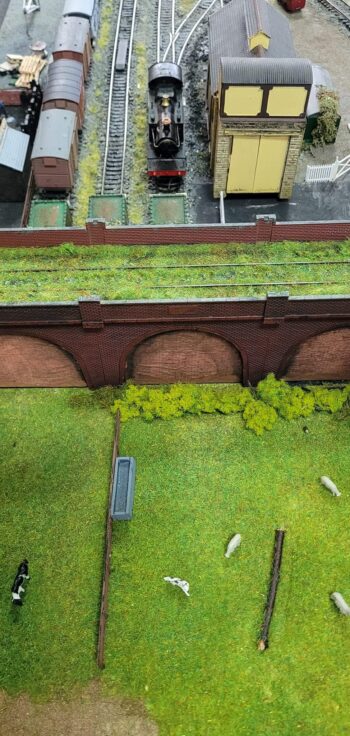
Aimford End was situated on a fictional Western Region line in the Cotswolds during the 1950s and 60s. This now features added wildlife, disused viaduct and agricultural scenes.
LLANTEULYDDOG 00 Gauge 4mm Scale
by Clevedon and Portishead Armchair Modellers. (CLAPHAM)
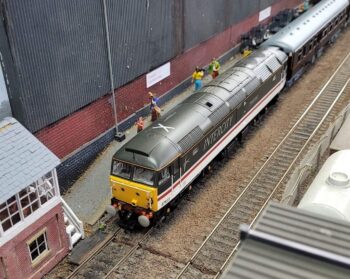
In mediaeval times the settlement that was to become Carmarthen was known as Llanteulyddog (St Teulyddog’s). However, what if history had taken a different course and the River Towy had proved too difficult to bridge, meaning no branch to Lampeter?
Llanteulyddog is a small but relatively busy station in West Wales, seen here circa 1990 and coping with emergency engineering diversions. Llanteulyddog is on a triangular connection with the West Wales main line, served by the usual mixture of DMU, Sprinter and loco hauled passenger trains between Swansea and Milford Haven, Pembroke Dock or Fishguard.
Under normal conditions, a small number of freights are seen in the station approaches serving a small terminal operated by Taylor Oils and a concrete hard standing in the yard, which is used for UKF/Kemira fertiliser trains, the loading of logs for transport to Chirk, and other ancillary Speedlink wagonload traffic. It also sees the overnight stabling and servicing of shunters employed in the Kidwelly area.
However, these are not normal conditions! What we see today is Llanteulyddog having to cope with the impact of a significant track defect on the main line that is forcing all traffic to use the ‘dog lrg’ triangle, with all the freight trains serving the refineries, MoD facilities and ports of West Wales, as well as the traffic for the little known nuclear complex at Abercastle and its new build construction project, using the station area to reverse and continue their journey west or east.
The local signalman, Owen the Signal, has never been so busy and spotters are in for a treat!
I would add that the white X on the roof of 47 835 Windsor Castle is an authentic aerial recognition feature for the Royal Train and isn’t it nice to see some sports grounds and other scenes in front of the fiddle yard? I liked the cat chasing a pigeon on the roof of the shipping container although there is no 4mm scale Jeremy Corbyn at the stables. We wouldn’t want the horses starting off at a Trot!
Michael Bishop and Barry and Penarth MRC brought their distinctive U shaped 00 gauge Weobley Marsh layout to the Cheltenham GWR Modellers Exhibition October 2023.
MARSHLEIGH WAGON REPAIR DEPOT
00 Gauge 4mm Scale
by Tom Kennison
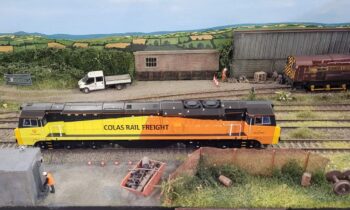
Marshleigh Wagon Repair Depot represented a fictional Wiltshire facility from 2010 onwards and its shunting operations. It was based on a fairly rural location but was supposedly near to a larger, busier marshalling yard. The principle of operation was based on the many wagon repair depots around the UK where wagons were taken on short trip workings to be repaired. These services are occasionally seen arriving at Marshleigh hauled by a mainline locomotive. The wagons are then shunted around the yard ready to be repaired. The majority of the rolling stock comprises ex British Rail civil engineering wagons – these are frequently seen in the real area at places such as Westbury and Eastleigh.
The layout started in November 2021 to showcase modern image rolling stock. Being only five feet long it was easy to transport in one piece. The wagons were a mixture of ready to run, scratchbuilt and kitbuilt, suitability weathered with acrylics, washes and airbrushing.
The scenery was built from products by Woodland Scenics, Green Scene, Javis and the Dapol Pothole Road kit to create the tarmac areas. The buildings were kit built or scratchbuilt using plastic card. The Peco Code 100 track had concrete sleepers and the layout ran on DCC.
THE SHUNTING LAYOUT
00 Gauge 4mm Scale
by Robert Webb
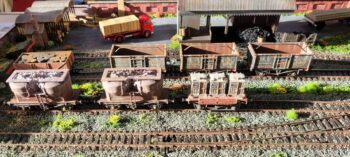
It is a shame that Rembrant lived before railways! Autumn light falls on The Shunting Layout at the Cheltenham GWR Modellers Exhibition October 2023. The Shunting Layout with its manual points was a last minute addition to the show but an inspiration to a similar project of my own.
THOMAS
by Hucclecote Model Railway Enthusiasts
00 Gauge 4mm Scale

Harold the helicopter first appeared in the book Percy the Small Engine. Martin Clutterbuck suggests that the inspiration for the story in which Harold races Percy came from the British Department of Transport’s claims that the helicopter would soon render railways obsolete.
Harold is based on a Sikorsky S-55 helicopter built in the UK as the Westland Whirlwind. This was one of the most successful early helicopters, with examples being used all over the world. The character’s name may arise from the fact that variants of the Whirlwind in UK military service were designated HAR 1, HAR 3, HAR 10 etc.
The first S-55s received by the Royal Navy in 1950 were built by Sikorsky, but Westland acquired a license in 1950 and the first British-made S-55 flew at Yeovil in November 1952. Like the American models, the first Whirlwinds had Pratt & Whitney engines and were delivered to No.705 Squadron based at Gosport.
The RAF also ordered this helicopter for transport and rescue missions: the Whirlwind HAR Mk.2 (the same as the naval version except for some differences in equipment) joined the Transport and Coastal Command Units from 1955. With Wright R.1300 engines, the Whirlwind Mk.3 went into production for the Royal Navy in 1953 and operated for many years from both ship and shore bases. The subsequent RAF HAR Mk.4 version was modified for use in the tropics and fitted with a new variant of the Pratt & Whitney R-1340. It was used in Malaysia.
WEOBLEY MARSH 00 Gauge 4mm Scale
by Michael Bishop
Barry and Penarth MRC
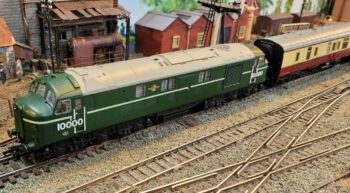
Situated on the main line between Hereford and Leominster, North of Moreton-on-Lugg is a line to some sidings for a Ministry of Defence Army depot. The era is 1960 to 1975.
In the Victorian era a branch might have been built towards Weobley and ended outside the town at a place called Weobley Marsh.
The layout was a fictional ‘could have been. Some of the buildings on the layout are copies of originals from around the town. The back scene shows others from the area.
MALLINGFORD CENTRAL
N Gauge 2mm Scale
by Frome Vale Modellers

Set in the early 1980s, Mallingford represented a fictional terminus south of Birmingham but with a station building very similar to Bristol Temple Meads.
The location was chosen because it seemed to give the maximum amount of interesting and varied passenger train workings together with justification for a small locomotive depot providing servicing facilities for freight locomotives allocated to Bescot and Saltley sheds as well as for passenger locomotives laying over between duties.
A revised version of the Domesday Book shows the hamlet of Mellinge Forde where there was not ver much to speak of. However, during the Industrial Revolution local resources of clay, coal and iron attracted investment in first the canals then the railways, both the Midland Railway (MR) and Great Western Railway (GWR) competing for business.
The GWR line ran past the outskirts of the town and was closed during the 1960s as part of the Beeching cuts, but before it shut you may have seen it in the factual documentary about GWR operating practices called The Titfield Thunderbolt.
The Midland/ LMS line which runs into the centre of the town however continued to prosper and survived.
The town is large enough to warrant regular calls by InterCity Cross Country trains together with loco hauled provincial routes and DMU services between Birmingham and Worcester, operating a sequence based on a British Rail 1982 timetable. Light engines working on and off shed also appear. The star performers are mainly blue diesel, for which the Frome Vale Modellers have a soft spot! These include the now historic Class 25s, 40s and 50s.
Visiting shows both as exhibitors and paying punters gives the impression that this is a much under modelled period of British railway history.
The operating sequence is governed by over 460 cards shared between two operators, each card showing both the train movements and the necessary electrical set up for the train to actually move. There are 17 points and 28 switches to provide scope for any lurking gremlins. The whole sequence can take in excess of 6 hours to run through.
The baseboards are built in the standard way using plywood, glued and screwed together. Buildings are either scratchbuilt or kits modified from the Kestrel and Peco ranges. Rolling stock was from Graham Farish.
RANNOCH N Gauge 2mm Scale
by Bristol East MRC
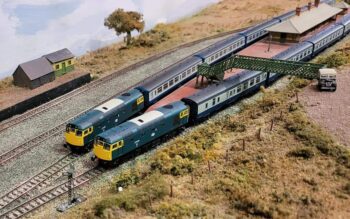
Rannoch was built by Bristol East MRC member Mike Harries in the 1980s. He was inspired to model this remote passing place on the West Highland Line after reading John Thomas’s book on the history of the route. It was later updated by the club.
I particularly liked the way that the layout was not afraid to use wide open space to evoke the Scottish Highlands with its distinctive station architecture and trains powered by NBL and BRCW traction.
BRS DEPOT 00 Gauge 4mm Scale
by Martin Nash

A static display of a busy British Road Services Depot set in a town scene evoked the road transport company formed by the nationalisation of Britain’s road haulage industry, under the British Transport Commission, as a result of the Transport Act 1947. British Road Services was consequently formed and set about acquiring 41,265 vehicles 80,212 staff and 3,766 undertakings. Six years after the 1947 Transport Act was introduced however, Parliament reversed this decision – another Transport Act was passed in 1953 providing for the return to free enterprise.
By the 1960s British Road Services was made up of four main operating areas: British Road Services Ltd, BRS Parcels Ltd, Pickfords and Containerway and Roadferry.
Back in the 1950s though, the Ayers Red freight lorries and green parcels vans of British Road Services were a familiar sight all over Britain, linking towns and cities by A roads before the first Motorways were built.
The 1950s was also a golden era of British lorry building and British Road Services was to employ such famous heavy goods vehicles as the AEC Mammoth Major, Mandator ( with articulated flatbed trailers) and the same company’s drawbar trailer towing Mark III and Mark IV four axled rigid trucks. The latter vehicles were allocated to a number of British Road Services depots including the one at Mitcheldean, Gloucestershire. Other lorry manufactureers embraced by British Road services were Atkinson, Leyland, Bedford, Bristol and ERF. These in turn were replaced by various guises of Bedford TK and more modern AEC lorries with ergonomic cabs. Martin’s diorama also embraces the architecture and road scene of the 1950s including a dilapidated house near to where a small flatbed BRS lorry is being loaded – although probably not in a way that the Twenty First Century Health and Safety Executive would approve of!
THE MELLOR BROTHERS
4mm Scale
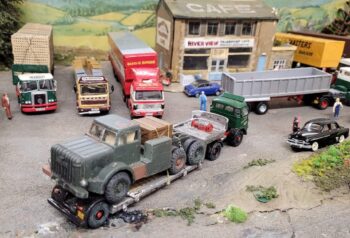
Paul and David Mellor were back in St Margaret’s Hall with their Gloucestershire Road Transport collection, reflecting their long affiliations to both the National Association of Road Transport Modellers
Paul Mellor specifically asked me to take some low level pictures of the River View Cafe dioramaas well as the easier ‘drone shots’.
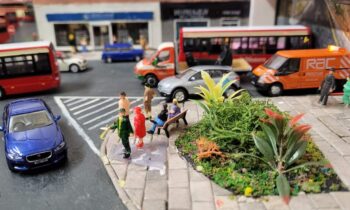
Meanwhile, Brocklecote Bus Station was being filmed by an enthusiast – and had acquired some sub tropical foliage!
ANDY PECKHAM’S TRANSPORT 2000
4mm Scale
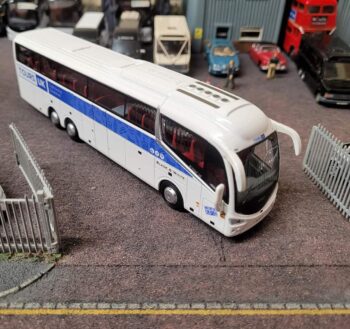
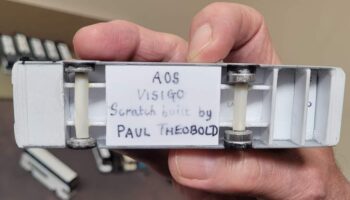
At the Cheltenham GWR Modellers Exhibition October 2023, Andy Peckham’s Transport 2000 boasted a newly liveried Scania Irizar i6 in Tours UK livery, another Irizar PSV with equally fictional Flexibus markings, a still-white Aos Visigo (Turkish built Izuzo) and Provincial’s take on the Pulham’s 99 service often seen around Cheltenham and Gloucester.
MILLBROOK TANK DUEL
4mm Scale
by Alan Drewett
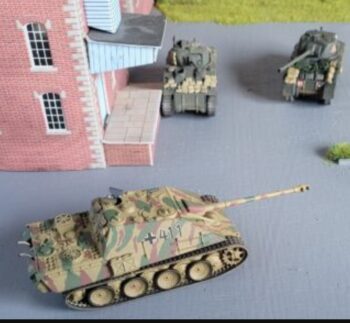
The Millbrook Tank Duel diorama started with a spare piece of Conti board measuring one metre by 390 mm over which two pieces of thin plywood were laid to create a canal channel. Once the whole base had been painted brown with a top coat of dark grey, the water effect was created with yacht varnish, which after several days dried to a translucent rubbery finish.
The banks of the canal were further defined by two lengths of square section timber rod, allowing the land on either side to be built up with expanding Gorilla Glue. This was further textured with the PVA glue used to hold down grass flock. The end result was an effective ramp for other tanks to use when approaching the portable bridge.
Further details can be found here
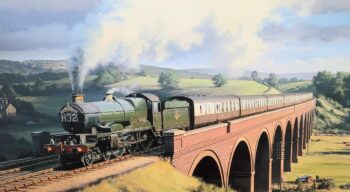
The Cheltenham GWR Modellers Exhibition always attracts interesting displays apart from railway layouts and in October 2023 these included the Gloucestershire Warwickshire Steam Railway with a new painting by Nicolas Trudgian of The Cornishman crossing Stanway Viaduct while a diorama and wagons from the Toddington based 2874 Trust raised awareness of, and hopefully money, for the only GWR 2-8-0 that will ever steam again in the ‘as designed and built’ form with internal steam pipes. It will thus be unique in working preservation.
MODELLING DEMONSTRATIONS
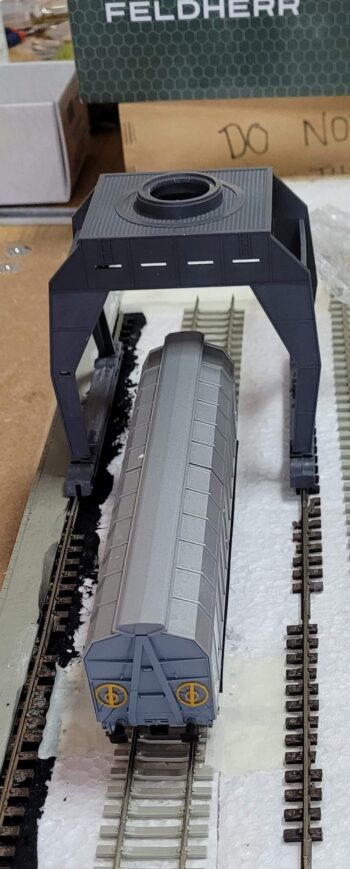
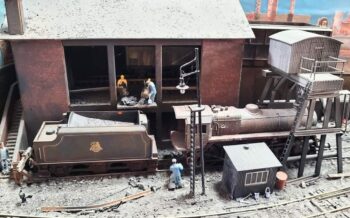
by Mark Begley, Steve Harrod, Trevor Hale and Richard Self.
TRADE SUPPORT
by Collett’s Models of Exmouth, Penduke Models, Sussex Parry pre owned models and Stewart Blencowe railway books and photographs.