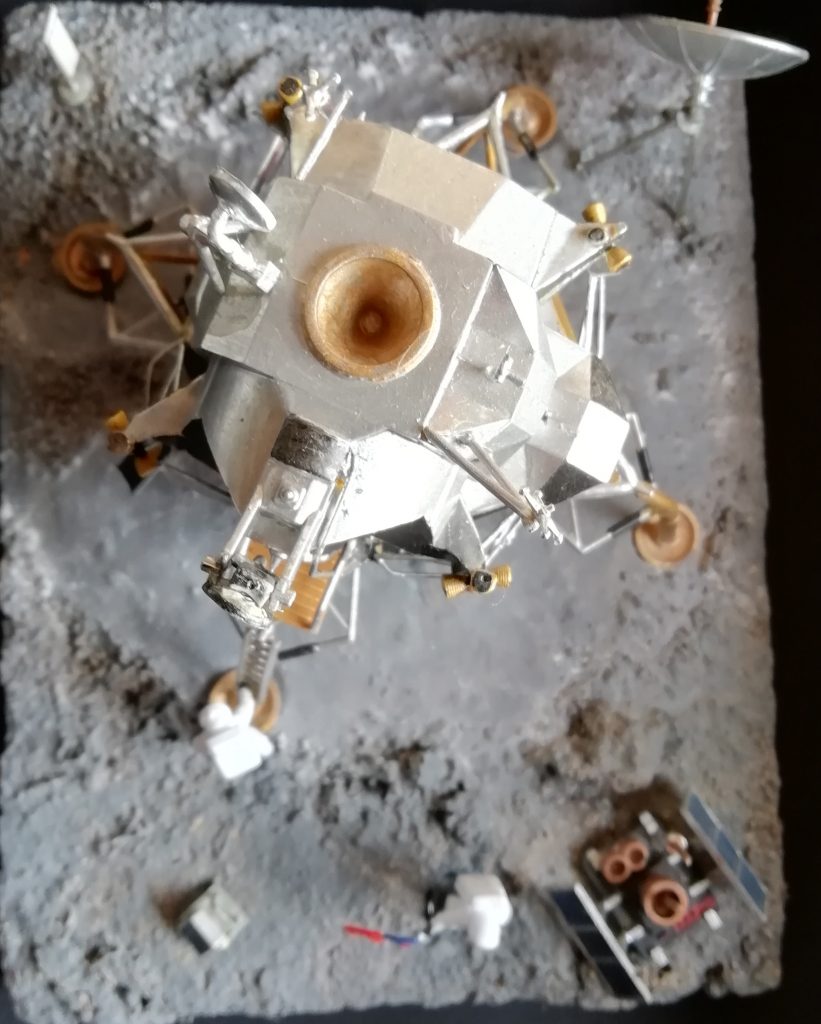
As part of a presentation at Jet Age Museum, Staverton, Gloucestershire to celebrate 50 years since the first Moon landings, I refurbished the Airfix Grumman Apollo Lunar Module originally built by the late Ron Brooks.
Although I still have my own Moon diorama based on the Airfix “One Small Step” set issued in 2009, Ron’s much smaller and more manageable piece of Lunar real estate offers the chance of a closer look at the science experiments included with the original Airfix LEM kit of 1970.
As luck would have it, the Airfix injection moulded circle of Moon and Ron’s additional expanded polystyrene and small rocks based on plywood all took grey enamel paint very convincingly with the ejecta from the LEM:s descent engine being once again replicated with talcum powder brushed out from the centre.
Which is just as well as perhaps the most high profile scientific endeavour of the Apollo missions was the collection of Moon rocks. Despite the best efforts of a number of automated Soviet probes, the United States became the first earthly nation to acquire these and currently still has the largest amount.
While the rocks and soil samples have been studied for decades and are still yielding new information, the Apollo missions also recognised the significance of the Moon as the first explored environment combining a natural vacuum with gravity outside the Earth’s Van Allen belts.
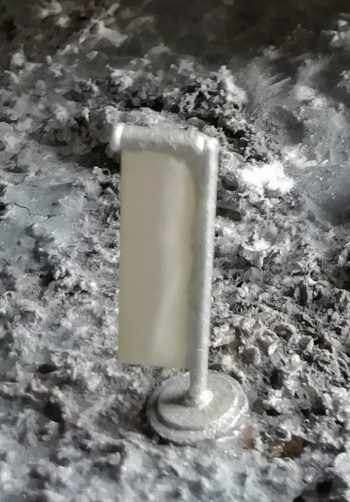
The Sun continually emits a flux of electrically charged particles into space. This is termed the solar wind. The Earth’s magnetic field prevents these charged particles from reaching the Earth’s surface, although in the Earth’s polar regions, these particles can reach the upper part of the atmosphere, causing auroras. The Moon is outside the Earth’s magnetic field for most of each month and has a negligible atmosphere, allowing solar-wind particles to reach the Moon’s surface.
Two different experiments, the Solar Wind Composition Experiment (pictured above) and the Solar Wind Spectrometer, were deployed on the Moon to study the solar wind.
The Solar Wind Composition Experiment was performed on Apollo 11, 12, 14, 15, and 16. It consisted of an aluminum foil sheet, 1.4 meters by 0.3 meters, that was deployed on a pole facing the sun. On Apollo 16, a platinum sheet was also used. This foil was exposed to the sun for periods ranging from 77 minutes on Apollo 11 to 45 hours on Apollo 16, allowing solar-wind particles to embed themselves into the foil. The foil was then returned to Earth for laboratory analysis. This allowed the chemical composition of the embedded solar wind to be determined more accurately than would be possible if the measurement were made using remotely controlled instruments on the Moon, but limited the periods at which observations could be made. The isotopes of the light noble gases were measured, including helium-3, helium-4, neon-20, neon-21, neon-22, and argon-36. Some variation in the composition of the solar wind was observed in the measurements from the different mission. These variations were correlated with variations in the intensity of the solar wind as determined from magnetic field measurements.

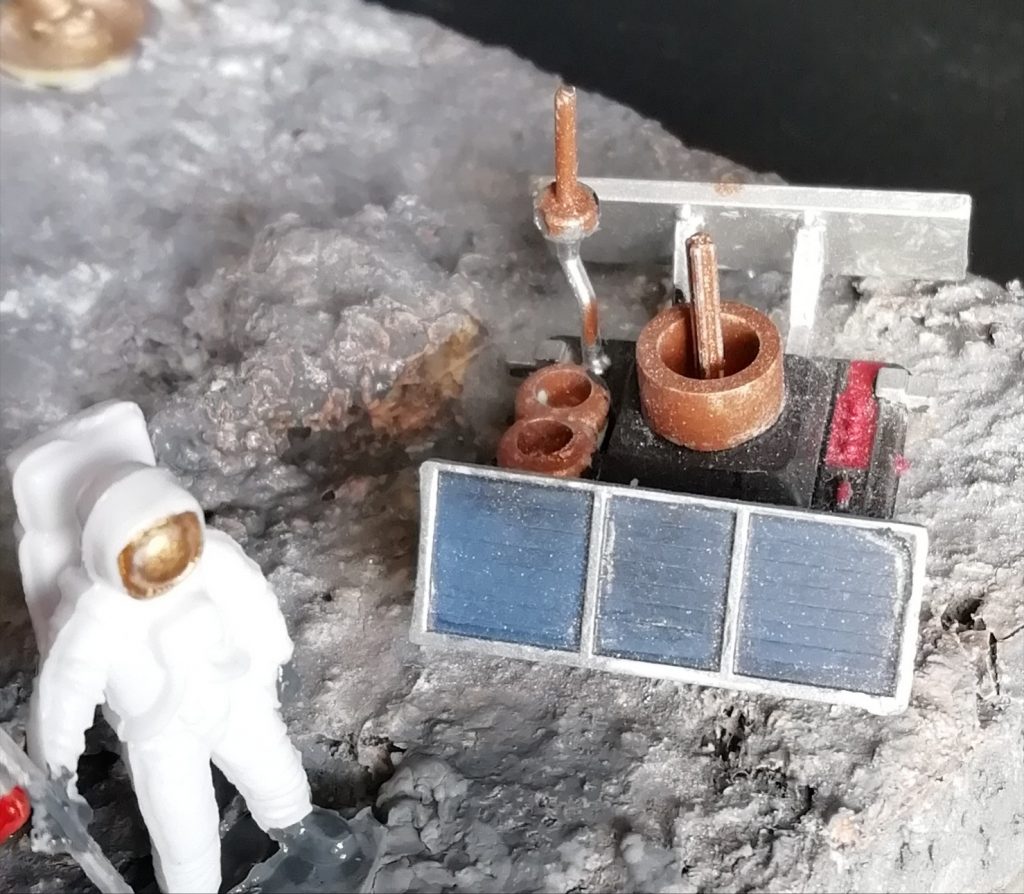
The Solar Wind Spectrometer was deployed on Apollo 12 and 15. Although the solar wind contains ions of most chemical elements (including the noble gases measured by the Solar Wind Composition Experiment), over 95% of the particles in the solar wind are electrons and protons, in roughly equal numbers. The Solar Wind Spectrometer measured the flux of protons and electrons as a function of particle velocity. The measurements were made in a set of seven detector cups with different orientations in order to determine the direction of particle motion. Most of the measured flux was in the detector that was oriented most directly toward the Sun.
Because the Solar Wind Spectrometer made continuous measurements, it was possible to measure how the Earth’s magnetic field affects arriving solar wind particles. For about two-thirds of each orbit, the Moon is outside of the Earth’s magnetic field. At these times, a typical proton density was 10 to 20 per cubic centimeter,with most protons having velocities between 400 and 650 kilometers per second. For about five days of each month, the Moon is inside the Earth’s geomagnetic tail, and typically no solar wind particles were detectable. For the remainder of each lunar orbit, the Moon is in a transitional region known as the magnetosheath, where the Earth’s magnetic field affects the solar wind but does not completely exclude it. In this region, the particle flux is reduced, with typical proton velocities of 250 to 450 kilometers per second. During the lunar night, the spectrometer was shielded from the solar wind by the Moon and no solar wind particles were measured.
In the same way that the Moon is not in a constant position relative to the Earth’s magnetosheath, it wobbles in its orbital path and is very slowly drifting off into space.

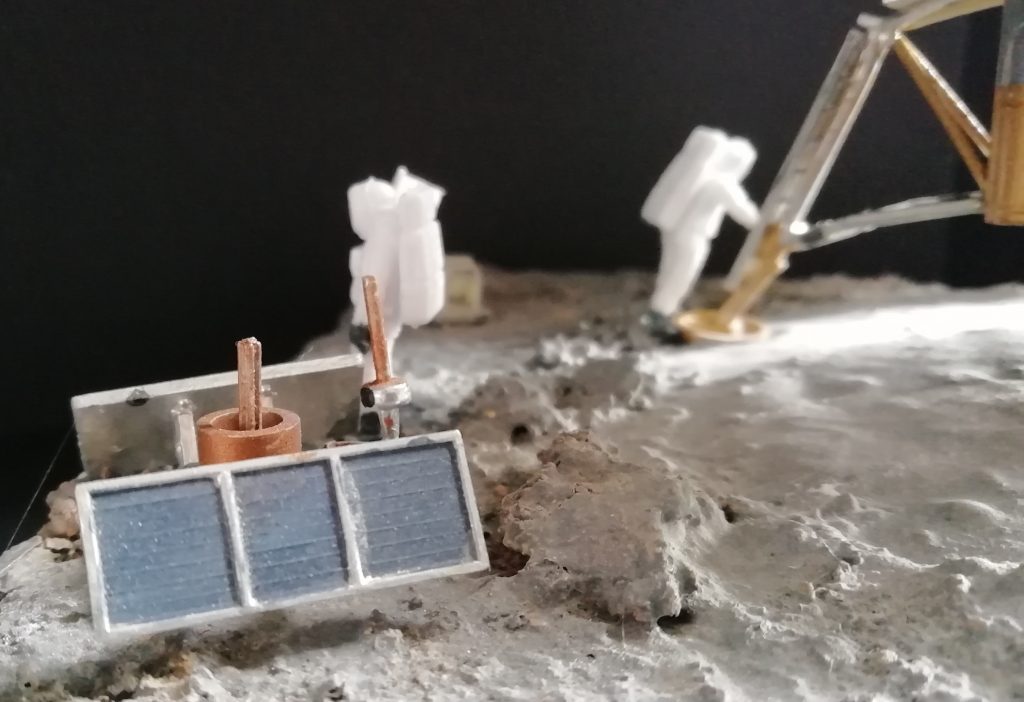
The Laser Ranging Retroreflector experiment (foreground above) was deployed on Apollo 11, 14, and 15. It consists of a series of corner-cube reflectors, which are a special type of mirror with the property of always reflecting an incoming light beam back in the direction it came from.
A similar device was also included on the Soviet Union’s Lunakhod 2 spacecraft. These reflectors can be illuminated by laser beams aimed through large telescopes on Earth. The reflected laser beam is also observed with the telescope, providing a measurement of the round-trip distance between Earth and the Moon. This is the only Apollo experiment that is still returning data from the Moon.
Many of these measurements have been made by McDonald Observatory in Texas. From 1969 to 1985, they were made on a part-time basis using the McDonald Observatory 107-inch telescope. Since 1985, these observations have been made using a dedicated 30-inch telescope. Additional measurements have been made by observatories in Hawaii, California, France, Australia, and Germany.
Laser beams are used because they remain tightly focused for large distances. Nevertheless, there is enough dispersion of the beam that it is about 7 kilometers in diameter when it reaches the Moon and 20 kilometers in diameter when it returns to Earth. Because of this very weak signal, observations are made for several hours at a time. By averaging the signal for this period, the distance to the Moon can be measured to an accuracy of about 3 centimeters (the average distance from the Earth to the Moon is about 385,000 kilometers).
The Laser Ranging Retroreflector experiment has produced many important measurements. These include an improved knowledge of the Moon’s orbit and the rate at which the Moon is receding from Earth (currently 3.8 centimetres per year) and of variations in the rotation of the Moon.
These variations in rotation are related to the distribution of mass inside the Moon and imply the existence of a small core, with a radius of less than 350 kilometers, somewhat smaller than the limits imposed by the passive seismic and magnetometer experiments. These measurements have also improved our knowledge of changes of the Earth’s rotation rate and the precession of its spin axis and have been used to test Einstein’s theory of relativity.

The structure of the whole Moon rather than just the composition of its soil and rocks was the objective of the Passive Seismic Experiment, solar powered rather than being wired to a nuclear isotope generator. It studied the propagation of seismic waves through the Moon and provided our most detailed look at the Moon’s internal structure. The Apollo 11 seismometer returned data for just three weeks but provided a useful first look at lunar seismology. More advanced seismometers were deployed at the Apollo 12, 14, 15, and 16 landing sites and transmitted data to Earth until September 1977. Each of these seismometers measured all three components of ground displacement (up-down, north-south, and east-west).
If a seismic event is observed by three or more seismometers, the time and location of the event can be determined. Because seismic waves from distant events travel deeper into the Moon than waves from nearby events, by measuring events at various distances from the seismometer, one can determine how seismic velocities vary with depth in the Moon. In turn, this information can be used to study the Moon’s internal structure. Most of the events observed by the seismometers were due either to moonquakes or to meteoroid impacts. However, the third stages of several Saturn 5 rockets and the ascent stages of several lunar modules were deliberately crashed into the Moon after these spacecraft were no longer needed. These man-made crashes produced seismic events of known times and locations and helped to calibrate the network of seismometers.
The Passive Seismic Experiment produced several important scientific results:
Firstly, knowledge of the lunar interior structure. Like the Earth, the Moon has a crust, mantle, and core. The lunar crust is rich in the mineral plagioclase and has an average crustal thickness of 60-70 kilometers, which is about 3 times the average crustal thickness on Earth. The lunar mantle lies between the crust and the core and consists mostly of the minerals olivine and pyroxene. The core is probably composed mostly of iron and sulfur and extends from the center of the Moon out to a radius of no more than 450 kilometers; i.e., the core radius is less than 25% of the Moon’s radius, which is quite small. In comparison, the Earth’s core radius is 54% of the Earth’s radius. However, the size of the lunar core is not well constrained by existing seismic observations. Better constraints come from the laser ranging retroreflector and magnetometer experiments.
Secondly, distribution of Lunar seismic sources. More than 1700 meteoroid impacts were recorded by the seismometer network, with impactor masses estimated to be between 0.5 and 5000 kilograms. Most moonquakes occur at depths of 800-1000 kilometers. These occur at monthly intervals at about 100 distinct sites, indicating that these moonquakes are caused by stresses from changes in lunar tides as the Moon orbits the Earth. These moonquakes are quite small, mostly with Richter scale magnitudes less than 2. The amount of energy released by earthquakes in a typical year is about 10 million times larger than that released by moonquakes in a year. Only a few near-surface moonquakes were detected.
Thirdly, attenuation of seismic waves. Meteoroid impacts cause heavy fracturing in the upper 20 kilometers of the lunar crust. These fractures in turn cause scattering of seismic waves in these regions. Below 20 kilometers, seismic wave scattering decreases as a result of either closure of these fractures due to increasing pressure or of a change in chemical composition of the crust. In the mantle, seismic waves are attenuated much less on the Moon than they are on Earth. Seismic wave attenuation is enhanced at high temperatures and in the presence of water, and the low attenuation on the Moon indicates a cold, dry interior. Because the Moon is smaller than Earth, it is expected to have cooled more rapidly, producing a cold interior. The absence of water may be due either to the failure of the Moon to accumulate water when it formed or to subsequent loss of water to space. Below 1000 kilometers depth, seismic wave attenuation increases, possibly indicating the presence of a small amount of molten rock.
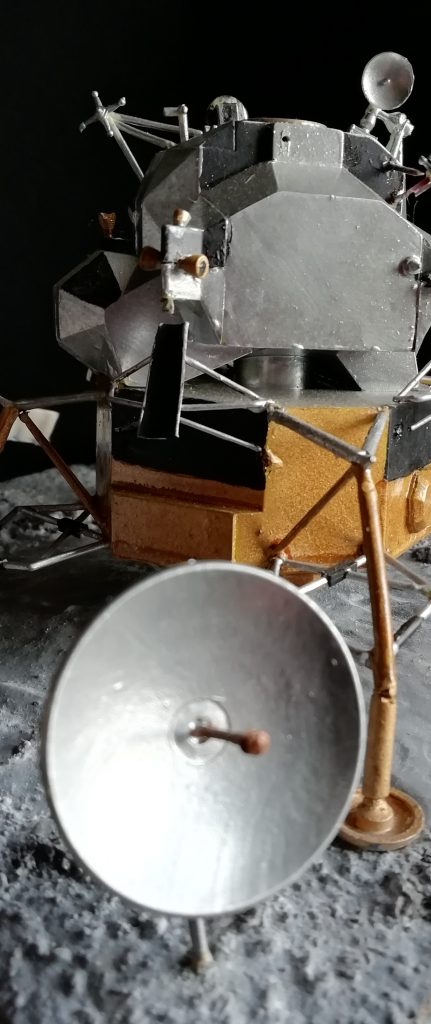
Although the experiments represented in the Airfix kit were either astronaut or laser operated or had their own solar powered transmitters, maintaining communication with the Lunar surface was in itself a challenge.
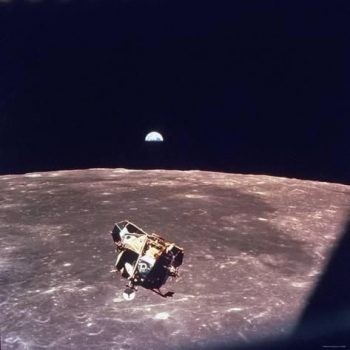
Apollo 11’s lunar landing and specifically Neil Armstrong’s first steps on the Moon was, arguably, the biggest television event of the 20th century. Knowing the impact a live broadcast would have on the world, Astronaut chief and Mercury program inductees Deke Slayton went so far as to push NASA to include an erectable antenna on the LM so Armstrong and Buzz Aldrin wouldn’t have to wait for a tracking station to come within range before stepping outside. NASA’s live broadcast of Apollo 11’s landing was nearly a decade in the making, and required some stunning feats of engineering.

A lot of information has to pass between a spacecraft and supporting ground crews on any mission, including but not limited to telemetry, computer upload information, and voice communication. As early as 1962, NASA realized that the Apollo missions would demand a unique communications system. The Mercury and Gemini programs, both of which saw missions flying only in Earth orbit, used separate radio systems. Two-way voice communications, uplinked data, and downlinked telemetry were done using ultra high frequency (UHF) and very high frequency (VHF) systems while tracking was achieved with a C-band beacon on the spacecraft interrogated by ground-based radar. The system worked on simpler missions, but Apollo would be going much farther than Earth orbit, and with three men working in two spacecraft that would be operating simultaneously and sending down live television images, NASA needed a new way to uplink and downlink more data.
The solution was called Unified S-band or USB. It combined tracking, ranging, command, voice and television data into a single antenna. Voice and biomedical data were transmitted on a 1.25 MHz FM subcarrier, telemetry was done on a 1.024 MHz bi-phase modulated subcarrier, and the two spacecraft — the command and lunar modules — would use a pseudo-random ranging code using a common phase-modulated S-band downlink frequency of 2287.5 MHz for the CSM and 2282.5 MHz for the LM. In short, every type of information traveling between the ground and a Moon-bound spacecraft had its place. Except for the television broadcast.
To free up space for a television downlink from the lunar module, NASA removed the ranging code and changed the modulation from phase to frequency. This freed up 700 kHz of bandwidth for a television downlink on the USB signal. The problem was that this wasn’t enough bandwidth for the standard video camera of the day that transmitted 525 scan lines of data at 30 frames per second at 5 MHz. Instead, NASA would need a slow-scan camera optimized for a smaller format, 320 scan lines of data at 10 frames per second that could be transmitted at just 500 kHz.
With the guidelines for the camera set, NASA awarded two contracts. One went to RCA for the command module camera. Another went to Westinghouse Electric’s Aerospace Division for the lunar module camera.
The Westinghouse slow-scan Lunar Camera was designed by Stan Lebar, Program Manager of the Apollo TV Lunar Camera. It was a small, lightweight camera designed to withstand the punishing forces of launch, the subsequent sudden weightlessness, and the striking temperature differences in space. It was also simple and maneuverable enough for astronauts to use it with their bulky gloves.

The surface camera also had a key piece of classified technology inside it. The lunar surface camera would have to capture a clear image in spite of a high contrast between the bright lunar surface and the atmosphereless black sky, and Westinghouse had the answer. The company had developed a special low-light television imaging tube for the Department of Defense to use in a jungle surveillance camera during the Vietnam War, one that could find a downed pilot at at night. The key was a sensitive image tube combining a variable-gain light intensifier with a secondary electron conduction target. That SEC tube could reproduce objects in motion at low light levels without smearing the image. The DOD allowed NASA to use the top secret technology in its lunar surface camera, though it’s likely few people who worked on the project for the space agency knew they were handling sensitive technology.

It was this camera that captured Armstrong’s first steps on the Moon. The camera was stowed in the LM’s descent stage in the Modularized Equipment Stowage Assembly (MESA) in the fourth storage area on the left of the LM’s ladder. The MESA released when Armstrong, standing on the lunar module’s porch, pulled a lanyard allowing it to unfold. Though covered with a thermal blanket, the lens poked through a hole so it could see everything going on. Inside the LM cabin, Buzz Aldrin hit a circuit breaker that turned the camera on, allowing it to capture Armstrong’s walk down the ladder and first steps on the Moon.
The signal was sent from the LM’s antenna to the tracking stations at Goldstone, Honeysuckle Creek near Canberra, and the Parkes Radio Astronomy Site in New South Wales, Australia. NASA used a scan converter to adapt the image to a broadcast standard format of 525 scan lines at the higher 30 fps rate. Then, the tracking stations transmitted the signals by microwaves to Intelsat communications satellites and AT&T landlines to Mission Control in Houston at which point they were broadcast to the world. The translation process left the image significantly degraded, but it was still live footage of man’s first steps on the Moon.
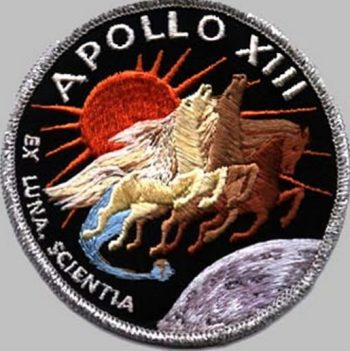
As a footnote, the title of this article – From the Moon, Science – is a translation of Ex Luna, Scientia – the motto of Apollo 13. The unfortunate 13 was the only Apollo mission to have a motto and also the only one with a mission patch not featuring the names of the crew as Jim Lovell, Fred Haise and Jack Swigert did not land on the Moon as planned.