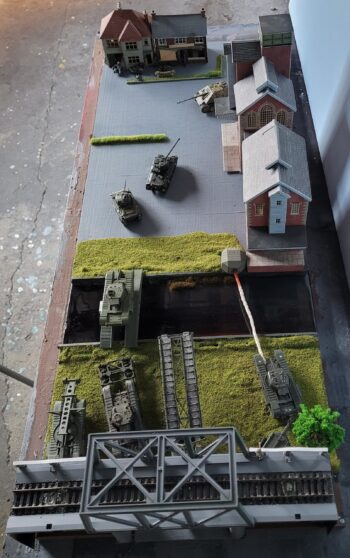
In late 2022 I was kindly invited to represent myself and my Gloucestershire Transport History website at the Heritage Hub, Alvin Street, Gloucester for an event called If It Moves celebrating transport in Gloucestershire.
With an interest in the Gloucester Railway Carriage and Wagon Company I decided to bring some of my models – mainly inherited from the late Ron Brooks – of variations on the Churchill tank, 764 of which were built at Bristol Road during World War II.
However, although I had a diorama with the Churchills lined up in rows I felt that I could do better, especially in terms of the bridge laying and flame throwing Crocodile Churchill.
At the same time, I had established a Land Warfare division of the Jet Age Museum Reserve Model Collection and looking through the shoebox I found some other donated 4mm scale vehicles and structures that could bring the martial quest of the Churchills to life.
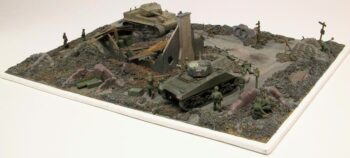
One initial inspiration was the Airfix D Day Battlefront set featuring a German Tiger and Allied Sherman tank approaching each other around the corner of a Forward Command Post.
However I already had some donated soldiers from each side and, as well as the Churchills, a German Jagdpanther tank destroyer and Sherman Firefly, fitted with the powerful long barrelled 17 pounder gun. I also wanted a diorama that could be put to alternative civilian uses in the future and one that maximised existing resources.
This started with a spare piece of Conti board measuring one metre by 390 mm over which two pieces of thin plywood were laid to create a canal channel. Once the whole base had been painted brown with a top coat of dark grey, the water effect was created with yacht varnish, which after several days dried to a translucent rubbery finish.
The banks of the canal were further defined by two lengths of square section timber rod, allowing the land on either side to be built up with expanding Gorilla Glue. This was further textured with the PVA glue used to hold down grass flock. The end result was an effective ramp for other tanks to use when approaching the portable bridge.
Apart from the canal, much of the other infrastructure on the diorama was designed to be either replaceable or easily adapt to other uses. Replaceable elements included the railway girder bridge, two mill buildings, shop and house. These were defined by either a gap in the canal bank or grass edge kerbs made from square section extruded plastic defining a road and mill yard.
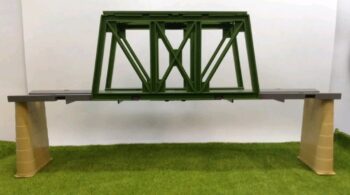
The railway girder bridge was in fact Hornby product R657 with the two oval section supports moved inward to make a smaller opening under the girders themselves. The space on either side was then covered with curtain walling made from balsa wood and brick printed card. Fortunately, a second hand example of R657 was available from Cheltenham Model Centre for only a pound more than the unmade Dapol girder bridge kit and looked just as realistic when sprayed with Halford’s grey primer. As with the other structures, this could be swapped for alternative scenery if the need arose.
What I thought of as some kind of mill building is in fact two elements of the now discontinued Metcalfe 00 gauge Brewery, bought for a total of £8.00 at the Cheltenham GWR Modellers Exhibition October 2022. These card buildings could provide a focus for lorry movements on a future presentation.
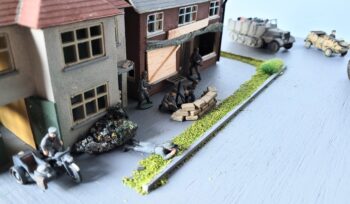
Similarly, the Dapol (ex Airfix) detached house and general store were war-weathered items donated to Jet Age Museum but could be replaced by conventional civilian versions, or even completely different buildings with the same footprint. In the same way, the road between the mill and the shop was left deliberately unmarked and not tied to a particular country.
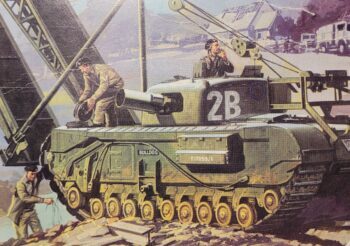
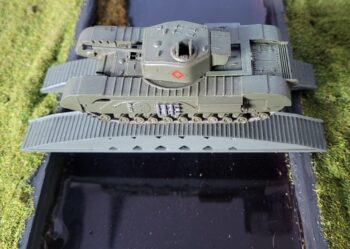
The Dieppe raid of 1942 failed with heavy losses of both armour and infantry because tanks were unable to penetrate inland. To overcome or destroy obstacles during future landings, J.J.Donovan of the Royal Canadian Engineers suggested a tank that could launch a small box girder as a bridge or a ramp and the Churchill Mark IV was chosen for this project due to its roomy hull with side doors for loading stores and equipment. The prototype Churchill Armoured Vehicle Royal Engineers was ready by December 1942 with a girder that could span a 30’ gap or allow a 14’ wall to be mounted and a Petard spigot mortar added to the modified turret in February 1943. The Petard could throw a 40 lb projectile containing a 26lb charge up to 230 yards to destroy concrete obstacles.
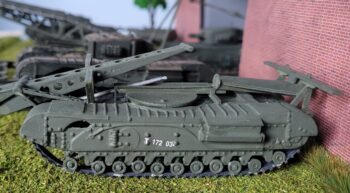
Taking just one and a half minutes to deploy, the Tank Bridge No.2 (seen above) provided a Class 60 tracked load and a Class 40 wheeled load over a 30ft gap. The bridge was in one piece and mounted on a turretless Churchill tank. The launching arm was attached by a pivoting arm mechanism with rollers to the front of the tank, the other end of the arm being attached to the centre of the bridge. The bridge remained horizontal as it was raised and then lowered by the pivot arm across the gap.
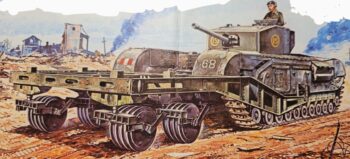
Between the two bridging tanks is the Churchill AMRCR (Anti-Mine Reconnaissance Castor Device) developed in 1943. Like the flail version of the Sherman, this was designed to clear a path through minefields by exploding any devices ahead of the tank and was based on a Churchill Mark IV.
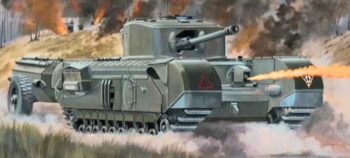
Like the Churchill design itself, a flame throwing tank was part of the British pre conception of the next war being a repeat of the static conflict of 1914-1918. Vehicles such as Universal Carriers, Valentine tanks and even unarmoured lorries had been evaluated with flame equipment before the 1942 arrival of the Churchill Oke.
Named after Major J. M. Oke who designed the conversion, three prototype vehicles, named “Boar”, “Beetle” and “Bull” featured a rear fuel tank linked to the front left hull Ronson flame projector, leaving the right-hand side hull machine-gun unobstructed.
On the Churchill Crocodile however the flamethrowing nozzle was mounted in place of the Churchill’s regular hull machine gun. A pipe ran from this through an opening in the hull floor to a coupling on the rear of the vehicle officially known as “The Link”. Attached to this was a wheeled trailer weighing 6.5 tons with armour up to 12 mm (0.47 in) thick.
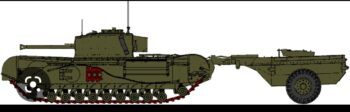
“The Link” was made up of 3 articulated joints which allowed it to move up, down, left or right and swivel on the horizontal axis to allow it to navigate rough terrain. The trailer carried 400 gallons of flamethrower liquid and 5 compressed bottles of nitrogen (N₂) gas and could be jettisoned from inside the tank.
The first wave of vehicles was nearing completion by October 1943. By the end of the production run, around 800 Crocodiles had been built or converted to the standard.
In service, Crocodiles would often work with Churchill AVREs, burning the contents of pillbox partly demolished by Petard spigot mortar charges. In this diorama however, the Crocodile is making a precision attack on a donated model pillbox to avoid damage to the mill, the flame being made by painting a pipe cleaner.
Like the Sherman Firefly with its long gun barrel, the Crocodile was easily identified by its trailer and thus made a priority target for the enemy. Indeed, at least one crew of a disabled Crocodile were executed on the spot as reprisal for what was seen as using a terror weapon.
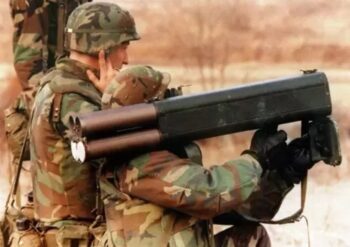
Flamethrowers, either man portable or vehicle based, are rarely used today as they have short ranges and endurance relative to the weight, bulk and logistics involved. They have been replaced by incendiary rocket warheads and artillery shells.
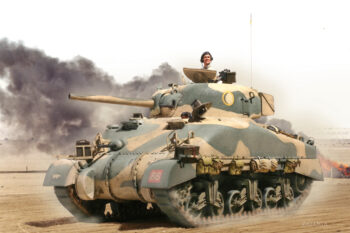
Like its Soviet opposite number the T-34, the strength of the M4 Sherman was the sheer numbers in which it was produced for American, British and other Allied armies. As such, it continued to serve around the World for many decades after 1945.
Although armed with a 75mm gun in the turret rather than in the hull, the fast and reliable Sherman was relatively lightly armoured with a high profile and a vulnerable fuel tank – hence the popular German nickname “Tommy Cookers”.
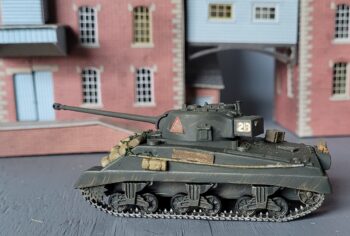
Like the Churchill, the standard Sherman spawned a variety of special variants including the Firefly – meeting the challenge of mounting the British 17 pounder gun which could penetrate the thick armour of the opposing Panther and Tiger tanks. The Sherman Firefly was initially seen as a stopgap before the next generation of British tanks such as the Comet and Centurion were ready for use but 2 200 examples were produced in 1944 and 1945.
The initial problem of mounting the 17 pounder gun in the small Sherman turret was the 40 inch long recoil. This could be solved quickly by locking the gun in place and letting the whole tank recoil but at the cost of long term damage to the whole vehicle.
A better but more radical solution came from Vickers, where engineer W.G.K Kilbourn fitted smaller recoil cylinders on either side of the turret and turned the gun 90 degrees so that it loaded from the left rather than from the top. This new equipment in turn meant that the existing radio equipment had to be moved from the rear of the turret to a new armoured box – or bustle – behind it. This created another visual difference between the normal Sherman and the Firefly as well as the longer gun barrel which gained unwelcome attention from German gunners.
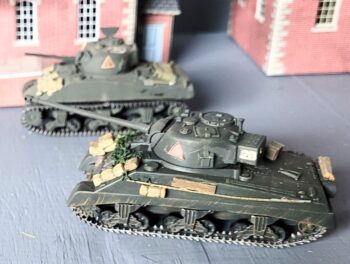
As the gun cradle for the new Sherman variant was shorter than before, special versions of the 17 pounder gun with less barrel tapering had to be manufactured to maintain stability. This was protected by a new pattern of mantlet and the Firefly turret was further distinguished by an extra hatch to allow quick egress for the gunner. The hull machine gun position was also deleted to allow more storage space for 17 pounder ammunition which was longer than the standard 75mm rounds. The size of the 17 pounder armour piercing rounds in a cramped turret also slowed the rate of fire of the Sherman Firefly.
In fact although the design of the Sherman hull allowed the stowage of 77 armour piercing 17 pounder shells, only 23 were easily available. Until late 1944 the 17 pounder gun also lacked an equally effective high explosive round, meaning that conventional Shermans with their standard 75mm guns were still needed to counter Infantry, soft vehicles and buildings.
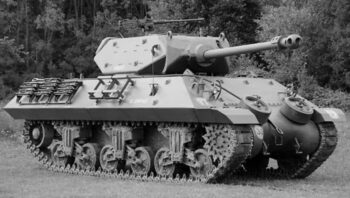
The name Firefly derived from the bright muzzle flash of the 17 pounder gun and during World War II the name Mayfly was also applied. More officially, any British armoured fighting vehicle with the suffix C indicated fitment with a 17 pounder gun and the name Firefly also attached to the Achillies M10C version of the American M10 tank destroyer (pictured above)
Like the 88mm gun on the German Tiger and Panther, the muzzle flash of the high velocity British 17 pounder jarred the crew when fired and could lead to night blindness. Firing also threw up dirt and produced smoke visible to the enemy and impairing the gunners view of shell fall. A Sherman Firefly would thus have to move every few shots. In 1945, some Sherman Fireflys were also fitted with the same 3 inch rocket propelled projectiles as fired by Hawker Typhoon aircraft but these were less successfully fired from “Sherman Tulips’ due to the lack of airflow over the guiding fins.
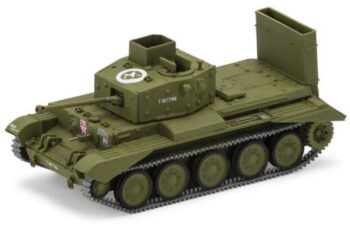
British tank troops comprised three standard Shermans and one Firefly. The same distribution occurred in Cromwell units, but this caused logistical problems, as each Cromwell troop then needed to be supplied with parts for two different tanks. The Firefly was also slower than the Cromwell (pictured above).
Churchill units received no Fireflies, and as a result often had to rely on any attached M10 or M10 Achilles units to provide increased firepower to deal with tanks their own guns could not eliminate.
In late 1944, with the creation of an effective high-explosive shell for the 17-pounder gun, British units started to receive two Fireflies per troop. By February 1945, some 2,000 Sherman Fireflies had been built and British, Commonwealth and Polish armoured units were equipped with a 50/50 mix of 75 mm and 17-pounder-armed Shermans.
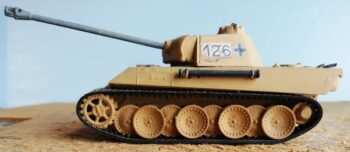
The Panzer V Panther was introduced in August 1943 and was the first German tank capable of successfully engaging the Soviet T-34. In fact many features of the Panther, including the low streamlined hull, sloping front glacis plate and long overhanging 75mm PAK 40 Canon, were copied from the T-34.
As such, Panthers completely outclassed the more lightly armoured petrol fuelled Shermans that they faced. By the end of the war nearly 5 000 Panthers had been produced but this was way below the number of tanks available to the Allies. Each one weighed 45 tons and was powered by a 690 bhp engine, giving a maximum speed of 29 mph.
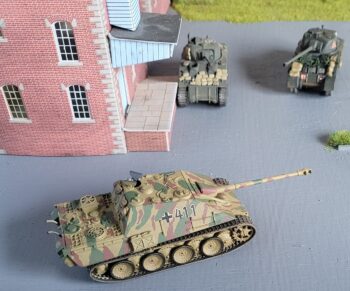
Facing the Sherman Fireflies, the SD.Kfz 173 Jagdpanther tank destroyer combined the Panther hull and suspension with the fearsome 88mm gun. Entering service in 1944, limited Jagdpanther production resulted in small numbers, a shortage of spare parts and shortened crew training periods of younger operators.
More importantly in this diorama, the Jagdpanther lacked a rotating turret. As such, if the 12 degree horizontal traverse of the 88mm gun within the fixed casemate was insufficient to acquire a target, the entire vehicle had to be turned to bring it to bear. Which tank destroyer crew would be able to fire at short range first?
In fact the last ‘production’ Jagdpanthers were produced at the factory by German staff just after the end of World War II under the supervision of the Royal Electrical and Mechanical Engineers (REME) during the American and British occupation of Germany. Nine Panthers and a dozen Jagdpanthers were produced, then shipped to England for evaluation. A complete Panther and a complete Jagdpanther produced this way are displayed at the Bovington Tank Museum in Dorset, with brass plates on them explaining their history.
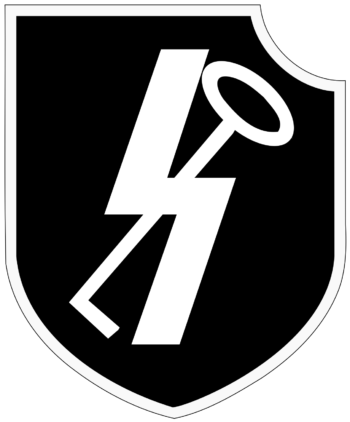
Having mentioned younger operators, Jagdpanther 411 (built from Matchbox kit PK-40) opposed the D-Day Normandy landings with the Panzer Regiment of SS Panzer Division 12 Hitler Jugend. The majority of the junior enlisted men of this Waffen SS formation were drawn during late 1943 from teenage members of the Hitler Youth with senior NCOs and officers coming from other Waffen SS Divisions: most notably 1 SS Panzer Division Liebstandarte SS Adolf Hitler. The result was a fanatical cadre of soldiers who committed many war crimes in their campaigns – including the defence of Caen after D-Day and the Battle of the Bulge.
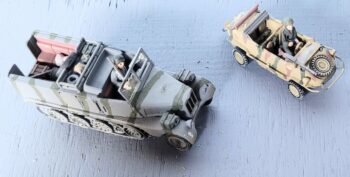
The main role of the 3 ton Sd Kfz 11 half track was towing medium sized guns and other trailers. The specialised artillery version pictured above could seat a crew of eight in a rear compartment separated from the driver by a large ammunition locker with side loading doors.
The basic engineering for all the German half-tracks was developed during the pre 1933 Weimar era by the Reichswehr’s Military Automotive Department but final design and testing was farmed out to commercial firms with the understanding that production would be shared with multiple companies.
Borgward was chosen to develop the second smallest of the German half-tracks and built a series of prototypes between 1934 and 1937. However development was taken over in 1938 by Hanomag of Hannover.
In the case of the Sd.Kfz 11, both tracks and wheels were powered as well as being used for steering. The steering system was set up so that shallow turns used only the wheels, but brakes would be applied to the tracks the farther the steering wheel was turned.
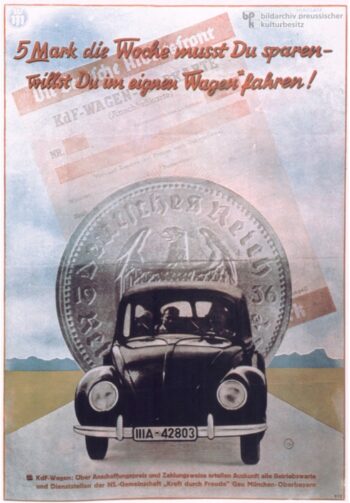
One of the 20th Century’s truly great automobiles, the Volkswagen ‘Beetle’ lived down its origin as Hitler’s ‘people’s car’, going on to become an all-time best-seller and cult classic, as well as spawning a host of derivatives. Outlined in the early 1930s, Hitler’s brief envisaged an affordable car costing less than 1,000 Reichsmarks. The man charged with translating the Führer’s dream into reality was Dr Ferdinand Porsche. One of Germany’s foremost automobile engineers, Porsche had presided over the design departments of Austro-Daimler, Daimler-Benz and Steyr, and had already developed several prototypes that went some way towards meeting Hitler’s requirements for the concept.
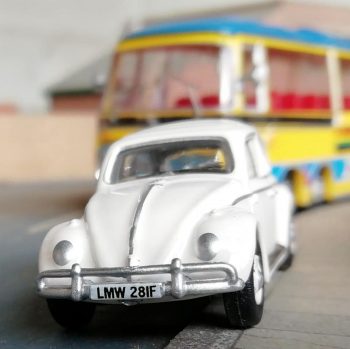
The Volkswagen that eventually entered production though, would be all new design, albeit one that would only come to fruition after WW2.
A substantial number of prototype Volkswagens had been touring Germany for some months promoting the car when the Wehrmacht rolled across the Polish border on 1 September 1939.
Civilian production trickled on, eventually ceasing as Germany’s fortunes declined, but the concept’s potential military applications had been under consideration for some time.
Indeed, Porsche’s Type 60 (the Volkswagen prototype) with its strong backbone chassis and air-cooled engine had been recognised as an ideal basis for the German army’s proposed Kübelwagen (‘bucket car’) – a lightweight, open utility vehicle. A small number of Type 62 Kübelwagens were in service by the time war broke out. Experience with these early vehicles soon led to a number of modifications, the result being the definitive Type 82 that would see service on virtually every front.
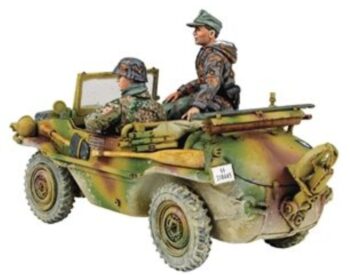
Yet another variant was the Schwimmwagen, an amphibious vehicle that represented almost total re-engineering rather than merely further development. The Schwimmwagen featured a watertight, door-less hull – designed by Porsche’s colleague Erwin Komenda – four-wheel drive and a power take-off from the engine that drove a retractable propeller. Types 128 Model A, 138 Model C and 166 Model C were manufactured as the design progressed, most of the 14,000-or-so Schwimmwagens manufactured ending up with units of the Waffen SS.