Having finished my diorama From Rockets to the Moon I was left with a number of foot square sections of thin MDF which could also fit under proprietary clear plastic covers. Not wishing to waste these, I explored the ideas of finding a display environment for my collection of 4mm scale racing cars and also commemorating the forthcoming 50th anniversary of the last Royal Mail Travelling Post Office pick up.

I was going to combine the two in a diorama entitled Brands Snatch, but space dictated two separate themes, which as it happens allowed even more eventual creativity and entertainment value.
My racing cars, largely written up under the title Clarkson’s End, needed somewhere more appropriate than the back streets of Ming Ing, Universal Works or Ingrow in Toedale to burn some rubber.
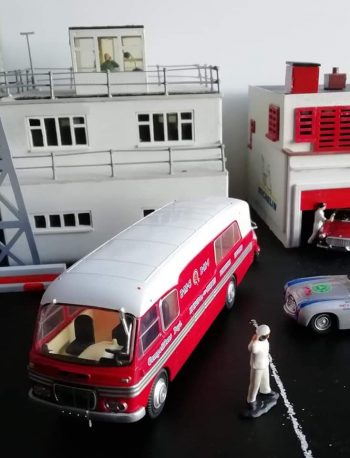
A dedicated motor racing circuit seemed logical, especially as many of the British sites were converted from wartime aerodromes and I happened to have a grey painted Airfix Control Tower going spare. Similarly, I realised that a starting grid light gantry could be made from the railway signal equivalent in the Dapol Kitmaster range.
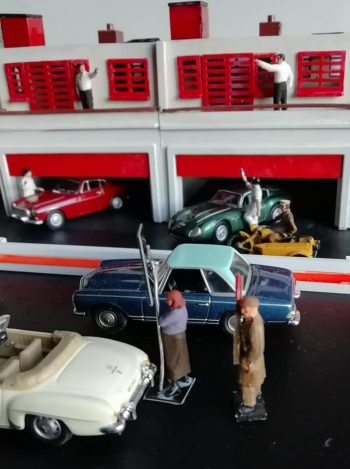
And by the same token, two examples of the Modern Flat and Shop could be united to make a pair of pit lane workshops with hospitality suites above. The window frames on the two walls about to be joined were omitted and a plasticard floor was added to the upper storey.
After spraying the conjoined structure white, the shop fronts and doors were replaced by shallow pieces of red painted plasticard to represent almost fully opened roller shutter doors. The horizontal sections of the roofs were painted matt black.
Crash barriers were made from square section hollow Plastruct extrusion and, as there are racing circuits named Castle Combe and Castle Donington in real life, I decided to call my diorama Castle Mingington.
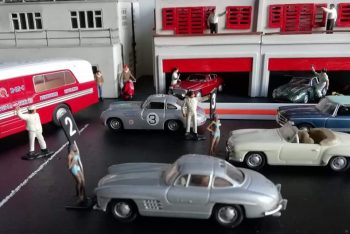
Coming across from Clarkson’s End with the cars were their white suited garage mechanics as well as hangers on such as the two scooter boys and the red flag man. New and more specific to Castle Mingington though were the VIP guests on the pit balconies (added after these pictures were taken), some course officials and the grid girls.

Clive Reid, I recall, supplied the VIPs (H0 scale German figures perhaps more interested in brau than Vorsprung Durch Technik!) while the grid girls started as H0 naturists. “You are over 18 aren’t you?” joked Des Penduke as I handed over my money, little knowing that the FKK recruits were about to be bowdlerised with blue tops and shorts and held up with wire.
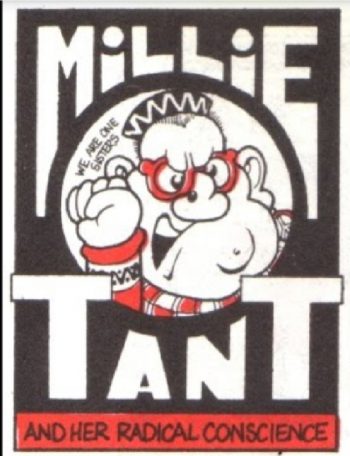
Their bases are placards were made from plasticard offcuts, the same being true of the feminist protester in her sensible purple sweater and long brown skirt. Not quite the Viz magazine character Mille Tant but going that way. Who says satire has no place on a model diorama?
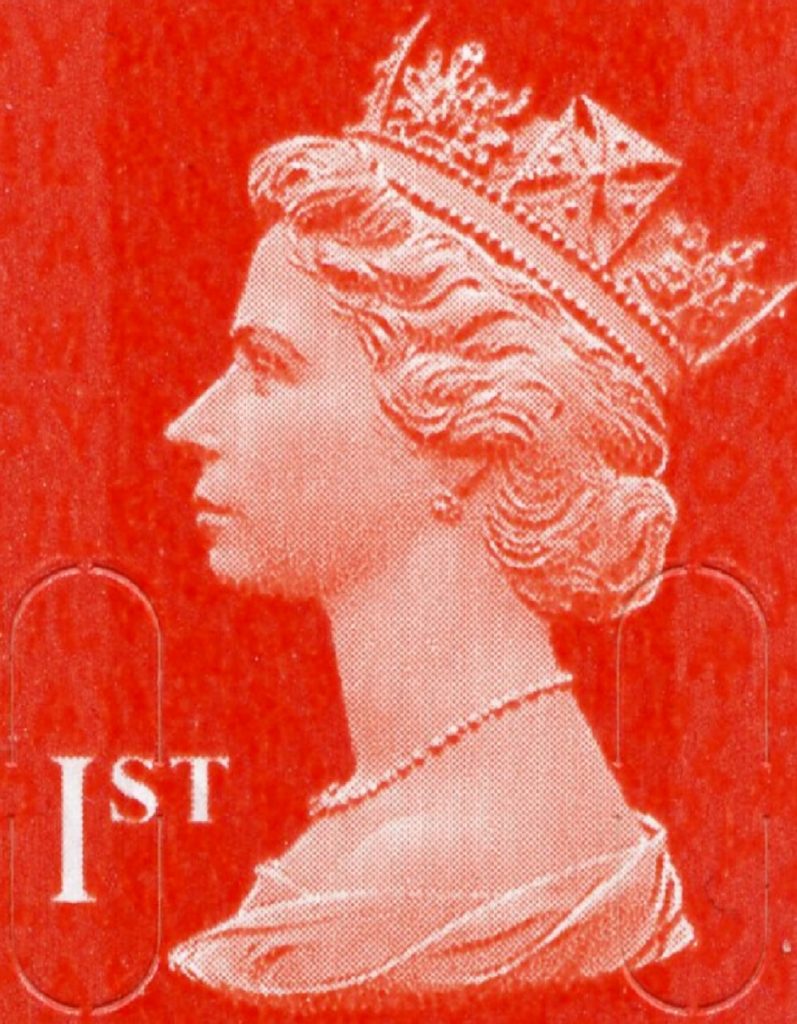
Much less controversial however is our own dear Queen Elizabeth II, 93 years old at the time of writing and heading serenely for her Platinum Jubilee in 2022. For nearly 70 years Her Majesty has dedicated herself to the well being of her subjects, uniting both the United Kingdom and the Commonwealth despite her reign being the longest and most tumultuous of all the Monarchs of her Royal House.
Indeed, Her Majesty stands on the shoulders of her antecedents in maintaining the stable constitutional monarchy which in turn allowed Britain’s industrial revolution to flourish.

1761 saw James Brindley open the Duke of Bridgewater’s Canal between Worsley and Manchester, beginning a network of narrow and wider inland waterways. In 1830 meanwhile, Manchester was linked to Liverpool by the World’s first inter City railway.
From this pioneering line came an even wider national railway network with the advantage of speed and more regular journeys. In turn, this allowed the Royal Mail to move to railways from long distance horse drawn stagecoaches.
The Travelling Post Office (TPO) was first introduced in 1838 and linked with Rowland Hill’s penny postage. These first mobile sorting offices were converted from horse boxes, allowing postal workers to sort up to 2000 letters an hour while on the move.

Mail bag exchange apparatus was used between 1852 – 1971 on Travelling Post Offices to pick up and put down mails without the need for trains to stop. Each apparatus operated by putting mail into leather pouches weighing between 20lb and 60lb that were attached to an arm which would suspend them 5ft above the ground and 3ft away from the TPO side. The carriage was equipped with a net, fitted to the side, with an opening into the carriage behind it to catch incoming pouches.
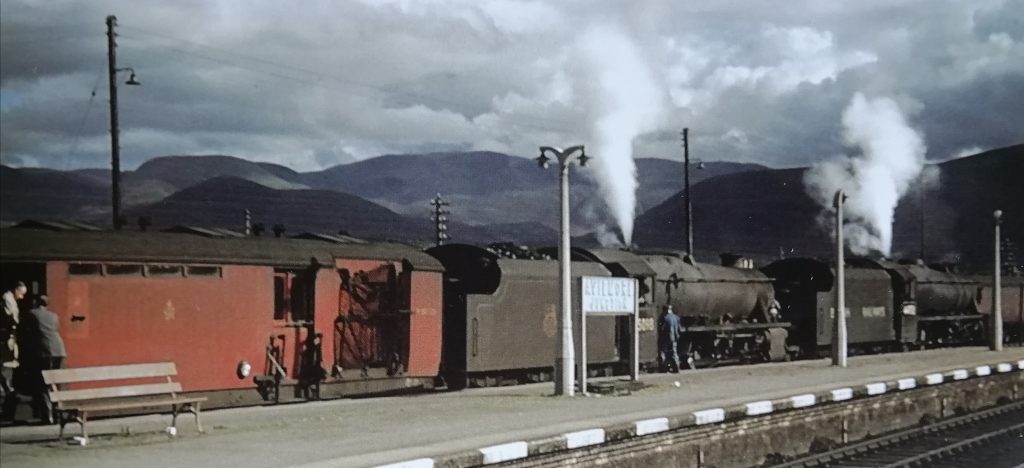
Even relatively small British railway companies such as the Highland Railway built and operated Travelling Post Office vehicles. One example is seen marshalled behind Black Five 4-6-0s 45488 and 45460 at the front of an Edinburgh bound Sunday excursion train at Aviemore in July 1955. The platform is today used by trains of the preserved Strathspey Railway.
The heyday of the Travelling Post Office was at the peak of Britain’s most frequent postal service before the First World War, but it is perhaps best remembered by the 1936 documentary film Night Mail, which combined the poetry of W. H. Auden and the music of Benjamin Britten.
Travelling Post Office services declined once again after the Second World War when new mail delivery options included long distance lorries on motorways, helicopters and fixed wing aircraft. Under the 1955 Modernisation Plan too, steam was replaced by diesel and electric traction which had the advantage of being able to accelerate and decelerate much faster. With the possibility of loading and unload mail at stations, costly, complicated and potentially dangerous on-train apparatus and its associated lineside infrastructure became obsolete.

The last TPO set down its mail pouches on the move just north of Penrith in Cumberland on 4 October 1971, nearly 50 years ago.
Despite, or possibly because of this, Travelling Post Office carriages, pick up hooks and catching nets have always been popular model railway accessories.
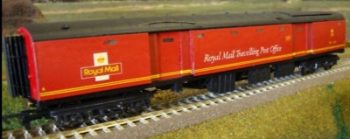
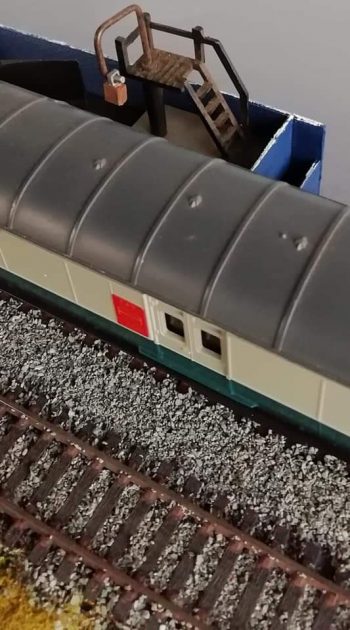
However, although the most popular 00 gauge representation of a TPO carries the running number M80328, Hornby product number R416 is not as faithful to the B5 bogie fitted Mark 1 NSX on the Severn Valley Railway as the more recent Southern Pride kit pictured above.

Unlike 80300, the 1959 vintage Wolverton built sorting van on show at the Engine House at Highley, 80328 is used for Santa’s Grotto at Arley each Christmas but is more usually stored in the carriage sheds at Kidderminster. 80328 was built at York in 1969 and is one of the TPO vehicles built with smaller windows after the Great Train Robbery of August 1963.
The Mark 1 TPO vehicles were also among the first to be built with centre gangway connections rather than the earlier offset type. Offsetting the gangways had the advantage of providing more room for the sorting staff and preventing access from any ordinary carriage coupled next to the TPO. However, offsetting also had the disadvantage of vehicles sometimes having to be turned to make the gangways connect.
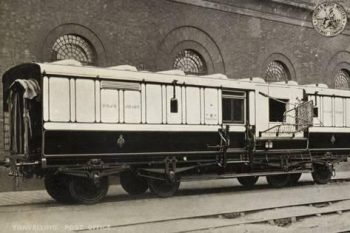
However, as late as the 1990s, Royal Mail Travelling Post Offices retained onboard posting boxes for late First Class letters, a feature of the Hornby product.
I owned an example of Hornby’s R416 blue and grey liveried working TPO – complete with pick up hook, set down bin, track actuation ramps and pouches – as a child. And seeing such a pre enjoyed vehicle in Cheltenham Model Centre set me on a quest to celebrate both the forthcoming half century of the last TPO pick up and the Platinum Jubilee of The Queen.
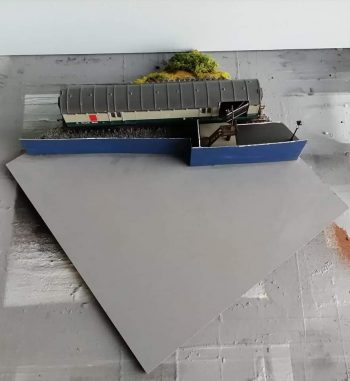
However, doing so on a square foot diorama without the associated stowage vehicles of a Royal Mail train required Hornby R416 to be positioned so that it spanned from one edge to another. In turn, this opened a vaguely rhomboid shape in front for other uses – an airfield, street or vehicle depot perhaps.
Having learned from experience too that exhibition patrons love dioramas on more than one level, I let the TPO form a background by raising the abbreviated track on an embankment. This had a sloping grass embankment on the small face and an engineer’s blue brick wall opposite. Made from plasticard, this also enclosed a short length of station platform to support the pick up gantry that was kindly sourced for me by Clive Reid.
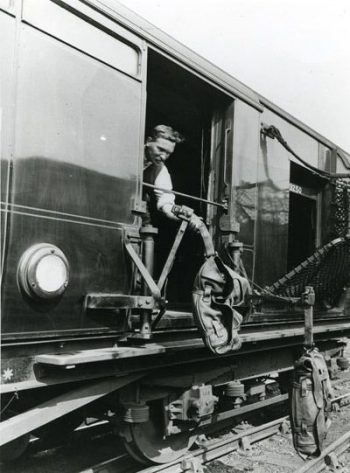
Although a limited number of blue and grey Hornby TPO carriages are sometimes available second hand, the associated gantries, collection bins and mail pouches are much harder to acquire. As such, I made my own pouch out of square section extrusion.
Even with a pick up gantry in place, the new diorama could also be used to display other British railway vehicles of a suitable length – but the question of foreground content remained open.

Given that the engineer’s blue brick walling reminded me of the railways that run alongside the canals of the West Midlands – and that 80328 had an M prefix – I decided to add a removable canal module to my new diorama. Happily, the shape available was long enough not only for the narrow boats that have previously featured on Universal Works but the 1/87 scale Architec 120 ton Rhine Barge that was a kind gift from Alan Postlethwaite when his Brockley Acres layout was dismantled.
Alan had explained the presence of a typically Continental vessel on Brockley Acres as part of the reparations made to Britain after the Second World War. Indeed, with mighty Rhine currently experiencing low water levels between Switzerland and the North Sea, Britain might offer big barges a better operating environment.
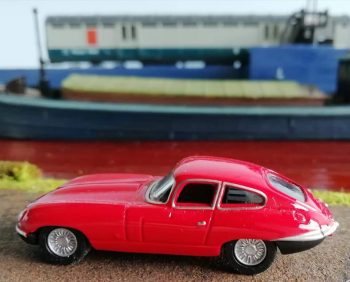
Similarly, my first set of pictures of what I now named Royal Reach would be even more closely dated as M80328 was only built in 1969 and TPO apparatus was last used in 1971. Hence the appearance of a red E Type Jaguar on the opposite bank. The possible future acquisition of an earlier liveried TPO however would open new possibilities.

The canal module was made from layers of thick plastic card, sprayed with brown textured paint and with the banks enhanced with grass flock powder and Peco winter grass tufts.
The water effect was created with four layers of yacht varnish and inspired a possible name of Regina’s Wet Snatch. However, Royal Reach might possibly more acceptable to exhibition organisers and a more classy pun on reach as both coverage and the upper reaches of a waterway.
