“The lure of speed is an urge that most civilized human beings feel. I know that it has interested and fascinated me ever since the day – quite a number of years back now – when, mounted on a bicycle, I shot past two terrified old ladies down the steep slope of Bickley Hill in Kent at the rate of twenty seven miles an hour. At least that was the speed estimated by the constable who gave evidence at Bromley Police Court where I was charged the next day with having driven a bicycle to the danger of the public. I was found guilty by the bench and fined thirty shillings. At the same time I was given a wigging and a warning, or should I say, words of advice. “Malcolm Campbell”, the presiding magistrate thundered, ” you have endangered public life and property on the public highway. You drove this machine of yours at a totally unnecessary speed. If you come before us again, we will take a much more serious view of the matter. We hope that this will be a lesson to you not to travel so fast in future.” This was a lesson I have never learnt. Since that day I have certainly managed to steer clear for the most part of speeding convictions, even though I have failed to take the magistrate’s advice..”
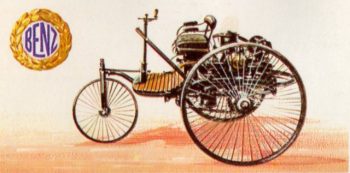
Malcolm Campbell was born on 1 March 1885, the same year in which both Gottlieb Daimler and Karl Benz built experimental motor cars. Benz was the first to manufacture them for sale in 1888, in three and four wheel formats with a single cylinder 1.7 litre horizontal engine at the rear of a tubular frame. A two speed transmission using belts and chains yielded a maximum speed of 12 mph.
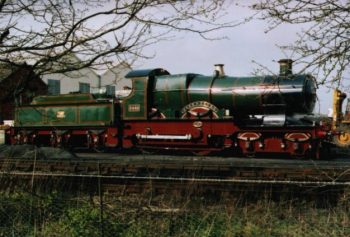
Malcolm Campbell would be 19 years old before the Great Western Railway’s 4-4-0 steam locomotive “City of Truro” – seen above at Toddington on the Gloucestershire & Warwickshire Railway – would claim the first 100 mph on land on 9 May 1904.
Aldous Huxley was to say that speed was the only unique experience of the Twentieth Century, but within that hundred year thrill ride the pursuit of speed on land, air and water would often involve both technological contributions from Gloucestershire and one family name : Campbell. Malcolm Campbell was the son of a wealthy Hatton Garden diamond merchant, who grew up with a restless spirit of adventure. Soon after his father had apprenticed him to a firm of City insurance brokers, he left to start his own business in partnership with a friend. Initially success proved elusive but in typical style Campbell refused to be deterred. When an uncle suggested he provide newspapers with insurance against libel actions the service proved very popular and suddenly the business prospered.
The first recognised speed record was set at 39 mph by French Count Gaston de Chasseloup-Laubat in his Jeantaud Duc electric car in 1898.
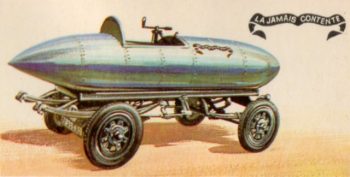
Then, on 29 April 1899, Belgian driver and designer Camille Jenatzy (1868-1913), known as the Red Devil because of his russet beard, became the first man to officially exceed 60 mph when he reached 65.7 mph at Acheres, France and set a World Land Speed Record in his electric car “La Jamais Contente” which also sported novel pneumatic tyres, as seen above.
In 1902, the Automobile Club of France marked out an officially measured kilometre on a stretch of road near Dourdan and provided a mechanised timing apparatus.
Frenchman Henri Fournier, winner of the Paris – Bordeaux and Paris – Berlin races of 1901, took the record to 76.6 mph in his 60 bhp chain driven petrol fuelled Mors Z Paris – Vienne.
On 21 July 1904 meanwhile, a 13 1/2 litre opposed piston Gobron Brillie became the first car to exceed 100 mph with a World Land Speed record of 103.56 mph and Frenchman Louis Rigolly at the controls. Another significant World Land Speed Record was set on 24 January 1905 when Arthur C. MacDonald drove his 15 litre 190bhp Napier 6 to a speed of 104.65mph. The car was a rebuild of a 6 cylinder L48 racing machine with a wraparound “gas pipe” radiator and Napier were to power many subsequent World Land Speed Records. The record was also the first to be set at Daytona Beach, Florida.
By 1914, the Association Internationale des Automobile Clubs Reconnus because recognised as the authority on land speed records. Its regulations required two passes in opposite directions to rule out wind assistance. Initially these had to be completed within 30 minutes, later changed to one hour.
The first time that the World Land Speed Record was set under these rules was also the first time that a British driver claimed the title. Lydston Hornsted achieved 124 mph in his Benz Number 3 in June 1914 at Brooklands race track.
Following his unsuccessful attempts to build and fly an aeroplane, Malcolm Campbell used his wealth to indulge his passion for high speed cars and boats, frequently to the detriment of his social life and obligations. Malcolm was a shrewd judge of character and an exacting taskmaster, but such was his personality that he was able to drive his friends and employees to their limits while still retaining their loyalty – the characteristic he prized above all others. Having determined a course of action, Campbell’s iron resolve would allow nothing to deflect him from his purpose. For him the word impossible simply had no meaning. Throughout his career as a record breaker this was to stand him in good stead and became a cause of concern to his numerous rivals. He faced and overcame each obstacle with implacable determination, regardless of the cost in time, effort and money and his remorseless concentration on the job in hand was undoubtedly one of his prime assets.
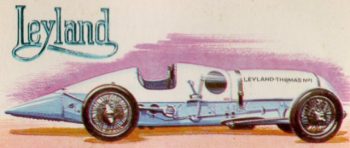
Using his exploits as a publicity medium for the motor trading business he had started, Malcolm Campbell raced many cars from 1910 at the Brooklands circuit at Weybridge, Surrey. Opened in 1907, Brooklands was the first banked motor racing track in the World and attracted aviation pioneers such as Alliott Verdon Roe as well as – in the 1920s – John Godfrey Parry-Thomas, who was assisted in designing cars by Reid A. Railton. In 1925 the pair’s 7.2 litre 8 cylinder Leyland Thomas Special – pictured above – lapped Brooklands at 129.36 mph.
However, Malcolm Campbell’s early Darracq and Peugeot cars – nicknamed “Flapper 1” and “Flapper 2” after a well-known racehorse – had not been successful, despite the winning ways of the voiturettes produced by Sunbeam-Talbot-Darraq from 1921 at the hands of Henry O’Neal de Hane Segrave and Kenelm Lee Guinness.
A day before a classic race at Brooklands, Malcolm Campbell went to the Whitehall Theatre to watch a play by the mystical Belgian poet and playwright Maurice Maeterlinck – “The Blue Bird” – based upon the story of the bluebird of happiness always tantalisingly close yet forever beyond reach. A friend mentioned that The Blue Bird was having ” a wonderful run in London”. Inspired, Malcolm Campbell returned home and overnight his Darracq car was painted blue and christened “Bluebird”.
Donald Campbell – a replica of whose K7 hydroplane is pictured above at the Lakeland Motor Museum – later said:
“Bluebird was the name given by my father to all his racing craft – Land or Water; and I would have no other for my own. She carries a mascot, a small silver plate with an enamelled Blue Bird, screwed to the dashboard. All his craft carried it – and so shall mine.”
“Life is an eternal challenge, a variant on Maeterlinck’s theme that the Bluebird of Happiness is by the side of each and everyone of us, always within reach, yet, if pursued to catch and possess is beyond our grasp.”. According to an article in the February 2003 edition of Marine Modelling magazine, a close approximation of “Bluebird” Saxe blue – a shade between Oxford and Cambridge – is 50% Humbrol Number 48, 35% Humbrol Number 15 and 15% Humbrol Number 14.
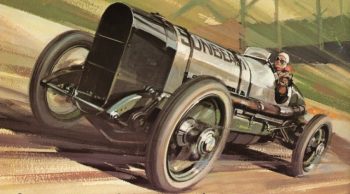
From that first Bluebird flowed a stream of cars that Malcolm Campbell raced with skill and distinction at Brooklands and also in continental Grand Prix and road races. In 1923 however Malcolm Campbell began to focus on outright speed and used all his renowned powers of persuasion to coax Sunbeam’s French engineer Louis Coatalen into selling him the 350 bhp car in which Kenelm Lee Guinness (pictured above) had set the World Land Speed Record of 133.75 mph in 1922.
This silver and black car – now preserved in the National Motor Museum at Beaulieu – had been built from aluminium in 1920. Powered by an 18.3 litre V-12 prime mover based on Sunbeam’s Arab and Manitou aero engines of the First World War, the back axle was differential-less and had first been driven at Brooklands by aviator Harry Hawker.
Kenelm Lee Guinness’s 1922 record was the last to be set at Brooklands, and Malcolm Campbell’s next attempts on the World Land Speed record were made on beaches at Saltburn, North Yorkshire, and at Fanoe in Denmark. In both cases, Campbell was denied international recognition due to the hand-timing apparatus used. On 25 September 1924 however Malcolm Campbell set a new World Land Speed Record of 146.16 mph at Pendine Sands, Carmarthenshire before raising the bar again to 150.76 mph on 21 July 1925.
Between 1924 and 1935 Malcolm Campbell broke the World Land Speed Record nine times. In doing so he became the first man to travel at four miles a minute and at 150, 250 and 300 mph.
On 21 March 1926 Henry Segrave set a new World Land Speed Record of 152.30 mph at Southport, Lancashire in his 4 litre Sunbeam “Ladybird”
On 28 April 1926 a new World Land Speed Record of 171.01 mph was set by John Godfrey Parry-Thomas in his 400 bhp Higham-Thomas Special car “Babs” at Pendine Sands.
On 4 February 1927 Malcolm Campbell was to better this by 3 mph to 174.88 in his Napier Campbell Bluebird, also at Pendine. It turned out to be the last time that the World Land Speed record was to be set in Europe.On 3 March 1927 Parry-Thomas made another attempt at the measured mile. At the end of his run however the external chain drives broke, sending Babs into a great shearing skid after which the aero engined vehicle rolled over and caught fire. Parry-Thomas was found half out of the car and half incinerated, his shoes burned away and the top of his head cut off by the flailing chains.
Following this calamity, Babs’ seat was ripped, the instruments smashed and the car itself buried at Pendine. Forty years later however, Babs was exhumed by restorer Owen Wyn Owen and despite having suffered from a highly corroded body has since been put back to running order. Nowadays Babs is on display at either the Pendine Museum of Speed or Brooklands Museum.
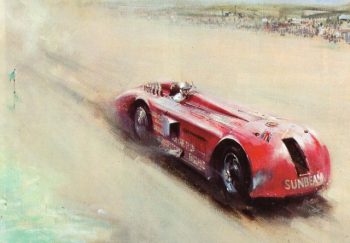
First past the 200 mph barrier at 203.79 mph was Henry Segrave on 29 March 1927 at Daytona Beach, Florida, USA. His red Sunbeam car – pictured above – designed by Jack S. Irving and nicknamed The Slug, is also preserved in the National Motor Museum at Beaulieu but was built when Sunbeam-Talbot-Darracq was short of cash. For this reason it was powered by two 2.6 miles to the gallon Sunbeam Matabele aero engines salvaged from a wrecked racing motorboat, one being placed in front of the driver and the other behind. The rear unit was started with compressed air which then turned over the front engine through a train of gears. Despite the white 1 000 horsepower boast on the bonnet, the two 45 litre engines produced less than 900 bhp. Dunlop produced special tyres capable of withstanding 200 mph for 3 1/2 minutes and chain guards were added after Parry-Thomas’s tragic death at Pendine. Other safety devices included a specially thick under shield and an inbuilt steel roll bar. The car was 25 feet long and eight feet wide.
Born in 1896 to Anglo-Irish parents in America, Segrave always though of himself as British and had served in the First World War both in the trenches and as a Royal Flying Corps pilot. A fitness fanatic and ascetic, he even chose tap water over Champagne after winning the 1923 French Grand Prix and was one of the first drivers to wear a toughened crash helmet. After this record breaking run Henry Segrave became a salesman for the Portland Cement Company and spent his spare hours building a model railway at his home in Kingston, Surrey, although the allure of the Land Speed record was to call him once again.
On 15 February 1928 Malcolm Campbell was at Daytona Beach and his Bluebird powered by a Napier Sprint Lion aero engine achieved an average of 207 mph.Next to hold the World Land Speed Record, also at Florida’s Daytona Beach, was Ray Keech in his White Triplex car “Spirit of Elkdom.” This had no aerodynamic body but three Liberty aero engines with a total capacity of 81 litres which powered the American driver to 207.55 mph.
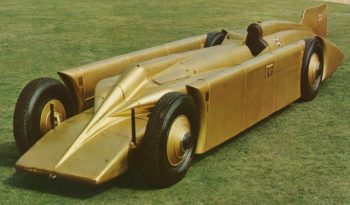
Arguably the most beautiful and futuristic looking Land Speed Record holder of the 1920s however was Golden Arrow, designed by Jack S. Irving and built at the KLG spark plug works in Putney Vale, London. The bodywork was by Thrupp and Maberly and its low lines were ensured by twin propeller shafts, one each side of the driver and the nose was shaped around the W-formation twelve cylinder 24 litre 930 bhp Napier Lion aero engine which had competed in the Schneider trophy air races.
The sponsons between the front and rear wheels housed radiators made by H.H. Martyn & Company of Cheltenham, the ancestor of the Gloster Aircraft Company. These were filled with ice at the start of a high speed run only to be turned to boiling water at the end by the heat from the Napier Lion.
On 11 March 1929 Sir Henry Segrave drove Golden Arrow to a new Word Land Speed Record of 231.44 mph, beating the previous White Triplex record by 25mph. Golden Arrow is preserved in the National Motor Museum at Beaulieu in its eponymous gold paintwork, although to prevent dazzle during the record attempt it was painted matt black and had gunsights mounted ahead of the cockpit to help the driver maintain direction by focussing on a landmark in the distance. After the record breaking run, Segrave’s Golden Arrow was displayed at Sir Alan Cobham’s Brockworth Air Day in 1931.
Henry Segrave was subsequently knighted for his exploits by King George V at Bognor. Rather than return to his model railway however, Sir Henry Segrave decided to take on the World Water Speed Record and on Friday 13 June 1930 his Rolls Royce powered Miss England II skimmed across Lake Windermere at an average speed of 99 mph, 6 mph faster than the existing record. But the temptation of the magic “Ton” was too great and on her last run of the day the slim white boat suddenly leapt from the lake and crashed back beneath it. Sir Henry Segrave and one of his mechanics was killed. Prime Minister Ramsay McDonald led the nation in mourning and Segrave’s ashes were scattered from the air over the fields of Eton where he had played as a boy.
Back at Daytona Beach on 5 February 1931, Malcolm Campbell set a new World Land Speed record of 246 mph – four miles a minute – in his Napier Railton Bluebird and later that year was knighted for his achievements. When Sir Malcolm Campbell achieved his 272.46 mph record at Daytona Beach in his Rolls Royce Railton Bluebird on 22 February 1933 he was already looking ahead to the magic 300 mph mark. Thus 1934 saw designer Reid Railton retaining the 36.5 litre V12 Rolls Royce R engine (as used in the Schneider trophy winning Supermarine floatplanes), which in supercharged form now gave 2 500 bhp, and the basic chassis frame which dated back to the original Campbell-Napier of 1927. However, a new front axle was designed and the rear end incorporated the revolutionary concept of twin rear wheels in an effort to improve traction by minimising the wheel spin Campbell felt was robbing the car of speed on Daytona’s soft sand.
Sir Malcolm Campbell’s 1935 Bluebird car was constructed by Thompson and Taylor (Brooklands) Limited, weighed nearly 5 tons and some 90% of the available horsepower was required to overcome wind resistance. The normal clutch worked through a crash type three speed gearbox to the back axle via a double propeller shaft. Wheelbase was 13′ 8″, track 5′ and overall length 28′ 3″. Fuel was Special Esso-Ethyl and Wakefield Patent Castrol oil was used for lubrication. The Dunlop tyres had a front pressure of 125 pounds per square inch and rear 110 psi.
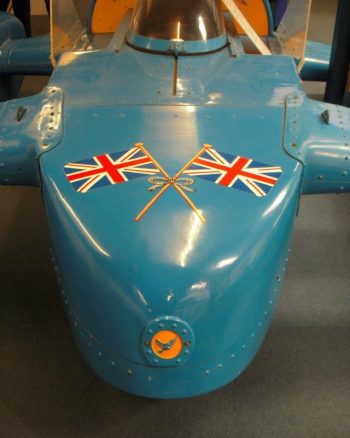
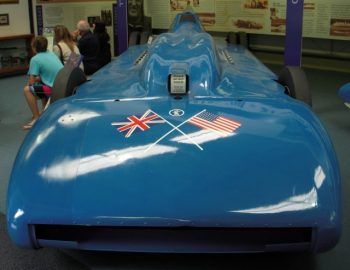
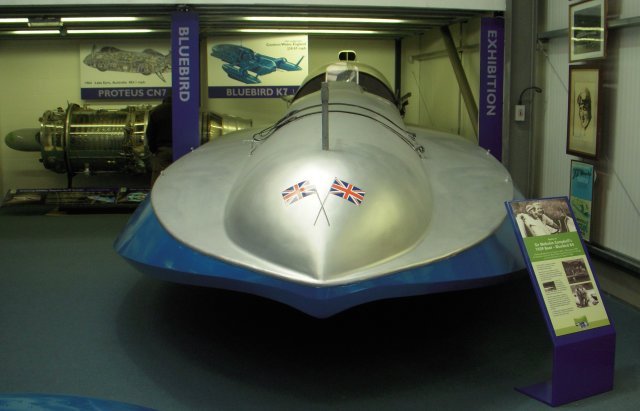
Also of note were the crossed British and American flags painted on the nose of the Lakeland Motor Museum replica pictured above. The Museum’s K7 hydroplane replica – as used in the BBC drama “Across The Lake” – has two Union Flags while the Bluebird CN7 car is shown with British and Australian flags as it sets its new World Land Speed Record at Lake Eyre.
On 3 September 1935 Sir Malcolm Campbell set a new World Land Speed Record at the new venue of Bonneville Salt Flats, Utah, at 301.129mph – over 5 miles a minute.This was to be Sir Malcolm Campbell’s last World Land Speed Record, being broken on 19 November 1937 by Captain George E.T. Eyston in his car Thunderbolt at 311.418 mph.
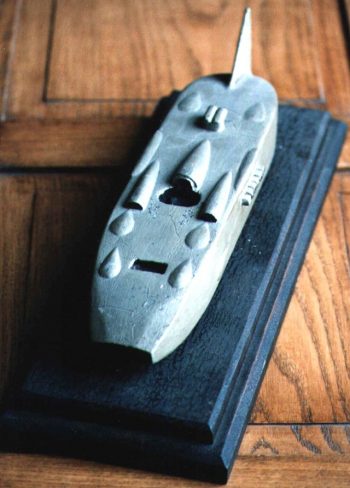
Thunderbolt was built at Tipton, Staffordshire, was powered by twin Rolls Royce R Type engines positioned side by side behind the driver and measured 30 feet long. To deliver the combined 4 600 bhp, Thunderbolt had four driving wheels at the back and four unpowered steerable wheels – under teardrop shaped covers – at the front. Like Golden Arrow before it, Thunderbolt was painted black for its record attempts after its original polished aluminium dazzled the optical timing apparatus used to record its flying mile.
The model pictured above – dating from the late 1930s – was the earliest example of woodwork made by my late father W.G. Drewett and is posed on a wooden coffer which was his last project before his death in 1987. Unfortunately Thunderbolt’s windscreen has been lost over time, but it was this model that first started my interest in the World Land Speed Record and its holders.
With his obsession with reaching 300 mph on land satisfied, Sir Malcolm Campbell turned to the water speed record like his competitor Sir Henry Segrave before him.
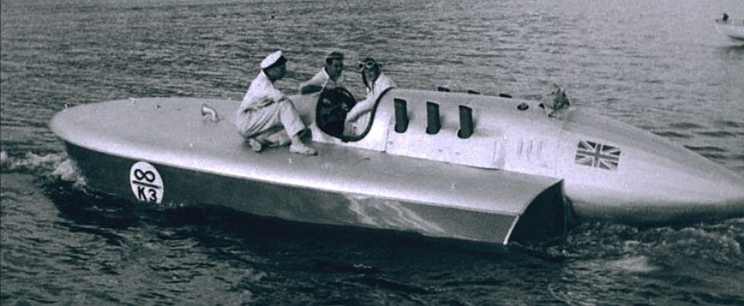
With a hydroplane known as K3, using the Rolls Royce R engine from his record car, he set two new records in 1937 and a third in 1938. K3 was conceived to beat the 1932 Water Speed Record set by the American power boat racer Garfield Wood. Designed by Fred Cooper of Saunders Roe, K3 reached 126.32 mph on 1 September 1937 on Lake Maggiore on the Swiss Italian border while on 2 September 1937 Sir Malcolm Campbell took K3 to 129.5 mph.

The 130 mph barrier was breached a year later, at 130.91 mph on 17 August 1938 on Lake Hallwil, Switzerland. This was just weeks after the LNER Pacific “Mallard” had set an all time steam locomotive speed record of 126 mph.
Realising that K3 had reached the limit of its potential, Campbell retired the piston engined boat. In 1988 it was acquired by Paul Foulkes-Halbard and his son Karl who then spent more than two decades restoring the vessel. On 26 September 2017, the restored K3 reached 52 mph on Bewl Water, Kent and in 2018 once more on Lake Maggiore.
However on 14 August 1939 Sir Malcolm Campbell set a new World Water Speed Record of 141.74 mph on Coniston Water in his all-new Bluebird K4, designed by Commander Peter Du Cane.
Back at Bonneville Salt Flats in the summer of 1938 however, a big, shy 39 year old named John Rhodes Cobb had hired Reid Railton and to design him an elegant tear-drop shaped Railton Mobil Special car powered by a pair of Napier Lion engines to challenge Eyston’s tail-finned Thunderbolt – at seven tons the largest and heaviest car ever to take on the World Land Speed Record in Utah and twice the weight of Cobb’s machine.
On 27 August 1938 Thunderbolt had set up a new World Land Speed Record of 345.20 mph which Cobb, on 15 September, raised to 350.2 mph. Eyston then topped this at 357.9 mph the next day.
Cobb – a racing driver at Brooklands between the two World Wars – returned to Utah in the summer of 1939 and on 23 August took the World Land Speed Record to 369.74 mph as well as taking the 5 and 10 km records off Sir Malcolm Campbell.Meanwhile, George Eyston’s Thunderbolt was sent to New Zealand in 1940 to celebrate the centenary of the founding of its capital, Wellington and became stranded there due to the outbreak of war. It was stored in a shed at Wellington Airport but after being damaged by fire in 1956 was apparently dumped in a landfill site at nearby Wilton which is now covered with playing fields. Ground radar searches in the early 21st Century returned an echo which is the right shape and size for its chassis but money has not so far been forthcoming for any recovery attempt.
As might be expected, no World Land Speed record attempts were made during World War II although the global conflict proved a catalyst for new technology that was to further accelerate fresh endeavours.
Despite this, the Railton Mobil Special, designed by Reid Railton and driven by John Cobb, which celebrated the State of Utah’s centenary with a new World Land Speed Record at Bonneville Salt Flats, USA of 394.20 mph on 16 September 1947 was still powered by two Napier Lion piston engines. The Railton Mobil Special is now preserved at Think Tank, Birmingham, having been acquired by Dunlop who made its tyres, and was only eclipsed as a World Land Speed Record car driven by piston engines in 1965.
While Cobb became the first driver to reach 400 mph, during 1947- 48 Sir Malcolm Campbell’s Bluebird K4, re-engined with a de Havilland Goblin jet engine from a Vampire fighter, failed to break the existing World Water Speed Record on Coniston Water.However, by this time Sir Malcolm Campbell was 62 years old, in poor health and with failing eyesight. He died on 31 December 1948 having set nine land and four water speed records and survived them all.
Donald Malcolm Campbell , later awarded the CBE, had been born on 23 March 1921 and grew up in his father’s exciting world of speed, together with his sister Jean who was born two years later.
Donald initially worked in the City of London, then as a travelling salesman, later entering into partnership engaged in the manufacture of machine tools. During World War II he had joined the Royal Air Force but had not been selected for pilot training as he had wished due to the discovery of a heart weakness caused by the effects of rheumatic fever as a child. Donald Campbell later developed an interest in powerboat racing and, following the death of Sir Malcolm Campbell, purchased Bluebird K4 from his father’s executors.
In 1945 he married Daphne Harvey and their daughter Gina was born in 1949. After the couple divorced, Donald married Dorothy McKegg in 1952, divorced her in 1957 and in 1958 married Tonia Bern.
Shortly following Sir Malcolm Campbell’s 1948 death, reports indicated a challenge to his 1939 record. Upon hearing of the planned American betterment of his father’s record, Donald Campbell – immensely patriotic – embarked upon a 17 year record breaking career that brought success on both land and water.
In 1949 Bluebird K4 – now fitted again with a Rolls Royce R-Type piston engine – still failed to break the World Water Speed Record on Coniston Water while in 1950 Slo-Mo-Shun IV, designed by Ted Jones and piloted by Seattle car dealer Stanley Sayres, set a new World Water Speed Record on Lake Washington, USA, at 160.32 mph. Indeed Slo-Mo-Shun IV reached 178.497mph in 1952 and also won the Harmsworth international motor boat Trophy for the United States. The 28′ long Ventnor type three point shovel nosed hydroplane had been launched in 1949 by the Jensen Motor Boat Company and was powered by an Allison liquid cooled V12 engine similar to those used by Lockheed P-38 Lightning fighter aircraft.
The secret of the oak and spruce built Slo-Mo-Shun IV was its relatively high power to weight ratio and its ability to ride at speed on just the rearmost portion of the hull with only one propeller blade in the water. The resulting “prop ride” was to throw up hundreds of tons of water in a spectacular rooster tail.
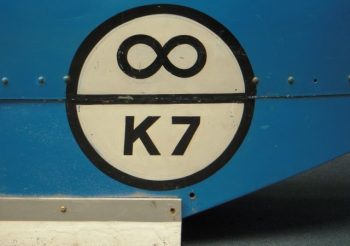
Donald Campbell and his team converted Bluebird K4 to prop riding and later in 1950 took Bluebird K4 to 152 mph before winning the Oltranza Cup race at Lake Garda, Italy, covering four laps of a 5 mile triangular course in 1951. He then made another record attempt with Bluebird K4 on Coniston Water in May 1951. However the craft, travelling at an estimated 160 mph, hit a submerged log, suffered a structural failure and sank. After salvage, K4 was stripped of useable parts and the hull burned.
The Lakeland Motor Museum replica seen above was created for the Rolls Royce Centenary display at the 2004 Goodwood Festival of Speed.Following his success in the 1951 Oltranza Cup, Donald Campbell considered building a new “prop rider” replacement for Bluebird K4 in order to compete against the Americans for the Harmsworth Trophy. However, the death of his friend John Cobb in October 1952 whilst piloting the jet powered “Crusader” on Loch Ness, led to the decision to build a totally new craft.
Crusader had been designed by Reid Railton and Peter Du Cane and was built by Vosper’s of Portsmouth – famous for their Wartime torpedo boats. Its format was a three point hydroplane with outriggers at the rear of the craft and thrust came from a De Havilland Ghost gas turbine – an improved version of the Goblin unit that Sir Malcolm Campbell used in Bluebird K4. Cobb’s Crusader project was also assisted by Castrol Oil, whose competitions manager was none other than George Eyston, who had been awarded the OBE in 1948.
Tests during September had shown signs of weakness in the front planing shoe which Du Cane suggested by strengthened before a record attempt was made. Cobb disagreed, but in making his first high speed Crusader hit the wash from a support boat at 240 mph. The vessel then porpoised across Loch Ness before the front planing shoe gave way, the nose dipped into the water and Crusader disintegrated. Although badly injured in the crash, Cobb actually died later from heart failure brought on by shock.
Donald, together with the Norris brothers – Kenneth and Lewis – prepared designs for a completely new jet powered boat – Bluebird K7 – and construction began during mid 1954 at Samlesbury Engineering, Preston, with the sole aim of bringing the World Water Speed Record back to Britain. The mainframe was constructed by Accles and Pollock Limited from high tensile chrome – molybdenum steel and the hull was made from Birmabright light alloy. Instrumentation was by Gloucestershire based Smiths Industries. Although not riding on a conventional screw propeller, Bluebird K7 was designed to rise up on its floats as it travelled at speed and maintain just three points of contact with the water totalling just 14 square inches – equivalent to one sixth of a piece of A4 paper. The infinity sign symbolised the unbounded ambition of its makers.
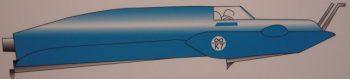
Launched in 1955, the £ 25 000 original Bluebird K7 was fitted with a Metropolitan Vickers Beryl turbojet which had been taken from TG 263, the surviving Saunders Roe SR A1 jet flying boat subsequently preserved at the Skyfame Museum at Staverton.
However, at low speeds water spray was sucked into K7’s intakes causing the turbojet to flame out. This was cured by the addition of transparent intake shields, rear buoyancy reduction and other minor modifications.In this form Bluebird K7 gave Donald Campbell a World Water Speed Record of 202.32 mph on Ullswater, Cumbria on 23 July 1955, taking the title back from Slo-Mo-Shun IV. Later that year Bluebird K7 sank at Lake Mead, Nevada. After being recovered and repaired K7 went on to a record breaking 216.20 mph on 16 November 1955.
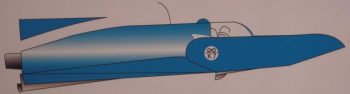
In 1956 a smooth canopy replaced the sharp edged original and the sponsons were altered to give more stability. On 19 September Bluebird K7 – thus modified – yielded two runs of 286.78 mph and 164.48 mph giving a new record average of 225.63 mph. 286.78 mph was the fastest single run for this Bluebird until 1967. In 1958-59 a small tail fin was added to Bluebird K7 and the air speed indicators originally fitted to the floats were removed.
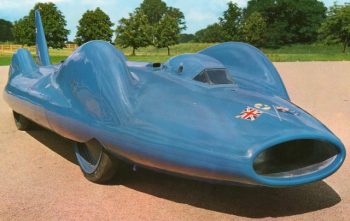
In 1956 too, work began on the £ 1 000 000 four ton 30′ long Bristol Proteus gas turbine powered Bluebird CN7 ( Campbell-Norris 7) car also designed by Kenneth and Lewis Norris and was built by Motor Panels Ltd of Coventry.
The chassis was built from a light but strong aeroweb sandwich of light alloy around resin bonded light alloy honeycomb: the ancestor of the crash protection used in Formula 1 cars today. Lewis Norris ( 20 September 1924 – 13 February 2009 ) also invented the modern automatic car seat belt and the go-kart and served his apprenticeship with Harland & Wolff at its London docklands shipyard building landing craft for D-Day.
The Proteus was the engine used on the “whispering giant” Bristol Britannia airliner and would go on to be used on the SRN4 Mountbatten Class hovercraft. The Proteus used in Bluebird CN7 was unique in having a drive shaft at both ends to power each axle, thus giving it four wheel drive.
In 1960 Bristol Aero Engines merged with Armstrong Siddeley to form Bristol Siddeley which in turn merged with Rolls Royce in 1966. Armstrong Siddeley itself had been purchased from luxury car and aero engine builder J.D. Siddeley by Hawker Aircraft to form Hawker Siddeley from 1935. September 1960 also saw Bluebird CN7’s first World Land Speed record attempt in Utah end in a crash, through which Donald Campbell a fractured skull and burst eardrum. Bluebird CN7 – now with a stabilising tail – was then shipped to Australia and on 17 July 1964 set a new World Land Speed Record at Lake Eyre, at 403.10 mph.
Most subsequent World Land Speed Record attempts after this 400 mph landmark would involve rocket or jet propulsion rather than a car being driven through its wheels like Bluebird CN7.
The fastest ever car with piston engines driving the wheels was American Bob Summer’s Goldenrod, a 32′ long torpedo like vehicle with four V-8 Chrysler engines, which achieved 409.227 mph at Bonneville on 13 November 1965 and is now preserved at the Henry Ford Museum in Detroit. However, another car with a gas turbine driving the wheels would not set a record until 2001 when Don Vesco drove his Turbinator powered by an Avco Lycoming engine to 458.440 mph at Bonneville.
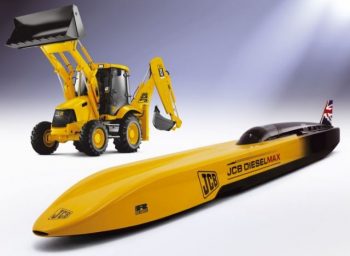
Mention should also be made at this point of the JCB Dieselmax which, on 22 August 2006 reached a speed of 328 mph at Bonneville with Squadron Leader Andy Green at the controls. This was powered by a pair of 5 litre engines developed from those used in the famous JCB diggers and claimed to be the World’s highest specific power diesel engines in an automotive application. Anthony Bamford, Chairman of JCB, lives at Stow on the Wold, Gloucestershire. He received a Knighthood in 1990 and became Baron Bamford in 2013.
More immediately from Donald Campbell’s point of view, on 5 September 1963 Craig Breedlove had set a World Land Speed Record of 418.312 mph at Bonneville Salt Flats in his jet propelled Spirit of America although this was recognised by the Federation Internationale de l’Automobile (FIA) as a motor cycle rather than a car due to having three wheels. A rocket powered Bluebird CN8 got as far as the mock up stage but by his time British money was becoming scarce for such a project.
Meanwhile, 5 October 1964 saw the four wheeled Wingfoot Express designed by Walt Arfons, driven by Tom Green, powered by a WH J46 jet engine, set a new World Land Speed Record at Bonneville Salt Flats for the USA at 413.10 mph.Walt Arfon’s half-brother Art Arfons was the first to go faster than 500 mph at Bonneville with a World Land Record Speed of 544.134 in his turbojet Green Monster on 27 October 1964.
Craig Breedlove became the first man to push the World Land Speed Record past 600 mph in his turbojet powered Spirit of America Sonic 1 at Bonneville on 15 November 1965 when he reached 600.601 mph
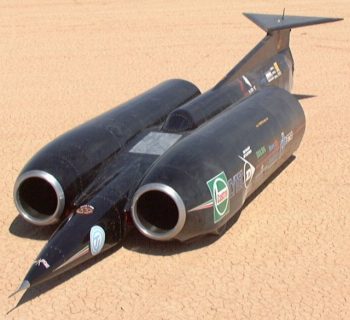
The World Land Speed Record was to remain American until 4 October 1983 when Briton Richard Noble drove his Rolls Royce Avon powered Thrust 2 across the Black Rock Desert in Nevada at 633.468 mph. Richard Noble was also behind the Thrust Super Sonic Car project which, with Squadron Leader Andy Green in the cockpit, set the current World Land Speed Record.
On 25 September 1997 Thrust SSC’s two Rolls Royce Spey engines powered it past 700 mph to 714.144 mph and on 15 October 1997 the first Supersonic World Land Speed Record was recorded with a maximum velocity of 763.43 mph. The suspension for Thrust SSC, pictured above, was partly designed by Gloucestershire based Dowty Hydraulics.
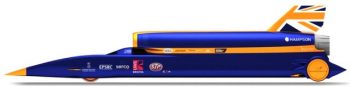
Squadron Leader Andy Green is currently set to drive for Richard Noble again at Hakskeen Pan, Northern Cape, South Africa, the site of one of Sir Malcolm Campbell’s record attempts in 1929 .
The new 44′ long World Land Speed Record car – called Bloodhound SSC – is unique in combining a Eurojet EJ200 engine from a Eurofighter Typhoon with the first new rocket motor built in Britain for 20 years, itself capable of making the loudest man-made noise in the World. Combined, the rocket and gas turbine will produce 135 000 horsepower, equal to 180 Formula One cars.
The team behind the project hopes to reach 1 050 mph – faster than a speeding bullet from a Magnum 357 and also beating the low-altitude thick-air speed record for aircraft, set by a Lockheed F-104 Starfighter – of 994mph.
In practical terms, Squadron Leader Green will face 2G of acceleration – the equivalent of 0 to 60 mph in 1.5 seconds – as the gas turbine reaches 350 mph in 40 seconds while a 750 bhp Ford Cosworth Formula 1 piston engine pumps hydrogen peroxide fuel to the 12′ long 18″ rocket, the largest of its kind ever designed in Europe and capable of producing 27 500 lb of thrust – equivalent to about 80 000 horsepower, the combined output of 95 Formula 1 cars. Deceleration however will be at 3G – the same as 60 mph to zero in 1 second or an average car crash – achieved by aircraft style dive brakes and than parachutes before Bloodhound SSC is turned and prepared for a second run in the opposite direction. Under FIA rules, the average speed of the two runs – which must take place less than one hour apart – will determine the recognised achievement.
The Ministry of Defence is backing the project, and Whitehall chiefs hope young people will be inspired to get involved in science, technology, mathematics and engineering. A team of five Royal Electrical and Mechanical Engineers experts will help build and maintain the car over the next two years in the UK, and be on hand during the record attempts in South Africa in 2014.Philip Dunne, Minister for Defence Equipment, Support and Technology, said nurturing engineering skills in youngsters is vital to British industry, and the project is a good opportunity for the Army to share its experience and skills and “That experience will feed directly back into the front line as they progress through their Army careers.”
Carbon Neutral Investments (CNI) has also signed an exclusive agreement to become the sole environmental sponsor of the Bloodhound SSC project, rendering it the world’s first carbon neutral land speed record attempt.
Also hoping to break the 1 000 mph barrier in the next few years are Ed Shadle with his North American Eagle (based on a Lockheed F-104 Starfighter and driven by Dane Per Wimmer), Mark Reed’s Aussie Invader R5 – based on a 30′ steel oil pipe, and the Perth, WA based Silver Bullet RV-1.
From Camille Jenatzy passing 60 mph to Andy Green travelling at Mach 1.016 had taken less than a century, but a century in which mankind had nearly destroyed itself with nuclear weapons and had flown to the Moon, enabling it to look back on the blue jewel-like oasis Earth set in the infinity of space and realise that all of us have to live on one planet together. Although the 65.7 mph of “La Jamais Contente” was soon eclipsed by fossil fuelled record breakers, electric cars – which can ultimately be fuelled by wind, tidal or maybe nuclear fusion energy – have more recently been reassessed by both ecological enthusiasts and potential speed seekers.
The current World Electric Land Speed Record is held by Roger Schroer driving the Buckeye Bullet 2.5 at 307.66 mph at Bonneville on 24 August 2010 compared to the first post World War II holder and fellow American Jerry Kugel who set a World Electric Land Speed Record of 138 mph in his Lead Wedge at Bonneville in 1968.
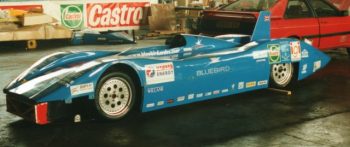
British Electric Land Speed Record was set on Pendine Sands, Carmarthenshire, on 19 August 2000 at 137.15 mph by Donald Wales, son of Jean Campbell and nephew of Donald Campbell, in Bluebird Electric 2000. Donald Wales was inspired to take up battery power after his young son Joe developed asthma and said in 1998:
“If I can show that electric cars do not have to be slow and cumbersome, I will have made a lasting mark for the health of my child.” In August 2009 Don Wales, sharing driving duties with Charles Burnett III, also set a new World Land Speed Record for steam of 148.166 mph at Edwards Air Force Base, California. The 25′ long British Steam Car – nicknamed “The Fastest Kettle in the World” – smashed the old record of 127 mph set by American Fred Marriott’s Stanley steam car in 1906.
Gloucestershire’s involvement in this feat came from Crouch and Hold of Gloucester who provided the team’s uniforms, Quedgeley based Eventageous who looked after the team’s publicity and Spirax Sarco of Cheltenham supplied the British Steam Car’s main steam bypass and throttle valves.
The 3 tonne British Steam Car – made from carbon fibre composites and aluminium on a steel frame – burned liquid petroleum gas in 12 boilers to raise 400 degree centigrade superheated steam to drive its turbine prime mover. As such it consumed a third of its weight in demineralised water in just 25 minutes, with 50 litres a minute being exposed to three megawatts of heat and steam entering the turbine at twice the speed of sound.
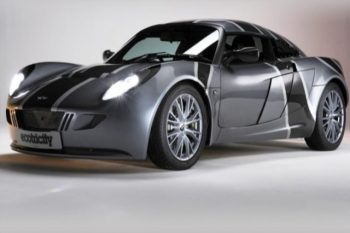
However, a new British Electric Land Speed Record of 151 mph was set on 27 September 2012 at Elvington Airfield near York by 21 year old Nick Ponting at the controls of Nemesis, a Lotus Exige modified at a cost of £750 000 by the Gloucestershire based founder of green energy company Ecotricity. “It’s the first electric supercar built in Britain. I’m very proud.” said 51 year old Dale Vince, referring to the Norfolk built Nemesis, which can reach 100 mph from a standing start in 8.5 seconds and can travel 150 miles between charges.
Then, on Friday 8 November 2013, the FIA Land Speed Records Commission announced the homologation of three new electric World Land Speed Records by Drayson Racing set between 8 and 10 October 2013, again on the 3 000 metre runway at Elvington.
The team’s prototype racing car achieve three flying starts of 1 km in 10.802 seconds with an average speed of 333.271 km/h, 1 mile in 17.549 seconds with an average speed of 333.271 km/h and a 4 mile stopped start in 9.742 seconds with an average speed of 148.676 km/h.
On the new record attempts, Lord Drayson (CEO) commented: “We are continuing the testing and development programme of our electric drivetrain technology and we are delighted with the results achieved. The engineering challenge of accelerating a 995kg electric car to these speeds and then stopping in time on such a short runway is pretty intense, but it’s a great proving ground for our technology. It’s also an exciting way of demonstrating what’s possible with a state of the art electric vehicle.”
The new records build on the Drayson Racing team’s existing electric land speed record portfolio. The team is a pioneer of green racing technologies and was one of the first to sign up for the FIA Formula E Championship in 2014.
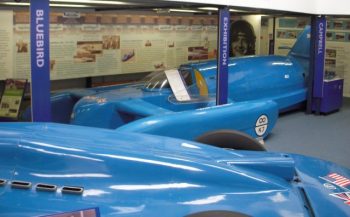
Nevertheless, by setting a new World Water Speed Record of 276.33 mph at Lake Dumbleyung in Australia on 31 December 1964 Donald Campbell became the only man ever to have held both the World Land and Water Speed Records in one year
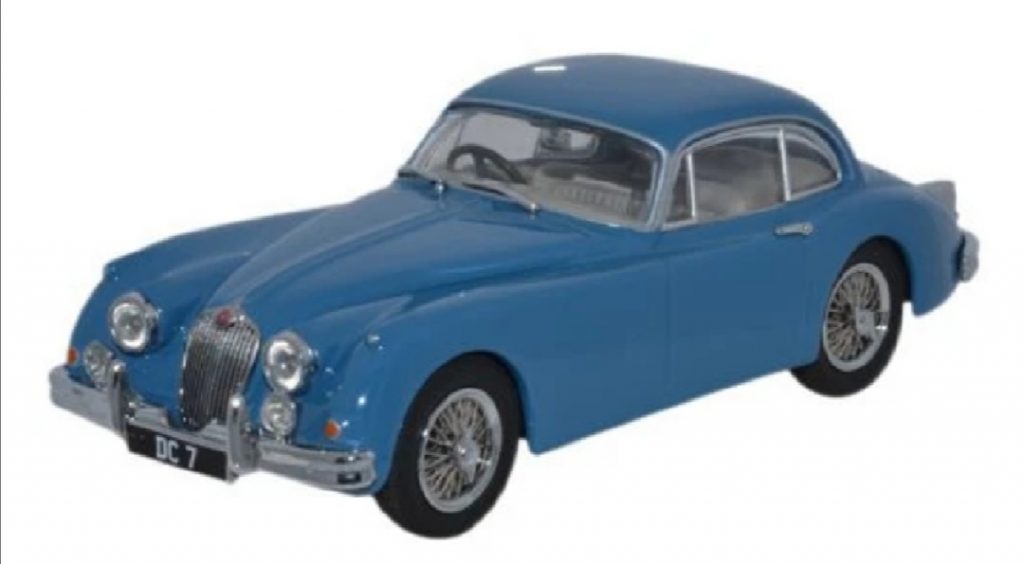
Indeed, between July 1955 and December 1964 Donald Campbell set World Water Speed Records on 7 different occasions and on the basis of this was made Managing Director of Dowty Marine, which had acquired the manufacturing rights to a New Zealand designed motorboat which was propelled by jets of water rather than a conventional propeller. This could not only travel very quickly but could also operate in very shallow water, as Donald Campbell was to demonstrate on the gravel pit lakes at South Cerney in Gloucestershire. Donald Campbell’s Dowty Marine company car was a Cotswold blue Mark II Jaguar with the registration 7759 DD although his own vehicles included XK150 and E Type Jaguars, both in Bluebird Saxe blue and with the registration DC7.
However, a new American threat to exceed 300 mph led to Donald and his team redesigning Bluebird K7.
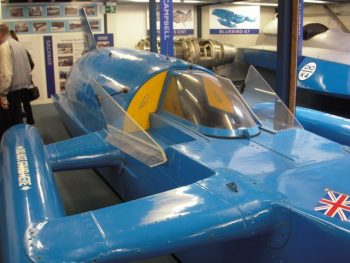
In 1965 a 5 000lb thrust Bristol Siddeley Orpheus jet engine – originally designed for a plastic cruise missile – replaced the heavier and less powerful Metro-Vick Beryl and a tail from a Folland Gnat jet trainer was added to Bluebird hydroplane K7 along with a single tail mounted air-speed indicator.
Kerosene consumption on the three point hydroplane was 650 gallons per hour as it sucked in three tons of air per minute. Beam was 10’6″, length 26′ 43/4″ and the vessel weighed 2 1/2 tons in working order. .On Coniston Water at 08.55 on 4 January 1967. Donald Campbell was tragically killed when Bluebird K7 soared into the air, somersaulted, crashed and disintegrated.
Not stopping to refuel after a first run of 297 mph, he had turned and made his way back to his starting point, hitting his own wake as he did so. Mr Whoppit, Donald Campbell’s teddy bear mascot, his helmet and shoes were recovered from Coniston Water at the time.
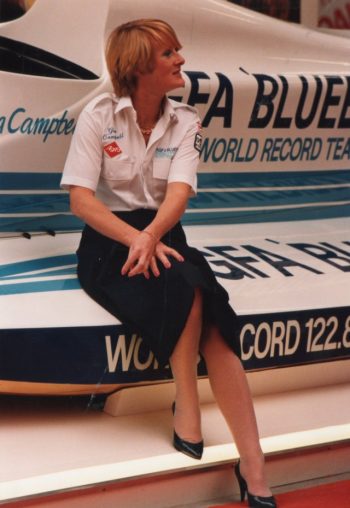
In 1984 Gina Campbell broke the Women’s World Water Speed Record at 122.85 mph on a lake in Nottingham in the Evinrude piston-engined Agfa-sponsored Bluebird II power boat before breaking both collar bones in a crash eerily similar to that which befell her father in 1967. Undeterred, Gina set a new record of 166 mph in New Zealand in 1990 in a three point hydroplane which she still owns. This was to stand until taken by New Zealander Heather Spurle in 1993 although Gina Campbell can still claim to have travelled faster on water than either her Grandfather or Father in a piston-engined vessel.
Interestingly, Londoner Dorothy Levitt became the first woman to set a land speed record of 91 mph at Blackpool in 1906, and the current title holder is Lee Breedlove of the USA who reached 308 mph in 1965.
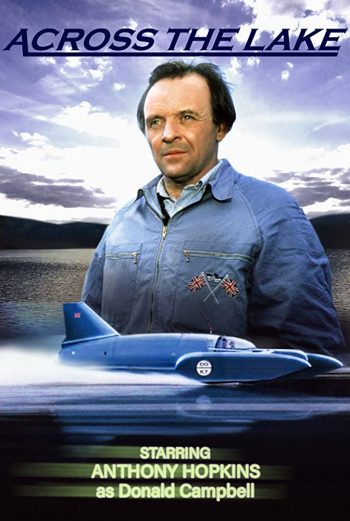
In 1988 BBC Television screened “Across The Lake”, a drama documentary about Donald Campbell with Anthony Hopkins in the lead role while ten years later in 1998 Britain’s Royal Mail issued a set of postage stamps commemorating wheel driven World Land Speed Record cars with Malcolm Campbell’s 151 mph Bluebird of 1925 on the 20p stamp, Henry Segraves 152 mph Sunbeam of 1926 on the 26p, John Parry-Thomas’s 171mph Babs of 1926 on the 30p, John Cobb’s 394 mph Railton Mobil Special of 1947 on the 43p and Donald Campbell’s 403 mph Bluebell CN7 of 1964 on the 63p.
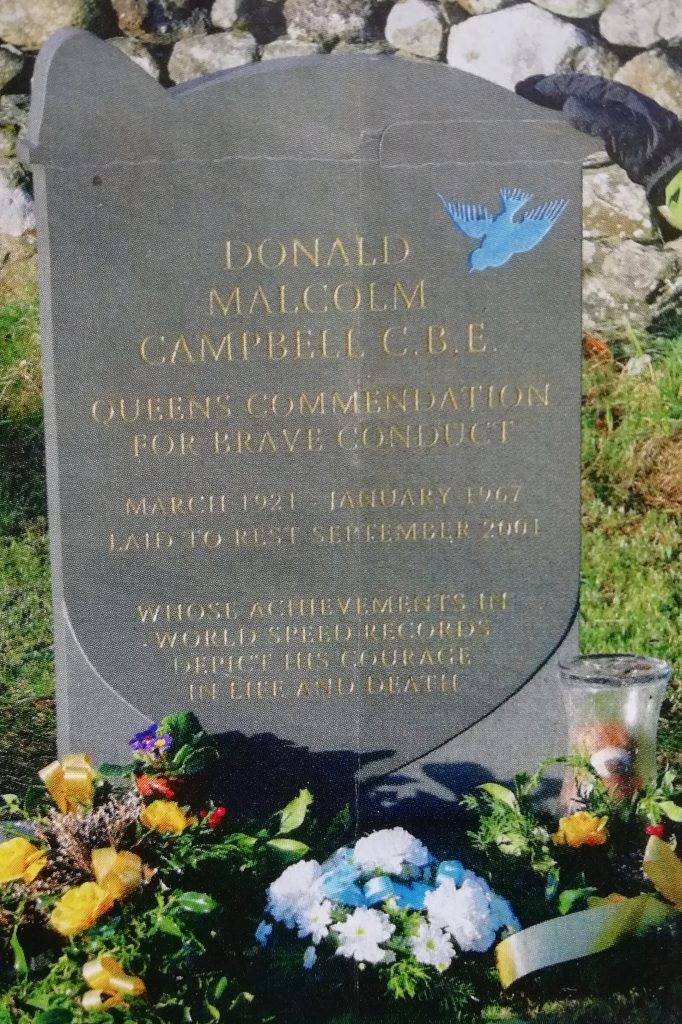
In 2001, Bluebird K7 and the body of Donald Campbell were recovered from Coniston Water. Donald Campbell was interred nearby and ambitious plans to restore K7 have still not been completed.
However, at 0848 on Wednesday 4 January 2017, a small group of people gathered on the shores of the lake to commemorate Donald Campbell and his quest for speed, 50 years after he paid the ultimate price for his daring.
Among the reflective gathering was Chris Ellison, in 1967 a 12 year old schoolboy: