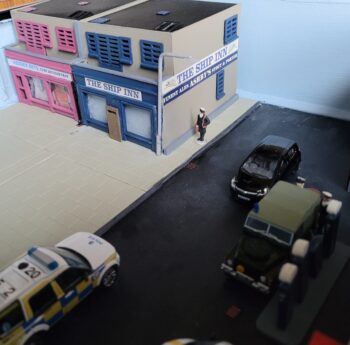
In early 2022 I began building a street scene diorama inside a compact, strong, portable lever arch file as an economics teaching aid for my good friend Mark Brassington. This was to make real some of the more abstract concepts contained within the study of Economics.
For example, in Economic terms, schools, public transport (as represented by the travel agency), the national electricity grid, hospitals, libraries, museums and art galleries are considered to be Merit Goods that are beneficial to society.
Demerit goods however would include tobacco and, with excessive use leading to anti social behaviour, betting shops and pubs.
Street lighting meanwhile is an example of public goods. Street lights provide an example of market failure resulting from missing markets. The characteristics of pure public goods are the opposite of private goods. They have non-excludability. The benefits derived from pure public goods cannot be confined solely to those who have paid for it.
Following on from this, a fire station is a quasi public good. Fire and rescue services are paid for through taxation and are not charged at the point of use but do require calling out to an incident which should be genuine and legitimate.
In terms of local and national security, the police and armed services work on a similar principle.

Having established the structures needed – in this case a fire station, pub, betting shop, library, travel agent and garage – the next challenge was finding examples that would fit the limited headroom of the box – to scale, less than the height of a standard concrete lamp post.
Luckily I had – already built by the late Ron Brooks – a fire station adapted from the Dapol (ex Airfix) Modern Shop and Flat. As well as filling the hinging door and window space with folding doors, Ron had crucially omitted the chimney and rooftop water tank supplied with Dapol kit C031. In this form, the fire station just fitted inside the box file, even allowing for a 10/1000″ plastikard tarmac roadway being inserted underneath.
This gave me the idea of using pairs of Modern Shop and Flat kits as pub, betting shop, library and travel agency to form an up to date pedestrianised shopping street at right angles to the fire station. This would have a Wills SSMP21 Victoria Stone pavement with a kerb made from extruded square-section plastic rod of appropriate size.
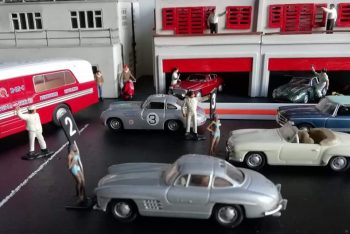
In fact similar techniques had previously used to create the pit garages on my Castle Mingington race track diorama. In both cases, the windows between the two examples of C031 were omitted.
First though, the inner walls of the box file itself were painted with Dulux First Dawn, which took to the paper lined long walls much more readily than the black plastic ends, and the first structure to be built from new and installed was the Service Station, Dapol kit C032.
Independent petrol stations such as the one moulded by Airfix in the 1950s are rapidly disappearing in favour of supermarket forecourts, who sold 40% of all road fuel in 2012. In fact while there were 37 500 petrol stations in the UK in 1970 – when the Esso ones were giving away free England World Cup Squad coins to collect – by 2012 there were only 8 677. These factors, combined with the small percentage of the price of a litre of petrol that the garage owner actually receives for each transaction, have thus driven many traditional garages into either just selling and/or servicing cars. Indeed, how many small garages will survive in the new age of electric vehicles charged at home?
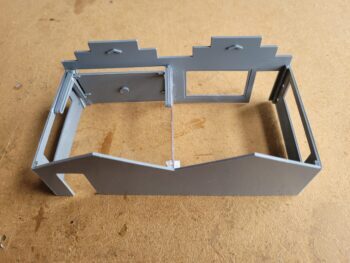
Kit C032 is also a product of its times in being a shell without interior detail featuring a toy-like moving up-and-over door supported by two L shaped brackets.
Due to the wear on the venerable moulds, these components are often compromised by flash and would need careful preparation if the door was to be used as intended.
As it happens, I was able to obtain an Oxford Diecast Ford Transit Mark 5 (76FT035) in National Grid markings with a light bar at the rear of the roof. This not only represented a merit good in itself but backed up into the service bay and stuck down, the light bar supported the door.
However, without a division between the service bay and shop, light would have bled unrealistically through the structure. For this reason, a 10 thou plastikard division was inserted and located in place with two short sections of plastic rod. Although the plastikard was clear, it was soon to be sprayed first with grey primer and then matt black. Before this however, the one-piece two-ridge roof was attached, located on the triangular pips seen in the picture above.
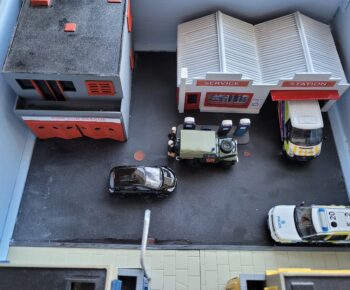
Once the interior was suitably darkened, the outside of the Art Deco service station was sprayed appliance white. The decor sheet of Kit C032 gave the options of Texaco or Esso markings for the petrol pumps and as the fire station next door was red and grey I opted for the red, white and blue of Esso. Further, I painted the body of the diesel pump black and, separated by the oil dispenser, a dark blue pump for unleaded petrol and light blue for super unleaded.
As is the practice with many British small roadside garages, the pump island is set back towards the shop and designed to be used on one side only: in this case just allowing two way traffic on the road assuming that no vehicle is larger than the Royal Navy Land Rover Lightweight (76LRL009) with its attendant Peco Modelscene RN figures or the Land Rover Discovery 4 of the West Midlands Police (76DIS006). The fourth, purely private civilian, car is a Vauxhall Corsa (76VC004), also from Oxford Diecast range and representing both a modern small hatchback and my fund of Girls Aloud jokes that I know Mark enjoys so much.
Before leaving the road, I should also mention the light column added to the shop to illuminate both the pumps and the entrance between the garage and the fire station. This supplements the public lamp post outside The Ship Inn across the street for security and safety at night.
The matt black road surface was weathered with a light dusting of talcum powder and the manhole covers and drains were brass components from Langley Models.
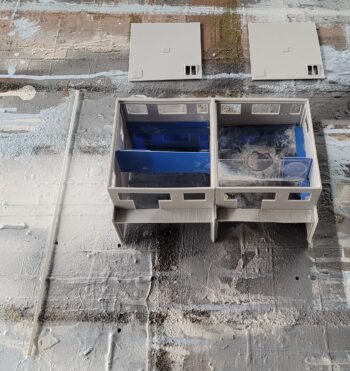
While the pits at Castle Mingington were sprayed complete, the frontages of the four pedestrianised premises were kept for separate painting. Care had thus to be taken to keep the conjoined structures square while the components were being glued. These comprised both the outer walls supplied with the kit and the floors and room dividers scratchbuilt from plastikard. As with the service station, all these components would ultimately be sprayed a uniform colour. The floors and dividers could also be built up from a number of pieces of thin material rather than one single thicker one with a precise fit.
In each case, the building roof was only glued into place when everything else was positioned satisfactorily, and the skylight in the now-blackened roof and all windows had been glazed.
While Appliance White had been used on the garage, the Cotswold Stone effect was produced by overlaying grey primer with Halford’s Camouflage Khaki.
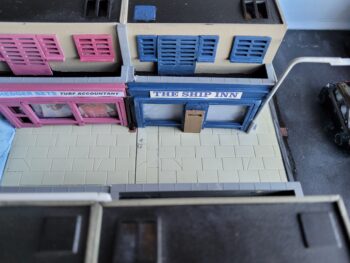
On the potential demerit side of the street, the graphics for The Ship Inn came from a sheet supplied free with Model Rail magazine in 2001 (and kept for such an occasion!) while that of Hedger Bets, Turf Accountant and the other C031 based structures was printed out on 11 point Arial typeface. With careful cutting out, these perfectly fitted the grooves above the shop fronts.
One of the solid doors intended for the rear of the C031 kit made a more credible pub entrance than the official glazed offering and the frosted glass was created simply by leaving on the protective skin of some clear plastikard.
In the bookmaker’s shop window, images of the cricketer and footballer were cut from TV listing magazines. The woodwork surrounding them was painted Polish Crimson, a tin of which I still had from the 1970s when it was one colour used for troops in the Napoleonic Wars. However, any shade of pink would have worked in giving Hedger Bets a more female friendly image – allowing the traditionally male industry a chance to compete with the proliferation of online bingo sites.
In contrast, the mid to dark blue of The Ship Inn gives off a more manly, slightly rough around the edges vibe.
The name Hedger Bets was not only a play on the phrase “Hedge your bets” but an homage to Blackpool born glamour model and former Miss Preston Nickie Hedger, who I always thought should go into turf accountancy when she hung up her bikini, in the same way that BBC journalist Stephen Sackur should sell vegetables wholesale.
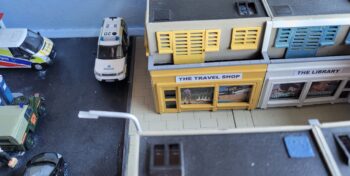
The merit goods side of the street was characterised by white and light blue for the library and a cheerful, sunny yellow (Nissan Solar Gold, left over from spraying a garden gnome for Mark) for the travel agency. Once again, TV listing magazines supplied the pictures of Steve McQueen and John F Kennedy (Art and History at the library, I couldn’t find a suitable picture of Charles Dickens) and holiday advertising yielded the swimming pool, villa and rural Europe. As it happens, the Model Rail sign sheet also included a hoarding poster for Lufthansa which matched the Travel Shop colours when affixed to the side facing the garage.