
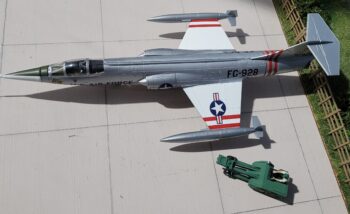
When preparing to present Universal Works Does McDonnell Douglas in 2013, I realised that the aircraft could be enhanced by the vehicles and personnel from the Hasegawa 1/72 scale US Aircraft Weapon Loading Set that had been kindly given to me by Ron Brooks along with a range of other military vehicles.
However, although Ron had built the Ford Tractor from the set, the components for the MJ-1 Lift Truck, trailers and ground crew were still unpainted on the sprues and the instruction sheet was missing.
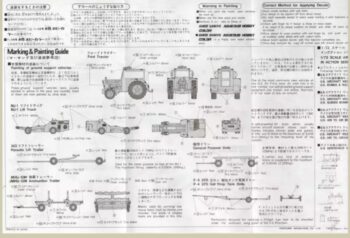
Although this information was not visible directly on the internet, I managed to contact Simon Tester of Hasegawa’s British distributor Amerang Limited of Lancing, West Sussex, who was kind enough to post me an instruction sheet. Unfortunately, as their website announces, Amerang are now in administration so to help anyone else in the same situation I here combine the details of how to assemble the Hasegawa 1/72 scale US Aircraft Weapon Loading Set with my finished results.
The instruction sheet itself is definitely pre-internet – mentioning only a telephone number and snail mail address – and judging by the artwork style and picture of an Fairchild A-10 Thunderbolt the kit dates from the 1970s. As might be expected from a Hasegawa kit, written information is in both Japanese and English and much space is given to warnings about the correct way to paint and apply decals and even an exhortation to “learn correct usage of tools” and “keep all materials and tools neatly”. However, the sprue guide, reproduced here larger than actual size, is a feature only now becoming common with Airfix.
Intriguingly, there is also a section advertising sets of US air launched weapons in the Hasegawa 1/72 scale Aircraft In Action series as well as a kit of “US Aerospace Ground Equipment” featuring a Generator Set, Hydraulic Test Stand, Air Conditioner, High Pressure Compressor, Lighting Unit, Fire Extinguisher, Tool Wagon and Wheel Chock. Now, where can I find one of those?
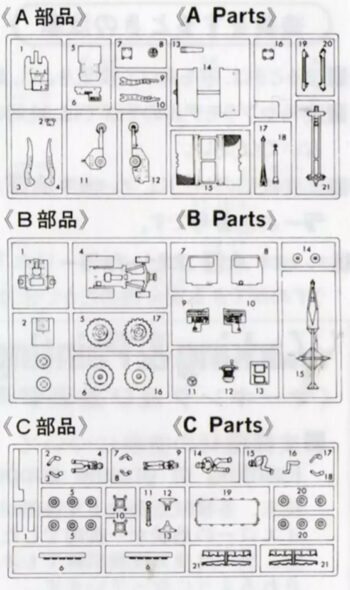
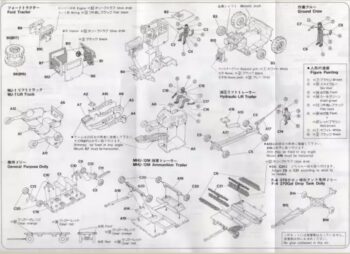
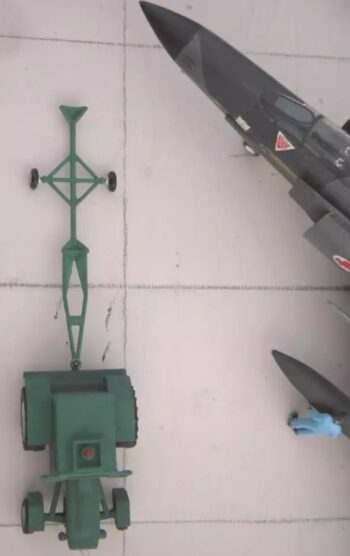
None of the vehicles or personnel in the kit proved difficult to assemble although it is worth keeping glue away from the hinges of the lifting arms of the MJ-1 Lifting Truck and Hydraulic Lift Trailer as these assemblies fit together snugly and can so be posed as lowered or raised depending on the represented situation. In both cases the components due to come in contact with the aircraft hardware (A7 and A16) should remain horizontal at all times.
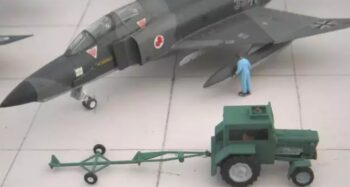
The instruction sheet describes the Ford Tractor as one of the most commonly seen vehicles at any US Air Force base but emphasises that it is not normally used to tow aircraft. In this case it is towing the Dolly specifically designed to move the 370 gallon drop tank fitted to the outboard wing pylon of the McDonnell Douglas F4 Phantom II.
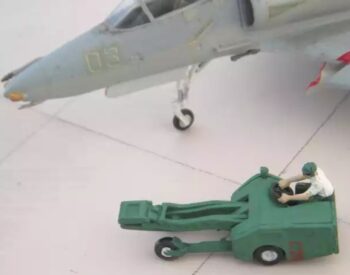
The self-propelled MJ-1 Lifting Truck is similarly described as being able to take a 3 000 lb (1360 Kg) load while the Hydraulic Lift Trailer (furthest left in the picture below) is rated at 2 200 lb or 998 Kg. To its right is the 5 000 lb (2 268 Kg) carrying General Purpose Dolly while the MHU-12M Ammunition Trailer can be completed with either a single or double row of racks for bombs and missiles.
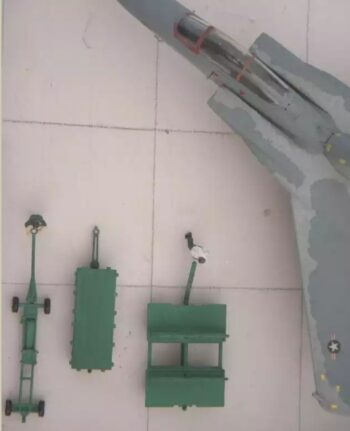
Ground crew member B (seen in the white shirt below and unique in being a one-piece casting rather than having separate arms) has a stomach indentation to take the probe outboard of the towing ring of all three of these trailers, which lend themselves to being assembled with the towbars unglued to allow them to be posed at rest or being pushed or towed.
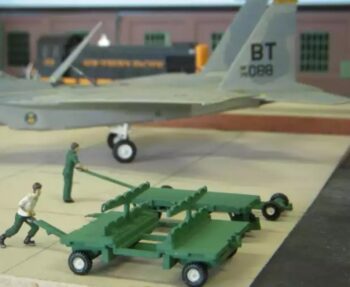
Finally, the instruction sheet notes that “These ground support vehicles were usually painted yellow in the past, but recently most of them are over painted by olive drab.” In this instance though, I saw the ground vehicles being used by Universal Works Inc, a subcontractor of McDonnell Douglas, and painted a more stylish Sage Green with white wheels. However, this livery could be rapidly converted to camouflage if the vehicles were commandeered by the US military for overseas service.