
2021 marks both the centenary of the Gloster Bamel racing biplane and the 70th anniversary of the first flight of the Gloster Javelin: the first T tailed twin engined delta winged fighter in the World.
Between these two events, flying boats and airships declined, helicopters rose, monoplanes supplanted biplanes and piston engines gave way to jet and rocket propulsion.
A model display presented at Jet Age Museum, Gloucestershire, in the summer of 2021 highlighted just some of the aircraft from that exciting era, ranging from ever more capable fighters and bombers to experimental aircraft that shrank distance and began to reach out towards space.
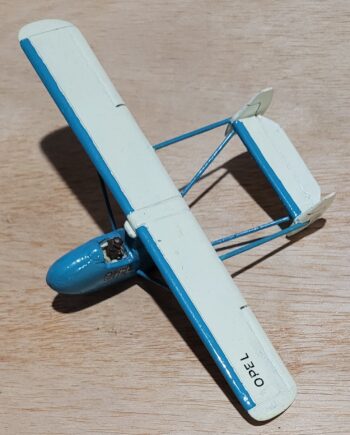
The Opel RAK.1 (also known as the Opel RAK.3) was the world’s first purpose-built rocket-powered aircraft. It was designed and built by Julius Hatry under commission from Fritz von Opel who flew it on September 30, 1929 in front of a large crowd at Rebstock airport near Frankfurt am Main. During the late 1920s, von Opel had undertaken a variety of publicity stunts involving rocket-powered vehicles, Opel-RAKs, for the Opel company. He was assisted in these endeavours by pyrotechnics manufacturer Friedrich Sander and rocketry advocate Max Valier. In June 1928, he had purchased an Alexander Lippisch-designed sailplane, the Ente, and fitted it with rockets. Opel did not get the chance to fly it, however, as the aircraft was destroyed by an engine explosion on its second test flight. The RAK.1 had a typical sailplane wing, under which a pod was suspended to accommodate the pilot and sixteen solid rocket engines. The tailplane was mounted on booms behind the wing and high out of the way of the rocket exhaust. Opel successfully piloted it over 1.5 km (0.93 mi) in 75 seconds of flight, but landed hard, damaging the aircraft beyond repair. Opel planned to build a second rocket plane, but apparently lost interest before the project was completed. The aircraft is sometimes referred to as the Opel-Hatry RAK.1 or Opel-Sander RAK.1 in acknowledgment of its builder or the supplier of its engines respectively. In still other references it is called the RAK.3 to distinguish it from Opel’s previous RAK.1 and RAK.2 rocket cars. As it happened, all three names, Opel, Sander, and Hatry were painted on the aircraft (with Opel’s most prominent), as was the RAK.1 designation.
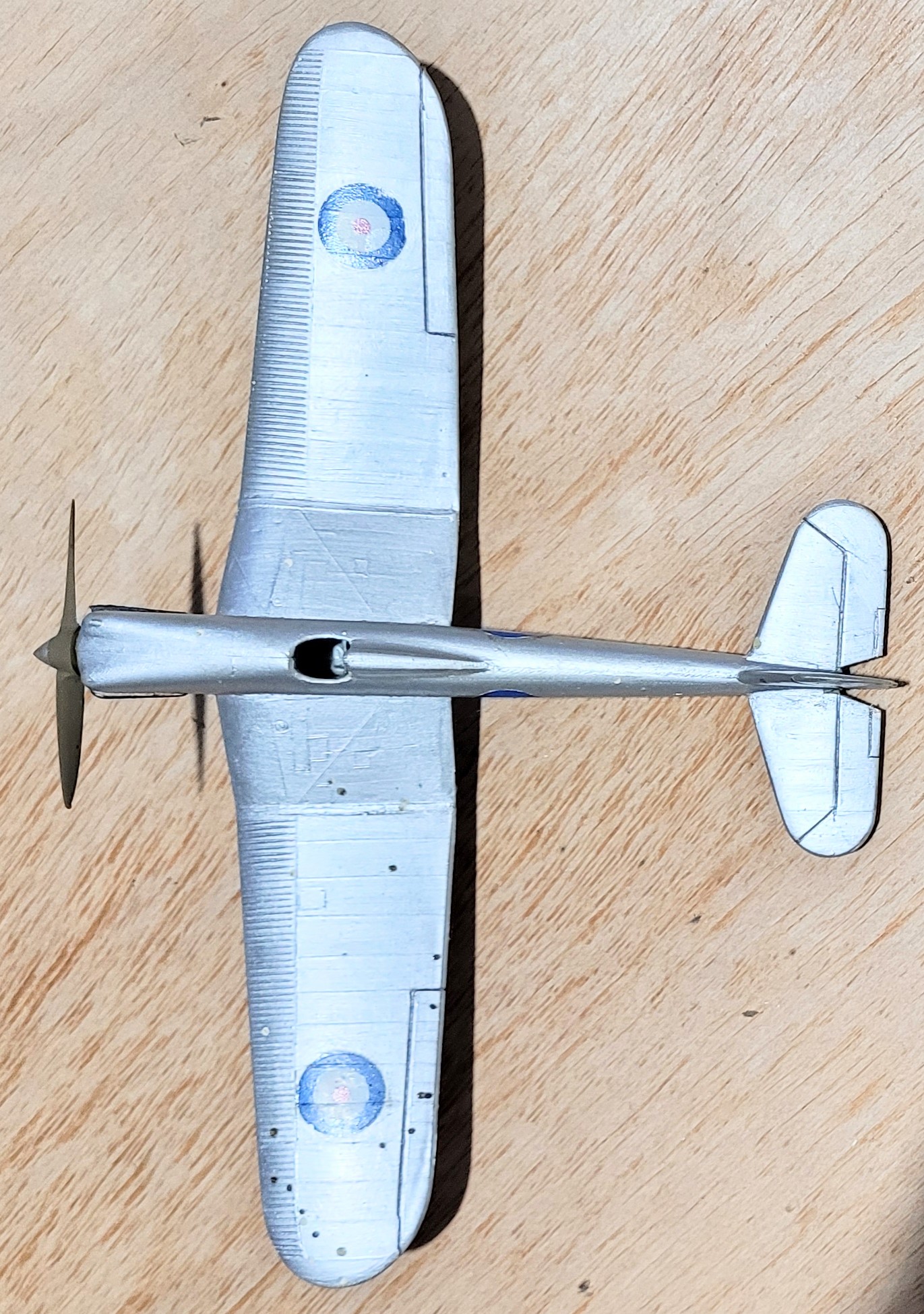
With the release of Air Ministry Specification F.7/30 on 1 October 1931 the the search began for a successor to the Gloster Gauntlet – which was still four years away from entering service.
The intended day and night fighter was to be able to reach 250 mph, be all metal and have armament consisting of four machine-guns. Other requested requirements included good pilot visibility, low landing speed and long endurance although any engine could power the aircraft.
The Supermarine design would have to compete against seven other entries and the Type 224, as it was known, was a monoplane featuring a inverted gull wing and fixed undercarriage. The engine chosen by the company was the 600 bhp Rolls Royce Kestrel IV which would later be renamed the Goshawk II. An experimental engine this was cooled by evaporation as opposed to the normal radiator engines which meant less water was needed and thus saved weight.
As required by the Specification, four machine-guns would be fitted. One in each side of the undercarriage fairings and one in each wing near the cockpit.
Using the gull wing design which was laterally unstable, meaning the aircraft moved from side to side whilst in flight, lead to the design undergoing heavy testing in the wind tunnel which showed that the aircraft was directionally unstable. To resolve this issue the fin area was increased.
In the hands of J ‘Mutt’ Summers Supermarine’s new fighter, which was unofficially named the Spitfire, made its maiden flight on 19 February 1934.
However the top speed of the Type 224 was only 228 mph some 22 mph down on the requirement and only 18mph faster than the Gauntlet which it was intended to replace.

Despite making an appearance at the Royal Air Force Display at Hendon on 30 June 1934 the Type 224 was to lose out to the successor of the Gauntlet, the Gloster Gladiator.
Only one Supermarine Type 224 was built and this arrived at the Aeroplane and Armament Experimental Establishment at Martlesham Heath on 25 May 1937 where it was used on a firing range as a target.
Whilst the Type 224 never entered production, the experience and data gained from the aircraft would prove beneficial for Supermarine’s next design, the Spitfire.
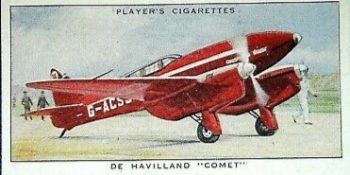
At the start of 1934, aviation pioneer Geoffrey de Havilland announced that his company would build a new aeroplane especially to win the MacRobertson air race to Australia. Just nine months later, the de Havilland DH88 Comet was introduced to an excited public.
Although there was little chance of de Havilland making money out of the DH 88, the company was keen to accrue publicity and prestige from the MacRobertson race and research advanced construction techniques.
In fact A. E. Hagg’s cantilevered monoplane featured mainly spruce and plywood stressed skin construction, only made possible by recently developed high strength synthetic bonding resins. The design also included an enclosed tandem cockpit, retractable undercarriage, split landing flaps and variable pitch propellers. These were set to fine pitch at take off and could be altered to coarse pitch pneumatically in flight – but could only be returned to fine pitch on the ground. The two specially tuned de Havilland Gypsy Six R engines could take the the DH 88 to at least 200 mph. Feeding these were two fuel tanks ahead of the cockpit and one smaller one behind to help the crew balance the aircraft.
Three of the sleek, twin engined racing machines were ordered – two of which would feature prominently in the race with the red G-ACSS Grosvenor House first to cross the finishing line.
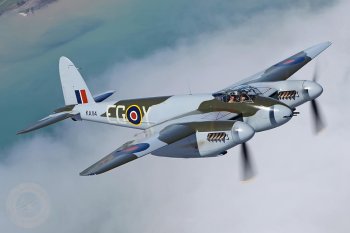
However, by 1939, lessons learned from the building of the Comet racers was being applied by de Havilland to the DH98 fighter and bomber better known as the Mosquito. Among other tasks, this wooden twin engined type was used by the RAF Pathfinder Force for marking targets for night time heavy bomber raids. Ranged against them were the aircraft of the Luftwaffe, many of which had begun life – somewhat euphemistically – as sports and high speed mail aircraft.
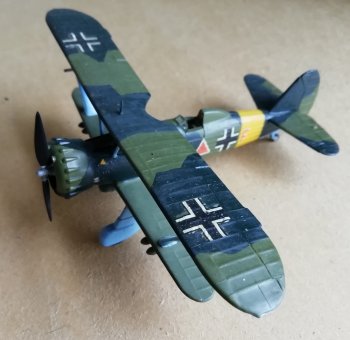
Henschel was a railway locomotive manufacturer before 1933 but like Gotha, ATG and shipbuilder Blohm und Voss was encouraged to move into aircraft production to equip the rapidly growing Luftwaffe. Similarly, existing aircraft manufacturers such as Dornier, Heinkel, Fieseler, Arado, Messerschmitt and Junkers were given new government contracts. The HS 123 was a sturdy sesquiplane which proved successful in the Spanish Civil War of 1936 to1939 despite its limited bomb load and range. It was replaced in Spain by the Junker Ju 87 Stuka monoplane dive bomber.
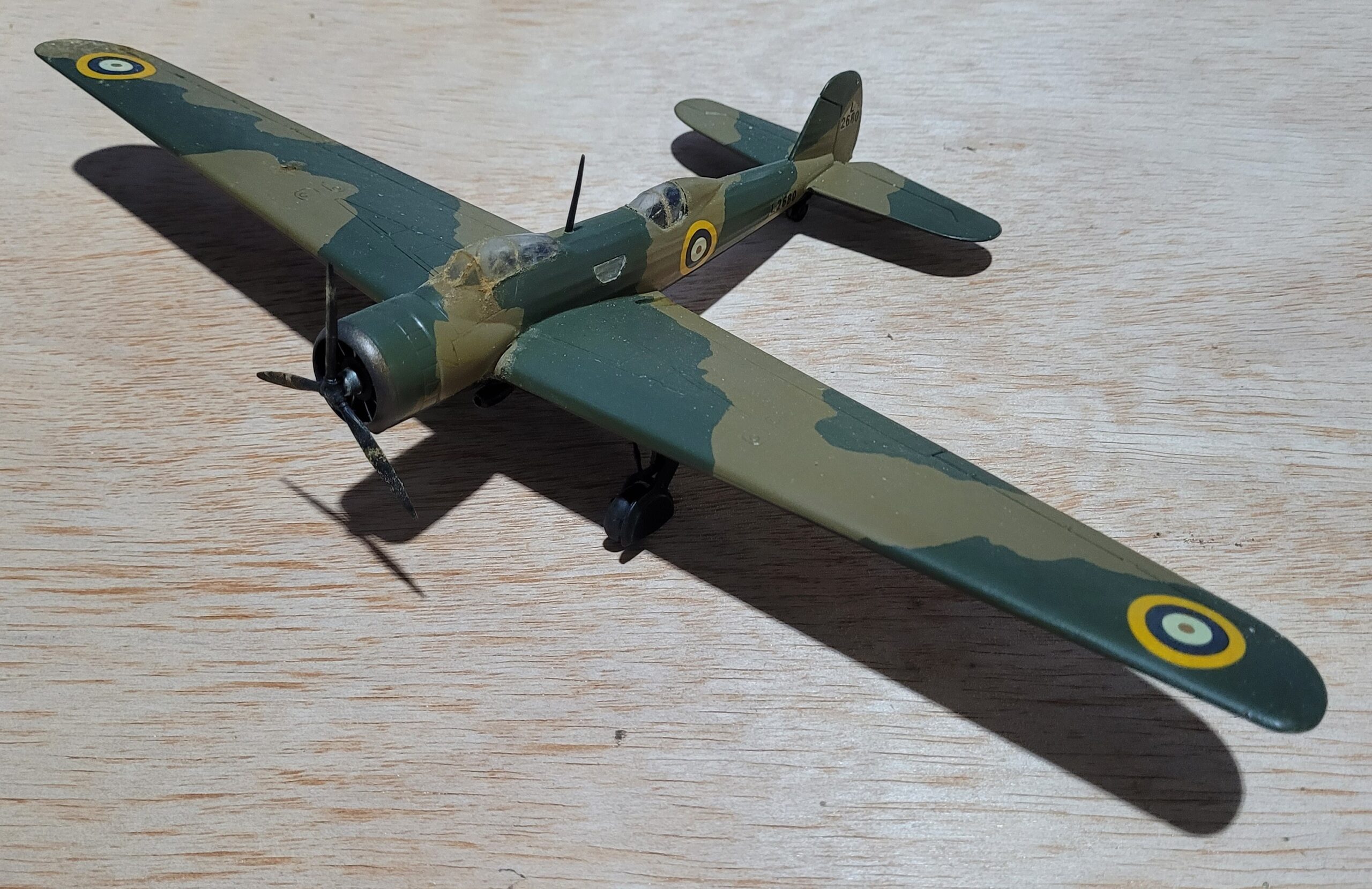
The Vickers Wellesley originated from Air Ministry Specification G4/31 which called for a general purpose aircraft capable of bombing, reconnaissance and army co-operation. Designed by Barnes Wallis using geodic construction, a Vickers Type 253 bi-plane won the G4/31 contest and in 1935 an order was placed for 150 machines. Meanwhile, Wallis was working on a monoplane, the Type 246, using the same construction techniques and this took to the air for the first time in June 1935. It soon became clear that the monoplanes performance was significantly better that that of the biplane and in September 1935, the Type 253 order was replaced with one for 96 Type 246s to fulfil a light bomber role. After a number of improvements, the first production aircraft, the Wellesley, took to the air in January 1937 and entered RAF service with No 76 Squadron at Finningley in April of that year. It went on to equip a total of 6 Bomber Command squadrons in the UK.
The Wellesley had a crew of 2, was powered by a Bristol Pegasus XX radial engine of 925 hp and featured a manually operated retractable undercarriage. Its armament comprised a Vickers .303 in forward firing machine gun in the starboard wing and a Vickers K machine gun in the rear cockpit. It was capable of carrying a 2,000 lb bomb load.
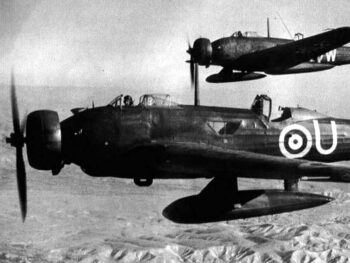
Five aircraft were modified to carry 3 crew members and equipped with a more powerful Pegasus XXII and extra fuel tanks for work with the RAF Long Range Development Flight. On 5th November 1938, 2 of the 3 aircraft that set out flew non-stop for 2 days from Ismailia, Egypt to Darwin, Australia (7,160 miles) to set a world distance record. This epic flight remains the longest by a single engined aircraft.
By the outbreak of the Second World War, Wellesleys had been retired from the UK units but continued to serve with 4 squadrons in the Middle East. As such they were heavily involved in the East African campaign against Italian forces in Eritrea, Ethiopia and Somalia from June 1940 until the last Italian-held town in theatre was taken by Allied forces in November 1941. Thereafter, one squadron carried out maritime reconnaissance duties over the Red Sea until the end of 1942.
Egypt and South Africa also operated the Wellesley. A total of 177 were built and there are no known survivors.

The Douglas C47, known as the Dakota in the Royal Air Force and Commonwealth services, became the world’s best known transport aircraft. The type saw widespread use by the Allies during the Second World War and by Air Forces and airlines post-war.
The C47 Skytrain and C53 Skytrooper were military versions of the DC3 airliner. The DC3 first flew in 1935 and was ordered by America’s airlines. With the outbreak of war these aircraft were diverted to the Allied Air Forces, followed by 10 000 military variants constructed before production ceased in 1946. Japan and the Soviet Union also built over 2000 unlicensed copies.
The first of over 1900 Dakotas received by the RAF arrived in India in 1942. Dakotas served in every theatre of the war, notably in Burma, during the D-Day landings and the airborne assault on Arnhem in 1944.
Most RAF Dakotas had been retired or sold by 1950, the last active aircraft leaving the service in 1970. The Royal Aircraft Establishment at Farnborough operated a former Royal Canadian Air Force example (ZA947) from 1971 until 1993, when it joined the Battle of Britain Memorial Flight.
British Overseas Airways Corporation (BOAC) took their first deliveries of Douglas Dakota C47s in 1943 and the last of approximately 60 aircraft in 1946. During WWII Dakotas were operated by both the RAF and BOAC.
After the war, BOAC sold the fleet, fourteen of which went to British European Airways when the airline was formed in 1946. One of the Dakotas acted as a testbed for the Rolls-Royce Dart engine before it powered the Vickers Viscount, the world’s first turbo-prop aircraft.
This particular model represents C-47B-35-DK with the constructors number 33282/16534. This was allocated USAF Serial 44-76950 going to the RAF as KN628 as a gift from General Eisenhower to Field Marshal Montgomery.
The Skytrain then passed to the British register as G-AOGZ and operated with Derby Airways, which operated services from Gloucestershire Airport to the Channel Islands.
G-AOGZ was sold by British Midland in 1967 to Sir Keith Murray and it was operated by “Strathair” It was then sold to Scottish Aviation Ltd in 1968 and exported to the USA in 1969 as N4849 before taking the French registration F-OGDZ.

The Bristol Blenheim was a truly unique aircraft and was a milestone in the history of British aviation as the first stressed skin aeroplane accepted by the RAF. It bore the brunt of the early war bombing effort and its crews paid a heavy price defending the nation, Winston Churchill paid homage to their bravery comparing them to the ‘Charge of the Light Brigade’. At the start of the war the RAF had 1089 Blenheim bombers in service, more than any other aircraft.
The Mark 1 Bristol Blenheim was based on the civilian Type 142: built by Bristol in 1935 for Lord Rothermere – proprieter of the “Daily Mail”newspaper – and named “Britain First”.
Powered by two 840hp Bristol Mercury VIII radial engines, the first chisel-nosed Blenheim 1 flew on 25 June 1936 and the type was exported to Finland, Yugoslavia, Turkey and Romania. A Mk 1F night fighter version followed, as did the Mark IV bomber version with the distinctive long scalloped nose and 920hp Mercury powerplants.
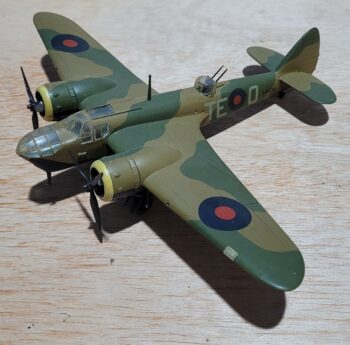
The Blenheim Mk IV in the display is an improved version of the Mark I, fitted with protective armour and extended nose, powered by two 905 hp (675 kW) Bristol Mercury XV radial piston engines, armed with a 0.303 in (7.7 mm) machine gun in the port wing, plus two 0.303 in (7.7 mm) machine-guns in a powered operated dorsal turret, and two remotely controlled rearward-firing 0.303 in (7.7 mm) machine guns mounted beneath the nose, maximum bombload 1,000 lb (450 kg) internally and 320 lb (150 kg) externally.
3,307 Blenheim IV were built and of these about 60 were converted to Mark IV F long range fighter standard long-range fighter version, armed with four 0.303 in (7.7 mm) machine guns in special gun pack under the fuselage.
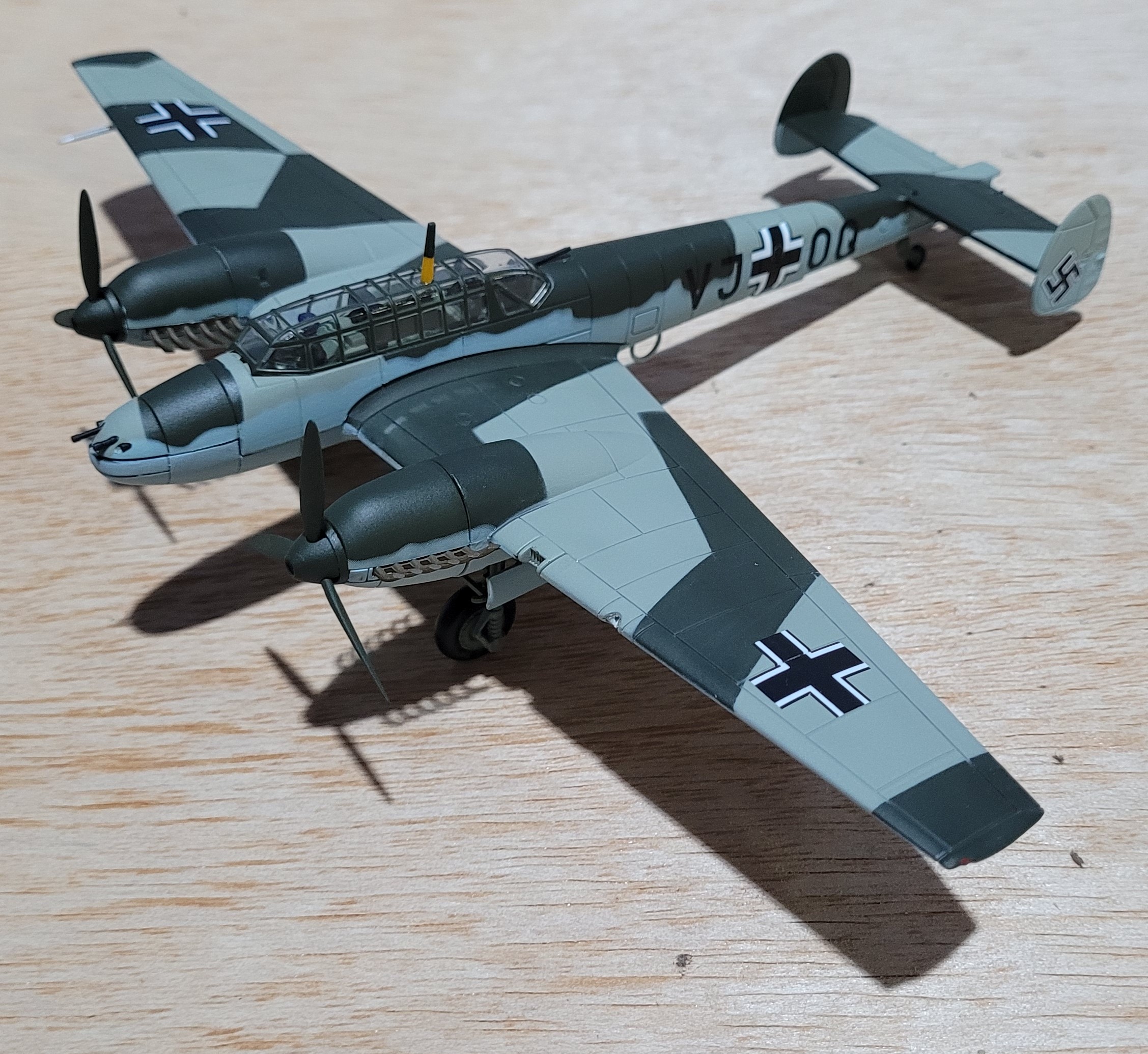
First flown in Bavaria in 1936, the Messerschmitt Bf 110 was an effective, highly versatile twin-engined aircraft. Outmanoeuvred by British single seat fighters during the Battle of Britain, it was converted into a night fighter and proved to be one of the most successful put into service during World War Two, claiming many four engined bombers of the RAF.
The Bf 110 was conceived as a long range escort fighter equally able to undertake defensive or offensive tasks. This high-performance, heavily-armed fighter first entered service in 1939 and was able to take part in the Polish campaign where it performed well.
The heavy long range fighter concept was not really put to the test during the opening months of the war but events in the Battle of Britain proved it to be a mistake.
Although a highly effective fighter the Messerschmitt Bf 110 was misused as an escort fighter on daylight bomber missions which resulted in huge losses. Operating well below its top speed it proved unable to fight on equal terms with the more agile Hurricanes and Spitfires of RAF Fighter Command.
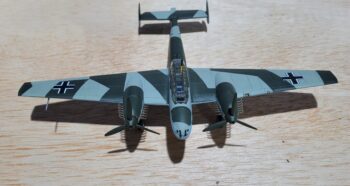
Although mounting losses should have resulted in its withdrawal, because of the limited range and endurance of the single engined Messerschmitt Bf 109Es the Germans were forced to continue using the type as a fighter escort on its daylight raids.
Messerschmitt Bf 110s also took part in the German campaigns in North Africa and against the USSR, but the subject of this Corgi diecast model is one of the most infamous and controversial of the twin-engined Bavarische Flugzeugwerke products. It was piloted to Scotland by Rudolf Hess.
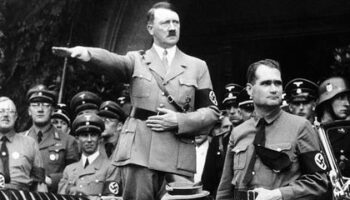
Rudolf Walter Richard Hess, pictured above with a black tie and swastika armband right of Adolf Hitler, was born on 26 April 1894 in Ibrahimieh, a coastal suburb of Alexandria, Egypt (then under British occupation, though formally a part of the Ottoman Empire) into a wealthy German family. Hess and Company, an import firm, had been founded by Rudolf’s grandfather and the family often visited Germany.
Hess’s youth in Egypt left him with a lifelong contempt for non-white peoples together with a strong admiration for the British Empire. He believed that the Egyptians could accomplish nothing on their own and credited all of the progress achieved in Egypt to the British “veiled protectorate”. A recurring theme in Hess’s later writings and speeches was that white peoples, especially those from countries in north-west Europe like Britain and Germany, were theose destined to rule the world and should co-operate with one another.

Having attended a German language Protestant school in Alexandria from 1900 to 1908, Hess was sent back to Germany to study at a boarding school. He demonstrated aptitudes for science and mathematics, but as his father wished him to join the family business, Hess & Co., he sent him in 1911 to study at the École supérieure de commerce in Switzerland. After a year there, Hess took an apprenticeship at a trading company in Hamburg.
Within weeks of the outbreak of World War I, 20 year old Hess enlisted in the 7th Bavarian Field Artillery Regiment. By the time that he was hit by shrapnel in the left hand and arm on 12 June 1916 during the Battle of Verdun he was a senior non commissioned officer in the 1st Infantry Regiment and had been decorated with the Iron Cross, Second Class and the Bavarian Military Merit Cross.
As a platoon leader of the 10th Company of the 18th Bavarian Reserve Infantry Regiment, Hess was again wounded on 23 July and again on 8 August 1917; the first injury was a shell splinter to the left arm, which was dressed in the field, but the second was a bullet wound that entered the upper chest near the armpit and exited near his spinal column, leaving a pea-sized entry wound and a cherry stone-sized exit wound on his back.

While still convalescing, Hess had requested that he be allowed to enroll to train as a pilot and by 14 October 1918 he was assigned to Jagdstaffel 35b although he had no chance to fly their Fokker D.VII biplanes in combat before the Armistice on 11 November 1918.
In 1919, with his family business effectively nationalised by the British in Egypt, Hess enrolled in the University of Munich where he studied under Karl Haushofer, whose theories of Geopolitics would later influence the Nazi doctrines of Lebensraum ( living space ), Autarky (national economic self sufficiency), an organic nationalist state and spheres of influence.
After becoming close to his fellow ex soldier professor, Hess joined the Nazi Party on 1 July 1920 and marched with Hitler in the Munich Beer Hall Putsch of 1923.
Hess was subsequently sent to Landsberg prison with his beloved leader and took dictation of much of his book Mein Kampf. Once Hitler had become Fuhrer of Germany in 1934, Hess gained the official title of Deputy Fuhrer, although as the decade progressed figures such as Hermann Goering and Heinrich Himmler wielded more influence on government policy.
Indeed, Hess did not build a power base or develop a coterie of followers. He was motivated by his loyalty to Hitler and a desire to be useful to him. Indeed, some of his most high profile roles included introducing Hitler at major rallies and fostering good relations with Nazi sympathisers in other countries.
Although gaining his own vehicle standard seen above, Hess did not seek power or prestige or take advantage of his position to accumulate personal wealth.
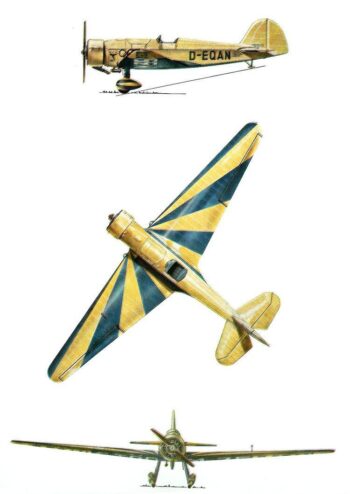
However, Hess continued to be interested in aviation and was successful in air races in the 1930s. With the outbreak of World War II, Hess asked Hitler to be allowed to join the Luftwaffe as a pilot, but Hitler forbade it, and ordered him to stop flying for the duration of the war. Hess convinced him to reduce the ban to one year.
As the war progressed, Hitler’s attention became focused on foreign affairs and the conduct of the war. Hess, who was not directly engaged in the war, became increasingly sidelined from the affairs of the nation and from Hitler’s attention. Martin Bormann had successfully supplanted Hess in many of his duties and taken Hess’s position at Hitler’s side.
Also concerned that Germany would face a war on two fronts as plans progressed for the invasion of the USSR scheduled to take place in 1941, Hess decided to attempt to bring Britain to the negotiating table by travelling there himself to seek meetings with the British government.
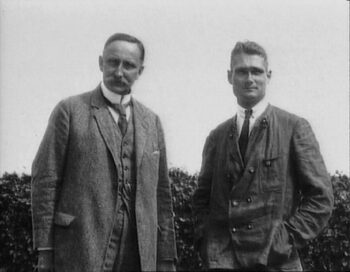
On 31 August 1940, Hess met with Karl Haushofer (pictured left, above) who told him that he believed that King George VI was opposed to Churchill and would dismiss him at the first opportunity. Haushofer also spoke of his belief that it was possible to make contact with the King via either General Ian Hamilton, a founding member of the Anglo German Association, or Douglas Douglas-Hamilton, who had become the 14th Duke of Hamilton in 1940.
Hess decided they should contact his fellow aviator, the recently ennobled Duke of Hamilton, whom he had never met. Hess chose Hamilton in the mistaken belief that he was one of the leaders of a party opposed to war with Germany, and because Hamilton was known to Karl Haushofer through his son Albrecht.
Indeed, Albrecht Haushofer – who worked for the German Foreign Office, had been a guest of Douglas Douglas-Hamilton at Dungavel House in April 1938 and his host had tried to introduce him to British Foreign Secretary Lord Halifax, who was abroad at the time.
On Hess’s instructions, Albrecht Haushofer wrote to the new 14th Duke of Hamilton in September 1940 suggesting that they meet in the neutral nation of Portugal but the letter was intercepted by MI5 and Hamilton, who did not see Albrecht Haushofer’s letter until March 1941, became an M15 double agent. While the Duke of Hamilton considered how a visit to Portugal could be arranged, Rudolf Hess took matters into his own hands.
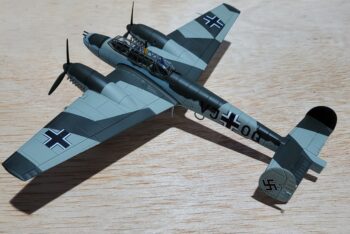
A letter Hess wrote to his wife dated 4 November 1940 shows that in spite of not receiving a reply from Hamilton, he intended to proceed with his plan. He began training on the Messerschmitt Bf 110 in October 1940 under the chief test pilot at Messerschmitt. He continued to practise, including logging many cross-country flights, and found a specific aircraft that handled well—a Bf 110E-1/N—which was from then on held in reserve for his personal use. He asked for a radio compass, modifications to the oxygen delivery system, and large long-range fuel tanks to be installed on this plane, and these requests were granted by March 1941.
After a final check of the weather reports for Germany and the North Sea, Hess took off at 17:45 on 10 May 1941 from the airfield at Augsburg – Haunstetten.
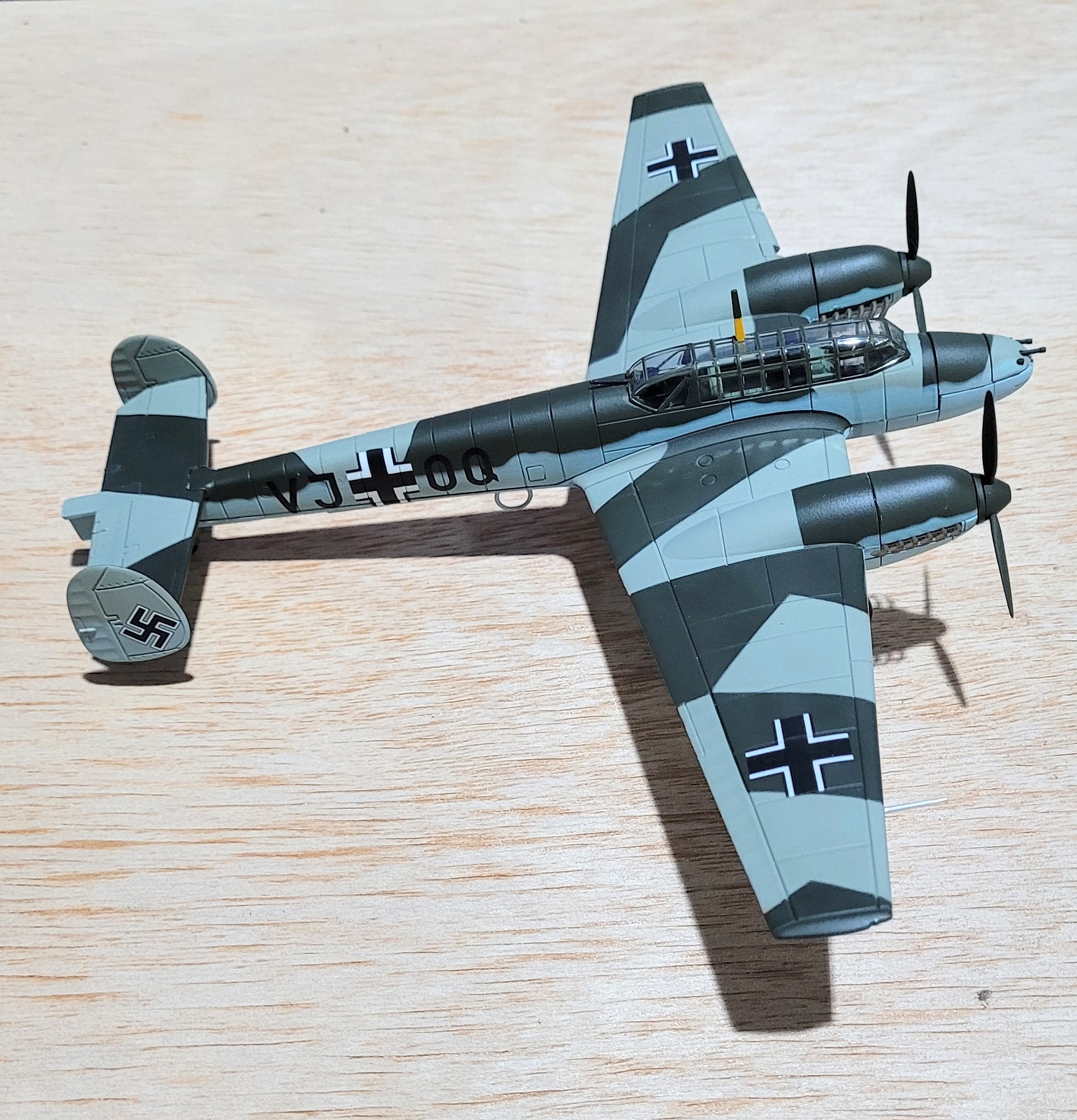
It was the last of several attempts to depart on his mission; previous efforts had to be called off due to mechanical problems or poor weather. Wearing a leather flying suit bearing the rank of captain, he brought along a supply of money and toiletries, a torch, a camera, maps and charts, and a collection of 28 different medicines, as well as dextrose tablets to help ward off fatigue and an assortment of homeopathic remedies.
Initially setting a course towards Bonn, Hess used landmarks on the ground to orient himself and make minor course corrections. When he reached the coast near the Frisian Islands he turned and flew in an easterly direction for twenty minutes to stay out of range of British radar. He then took a heading of 335 degrees for the trip across the North Sea, initially at low altitude, but travelling for most of the journey at 5,000 feet (1,500 m). At 20:58 he changed his heading to 245 degrees, intending to approach the coast of North East England near the town of Bamburgh in Northumberland.
As it was not yet sunset when he initially approached the coast, Hess backtracked, zigzagging back and forth for 40 minutes until it grew dark. Around this time his auxiliary fuel tanks were exhausted, so he released them into the sea.
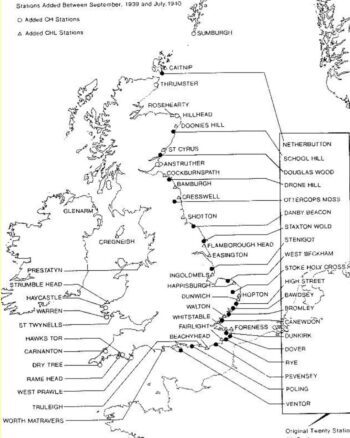
Also around this time, at 2208, the British Chain Home radar station at Ottercops Moss near Newcastle upon Tyne detected his presence and passed along this information to the Filter Room at RAF Fighter Command’s Bentley Priory.
Soon Hess had been detected by several other stations, and the aircraft was designated as “Raid 42”.
Two Spitfires of 72 Squadron, 13 Group RAF, were already airborne but failed to find him, as did a third Spitfire Sent from Acklington at 2250.
In the darkness, Hess had dropped to an altitude so low that the volunteer on duty at the Royal Observer Corps (ROC) station at Chatton was able to correctly identify it as a Bf 110, and reported its altitude as 50 feet (15 m).
Tracked by additional ROC posts, Hess continued his flight into Scotland at high speed and low altitude, but was unable to spot his destination, Dungiven House, so he headed for the west coast to orient himself and then turned back inland.
At 22:35 a Boulton Paul Defiant sent from Ayr based 141 Squadron began pursuit.
Hess was nearly out of fuel, so he climbed to 6,000 feet (1,800 m) and parachuted out of the plane at 23:06. He injured his foot, either while exiting the aircraft or when he hit the ground.

The aircraft crashed at 23:09, about 12 miles (19 km) west of Dungavel House. He would have been closer to his destination had he not had trouble exiting the aircraft but Hess considered this achievement to be the proudest moment of his life.
Shortly before midnight on 10 May 1941, Hess landed at Floors Farm where he was discovered still struggling with his parachute by local ploughman David McLean. Identifying himself as Hauptmann Alfred Horn, Hess said he had an important message for the Duke of Hamilton. McLean helped Hess to his nearby cottage and contacted the local Home Guard unit who in turn passed Hess on to civilian police and then the Army at Maryhill Barracks, Glasgow. All the while, Hess repeatedly told his captors that he had a message for the Duke of Hamilton.

The Duke of Hamilton himself been on duty as a Wing Commander at RAF Turnhouse near Edinburgh when Hess had arrived, and his station had been one of those that had tracked the progress of the flight. He arrived at Maryhill Barracks the next morning, and after examining Hess’s effects, he met alone with the prisoner. Hess immediately admitted his true identity and outlined the reason for his flight. Hamilton told Hess that he hoped to continue the conversation with the aid of an interpreter; Hess could speak English well, but was having trouble understanding Hamilton. He told Hamilton that he was on a “mission of humanity” and that Hitler “wished to stop the fighting” with England.
After the meeting, Hamilton examined the remains of the Messerschmitt (parts of which are still displayed in British museums) in the company of an intelligence officer, then returned to Turnhouse, where he made arrangements through the Foreign Office to meet Churchill, who was at Ditchley for the weekend. They had some preliminary talks that night, and Hamilton accompanied Churchill back to London the next day, where they both met with members of the War Cabinet.
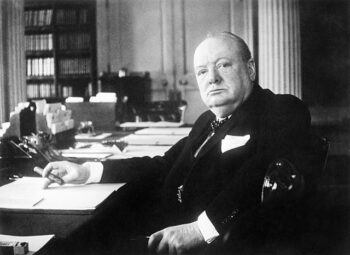
Churchill sent Hamilton with foreign affairs expert Ivone Kirkpatrick,who had met Hess previously, to positively identify the prisoner, who had been moved to Buchanan Castle overnight.
Hess, who had prepared extensive notes to use during this meeting, spoke to them at length about Hitler’s expansionary plans and the need for Britain to let the Nazis have free rein in Europe, in exchange for Britain being allowed to keep its overseas possessions. Kirkpatrick held two more meetings with Hess over the course of the next few days, while Hamilton returned to his duties. In addition to being disappointed at the apparent failure of his mission, Hess began claiming that his medical treatment was inadequate and that there was a plot afoot to poison him. Similar paranoia was to afflict the rest of his life in captivity until his death in 1987.
Before his departure from Germany, Hess had given his adjutant, Karlheinze Pintsch, a letter addressed to Hitler that detailed his intentions to open peace negotiations with the UK. He planned to initially do so with the Duke of Hamilton, at his home, Dungavel House, believing (falsely) that the Duke was willing to negotiate peace with Germany on terms that would be acceptable to Hitler.
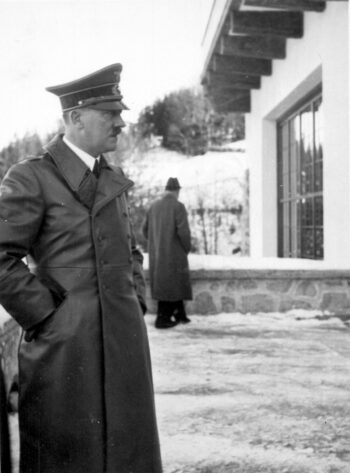
Pintsch delivered the letter to Hitler at the Berghof around noon on 11 May. After reading the letter, Hitler let loose an outcry heard throughout the entire Berghof and sent for a number of his inner circle, concerned that a putsch might be underway.
Hitler was also worried that his allies, Italy and Japan, would perceive Hess’s act as an officially sanctioned attempt to secretly open peace negotiations with the British. He contacted Mussolini specifically to reassure him otherwise.
For this reason, Hitler ordered that the German press should characterise Hess as a madman who made the decision to fly to Scotland entirely on his own, without Hitler’s knowledge or authority. Subsequent German newspaper reports described Hess as “deluded, deranged”, indicating that his mental health had been affected by injuries sustained during World War I. Some members of the government, including Göring and Propaganda Minister Joseph Goebbels, believed this only made matters worse, because if Hess truly were mentally ill, he should not have been holding an important government position.
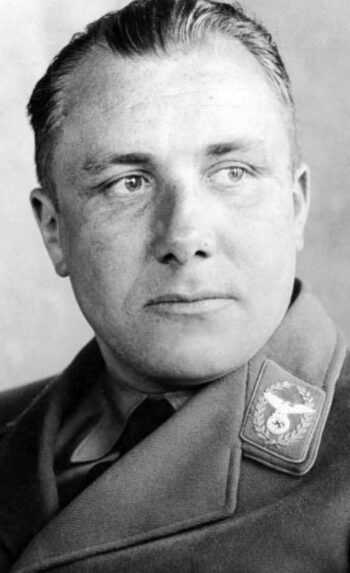
Hitler stripped Hess of all of his party and state offices, and secretly ordered him shot on sight if he ever returned to Germany. He abolished the post of Deputy Führer, assigning Hess’s former duties to Martin Bormann, with the title of Head of the Party Chancellery. Bormann (pictured above) used the opportunity afforded by Hess’s departure to secure significant power for himself.
Meanwhile, Hitler initiated Aktion Hess, a flurry of hundreds of arrests of astrologers, faith healers and occultists that took place around 9 June 1941. The campaign was part of a propaganda effort by Goebbels and others to denigrate Hess and to make scapegoats of occult practitioners.
US journalist Hubert Renfro Knickerbocker, who had met both Hitler and Hess, speculated that Hitler had sent Hess to deliver a message informing Winston Churchill of the forthcoming invasion of the Soviet Union, and offering a negotiated peace or even an anti-Bolshevik partnership.

Soviet leader Josef Stalin (above, left) believed that Hess’s flight had been engineered by the British and persisted in this belief as late as 1944, when he mentioned the matter to Churchill, who insisted that they had no advance knowledge of the flight.
While some sources reported that Hess had been on an official mission, Churchill later stated in his book The Grand Alliance that in his view, the mission had not been authorized. “He came to us of his own free will, and, though without authority, had something of the quality of an envoy”, said Churchill, and referred to Hess’s plan as one of “lunatic benevolence”.
After the war, while in Spandau prison, Hess told journalist Desmond Zwar that Germany could not have won a war on two fronts.
“I knew that there was only one way out – and that was certainly not to fight against England. Even though I did not get permission from the Führer to fly I knew that what I had to say would have had his approval. Hitler had great respect for the English people …”
Hess wrote that his flight to Scotland was intended to initiate “the fastest way to win the war”
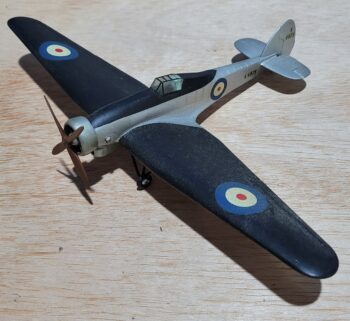
The lone Bristol Type 138A (serial number K4879) was a modification of designer Frank Barnwell’s 1933 vintage Type 138 fitted with a supercharged Pegasus IV engine and four bladed propeller. At the time it was the single largest monoplane in the World.
Squadron Leader F.R.D. Swain flew the Bristol Type 138A from Farnborough on 28 September 1936 to a new World altitude record of 49 967 feet (15 230 metres).
This was also a new altitude record for pressurised flying suits, the ancestors of the spacesuit worn by astronauts and cosmonauts from 1961.
Swain’s suit, developed by Professor John Scott Haldane, and Sir Robert Davis, maximised the available oxygen by scrubbing the dangerous carbon dioxide out of the air supply.
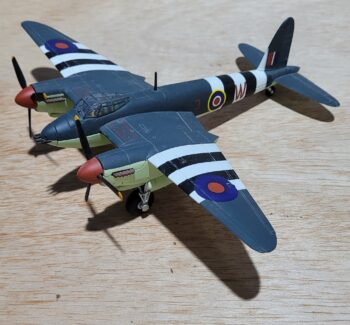
In 1934 a twin engined De Havilland 88 Comet took 71 hours to fly to Australia. By 1944 it had evolved into the De Havilland Mosquito, powered by two Rolls Royce Merlin engines and capable of reaching Cape Town from Britain in just over 21 hours.
Crucially, both aircraft were made from wood. But although the Air Ministry first rejected a bomber version of the DH 88 racer as “regressive”, the Mosquito was finally made in factories that had previously turned out coffins, furniture and pianos both in Britain and in Canada. Not only did the Mosquito make minimum demands on strategic materials – even the undercarriage used rubber blocks rather than complicated hydraulics – but battle damage could be quickly repaired by simple carpentry. The use of beech plywood sandwiching layers of balsa also made a light, strong fuselage that was to contribute to a top speed of over 400 mph.
After being ordered as a reconnaissance machine by Air Chief Marshall Sir Wilfred Freeman in 1939, prototype W4050 first flew on 25 November 1940 and completed trials inside three months. The first RAF examples went into action over France on 20 September 1941 and proved that they could outrun any Nazi fighter, even performing smooth climbing rolls on one engine!
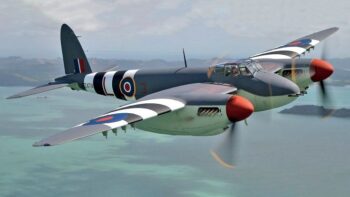
By March 1942 bomber and fighter variants had joined the 50 strong RAF fleet. The night fighter Mosquito was armed with four 20mm canon and four machine guns although much of the success of pilots like John Cunningham – later to test fly the De Havilland Comet jet airliner – was due to air interception radar: top secret at the time!
Radar was also used by Mosquito bombers of the target marking Pathfinder force, which carried first a 2000 lb and then a 4000 lb bomb load. At low level too, the Mosquito – with engine radiators in its wing roots – proved a precisely lethal weapon. Raids on Gestapo headquarters in Denmark and on Amiens jail were able to free local Resistance members while killing their captors, and rocket firing Mosquitos devastated tanks and trains in Europe. Enemy shipping too was harassed by Mosquitos equipped with a one ton 57mm anti-tank gun firing a six pound shell every second!
Mosquitos also dropped “Highball” bouncing bombs experimentally but the War ended before these could be used against Japanese warships. However, fighter Mosquitos did shoot down over 600 V1 flying bombs and were the basis for the single seat De Havilland Hornet long range interceptor. Indeed, the company’s post War Vampire and Venom jets were also largely built of wood and target tug Mosquitos did not leave RAF service until 1963.
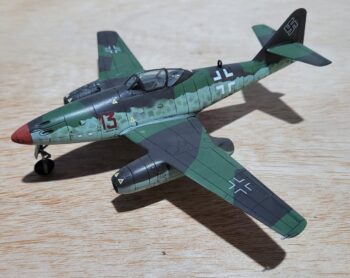
Heinkel’s experimental 178 of 1939 and twin-engined twin-tailed 280 fighter design of 1940 used the same centrifugal gas turbine technology that Frank Whittle used on the Gloster E28/39 and Meteor but in 1940 the German Air Ministry decided to focus development on Messerschmitt’s 262 – powered by more advanced axial flow turbojets. Production of these new engines by BMW and Junkers were hampered by shortages of high temperature metals and as a result the turbojets needed intensive maintenance during their short lives. The first Me 262 combining pure turbojet power and a suitable nosewheel undercarriage was thus not demonstrated to Hitler until 26 November 1943 when the Fuhrer decreed that the Me 262 be used as a bomber against a future invasion of France. Although armed with two rather than four nose canon, the Sturmvogel (Stormbird) Me 262 loaded with 1 00 kg of bombs was slow enough to be shot down by Allied fighters although the Schwalbe (Swallow) interceptor version – operational from August 1944 – additionally armed with rockets proved effective against two and four engined bombers. Fewer than 300 Me 262s – capable of 559 mph – were actually used in combat.
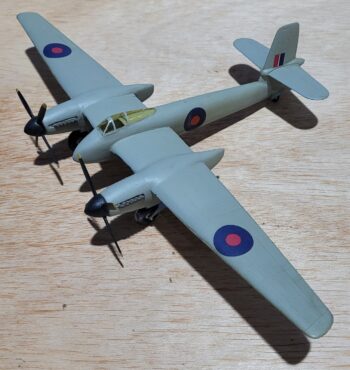
Prior to World War II, few aircraft were called upon to operate much above 25,000 feet. High-altitude flight subjected aircrews to extreme cold and lack of oxygen, which necessitated heated pressure suits or cabin pressurization. The air was so thin that special wings were required to provide sufficient lift. Internal combustion engines could not run efficiently in the thin air either, unless they were equipped with superchargers to compress the air prior to combining it with fuel in the cylinders. Even the U.S. Army Air Forces’ Boeing B-17 and Consolidated B-24, as well as the pressurized Boeing B-29 that arrived late in the war, seldom ventured much above 30,000 feet. As a result, few fighters existed that were capable of operating above that altitude.
All that changed in 1940, when the Luftwaffe began deploying the Junkers Ju-86P. A radical redesign of an obsolete prewar medium bomber, the Ju-86P featured longer wings, a pressurized cabin and supercharged Junkers Jumo 207 diesel engines. It could operate at altitudes in excess of 39,000 feet, out of the reach of any production fighters of the day.
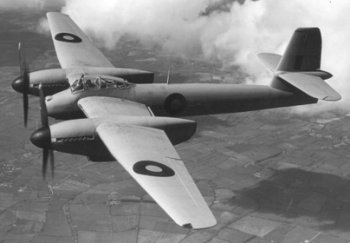
Like the Lockheed U-2 of the 1950s, the Ju-86P could conduct strategic reconnaissance missions over enemy territory with impunity, simply by virtue of its extreme high-altitude performance.
It became obvious to the RAF that if enemy reconnaissance planes could fly higher than its fighters, then high-altitude bombers wouldn’t be far behind. An immediate request went out to the Air Ministry for a fighter capable of reaching altitudes far higher than any previously contemplated. Rolls-Royce responded by developing an improved version of its famous Merlin engine with a two-stage supercharger for better high-altitude performance, while Vickers and Westland began designing specialized fighters to utilize it.
The Vickers 432, which looked a bit like a modified de Havilland Mosquito, ended up losing out to its Westland competitor. Westland’s Welkin resembled its smaller predecessor, the Whirlwind, modified with a longer fuselage, wings and tail surfaces.
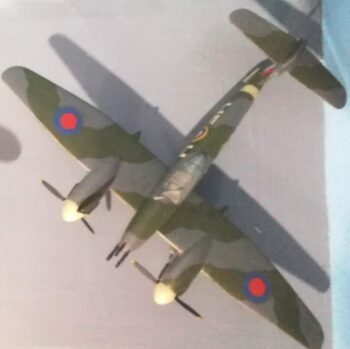
There was much more to the new fighter than that, though. In place of the Whirlwind’s less-than-satisfactory 885-hp Rolls-Royce Peregrine engines, the Welkin was fitted with a 1,233-hp Merlin 76 and a 77, each equipped with a two-stage supercharger.
The most important feature of the new interceptor, however, and the one that took the most time to develop, was its pressurized cockpit. The Welkin had a sealed, bulletproof sliding canopy constructed of a double layer of perspex, with hot air fed between the layers to prevent condensation from interfering with the pilot’s view at high altitude. All control and electrical conduits had to be sealed to maintain cabin pressurization, and the entire cockpit was armored to protect against depressurization in the event of battle damage.
The design work that went into the Welkin’s cockpit would pay dividends later in the development of jet fighters such as the Gloster Meteor. Indeed, William Edward Willoughby Petter who designed both Westland’s Whirlwind and Welkin went on to design English Electric’s Canberra and Lightning and the Folland Gnat.

A valve which helped solve the problems of pressurising the cabin of the Welkin was also developed by Cheltenham educated Francis Walley, later a noted civil engineer.
The Welkin was huge for a single-seat fighter, with a length of 41½ feet and a whopping wingspan of 70 feet. By contrast, the Whirlwind was 32 feet long, with a span of only 45 feet. Both fighters were armed with four 20mm cannons, and the Welkin’s top speed of 385 mph wasn’t much higher than its predecessor’s 360 mph. The Whirlwind, however, had a service ceiling of only 31,000 feet, whereas the Welkin could operate at 44,000 feet.
The Welkin made its first flight on 1 November 1942, only two years after it had been ordered, a commendably short time for the development of a new fighter.
Like many new aircraft, it had handling problems—some endemic to the design—that needed to be addressed. Not the least of these was its very small flight envelope (flyable speed range) at the lofty altitudes where it typically operated. Due to its long, thick wings, the Welkin was also susceptible to compressibility stall in a high-speed dive.
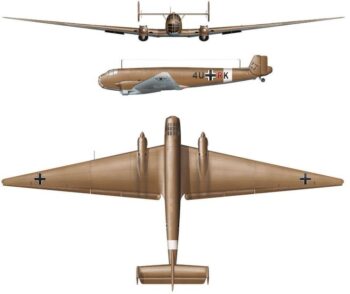
The war didn’t wait for the Welkin to become fully developed. On 24 August 1942, the Luftwaffe commenced very-high-altitude bombing attacks on Britain with the new Junkers Ju-86R, capable of reaching the then-phenomenal altitude of 45,000 feet.
Although each bomber could carry only a single 500-pound bomb at that height, the fact that the new Junkers could operate in British airspace without fear of being shot down gave it a powerful potential impact on morale.
Fortunately for Britain, the RAF hadn’t pinned its hopes entirely on the Welkin. Specially modified Supermarine Spitfire Mark IXs proved capable of reaching the high-flying Junkers, with the first such interception taking place on September 12, 1942.

In what would become the highest air combat recorded during World War 2, Flying Officer Emanuel Galitzine attacked a Ju-86R at 44,000 feet. Galitzine’s attack was unsuccessful because his left wing-mounted cannon jammed, causing the Spitfire to yaw to the right when he fired the other one, throwing off his aim.
But the German crew’s lucky escape worked in the RAF’s favor. Realizing that Spitfires were capable of intercepting its supposedly invulnerable bomber, the Luftwaffe high command reconsidered its feasibility, and the program was discontinued.
By the time the Welkin was ready for production in August 1943, the Ju-86s had been withdrawn, and there simply weren’t any more high-altitude enemy bombers to intercept.
As a result only 75 Welkins were completed, and none was issued to an operational squadron. During 1944 Fighter Command flew two Welkins to formulate high-altitude fighter interception tactics—as close as the type ever came to operational service. A two-seat night fighter version, the Welkin Mark II, had also been planned but was scrapped because the de Havilland Mosquito could handle that mission.

A descendent of the Gloster built Hawker Typhoon and Hurricane, the Tempest was designed by Sir Sydney Camm. Although the Typhoon had proved successful in a ground attack role, it was only partially successful as a fighter and the Tempest was evolved to repair the shortcoming of its predecessor.
Distinguished from Hawker Typhoons by the fin that curved to join the rear fuselage, Hawker Tempests first joined the RAF in April 1944 and provided support for the D-Day landings. Then came the threat of the V1 flying bombs which only the Tempests – among the single piston engined fighters – had the speed to tackle effectively. Altogether Hawker Tempests claimed no less than 638 of the 1 771 flying bombs which the RAF destroyed in three months.
In September 1944 Tempest Squadrons were moved to the Continent to meet the mounting menace of the German jet aircraft which were appearing in increasing numbers. While the Gloster Meteor jets were proving themselves against the flying bombs the Tempests contained the new enemy threat, destroying 29 German jet fighters by VE Day.

At the end of the War a new Mark II version of the Tempest appeared, powered by the Bristol Centaurus V radial engine. This version was highly successful and gradually replaced the earlier Tempests which, like the Gloster built Hawker Typhoon, had been powered by the in-line Napier Sabre engine. The 2 520 bhp Centaurus V powered Tempest Mark II became the standard RAF fighter in Germany and the Middle and Far East with a top speed of 440 mph and the ability to climb 15 000′ in 4 minutes 30 seconds to a service ceiling of 37 000′. With an 800 mile range the Tempest Mark II had a 41′ wingspan, 33′ 5″ length, 16′ 1″ height and a wing area of 302 square feet. Weights were 8 900 lb empty, 11 400 lb loaded and armament comprised for 20mm Hispano Canon, rockets or 2 000 lb of underwing bombs.
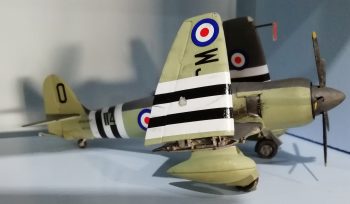
In late 1942, Hawker Chief Designer Sydney Camm proposed a lighter version of the Tempest fighter, for which Specification F.2/43 was issued in May 1943.Around the same time, Specification N.7/43 was also issued for a naval interceptor and Camm realised that the same basic design, could fulfill both requirements. Eventually, the two Specifications were brought together under F.2/43. By the end of 1943, five flying prototypes with alternative power plants (including variants of the Rolls-Royce Griffon and the Bristol Centaurus) had been ordered. Confidence in the new design was high and in April 1944, orders were placed for 200 examples of F.2/43 fighters, destined for the RAF. Additionally, 200 ‘navalised’ examples were built to Specification N.22/43 for the Fleet Air Arm (FAA).
The first F.2/43 prototype (NX798) made its first flight on 1st September 1944 fitted with a Bristol Centaurus XII engine and four-bladed propeller. The following month, a second prototype (LA610), fitted with a Griffon 85 and six-bladed contra-rotating propeller, made its maiden flight.
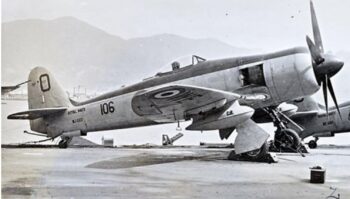
It was announced that the RAF version would be named the Hawker Fury I and the naval version the Hawker Sea Fury F.X. However, after the completion of two more Hawker Fury prototypes (NX802 and VP207), fitted with Bristol Centaurus and Napier Sabre engines respectively, the entire RAF Fury order was cancelled. This was due in the main to the end of the Second World War, when the RAF found themselves with an abundance of idle, late-mark Spitfires and Hurricanes. Additionally, the Hawker Sea Fury order was also halved in January 1945.
Meanwhile, Hawker Sea Fury development continued and the first semi-navalised example (SR661) with a short arrester hook and non-folding wings, made its first flight on 21st February 1945.
The second Hawker Sea Fury prototype (SR666) was fully-navalised and fitted with the production standard five-bladed propeller and it made its first flight on 12th October 1945. Later, 50 production Hawker Sea Fury F.Xs were built with the first (TF895) flying on 7th September 1946. After extensive trials with the second prototype (SR666) it was decided that the Hawker Sea Fury would make an excellent ground-attack aircraft and so all subsequent 615 examples would be built as fighter-bombers, designated Hawker Sea Fury FB.11s.
The Hawker Sea Fury F.X entered FAA service in September 1947 with the FB.11 joining it in May 1947. By the time the Korean conflict broke out in June 1950, the Hawker Sea Fury was the Royal Navy’s leading single-seat fighter. The type served throughout the conflict with distinction in both FAA and Royal Australian Navy (RAN) service, the latter having acquired ex-Royal Navy examples during 1949–50, as had the Royal Canadian Navy (RCN). In Korea, the Hawker Sea Fury saw its share of air combat against Soviet-built jet fighters with the Hawker fighter accounting for the loss of one jet in August 1952. This would prove ironic as the Hawker Sea Fury was eventually replaced in front-line service by the Armstrong Whitworth Sea Hawk jet fighter from 1953.
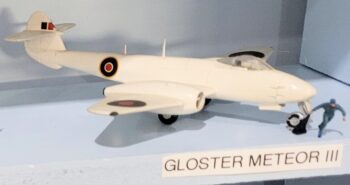
The Gloster Meteor F Mark III was the first version of the Meteor to be produced in large numbers, and the first truly satisfactory version of the aircraft. The first production version, the F Mark I lacked engine power, and was at best equal in performance to the best piston engined aircraft, but the majority of Meteor F Mk.IIIs were powered by a pair of Rolls-Royce Derwent I engines, each providing 2,000lb of thrust, making the Meteor F Mk.III clearly superior to the contemporary Spitfires and Mustangs, at least in speed. However both the Mk.I and Mk.III were slow to respond to the throttle, with the result that they tended to take too long to reach top speed.
The prototype for the F Mk.III, DG209, had first flown on 18 April 1944 and had been powered by the Rolls-Royce W.2B/37 engine, the original Derwent. DH209 was the first Meteor to fly with 2,000lb of thrust per engine, and achieved the highest speeds yet, reaching 465mph at 16,000ft.
The F Mk.III was powered by three different engines. The Derwent I was not ready in time to be used on the first fifteen aircraft, and so they were given W.2B/23c Wellands. The majority were equipped with the Derwent I. Finally, a number of aircraft were given 2,400lb Derwent IV engines. The published performance statistics for the F Mk.III are normally for this version. The last fifteen F Mk.IIIs were given the longer engine nacelles used on the Mk.4, while a number of aircraft were retrofitted with these nacelles, which increased the top speed of the aircraft.
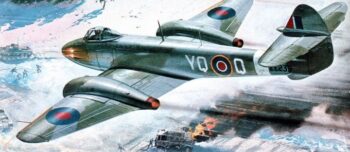
During the Second World War the Meteor F Mk.III served with 616 and 504 Squadrons but only 616 used them in action.
In January 1945 a flight of four aircraft moved to Melsbrook in Belgium, partly to defend the airfield, and partly in the hope that the Me 262 might appear. The entire squadron moved to the continent in March, and spent the rest of the war carrying out armed reconnaissance and ground attack missions. During this period a number of Meteor IIIs were painted white to distinguish them from the Messerschmitt jet.
The much anticipated clash with the Me 262 never came but the F Mk.III became the RAF’s standard jet fighter, until replaced by the F Mk IV from 1947.

In 1943 Reichsmarschall Hermann Göring required an aircraft which could carry 1 000 kg (2 200 lb) of bombs 1 000 km (620 miles) at 1 000 km/h (620 mph). This speed was beyond piston engines but the range and load challenged the thirsty and underpowered early turbojets. The Horten brothers – Walter and Reimar – had been working on flying wing gliders since the 1930s and believed that the low drag of this design could meet the “3 x1 000” challenge. Following a state investment of 500 000 Reichsmarks, a glider version of the Horten H IX flew in March 1944 after which the project was developed by Gothaer Waggonfabrik at Friederichsroda while the Horten brothers worked on a flying wing to bomb America. The first Horten H IX – built from carbon injected plywood panels stuck together with charcoal and sawdust – flew on 2 February 1945 before the factory was captured by the US Army on 14 April 1945. Although Westland and Armstrong Whitworth in Britain built experimental flying wings before and after the H IX, it was not until the 1980s that Northrop in the USA returned to the same format with the B-2 Spirit stealth bomber.
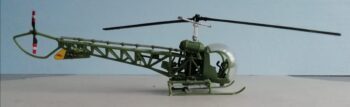
The Bell Model H13 Sioux, – developed from the earlier civilian Model 47 – was used by British armed forces but remains best known as flying ambulance in the Korean War as illustrated in the film and later TV show M*A*S*H. First flown in 1946, the three seat Sioux became one of the most popular light utility helicopters ever built, produced continuously from 1946 to 1973, and by Agusta, in Italy, through 1976. Available in 20 different configurations, with model numbers ranging from A to T, the Bell 47 was used in 40 countries

The XS-1 (later better known as X-1) was jointly developed from 1944 by the National Advisory Committee for Aeronautics (NACA) and the U.S. Army Air Forces (later the U.S. Air Force) to develop special manned transonic and supersonic research aircraft.
On March 16, 1945, the Army Air Technical Service Command awarded the Bell Aircraft Corporation of Buffalo, New York, a contract to develop three transonic and, hopefully, supersonic research aircraft under project designation MX-653. The Army designation was XS-1, standing for Experimental Sonic-1. Bell Aircraft built three rocket-powered XS-1 aircraft.
The first of these, with the serial number 46-062, was named Glamorous Glennis by its USAF pilot, Captain Charles “Chuck” Yeager in honour of his wife.
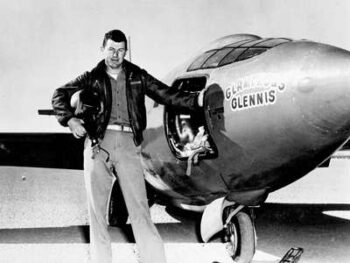
On 14 October 1947, ‘Chuck’ Yeager became the first pilot to fly faster than sound with 46-062 reaching Mach 1.06 at 700 mph, at an altitude of 43 000 feet, over the Mojave Desert near Muroc Dry Lake, California. The flight demonstrated that aircraft could be designed to fly faster than sound, and that the ‘sound barrier” was not an absolute.
The first two XS-1 aircraft were constructed from high-strength aluminum, with propellant tanks fabricated from steel. The fuel feed system was directly pressurised by nitrogen, held in twelve spheres crowded into a fuselage shaped like a.50 calibre machine gun bullet and owing much to the cancelled British Miles M52 jet.
Also under the skin of the XS-1 were a pair of propellant tanks, the pilot’s pressurized cockpit, three pressure regulators, a retractable landing gear, the wing carry-through structure, a Reaction Motors, Inc., 6.000-pound-thrust rocket engine, and more than five hundred pounds of special flight-test instrumentation.
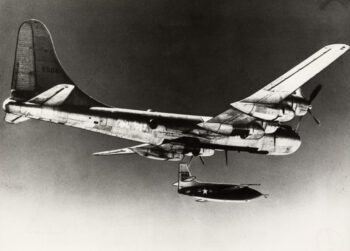
Though originally designed for conventional ground takeoffs, all X-1 aircraft were air-launched from Boeing B-29 or B-50 Superfortress aircraft. The performance penalties and safety hazards associated with operating rocket-propelled aircraft from the ground caused mission planners to resort to air-launching instead. Nevertheless, on 5 January 1949 46-062 Glamorous Glennis successfully completed a ground takeoff from Muroc Dry Lake, piloted by Chuck Yeager.
The maximum speed attained by 46-062 was Mach 1.45 at 40,130 feet, approximately 957 mph, during a flight by Yeager on 26 March 1948. On 8 August 1949, Major Frank K. Everest, Jr., USAF, reached an altitude of 71,902 feet, the highest flight made by the little rocket aeroplane.
It continued flight test operations until mid-1950, by which time it had completed a total of nineteen contractor demonstration flights and fifty-nine Air Force test flights. On 26 August 1950, Air Force Chief of Staff General Hoyt Vandenberg presented 46-062 to Alexander Wetmore, then Secretary of the Smithsonian Institution. The X-1, General Vandenberg stated, “marked the end of the first great period of the air age, and the beginning of the second. In a few moments the subsonic period became history and the supersonic period was born.”
Earlier, Bell Aircraft President Lawrence D. Bell, NACA scientist John Stack, and Air Force test pilot Chuck Yeager had received the 1947 Robert J. Collier Trophy for their roles in first exceeding the speed of sound and opening the pathway to practical supersonic flight.
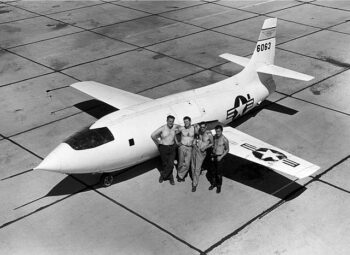
The second XS-1 (46-063, as depicted in the Jet Age Museum model) was flight-tested by NACA and later was modified as the X-1 “Mach 24” research airplane.
In this form it had a thinner wing and an improved fuel system. The most obvious visible difference was the cockpit, which was changed to incorporate an ejection seat. Hundreds of sensors were built into the aircraft’s surfaces to measure air pressure and temperature.
The Bell X-1E was 31 feet (9.449 meters) long, with a wingspan of 22 feet, 10 inches (6.960 meters). The rocketplane’s empty weight was 6,850 pounds (3,107 kilograms) and fully loaded, it weighed 14,750 pounds (6,690 kilograms). The rocketplane was powered by a Reaction Motors XLR11-RM-5 rocket engine which produced 6,000 pounds of thrust (26.689 kilonewtons). The engine burned ethyl alcohol and liquid oxygen. The X-1E carried enough propellants for 4 minutes, 45 seconds burn.
The X-1E reached its fastest speed with NASA test pilot Joseph Albert Walker, at Mach 2.24 (1,450 miles per hour/2,334 kilometers per hour), 8 October 1957. Walker also flew it to its peak altitude, 70,046 feet (21,350 meters) on 14 May 1958.
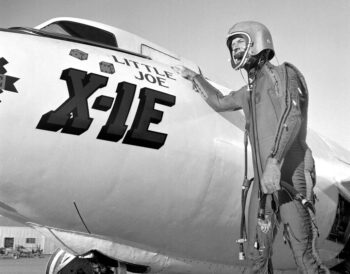
On 6 November 1958 NASA Research Test Pilot John B. McKay made the final flight of the X-1 rocketplane program, with 46-063 making its 26th and final flight after being dropped from a Boeing B-29 Superfortress over Edwards Air Force Base on a flight to test a new rocket fuel.
When the aircraft was inspected after the flight, a crack was found in a structural bulkhead. A decision was made to retire the X-1E and the flight test program was ended.
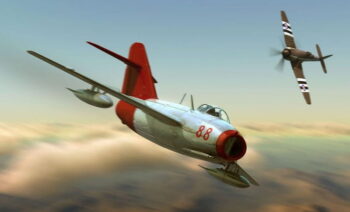
Both the MiG-15 (pictured above) and the North American F-86 Sabre drew inspiration from a German concept produced at the end of World War II when Allied aircraft had achieved numerical superiority. Desperate, the Luftwaffe High Command held a contest. The winning entry in “The Emergency Fighter Competition” was submitted by Focke-Wulf head designer Kurt Tank and designated TA-183. It was a concept for a single-engine jet with swept wings and a high T-tail.
In 1945, British troops entered the Focke-Wulf facility in Bad Eilsen and confiscated plans, models, and wind tunnel data, which they quickly shared with the Americans. When Berlin collapsed, Soviet forces sifted through the German Air Ministry and found a complete set of TA-183 blueprints and a treasure trove of wing research. Less than two years later, and within weeks of each other, the United States and the Soviet Union introduced single-engine jet fighters with wings swept to 35 degrees, stubby fuselages, and T-tails.
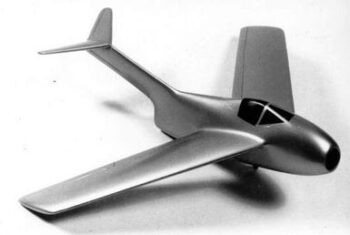
Although neither aircraft was a direct copy of Tank’s design (picturedabove), both were a result of similar technologies reaching for an identical result.
The first jet to fly from the Mikoyan-Gurevich (MiG) Design Bureau in Moscow had been a straight-wing fighter, the MiG-9. However, the MiG 9’s twin rudimentary BMW jet engines fell short of the design bureau’s specifications for the MiG-15. Instead, the swept wing interceptor would be powered by copies of Rolls Royce Nenes.
Keen to thaw Anglo-Soviet relations – and under economic pressure to maintain food supplies from the USSR – British Prime Minister Clement Attlee had invited Soviet scientists and engineers, including Artem Mikoyan, to visit Rolls-Royce. He further offered to license production to the USSR—after exacting a solemn promise that the engines would be utilized only for non-military purposes.
The offer stunned the Americans, and Stalin himself said “Who in their right mind would sell anything like this to us?”

The Soviet copy of the Rolls Royce Nene was dubbed the Klimov RD-45 but, rather like the Lada cars of later decades, they were not made with the precision associated with British and American aircraft components. The time between the introduction of the Klimov engines and their failure was measured in hours while materials for high-stress parts were substandard.
Despite the MiG 15 remaining inexpensively built and unapologetically spartan, the finished product, which first flew on the last day of 1947, was – like the same year’s AK 47 rifle – rugged and reliable.
In the Korean War of 1950 -1953, the MiG proved not only faster than the opposing Lockheed F-80 Shooting Star and North American F-86 Sabre but able to outclimb them.
The MiG-15 was also equipped with a devastating range of machine guns and canon that could attack from a range of 2 000 feet. This combination of speed and firepower overwhelmed Boeing B-29 Superfortresses trying to bomb North Korea in daylight and gave a hint of what might have happened at the end of World War II had the Ta 183 reached production.
However, more MiG-15s were lost in training accidents than combat and sometimes proved vulnerable in dogfights with more nimble aircraft such as Gloster Meteors and Hawker Sea Furies.

Ironically, the Sea Fury had been influenced by Kurt Tank’s earlier Focke-Wulf 190 and the standard of Soviet precision was to be raised by the Tupolev Tu-4 being back engineered from B-29s which had made emergency landings during World War II.

Despite the early shock appearance of the MiG-15, the North American F-86 Sabre eventually achieved a 10 to 1 kill rate over its Communist opponents and all 39 United Nations jet aces won their laurels in America’s first swept wing fighter.
Four models of the craft (F-86A, E, F and H) were day fighters or fighter bombers, while the F-86D, K and L versions were all-weather interceptors.
Successive models of the daylight versions — all designed to destroy hostile aircraft in flight or on the ground — were equipped with more powerful engines and armament systems that ranged from bombs and rockets to machine guns and cannon.
All were rated in the 650-mph (1,046-kph) class – but with some supersonic capability, a 600-mile (966-kilometre) combat radius and a service ceiling of more than 45,000 feet (13,716 metres).
The three interceptor versions sported black radome noses, replacing the yawning jet intakes of the other models. The K model, manufactured in Turin, Italy, by Fiat, was flown by NATO forces. The F-86L had added equipment for use in conjunction with the U.S. Semi-Automatic Ground Environment (SAGE) defense system.
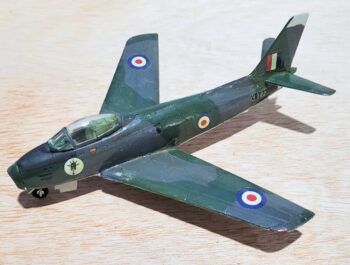
The prototype XF-86 was first flown on 1 October 1947 and in September 1948, an F-86A set the Sabre’s first official world speed record of 671 mph (1,080 kph). This mark was bettered in 1952 by an F-86D that flew at 698 mph (1123 kph). The D became the first model of a fighter to better its own record, in 1953, with a run of 715 mph (1151 kph).
The F-86E and subsequent models incorporated a unique control system, developed by North American, called the “all-flying tail.” The F-86A contained a booster control system that called for the pilot to do part of the work of controlling the aircraft, whereas the newer system added full power-operated control for better maneuverability at high speeds. An “artificial feel” was built into the aircraft’s controls to give the pilot forces on the stick that were still conventional but light enough for superior combat control.
U.S. production of the F-86 ended in December 1956 although Canadair built Sabres served with the Royal Air Force from 1953 to 1956.
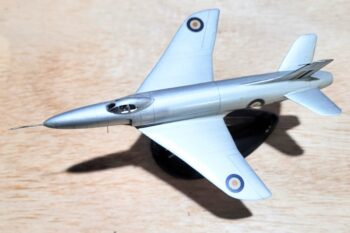
The Supermarine Swift F1 prototype WJ960, modelled here, first flew on 1 August 1951 but its ancestry can be traced back to the Supermarine 510, first flown on 29 December 1948.
This was based on the fuselage of the straight-wing Supermarine Attacker but was the first British jet aircraft with both swept wings and a swept tailplane. It also became the first swept-wing jet to both land on and take-off from an aircraft carrier. However, it was built around a Rolls Royce Nene gas turbine rather than the thinner Avon axial flow powerplant which would propel the Hawker Hunter.
The Supermarine 510 would eventually evolve into the Supermarine Scimitar naval jet fighter, but more immediately it spawned the Supermarine 535 with a nosewheel undercarriage and longer nose.
The Supermarine 535 first flew on 23 August 1950, not long after the outbreak of the Korean War. With the Hawker Hunter programme falling behind schedule, the British Air Ministry ordered 100 similar fighter aircraft. Supermarine dubbed these Type 541 and they became known in RAF service as the Swift.
The Swift was to be powered by the Rolls-Royce Avon but retained the wide fuselage designed for the Nene. This made it a poor high altitude interceptor and later marks featured four Aden canon with ammunition storage space being created by extending the wings forward at the fuselage join. This gave the Swift a tendency to pitch up and flip over on to its back – a problem initially tackled by weighing down the nose and later, on the F4 mark, by fitting a variable incidence tail.

The F.4, which had first flown in May 1953, soon made its name by breaking the world absolute speed record over Libya on 26 September 1953 with Mike Lithgow at the controls – 735 miles per hour, beating Neville Duke’s record of 727 mph set using a Hunter F.3 three weeks earlier. The record only lasted a matter of days, though, before the American’s Douglas Skyray pushed it up to over 753 miles per hour.
However, despite being the first British built swept-wing fighter jet in RAF service, the Swift continued to be incapable of combat above 40 000 feet and production soon switched to the low level Fighter Reconnaissance 5. These proved remarkably effective until replaced by later marks of Hawker Hunter although the Swift’s final claim to fame was as the first RAF fighter to sport air to air missiles. These F7s did not reach squadron service but did help prove the Fairey Fireflash beam riding AAM.

Sydney Camm’s first straight winged jet prototype, the Hawker P1040, had first flown on 2 September 1947 and entered Royal Navy service as the Sea Hawk.
VX 272, the first of two swept wing P1052 aircraft – ordered under Air Ministry Specification E 38/46 – followed on 19 November 1948 to explore work done by German aerodynamicists and was again powered by a single Rolls Royce Nene turbine.
The second P1052 – VX 279 – first flew on 13 April 1949 but was soon rebuilt as the Hawker P1081 and flew again in this guise on 19 June 1950 with a swept horizontal tail and single jet tailpipe rather than the split exhaust of both the Sea Hawk and P1052.
Although deck landing trials were undertaken aboard HMS Eagle in May 1952, experience gained by VX 272 (pictured above) and VX279 was to lead not to a naval aircraft but to Britain’s most widely exported land based swept wing fighter: The Hawker Hunter.
After a number of experimental modifications VX 272 last flew in 1953 and is preserved at Yeovilton while the sole P1081 was destroyed during a test flight on 3 April 1951 with the loss of test pilot Squadron Leader Trevor Sydney “Wimpy” Wade AFC DFC.

The Canberra story began in 1944, when the Air Ministry issued a requirement for a successor to the de Havilland Mosquito
with no defensive armament and a high-altitude capability to evade interceptors’.
A number of British manufacturers submitted proposals and amongst those short-listed was Lancashire-based English Electric Company. At the time, the company had little experience in the design of military aircraft, having spent most of their formative years during WW2 building aircraft for the likes of Handley Page and de Havilland.
This all changed when William Edward Willoughby Petter arrived from Westland Aircraft and he immediately set up his own design team.
Initial designs produced a centrally-mounted, single-engine concept, although this was quickly replaced by a two wing-mounted engines.
On 7 January 1946 The Ministry of Supply issued Specification B.3/45 for the further development and production of 4 aircraft. The project was named EE A.1 and after numerous post-war political and economic delays, the initial A.1. prototype (VN799) flew on 13 May 1949 by which time the Ministry had actually pre-ordered 132 production aircraft in various configurations.
The A.1 was formally named Canberra on 19 January 1951 by The Rt Hon R.G Menzies, Prime Minister of Australia and the first export customer for the new jet.
The addition of a glazed nose (for a bomb-aimer), twin Rolls-Royce Avon R.A. 3 engines and teardrop wing tip fuel tanks resulted in the Canberra B.2, which took to the air at Warton on 21 April 1950 in the hands of EE Chief Test Pilot Roland (Bea) Beamont.
The Canberra could fly at a higher altitude than any other bomber throughout the 1950s and by 1958 it had set nineteen point-to-point speed records and three height records, including one of 70,310 ft (21,430 m) in 1957.
Such was the ease of transition from propeller aircraft into the English Electric Canberra, that the first aircraft was delivered to RAF 101 Squadron at Binbrook on 25 May 1951. The success and adaptability of the design was such that it was built in over 40 versions and equipped 65 RAF squadrons.
It was exported to 15 countries: Australia, Argentina, Chile, Ecuador, Ethiopia, France, India, New Zealand, Peru, Rhodesia / Zimbabwe, South Africa, Sweden, USA, Venezuela and West Germany. A total of 925 English Electric Canberra aircraft were built in the UK.
451 ‘Canberra’ aircraft were also built under licence in the USA: 403 in the USA by the Glenn L Martin Company and designated as the B-57 ‘Canberra’ in many versions.
A number of these were transferred from the USA to Pakistan as well as the Republic of China (Taiwan).
A further 48 English Electric Canberras were built under licence by the Government Aircraft Factory, Australia as the Mk.20. In total 1,376 English Electric Canberra aircraft were built.
The aircraft was eventually retired by its first operator (the RAF) in June 2006, some 57 years after its first flight. Meanwhile, 3 of the Martin B-57 variants remained in service, performing meteorological work for NASA.
Although only 150 Heron Mk 2s were built they served with both the RAF and Royal Navy as well as airlines like Jersey. The wings and fuselage were larger than that of the preceding Dove and four Gypsy Queen piston engines provided power for 17 passengers.
The Mark 2 was introduced in 1952, adding a retractable undercarriage to the original 1950 design.
de Havilland DH114 Heron 2 ‘G-AORG’
c/n 14101 wa built 1956 as ‘G-AORG’ and flew with Jersey Airlines. Between 1961 and 1989 she saw Royal Navy service as a Sea Heron C.1 with the serial ‘XR441’.
She then returned to civil use, was given back her original registration and repainted in genuine ‘Jersey Airlines’ colours as ‘Duchess of Brittany’.
Although in an airworthy condition, she has been at Coventry since 2009, initially for servicing and then waiting for the inevitable paperwork. Despite regular engine runs the aeroplane has not flown again and now appears to be on outside display.
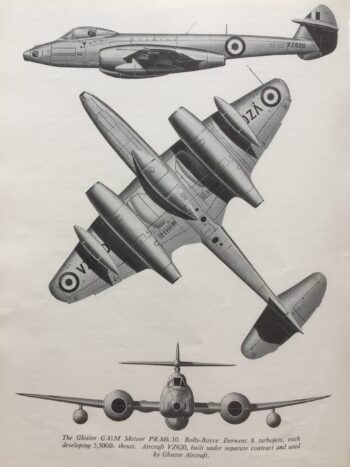
The high altitude Gloster Meteor PR Mk.10 featured the long wings of the F Mark 3, the tail of the F4, the central fuselage of the F8 and the nose of the FR9 fighter reconnaissance aircraft, but without the four cannon.
The PR Mk.10 carried three cameras, one F.24 in the nose and two F.52s in the rear fuselage. The PR.10 was developed at the same time as the FR Mk.9, and made its first flight on 29 March 1950.
PR10 squadron deliveries began in December 1950 when 541 Squadron, based at Benson, received the type.
The PR.10 remained in use until 1958-61, when it was phased out in favour of faster, higher flying aircraft such as the Canberra.
As well as being based on a 1940s airframe, the PR Mk.10 also suffered from a relative lack of manoeuvrability, which meant that it could neither run away from enemy fighters nor evade them. The Meteor PR.Mk.10 was used by 13 Squadron against the Mau Mau in Kenya, and by 81 Squadron during Operation Firedog, the RAF’s contribution to the fighting during the Malayan Emergency.
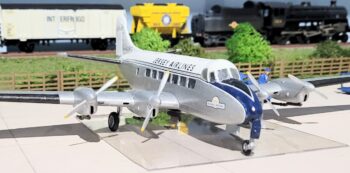
Although only 150 de Havilland Heron Mk 2s were built they served with both the RAF and Royal Navy as well as airlines like Jersey. The wings and fuselage were larger than that of the preceding Dove and four Gypsy Queen piston engines provided power for 17 passengers.
The Mark 2 was introduced in 1952, adding a retractable undercarriage to the original 1950 design.
de Havilland DH114 Heron 2 ‘G-AORG’
c/n 14101 wa built 1956 as ‘G-AORG’ and flew with Jersey Airlines. Between 1961 and 1989 she saw Royal Navy service as a Sea Heron C.1 with the serial ‘XR441’.
She then returned to civil use, was given back her original registration and repainted in genuine ‘Jersey Airlines’ colours as ‘Duchess of Brittany’.
Although in an airworthy condition, she has been at Coventry since 2009, initially for servicing and then waiting for the inevitable paperwork. Despite regular engine runs the aeroplane has not flown again and now appears to be on outside display.
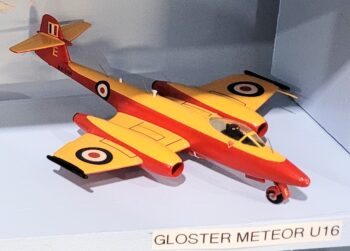
When the Royal Air Force commenced retirement of the Meteor F.4 fighter it looked at converting a number to target drones to help develop ground and air-launched guided missiles. It was decided to convert a number to be used as expendable targets that could be tested to destruction. Up to this stage the conversion of Fairey Fireflys to U-8 and U-9 configuration had been used but their performance was not similar to fast Soviet jet-powered fighters and bombers and development of the Meteor F.4 proceeded in order to provide an aircraft with much higher performance.
A Meteor T-7 was initially converted and fitted with autopilot and equipment for the proposed U-16, a conversion of the Meteor F-8, the T-7 carrying out trials at the Royal Aircraft Establishment (RAE) Farnborough in Hampshire. Subsequently a contract was received by Flight Refuelling Limited of Tarrant Rushton to convert aircraft to this configuration, some 94 being converted, commencing in 1955. The first U-15 conversion was flown on 11 March 1955.
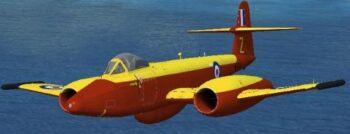
Conversion involved fitting additional radio equipment, a fully automatic pilot, a remote control system that could be used to control the aircraft from the ground, and wingtip camera pods which could be ejected automatically by radio command just before the missile impacted the aircraft. These aircraft could be piloted, or be entirely remotely controlled, or could carry a non-pilot observer. Records indicate a total of 130 F.4s was converted.
A total of 61 was delivered to the Woomera Weapons Research Establishment in South Australia between 1958 and 1963, the first un-manned flight there being made on 7 May 1957 when a drone was destroyed by a Fireflash missile. Another 20 aircraft were delivered to the RAF unit at Llanbedr in North Wales, the first flight there being made over Cardigan Bay on 17 July 1958. A few were also attached to No 728B Squadron of the Royal Navy (RN) at Hal Far air base in Malta.
As time went by the number of U-15 survivors diminished and, as the F-8 was being retired, a number of these had similar conversions undertaken, becoming the U-16. Subsequently the U-21 was developed, this also based on the F-8 fighter, this model having the electronic telemetry equipment of the U-16 but with a lengthened nose, work on this model commencing at Flight Refuelling Limited in 1962. The U-21 were aircraft converted in the United Kingdom, and U-21A were Australian conversions. All were fitted with ventral fuel tanks and Mk 3 Ampor pods,. The colour scheme was red and white, although this varied.
In Australia Fairey Aviation at Bankstown, NSW obtained kit parts provided by Flight Refuelling Limited and 15 aircraft were converted using ex RAAF aircraft. One of these was shipped back to the United Kingdom in July 1971 and converted to U-16 configuration, continuing in service until 11 October 2004, at which time RAF Llanbedr closed.