
My shunting puzzle layout , which I call Susan’s Sidings in honour of my lovely partner who lost her battle with MS, first appeared in public in February 2024.
It is my first front control layout and also features a raised non powered track for displaying longer vehicles.
Measuring 39 1/2″ by 7″ it can work on its own or together with my Millbank diorama base as used in the Millbank: Tank Duel presentation or the Millbank Down airfield, pictured above.

As a tribute to Susan’s father – and also my good friend – Alwyn, I next configured my Millbank baseboard as part of Slough Trading Estate, where he worked as a printer in a building something like the one in the picture above. I created this from a pair of Dapol (ex Airfix) Engine Shed kits and a Modern Shop and Flat from the same source. By this time too, I had enhanced Susan’s Sidings with a set of Peco Modelscene Yard Lights.
There are six in each 5047 pack and only require the ladder to be glued to the combined column and base. Painting is also easy, with just a little white or silver for the lamp over the dark base colour. Just right for shunting on a dark morning or evening.
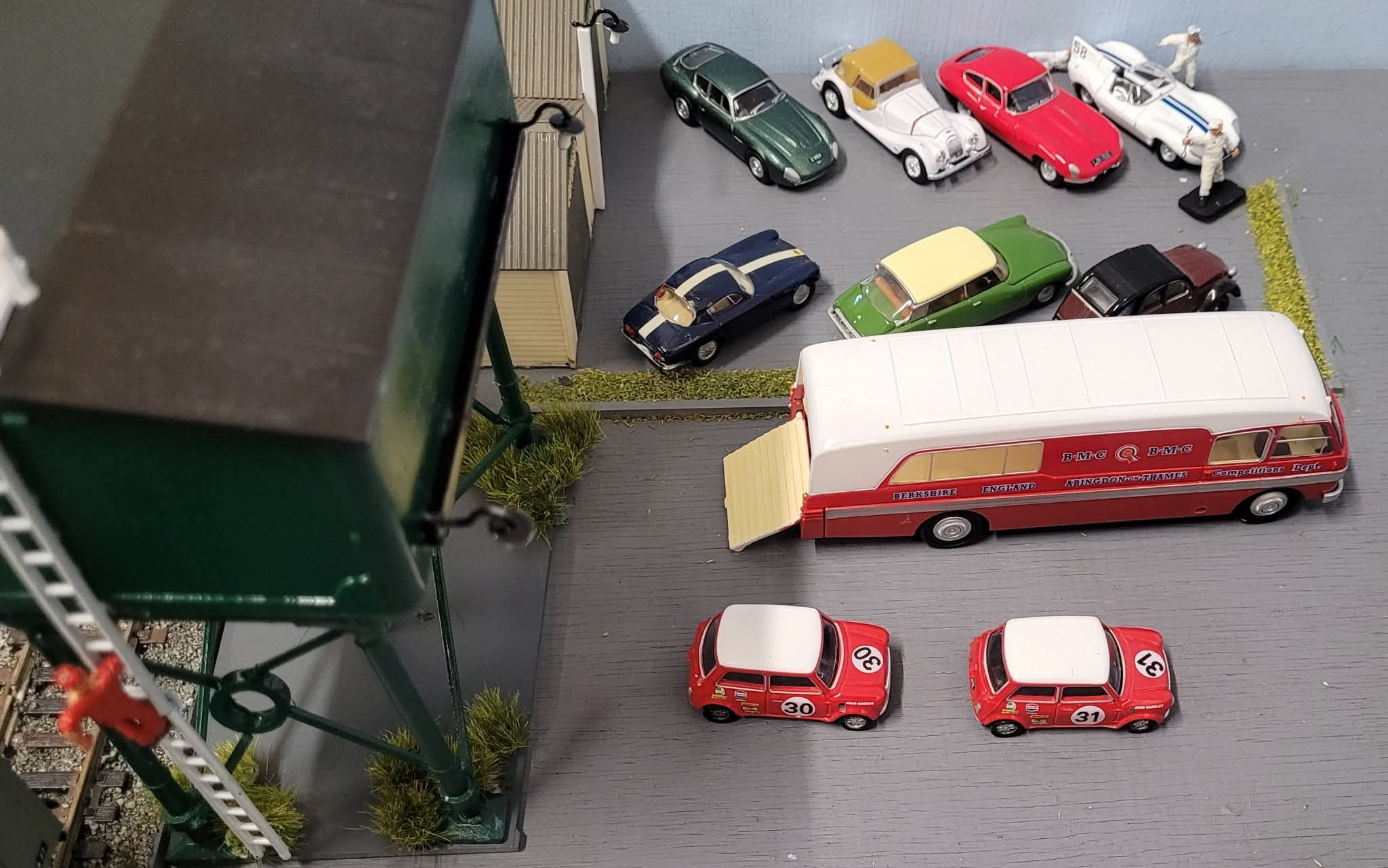
Slough Trading Estate was the home of the Ford GT40 (please someone make this in 1/76 scale!) and also British built Citroën cars. For this reason, my Spirit of Slough Trading Estate presentation featured a garage dealing in performance cars. In these pictures, on the forecourt are Aston Martin DB4 GT Zagato (green), Morgan Super 8 (white with buff roof), Jaguar E Type), Jaguar D Type (white with blue stripes), Lotus Elan, Citroën DS and Citroën 2CV. Arriving on the road are two racing Mini Coopers and their BMC transporter.

Indeed, Slough Trading Estate was so extensive that it eventually had its own banks, shops, restaurant, hospital and fire station.
With this in mind, while at the Cheltenham GWR Modellers Exhibition in April 2026, I noticed that trader Hereford Model Centre was selling well-assembled Metcalfe model buildings at roughly the price of the original unassembled kits. Among these was PO289, the 00 gauge fire station. As both Five Valleys Models and some other vendors had some Oxford Diecast fire engines for sale, also at very reasonable prices, I took the strategic decision to invest.
The pictures on the current version of this article represent the first shakedown of these new assets. The building, complete with training tower, was a perfect fit for its intended location on the diorama base and, once separated from their plinths, the three fire appliances all fitted the fire station doorways and fire station yard.
Two of the engines, the Leyland Cub FK7 and Dennis Light 4, dated from the 1930s, while the AEC Regent was produced from 1950. All three types were still in use in the 1960s, contemporaneous with most of my railway rolling stock, and could have survived longer with a private rather than municipal fire brigade.

The Dennis Light Four Pump Escape (pictured above) was manufactured in the 1930s. It was fitted with a 50′ Merryweather Escape Ladder, a Dennis No.2 main pump and a first aid tank of 50 gallons for the hose reel.
The engine was a 4 cylinder Dennis ‘C’ type sidevalve unit with a capacity of just over 4 litres. This engine was used extensively in all Dennis’s of the 2 1/2 ton to 5 ton chassis range of this period. It was also fitted to the Dennis trailer pump of which several thousand were made for war time use. In the fire engine application a twin plug head was fitted with the plugs being supplied either by a coil ignition circuit or by a magneto. This gave extra reliability.
The Dennis Light Four had the feel of a ‘modern’ appliance with a top speed of 55-60mph and good brakes.

Known for its saloon style enclosed body offering increased crew protection, the 1937 vintage Leyland Cub FK7 offered a template for future crew safety and protection. It also featured a powerful petrol engine and, unlike the Dennis Light Four, a demountable ladder on wheels.
Both these pre Second World War appliances had the advantage of small size, giving access to narrow roads in the manner of modern rapid intervention vehicles such as those built on Land Rover chassis. Balanced against this, only limited amounts of personnel, equipment and ladder length could be carried.
By 1939, larger Leyland Metz appliances were pioneering the use of turntables with metal ladders that could reach 100 feet high while in the 1960s Simon Snorkel was one of the first brands of hydraulic platform fire engine.
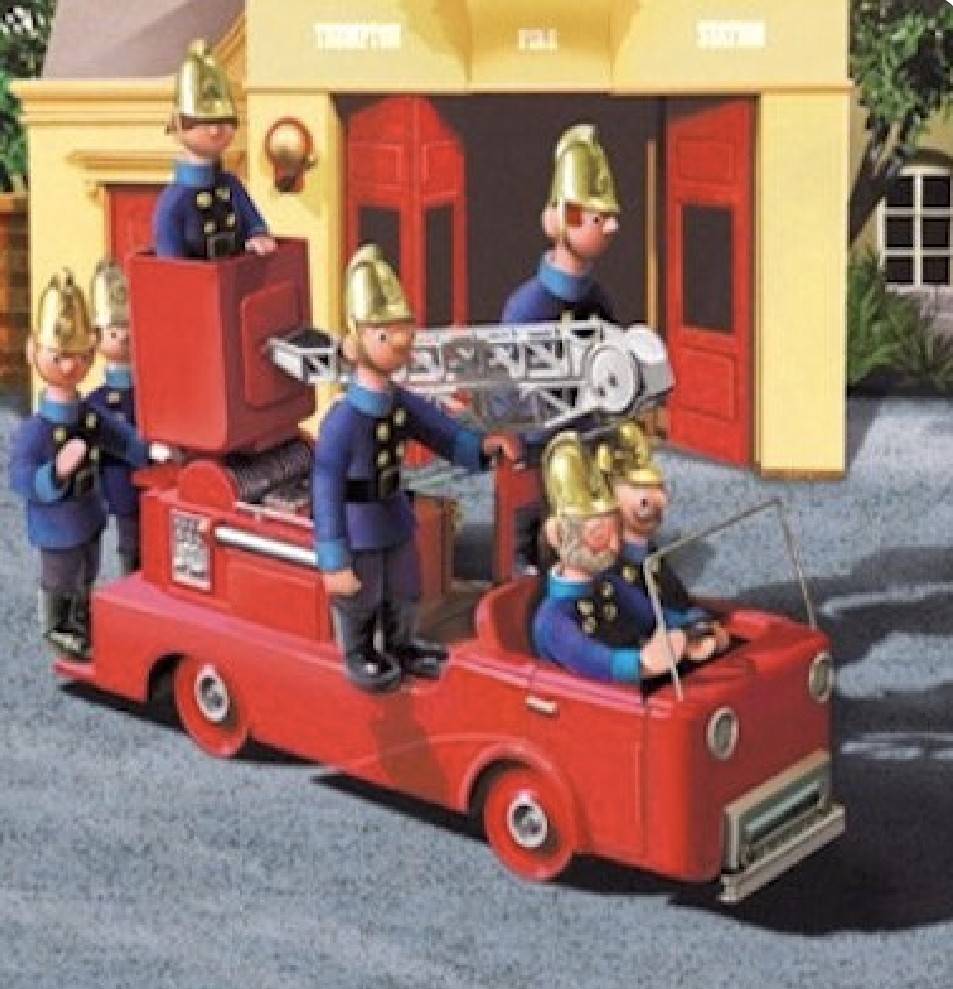
An hydraulic platform appliance was famously used by the fictional Trumpton Fire Brigade although with Pugh, Pugh, Barney McGrew, Cuthbert, Dibble and Grubb riding largely on the outside of the vehicle. An archaic practice in the 1960s but one that made stop-motion animation easier.
Perhaps the ultimate large fire engines are the New York ladders with a separate steersman needed to operate round tight corners in the Big Apple.

Meanwhile, The London Fire Brigade took 62 of the total of 139 AEC Regent III appliances that Merryweather built on AEC Regent chassis between 1950 and 1956.
Of the total, 111 were dual-purpose fire engines, equipped to carry wheeled escape for use in fighting large fires – seen detached in the picture above – or supplied with 35 feet extension ladders to combat small fires.
The fire brigades usually purchased the vehicles in pairs comprising both options. The AEC Regent fire engine chassis were assembled at the Maudsley Motors Coventry Works and the coachwork was built at the Park Royal Coachworks in London.
It was the first post war diesel fire engine and had a carrying capacity of 100 gallons of water, with the ability to pump 1000 gallons a minute from its midship pump.
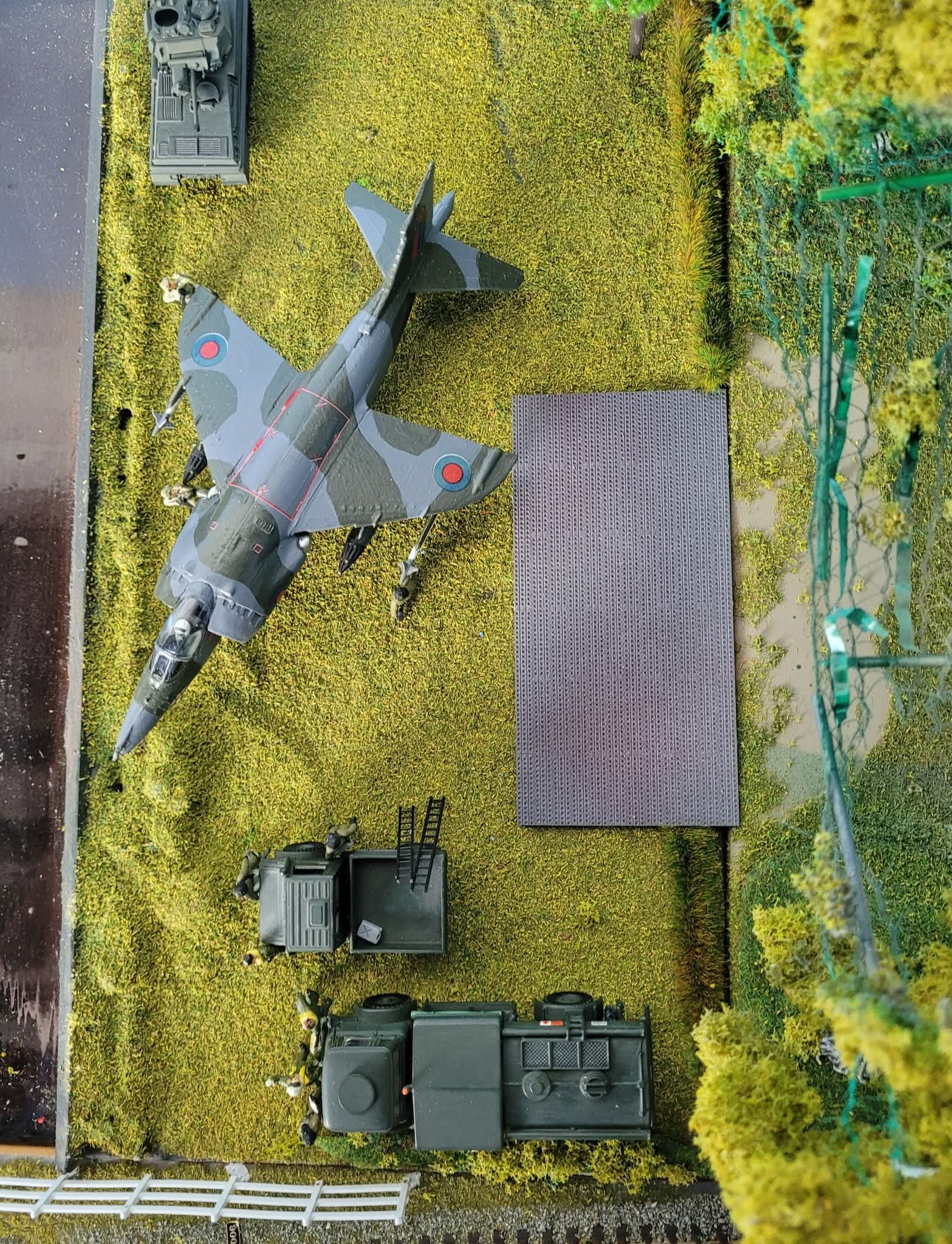
Having checked out the fire station and its appliances, my next decision involved the field on the far side of the canal. This had originally been filled by Churchill tanks (giving the bridgelayer versions something to do) and was later used as an improvised Hawker-Siddeley Harrier base connected to 1974’s Operation Marmion.
In search of novelty, I hit on the idea of yellow construction plant as a counterpoint to the red of the fire engines and as luck would have it three suitably sized vehicles were already on strength.

Although now synonymous with earth moving equipment in the same way that all vacuum cleaners are called Hoovers, J.C. Bamford (Excavators) Limited began in 1945 with just Mr Joseph Cyril Bamford building agricultural trailers and Jeep conversions in a lock-up garage in Uttoxeter, Staffordshire, with a 50 shilling welding machine.
In 1948 he built what was probably the World’s first two wheeled hydraulic tipping trailer and then the first hydraulic loaders in Europe before designing and building his first hydraulic excavator, the JCB Mark 1, in 1954. This was essentially a farm tractor with a back hoe and stabilisers to take the weight off the rear wheels balanced by a system of weights between the wheels and at the front.
The more compact, elegant and useful JCB 3 of 1961 however featured dual hydraulics to work both a shovel at the front and a three-in-one backhoe loader which could dig square holes up to 11 feet deep. Indeed, the JCB 3’s other breakthrough was that the backhoe’s king post could slide on rails along the width of the vehicle and be locked to work in any position. A range of other attachments were also available, with power coming from a 51.8 bhp Fordson Super Major diesel engine to give a total lifting capacity of 4 600 lb.

Four years later, the larger tracked 7 was JCB’s first 360◦ vehicle, originally developed and produced in 1965. With a 6-cylinder Ford 590E engine, it had a power output of 96 hp at 2250 rpm. The 12 tonne machine could dig a maximum depth of nearly 17 feet or 5.5 metres.
This Oxford Diecast model is in the markings of J C Balls & Sons a family-owned construction and plant hire company founded in 1963 by Jim Balls, a prominent figure in the East Midlands’ plant hire and earthmoving sector.
The company still offers services such as plant hire, excavation and aggregates and remains a closely-knit family business with the founder’s descendants still involved in its operations from its base in Ambergate, Derbyshire.
Useful black and white signage indicates the front and the rear of the excavator with a special instruction ‘Do not Grease Slewing Gears’.

The Bedford CF is a small commercial van, a vehicle first introduced by Bedford – a subsidiary of Vauxhall – in 1969. It succeeded the ubiquitous Bedford CA van and was seen as a competitor to rival Ford’s Transit van. It was the last vehicle to be designed solely by Vauxhall and was discontinued in 1986.
During its day, its versatility made it one of the most popular light commercials of the day and it was equally sought after as the template for a caravanette, notably the Bedford Dormobile.
It came with longitudinal front engine and rear wheel drive and transmission of 2/4/5 manual to a 3-speed General Moors automatic. In 1980, a CF facelift introduced a 2.3L diesel engine as an alternative to the petrol engine.
Founded in 1890 by the Gunn brothers, Gunn JCB was to become one of the first JCB dealers in 1958. The family-owned company has dealerships at six strategically placed depots in the UK with its headquarters in Altrincham and branches across the Marches, the Isle of Man and Preston in Lancashire.
It is now one of the largest and successful dealers worldwide. Offering both new and used quality JCB machinery, it also prides itself on service support and the supply of consumable products, namely the accessories needed for the vehicles offered.
This model of the Bedford CF used by Gunn JCB is registered BBA 712T from 1978, pre face-lift.
The van design includes double back doors as well as the driver and passenger cab doors. The Gunn name also features across the front of the bonnet above the famous Vauxhall Griffin badge.
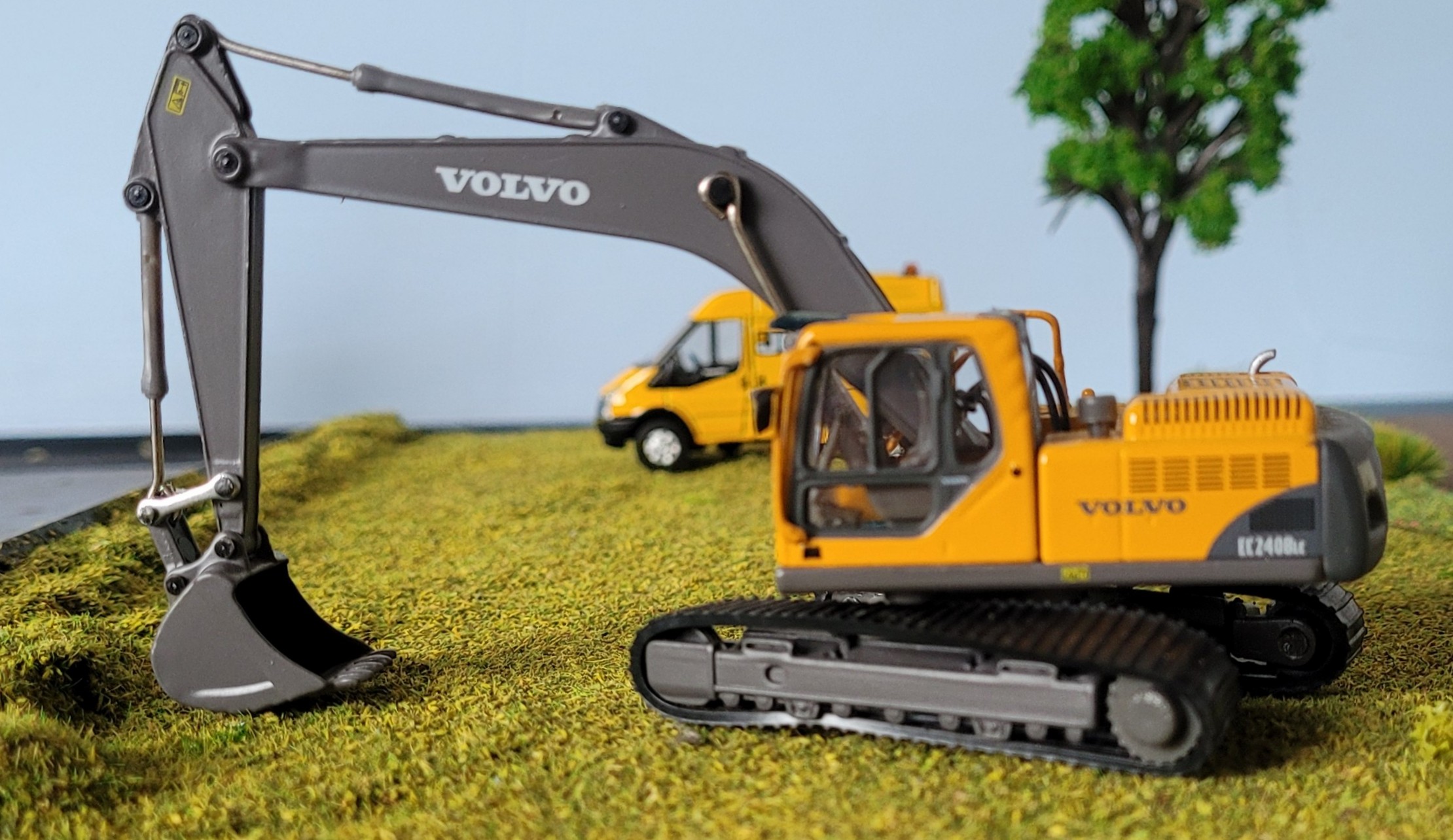
Still an impressive machine in Cararama’s 1/87 scale model, the Volvo EC240B LC )long crawler) is a 24 ton class excavator manufactured between 2002 and 2007.
The EC240B LC is known for its robust X-shaped frame and efficient turbocharged Cummins diesel engine, delivering 134 kW (180 hp). It is designed for high-productivity digging with a 6.0m monobloc boom and various arm options, making it a reliable, high-torque machine for heavy-duty earthmoving. The ergonomic, pressurized, and low-noise cabin has air conditioning, 13-vent climate control, and a sliding front window.
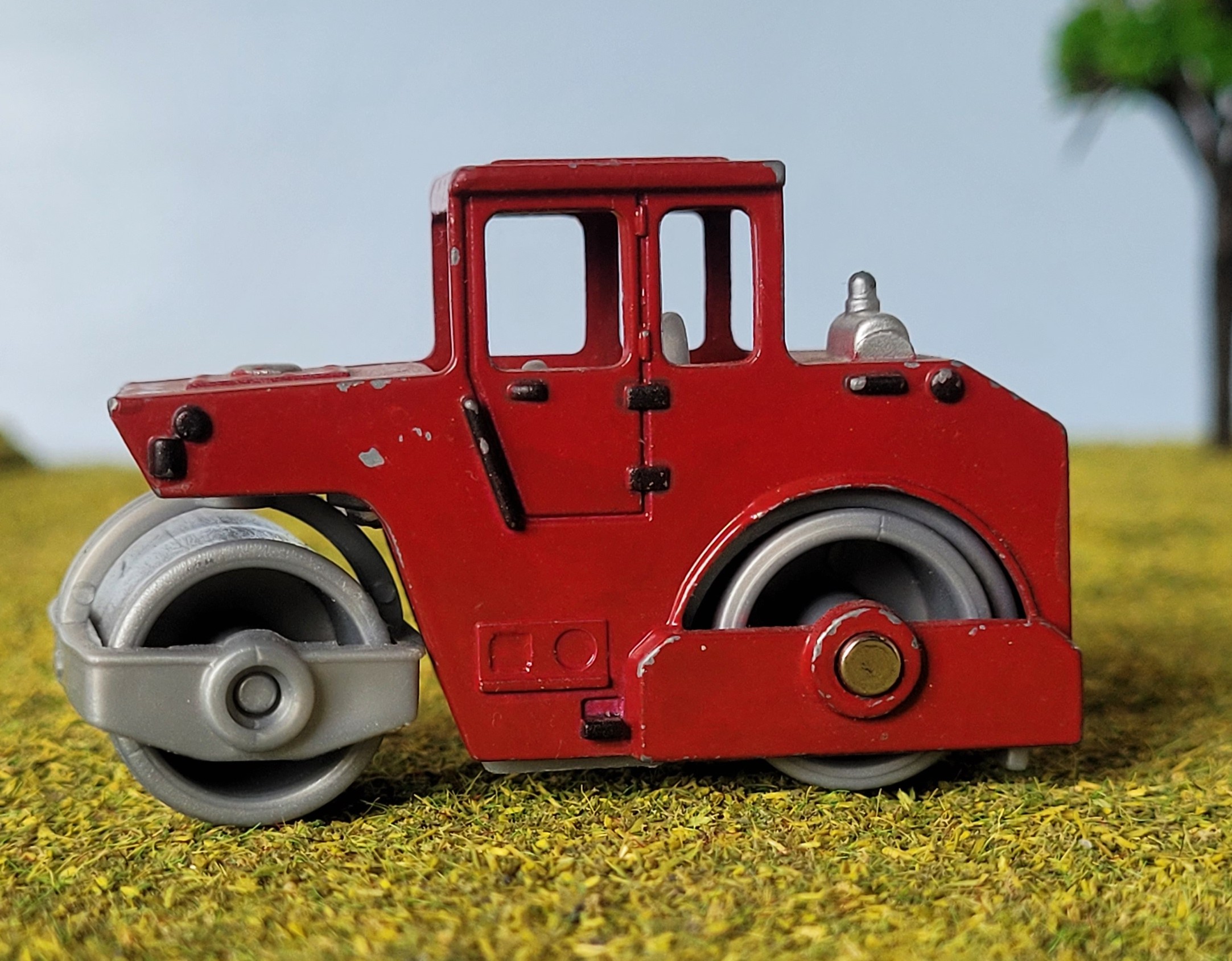
Also convincing despite being 1/87 scale is this Wiking model of a red AGB road roller.

Back in 1/76 scale, Oxford Diecast’s JCB liveried short wheelbase Ford Transit with medium height roof registered FH63 NYV is as run by T C Harrison of Sheffield. Complete with the bright yellow colour scheme and black and white logo, the Transit also features a black interior. A modification sees a yellow and black beacon light on the rear of the roof.
More and different vehicles may be added to Susan’s Sidings: Fired Earth when it debuts at St Margaret’s Hall in October 2026.