Model railway enthusiasts from all over Gloucestershire travelled to the Cheltenham GWR Modellers October 2022 Exhibition in aid of St Margaret’s Hall, Coniston Road, Cheltenham, GL51 3NX on Saturday 29 and Sunday 30 October 2022 to raise money by enjoying the following attractions:
Peasevern Yard
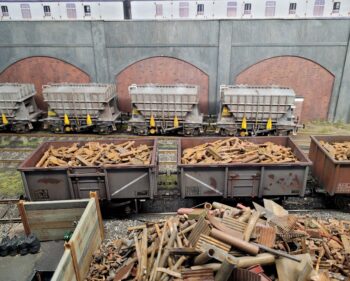
by Rob Owst
O Gauge 7mm scale
Peasevern Yard was inspired by the Midland Railway’s Avon Street Yard in Bristol, nestled in the shadow of Bristol Temple Meads Station. In the late 1970s the Yard was used for the transport of cement, molasses and occasional scrap trains with Classes 03 and 08 providing motive power. The sidings were removed in the 1980s and little trace of the railway remains today.
Peasevern Yard was a loose copy of Rob’s earlier 4mm scale Peafour Yard. The upper level of Peasevern Yard incorporates a small part of Temple Meads station and the now demolished parcels conveyor. Below is a private scrap siding and holding lines for United Distillers and Blue Circle Cement wagons.
This layout was a fine example of minimum-space design, but for me the stand-out feature was the scrap pile. This isn’t just a lump of foam with painted ‘scrap’ pushed in, oh no… every single piece of scrap was added individually! I also believe that the pile grew as more scrap metal was found. The end result was a scrap pile that actually looked like a scrap pile. Similarly impressive was the detail on the various vehicles lying around in various states of disrepair – the kind of detail I can only dream of in 4mm scale. Oh, and the ground textures were incredibly well-observed; including some rather nasty looking oily puddles!
Dinas (NWNGR)
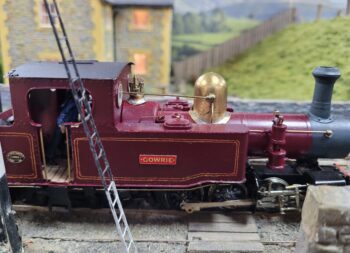
by Peter Booth
O-16.5 gauge 8 mm scale
This layout portrayed part of the 2 foot narrow gauge railway at Dinas Junction station, the northern terminus of the North Wales Narrow Gauge Railways company’s line to Rhyd Ddu. (South Snowdon in later years). It was modelled as it was thought to have been in the early part of the 20th century, and was based upon plans and photographs. This railway was eventually incorporated into the ill-fated Welsh Highland Railway in 1922. However, it is now the focal point of the new expanding Welsh Highland Railway, which is now one of the most impressive narrow gauge railways in the British Isles.
The right hand portion of this layout has been exhibited many times in the area under its original name of ‘Dinas Ddu’, and showed the approach to the station. However it has now been expanded to include most of the station up to the end of the goods shed. However, there has never been any intention of trying to model the standard gauge section of the station, which in this scale would be extremely large.
The intention has always been to model everything virtually from scratch, and this has largely been accomplished, the unusual scale of 8mm=1ft leaving little option. The track is spiked to wooden sleepers in the prototypical manner, the ballast being produced from crushed slate. The locomotives have been constructed from nickel silver and brass, closely following the dimensions on the manufacturers’ original drawings. Coaches and wagons were constructed from wood, nickel silver or plasticard on brass/nickel silver underframes.
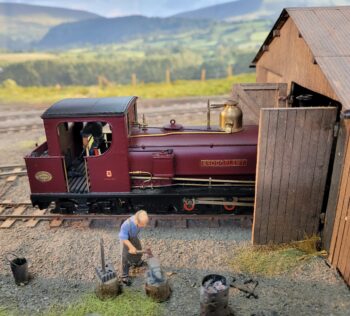
Stonework on the buildings has was produced by building up layers of polyfilla onto a scribed plaster base, the resulting textured finish being painted in water colours. The corrugated iron for the sheds was produced from Slater’s sheet, suitably trimmed and pinned. Grass is made from individual clumps of plumber’s hemp, although some experiments with the modern static grass methods have been incorporated.
The model was started in the early 1980s; although virtually complete, there is still potential for more scenic development. The increased size of the layout also means that an increased amount of rolling stock can be used.
Derwent Road
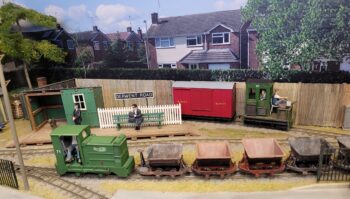
by Bill Flude
O9 gauge 7mm scale
This innovative layout was inspired by the encroachment of suburban Leighton Buzzard on the Leighton Buzzard Railway in the 1960s and 70s. In those decades the town still had a sizeable sand quarrying industry, with sand of sufficient quality to export to Egypt.
The fictional 18 inch gauge line was built to the west of the standard gauge main line that would have been the destination for loaded sand trains. Bill decided that the mid 1980s was a good time frame for the layout with the railway being shared between the sand company and the Preservation Society: passenger trains terminating at Derwent Road.
The baseboards were built from 6mm ply and sit on metal trestles. Derwent Road was controlled using a Digitrax DCC system. The track was Peco 009 with Cobalt IP digital point motors. The control system, lights and sound were built into the two boards to reduce layout setup time. The photographic backdrop was produced by a commercial printing firm from a panorama of six images. The rolling stock was a mixture of kits and scratch building. Structures were built from styrene, wood, brass and glass.
Fryupdale Brewery
By Nigel Hawkins
EM gauge 4mm scale
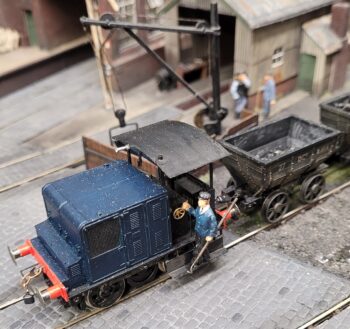
The layout was built for the 2002 DEMU small layout competition which among other things, stipulated that it mustn’t exceed an area of 654 sq ins and have at least one working point.
The track plan was arrived at using points that we already had in stock and a traverser, to save space and allow hidden sidings plus connection to the run round and grain uploading shed. We chose to model a brewery as we like beer! Such a prototype would also allow industrial buildings and a variety of wagon types. The wagons that can be seen are opens, vans, coal, grain and the odd internal user. The buildings are from the Walthers meat packing warehouse kit, from which we got the main building (with loading dock) and grain unloading building.
The baseboard is built as a single unit with legs that plug into pockets underneath. The layout gives a chance to show a varied display of shunters and wagon types, some which are scratch-built. We wanted to build a layout that would be of use beyond the competition and be interesting to operate too, as such it has exceeded the original design brief.
A Remote Depot
by Jeff Pike
OO gauge 4mm scale
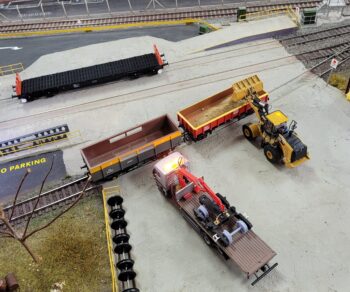
The layout may be pretty simple, just a line in which leads to a headshunt, and three sidings. Ballast is brought in by road by remote controlled vehicles, tipped, and loaded into the wagons before being taken away by the Class 08 shunter. On the right is an HGV / PSV servicing facility giving a reason to bring other trucks, buses and vans on and off scene. A Remote Depot measures1600 x 600mm, plus a small fiddleyard (for both wagons and road vehicles) on the left.
Whitcliffe Quarry Branch
by Rob Mills
OO gauge 4mm scale
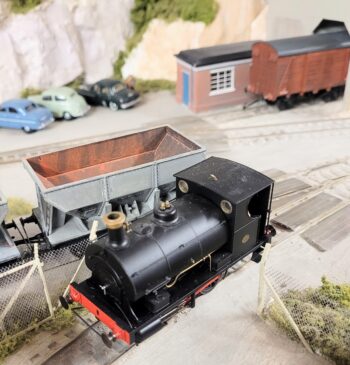
This layout is inspired by various locations in the Forest of Dean.
Whitcliffe Quarry is an actual place to the south-west of Coleford. The prototype is a lot larger than the model, I have had to down size the stone crushing and storage plant to a much reduced version of the real thing.
Fred Watkins was the local entrepreneur who operated the quarry, along with the engineering works and scrapyard at the end of the real life Sling branch, using modellers licence I have placed all the points of interest adjacent to the quarry complex.
The layout also features the sand siding, plus an abandoned horse-drawn tramway wharf for loading stone blocks from local quarries. This is based on the prototype at Bicslade wharf near Cannop Ponds.
Stock operated on the layout is what was actually used on the Coleford branch but is expanded to what could feasibly have been seen if the full service had been maintained until closure of the line to the quarry in 1957.
Operation is DC analogue and points are manually operated as in real life.
Hillside Exchange
by David and Sue Griffin
00 Gauge and P4 4mm scale
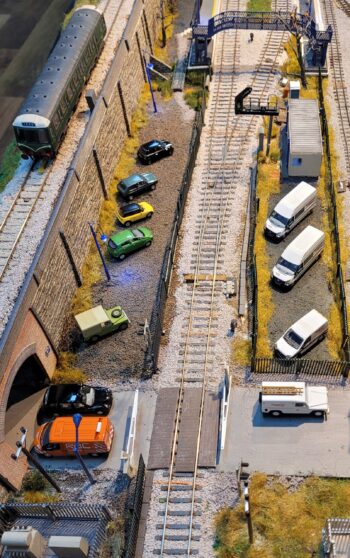
This was the last public appearance of a layout built in Lockdown and representing a fictional passenger exchange between standard and narrow gauge systems in mid Wales.
A simple shuttle controller on the high level preserved line provided essential continuous movement while the standard gauge track was built to P4 18.83 format using largely ply and rivet technique to paper templates. The narrow gauge track was PECO 009 with small radius point work. All were electronically operated with a Capacitor Discharge Unit with switch control by means of a control panel mounted on the main baseboard.
Huntley
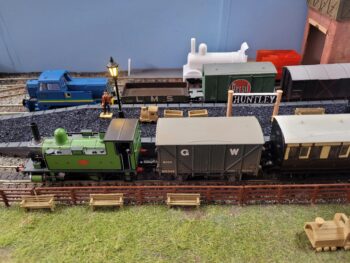
by Bobby Barnard
OO gauge 4mm scale
Huntley was a small railway centre in Gloucestershire with a strong military history. The local volunteers restored the railway to running order in the early 21st Century.
Thomas
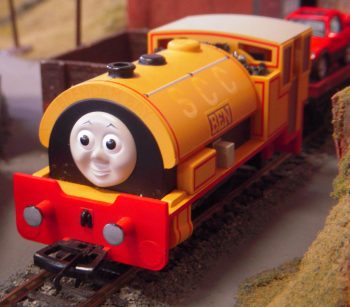
00 gauge 4mm scale
Curated and refurbished by Trevor Hallam for many years, this very popular Thomas layout is now cared for by the Hucclecote Railway Modellers.
Although the Reverend Wilbert Vere Awdry (1911-1997) is well remembered in Gloucestershire as a resident of Rodborough, Stroud, and a patron of the Dean Forest Railway, his childhood association with the Great Western Railway is less well known. However, when Wilbert was six years old, his father, also an Anglican vicar, moved the family to his new parish of Box in Wiltshire. By 1920 their house- “Journey’s End” – was only 200 yards from the western end of Box Tunnel and the nine year old Wilbert could lie awake at night and hear eastbound freight trains being banked up the two mile long 1 in 100 incline, engine crews communicating by coded whistles. Awdry related: “There was no doubt in my mind that steam engines all had definite personalities. I would hear them snorting up the grade and little imagination was needed to hear in the puffings and pantings of the two engines the conversation they were having with one another: ‘I can’t do it! I can’t do it! I can’t do it!’ ‘Yes, you can! Yes, you can! Yes, you can!’”. Here was the inspiration for the story of Edward helping Gordon’s train up the hill, a story that Wilbert first told his son Christopher some 25 years later, and which appeared in the first of the Railway Series books.
Burford GWR
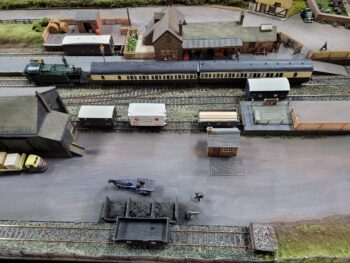
by Pete Howells
HO gauge 3.5mm scale
This is a fictional GWR Cotswold branch terminus typical of that area. It is pictured as it might have been in the late 1930’s.
What makes this apparently typical model branch terminus different, even rare, is its scale of 3.5mm to the foot, 1/87 scale. Most items on the layout have therefore had to be scratch or kit built.
Peco code 75 track is used and has replaced the previous track which dated from just after World War Two. The layout as a whole was initially built in the 1930’s and was well ahead of its time then.
Baseboards are original old wood of two by one frames supported largely on trestles. Two of the boards do have integral legs.
Coupling are 4mm DG items which are operated magnetically. The signals are over 50 years old, and are operated by the wire in tube method. Control is analogue and points are operated by more modern SEEP point motors.
Attobeck
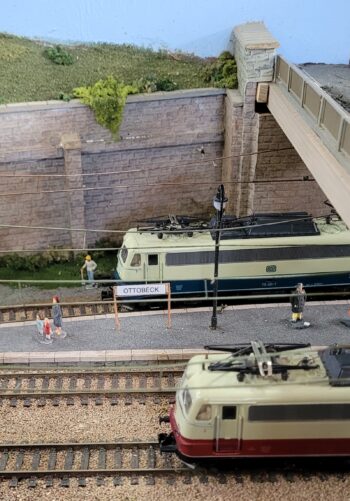
by Reg Owens
HO gauge 3.5mm scale
Ottobeck was a fictional town served by a main line branch Railway. It was also an interchange with a narrow gauge system that went up into the very steep mountain area nearby. After the narrow gauge railway declined, it was replaced by a network of roads after a river was diverted.
Ottobeck was constructed with plywood on a timber frame with mainly kit buildings and control is analogue with Gaugemaster equipment.
Smoke Leaf
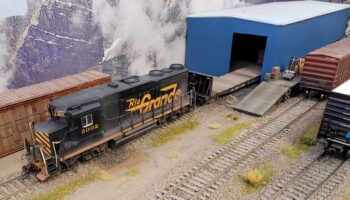
by Matthew Wathen
HO gauge 3.5mm scale
Smoke Leaf was a shunting layout based on the Rio Grande railroad from the 1970s to the mid 1990s and operated by railway workers known as Leafers. The yard linked local businesses high in the Rocky Mountains with the the fictional Colorado town of Burkittsville and thence to the rest of North America.
Heybridge Wharf

by Mike Corp
14.2mm gauge 3mm scale
The layout was built for the 50 something challenge to commemorate the 50th anniversary of the 3mm Society 1965 -2015. The scenic part is 50 inches long by 50cm wide and was built to fine scale standards with a track gauge of 14.2mm. Heybridge Wharf is purely fictitious and is situated somewhere in Suffolk at one of the last inland wharves still operating. The railway was built under the Light Railways act as the Hey Light Railway to connect the town of Heybridge to the Great Eastern Main Line via Heybridge Wharf. The trains from the main line enter Heybridge Wharf via the line between the church and the gas works. This is the end of the line for the stock not allowed to proceed along the tramway to Heybridge Town. Those that are allowed run round their train and proceed along the tramway squeezed between the gasworks and Colly Tobbold’s brewery. The wharf still receives one of the last barges still trading but now converted with a diesel engine.
Malmesbury

by Swindon MRC
N gauge 2mm scale.
Malmesbury was built by a vicar, now deceased, in the Midlands some years ago and became a Swindon MRC asset in November 2018. The layout is under refurbishment and the cattle dock is set to be moved to its accurate location.
Fairground
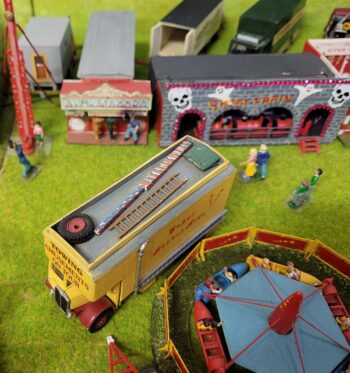
by Martin Nash
1/76 scale
A look back at the travelling fairs of the 1960s with attractions including a test-your-strength machine, carousel, ghost train- and my favourite, the rifle range. The two customers were adapted from Airfix figures of First World War German soldiers while the box van was converted from a Greenford built AEC Regent double decker bus- itself based on the London Transport RT made famous by Cliff Richard in the film ‘Summer Holiday’.
The Mellor Brothers and Andy Peckham
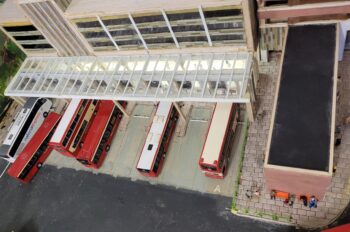
1/76 scale 4mm to the foot
Paul and David Mellor were back with their Gloucestershire Road Transport collection, reflecting their long affiliations to both the National Association of Road Transport Modellers and the Model Bus Federation. Specifically, as the young people say, the new version of Brocklecote Bus Station was lit, and the outer corner boasted a large scale statue of a Gloster Meteor.
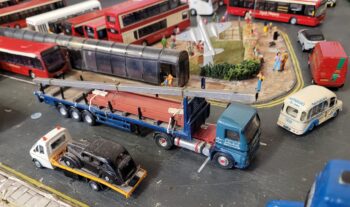
Despite the changes, Brocklecote remains a fictional town built on the site of the former Gloster Aircraft Company works and close to the Coopers Hill Cheese Roll slope. Brocklecote is also the site of the head office, main depot and central works of the North Western Gloucestershire Road Car Company, serving destinations inside the county and beyond. Although celebrating 50 years of service, the 160 strong fleet includes the latest electric PSVs.
As can be seen from the Lilleshall Steel articulated vehicle seen above, road haulage played a large part of the Mellor Brothers display including new members of the Tewkesbury based Edgwick fleet.
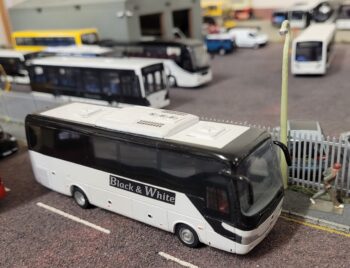
Meanwhile, Andy Peckham’s Transport 2000 fleet – including its Black and White sub brand – continues to grow, embracing such manufacturers as Yutong of China.
Yutong is the world‘s largest bus manufacturers by sales volume of large and medium-sized buses and coaches. It has ranked first globally for 9 consecutive years and first in China’s bus industry for 17 consecutive years. Yutong also has a separate construction equipment manufacturing division and develops thousands of apartments across China each year.
A Taste of America
by Vincent Tweed
3.5 mm to the foot 1/87 Scale
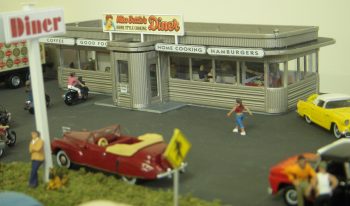
Having impressed us over the years with his Southdown buses and transport rally dioramas, Vincent took Hucclecote visitors to Miss Bettie’s Diner, Colorado, USA with a dazzling array of chrome and tailfins parked outside. He commented:
“Since my first visit to the United States I have held a fascination for diners, especially those constructed with a stainless steel finish. Miss Bettie’s Diner is found on a busy highway sometime in the 1960s. The now disused rail track will eventually become an extension to a nearby preserved railroad. The ranch is a stud for breeding racehorses and also houses a collection of vintage tractors and farm machinery which is open to visitors at weekends. The diner is a grey Walther’s Cornerstone kit sprayed to achieve a stainless steel finish and with added detail. The cars are from the Oxford Diecast range and various US manufacturers with the majority of figures by Woodland Scenics.”
Spicy Sanita’s
by Vincent Tweed
3.5mm to the foot 1/87 scale
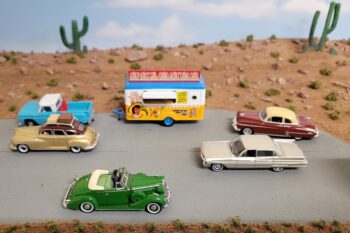
This fictional 1960s vintage eye-catching mobile ‘cantina’, serving delicious spicy Mexican food, is owned by Carmen Gomez. Her family has a Mexican background but she was born and brought up in the United States. She gained a love of food at an early age when taught to cook by her mother, Rosa, and grandmother Sanita. Now in her early 30s with the desire to share her culinary expertise, she has this food outlet, assisted by her sister Silvia, in an awesome scenic setting in the state of Utah. It is located on a small but busy highway near Monument Valley where John Wayne’s ‘Stagecoach’ and ‘The Searchers’ were filmed. Carmen also jointly owns a popular family Mexican restaurant with her parents and where her husband Pedro is the chef. It is situated in their nearby home city.
All Carmen’s food is home prepared and then cooked on site on a daily basis with her getting up early to carry out this task. The cantina is towed to the location every day behind her Chevrolet Stepside pickup. It attracts both tourists and locals who want a tasty takeaway or a brief sit-down break from driving.
The rocks on the diorama are from Vincent’s garden, the backscene is a mixture of Gaugemaster and Vincent’s own photographs and the vehicles are either Oxford Diecast or Woodland Scenics.
Incidentally, the President of Mexico made a State Visit to Britain in 2015 but was not made an Associate of the Royal Institute of British Architects.
The Lancaster Story
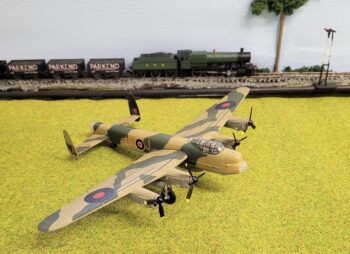
1/144 Scale N Gauge
A look back at one of the most iconic British aircraft, more details of which can be found here.
Thanks are also due to Colin Green for the loan of locomotives and rolling stock.
Modelling demonstrations were staged by Mark Begley, Steve Harrod, Richard Self and Trevor Hale.
Trade Support was
Collett’s Models of Exmouth WEBSITE
Penduke Models WEBSITE
Railway books, timetables and photos by Stewart Blencowe WEBSITE
RCSW (Pre-owned) Models, Clive Reid.
Also represented was the Gloucestershire Warwickshire Steam Railway.
Admission to the Exhibition was
£5.00 Adults
£2.50 Children