
To celebrate the arrival of David West’s splendid 1/72 scale Douglas Thor Intermediate Range Ballistic Missile in the model cabinets of Jet Age Museum, a display of earlier and later Douglas products was assembled.
Donald Wills Douglas had been chief engineer at Martin before leaving to establish the Davis-Douglas Company in early 1920 in Los Angeles. He bought out his backer and renamed the firm the Douglas Aircraft Company in 1921.

Douglas Aircraft found fame and success with a number of landmark designs, the first being the Douglas World Cruiser biplanes which the US Navy had used to make the first circumnavigation of the Earth by air in 1924. This in turn led to Douglas adopting he motto “First Around the World – First the World Around” and replacing its original winged heart logo with one depicting an aeroplane flying around the globe. This later evolved into an image with aeroplanes and rockets and became the basis for the logo of McDonnell Douglas and, later still, Boeing.
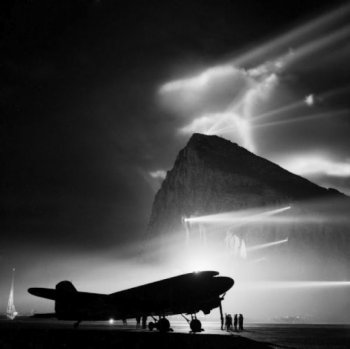
Meanwhile, even more important for World aviation was the Douglas Commercial series of low wing all-metal twin engined monoplanes, starting with the single DC-1 first flown in July 1933. This was followed by the 14 passenger DC-2 – a KLM example of which came second to the specially designed De Havilland DH88 Comet racer in the 1934 England-Australia MacRobertson Air Race in 1934 – and the DC3, first flown in December 1935. By 1938, DC-3s were carrying the bulk of America’s internal air traffic and the design formed the basis for the C-47 – or Dakota – used by the Allies all around the World during the Second World War.
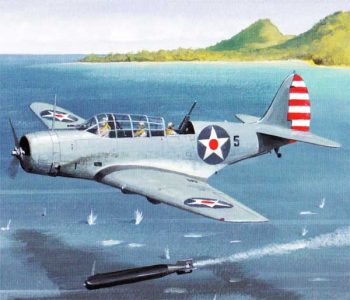
In fact Douglas produced almost 30 000 aircraft from 1942 to 1945 and the workforce – spread over factories around the USA – swelled to 160 000. As well as the C-47, Douglas types included the twin engined Boston and Havoc bombers as well as the single engined Devastator (pictured above) Dauntless and Skyraider naval attack aircraft.
First flown in 1935, the Torpedo Bomber Douglas Devastator was the most advanced naval aircraft in the World when introduced in 1937 but was no match for the Japanese Mitsubishi Zero fighters opposing it after 7 December 1941. However, despite heavy losses at the Battle of Midway, some of the Devastator’s failure as a combat aircraft must be attributed to the design of the torpedoes that it carried.

The Douglas Dauntless – pictured above – first flew in 1940 and is best remembered for its decisive blows against Japanese aircraft carriers at the Battle of Midway in June 1942. It was subsequently developed with a more powerful engine – but no tail hook – as the A-24 Banshee for the US Army and Free French forces.
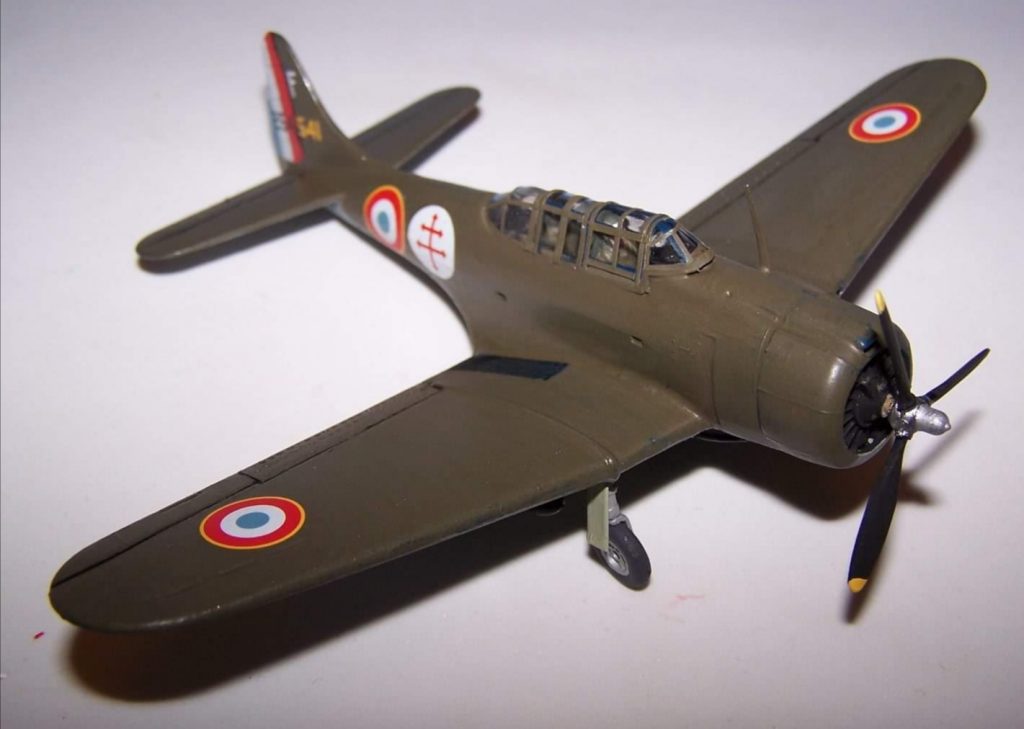
The most combat-experienced of the Banshee units was GC 1/18 Vendee, which flew A-24Bs in support of Allied forces in southern France and also experienced how deadly German flak was, losing several aircraft in 1944. This squadron flew from North Africa to recently liberated Toulouse to support Allied and French resistance troops. Later, the unit was assigned to support attacks on cities occupied by the Germans on the French Atlantic coast. In April 1945 each SBD-5 averaged three missions a day in the European theatre.
French Navy Dauntlesses were based in Cognac at the end of 1944. The French Navy Dauntlesses were the last ones to see combat, flying from the carrier Arromanches (the former Royal Navy carrier Colossus). In late 1947 during one operation in the Indochina War, Flotille 4F flew 200 missions and dropped 65 tons of bombs. By 1949, the French Navy removed the Dauntless from combat status although the type was still flown as a trainer through 1953.
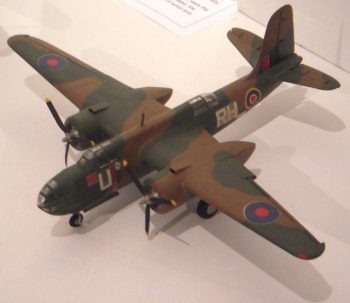
The Douglas Boston was the best of a series of American light bombers to serve with the RAF during the Second World War, serving with ten RAF and South African Air Force bomber squadrons and three night intruder squadrons.
The Boston III was often used to replace the Bristol Blenheim, having a top speed of over 300 mph and a maximum bomb load of 4 000lb, and began to reach Britain in the summer of 1941, having been ordered in 1940. The Boston I and II were designations given to similar aircraft ordered by the French, and which entered RAF service after the fall of France.
The first to get the Boston was 88 Squadron – as depicted in the model above – replacing its Blenheims in October 1941. Nos.107 and 226 squadrons were next to gain the Boston, but it would be two years before a fourth bomber squadron – No.342 (Free French) – would receive the type.
Nos.88 and 226 squadrons were the first to take the Boston into combat, taking part in the unsuccessful attempts to stop the German warships Scharnhorst, Prinz Eugen and Gneisenau return to German ports from Brest in February 1942. Only one aircraft from the two squadrons actually found the German ships, inflicting no damage but escaping intact.
The main role of these Boston squadrons was to carry out daylight bombing raids over France, Belgium and Holland as part of the RAF’s policy of “leaning over the channel”. These raids were intended to provoke the Luftwaffe into responding, generally without success, but the Boston did prove to be a capable medium bomber, fast and robust with a useful bomb load. The first proper Boston attack came on 8 March 1942, against the Matford Works at Poissy.
During 1943, 226 Squadron converted to new aircraft while No.342 (Free French) Squadron converted to the Boston. The three Boston squadrons (Nos. 88, 107 and 342) formed 137th Wing, 2nd Tactical Air Force. In the first half of 1944 they concentrated on attacking invasion targets in northern France, amongst them coastal defences, German airfields and communications.

After D-Day the wing moved to France, supporting the Allied armies as they advanced towards Germany. The Boston was slowly phased out during this period – No.107 Squadron was withdrawn and replaced with No.226, which had converted to the Mitchell, and in April 1945 88 Squadron was disbanded, leaving No.342 (Free French) as the only Boston squadron still operating in Germany at the end of the war.
The Boston III (Intruder) was used by three squadrons – Nos.23, 418 and 605 – as a night intruder, operating over German occupied Europe at night in a role made more famous by the Mosquito, but pioneered in part by the Havoc, the name given to earlier versions of the DB-7 taken from French orders.
The Boston entered service in North Africa with 24 Squadron South African Air Force in November 1941, just before the first American A-20 Havocs arrived in the area. At first No.24 SAAF used its Bostons on unescorted reconnaissance missions in small groups, and suffered very heavy losses. By the end of December the squadron had to be withdrawn to recover but returned to the fight on 22 February 1942, this time operating with fighter escorts.
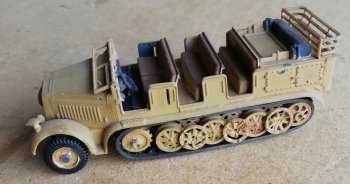
They were joined on 15 March 1942 by 12 Squadron SAAF. The two squadrons operated together during the desert battles of 1942, which culminated in the second battle of El Alamein. In the period before that battle they were used to attack German tank columns, air fields and lines of communication, while after the victory at El Alamein they carried out a large number of low level attacks. These were dangerous missions and the squadrons suffered heavy losses, but they were able to destroy a large number of the crucial soft skinned transport vehicles needed by the retreating Germans and Italians.
The number of Boston squadrons doubled in March 1943 when Nos.18 and 144 converted to the aircraft. All four squadrons were involved in the final fighting in Tunisia, which ended with the German surrender in May 1943. They then took part in the early stages of the fighting in Italy, taking part in the invasion of Sicily and southern Italy. The two South African squadrons converted to the B-26 Marauder in December 1943-January 1944, and for most of 1944 only two squadrons operated the Boston.
The number rose to four again in October 1944 when Nos.13 and 55 squadrons converted to the Boston from the Baltimore. The four squadrons (Nos.13, 18, 55 and 114) formed 232nd Wing, operating the Boston IV and V. The wing operated at night, often carrying out prolonged nuisance raids over German positions, attacking the same point at regular intervals through the night.
Later in 1944 No.13 (from October 1944), No.18, No.55 (from October 1944) and No.114 Squadrons formed 232nd Wing. The Boston IV and V replaced the Boston III and the wing carried out night bombing missions in Northern Italy. A Boston V is credited with carrying out the final night raid in Italy on 30 April 1945. After that the Bostons were used to drop surrender leaflets to isolated German troops. The four squadrons retained their Bostons until 1946.
Boston IIIs fitted with Turbinlite equipment also served with 771 Squadron of the Fleet Air Arm based at RNAS Tern at Twatt in Orkney.
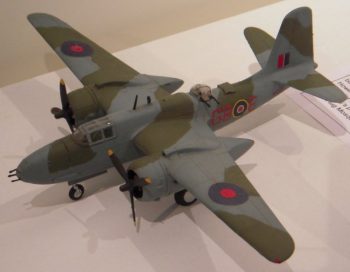
Flown by the Allies in the Pacific, the Middle East, North Africa, Europe and Russia, the versatile A-20 went through many variants. The A-20G, which reached combat in 1943, was produced in larger numbers than any other model. By the time production ended in September 1944, American factories had built 2 850 “solid nose” A-20G models. Attacking with forward-firing .50-cal. machine guns and bombs, the A-20G lived up to its name by creating havoc and destruction on low-level strafing attacks, especially against Japanese shipping and airfields across the Southwest Pacific.
With its bomb load reduced to 1,000lb the Havoc I (Intruder) could reach German air bases in northern France, Belgium and Holland. No.23 Squadron was the first to receive the Havoc and from March 1941 until August 1942 it flew low level night time missions, harassing the Germans while suffered very low losses. The Havoc was joined by the Boston III (Intruder) in July 1942, before converting to the De Haviland Mosquito in August 1942. The Havocs moved on to No.605 Squadron, which operated the Havoc (Intruder) from 14 July 1942, before replacing them with the Boston in October and the Mosquito in August 1943.

No.85 Squadron was the only squadron to use the Havoc I and Havoc II (Night Fighter) exclusively, receiving its first aircraft in February 1941. The Havoc I (Night Fighter) replaced the Boulton-Paul Defiant (pictured) , with which it had achieved a single night time victory. The Havoc went operational on 7 April, and only two days later the squadron scored one confirmed, one probable and one damaged.
The Havoc I remained in use to the end of 1941, while the Havoc II (Night Fighter), with twice the firepower, arrived in July 1941. The squadron operated the Havoc for eighteen months, before replacing them with the Mosquito in September 1942. No.25 Squadron also operated a number of Havocs alongside its Bristol Beaufighters. The Beaufighter IF was more heavily armed and had twice the range of the Havoc I, although the Havoc was slightly faster.
Numerically the largest group of squadrons to operate the Havoc were the ten Turbinlite squadrons that had a brief existence from September 1942 to January 1943, when the entire idea was abandoned. The Turbinlite was a massive spotlight that was installed in the nose of a Havoc or Boston. A total of 21 Havoc I (Turbinlites), 39 Havoc II (Turbinlites) and at least three Boston III (Turbinlites) were produced.
The idea was that the Havoc would use its radar to find a German aircraft, then catch it in the spotlight and let a normal day fighter attack it. At first the Havocs operated in Turbinlite flights, starting with No.1422 Flight (Air Illumination Unit) working alongside Hurricane squadrons, but the two aircraft rarely met up, and so in September 1942 ten Turbinlite squadrons were formed, operating a mix of Havocs, Bostons and Hurricanes. This improved the cooperation between the two types of aircraft, but successes were still rare. As better radar equipped night fighters began to appear the Turbinlite concept was abandoned, and all ten squadrons were disbanded early in 1943.
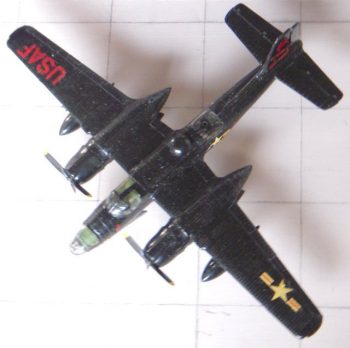
The Douglas A-26 was designed as a medium attack bomber replacement for the B-25’s and Martin B-26’s of pre World War II vintage. The Douglas A-26 saw combat in every theatre of World War II, Korea and Vietnam. It was redesignated as Douglas B-26 in 1948 after the retiring of all Martin B-26 Marauders. There were 226 aircraft lost in the Korean War where the Invader performed night harassment missions. It was the last aircraft to bomb North Korea, dropping a bomb load just 3 minutes before the cease-fire was signed. Several A-26’s were supplied to Cuban revolutionaries during the April 1961 Bay of Pigs invasion.
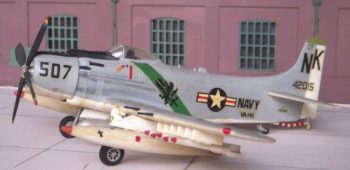
The prototype of the Skyraider was first flown on 18 March 1945. Designed as a robust, multi-role attack aircraft for the US Navy, the carrier-based Skyraider was able to carry a wide variety of weapons on its numerous wing hard points. The Skyraider first saw combat in the Korean War, where its 10 hour loiter time and heavy load-hauling capability gave it a distinct utility advantage over the jet aircraft of the time.
The Skyraiders of VA-55 went into action from the USS Valley Forge on 3 July 1950 while on 2 May 1951 Skyraiders also made the only aerial torpedo attack of the war – successfully hitting the Communist controlled Hwacheon Dam. On 16 June 1953 a US Marine Corps Skyraider crewed by Major George H. Linnemeier and CWO Vernon S. Kramer of VMC-1 shot down a Soviet-built Polikarpov Po-2 biplane, the only documented Skyraider air victory of the Korean conflict.
Other Skyraider variants flew nocturnal bombing and radar-jamming missions from aircraft carriers and land bases and in total 128 Skyraidrs were lost in the Korean War.
Skyraider 42015 is seen here in the post Korean War markings of VA-145, nicknamed “The Swordsmen”, grey and white paintwork having replaced overall gloss dark blue.
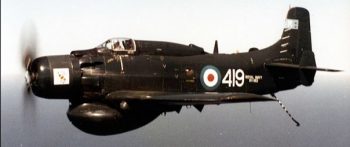
Beginning in November of 1951, the United Kingdom received 50 AD-4W Skyraiders under the Mutual Defense Assistance Program (MDAP). They were intended to provide airborne early warning for the Royal Navy, and were designated Skyraider AEW.1 in Fleet Air Arm Service.
20 of the Skyraiders (WT944/WT963) were delivered to the Royal Navy factory-fresh, but the remainder came from US Navy stocks.
The Skyraider AEW.1 first entered service in late 1951 with No.778 Training Squadron, based at RNAS Culdrose, and this unit conducted British carrier trials aboard HMS Eagle. No.849 Squadron was the only unit to fly the Skyraider, and they maintained a Headquarters Flight permanently based at Culdrose and four operational Flights which were detached for service in four-lane units aboard carriers. One of these Flights was operating aboard HMS Bulwark during the Suez operation in November of 1956.
The Skyraider AEW.1 was replaced in active service by the Fairey Gannet AEW.3 by November of 1960, but some Skyraiders remained in supporting and training roles until 1962.
In late 1962 and early 1963, twelve surplus Skyraider AEW.1 aircraft were sold to the Swedish company Svensk Flygtjanst AB. This private company operated target tugs under contract to the Flygvapnet. These were ex WT952, WT949, WT962, WT950, WT956, WT957, WT944, WT959, WTWT0948, WV181, WT987 and WT951. Before delivery, they were modified by Scottish Aviation at Prestwick. These changes included the removal of the military equipment (including the tailhook and the radome) and the fitting of a large bubble observation window on both sides of the fuselage immediately to the rear of the entrance doors. A winch operator’s station was installed in the crew position previously occupied by a radar operator. Two more aircraft (ex WT945 and WV185) were later delivered to Sweden as spares. The twelve modified aircraft were assigned the Swedish civilian registrations SE-EBA to SE-EBI and SE-EBK to SE-EBM. The planes were painted a brilliant yellow to make it easier for them to be seen. SE-EBH (ex-WT959) was destroyed by fire after a taxiing accident at Lulea in Sweden on September 8, 1968 and was replaced by ex-WT849, which was converted to target tug configuration at Bullofta and became SE-EBN. This machine was written off in a wheel-up landing accident at Midlanta Airport on May 6, 1971. The Swedish Skyraiders were still in use as target tugs as late as the early 1970s.
Two Fleet Air Arm Skyraiders (WT121 and WV106) are now on display at the Fleet Air Arm Museum at RNAS Yeovilton.
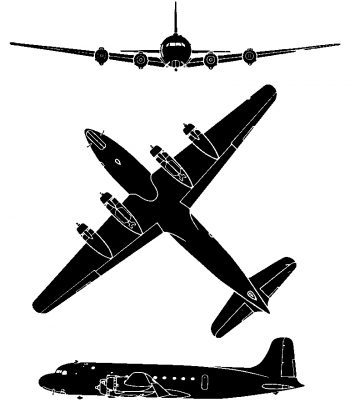
Douglas continued to develop its piston engined transport types with the four engined nosewheel DC-6 and DC-7 which in turn led to the four jet engined DC-8 of 1958 as a competitor for the Boeing 707 and de Havilland Comet IV.
In parallel, Douglas military jet designs included the straight winged F3D Skyknight all-weather fighter of 1948 and the delta winged F4D Skyray of 1951 and A4D Skyhawk in 1954.

The end of World War Two found the aircraft industry of the United States of America untouched by bombing and with access to a wealth of new British and German aeronautical data as well as the financial power to turn these ideas into reality.
One such result of this American good fortune was the D-558-1 Skystreak, designed by the Douglas company in 1945 to obtain high speed data.
After completing only 14 hours flying time, the Skystreak piloted by Commander Turner F. Caldwell of the US Navy achieved 640.5 mph to win the World Record. Five days later, on 25 August 1947, Major Marion F. Carl, US Marine Corps, raised it again, this time to 650.5 mph. The aircraft shown is in the shape used for the first attempt. A modified canopy and windscreen was fitted for the second attempt.
Then, on 14 October 1947 Captain Chuck Yeager of the US Army Air Force became the first pilot to break the Sound Barrier at a speed of 670 mph at 42 000 feet in his Bell X-1 “Glamorous Glennis”.
The high speed single-seat aircraft of both Douglas and Bell used thin, deep straight wings but while the D-558-1 Skystreak took off from a conventional runway powered by a jet engine, the X-1 was dropped from a high altitude B-29 bomber and was rocket powered. This latter approach to high speed research was to lead to on to the spacegoing X-15 programme and to NASA’s Space Shuttle.

After Britain’s miracle month of September 1953, the World Air Speed Record was back in American hands on 30 October 1953 when Lt Cdr James B. Verdin reached 753.5 mph in the skies over the California desert at the controls of the prototype Douglas XF4D-1 Skyray. This naval fighter was also the first aircraft with delta wings ( a concept originally developed in Britain ) to hold the World Air Speed Record and for the attempt was specially fitted with an afterburning Westinghouse J40-WE-8 rather than the standard production Pratt and Whitney J-57. The Douglas Skyray was a contemporary of the slower Gloster Javelin and its curved delta shape was often confused with the much larger four engined Avro Vulcan nuclear bomber.
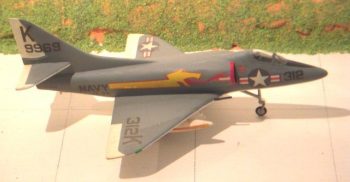
In 1952, the US Navy and Marines requested a new tactical attack jet weighing 30,000 lb. The Navy was quite surprised when the Douglas Aircraft Company claimed to be able to meet the design specifications with an aircraft weighing only half as much. Not only did the resulting A-4 fully meet all performance requirements, but the aircraft also set a World speed record in 1954.
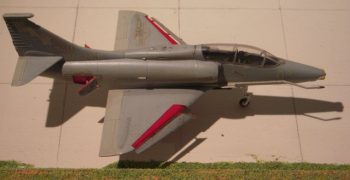
The A-4 was designed from experience gained in the Korean War that made clear the need for an aircraft with greater range and payload, suitable for use on aircraft carriers, and able to provide close-in support for ground forces. The Skyhawk proved a great success in Vietnam and also became popular with many foreign air arms. The A-4 was also popular as a two seat training aircraft and as the equipment of the US Navy Blue Angels display team.
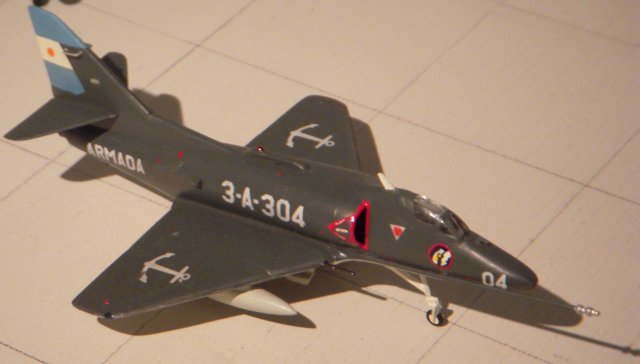
Although nearly 30 years old at the time of the Falkland Islands conflict, A-4s operating from Argentine land bases successfully attacked and sank a number of British ships. The last of 2,960 Skyhawks was built in 1980, though upgrade programs continued well into the 1990s.
The A-4 also pioneered the concept of “buddy” self air-to-air refueling. This allowed the aircraft to be used as a tanker for others of the same type, removing the need for entirely different tanker aircraft – a particular advantage for small air arms or when operating in remote locations. This worked by designating a tanker aircraft and fitting it with a centre-mounted “buddy store” that was a large external fuel tank with a hose reel in the aft section and an extensible drogue type refueling bucket. This aircraft was fuelled up without armament and launched prior to the attack aircraft. The attack aircraft were then armed up to the maximum and given only just enough fuel to bring them up to the maximum take-off weight. Once airborne, they would then proceed to top up their fuel tanks from the tanker using the A-4’s inbuilt re-fuelling probe on the starboard side of the aircraft nose. They could then proceed to the target with both full armament and fuel loads.

Douglas also produced missiles including the long range anti-aircraft Nike, the ballistic nuclear Thor and the air-launched Skybolt before the company built parts of NASA’s Saturn V moon rocket.
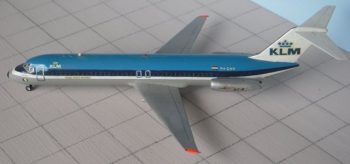
McDonnell Douglas was formed in 1967 with the merger of McDonnell Aircraft and Douglas Aircraft and was itself merged with Boeing in 1997.
By 1963 both McDonnell and Douglas faced financial difficulties with McDonnell facing lean times in any lull in fighter aircraft procurement and Douglas being strained by the development of the twin rear engined DC-9 (seen above). In particular, DC-8 and DC-9 production began to fall months or even years behind delivery dates with financial penalties being imposed on Douglas by the customer airlines for these delays.