Once again model railway enthusiasts from all over Gloucestershire travelled to the Cheltenham GWR Modellers April 2024 Exhibition at St Margaret’s Hall, Coniston Road, Cheltenham, GL51 3NX in aid of the hall itself on Saturday and Sunday 1 and 2 April 2023 for the following attractions.
SEVERNSIDE STEEL
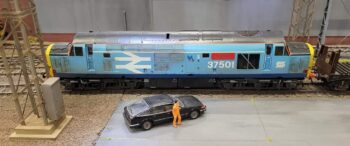
0 Gauge 7mm Scale
By Andy Goulding
Severnside Steel featured a typical suburban factory complex set in the middle to late 1980s on the Western Region. It featured a steel handling plant complete with a scratch built fully working steel coil unloading crane. It also featured a small refuelling facility for a variety of visiting locomotives.
FRAMPTON

P4 Gauge 4mm Scale
By Richard and Paul Eason
During a 1980s summer, the fictional yard at Frampton served the nearby Sharpness Dock and was connected via the spur to the Sharpness branch. The decline of railway traffic to the Docks had contributed to the deterioration of Frampton yard but it survived due to its location. Frampton provided a useful useful rail connection to both nearby surviving industries and the District Civil Engineer responsible for the Bristol ti Gloucester main line. As such, mainline locomotives jostle for space with the resident 08 and wagons.
The layout was originally built for the Scalefour 18.83 Challenge to permit easy storage and transport in a small family car. Frampton also demonstrated how much intensive operation can be fitted into a small space. Operation was by 12v direct current. Wagons and locomotives were converted from kit built and ready to run and detailed. The track was hand built using copper clad and ply and pins method.
SWANISH
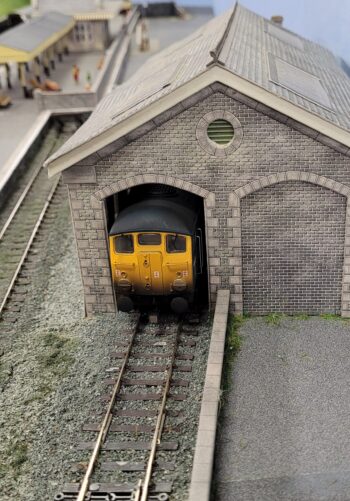
EM Gauge 4mm Scale
By Ian and Michelle Sandell
Swanish, loosely based on the Swanage Railway, was an entry in the EM Gauge Society Chairman’s Challenge for 2021/2022. The track and points had to be Peco EM gauge with a minimum of three points and the entire layout, rolling stock and operators had to fit in one car. The layout was 16 feet long by two feet wide, comprising four 4’x2′ boards. Once assembled, Swanish represented no particular time period and so a Blue Pullman operated with a GWR railcar.
The station platform was a wooden base covered in Metcalfe tarmac card and Wills stone walling. The station building and signal box were Metcalfe GWR kits. The station lighting was from Layout4You. The goods and engine shed were Metcalfe Settle to Carlisle kits and building lighting was from Railroom Electronics. Points were operated by Tortoise motors. The operating water tower was by Dapol and DC control was by Morley.
APPLE LANE MARK II
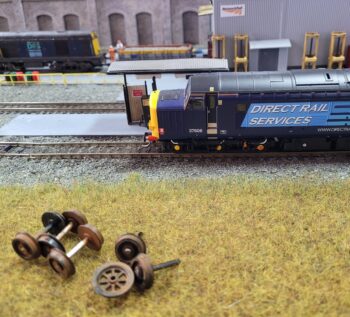
00 Gauge 4mm Scale
by Alex Barnard
Apple Lane Traction Maintenance Depot was loosely based on Derby Railway Technical Centre and Crewe Gresty Bridge. It featured modern diesels and rolling stock from the last 25 years as well as fuel trains and the occasional steam locomotive.
BLAGDON
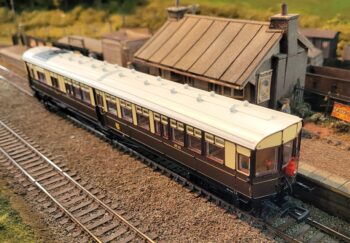
00 Gauge 4mm Scale
By Bristolian MRC
Blagdon was the terminus of the Wrington Vale Light Railway which left the Cheddar Valley Line at Congresbury. The station layout was one of the simplest possible, requiring only four points, yet it maintained operator interest with a regular passenger service and a small goods yard behind the station. The station building was typical of the style used on the line, the others being of GWR origin. There was no signalling, the branch being worked as one engine in steam.
The well ballasted and weathered track and point motors were both Peco and buildings were made from a mixture of card, plastic sheet, paper and corrugated foil. The rolling stock was a mixture of proprietary and kit built with a large selection of kit built wagons.
HALFPENNY GREEN

00 Gauge 4mm Scale
By Cradley Heath MRC
Halfpenny Green was a ‘might have been’ layout. The Wombourn branch line of the Great Western Railway commenced construction in 1913, eventually opening in 1925 after a pause during the First World War. When the idea was originally conceived, the branch line was to be constructed between Wolverhampton and Bridgnorth via Wombourn, with an additional line to branch off and join up with the Oxford, Worcester and Wolverhampton line in Kingswinford. However, when the branch line finally opened, the section between Wombourn and Bridgnorth never came to fruition.
The premise of the layout is that the line from Wombourn was built as far as Halfpenny Green, opening to all traffic in 1925 but closing to passengers in 1932. However, passenger services returned with the onset of World War II to serve RAF Halfpenny Green and remained until the line closed in the early 1960s. The layout depicts the terminus at Halfpenny Green in the 1950s when both freight and passenger traffic was beginning to decline.
MARSH END

00 Gauge 4mm Scale
By Doug Johnson
DCC sound fitted Marsh End was a mixture of Parkend and Marsh Sidings in the Forest of Dean with a backdrop of Ross on Wye. This could portray any period between the 1970s and 1990s with its single DMU platform, run round area and aggregate loading sidings.
KING’S LANE

00 Gauge 4mm Scale
By Freddie Papper
King’s Lane was a micro shunting puzzle layout, begun when the owner was just seven years old. It was built from second hand Peco Code 100 track with a deliberately generic design to allow different eras and regions to be represented. Buildings included a small station, fuelling point and engine shed, built either from plastic or laser cut wooden kits. Rolling stock was either kit built or ready to run by Bachmann, Hornby or Heljan. DCC operation was by NCE Powercab.
PENMAENBACH

00 Gauge 4mm Scale
By Chris Hopper
Penmaenbach was a self contained shunting puzzle layout built using a custom made Grange and Hodder baseboard kit and Peco Code 75 Bullhead track with a connected branch line and small halt. The buildings were a mixture of scratch built, plastic or laser cut kits. The bridges were made of styrene sheet.
The overall setting was inspired by the railways of North Wales ( both London Midland and Western Regions) in the Speedlink era of the 1980s and 90s when the BR blue era was giving way to colourful Railfreight liveries. Civil Engineers wagons, DRS locomotives and nuclear flasks could also appear.
Penmaenbach featured sound chipped NCE DCC motive power fitted with magnetic Kadee couplings for maximum hands-off operation. The locomotives were mainly detailed and weathered ready to run items from Hornby, Accurascale, Bachmann and Sutton’s Loco Works while the wagons were mainly Bachmann, Hornby or kit built.
PEN-Y-BONT FAWR
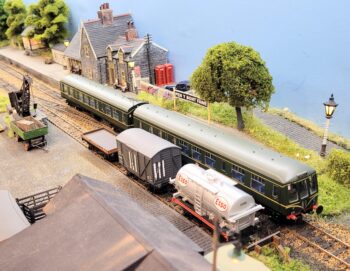
00 Gauge 4mm Scale
By Steve Monk
Pen-y-Bont Fawr was a small town located in the Tanat Valley in mid Wales. The original line was built to transport granite and lead ore from the mines at Llangynog to Oswestry and beyond.
The 2019 vintage layout with its Peco Code 75 bullhead rail was loosely based on the station and small goods yard as it might have been had the line been developed further after the Great Western Railway after the 1923 Grouping. It was also assumed that the line between Pen-y-Bont Fawr and Llangynog to the west had closed due to flooding and landslip.
Most of the buildings and infrastructure were scratch built from plastic card and painted with household emulsions. The exception was the signal box built from the Ratio kit. The goods shed and cattle Dock were true scale replicas of the Pen-y-Bont Fawr prototypes. The trees were a mixture of handmade and Woodland Scenic. Ground cover was by hanging basket liner and varieties of static grass. The level crossing gates, points and signals all worked and were electronically interlocked to prevent conflicting movements. The layout was wired to run on either 12v dc analogue or DCC. Pen-y-Bont Fawr also featured an auto shuttle allowing an auto train or DMU to run back and forth automatically.
THOMAS

00 Gauge 4mm Scale
By Hucclecote Model Railway Enthusiasts
Harold the helicopter first appeared in the book Percy the Small Engine. Martin Clutterbuck suggests that the inspiration for the story in which Harold races Percy came from the British Department of Transport’s claims that the helicopter would soon render railways obsolete.
Harold is based on a Sikorsky S-55 helicopter built in the UK as the Westland Whirlwind. This was one of the most successful early helicopters, with examples being used all over the world. The character’s name may arise from the fact that variants of the Whirlwind in UK military service were designated HAR 1, HAR 3, HAR 10 etc.
The first S-55s received by the Royal Navy in 1950 were built by Sikorsky, but Westland acquired a license in 1950 and the first British-made S-55 flew at Yeovil in November 1952. Like the American models, the first Whirlwinds had Pratt & Whitney engines and were delivered to No.705 Squadron based at Gosport.
The RAF also ordered this helicopter for transport and rescue missions: the Whirlwind HAR Mk.2 (the same as the naval version except for some differences in equipment) joined the Transport and Coastal Command Units from 1955. With Wright R.1300 engines, the Whirlwind Mk.3 went into production for the Royal Navy in 1953 and operated for many years from both ship and shore bases. The subsequent RAF HAR Mk.4 version was modified for use in the tropics and fitted with a new variant of the Pratt & Whitney R-1340. It was used in Malaysia.
NARTM AND MBF

4mm Scale
By David and Paul Mellor
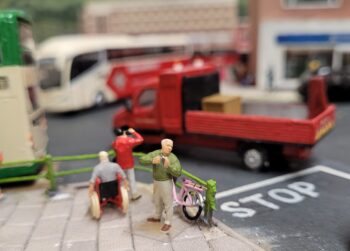
Once again the Mellor Brothers did both the National Association of Road Transport Modellers and the Model Bus Federation proud with their lorries resting at the Riverview Cafe – including this 1972 vintage Albion Chieftain in red and cream C.M. Downton livery used to move ISO shipping containers from Sharpness Docks. Meanwhile, the bus spotters enjoying a target rich environment at Brocklecote Bus Station.
TRANSPORT 2000 LTD
4mm Scale
By Andy Peckham
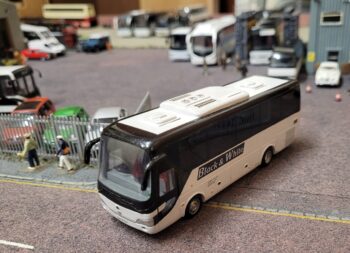
The origin of Andy’s latest diesel Yutong coach can be traced to the Zhengzhou Bus Repair Factory which was established in 1963. In 1993, Zhengzhou Yutong Bus Co., Ltd. was founded with a sales volume of 708 units and in March 1997, Yutong became the first bus company in China on the Shanghai Stock Exchange. In 1998, Yutong opened its ¥400 million ($50,000,000) Yutong Industrial Park in Zhengzhou, which was the largest bus factory in Asia at the time.
By 2005, Yutong had a 22% market share of buses and coaches across China, becoming China’s biggest bus manufacturer, and had won an award for being the best manufacturer in China by the World Bus Alliance. Yutong then launched an overseas market strategy and began exporting buses worldwide to markets such as Latin and South America, Asia-Pacific and Europe.
RUHR CRISIS 1923

H0 Gauge 3.5mm Scale
By Alan Drewett
On 11 January 1923, a French army invaded the industrial Ruhr region of Germany. Earlier in the month, Germany had defaulted on the reparations imposed on it by the victorious Allies at the end of the First World War.
The French occupation was greeted by a campaign of passive resistance by the German inhabitants, of whom about 130 were killed by the French army.
Among those was Albert Leo Schlageter, a German officer during the First World War decorated with two Iron Crosses. He helped blow up a bridge to slow the transport of German coal to France but was denounced by an informer to the invaders. Taking all the responsibility on himself, he was shot by firing squad on 26 May 1923.
The last French troops left the Ruhr on 25 August 1925 after World condemnation and the adoption of the American Dawes Plan to substantially reduce German Reparations.
By this time the German government was discredited and the German people longed for stronger leadership, eventually to be fulfilled after he 1929 Wall Street Crash.
WEDMORE HALT
00 Gauge 4mm Scale
By Martin Nash
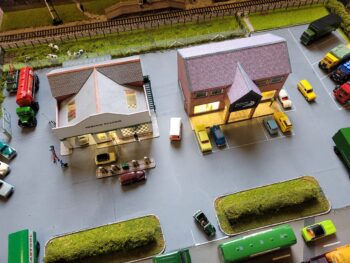
Martin Nash’s new diorama features a railway halt and signalbox behind a garage and cafe with accommodation- both built from Metcalfe kits. The petrol pumps are white metal kits from P&D Marsh.
CASTLE WHARF KENDAL
009 Gauge 4mm Scale
By Ian Kirkwood
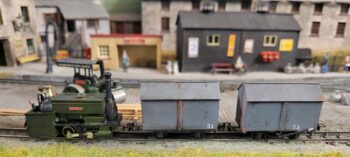
Plans for standard gauge light railway running south east from Canal Head in Kendal, Westmorland, to Arkholme, serving various quarries and gunpowder works as well as local farming interests failed due to lack of interest but this 009 layout supposes that the cheaper option of a narrow gauge railway was built instead. Castle Wharf Kendal represents the northern terminus of the line in the 1930s with LMS transfer sidings just south of the area modelled making the canal redundant. Trains to and from the transfer sidings are shunted at the wharf on a track plan very similar to that of the similar narrow gauge tramway at Wantage.
The buildings on Castle Wharf Kendal – based on such real structures as the grey stone K Shoe factory – were hand built from card while the rolling stock was kit built. The locomotives were from the Backwoods range and feature both Barclay and Manning Wardle tank engine as well as a four wheeled diesel from French autorail builder Billiard.
The 4’x 1’8″ layout neatly solved the problem of “90 degree sky” with a curved cyclorama and also boasted a sector plate beneath the cottages for easy handling of trains to and from storage.
ELIN BACH

009 Gauge 4mm Scale
By Jez Kirkwood
Elin Bach was one of the levels of the extensive Brynmwg Slate Quarry in North Wales. The layout depicted the loco shed where the levels two Hunslet locomotives lived and the sidings that originally served the incline down to the lower levels. This incline had been out of use for a number of years and partially buried. As the slate tips expanded, a new incline was built clear of them.
The Hunslets could be seen shunting wagons of finished slate from the cutting Mills, ready to head for the new incline head and beyond – “from the top of the world to the roofs of the world”.
The compact layout was powered by two 9v batteries and used commercially available components.
FARR END

009 Gauge 4mm Scale
By Peter Cullen
Farr End was a small market town in Shropshire which has a narrow gauge tramway style railway linking local communities. This featured a passenger railcar and short goods trains for local produce and may in future be linked to the nearby preserved Bowleggett Manor railway.
THREE ACRES

TT 14.2mm Gauge 3mm Scale
By Peter Stratford
Three Acres was based on the station that was at Dymock in the Forest of Dean on the Gloucester to Ledbury line after the line from Dymock to Ledbury had been lifted. Although the station area and yard was a good representation of the site it was not totally accurate so hence the name change. Three Acres was chosen as there is a similar named place, Five Acres, close to Coleford and the area modelled is approximately three acres. The area to the left of the layout was purely fictional but was modelled to give that area some interest. Everything apart from the stock, which are from kits, was scratch built- a very time consuming pleasure. Dymock itself at this stage, from July 1959, had no passenger service being goods only, but Three Acres retained a service to the community as a rural terminus.
DREWITT HALL

N Gauge 2mm Scale
By Alan Drewett and Vincent Tweed.
There is quite a story to this diorama. It started out as a lift-off cover for an N gauge layout tunnel, then my good friend Vincent Tweed took it on as the gatehouse to Drewitt Hall (his spelling!). I admire all the improvements that he has added!
MODELLING DEMONSTRATIONS

By Mark Begley, Trevor Hale, Steve Harrod and Richard Self.
TRADE SUPPORT
By Hereford Model Centre and Stewart Blencowe’s Railway books, timetables and photographs. I wish Stewart a long and happy retirement after this, his last ever show.
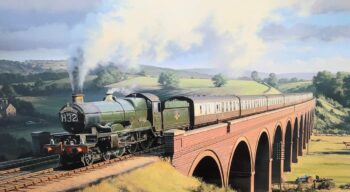
The Gloucestershire Warwickshire Steam Railway was also represented.