Model railway enthusiasts from all over Gloucestershire travelled to the Cheltenham GWR Modellers October 2019 Exhibition at St Margaret’s Hall, Coniston Road, Cheltenham, GL51 3NX on Saturday and Sunday 26 and 27 October 2018 to raise money in aid of the Pied Piper Appeal by enjoying the following attractions.

However, time was also taken to reflect on the past. Less than three weeks before the show, the modelling community lost its dear friend Peter Lee. Mid Wales based Peter had a great sense of fun and his creative skills can be judged by the Ribblehead style viaduct pictured above. He will be greatly missed.
On a happier note, it is now 32 years since the first Cheltenham GWR Modeller’s Exhibition, held on 31 October 1987 at Holy Apostles Church Hall, London Road. This featured ten layouts, four traders and live steam train rides from the Cheltenham Society of Model Engineers.
SNOWDON
By Peter Booth 16mm Gauge 8mm Scale
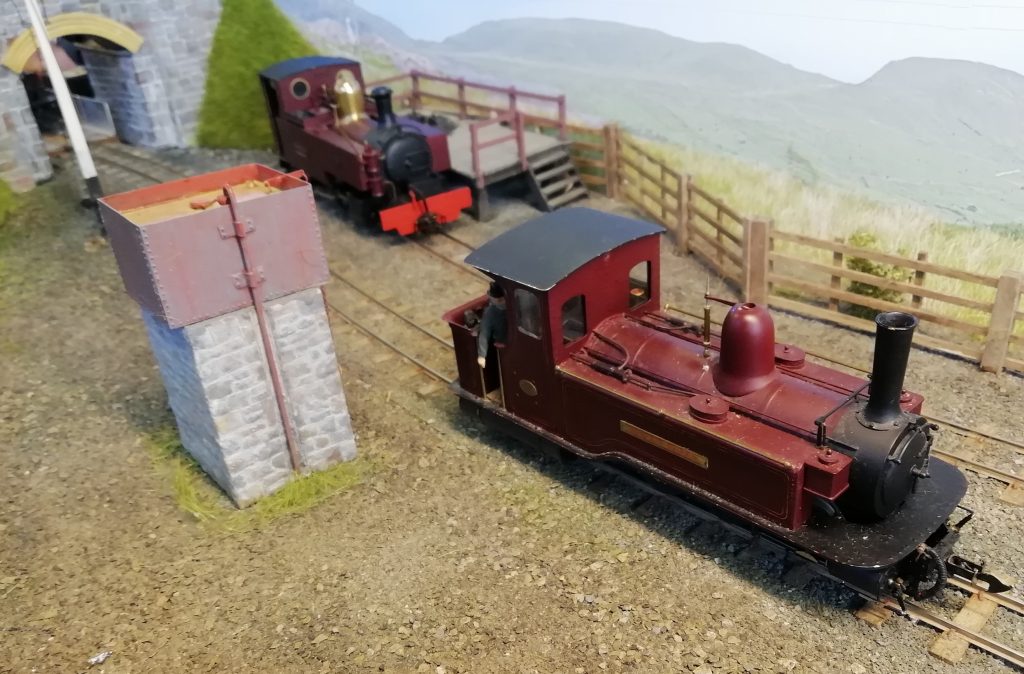
This layout portrayed the two foot narrow gauge railway at Rhyd Ddu, the southern terminus of the North Wales Narrow Gauge Railways’ line to Dinas. The station was called Rhyd Ddu until the late 1880’s when it took on the name Snowdon, finally in later years it was called South Snowdon. Peter modelled the site as it is thought to have been in the early part of the 20th Century, and was largely based upon photographs and information found in the Welsh Highland Heritage Magazine. The railway was eventually incorporated into the ill fated Welsh Highland Railway in 1922. However it is now the mid point of the new expanding Welsh Highland Railway, which is one of the most impressive narrow gauge railways in the British Isles.
Every attempt was made to model the station building as accurately as possible. However, it was necessary to shorten the run round loop considerably to keep the layout down to a reasonable size. It was also necessary to model the area around the station as it might have been, using a degree of modelling license, due to the lack of detailed photographic information away from the immediate station area.
As with Peter’s earlier Dinas layout, his intention was to model everything virtually from scratch, and this has largely been accomplished, the unusual scale of 8mm to one foot leaving little option. The track was spiked to wooden sleepers in the prototypical manner, the ballast being produced from crushed slate. The locomotives operated on the layout were constructed from nickel silver brass, closely following the dimensions on the manufacturers original drawings. Coaches and wagons were constructed from wood, nickel silver or plasticard on nickel silver underframes.
Stonework on the buildings was produced by building up layers of Polyfilla onto a scribed plaster base, the resulting textured finish being painted in water colours. The corrugated iron for the sheds and roofs was produced from Slaters sheet, suitably trimmed and pinned. Grass was made from individual pieces of Gaugemaster grass mat together with static grass. The major structures are now fully completed with internal lighting to show the detail. There are still some areas that are being developed and this will probably continue over the next year or so. It is hoped that it will be possible to connect Snowdon NWNGR to Dinas NWNGR at some time in the not too distant future. The combined layouts would make a total length of 34 feet.
ALDERMOUTH
By Jim Edwards 0 Gauge 7mm Scale
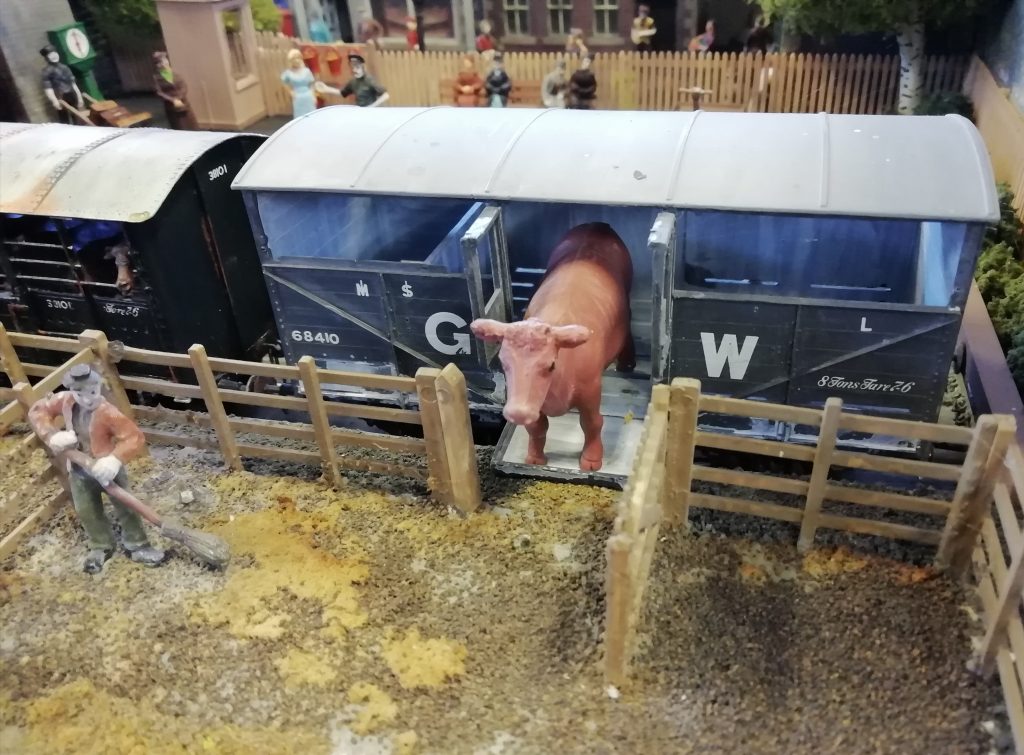
Aldermouth was a totally fictitious layout portraying a GWR branch line terminus in the 1930s. The station was also served by the Southern Railway so a mix of trains could be seen, including GWR diesel railcars.
A canal ran along part of the front of the layout, hosting a number of factories and warehouses.
Stock was a mix of ready to run and kit built while the buildings on the 17′ x 2′ were kits and scratchbuilt.
BRADE’S SIDING
By Andrew Jaimson 0 Gauge 9mm Scale
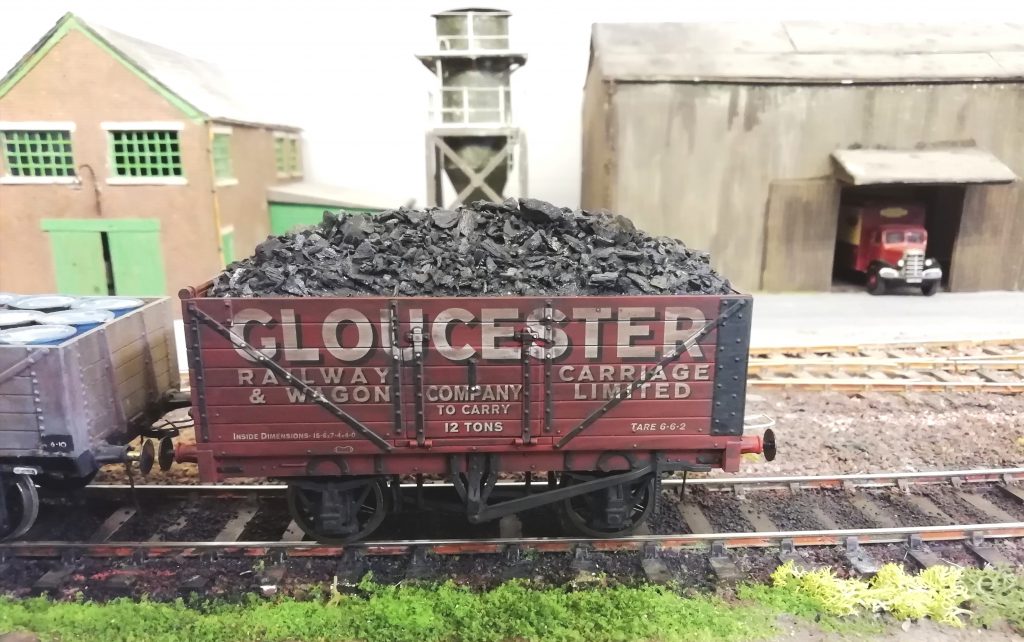
Brade’s Siding was a simple but effective layout built to 0 gauge using Peco track work. Its first outing was at the NEWGOG exhibition in Newport in April 2018. It represented the changeover era between steam and diesel. Rolling stock was a mixture of ready to run and kit built.
ALLERDALE FARM
By Matthew Wathen 09 Gauge 7mm Scale

Allerdale Farm was a fictional agricultural railway located in the Lake District, 9mm track in 7mm scale representing 15″gauge in real life.
Following the overwhelming popularity of the “La’al Ratty”, the Keswick Granite Company decided to use a 15″ gauge railway to take its goods as far as the shores of Derwent Water. The project became surprisingly lucrative and the narrow gauge line was eventually extended from Castlehead to Cockshot Wood on the old coffin route. There was also an offshoot to the grounds of Castlerigg Manor and its secret walled garden. The majority of the traffic was timber from the two adjacent woods, which would then be sent across Cumbria for use in homes, furniture and boat manufacturing. Livestock and general farming “debris” was also sent down the railway.
BLAGDON
By Bristol Ian MRC. 00 Gauge 4mm Scale
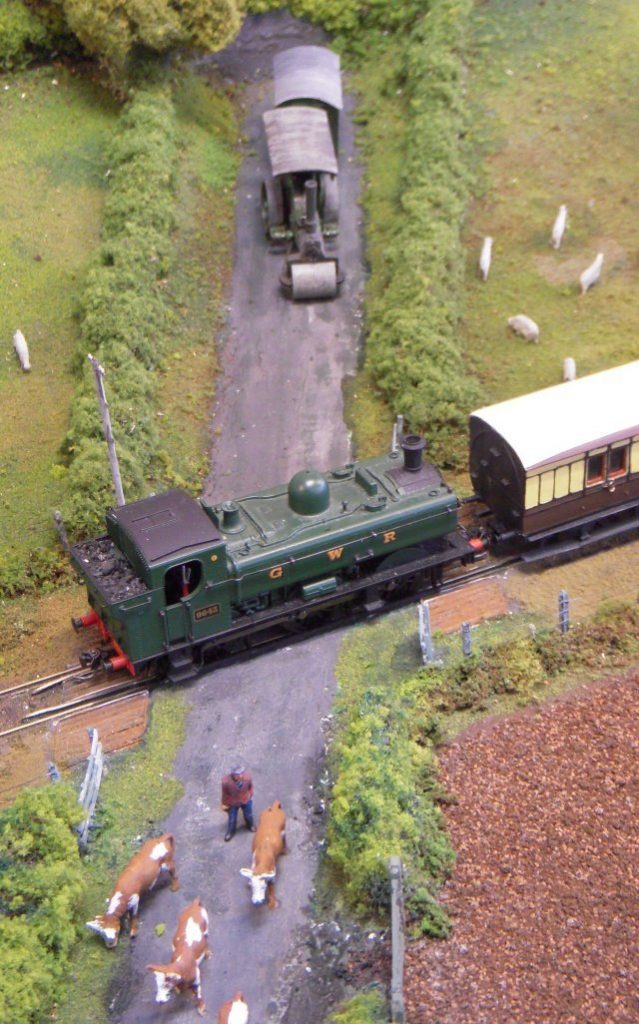
Blagdon was the terminus of the Wrington Vale Light Railway which left the Cheddar Valley Line at Congresbury. The station layout was one of the simplest possible, requiring only four points, yet it maintained operator interest with a regular passenger service and a small goods yard behind the station. The station building was typical of the style used on the line, the others being of GWR origin. There was no signalling, the branch being worked as one engine in steam.
The well ballasted and weathered track and point motors were both Peco and buildings were made from a mixture of card, plastic sheet, paper and corrugated foil. The rolling stock was a mixture of proprietary and kit built with a large selection of kit built wagons.
CARADON JUNCTION
By Mike Kelly 00 Gauge. 4mm Scale
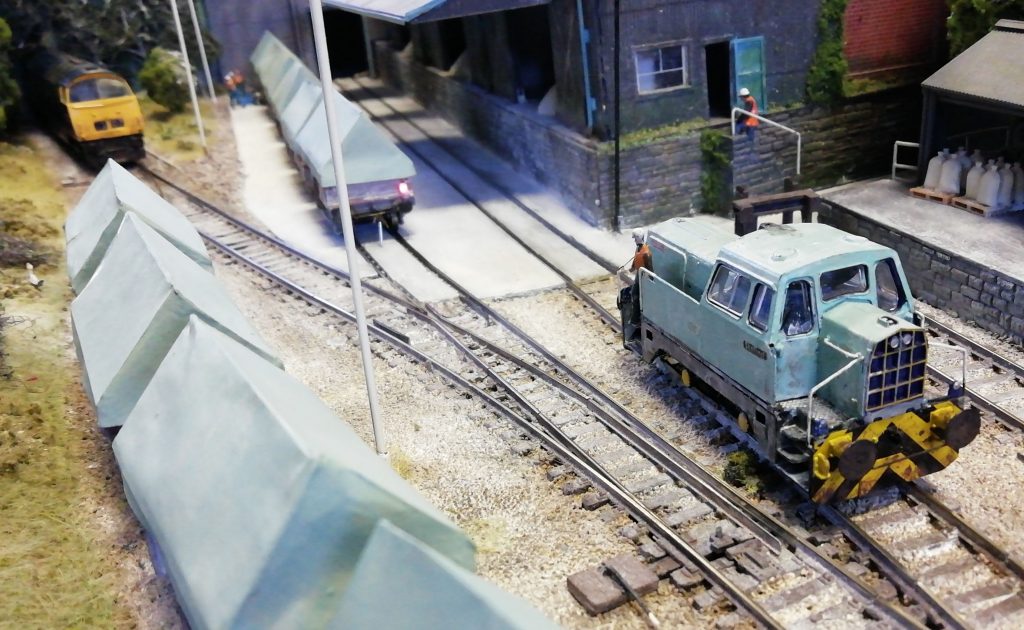
Caradon Junction was based on a small section of Coombe Junction on the Liskeard to Looe branch in Cornwall. The trains descend a 1 in 40 incline to the junction where passenger trains run into a dedicated small platform. From here they reverse and proceed back through the junction taking the branch line down to Looe. Freight trains, which due to the incline were quite short, were mainly made up of the distinctive china clay “hoods”. They proceeded on a separate track and under the bridge to the clay driers at Moorswater. In reality the driers were much further away and the model driers were more generic than being being a rivet-accurate copy of the Moorswater facility. The layout was based on the mid 1970s and early 1980s with blue diesel locomotives of Classes 03, 25,37 and 52 working alongside blue and white Class 121 “Bubble cars”. All motive power was DCC fitted with sound and the majority of buildings were scratch built.
PAYNESTOWN
By Reg Owens 00 Gauge 4mm Scale
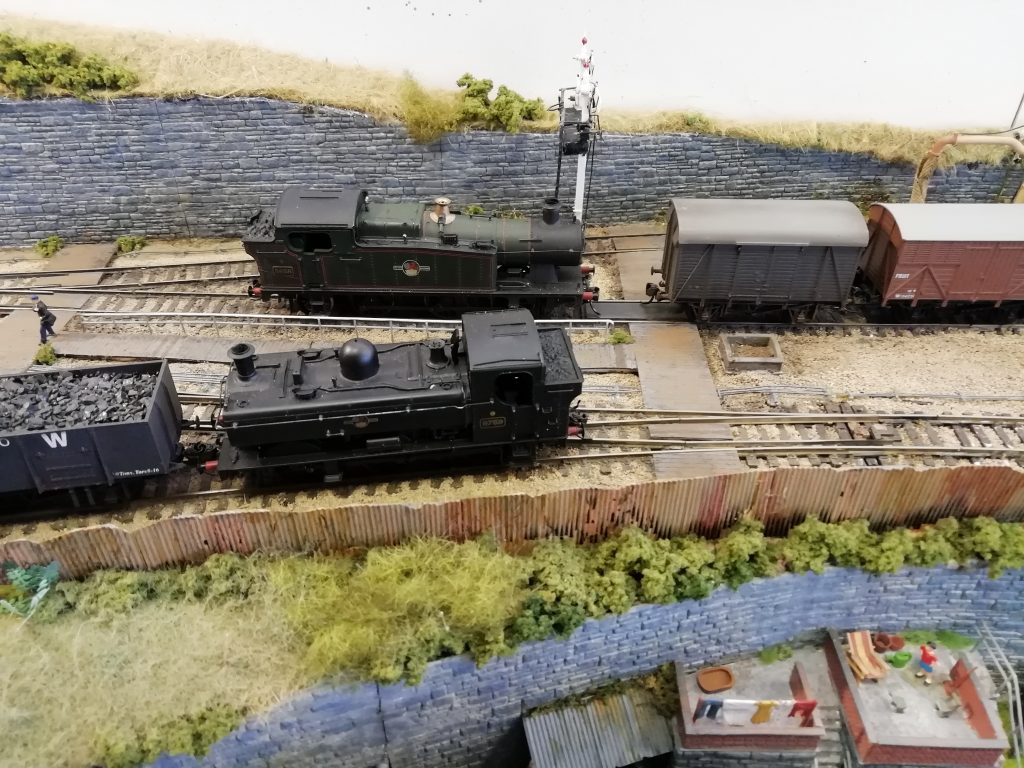
Paynestown was a fictional South Wales valley terminus served by one of the pre-grouping railway companies which later became part of the G.W.R and in turn Britush Railways Western Region. Paynestown was modelled around the 1960s, which enabled the operators to run steam and diesel locos in the transition period. Because Paynestown was supposedly situated at the northern part of the South Wales coalfield it was assumed that the connection with the former London & North Western / London Midland and Scottish Railway was made, which allowed the operators to run a greater variety of locos and rolling stock. The layout used Peco code 100 track and points. Buildings – such as the non conformist chapel seen here – were mostly scratch built using different types of materials. Control of the layout was originally analogue but has been converted to D.C.C.(Digitrax system) which allows the operation of some sound locos
PUFFIN COLLIERY
By John Stephens (Swindon MRC) 00/009 Gauge 4mm Scale
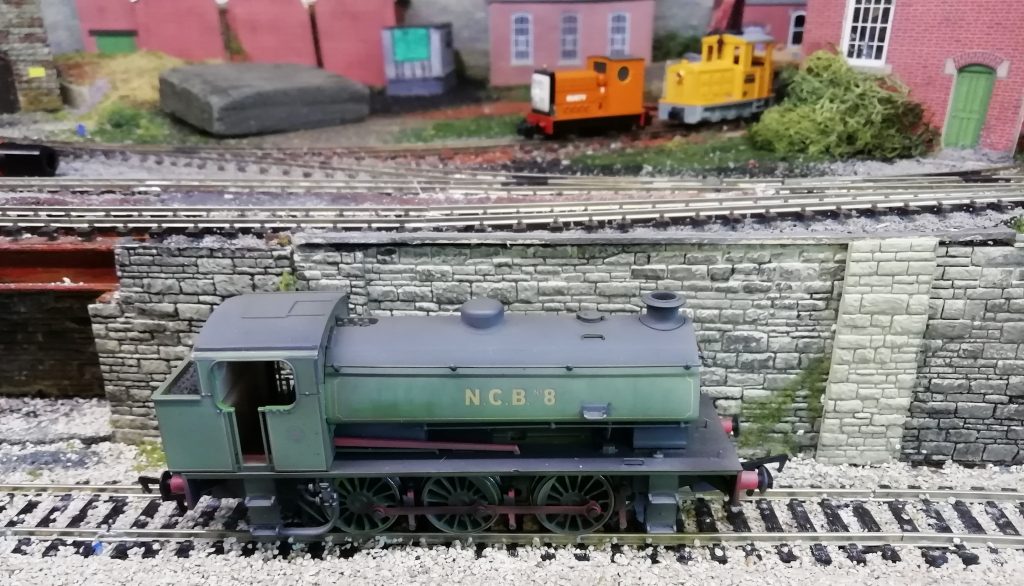
Puffin Colliery, based in Wales, was served by a narrow gauge railway which transferred coal to standard gauge trains which ran down to the docks. The pit head gear actually worked and the layout was built with Peco track and point motors. The narrow gauge was analogue while the DCC standard gauge featured sound equipped locomotives.
ROSSITER RISE
By Terence Tew 00 Gauge 4mm Scale

Rossiter Rise was a fictitious through station based in North West London, somewhere in an arc between the Western Avenue in the west and Edgware Road in the north. It was set in the mid-late 1950’s and consisted of two main electrified tracks using the 4 rail system. Trains on these were mainly ex LNWR/LMS electrics, together with the later BR versions. To the rear of this was a through, non-electrified bay platform, which usually has push/pull trains, dmu’s etc. In front of the main platforms was a terminating London Transport bay. This was designed to be used by various types of LT stock. In front of the station was a small LT depot. Many of the buildings were scratch-built. Others were ‘kit-bashed’ whilst some were kits or ‘ready to plant’ items that had been modified and detailed.
Similarly, most of the rolling stock was recherche, being converted, scratch built or 3D printed. Although freight and light engine workings could feature some unexpected motive power.
Rossiter Rise was designed for constant train movement with front operation and rolling stock visible in the fiddle yards.
The inspiration for the layout was extensive and varied. Such locations as Willesden, Harrow & Willesden, Watford Junction, Drayton Park, Lillie Bridge, Acton Central, Richmond, the eastern end of the Central Line, all came to mind.
THOMAS
By Cheltenham GWR Modellers Group 00 Gauge 4mm Scale
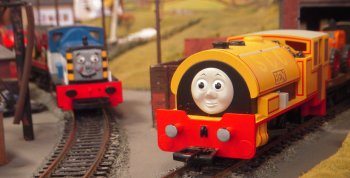
Bill and Ben are based on the Bagnall 0-4-0STs “Alfred” and “Judy” of Par, Cornwall, who are both preserved and in working order at the Bodmin and Wenford Railway. According to the lore of the Reverend Awdry’s Railway Series, Bill and Ben are Sodor’s mischievous saddle tank engine twins, who have great fun in teasing other engines of the railway. The two have four wheels, a tiny chimney and dome, and a small squat cab. They often work in the China Clay pits and quarries. Their loads of clay can be used for many things such as paper, paint, and pottery. They take trucks for engines on the main line and ships in the harbour and are regularly seen around Brendam Docks. They enjoy attention and love taking visitors and being photographed. They tend to work together, like most twins, but even this youthful pair can have their arguments among themselves and can squabble with one another – particularly about whose fault one of their follies was. They are highly prone to playing tricks and being cheeky. They have even teased Gordon on more than one occasion. Duck has called them “the bees” before, for being terrors when they start buzzing around. Edward and BoCo are the only engines who can really keep them in order enough to put a stop to their games and make them scamper along and behave. There is no real harm to them, but even Edward admits that they are maddening at times. Despite their cheeky and mischievous antics, if a dangerous event occurs, such as a rockslide, they are shown to be quick-witted and capable to act to rescue anyone in trouble. This was shown when they saved a group of workman and Thomas from many different rockslides.
WHITEDOWN MPD
(SUNDAY ONLY)
By Richard Pretious 00 Gauge 4mm Scale
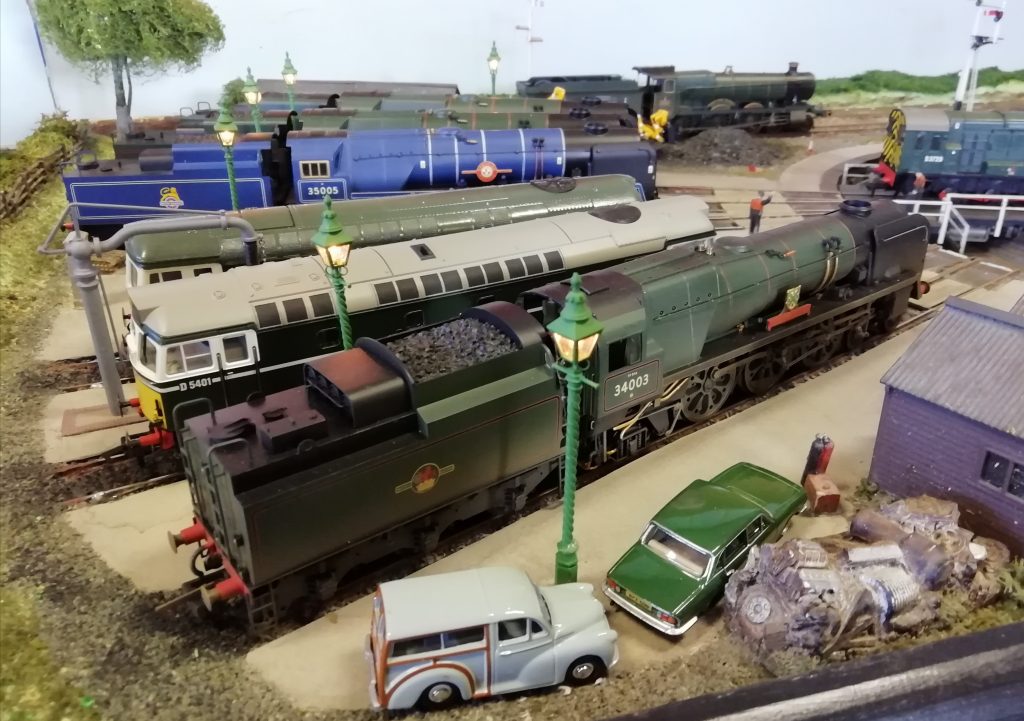
The fictional Whitedown Motive Power Depot was located in North East Hampshire on British Railways Southern Region and featured steam and diesel locomotives from 1930 to the present day.
THE GLOUCESTER EIGHT
By Mike Joyner 00 Gauge. 4mm Scale
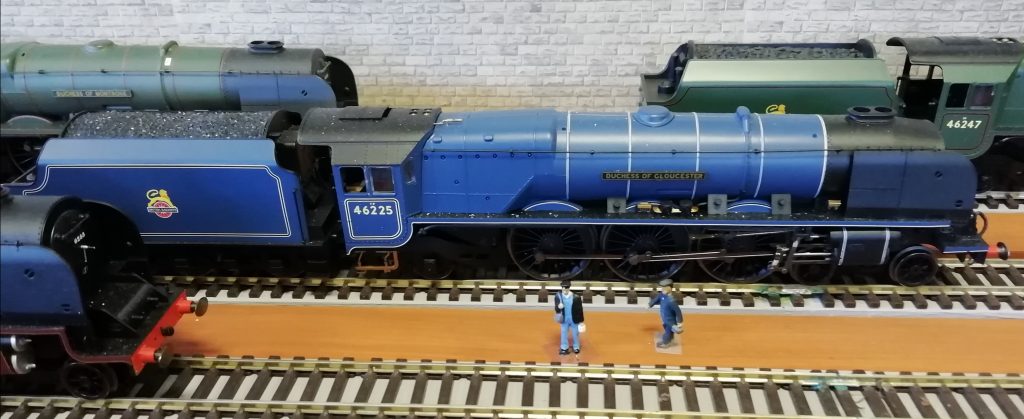
Models of eight of the locomotives named after Gloucester, its aristocrats and brave fighting men. Pictured above is London Midland Region’s experimental blue liveried 46225 “Duchess of Gloucester”.
The first of these was locomotive 10 “Gloucester” of the Birmingham and Gloucester Railway. This was built in 1840 by Norris of Philadelpia USA to a design renowned for its hill climbing ability. Sadly for the Birmingham and Gloucester though, its track up the steep Lickey Incline was unsuitable for the American engines it had bought : and coke burned in fireboxes intended only for wood caused further damage. “Gloucester” was sold to the Taff Valley Railway in 1845, who in turn tried to sell it in 1852 and 1855. As nobody was prepared to buy the 4-2-0 it was condemned in 1858.
The “Gloucester” name was resurrected by the Great Western Railway in March 1866 and applied to a Broad Gauge 0-6-0 of the Swindon Class. This was withdrawn in June 1873 and one month later became engine 102 of the Bristol and Exeter Railway – a subsidiary of the GWR. As soon as 1876 however, “Gloucester” was back in Great Western stock as number 2083. It kept this identity until scrapping in December 1891 – just months before the Broad Gauge railway disappeared.
3437 “City of Gloucester” meanwhile was a very different engine. Outshopped from Swindon Works in 1903, the Churchward designed 4-4-0 was a sister to 3440 “City of Truro” which, in 1904, became the first wheeled vehicle to exceed 100 mph. Both engines received superheated in 1911 and were renumbered in 1912 – “City of Truro” becoming 3717 before Preservation in March 1931 and “City of Gloucester” becoming 3714 before withdrawal in 1929.
1912 also saw “County of Gloucester” take to the rails as GWR locomotive 3827. Another Churchward designed 4-4-0, “County of Gloucester” was one of the last 10 such Counties built. The final batch was given Swindon works numbers 2416-25 under GWR Lot 184, and after 19 years service “County of Gloucester” was withdrawn in December 1931. The rest of the Class was to follow it to the scrapyard by 1933.
The London Midland and Scottish Railway were next to take up the cudgel in 1937 when their streamlined Princess Coronation 4-6-2s were introduced. Pacific 6225 was named “Duchess of Gloucester” and remained as such during the removal of its streamlined casing in 1946 and a change of number – to 46225 – on Nationalisation. Sadly the 8P locomotive did not survive the 1960s although its sister engine “Duchess of Hamilton” is now part of the National Railway Museum collection.
While Crewe Works were busy de-streamlining 6225, a brand new type of “County” was being built at Swindon. Designed by F. W. Hawksworth, these 4-6-0 machines had a 280 psi boiler pressure and distinctive long straight splashes. It was to these parts of engine 1015 (outshopped in March 1946) that the name “County of Gloucester” was applied in April 1947.
Alas it was only to work for 16 years before withdrawal in November 1962, but those were a golden age for “Gloucester” namings. May 1949 saw 7020 “Gloucester Castle” introduced to Western Region, and the Brunswick Green 4-6-0 was even shredded at Gloucester Horton Road for a spell in 1958. Then, in April 1954, an older Castle – 5017- lost the name “St Donats Castle” which it had borne since 1932 and became “The Gloucestershire Regiment 28th 61st” in honour of that unit’s bravery in the Korean War.
In addition to 46225, 7020 and 5017, British Railways 8P Pacific 71000 was outshopped from Crewe in May 1954. Named “Duke of Gloucester” it was to lead an extraordinary life before being withdrawn in November 1962. The two Castles had followed it by 1964.
On Gloucester Rail Day in July 1990, Parcels Sector Class 47/4 Co- Co 47 569 was named “The Gloucestershire Regiment” by Brigadier S. D. A. Firth whose father – Major General C. E. A. Firth – named 5017 in 1954. 47 569 was allocated to Bristol Bath Road in the latter part of 1990. It is still in service today as 47 727.
1960s BRS DEPOT
By Martin Nash 4mm Scale

A static display of a busy British Road Services Depot set in a town scene evoked the road transport company formed by the nationalisation of Britain’s road haulage industry, under the British Transport Commission, as a result of the Transport Act 1947. British Road Services was consequently formed and set about acquiring 41,265 vehicles 80,212 staff and 3,766 undertakings. Six years after the 1947 Transport Act was introduced however, Parliament reversed this decision – another Transport Act was passed in 1953 providing for the return to free enterprise.
By the 1960s British Road Services was made up of four main operating areas: British Road Services Ltd, BRS Parcels Ltd, Pickfords and Containerway and Roadferry.
Back in the 1950s though, the Ayers Red freight lorries and green parcels vans of British Road Services were a familiar sight all over Britain, linking towns and cities by A roads before the first Motorways were built.
The 1950s was also a golden era of British lorry building and British Road Services was to employ such famous heavy goods vehicles as the AEC Mammoth Major, Mandator ( with articulated flatbed trailers) and the same company’s drawbar trailer towing Mark III and Mark IV four axled rigid trucks. The latter vehicles were allocated to a number of British Road Services depots including the one at Mitcheldean, Gloucestershire. Other lorry manufactureers embraced by British Road services were Atkinson, Leyland, Bedford, Bristol and ERF. These in turn were replaced by various guises of Bedford TK and more modern AEC lorries with ergonomic cabs. Martin’s diorama also embraces the architecture and road scene of the 1950s including a dilapidated house near to where a small flatbed BRS lorry is being loaded – although probably not in a way that the Twenty First Century Health and Safety Executive would approve of!
MODEL BUS FEDERATION AND NATIONAL ASSOCIATION OF ROAD TRANSPORT MODELLERS
By Paul and David Mellor 4mm Scale
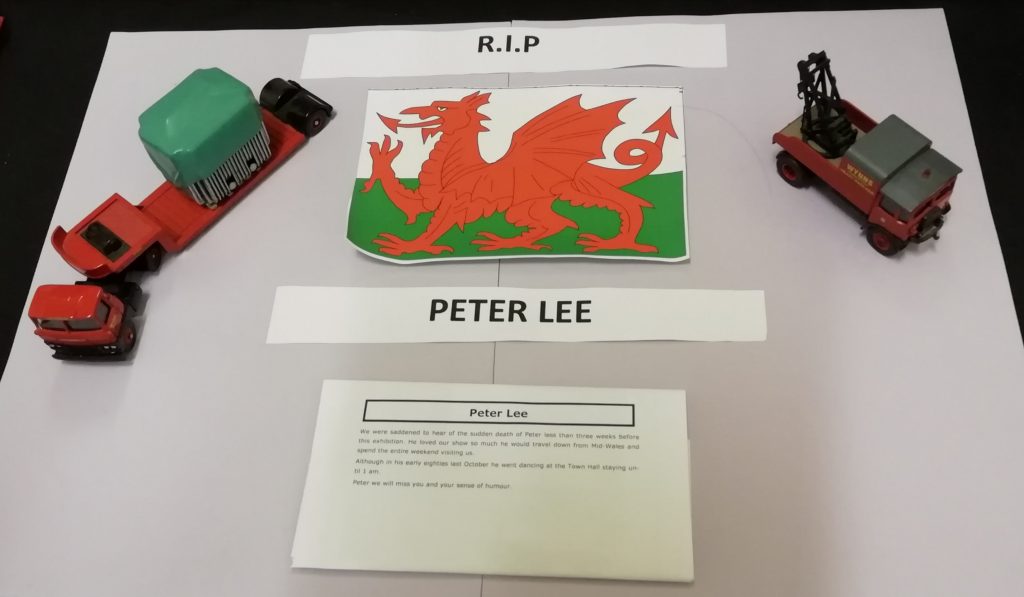
As well as documenting Gloucestershire Road hauliers, including C. M. Downton, Elliotts of Cheltenham and Moreton Cullimore, Paul and David Mellor paid a poignant tribute to their good friend Peter Lee, himself a student of Wynns transport
RETURN TO THE RAILS
By Vincent Tweed
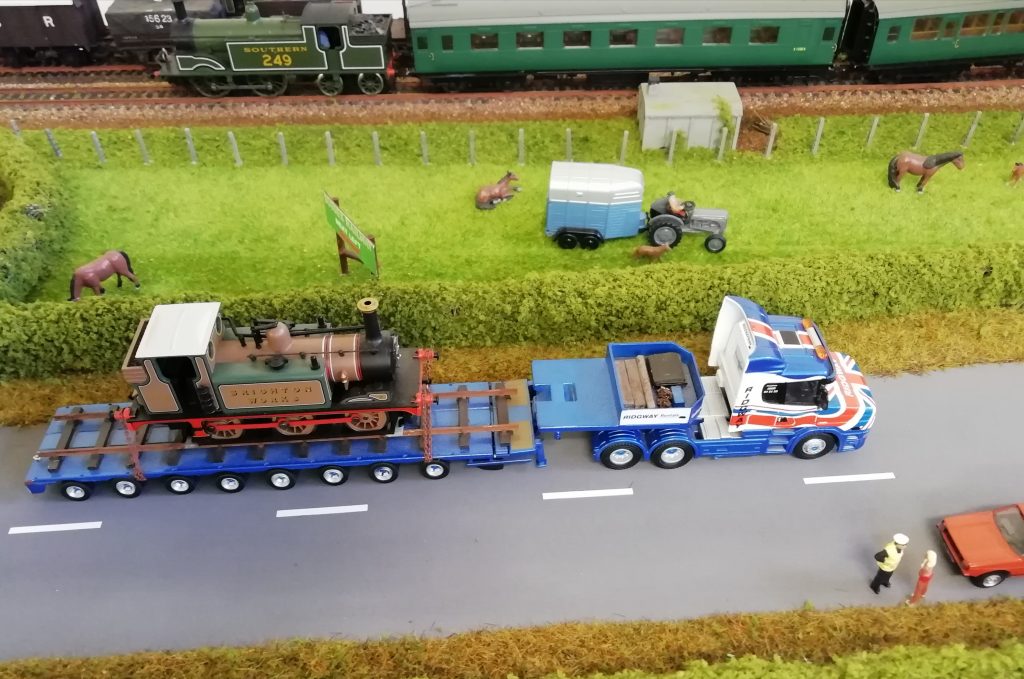
Following a major overhaul and repaint, former LB&SCR Terrier 0-6-0T is being returned to its heritage railway somewhere in West Sussex. The Scania T cab and matching trailer were in the markings of Ridgeway of Oswestry. Although not a company which normally transports locomotives, the colour scheme is eycatching. In fact this cab unit was withdrawn in 2016 but is seen here equipped with Isle of C5 Wight built Kytes Lights. Locomotive 249 seen in the background belongs to the M7 Class.
TRAVEL 2000
By Andy Peckham 4mm Scale
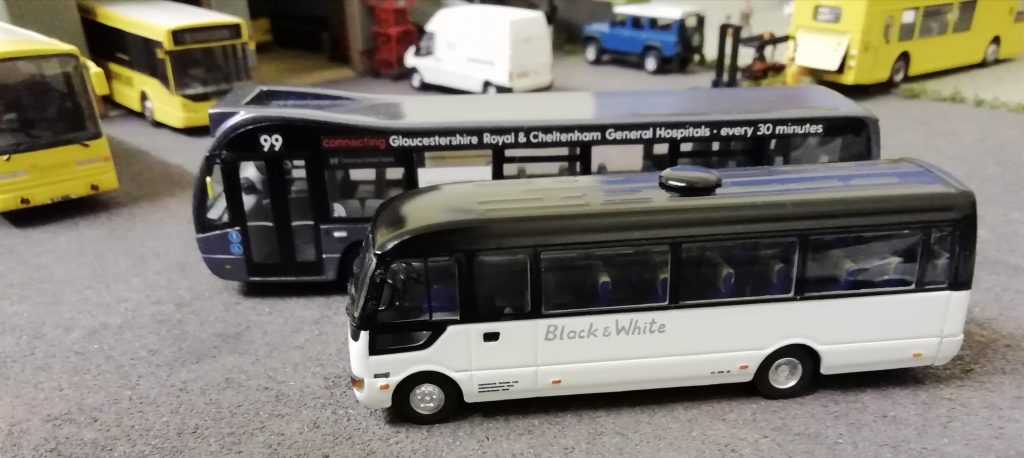
New in the Travel 2000 yard in October 2019 were a rare Mitsubishi Fuso Rosa midi bus in Black and White livery and behind it an Optare Versa branded to operate the 99 Hospital service.
UNIVERSAL WORKS: INTEGRATION STATION
By Alan Drewett 00 Gauge 4mm Scale
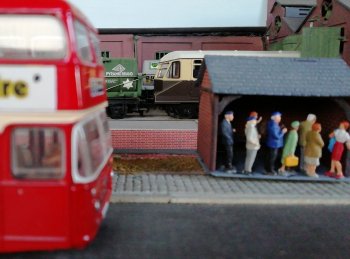
Integration Station celebrates the “Joined Up” partnership of buses and railways in moving passengers and goods. In the yard of Universal Works, one of the GWR Swindon built diesel railcars and a London Transport pannier tank engine are shunting petrol tank wagons while the bus stop outside is served by buses from many different companies.

Also making the show a success were Cheltenham Model Centre (Exhibition Sponsors, Saturday only), Martin Lewis (Sunday only), Stewart Blencowe Railway books, photos and slides, Clive Reid Pre Owned Model Railways, Penduke Models, Tracey Lippett’s Mini Scenes and the Gloucestershire Warwickshire Steam Railway. Modelling displays were by John Emerson, Richard Self, Trevor Hale, Mark Begley and Steve Harrod.