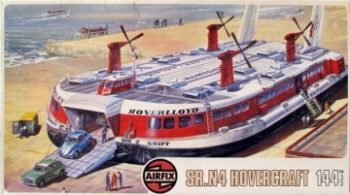
21 years ago I was waiting at Calais Hoverport for what turned out to be one of the last public air cushioned crossings to Dover. Even the mighty SRN4 had been delayed by bad weather, and staring out to an English Channel that seemed to be made of animated porridge I thought back 90 years to the aviators who first dared to cross the forbidding sea.
History of course records that on the morning of 25 July 1909 Louis Bleriot was first to land his own monoplane at Dover. And that whoever is the second person to do something to do something is seldom remembered.

Less than sixty years after Monsieur Bleriot left Cap Griz Nez, Apollo 11 astronaut Edwin “Buzz” Aldrin proved to be an exception and I would like to begin this article by saluting another gallant runner up who was also a pioneer in his own right.
Hubert Latham was born in Paris in 1883, the grandson of Charles Latham, an English merchant adventurer and trader who had settled in Le Havre in 1829.
Fluent in French, English and German, Hubert attended Balliol College Oxford in 1903/4 and later, among other activities, raced motor boats in Monaco and led an expedition to Abyssinnia to collect samples for the Natural History Museum of Paris.
On the night of 11-12 February 1905 Hubert also accompanied his cousin, the balloonist Jacques Faure, on a gas balloon night crossing of the English Channel from London to Paris.
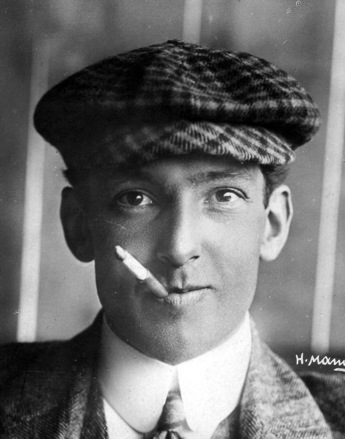
In 1908, Latham returned from the Far East in time to witness Wilbur Wright demonstrating his Flyer to the French government and became intrigued by the idea of becoming a pilot.
Fortunately, his distant cousin Jules Gastambide was head of the Antoinette aeroplane company, whose chief engineer Leon Levavasseur was also the designer of the motor boats that Hubert had raced in Monaco. In fact, Leon Levavasseur had also designed the engines of the boats, which were now evolving into aero engines for many companies including Bleriot.
Within months of learning to fly Latham became the Antoinette school’s principal instructor. On 17 August 1909 he was awarded Aviator’s Certificate 9 by the Aéro-Club de France and his pupils included Marie Marvingt – who became the first woman bomber pilot and established air ambulance services and the Duke of Galliera, the first Spanish pilot.
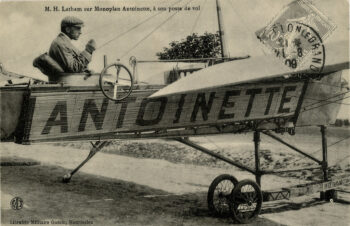
In May 1909, Hubert Latham set the European non-stop flight record at 1 hour and 7 minutes, during which he became the first pilot to smoke a cigarette in flight. This proved not only the inherent stability of his Antoinette IV monoplane but that both he and his machine could take on the challenge laid down by the Daily Mail to fly across the English Channel and claim a £1,000 prize.
At the start of July 1909, Latham was encamped at Sangatte, west of Calais while at nearby Wissant, the Comte Charles de Lambert also waited with two Wright Flyers for a suitable day to fly.
On 19 July 1909, Latham took off towards England followed by the French torpedo boat destroyer Harpon. However, after only eight miles, engine failure forced him to become the first pilot to land on a body of water. Luckily though, the Antoinette monoplane floated. Hubert Latham lit a cigarette and waited for his rescuers.

During the next 60 years and a few days, Edwin “Buzz” Aldrin, who also had two sisters, would twice wait to be rescued in floating former flying machines – Gemini 12 and Apollo 11. He was also one of the first astronauts to train underwater to replicate the long periods of working in a zero gravity environment.
As Latham’s aircraft was severely damaged during efforts to salvage it, Levavasseur sent an improved model, an Antoinette VII, to Sangatte but Hubert only had a brief chance to test fly it on 21 July 1909 before foul weather set in.
On 22 July 1909, Louis Blériot set up camp less than two miles away from Latham at Les Baraques and announced his intention to win the Daily Mail prize in his Blériot XI monoplane just before de Lambert decided to drop out of the competition.
Then, at 0300 on 25 July 1909, Blériot’s team noticed a break in the weather, woke their pilot and prepared the aeroplane for a dawn departure. Taking off at 0441, Louis Blériot made the first successful heavier than air flight across the English Channel.
By the time that Latham’s team responded to what Blériot was doing, the wind and rain had set in again and taking off from the cliffs would have been suicidal.
Two days later, on 27 July 1909, Latham made a second attempt to cross the Channel. He was within minutes of arriving in the vicinity of Dover when engine failure again forced him into the sea. This time he could not control the angle of descent as well as he had in his first attempt and when he hit the water he seriously damaged the aircraft and suffered severe lacerations to his forehead.
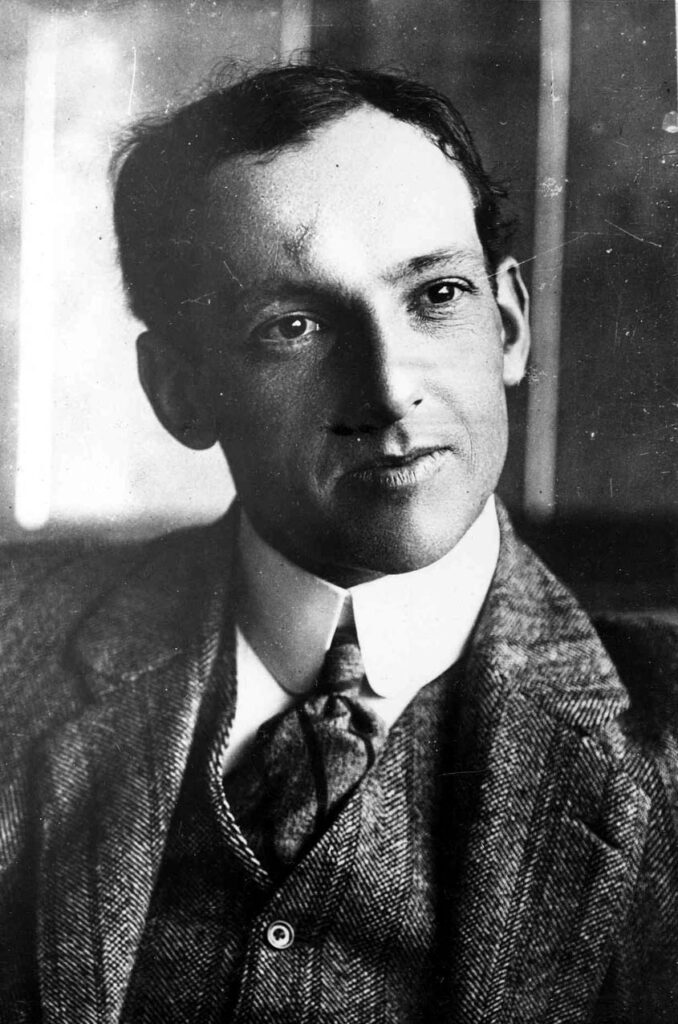
Although no definitive cause of engine failure for this second attempt was found, two possibilities were unfiltered petrol clogging the fuel injection system and the tendency of the Antoinette V-8 engine to lose power after running for more than 15 minutes.
Although Latham wanted to make a third attempt to fly across the Channel, the Antoinette Company decided that more money and aeroplanes would be best invested in the forthcoming Rheims air show.
At the World’s first flying meeting at Rheims, from 22 to 29 August 1910, Louis Bleriots Type XI monoplane set up a new air speed records of just over 46 mph and then 47.8 mph. At the same event, Latham set a new World altitude record of 509 feet in his Antoinette IV.
New World height and speed records were to follow but on 22 October 1909, having promised a cousin of the Russian Tsar that he would fly, Latham took off from Blackpool and covered 8 miles in 11 minutes despite dangerously windy conditions. When flying down wind, Latham estimated his air speed at 100mph but flying into the wind he at some points flew backwards!
Other career highlights included dropping a bag of flour down a battleship’s chimney at Baltimore in November 1910 while in December that year he became the first pilot to shoot a duck in flight. The duck was later stuffed and still exists.
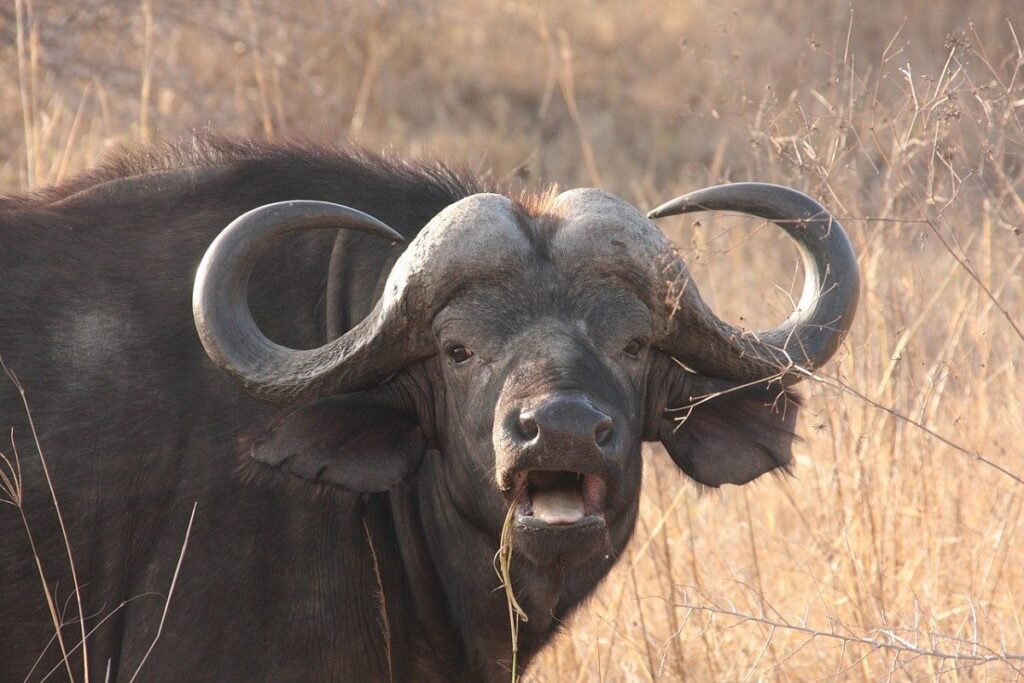
Ironically, wildlife was to be the cause of Hubert Latham’s death on 25 June 1912 – officially at least. At the time he was leading a government sponsored expedition to the French Congo and despite his experience as a big game hunter, the porters following him claimed that he had been gored by a wounded buffalo. A military official who recovered his body however later reported that Latham had received a single gunshot to the head.
However, Hubert was by no means the last of the flying Lathams. In 1916 his cousin Jean set up Société Latham at Caudebec-en-Caux on the banks of the River Seine to build seaplanes for the French Navy. The company’s works stayed there until a 1951 restructuring of the Latham, Bréguet and Potez companies, in which it was renamed REVIMA (Révision de Matériel Aéronautique) and merged into the Chargeurs Réunis group.
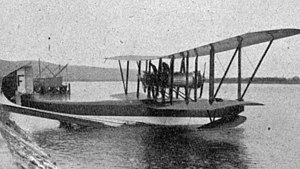
Jean Latham’s first design was the H5, a three engined (two tractor and one pusher) high seas biplane flying boat,powered by three 340 hp Panhard-Levassor P1-12CB engines.
Like Gloster Supermarine and Macchi, Latham later built entries for the Schneider Trophy competition. In 1923, his wooden single seat biplane flying boats L-1 and L-2 were powered by two tandem 400 hp Lorraine-Dietrich 13 V-12 engines and featured fabric covered wings.
The pilot’s open cockpit was positioned between the two front engine-mounting struts and behind the front propeller and had an air dam rather than a transparent windscreen. The advantage of having two piston engines back to back was to cancel each other’s torque.
The wing bracing of the Latham L.1 was a novelty, described in the October 4, 1923 issue of ‘Flight, The Aircraft Engineer and Airships’ as follows:
“A feature which is new to us was noticed in the wing bracing, which consisted of laminated streamline wires. We believe that M. Latham has patented this form of wire, which consists of several separate wires placed side by side, the inner one being of the greatest width, the next ones narrower, and so on. Thus in case of a flaw in one lamination the complete wire is only weakened somewhat, but has still, if the factor of safety has been chosen high enough, more than sufficient strength for its work. The idea seems to have a good deal to recommend it, and might be worth investigation.”
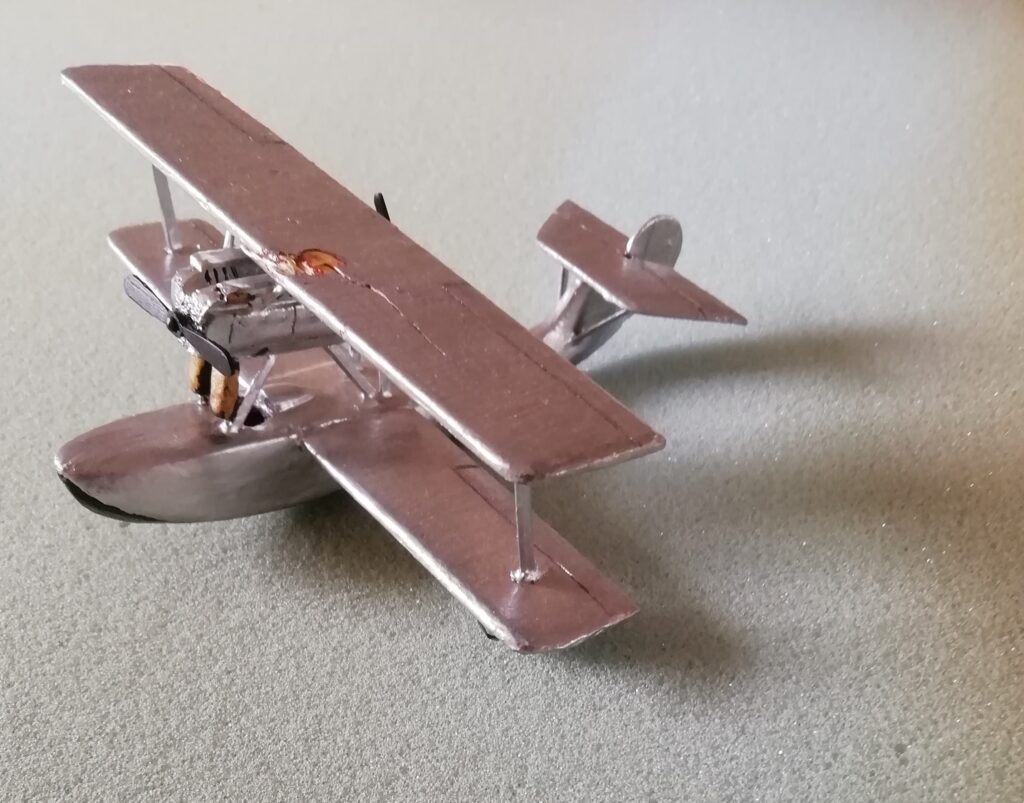
The L-1, F-ATAM, seen here in a 1/96 scale wooden model, differed from the L-2, F-ESEJ, in having Lamblin radiators mounted vertically between the fuselage and the front of the engine nacelle.
Both flying boats were flown from France to the competition site at Cowes, Isle of Wight, but due to engine trouble F-ATAM diverted to Littlehampton where it was damaged by surf and a well meaning but clumsy British crowd. F-ESEJ did make it to Cowes but was unable to race due to magneto failure.
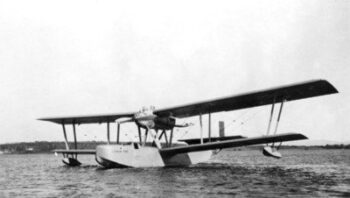
Possibly the most famous of Jean’s flying boats however was the Latham 47, the prototype of which disappeared in 1928 with Roald Amundsen onboard during a rescue mission to the North Pole in search of Italian explorer Umberto Nobile.
Nobile had been Amundsen’s pilot for the first flight over the North Pole in the airship “Norge” while in 1928 Nobile’s own airship “Italia” had crashed in a storm. He was rescued by the Swedish Air Force, but not before Amundsen and five others had set off in the Latham Type 47. This was intended as long range transatlantic flying boat for bombing and reconnaissance, powered by two 500 hp Farman 12W engines.
The sesquiplane was en route from Tromso in Norway to the island of Svalbard when it disappeared, only for one of the under wing sponsons to be found later.
While the French side of the Latham family might, over the years, have slipped from public consciousness, one of the English cousins helped define what we expect from aerobatic flying – and also had a connection with water.
Son of a master plumber, Peter Anthony Latham was born in Birmingham on 18 June 1925. He grew up immersed in his father’s workshop, later read Mechanical Engineering at Cambridge University and completed his RAF flying training in August 1946. As a fighter pilot he flew piston engined Hawker Tempests before joining the jet age with Gloster Meteors, de Havilland Vampires and Hawker Hunters.
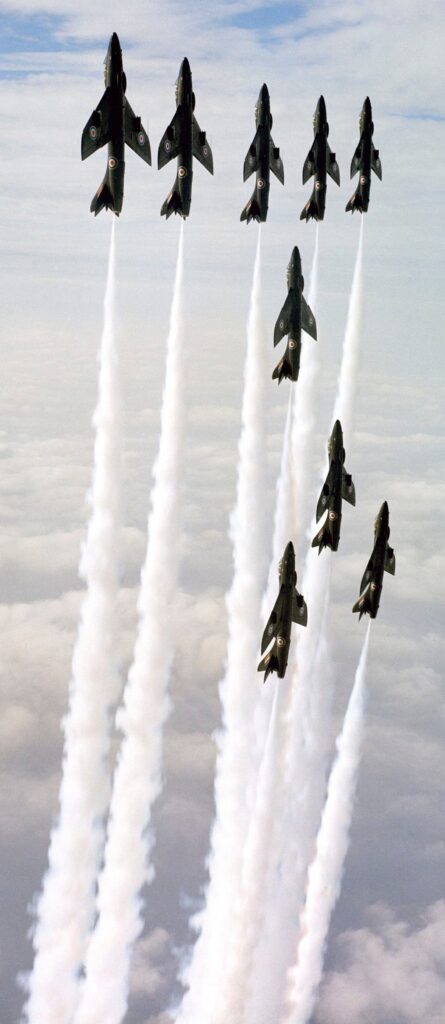
This led him to take command of 111 Squadron Royal Air Force in October 1958, just after 22 Hunters had looped the loop at the Farnborough Air Show – a spectacle that has never been repeated since.
As one of the pilots commented, “We are now in the world of entertainment” and Latham, a keen aerobatic pilot himself, realised that more was required than just a perfect display of precision flying. He introduced bolder manoeuvres and new sequences for the nine strong Black Arrows and gave them attractive names such Wine Glass. Similarly, each display ended with a vertical bomb burst with coloured smoke – something that the later Red Arrows still do today.
Treble One opened the 1959 Farnborough Air Show using all 16 of the squadron’s Hunters and became the first RAF unit to win the Royal Aero Club’s Britannia Challenge Trophy, which was presented to them by the Duke of Edinburgh.
After more than 150 displays at home and abroad, the Black Arrows last ever show was at their base at Wattisham in November 1960 before 111 Squadron converted to the new English Electric Lighting.
In June 1960, Latham was awarded the Air Force Cross ” in recognition of his leadership of the Black Arrows and the international esteem in which its work is held”.
Peter Latham’s later RAF career included commanding the Canberra equipped Strike Wing of RAF Akrotiri, Senior Air Staff Officer of the RAF’s highly mobile 38 Group which included transport aircraft, helicopters and Hawker Siddeley Harriers and commander of RAF Tengah. This was the largest operational RAF airfield in the Far East and hosted Hunters, Canberras and Lightnings as well as RAAF and RNZAF units. In September 1971, it was Peter Latham who handed Tengah over to the new Singapore Air Force.
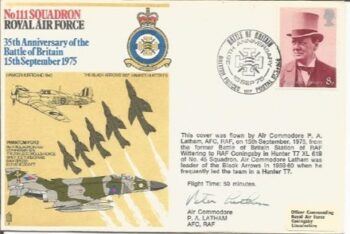
In 1977 he was appointed Air Officer Commanding of Number 11 Fighter Group in charge of the air defence of Great Britain, the tools of his trade including Lightning and Phantom fighters and the Bristol Bloodhound surface to air missile. However, on a farewell visit to RAF Coningsby, the home of the Battle of Britain Memorial Flight, he declined the offer of a flight in a Phantom but expressed an interest in flying the BBMF Hurricane. The request was granted and the Hurricane safely returned.
On retirement from the RAF, Air Vice Marshall Peter Latham became an adviser to Short Brothers, makers of the Skyvan, and Honorary President of the International Air Tattoo. He was also a keen yachtsman and clock repairer before he passed away on 4 December 2016.
As well as the fabulous flying Lathams, ground based members of the wider clan include the private bank Arbuthnot Latham, legendary book seller and author Martin Latham, TV actor Jody, and Sara, senior adviser to Hilary Clinton’s 2016 Presidential Campaign and more recently PR adviser to Harry and Meghan, the Duke and Duchess of Sussex.

However, the Latham who stands out from my teenage years is glamour model Joanne Latham, who hailed from Tettenhall in Wolverhampton. Could some of her ancestors have worked for the nearby aircraft firm of Boulton Paul? Could they qualify as flying Lathams? Genealogists, it is over to you!