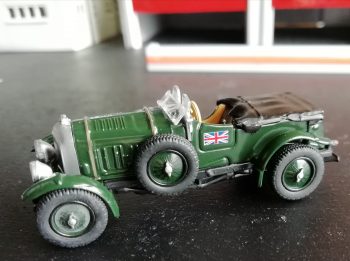
This Oxford Diecast 1:76 scale model of the 1927 Bentley 4 ½ litre car is a replica of the vehicle which W O Bentley developed on a sports car chassis. However, the supercharged vehicle known as the Bentley Blower was the result of some tinkering by one of his ‘Bentley Boys’ who saw the potential of a more powerful engine suitable for racing.
Despite protests from W O Bentley himself, the Bentley Blower saw great success on the race track, although of the 740 Bentley 4 ½ litre cars made, only 50 were converted to the souped up Blower status.
After the Armistice of 1918, Great Northern Railway works trained engineer Walter Owen Bentley began to build his ideal sports car.
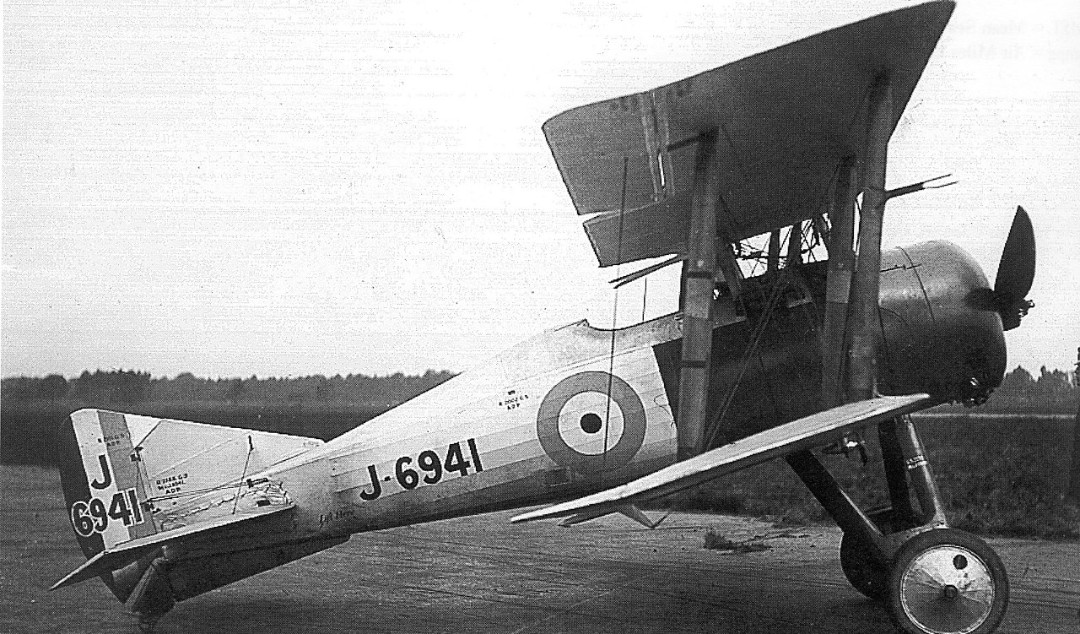
He had previously designed the BR1 and BR2 rotary aero engines used by the Royal Flying Corps in World War I. In particular the Bentley Rotary 1 had powered the Sopwith Camel and the BR2 the Sopwith Snipe and Gloster Nightjar (pictured above)
W. O. Bentley’s first 3 litre car was influenced by both pre War Grand Prix Peugeots and, from the same competition, the 4.5 litre Mercedes cars with their sixteen valve twin-plug fixed head overhead cam engines.
After financial and technical issues had been overcome, the first 3 litre Bentley sports car was fired up at New Street Mews, near Baker Street, London, in 1919 in the presence of such Bentley personalities as designer Frederick Tasker Burgess, fighter pilot and racing driver Clive Gallop, Harry Varley, who had previously designed the Vauxhall badge, and Works Manager “Nobby” Clarke.
An instant complaint from a nearby nurse highlighted the work that would be needed to reduce the engine noise but despite this the new car – albeit incomplete – was exhibited at the 1919 Olympia Motor Show.
In fact W.O. Bentley recalled that a mere 367 days elapsed between the first serious discussion about his new car and S.C. H “Sammy” Davis, the sports editor of Autocar magazine, taking it for a test drive.
The Bentley factory was established at Oxgate Lane, Cricklewood, not far from the Welsh Harp lake. Its showroom was in Conduit Street in the West End of London, not far from that of Rolls-Royce. More factory staff were taken on as sales increased, an Bentley even started an apprentice scheme. Among those under training was Lord Settringham, later better known as racing driver the Earl of March and then His Grace the Earl of Richmond and Gordon, owner of the Goodwood Circuit.
On one occasion, he was working in oil and grease beneath a Bentley when a fellow mechanic said to him “Freddie, they say there’s a bleedin’ Lord somewhere in the factory.”
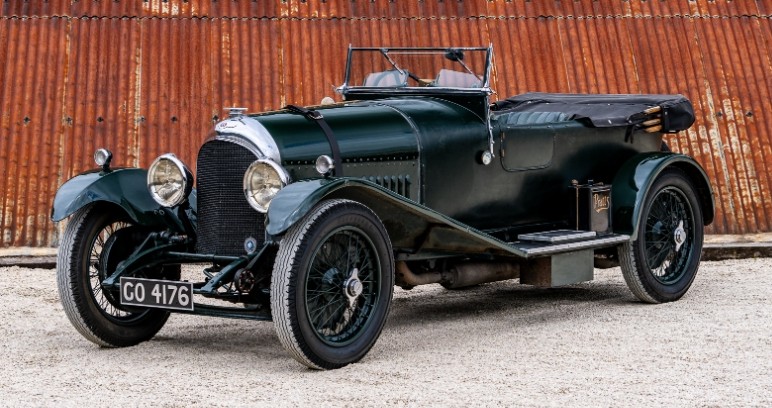
The three litre was an eventual solid success. A good “Red Label” (such as the one pictured above) would do about 82 mph and acceleration was aided by a good close-ratio gearbox. When more power was needed, partly in order to go faster, but also to meet the elegant closed bodies some customers insisted upon, W.O. enlarged the 3 litre to form the 4 1/2 litre. This was still a four cylinder car and it gave the open tourer Bentley a speed of over 90mph.
However, W.O. had his experienced eye on the luxury car market with a car for the carriage trade. This arrived in 1925 as the impressive and dignified Big Six Bentley, using a six cylinder engine of 6 1/2 litres, its single overhead camshaft driven, not by a vertical shaft and bevel gears as on the 3 litre and 4 1/2 litre four cylinder Bentleys, but by quiet functioning tiny crankshafts whereby an ‘upstairs’ camshaft and massive crankshaft were mated by long coupling rods, similar to steam locomotive practice.
In fact the great Welsh racing driver and engineer J.G. Parry-Thomas had a similar silent overhead camshaft mechanism on his Leyland Eight luxury car of 1919 and this, like the Big Bentley, was later to excel at racing.
The 6 1/2 litre Bentley was in production from 1927 to 1931 and its six cylinder engine was basis for that in the Speed Six. Although built with a relatively quiet gearing system, it was still much noisier than the 3 litre Bentley and its fuel consumption was still 3 miles per gallon.
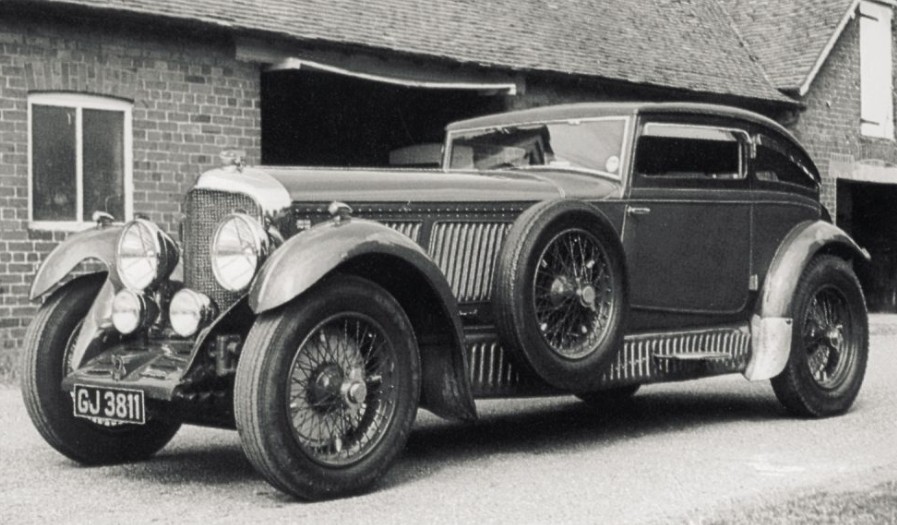
W.O’s customers flocked to buy the new Big Six and it was easy to develop it into the Speed Six Bentley (pictured above) which consolidated the Le Mans victories.
In March 1930, Bentley chairman and “Bentley Boy” Woolf Barnato made a bet while at a dinner party in Cannes that he could drive his Speed Six Bentley four door saloon to Calais before the luxury Blue Train night express arrived.
Barnato and his co-driver won the bet, arriving in London well before the train reached Calais. His total journey from Cannes to his club in London was completed in under 22 hours.
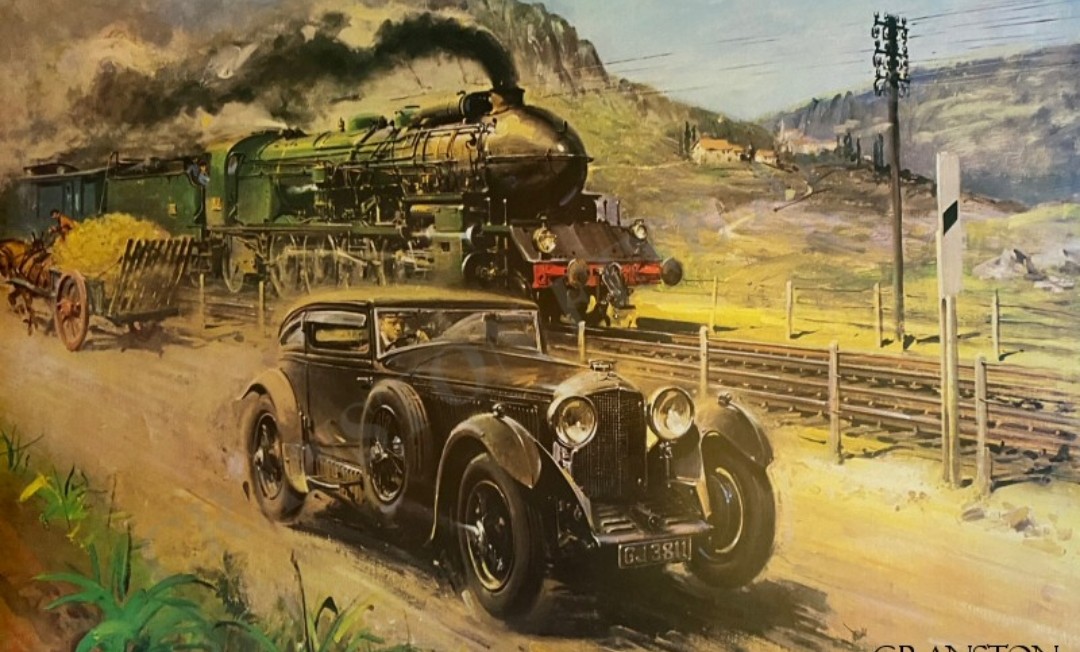
The later Terence Cuneo’s painting, titled “Bentley v ‘Blue Train’,” depicted a powerful two-door Gurney Nutting coupé version of the Bentley Speed Six racing alongside the train, not the four door Speed Six of the actual race. This coupé was built for Barnato after his victory and was named the “Blue Train” Bentley in celebration of his feat.
The Speed Six in turn led to the 8 litre Bentley, one of the first catalogue enclosed cars to exceed the magic 100 mph. The 8 litre Bentley also made a formidable track car.
The magnificent 8 litre Bentley with a gigantic 8, 300 cc engine capable of a top speed of 110 mph was the largest capacity car that the firm produced and also one of the last ‘true’ Bentleys before the 1931 Rolls-Royce takeover.
The 4 1/2 litre Bentley which was made between 1936 and 1939 contained a 4 257 cc Rolls-Royce engine.
The 3 litre Bentley won Le Mans in 1924 and 1927. It was the first British car to challenge the dominance of the Lorraine – Dietrich’s and other Continental rivals.
In 1924, John Duff drove a four wheel braked 3 litre Bentley with wire mesh over the radiator and headlights to protect them from flying stones. His average speed was 53.78 mph over 1290 miles.
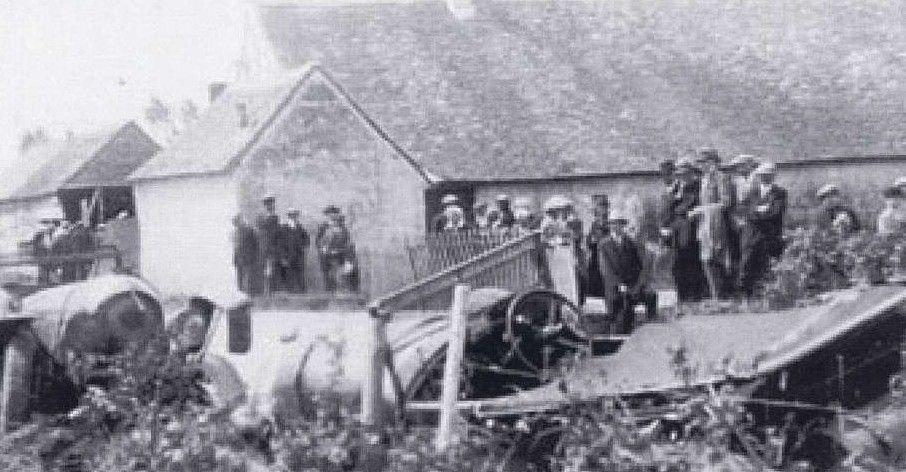
In 1927, a Bentley 3 litre driven by Sammy Davis even managed to take first place despite being badly damaged in the severe White House multiple crash. Davis averaged 61.35 mph over 1472 1/2 miles. Some 1620 of these cars were produced over 9 years.
The Bentley Speed Six won the Le Mans 24 hour race twice – in 1929 and 1930 – during the five years that it was produced. In 1929 Bentleys took the first four places at Le Mans and in 1930 Speed Sixes came in First and Second.
The normally aspirated 4 1/2 litre Bentley, developed from the earlier 3 litre, could reach 92 mph and consolidated Bentley’s reputation at Le Mans with an outright win in 1928 and then taking second and fourth positions in 1929 alongside Bentley Speed Sixes. It was produced in the famous Cricklewood factory for four years from 1927.
The supercharged 4 1/2 litre Bentley was purely bred as a sports car and produced briefly in 1929 to satisfy the Le Mans 24 hour race condition that no car should be allowed to compete unless at least 50 examples of a racing model were to be offered for sale to the public. In supercharged form, the 4 1/2 litre Bentley had a speed in excess of 100 mph.