This article is based on a diorama built in 2021 to showcase some of Ron Brook’s models of the vehicles which, from 1940 to 1943, threatened the British Empire with defeat in World War II but were ultimately vanquished in the North African campaign.
Historical Context
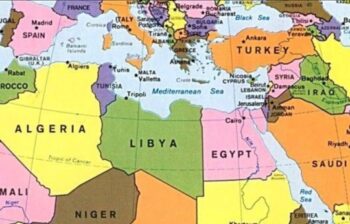
On 10 June 1940, Italian Fascist dictator Benito Mussolini declared war on Great Britain and France.
At the time, Germany had been at war with Great Britain and France for nine months and after a winter of “phoney war”, the summer of 1940 had seen Germany invade and subjugate France and most of Western Europe. The British Expeditionary Force had been evacuated from Dunkirk in May 1940 and in June 1940 there was real fear in Britain of a German invasion, especially if the Luftwaffe were able to gain air superiority from the RAF’s Fighter Command.
Benito Mussolini and Adolf Hitler, Fuhrer of Nazi Germany, had signed the May 1939 Pact of Steel promising mutual military assistance but by June 1940 Italy had not achieved anything like the German Blitzkrieg across Europe. Mussolini realised that this would place him at a disadvantage in future discussions about Italy’s role in Hitler’s New World Order.
One remedy for Mussolini’s predicament would be to use the Italian colony of Libya as a springboard for the invasion of British controlled Egypt to the east and the ultimate prize of the Suez Canal, separating Britain from the oil of the Middle East and its Far East Empire.
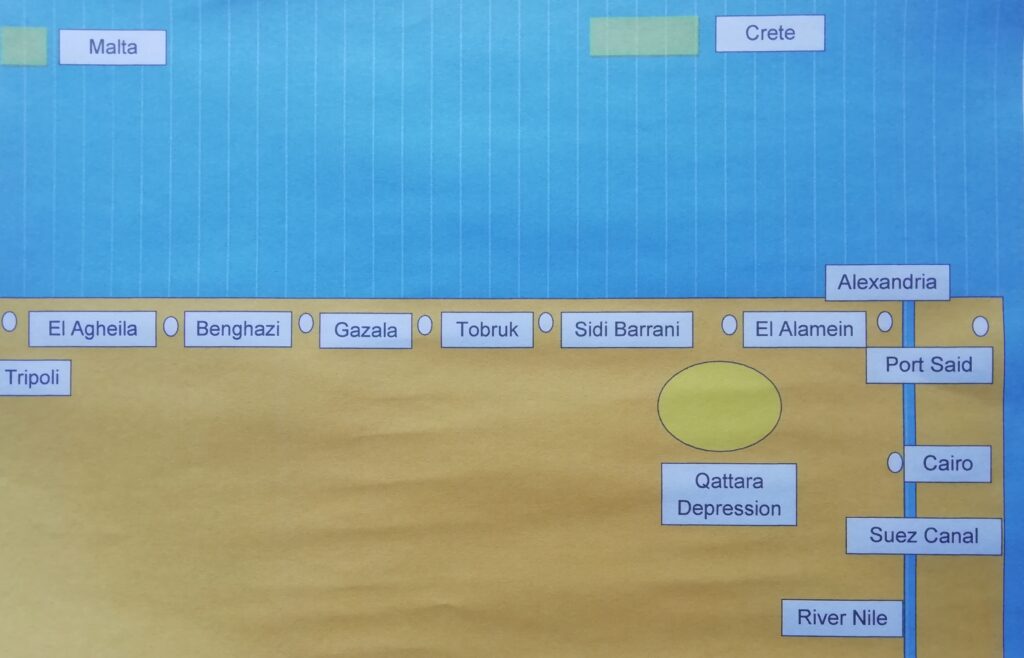
On 13 September 1940, 250 000 Italian troops invaded Egypt from Libya. Opposing them, 30 000 British and Empire soldiers fell back to the Suez Canal but after four days the Italians halted at Sidi Barrani, 60 miles inside Egypt but 300 miles from the Egyptian capital Cairo, on the River Nile. Being dependent on a long supply column from Libya and possessing few tanks, the Italian army settled into a series of widely spaced fortified camps.
Although the small number of Italian tanks would have been adequate for war against tribal warriors, they were inferior to the opposing British tanks and their commanders did not use them to their full potential. Although well designed, the Italian tanks lacked depth of armour, firepower, good suspension and engine output.
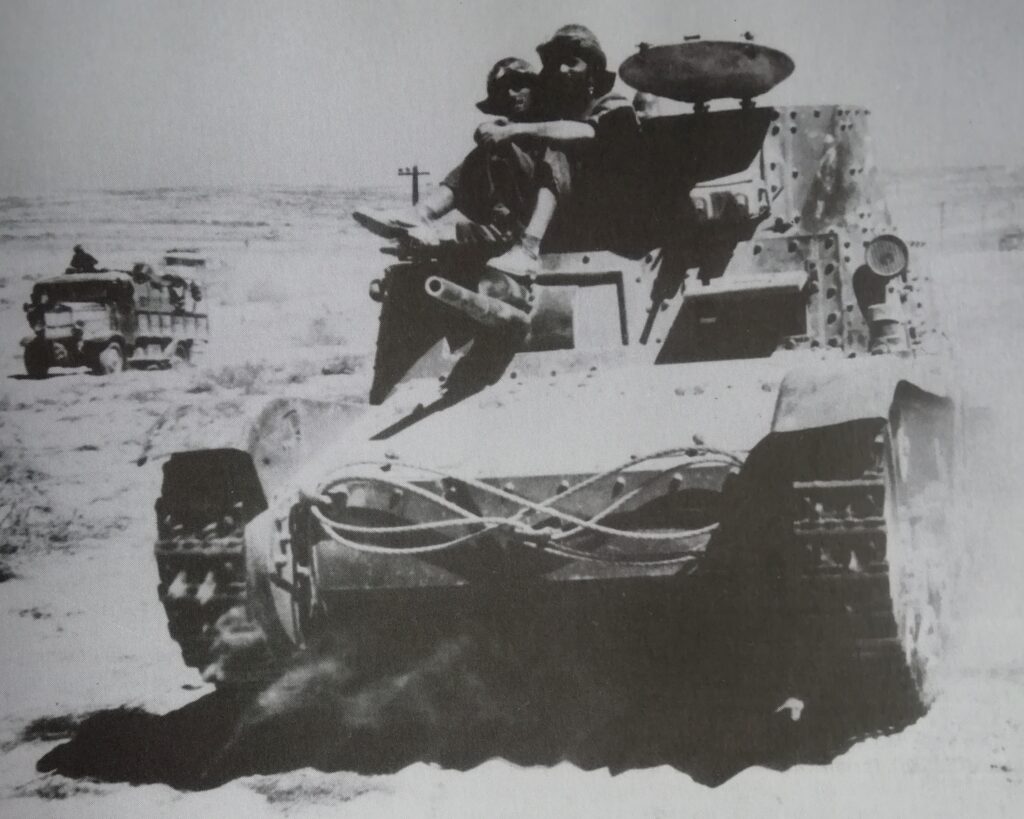
Specifically, they were of only light or medium size compared to the British heavy Matilda II. Of the 70 Carro Armato 11/39 medium tanks sent to Libya in July 1940, all had been either destroyed or captured by British, Australian or Indian units by January 1941.
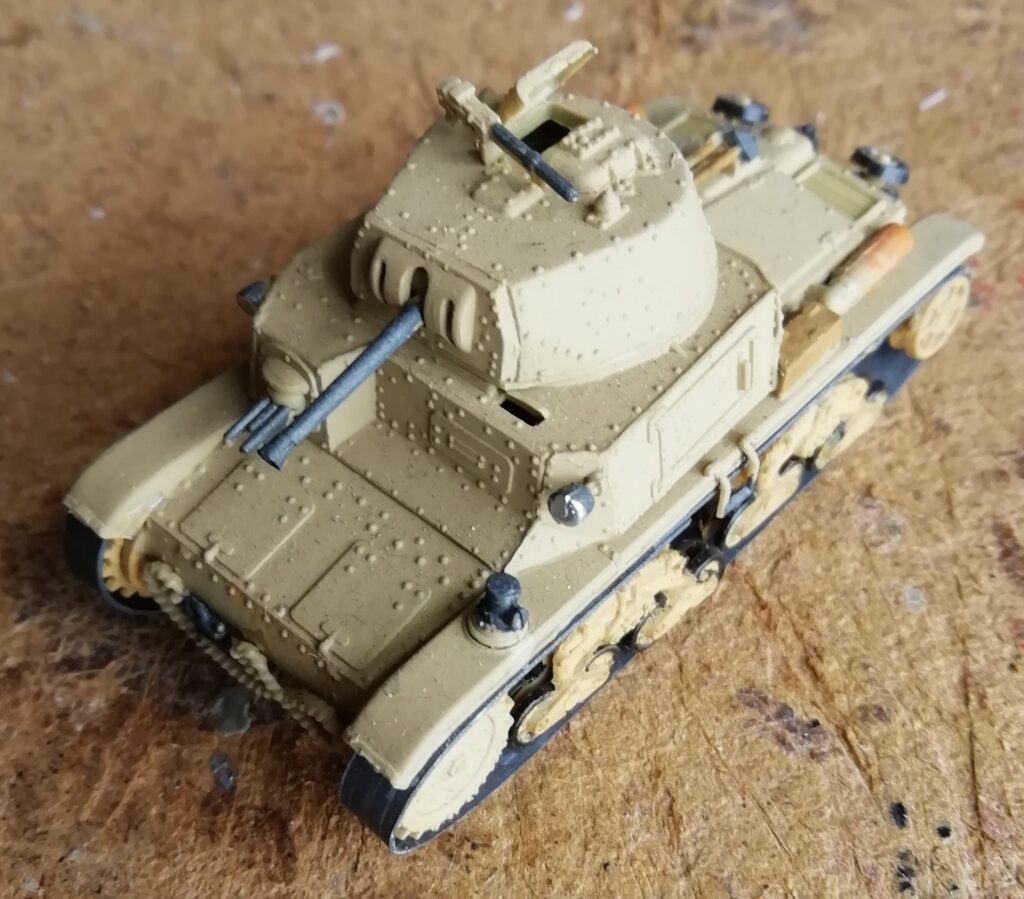
When it became clear that the M 11/39 (Medium tank, 11 tons, introduced 1939) was unsatisfactory, development work began at manufacturer Ansaldo on its successor, the M 13/40.
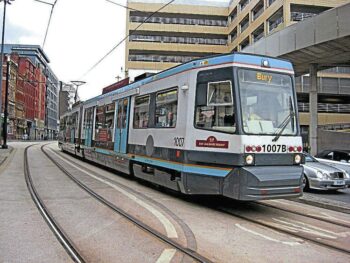
Founded by Giovanni Ansaldo in 1853, the company was to change ownership and product range many times – entering the businesses of railway locomotive, ship and aircraft building. Although Ansaldo disappeared as a separate company in 1993, the brand lives on in a number of current firms. From a British perspective, Ansaldo Breda – now part of Hitachi – built the first trams of the Manchester Metrolink. These served from 1992 to 2012 when they were replaced by Bombardier T5000 vehicles.
The M 13/40 featured a more useful 47mm gun mounted in the turret rather than the hull, the sponson position opposite to the driver being taken by a pair of 8mm Breda machine guns. The 47mm gun could pierce 45mm of armour at 500m, making it dangerous for British light and cruiser tanks but not the heavyweight Matilda II. As well as armour piercing rounds, 47mm high explosive shells proved effective against British soft vehicles and towed artillery.
Although better armoured at the side than its predecessors, the M13/40 still had bottom armour just 6mm thick – making it vulnerable to mines.
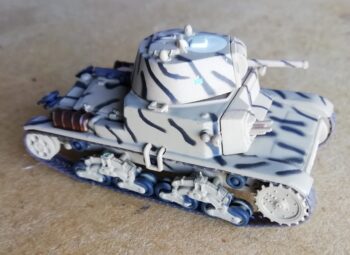
Like the M11/39, its successor was powered by a diesel engine: reducing the risk of fire and offering greater range at reduced cost but producing a more noticeable noise and exhaust. As such the M13/40 presaged modern tank design but even with a 125 bhp rather than 105 bhp engine, the M 13/40 was still prone to mechanical breakdown.
More importantly, many M 13/40s were sent into battle without radios and only a minimum of crew training.
Despite this, the M 13/40 became the best known Italian tank of the Second World War and examples captured by the Australian 6th Cavalry Squadron joined M11/39s in being painted with white kangaroos and used against their former comrades until their fuel ran out.
The green camouflaged diecast model of an M 13/40 pictured above was present at El Alamein in 1942 on the strength of Divisione Corazzata Littorio.
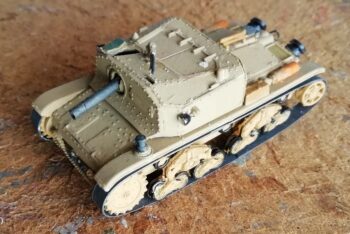
The Semovente (self propelled gun) 75/18 originally used the chassis of the M 13/40 to carry a 75mm mountain gun – an artillery piece which could be dismantled into many parts for transport over steep terrain. The Semovente 75/18 was intended to be a stop gap before the introduction of the P40 heavy tank.
Design was based on that of the German StuG assault gun which had proved successful in the Blitzkrieg against France and the prototype 75/18 was delivered on 10 February 1941, only 13 months after the first M13/40. Sixty examples were ordered, which reached North Africa in January 1942.
Although the 75/18 featured thicker armour and a lower profile than its forebears, it was still made of riveted rather than welded plate or cast sections. This made the crew vulnerable to rivets flying around the fighting compartment if the vehicle was hit by explosive shells. Similarly, the inherited leaf spring suspension of the rear engined vehicle was reliable but did not permit high speeds.
Unlike the four man M 13/40, the crew consisted of only three members: driver, loader/radio operator, and tank commander/gunner.
The 75mm gun had a relatively low muzzle velocity (around 450 m/s) and the casement mounting only allowed limited elevation and traverse. As a result its range was only about 8 kilometres and the designed ammunition load was only 44 shells. However, in North Africa some crews removed their seats to store extra 75mm rounds.
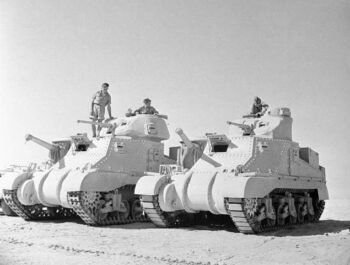
Some of these were 5.2 kg High Explosive Anti Tank munitions which could pierce 80mm armour at 500 metres. This made the 75/18 a threat to the M3 Grant and M4 Sherman tanks of the opposing British army.
Although these Semoventes are still not widely known, the vehicle performed well in its role. Though it was technically similar to the StuG III, it had a totally different role, serving as divisional artillery instead of a pure assault gun. The Italian army organisational structure consisted of two artillery groups for every armoured division, with two batteries each (four 75/18 each and a command vehicle). The total was of eighteen 75/18s (included two in reserve) and 9 command vehicles, which were characterized by additional radio equipment and a 13.2 Breda heavy machine gun.
The most successful action fought by Semovente 75/18 took place on 10 June 1942, south of the Knightsbridge Box, during the Battle of Gazala. Of thirty attacking M3 Grant and ten Stuart tanks, 15 Grants and 5 Stuarts were destroyed for the loss of two M 13/40s.
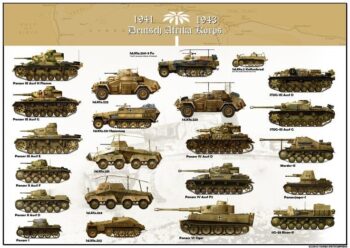
On 12 February 1941, Adolf Hitler sent his newly formed Deutsche Afrika Korps (DAK) to Tripoli to aid Mussolini in defending the southern flank of Europe. Its initial aim was to tie up as many British troops and resources as possible, but if victorious in battle, the DAK also offered the prospect of capturing the Suez Canal and advancing through Palestine to the oilfields of Iraq.
Were this prize to be won, a divided British Empire would be in little position to stop a German advance between the Black and Caspian Seas to more oil in the Caucasus, perhaps persuading Turkey to join the Axis powers as well.
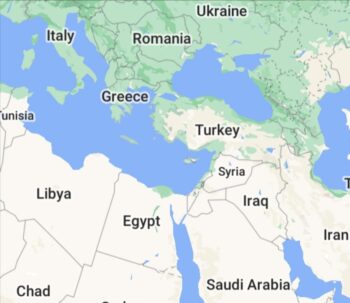
By this time, planning for Germany’s invasion of the western USSR was at an advanced stage, which explains Hitler’s howl of dismay when, on 12 May 1941, he discovered that his one time deputy Rudolf Hess had flown to Britain on a personal mission to make peace and ideally form an Anglo German alliance against Bolshevism. In fact the British kept Hess as a prisoner and his pleas had no effect on their prosecution of the war.
Back in February 1941 however, General Rommel, fresh from his success in conquering France, began building up the Afrika Korps, both in terms of real vehicles and 150 fake wood and canvas tanks to fool RAF reconnaissance aircraft. Unlike the Wehrmacht in Europe, there was no dependence on horses – the terrain was entirely unsuitable.
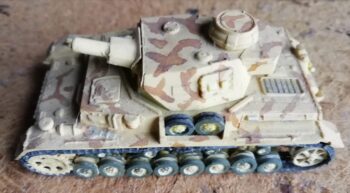
Distinguished from the earlier Panzer III by the presence of eight rather than six road wheels, the first Panzer IVs were introduced in 1936 and by the outbreak of the Second World War some 200 were in service. Originally designed as a support tank for the lighter Panzer III, the earliest versions were armed with a short barrelled 75 mm assault gun. However, as a result of experience gained during the 1939 Polish campaign the Panzer IV armour was increased and detail improvements made to create the Panzer IV F1.
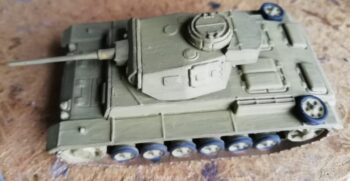
In 1942 the new long barrelled 75 mm gun was introduced on the Panzer IV F2 which was the only German tank capable of meeting Allied armour on equal terms until the 75mm PAK 40 armed Panther and 88mm gun armed Tiger tanks became available.
In addition to its 75mm gun the Panzer IV carried two 7.92mm machine guns and had a road speed of 24 mph courtesy of a 300 bhp petrol engine manufactured by Maybach. The same company would go on to design the MD655 engines built by Bristol Siddeley that powered the Western Class diesel hydraulic locomotives of British Railways Western Region in the 1960s.
Robust and reliable, the Panzer IV saw service in all combat theatres involving Germany and was the only German tank to remain in continuous production throughout the war, with over 8 800 produced between 1936 and 1945.
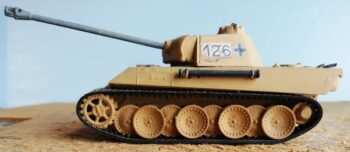
The Panzer V Panther was introduced in August 1943 and was the first German tank capable of successfully engaging the Soviet T-34. In fact many features of the Panther, including the low streamlined hull, sloping front glacis plate and long overhanging 75mm PAK 40 Canon, were copied from the T-34.
As such, Panthers completely outclassed the more lightly armoured petrol fuelled Shermans that they faced in North Africa. By the end of the war nearly 5 000 Panthers had been produced but this was way below the number of tanks available to the Allies. Each one weighed 45 tons and was powered by a 690 bhp engine, giving a maximum speed of 29 mph.
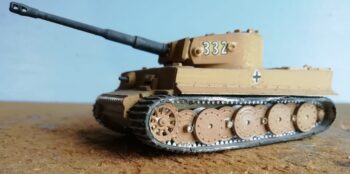
Although only 1 360 of the 55 ton Panzer VI Tiger I were built, being armed with the deadly 88mm gun they proved a serious challenge to Allied Churchills, Comets and Shermans. However, they could be knocked out by British 17 pounder guns and Hawker Typhoon aircraft.
Production began in 1942 although one design fault was the very low geared turret traverse – making the 88mm gun slow to bear on a target. In fact the first Tiger to be captured intact by the British – on 21 April 1943 near Tunis – was the now-preserved 131, hit by three six pounder solid shots from Churchill tanks which disabled the traverse and elevation of the gun.
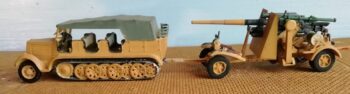
Krauss-Maffei built Sd Kfz 7 (Sonderkraftfahrzeug 7, or Special motor vehicle 7) eight ton half tracks were introduced in 1938 to tow the much feared 88mm flak and anti-tank gun. Although widely featured in Nazi propaganda to suggest that the entire Wehrmacht was highly mechanized, Maybach-engined Sd Kfz 7s only equipped Panzer and Panzergrenadier (mechanized infantry) units while other artillery in Europe was often still hauled by horses. Sd Kfz 7s could tow an eight ton load at 30 mph on roads or 18 mph cross country with a crew of 12.
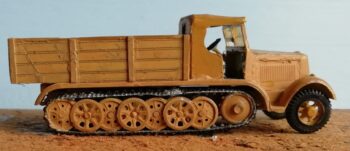
Some Sd.Kfz 7s were also built by Krauss-Maffei as supply vehicles, one of which is seen in the diorama behind the artillery tractor version with the 88mm gun.
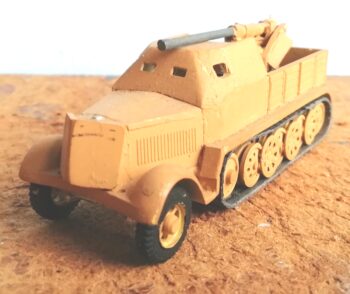
Following on from the wooden dropside supply vehicle, another significant Krauss-Maffei conversion was the Sd.Kfz 7/2 Flakvierling of 1943. This had a crew bench back to back with that of the driver with the rest of the rear compartment filled with either quadruple 20mm Flak 38 guns or, as modelled, a single barrelled 37mm Flak 36. As the Allied fighter bomber threat in North West Europe increased during 1944, armoured cabs and radiator grilles were fitted to better protect the crew while travelling.

Proven in the Spanish Civil War, the “88” was the best known of all German guns in the Second World War, being capable of destroying any tank then in service. It was introduced as an anti-aircraft weapon but had a maximum horizontal range of 16 200 yards (14 815 metres) and an effective vertical range of 25 000 feet (7 620 metres) It could fire either a 20 lb (9 kg) high explosive or a 21 lb (9.52 kg) armour piercing shell at a rate of fire exceeding 15 rounds a minute.

The Sturmgeschutz III, or StuG III, Ausf F assault gun was based on the Panzer III tank chassis and appeared late in 1942 although earlier StuG III versions mounting the short and medium 75mm guns and also based on the Panzer III chassis had been in service since 1940. In fact the StuG concept went back as far as 1937.
Assault guns were used in fairly large numbers with Panzer and Infantry Divisions of the German army during the Second World War. They differed from normal self propelled guns in having their guns positioned low in the hull and greatly thickened armour. The role of the assault gun was to accompany attacking infantry, knocking out pill boxes, machine gun nests, anti tank guns and other obstacles. Later in the war, StuGs helped fill gaps in Panzer divisions despite the whole vehicle having to be turned to traverse the long barrelled Stu K40 gun.
The 23 ton StuG III was powered by a Maybach V12 petrol engine giving a maximum speed of 22 mph.
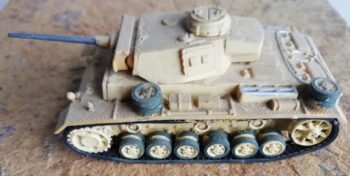
The Panzer III was first introduced in 1939 and saw action in small numbers during the invasion of Poland. The Ausf L entered service in 1942 with a 50mm gun, for which storage was provided for 76 rounds of ammunition. A total of 1 900 Panzer III Ausf Ls were built and saw action on the Russian front and in Europe as well as in North Africa, where 15th Panzer Division used them to attack from Sidi Rezegh during 1942. Having gained a reputation as a highly effective fighting vehicle which shaped the development plans of Allied tank designers. Specialist versions included flame throwers, experimental submersibles, command vehicles, ammunition carriers. The Panzer III was also the basis for the StuG III assault gun.

Linking the later Panzer III to the earliest Versaille Treaty breaking Panzer I, the 10 ton Panzer II mounted a 20mm cannon capable of firing both high explosive and armour piercing ammunition along with a coaxial MG34 machine gun. The definitive Ausf F version, modelled here from an Esci kit, substituted the earlier suspension for one based on five independently sprung road wheels and four top rollers. The hull was also made from one flat 35mm plate.
Panzer IIs served in all German theatres of war with specialist versions including flame throwers, light reconnaissance and munition carrier versions. When withdrawn from front line service in 1942, a number were converted into Wespe self propelled guns.
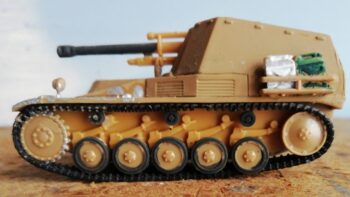
The Sd Kfz 124 Wespe (Wasp) was first introduced in 1942 and served with the batteries of armoured artillery regiments in Panzer divisions, including XXI Division of the Deutsch Afrika Korps. Over 680 of these self propelled 105 mm guns were produced until the FAMO factory in Warsaw, Poland, was over run by Soviet forces in 1944. Of the examples produced, 150 were gun-less munition carriers capable of moving 90 rounds of ammunition to supplement the 32 rounds carried by the regular Wespe.
The driver sat ahead of the 6 cylinder 140 bhp Maybach petrol engine while the commander and three gunners occupied the cramped open topped fighting compartment.

Literally translated as a “bucket seat car”, the four wheeled Kubelwagen was designed by Dr Ferdinand Porsche and developed from the “Strength Through Joy” Volkswagen Beetle. Although lacking the four wheel drive of its Allied equivalent, the Willy’s Jeep, the Kubelwagen’s flat underside meant that it could be scooted along in deep sand or snow to keep up with armoured units. Like the Jeep, it could also mount a machine gun if needed.

During the 1930s BMW were producing a number of popular and highly effective motorcycles. In 1938 this led to the development of the R75 started in response to a request from the German army.
Preproduction models of the R75 were powered by a 750 cc side valve engine, which was based on the R71 engine. However it was quickly found necessary to design an all-new OHV 750 cc engine for the R75 unit. This OHV engine later proved to be the basis for subsequent post-war twin BMW engines like the R51/3, R67 and R68.
The third side-car wheel of the R75 was driven, by an axle connected to the rear wheel of the motorcycle, through a locking differential, and a transfer case made road and off road gear ratios available through which all four and reverse gears worked. This made the R75 highly manoeuvrable and capable of negotiating most surfaces. A few other motorcycle manufactures, like the Belgian FN and British Norton offered optional drive to sidecars.
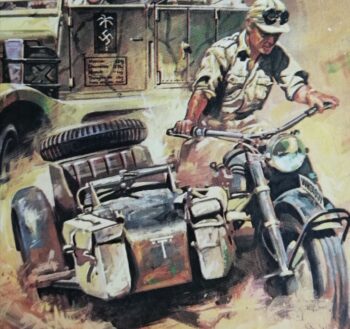
The BMW R75 and its rival the Zündapp KS 750 were both widely used in Russia and North Africa though after a period of evaluation it became clear that the Zündapp was the superior machine. In August 1942 Zündapp and BMW, on the urging of the Army, agreed upon standardization of parts for both machines, with a view of eventually creating a Zündapp-BMW hybrid (designated the BW 43), in which a BMW 286/1 side-car would be grafted onto a Zündapp KS 750 motorcycle. They also agreed that the manufacture of the R75 would cease once production reached 20,200 units, and after that point BMW and Zündapp would only produce the Zündapp-BMW machine, manufacturing 20,000 each year.
Since the target of 20,200 BMW R75’s was not reached, it remained in production until the Eisenach factory was so badly damaged by Allied bombing that production ceased in 1944. A further 98 units were assembled by the Soviets in 1946 as reparations.
However the standardisation programme meant that machines that were produced by BMW and Zündapp used 70% of the same components. This simplifies the supply of spare parts for these vehicles, many of which are still in the hands of historic motorcycle enthusiasts. The success and reliability of the shaft-driven R75 during the war led to the US Army requesting that Harley Davidson produce a similar shaft-driven cycle for American troops. This led to Harley producing their first ever shaft-driven model, the Harley Davidson XA which was a near duplicate of the R75.
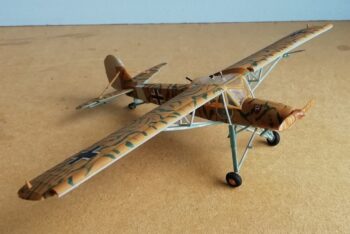
The awkward looking Fiesler Fi 156 Storch proved to be the most efficient of all the observation and communication aircraft of the Second World War. Some captured examples were even pressed into service with the RAF.
Design of the Storch (Stork) dated back to 1935 when the German Air Ministry issued a requirement for a single engined aircraft with short field performance for army co operation, liason, rescue and observation duties.
Fiesler’s winning design appeared in 1936 and featured a thick wing with Handley Page slots and a bulged transparency cockpit to give excellent visibility and an extremely long undercarriage to absorb the shock of an almost vertical landing. Low speed characteristics were so good that in a light breeze the aircraft could almost hover before landing in little more than 50 feet. The Fi 156C variant, introduced in 1939, featured a tailwheel rather than a skid and a raised rear cockpit section to accept a defensive machine gun. Top speed was 109 mph.
Different versions included staff transport, observation, rescue and even light bombing. So as to leave the Fiesler works free for other work (including development of the the Fi 103, or V1, flying bomb), Storch production was transferred to Moraine Saulnier in France and Mraz in Czechoslovakia – both at the time within Nazi occupied Europe. In fact both these companies continued building variants of the Storch after the war, when they proved useful as glider tugs.
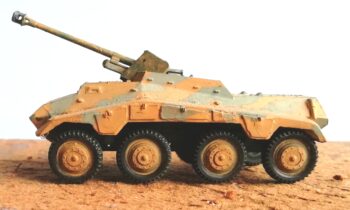
The 1942 vintage Sd Kfz 233 heavy armoured car was a development of the earlier Sd Kfz 231 8 Rad. Normally fitted with a turret, this was the largest of three basic designs of German armoured car already standardised by 1939.
The early eight wheeled armoured cars proved their value during the first year of the war but it was in North Africa they were used for reconnaissance, long range raids and police duties. In the open desert they were faster than tanks and the Afrika Korps took advantage of this, fitting them first with 50mm and then 75mm guns in open fighting compartments and using them in the tank role.
The long 75mm calibre weapon on what effectively was a wheeled self propelled gun carriage was mainly used as against Allied tanks but could also be used in the close support role.
The Sd Kfz 233 was fitted with two steering wheels and could be driven from either end, up to 50 mph being possible courtesy of a 12 cylinder 180 bhp Tatra engine.
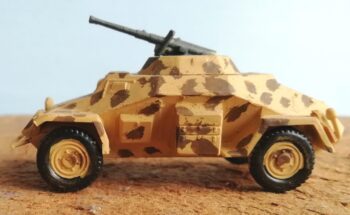
Development work on the four wheel drive SdKfz 222 began in 1937 with the criteria of reliability, a multi fuel engine, simple construction and good cross country performance. The Sd Kfz 222 entered service in 1938 and remained the standard light armoured car of the German army throughout World War II. Both the 20mm cannon, with a firing pedal on the floor, and coaxial machine gun could be elevated to 87 degrees to engage enemy aircraft and the rear engine deck was sharply sloped to improve driver vision when reversing.
However, cross country performance and range left much to be desired and it was retired from front line service during the invasion of the Soviet Union in 1941. Production stopped in 1943 after 989 examples had been constructed.
A replica Sd Kfz 222, built on a Land Rover chassis, featured in the BBC TV comedy “‘Allo’ Allo” as Lieutenant Gruber’s “little tank”.
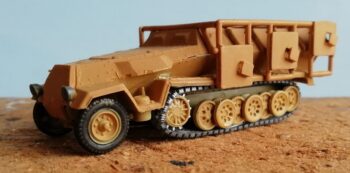
Of the 22 official variants of the 1939 vintage Sd.Kfz 251 the most powerful was the Sd.Kfz 251/1. Known as the Stuka zun Fuss, or Infantry Stuka, three racks on each side of the vehicle could fire 280 or 320mm diameter rockets which could be fitted with either high explosive or incendiary warheads. These were used to demolish strong points of large structures and also to give support to an attack on an enemy positions. The Sd.Kfz 251/1 was also defensively armed with a machine gun on top of the driving cab or, in the case of a platoon commander’s vehicle, a 37mm anti tank gun.
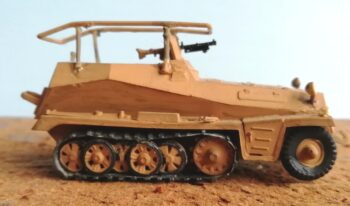
The Sd Kfz 250 half track armoured personnel carrier was a smaller development of the earlier Sd Kfz 251 medium half track, first conceived in the 1930s to allow Panzer Grenadiers to keep up with advancing tanks. Introduced in 1940, the Sd Kfz 250 itself could carry a five man half-section of infantry in support of reconnaissance units. Although the front wheels were not powered, a sharp turn would also engaged the required track brake.
The first variant of the basic vehicle was an ammunition carrier for the StuG while the second was a signals car that could carry two large radio sets and a large frame aerial on top.
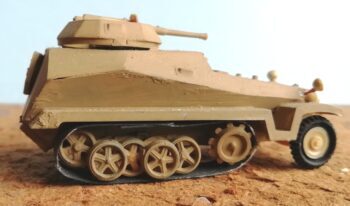
A later variant featured an armoured cover over the nominally open top of the passenger compartment and a turret placed on top. These vehicles replaced the 4×4 Sd Kfz 222 armoured cars in front line service from 1942.
Other specialist versions included a mortar carrier, plug-in mobile field telephone exchange, command car and self propelled gun.
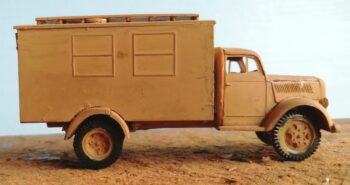
Serving as the backbone of Wehrmacht’s and Waffen SS’ motorized corps, the Opel Blitz truck was involved in the transport of many loads during WWII ― from soldiers to ammunition, from towing artillery pieces to delivering supplies.
Since the 1930s, Opel had been the largest manufacturer of trucks in Germany, but in 1934, one year after Hitler took office, their production numbers rose rapidly due to the German re-armament plan. New facilities were built in Brandenburg, leading to the production of the Blitz 3.6 three-ton version, which soon became the trademark of the Wehrmacht.
It was the truck that put the Blitz into Blitzkrieg as its mass production led to wide use during the swift invasions of Poland, and subsequently other European countries.

During the war, controversy arose in the United States due to the fact that Opel was formed as a General Motors subsidiary. Since there were reasons to believe that Opel was using forced labor, GM’s role became a subject of debate, as it was unclear to what extent the American company had control over its subsidiary during the war.
On the other hand, once the German army started retreating due to rapid Allied advances on both fronts, and leaving broken hardware behind, the trucks were easily put to use again, as American spare parts fitted the Opel Blitz trucks made under license from General Motors.
Although more than 130,000 Blitz trucks and chassis were produced in a period between 1935 and 1944 in the Brandenburg department Of Opel, an RAF raid conducted in August 1944 put an end to the factory.
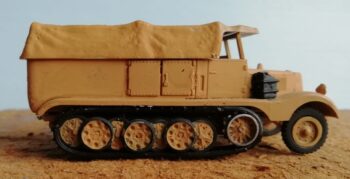
The main role of the 3 ton Sd Kfz 11 half track was towing medium sized guns and other trailers. The specialised artillery version pictured above could seat a crew of eight in a rear compartment separated from the driver by a large ammunition locker with side loading doors.
The basic engineering for all the German half-tracks was developed during the pre 1933 Weimar era by the Reichswehr’s Military Automotive Department but final design and testing was farmed out to commercial firms with the understanding that production would be shared with multiple companies.
Borgward was chosen to develop the second smallest of the German half-tracks and built a series of prototypes between 1934 and 1937. However development was taken over in 1938 by Hanomag of Hannover.
In the case of the Sd.Kfz 11, both tracks and wheels were powered as well as being used for steering. The steering system was set up so that shallow turns used only the wheels, but brakes would be applied to the tracks the farther the steering wheel was turned.
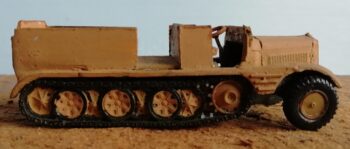
The engineer bodied Sd.Kfz 11 had three bench seats for the crew and a convertible canvas top was mounted at the upper part of the rear body. It fastened to the windshield when erected. Side pieces could be mounted to protect the crew from the weather. There was a storage compartment at the rear of the vehicle, underneath the crew seats. Photographic evidence shows both “artillery” and “engineer” versions were used by artillery units.
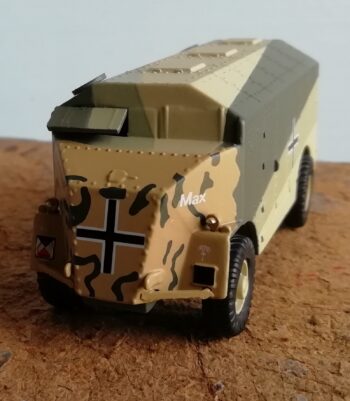
North Africa saw the first deployment of the British AEC Dorchester 4×4 Armoured Command Vehicle, three of which were captured by the German Afrika Korps under the direction of Field Marshall Erwin Rommel. Two, named ‘Max’ and ‘‘Moritz’, and were employed by Rommel and his staff throughout their North African campaign. In the same way, “Monty’s caravan” was formed with captured Italian bodywork on a British lorry.
Britain was the only country to develop and widely employ Armoured Command Vehicles (ACV) which were essentially armoured buses based on truck chassis: in this case that of the Southall based Associated Equipment Company’s Matador lorry. The AEC ACV was bigger and more comfortable than the preceding Guy Lizard ACV, resulting in the troops nicknaming it Dorchester after the luxury hotel on Park Lane in London.
Just over 400 were built in all for use by the British Army and a single .303 Bren light machine gun could be fired from a position next to the driver.
The Dorchesters deployed in North Africa by the 2nd Armoured Division – including the eventual Max and Mauritz – wore the light grey, stone and dark grey Caunter disruptive colour scheme used in the stony desert of North Africa and Greece. When captured, this was modified with more typically German buff and green camouflage at the front, Deutsch Afrika Korps palm and swastika emblem and the Balkenkreuz, the straight-armed black/white cross which was the emblem of the Wehrmacht (German Armed Forces) .

In early 1942, the Deutsch Afrika Korps under Erwin Rommel reached Gazala and by June had captured Tobruk. For this victory, and for pushing the British further back than ever into Egypt, Hitler promoted Rommel to the rank of Field Marshall.
However, his supply lines from Tripoli were now 1 400 miles long and only one in four of his supply ships were reaching Tripoli in the first place. In contrast, the British Desert Air Force could harass the DAK from their bases near the Nile. In September, Rommel fell ill and was sent back to Germany to recover on Hitler’s orders.
On 30 June 1942, the Eighth Army had fallen back to El Alamein, a remote railway station between the Mediterranean and the Qattara Depression, a large area of unstable ground below sea level unsuitable for tanks and other vehicles.
It was in and around this area that the First Battle of El Alamein was fought during most of July 1942, resulting in a stalemate but with a greater degradation of German and Italian forces.
During August 1942, overall command of British forces in North Africa had been taken by General Alexander while the new commander of the Eighth Army was General Bernard Law Montgomery.
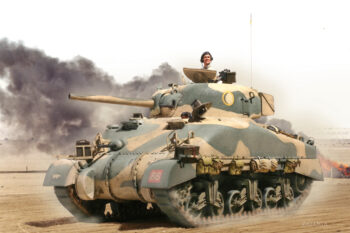
On 23 October 1942 the Second Battle of El Alamein began with a huge artillery barrage before 800 tanks – including British Churchills and American built Sherman – attacked with 250 000 soldiers from Britain, Australia, New Zealand, South Africa, India, Greece, Poland, Czechoslovakia and France.
Despite Rommel being back in command of his forces and counter attacking, the DAK were overwhelmed and by 4 November 1942 were in full retreat.
On 13 November Tobruk was back in Allied hands with Benghazi falling to the Eighth Army on 20 November. By mid January 1943, the victorious Eighth Army were parading through Tripoli.
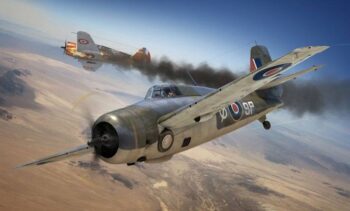
However the DAK were only defeated in Western North Africa seven months after the amphibious Operation Torch landings in Vichy French held Morocco and Algeria on 8 November 1942.
The Eighth Army continued to fight into Tunisia – at times against Tiger tanks – as American forces approached from Algiers in the west. The DAK finally surrendered on 13 May 1943.
The Allied victory in North Africa would allow Sicily to be invaded as soon as July 1943 while the surrender of Vichy governments in Morocco and Algeria caused Germany to invade previously unoccupied Vichy France.
Even more worrying for Adolf Hitler was that while the DAK was facing off – and then losing – against Montgomery’s Eighth Army, his Sixth Army was losing the Battle of Stalingrad to the Soviets, who would then advance inexorably to Berlin by April 1945.
His desire to help Mussolini had come at a heavy price, not least as Il Duce himself was voted out of power by his fellow Fascists on 25 July 1943.