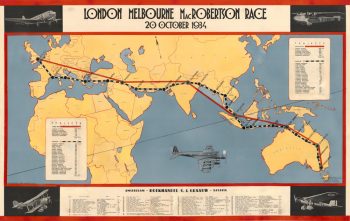
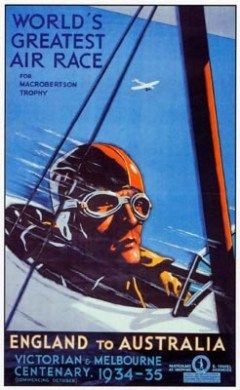
At 0630 on 20 October 1934 at Mildenhall Aerodrome, soon to be handed over to the RAF, began what was described as “the world’s greatest air race” to Australia.
The most celebrated pilots on the planet in the most technically advanced aeroplanes vied for a £ 15 000 prize and a gold cup. This was sponsored by Australian confectionery baron and philanthropist Sir Macpherson Robertson, who had introduced chewing gum and candy floss to the island continent.

The idea for the race across three continents came from Sir Harold Gengoult Smith, the Mayor of Melbourne, to celebrate the centenary of the State of Victoria. It also served to stimulate imperial air travel, some four years after the loss of the R101 airship.
The MacRobertson Air Race was to be the longest ever held, spanning 16 nations and some of the most dangerous parts of the planet. There were prizes for the overall fastest aeroplane as well as the shortest flying time within 16 days based on a handicap system. However, no entrant was allowed to win more than one prize.
Organised by the Royal Aero Club of Great Britain, the rules placed no limit to the size of aircraft or power and no limit to crew size although no pilot was to join any aircraft after it left England.
Aircraft had to carry three days’ rations per crew member, floats, smoke signals, and efficient instruments.

Compulsory checkpoints were at Baghdad, Iraq, Allahabad, India, Singapore and Darwin and Charleville in Australia. Apart from this, competitors could choose their own routes and make their own stops. 22 optional locations were provided along the way stocked with Shell and Stanavo aviation fuel and oil.
However, in those golden days of aviation, there was national concern that no British entrant had a good chance of winning.
At the start of 1934 though, aviation pioneer Geoffrey de Havilland announced that his company would build a new aeroplane especially to win the race. Just nine months later, the de Havilland DH88 Comet was introduced to an excited public.
Although there was little chance of de Havilland making money out of the DH 88, the company was keen to accrue publicity and prestige from the MacRobertson race and research advanced construction techniques.

In fact A. E. Hagg’s cantilevered monoplane featured mainly spruce and plywood stressed skin construction, only made possible by recently developed high strength synthetic bonding resins. The design also included an enclosed tandem cockpit, retractable undercarriage, split landing flaps and variable pitch propellers. These were set to fine pitch at take off and could be altered to coarse pitch pneumatically in flight – but could only be returned to fine pitch on the ground. The two specially tuned de Havilland Gypsy Six R engines could take the the DH 88 to at least 200 mph. Feeding these were two fuel tanks ahead of the cockpit and one smaller one behind to help the crew balance the aircraft.
Three of the sleek, twin engined racing machines were ordered – two of which would feature prominently in the race.
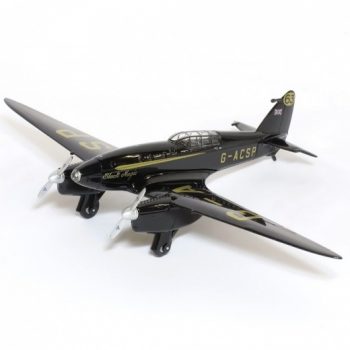
The first, painted black and gold, registered G-ACSP with the racing number 63 and named “Black Magic”, was to be raced by the power couple of British flying, Jim and Amy (née Johnson) Mollison.
A second, pillar box red, Comet, named “Grosvenor House” was entered by Arthur Edwards, the managing director of the prestigious London Hotel and was to be flown by Charles Scott and Tom Campbell Black. With the racing number 34 it was registered as G-ACSS.
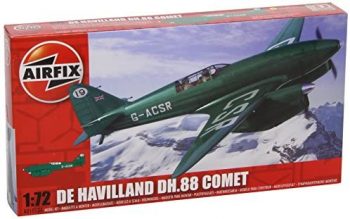
The third DH88, racing number 19, painted British Racing Green but not named, was owned by racing driver Bernard Rubin. Unfortunately he fell ill just before the race and was unable to pilot G-ACSR, but handed the task to Owen Cathcart Jones and Ken Waller.
Among the other pilots were flamboyant American stuntman Roscoe Turner in his twin engined Boeing 247 “Warner Bros Comet” NR257Y (racing number 5) and K. D. Parmentier at the controls of a twin engined Douglas DC2 named “Uiver” (Stork).

Registered as PH-AJU with the racing number 44, this was carrying fare paying KLM passengers. These two all-metal radial-engined machines pointed towards the future of airliner design, as did race number 36. The single engined Lockheed Vega “Puck”, registered as G-ABGK, was crewed by British pilot James Wood and Australian Don Bennett, who would later lead the Pathfinder Force of the RAF during World War 2.
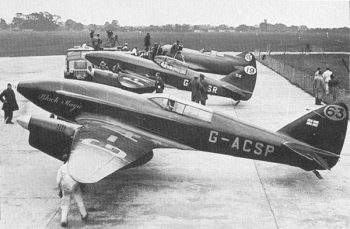
On 29 October 1934, 60 000 spectators braved the cold of dawn to watch “Black Magic” lead the 20 other competitors at 45 second intervals.
Dodging bad weather that was affect the rest of the pack, Jim and Amy were first to reach Baghdad, Iraq, that evening: the only competitors to reach the first checkpoint without stopping.
As ground staff attended to “Black Magic” , the couple took the opportunity to grab a quick bath and a drink before taking off again for Karachi (now in Pakistan) en route to the next compulsory stop in Allahabad, India.

With “Grosvenor House” just over 30 minutes behind them, the Mollisons made Karachi in record time, only for mechanical, fuel and navigation issues to force them to retire. Specifically, they turned back to Karachi first when the undercarriage failed to retract, second when they found they had the wrong map and on the way to Allahabad after a third departure drifted off course and were forced to land at Jabalpur. With no aviation fuel available, the local bus company gave the Mollisons some motor car petrol, but following burned cylinders, the seizure of a piston and a ruptured oil pipe “Black Magic” limped into Allahabad on one engine and was forced to retire.
Having stopped to refuel in Kirkuk and arriving in Baghdad after “Black Magic”, the red Comet was first to Allahabad and then led the race, flying through severe storms in the Bay of Bengal to reach Singapore. From then, G-ACSS crossed the Timor Sea on one engine (due to a faulty oil pressure indicator) to Darwin in Australia’s Northern Territory. The final staging post was at Charleville, Queensland, before Grosvenor House swept across the finishing line at Melbourne’s Flemington racecourse “like a crimson winged bullet” in front of over 100 000 thrilled spectators.
Charles Scott and Tom Campbell Black had completed the MacRobertson Air Race in 70 hours 54 minutes 18 seconds. The following day, Uiver landed, two and a half hours ahead of Warner Bros Comet despite getting lost.
In all, 12 of the competitors finished, five others were forced to withdraw, and three suffered crashes. Among these were Bennett and Wood whose Lockheed Vega came to grief in Aleppo, Syria, and more tragically the crew of British Fairey Fox biplane G-ACXX who died in Italy. However, the other competing Fairey Fox, G-ACXO, having officially retired in Paris, finally made it to Melbourne on 13 February 1935.
Having become lost at Baghdad and stopping at Batavia (modern Jakarta) for repairs, the green Comet G-ACSR crossed the finishing line fourth in 108 hours 13hours 30 seconds. Cathcart Jones and Waller then collected film of the Australian legs of the MacRobertson race and the next day set off for England. Their out and back time of 13 days 6 hr 43 min set a new record, even allowing for a stop at Allahabad with engine trouble. The Mollisons, still there with Black Magic, donated two good pistons from their stricken aeroplane.
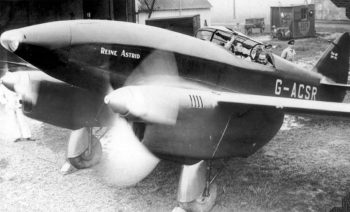
In December 1934, named “Reine Astrid” in honour of the Belgian queen, G-ACSR flew the Christmas mail from Brussels to Leopoldville in the Belgian Congo. It was then sold to the French government and modified as mail plane registeted F-ANPY, its delivery flight setting a Croydon to Le Bourget record on 5 July 1935. F-ANPY then made high speed Paris to Casablanca and Paris to Algiers proving flights. It was last seen in an unflyable state at Etampes, France, in 1940 and is presumed to be destroyed.
Meanwhile, G-ACSS toured Australia to great acclaim before being dismantled and returned to Britain by sea
“Grosvenor House” was later bought by the Air Ministry, given the military serial K5085 and painted silver overall with RAF markings. K5085 was flown to RAF Martlesham Heath for evaluation by the Aeroplane and Armament Experimental Establishment. It made several flights before being written off in a heavy landing and sold for scrap.

The former G-ACSS was subsequently sold on, rebuilt and fitted with Gypsy Six series II engines and a castoring tailwheel. In this form it made several race and record attempts under various names. It claimed fourth place in the 1937 Istres-Damascus-Paris race and later in the same year lowered the out-and-home record to the Cape to 15 days 17 hours. In March 1938, a return journey from Britain to New Zealand in 10 days, 21 hours and 22 seconds.
G-ACSS was requisitioned for the RAF once again in 1943 but soon passed on to de Havilland. Restored for static display as “Grosvenor House”.
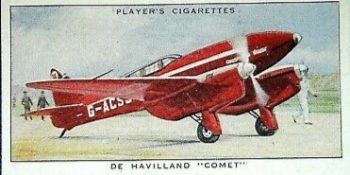
It was put on show at the 1951 Festival of Britain and in 1965 acquired by the Shuttleworth Collection at Old Warden Aerodrome, Bedfordshire. Re registered as G-ACSS in 1972, the red Comet finally returned to the skies in 1987.
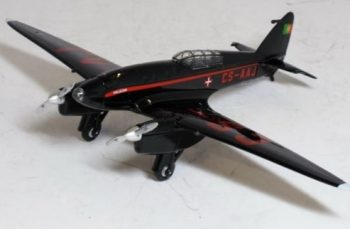
“Black Magic”, once returned from Allahabad, was sold to the government of Portugal for a projected flight from Lisbon to Rio de Janeiro. Re-registered CS-AAJ and renamed “Salazar” after the Prime Minister of the time, it was damaged on its attempted takeoff at Lisbon Cintra Airport for the Atlantic crossing. On a later return flight from Hatfield it made a record flight from London to Lisbon, setting a time of 5 hours 17 minutes in July 1937.
CS-AAJ “Salazar” was rediscovered in Portugal after being lost for more than 40 years. It was brought back to the UK and re-registered once again as G-ACSP. It is currently under restoration to flying condition, in its original livery as “Black Magic”, by the Comet Racer Project Group at the Amy Johnson Comet Restoration Centre, Derby Airfield.

Following the acquisition the green DH88 G-ACSR which was re registered as F-ANPY, the French government ordered a fourth Comet, F-ANPZ, with a mail compartment in the nose. It was later taken on charge by the French Air Force before being destroyed in a hangar fire at Istres in June 1940.
The fifth and last Comet, registered G-ADEF and named “Boomerang” was built for Cyril Nicholson. It was piloted by Tom Campbell Black and J. C. McArthur in an attempt on the London – Cape Town record. It reached Cairo in a record 11 hours, 18 minutes, but the next leg of the journey was cut short due to oil trouble while in flight over Sudan.
On a second attempt at the Cape Record, the same crew left Hatfield on 21 September 1935 but experienced propeller problems over Sudan a day later. Campbell Black and McArthur escaped from their doomed aircraft by parachute.
Later in 1934, the KLM DC2 “Uiver” crashed in Iraq en route from the Netherlands to Batavia with the loss of all on board. More recently however, one of the few DC2s still flying has been restored in its colours.
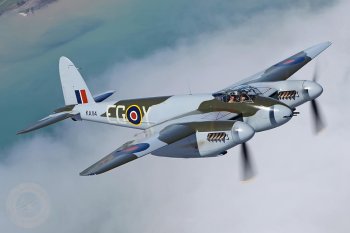
Similarly, replicas of the DH88s have been built and flown. However, by 1939, lessons learned from the building of the Comet racers was being applied by de Havilland DH98 fighter and bomber better known as the Mosquito. Among other tasks, this wooden twin engined type was used by the RAF Pathfinder Force for marking targets for night time heavy bomber raids. Ranged against them were the aircraft of the Luftwaffe, many of which had begun life – somewhat euphemistically – as sports and high speed mail aircraft.
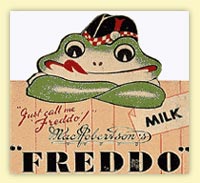
Macpherson Robertson died in 1945 and in 1967 his heirs sold the company to English confectioner Cadbury. However, the MacRobertson logo only disappeared from products such as Freddo and Old Gold in 2002.
Disappearing even more completely however was the MacRobertson Trophy itself. On 24 January 1941, the Sydney Morning Herald reported that Arthur Edwards, owner of G-ACSS “Grosvenor House” had donated the cup to the Red Cross so that it could be melted down for the War Effort.