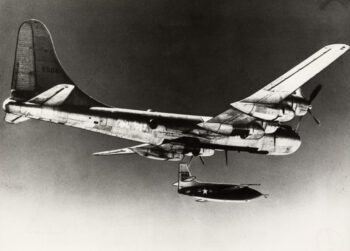
SEVENTY FIVE SUPERSONIC YEARS
Seventy five years ago, on 14 October 1947, Bell X-1 “Glamorous Glennis” was dropped in mid air from a B-29 bomber. Pilot Chuck Yeager ignited its rocket propulsion and the small straight winged aeroplane became the first manned vehicle to exceed the speed of sound.
THE NEED FOR SPEED
“The lure of speed is an urge that most civilized human beings feel.” said World Land Speed Record holder Sir Malcolm Campbell.
“Speed is the only unique experience of the Twentieth Century.” said Aldous Huxley, author of Brave New World.
For Count Ferdinand Von Zeppelin, speed and direction were what his lumbering dirigibles offered beyond balloons and for the Wright Brothers speed was essential to generate lift on the aerofoils of their Flyer.
Less than a century earlier, railways had replaced stagecoaches and shrunk nations, bringing fresh milk and football teams from country to city in hours rather than days. In the 20th Century, the desire for speed in the air would push back the frontiers of technology, decide the pride and fate of nations and individuals and bring people, goods and ideas together across oceans.
SETTING RECORDS

The first aeroplane speed record was set at 25.5 mph by French based Brazilian Alberto Santos-Dumont in 1906.
Then, at the World’s first flying meeting at Rheims, from 22 to 29 August 1910, Louis Bleriot’s Type XI monoplane (pictured above) set up a new air speed record of just over 46 mph. Before this meeting, on 25 July 1909, Bleriot had become the first man to fly a heavier than air machine across the English Channel. Bleriot took three flying machines to the Rheims meeting and four days later, in a Type XIII, he raised the record to 47.8 mph.
The 670 lb Type XI had a 25 bhp three cylinder Anzani engine. In 1910 Italian examples became the first aircraft to go into combat. The Royal Flying Corps received its first Bleriot XIs in 1912 and used them for bombing, observation and training duties in the opening stages of the Great War.
In fact, on 4 August 1914, Bleriots were part of the first military force to leave Britain other than by sea when 60 aircraft of 2,3,4 and 5 squadrons of the Royal Flying Corps took off from Dover and flew to Bologne, following the coast to the mouth of the Somme and then upstream to Amiens. However, en route to Dover from Netheravon, Wiltshire, a Bleriot flown by Lieutenant Robert Skene with Air Mechanic Raymond Barlow seated behind him crashed on take off, the two dead men becoming the first casualties of the British Expeditionary Force.

Indeed, The Great War proved to be a crucible of aircraft development, with the emergence of distinct fighter, bomber and reconnaissance types. The nimble Sopwith Camel biplane for example had a top speed of 113 mph although it was more often used to fight German Fokker Triplanes than set official records.

After the Armistice, Britain’s Gloucestershire (later Gloster) Company designed, built and flew the Mars 1 single seat racer in three weeks in 1921 as the prototype for a new fighter. It won the Aerial Derby in 1921, 1922 and 1923, and set up a British speed record of 196.6 mph.
Designed by H. P. Folland, the Mars I or ‘Bamel’ was a single-seat racing biplane: the greater part of the fuselage, landing gear and tail unit being constructed from components similar to those used in the well-known Nieuport Nighthawk, which the British company took over in 1920.
In 1922, the Gloster Bamel made an attempt on the World Air Speed Record. Although the recorded speed of 212.15 mph was faster than the existing record, it did not exceed it by the required margin, so the record was not recognised.
In 1923, G-EAXZ was modified with new wings and a more powerful Lion engine as the Gloster I. This was sold to the RAF in December 1923, being fitted with floats and used as a trainer for the High Speed Flight before being scrapped in 1927.
THE SCHNEIDER TROPHY

The Schneider Trophy competition for seaplanes and flying boats had been inaugurated in 1913 with the condition that the trophy would be permanently retained by the first team to gain three successive victories.
The inaugural 1913 event was won by a French Deperdussin Monocoque with an average speed around the course of 45.71 mph while in 1914 victory went to a British Sopwith Tabloid (later developed into the Sopwith Baby, seen above) with a speed of 86.83 mph.
The competition was suspended during the Great War and the 1919 event was declared void after the apparently victorious Italian team were judged to have flown around a marker buoy incorrectly.
In 1920 only the Italian team entered and in 1921 the French aircraft failed start. After 1921, an additional requirement was added. The winning seaplane had to remain moored to a buoy for six hours without human intervention.
In 1922, a Supermarine Sea Lion II flying boat became the first British aeroplane to win a post War International competition with a Schneider Trophy triumph at 145.7 mph.
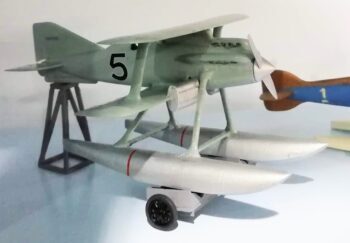
1923 however was a year of American speed with United States Marine Corps Lieutenant Lawson H. Sanderson setting a new world airspeed record of 238 mph on 10 September in a Navy-Wright NW and the United States winning the Schneider Trophy when the British and French entries withdrew.
The Schneider Trophy was not contested in 1924 but was won by America again in 1925 with Jimmy Doolittle in a Curtiss R3C outpacing Britain’s Gloster III biplane around Chesapeake Bay.
1925 was also the first Schneider Trophy competition in which the British entry was funded by the Air Ministry rather than private firms. The Air Ministry had ordered two racing seaplanes from the Gloster Aircraft Company which offered a design based on the existing Gloster I. Of this pair of Gloster IIs, the first sank after completing its first test flight on 19 September 1924 while the second was converted into a landplane but was lost in a crash in June 1925.
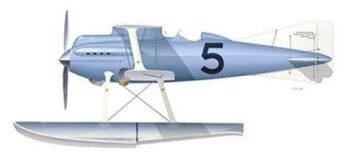
In order to still compete in the October 1925 Schneider Trophy event, the Air Ministry ordered two more racing seaplanes from Gloster. These were built to Henry Folland’s Gloster III design, pictured above.
The wooden, single bay biplane was fitted with Lamblin radiators on the leading edge of the lower wings and with a 20′ wingspan was the smallest British aeroplane of the time to be fitted with a 700 bhp engine, in this case a Napier Lion. The first prototype with the military serial N194 was first flown on 29 August 1925 while the second took to the air a few days later carrying both the civil registration G-EBLJ and the military serial N195.
Of these, only N194 raced against Lieutenant James Doolittle’s Curtiss R3C, averaging 199.091 mph around the course against the American’s 232.573 mph. The two Gloster IIIs were later returned to Britain and modified to train pilots for the 1927 Schneider Trophy race.
1926 saw Italy win at the exhortation of Fascist dictator Benito Mussolini with a Macchi M39 monoplane setting the bar at 246.49 mph. After coming second in 1926, America, short of funds, withdrew from the Schneider Trophy competition.
In contrast, Britain’s Air Ministry was determined to improve Britain’s performance and placed orders for designs of high speed floatplanes from Supermarine (S.5) and Shorts (Crusader) as well as the Gloster IV to be flown by the RAF High Speed Flight.
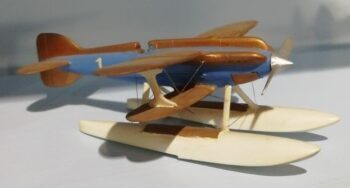
The blue and gold Gloster IV (pictured above) was designed by Henry Folland based on his earlier Gloster III. It had a wooden monocoque fuselage with single bay wings gulled to allow the drag of the wing/fuselage junction to be minimised. Streamlined radiators were built into the surfaces of the wings and floats.
Three aircraft were built, differing in the surface area of the wings and the arrangement of the tail. The short wingspan Gloster IV B started the 1927 Race but retired after five laps with mechanical issues. However, it was later to set a World Air Speed Record for seaplanes and remains the fastest biplane ever to enter the Schneider Trophy competition. Like the Gloster racing floatplanes before them, the IV A and IV B went on to serve as training aircraft for the RAF High Speed Flight. They too proved to be the last and ultimately fastest ever biplanes to partake in the Schneider Trophy competition.
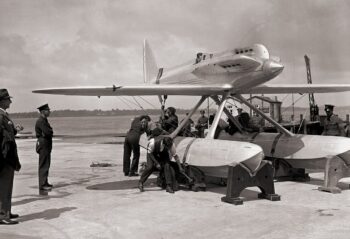
As it turned out, Supermarine’s Mitchell-designed S.5s took first and second places in the 1927 Schneider Trophy competition. No other entrants finished and the race was witnessed by an estimated 250,000 spectators.
1927 was the last annual competition, the event then moving to a biennial schedule to allow for more development time under mutual agreement.
1928 also saw the death of Jacques Schneider, the industrialist and aviation enthusiast who had founded the competition – just before its greatest triumphs.
In 1929, at Calshot, the Supermarine S.6 powered by the new Rolls Rolls-Royce R engine won for Britain with an average speed of 328.64 mph.
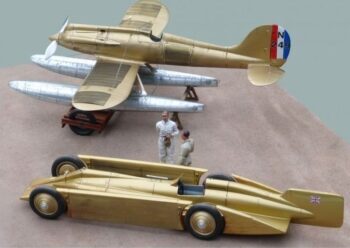
However, Gloster once again made a contribution, this time with a floating monoplane officially called the Gloster VI but popularly known as the Golden Arrow.
This was partly due to its colour and also because of the distinctive three-lobed cowling of the ‘broad-arrow’ Napier Lion Napier engine, which also powered Henry Seagrave’s Golden Arrow Land Speed Record car.
In fact the sponsons between the front and rear wheels of the car housed radiators made by H.H. Martyn & Company of Cheltenham, the ancestor of the Gloster Aircraft Company. These were filled with ice at the start of a high speed run only to be turned to boiling water at the end by the heat from the Napier Lion. After the record breaking run, Segrave’s Golden Arrow was displayed at Sir Alan Cobham’s Brockworth Air Day in 1931.
Despite its good looks, the Gloster VI suffered from the unreliability of its engine and was withdrawn from the 1929 Schneider Trophy competition.
However, almost immediately afterwards on 10 September 1929, the Gloster VI set a new World Air Speed Record of 336.3 mph with Flight Lieutenant George Stainforth at the controls, only to be beaten a few hours later – and by 20 mph – by Squadron Leader Orlebar in the Supermarine S6 which had won the 1929 Schneider Trophy competition.

In 1931 the British government withdrew support, but a private donation of £100,000 from the wealthy and ultra-patriotic Lucy, Lady Houston, allowed Supermarine to compete. When the French, German and Italian teams dropped out, leaving no other competitors, the British team flew the course alone on 13 September and won the coveted Schneider Trophy outright, having beaten the time record from the 1929 competition. Reportedly half a million spectators lined the beachfronts.
The British team set a new world speed record of 380 mph and the following days saw the winning Supermarine S.6B further break the world speed record twice, making it the first craft to break the 400 mph barrier on 29 September at an average speed of 407.5 mph.
SPEED ON THE WATER
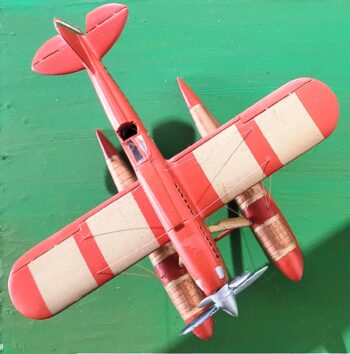
Although the British team had secured the trophy for the UK permanently with the 1931 uncontested win, development of the other 1931 entrants continued. The proposed Italian entrant, the Macchi MC 72 which had pulled out of the contest due to engine problems later went on to set two new world speed records. In April 1933 (over Lake Garda in northern Italy) it set a record with a speed of 424.00 mph and in October 1934 raised this to 440.678 mph. Both times the plane was piloted by Francesco Agello. This speed remains the fastest ever attained by a piston-engined seaplane. The MC 72 was also the first twin engined aeroplane to set a World Air Speed Record and the first with contra-rotating propellers.
BACK ON LAND
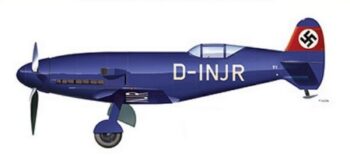
While the S-6B with its 2 600 bhp Rolls Royce R engine was to evolve into the Supermarine Spitfire, a cousin of its famous opponent the Messerschmitt 109 was to win back the World Air Speed Record for both landplanes and Germany in April 1939 when Flug-kapitan Fritz Wendel took his Messerschmitt 209 to 469 mph. However, the 1000 bhp Daimler Benz powerplant of the Messerschmitt 209 could only carry just enough coolant for the record breaking run. But the flight of another special German aircraft that August was to sow the seeds of a whole new chapter in high speed flight.
THE JET AGE
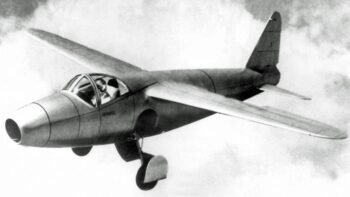
The Heinkel 178, the World’s first jet propelled aeroplane, flew on 27 August 1939 at Marienehe, north Germany. It was a test bed for the He53B turbojet designed by Dr Hans Pabst von Ohain, based on original theories put forward by British inventor Group Captain Frank Whittle, who had been ground testing gas turbine engines since 1937. However, von Ohain’s diesel fuelled gas turbine was only capable of a six minute flight and lack of suitable metal alloys was to hamper the development of German jet aircraft as much as official indifference and indecision.

Britain’s first jet propelled aeroplane – the Gloster-Whittle E28/39 – first flew at Hucclecote, Gloucester in April 1941 and could attain 350 mph in level flight. However, the relatively low thrust of early jet engines meant that the first operational combat types on each side of World War Two had twin powerplants.
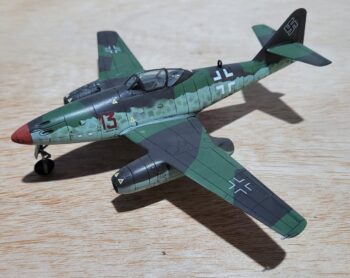
The formidable German Messerschmitt 262 first flew in the same month as the Gloster-Whittle E28/39, packed four heavy canon and could reach 540 mph, due in part to its revolutionary swept wings. However, the service career of the World’s first operational swept wing jet fighter did not get under way until mid 1944. Initial German government disinterest resulted in slow development and production while Hitler’s personal directive that they were to be used only as bombers – not interceptors – greatly softened the impact which even the few aeroplanes in service would otherwise have had on the Allied bomber offensive. Less than 1500 Me 262s were built.

High speed propeller aircraft as the Gloster built Hawker Typhoon (the RAF’s first fighter to exceed 400 mph) had already experienced the phenomenon of compressibility as shock waves formed over their wings as they approached the speed of sound – 760 mph at sea level but decreasing with altitude and air temperature. This compression of air molecules – unable to pass over the wing aerofoils fast enough to escape the oncoming aircraft – caused the aircraft to buffet to such an extent that the pilot could lose control. However, German engineers discovered that compresability could be postponed by sweeping the wings back and presenting a more streamlined profile to the airflow – effectively making the swept wing the equivalent of a thinner, deeper straight wing.
Luckily for the Allies, the first Messerschmitt 262s did not reach squadron service until August 1944, just two weeks ahead of the first Gloster Meteors being issued to 616 Squadron Royal Air Force. By this time too, German industry was so desperately short of raw materials that the Junkers Jumo engines of the Me 262 were often unreliable.
GLOSTER METEOR RECORDS

Thus it was that the first World Air Speed Record of the Jet Age went to straight winged Gloster Meteor F4 EE 454, named “Britannia”, flown by Group Captain H.J. Wilson AFC on 7 November 1945 at Herne Bay, Kent. His speed of 606 mph was also the first to exceed 600 mph and at the time the Gloster Meteor was only the second twin engined aircraft to set a World Air Speed Record.
The RAF High Speed Flight had been reformed in late 1945 at Tangmere in order to make an attempt on the world air speed record. Then, in August 1946, it received Meteor F4 EE549 direct from the Gloster Aircraft Company. On 7 September 1946, Gp Capt E M (Teddy) Donaldson set a new world record of 615.78 mph flying EE549 off the Sussex coast at Rustington. On returning from the Paris Air Show in January 1947, the same aircraft set a new record time of 20 min 11 sec between Paris (Le Bourget) and London (Croydon). She later saw service with the Fighter Command units before being retired to instructional airframe duties at Cranwell in June 1952. EE549 went into store in June 1958 before finally going on display at the RAF Museum in 1972. She is currently on loan to the Tangmere Military Aviation Museum.
SPEED AND DISTANCE
As had been the case in the First World War, the struggle against Nazi Germany was finally won by aircraft which demonstrated not only speed but agility, robustness and range.
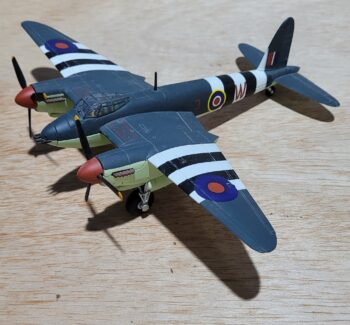
One Allied aircraft which ticked all of these boxes was the de Havilland Mosquito. This had evolved from the de Havilland DH 88 Comet racer built specifically for, and winning, the Britain to Australia MacRobertson Air Race of 1934. The B XVI Mosquito had a top speed of 415 mph at 28 000 feet and a range of 1 300 miles. As such it was more than 100 mph faster than the four engined Avro Lancaster, although the fastest manned aircraft of the Second World War was to achieve speed and altitude at the expense of pilot safety.
ON THE TAIL OF THE KOMET

The World’s first – and so far only – operational rocket interceptor was the Me 163 B-1 Komet.
First flown in August 1941, this entered service in the summer of 1944 and could reach 30 000′ in 2.6 minutes at a speed of 596 mph. However, it only carried enough fuel for 8 minutes of powered flight, after which the tail-less swept wing aeroplane glided back to base and landed on a skid, its main wheeled undercarriage having been jettisoned at take off to improve streamlining and save weight. The shock of such a heavy skid landing often caused the residual fuel in its tanks to explode and more of the 470 Komets built were lost in such accidents rather than in combat.
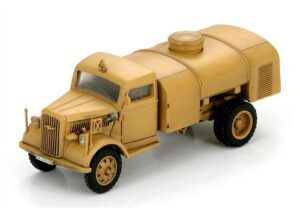
Once on the ground, the aircraft had to be retrieved by a Scheuch-Schlepper, a converted agricultural vehicle towing a special retrieval trailer with a pair of short tracks supporting twin trailing lifting arms.
The Komet was fuelled by a pair of hypergolic chemicals – ones that spontaneously ignite when mixed. Of these, the fighter – designed by Dr Alexander Lippisch – needed 3 parts of T-Stoff oxidiser to 1 part of C-Stoff fuel.
T-Stoff was 80% High Test Peroxide and 20% water with some stabilisers such as phosphoric acid. With added permanganate catalyst Z-Stoff, T-Stoff rapidly decomposed into steam and oxygen and was thus used on the launch catapults for V1 cruise missiles as well as driving the propellant pumps on the V2.
C-Stoff was a mixture of methanol, hydrazine and water but both clear liquids were highly toxic and corrosive. As a result, one tanker truck would fuel the Komet with C-Stoff and be driven well away before another – often an Opel Blitz – would approach with T-Stoff oxidant.
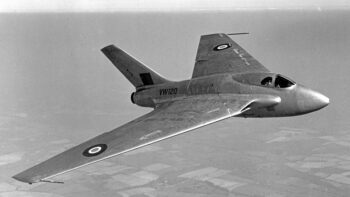
Although the Komet never set any official speed records, its tail-less swept wing design was to influence the design of the jet propelled de Havilland DH108 Swallow (pictured above) which became the first British aircraft to break the Sound Barrier on 8 September 1948.
The designer of the Komet, Alexander Lippisch, found post- War employment with Convair in America and hypergolic rocket engines would eventually be used in the Apollo space programme.

Indeed, the end of World War Two found the aircraft industry of the United States of America untouched by bombing and with access to a wealth of new British and German aeronautical data as well as the financial power to turn these ideas into reality.
One such result of this American good fortune was the jet propelled D-558-1 Skystreak, designed by the Douglas company in 1945 to obtain high speed data.
After completing only 14 hours flying time, the Skystreak piloted by Commander Turner F. Caldwell of the US Navy achieved 640.5 mph to win the World Record. Five days later, on 25 August 1947, Major Marion F. Carl, US Marine Corps, raised it again, this time to 650.5 mph. The aircraft shown is in the shape used for the first attempt. A modified canopy and windscreen was fitted for the second attempt.
Beyond this however, the first attempt by the United States to produce a manned supersonic vehicle was both rocket powered and air dropped, rather than taking off from a conventional runway.
FASTER THAN SOUND
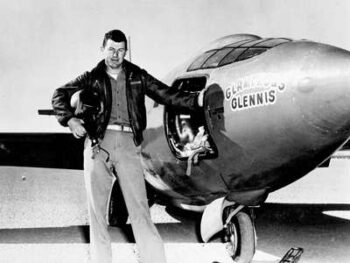
On 14 October 1947, flying the first Bell XS-1 with the number 46-062, Captain Charles ‘Chuck’ Yeager, USAF, became the first pilot to fly faster than sound.
The XS-1, later designated X-1, reached Mach 1.06, 700 mph, at an altitude of 43,000 feet, over the Mojave Desert near Muroc Dry Lake, California. The flight demonstrated that aircraft could be designed to fly faster than sound, and the concept of a ‘Sound Barrier” crumbled into myth.
The XS-1 was developed as part of a cooperative program initiated in 1944 by the National Advisory Committee for Aeronautics (NACA) and the U.S. Army Air Forces (later the U.S. Air Force) to develop special manned transonic and supersonic research aircraft.
On 16 March 1945, the Army Air Technical Service Command awarded the Bell Aircraft Corporation of Buffalo, New York, a contract to develop three transonic and supersonic research aircraft – powered by 6 000 lb thrust rocket motors fuelled with ethyl alcohol and liquid oxygen – under project designation MX-653. The Army assigned the designation XS-1 for Experimental Sonic-1.
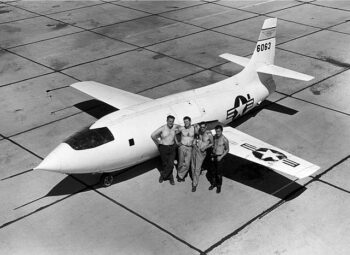
The second XS-1 – 46-063 – was flight-tested by NACA and later was modified as the X-1E “Mach 24” research aeroplane. In this guise it only stopped flying in 1958 due to a cracked bulkhead. The X-1 E is currently exhibited outside the NASA Flight Research Center at Edwards, California.
The third X-1(46-064) had a turbopump-driven, low-pressure fuel feed system rather than the nitrogen pressurisation of the first two XS-1s.
This aircraft, known popularly as the X-1-3 Queenie, was lost in a 1951 explosion on the ground that injured its pilot. Three additional X-1 aircraft, the X-1A, X-1B, and X-1D, were constructed and test-flown. Two of these. the X-1A and X-1D, were also lost, as a result of propulsion system explosions.
The smooth contours of the XS-1 were patterned on the lines of a .50 calibre bullet, and owed much to the British Miles M-52 jet aeroplane which had been cancelled in 1946 with a letter from the Air Ministry reading “Dear Miles, please cease all work on this project to save time and money because Man will never fly faster than sound.” Sixteen years later, Decca Records turned down The Beatles with the words “We don’t like their sound and guitar music is on the way out”.
However, the X series of research aircraft that followed in America took many shapes. Some, like the X-15, were air launched and rocket powered while others, like the Douglas X-3 Stiletto were jet propelled and took off from a runway.
THE REALM OF SPEED
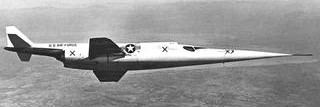
The Douglas X-3 Stiletto was the most futuristic of the early experimental aircraft, but its research accomplishments were not those originally planned.
The goal of the aircraft was ambitious – it was to take off from the ground under its own power, climb to high altitude, maintain a sustained cruise speed of Mach 2, then land under its own power. The aircraft was also to test the feasibility of low-aspect ratio wings, and the large-scale use of titanium in aircraft structures.
Construction of a pair of X-3s was approved on 30 June 1949. During development, the X-3’s planned engines failed to meet the thrust, size and weight requirements. As a result, lower-thrust Westinghouse J34 turbojets were substituted.
The first aircraft was completed and delivered to Edwards Air Force Base, California, on 11 September 1952. Due to both engine and airframe problems, the partially completed second aircraft was cancelled, and its components were used for spare parts.
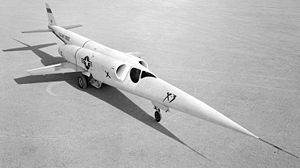
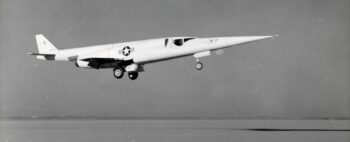
The first X-3 “hop” was made on 15 October 1952, by Douglas test pilot Bill Bridgeman. During a high-speed taxi test, Bridgeman lifted the X-3 off the ground and flew it about a mile before settling back onto the lakebed.
The official first flight was made by Bridgeman on 20 October and lasted about twenty minutes. He made a total of 26 flights (counting the hop) by the end of the Douglas tests in December 1953. These showed that the X-3 was severely underpowered and difficult to control. Its take off speed was an astonishing 260 knots! More seriously, the X-3 did not approach its planned performance. Its first supersonic flight required that the airplane make a 15 degree dive to reach Mach 1.1. The X-3’s fastest flight, made on 28 July 1953, reached Mach 1.208 in a 30 degree dive.
With the completion of the contractor test programme in December 1953, the X-3 was delivered to the U.S. Air Force. The poor performance of the X-3 meant only an abbreviated program would be made, to gain experience with low-aspect ratio wings. Lt. Col. Frank Everest and Maj. Chuck Yeager each made three flights. Although flown by Air Force pilots, these were counted as National Advisory Committee on Aeronautics (NACA) flights.
With the last flight by Yeager in July of 1954, the NACA made plans for a limited series of research flights with the X-3. The initial flights looked at longitudinal stability and control, wing and tail loads, and pressure distribution.
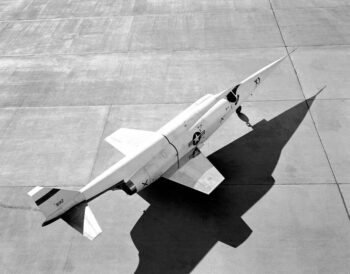
NACA pilot Joseph A. Walker made his pilot checkout flight in the X-3 on 23 August 1954, then conducting eight research flights in September and October. By late October, the research program was expanded to include lateral and directional stability tests. In these tests, the X-3 was abruptly rolled at transonic and supersonic speeds, with the rudder kept centred.
Despite its shortcomings, the X-3 was ideal for these tests. The mass of its engines, fuel and structure was concentrated in its long, narrow fuselage, while its wings were short and stubby. As a result, the X-3 was “loaded” along its fuselage, rather than its wings. This was typical of the fighter aircraft then in development or testing. These tests would lead to the X-3’s most significant flight, and the near-loss of the aircraft.
On 27 October 1954, Walker made an abrupt left roll at Mach 0.92 and an altitude of 30,000 feet.
The X-3 rolled as expected, but also pitched up 20 degrees and yawed 16 degrees. The aircraft gyrated for five seconds before Walker was able to get it back under control. He then set up for the next test point. Walker put the X-3 into a dive, accelerating to Mach 1.154 at 32,356 feet, where he made an abrupt left roll. The aircraft pitched down and reached a g-loading of -6.7, then pitched upward to +7 Gs. At the same time, the X-3 sideslipped, resulting in a loading of 2 Gs. Walker managed to bring the X-3 under control and successfully landed.
The post-flight examination showed the fuselage had been subjected to its maximum load limit. Had the G forces been higher, the aircraft could have broken up.
Walker and the X-3 had experienced “roll coupling,” in which a movement in one axis will cause an uncommanded movement in one or two others.
At the same time, several F-100 Super Sabres were involved in similar incidents. A research program was started by NACA to understand the problem and find solutions.
For the X-3, the roll coupling flight was the high point of its history. The aircraft was grounded for nearly a year after the flight, and never again explored its roll stability and control boundaries. Walker made another 10 flight between September 20, 1955, and the last on May 23, 1956. The aircraft was subsequently retired to the Air Force Museum. Although the X-3 never met its intention of providing aerodynamic data in Mach 2 cruise, its short service was of value. It showed the dangers of roll coupling, and provided early flight test data on the phenomena. Its wing platform was used in the F-104, and it was one of the first aircraft to use titanium. Finally, the X-3’s very high take off and landing speeds required improvements in tyre technology.
COLD WAR, HOT EXHAUSTS

While the NACA X Planes were pushing the envelope of scientific knowledge about flight, World Air Speed Records were being set by existing fighters and bombers, or the aircraft that had much more potential to be developed into them.
On 15 September 1948, thirteen months after the record flight of the D-558-1 Skystreak, Major Richard L. Johnston of the United States Air Force flew a North American F-86 Sabre at a speed of almost 671 mph while on 16 July 1953 Lt Col William J. Barnes, USAF, took the later D model Sabre ( with air interception radar in a bullet fairing in the nose ) to 715.75 mph. Like the the Messerschmitt 262, the single engined Sabre had swept wings set low on its fuselage – a design format that was to unite many of the World Air Speed Record Holders of the early 1950s.

On 17 September 1953 the World Air Speed Record was brought back to Britain by Squadron Leader Neville Duke who reached 727.5 mph in a unique Mark 3 variant of the Hawker Hunter designed by Sir Sidney Camm . The sharp-nosed overall red Hunter was powered by a Rolls Royce RA7 turbojet fitted with an afterburner, allowing jet fuel to be injected into the hot exhaust and so add a rocket-like thrust to the aircraft.

However, Duke’s Hunter record was beaten as soon as 28 September 1953 by a Mark 4 Swift, another swept wing fighter powered by a Rolls Royce RA7 turbojet fitted with an afterburner. The Swift, built by Supermarine, the company responsible for the Spitfire, had been ordered by the British Air Ministry as a back-up for the Hunter development programme but while the Hunter went on to a long RAF career, export success and private preservation the Swift only equipped a handful of RAF squadrons. It did however, along with the Supermarine 508, provide the basis for the Supermarine Scimitar naval bomber. Back in 1953 though, Lt Cdr Mike J. Lithgow’s Mark 4 Swift reached 735.5 in the skies over Libya where temperature and calm air conditions were optimum for supersonic flight.


FAIREY DELTA 2

In the late 1940s, with the Miles M52 straight-wing jet cancelled by the Labour Government, Britain was trailing far behind in supersonic aircraft design. To try to retrieve matters the Ministry of Supply issued specification ER 103 for a supersonic research aircraft, and the Stockport based Fairey company set about meeting this with a delta-winged aircraft designed for investigation into flight and control at transonic and supersonic speeds.
The sole Fairey Delta 1 – VX350 – had begun life as a zero-feet-launch interceptor project and would have had a small but very powerful Rolls Royce turbojet to lift it off a ramp, efflux gases passing through steerable nozzles under the tail to provide control until the 19’6″ span wings could generate aerodynamic lift. Once the ramp fighter idea had been abandoned however, VX350 spent a useful career testing different tail and control configurations for transonic speeds.

The two much larger Fairey Delta 2s were powered by afterburning Rolls-Royce Avon RA.14R 200 series engines. Unlike the FD1, they had wing root air intakes either side of very long, sharp noses. To improve the pilot’s forward view during landing, taxiing and take-off, the cockpit and nose section could be hinged downwards by ten degrees: a similar arrangement to that eventually used on Concorde.
The contract, which was the last fixed-wing type to be designed and built by Fairey, was placed in October 1950 and allowed for the development of two aircraft, WG774 and WG777. There was also a static test airframe. However, as the relatively small company was committed to building Fairey Gannet anti-submarine turboprop aircraft for the Royal Navy, Fairey Delta 2 production did not commence until 1952.
Fairey Test-Pilot Peter Twiss first flew WG774 on 6 October 1954 although disaster nearly struck on the fourteenth of 400 proving flights, made in November 1954 from Boscombe Down in Wiltshire
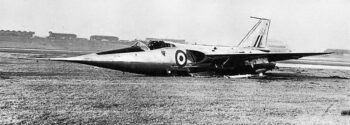
Prior to take off, a loose rubber sealing strip had been removed from between one intake and the fuselage to prevent it being sucked into the engine. However, as Twiss climbed to 30 000′ high pressure air entered the fuselage through the hole left by the removed rubber seal, collapsed a rubber expansion tank in the fuel system and jammed the valves, cutting off fuel to the engine.
Without engine power to pressurise the system too, Twiss only had residual hydraulic power to move the controls but, like Gloster’s Test Pilot Bill Waterton with Javelin WD804 at Boscombe Down on 29 June 1952, he resolved to save WG774 rather than eject. This he managed to do, but due to the main landing gear not extending, damage to the Fairey FD2 took eleven months to repair.
The effort was worthwhile however as Twiss, awarded the Queen’s Commendation for Valuable Service in the Air, was to write in his 1963 book “Faster than the Sun”:
“If ever the Delta had to justify herself to me after the crash, this wonderful little aircraft did so that morning when she flew as gently as a bird into the hard supersonic October sky. From that moment, I knew we had a world-beater.”
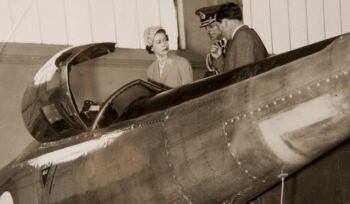
The idea of a record attempt occurred to him after the Fairey Delta 2 effortlessly passed the sound barrier without using full power or reheat. The Ministry of Supply however only reluctantly allowed “their” aircraft to be used and only at the expense of Fairey – a very different reaction from the official support given to the RAF’s High Speed Flight Meteors just ten years earlier. However the RAF co-operated and their south coast radar stations were used to guide the Boscombe Down based aircraft along the shortest route to the starting gate, this being essential as the colossal fuel consumption using the afterburner limited the endurance severely.
Thus in early March 1956 several attempts were made on the World Air Speed Record, but although the aircraft flew amply fast enough in each, the telephoto cameras could not catch the high altitude aircraft over the start and end lines of the measured course at the right instant, such images being necessary for ratification. Only on the eighth attempt – on 10 March 1956 – was all instrumentation successful enough and Twiss officially broke the record by more than 300mph.
The nine mile course was along and just inland of the English south coast at 38 000 feet, between Ford and Chichester. This altitude was chosen for both optimum conditions for supersonic flight and to allow the contrail of the Fairey FD2 to be clearly visible.

This new record at 1132mph was a significant achievement considering the old record had only been set the previous year and was so much slower. It was, in fact, the first time the record exceeded 1 000 mph under rigorously controlled conditions. Fairey Delta 2 WG774 also became the first manned vehicle to exceed 1 000 mph, just 52 years after the first 100 mph record had been set by Great Western Railway steam locomotive “City of Truro” and just 13 years before Apollo 10 would set a so-far-unbeaten manned vehicle speed record of 24 791 mph returning from the Moon on 26 May 1969.
Following the de Havilland Comet and DH 110 and Bristol Britannia airliner crashes just a few years earlier, Peter Twiss received much positive media coverage for his achievement – as well as an OBE in 1957 to add to his DSC and Bar – while “Dude” Hanes cabled his congratulations following those of Prime Minister Anthony Eden and The Queen.
The Ministry of Supply however did not want any further FD2 development because of their supersonic bangs ( which caused may broken windows and a threatened £ 16 000 lawsuit from one irate market gardener!) and also because – even before the publication of the 1957 Duncan Sandys Defence White Paper – the age of the fighter was considered by the Minister of Supply Reginald Maudling to be over.
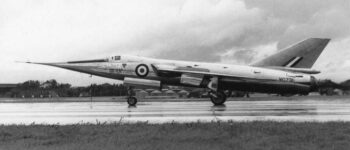
In October 1956 an FD2 went to Cazaux near Bordeaux for a month of low flying trials, hosted by Dassault and the French Air Force. This revealed that supersonic bangs were no more intense from 5000 feet and indeed were heard over a much smaller area.
However, it was found that the hydraulic flying controls needed strengthening and after modifications back home, months of testing at slower speeds followed.
The political situation in France prohibited a return for low level supersonic testing and the embargo continued at home. Thus it was not until July 1958 that the necessary tests were conducted in Norway, Twiss having flown an FD2 across from Newcastle to hand over to Sqdn. Leader J.O. Matthews to conduct the testing.
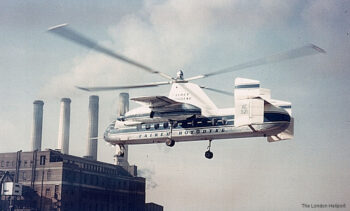
Twiss was also employed on the development of both the Fairey Gannet and Rotodyne but in March 1959 when Fairey was taken over by Westlands the Yeovil based firm did not choose to develop FD2 and the aircraft was handed over to R.A.E. Farnborough. After flying careers that influenced the wing designs of both the Dassault Mirage series and Concorde both WG 774 and WG 777 were preserved – although not before they developed and contributed even more to the understanding of flight
Under the terms of Experimental Requirement ER193D WG774 was rebuilt by the Filton Division of the newly formed British Aircraft Corporation in support of the Concorde development programme. The most noticeable modification was a new untried wine-glass shaped “ogive” wing with a new engine inlet configuration underneath it feeding air to a Rolls-Royce Avon RA.28 power-plant. The vertical stabiliser was also modified – including a fairing at the top of the tail for a cine camera – the fuselage was extended by six feet between the cockpit and the engine intakes, and a new lengthened undercarriage simulated Concorde’s attitude on the ground. The original “droop snoot” was also made fully controllable – rather than simply being positioned up or down.

Less visible new features included increased fuel tankage and redesigned electric and hydraulic systems as well as an Elliot autostabilisation system used to simulate certain unstable conditions during flight tests.
The “new” aircraft was renamed the BAC 221 and was re-flown on 1 May 1964 from Filton by Bristol’s Chief Test Pilot Gofrey Auty. By this time the construction of Concorde was already well underway so the BAC 221 was too late to really give any input to the wing design process. However WG774 was used for other tests until retirement in 1973 after 273 flights is now preserved at the Fleet Air Arm Museum, Yeovilton.
HIGHER AND FASTER

The reign of Peter Twiss was the fastest jet pilot in the World ended on 12 December 1957 when USAF Major Adrian Drew took the twin engined McDonnell F-101A Voodoo to 1207.5 mph at Edwards Air Force Base, California. Apart from a brief journey to the USSR in the autumn of 1959, the World Air Speed Record would stay in America for the next half century.

Then, on 16 May 1958, USAF Captain Walter Irwin piloted a Lockheed F-104 Starfighter to 1404 mph, just nine days after another Starfighter had set up a World Altitude Record of 91 249 feet.
Like the Douglas D-558-1 Skystreak of a decade earlier, the F-104 used thin, straight wings – a design that was to prove efficient at both low and high speeds for such a tubular “manned missile” fighter.
Though the single and twin jet engined World Air Speed Records were impressive, their measured courses were short: more easily achievable by point defence fighters than long range aircraft.
THE BLERIOT TROPHY
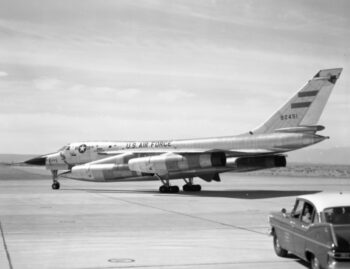
However, five years before his death in 1935, Louis Bleriot – the first man to fly the English Channel in 1909 – established a trophy in his name for the first aviator to fly at 2 000 km/h (1 243 mph) for a minimum of 30 minutes.
The 1930 vintage Bleriot Trophy was finally claimed on 10 May 1961 by the crew of US Air Force B-58 Hustler 59-2451 The Firefly. With Major Elmer E. Murphy at the controls, the four engined Convair bomber covered 669.4 miles in 30 minutes 43 seconds, yielding an average speed of 2 095 km/h (1 302.07 mph).
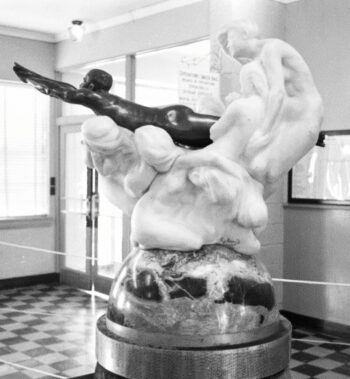
The Bleriot Trophy itself was presented to the three strong crew by Alice Bleriot, the widow of Louis, in Paris France, on 27 May 1961. Like the Schneider Trophy before it, the marble Bleriot was a large, heavy item with a naked man prone on white clouds and women. It has a permanent home at the US Air Force Academy in Colorado Springs.
On 26 May 1961 another crew climbed into The Firefly for a record breaking International flight from New York to the Paris Air Show at Le Bourget. The 3 626.46 miles were covered in 3 hours, 19 minutes and 58 seconds with an average speed of 1 089.36 mph.
On 3 June 1961, the Bleriot Trophy winning crew of Major Murphy, Navigator Major Eugene Moses and Defensive Systems Officer First Lieutenant David F. Dickerson, took off in The Firefly to perform some aerobatics before their return to America. Tragically, all three were killed when The Firefly crashed five miles from Le Bourget.
The 116 B-58s were built by Convair from 1956 to 1961 and were in service from 1960 to 1970.
THE HEAT BARRIER

Also in 1961, the North American X-15 was probing the edge of atmospheric flight. Once again dropped from a strategic bomber – this time the Boeing B-52 Stratofortress – the rocket powered X-15 would eventually fly at Mach 6.72 ( 4 534 mph ) and reach an altitude of 67 miles (earning “Astronaut Wings” for its pilot) by 1967.
However, the X-15 had to do more than merely fly very fast and high. Above Mach 2, aircraft encounter the so-called Heat Barrier – a phenomenon caused by friction between the aircraft itself and the particles of air it passes through. Even the leading edges of the wings and tailplane of the nickel-alloy steel built X-15 glowed red at maximum velocity despite operating at the most rarefied edge of the Earth’s atmosphere.

The Heat Barrier was one aspect of the development of larger supersonic aircraft that was scheduled to be investigated by the Bristol 188 research aircraft (pictured above) and also one of the stumbling blocks in the programme to develop an American Mach 2.7 supersonic passenger transport. Cost considerations apart, engineers working on the swing-wing Boeing 2707-300 could not overcome the challenge of keeping cabin temperatures down to acceptable levels.
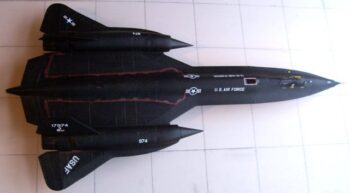
Even faster among jet aircraft flying from runways though was the Lockheed SR-71 Blackbird. Regularly flown on reconnaissance missions at Mach 3 – and reaching over 2 200 mph in 1976 – the Blackbird used a special high-flashpoint waxy fuel.
In January 1960 the U.S. Air Force gave Lockheed’s Skunk Works the go-ahead for the design, manufacture, and testing of twelve A-12 reconnaissance aircraft. “The aircraft that were to become the Blackbirds were the first to use the ‘stealth’ technology we developed for radar avoidance,” said Chief Designer Clarence “Kelly” Johnson, “The idea of attaining and staying at Mach 3.2 (more than three times the speed of sound) over long flights was the toughest job the Skunk Works ever had and the most difficult of my career”.
Aircraft operating at those speeds would require development of special fuels, structural materials, manufacturing tools and techniques, hydraulic fluid, fuel tank sealants, paints, plastics, wiring, and connecting plugs. Everything about the aircraft had to be invented.
The A-12’s first flight was in 1962 followed by the YF-12A in 1963 and the SR-71 in 1964. With in-flight refuelling, the SR-71 attained global range and in the 1970s chalked up records for speed (2,193 mph), altitude (85,069 feet), a trans-Atlantic timing of one hour, fifty-four minutes over 3,470-miles from New York to London and a world speed record of three hours, forty-seven minutes on a 5,463-mile flight from London to Los Angeles. In March 1990, the year the Air Force retired the Blackbirds from service, an SR-71 streaked across the United States in a record sixty-eight minutes on the 2,400-mile flight coast to coast.
This Italeri model of the A-12 was supplied with markings for a later SR-71 numbered 17974. “Ichi Ban” was the first SR-71A to fly a combat mission, on 21 March 1968, and the last one to be lost, on 21 April 1989. Both crew members ejected safely over the Philippines and presented one of the “bang seats” as a throne to the cannibal king whose tribes people rescued them from the sea.