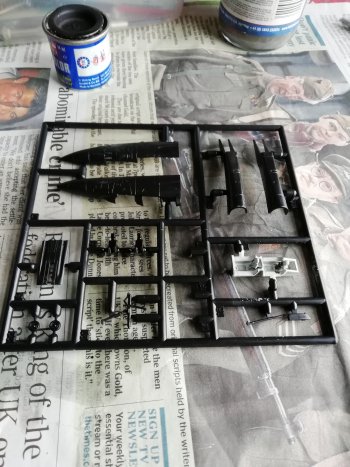
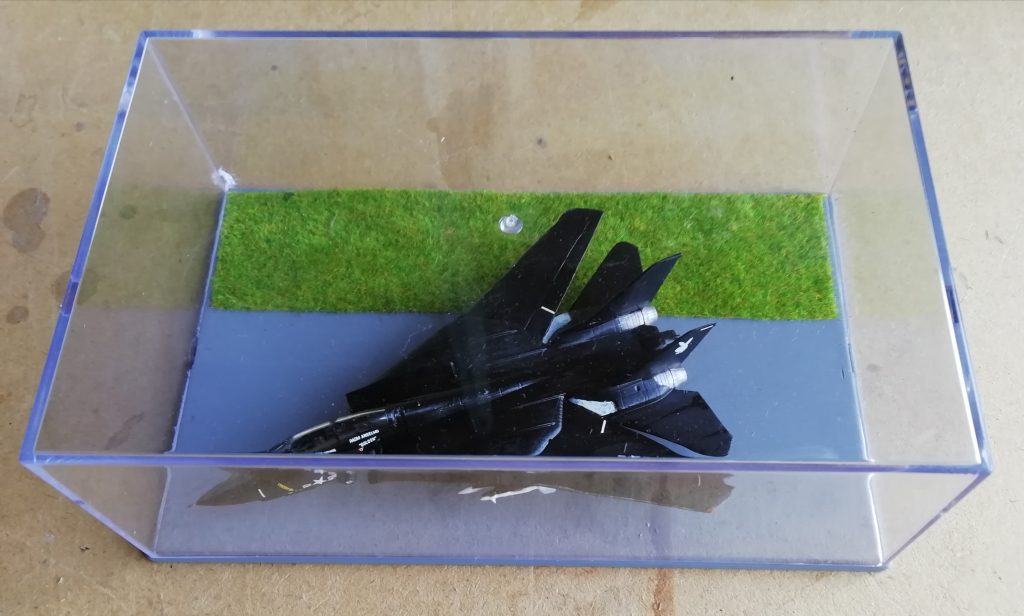
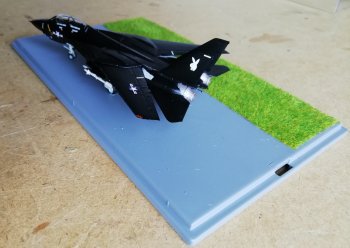
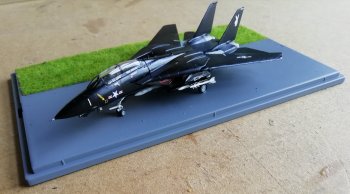
In early 2019 I was given the challenge of building 1/144 scale Revell kit 04029 of the Grumman F-14A Black Tomcat numbered 159853 so that it could fit into one of the wider Perspex boxes used to encase Oxford Diecast vehicle sets, in this case the box which once contained 76BMC003, comprising a BMC Transporter and two racing Minis. The moulded ferrules that once supported these vehicles were cut down from the black plastic plinth, which was sprayed with grey primer to represent a small section of airfield perimeter track. A small section of grass roll was then used to define the tarmac area and cover four of the ferrule divots while the remaining two were disguised by the Tomcat itself. For this reason, the F-14A was modelled with wings partially swept back rather than fully forward as would have been the case on take off and landing.
The reason for affixing the model to the former Oxford base was to give it the capability of being transported intact by rail for possible eventual delivery to Marretta Dyer in London. It was a fiddly job, as unlike most of my previous 1/144 scale model aircraft it featured many external stores. The variable geometry wings also meshed together with an internal rack system which had to be precisely engaged, although to their credit Revell did provide a very detailed and comprehensive decal sheet with alternative markings for an F-14A of VF-142 “Ghostriders” as emberked on CVW-6 USS America in 1976.
First flown in December 1970, the F-14 Tomcat entered service in 1973, specifically countering the threat of the Soviet Tupolev Tu-22M “Backfire” martime bomber to the carrier fleet and replacing the similarly supersonic two seat McDonnell Douglas F-4 Phantom IIas the US Navy’s air superiority and precision strike fighter.
However, as a variable geometry aircraft, it had the advantage of relatively slow approaches to landing on aircraft carriers with its wings swept fully forward, and was faster than the Phantom with more sophisticated AWG-9 radar, target management avionics and weapons. As many as six AIM-54 Hughes Phoenix long range air-to-air missiles could be carried with six different targets being acquired and identified at once: the first time that such capability had been available in a fighter aircraft. The key to the success of this system was that the AIM-54 had a fire-and forget capability due to its own onboard radar which left the Tomcat’s AWG-9 system free to track more targets or offer target illumination to the shorter range AIM-7 Sparrow air-to-air missile fitted with a semi-active homing seeker.
As well as Phoenix, Sparrow and Sidewinder missiles , the F-14 was armed with a 20mm Vulcan M-61 gun for air-to-air combat. Alternatively, missions could be flown with the Tactical Air Reconnaissance Pod System
Grumman F-14 Tomcats are perhaps most famous for their starring role in the 1986 Tom Cruise film “Top Gun”, based on the work of the US Navy Fighter Weapons School at Miramar, California.
Top Gun was set up in 1969 to stem the losses of McDonnell Douglas F-4 Phantom IIs over Vietnam to single engined MiG-21s and its syllabus of air combat manoeuvring skills owed much to both the Royal Navy’s Air Warfare Instructor’s School at Lossiemouth in Scotland and more specifically to its exchange graduate Richard Stanley Lord RN, later a Brigadier General in the South African Air Force, who always used the radio call sign “Brit 1”. Soon after Top Gun was established, a Phantom flown by one of its students shot down a MiG-21, the first time a US Navy aircraft had succeeded in aerial combat in two years.
The F-14B, introduced in November 1987, incorporated new General Electric F-110 engines and from 1995 an upgrade program incorporated new digital avionics and weapon system improvements.
The F-14D, delivered in 1990, was a major upgrade with F-110 engines, new APG-71 radar system, Airborne Self Protection Jammer (ASPJ), Joint Tactical Information Distribution System (JTIDS) and Infrared Search and Track (IRST). Additionally, all F-14 variants were given night vision compatibility, new defensive countermeasures systems and a new digital flight control system.
As such, the F-14 – larger and more expensive than the McDonnell Douglas F/A-18 Hornet introduced in 1983 – was to take on a much broader range of roles before retirement from service in 2006. The combination of Martin Marietta LANTIRN (Low Altitude Navigation and Targeting Infra-Red for Night) and GPS equipment in one underwing store turned the Tomcat into an all-weather precision bomber which delivered laser guided munitions in the Balkans from 1995 and later as part of Operation Desert Fox over Iraq.
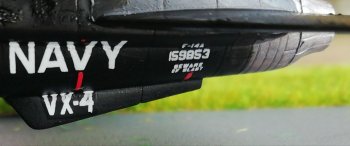
Several early F-14 examples went for test and evaluation to the US Navy’s VX-4 unit at Naval Air Station Port Mugu, California and for a few years after 1987 the F-14A numbered 159853 was painted in an overall gloss black scheme and was one of the black jets given the call sign as “Vandy One”.
VX-4 has the task to conduct evaluations of air-launched guided missiles as assigned by the Commander, Operational Test and Evaluation Force. In 1960 the squadron began to include additional project tasks not directly associated with guided missiles. Projects such as the operational test and terrain clearance radar, Doppler navigation systems, and air-to-air distance measuring equipment were included in the squadron’s tasks.
VX-4 eventually received the F-14A+ while the F-14D Super Tomcat arrived to enter Operational Evalution in the 1990s. The squadron used the F-14 to conduct operational test and evaluation of airborne fighter weapons systems included AIM-7M Sparrow, AIM-9M Sidewinder, and AIM-54C Phoenix missiles, radar warning devices, and self-protection jammers. On 30 September 1994, VX-4 was disestablished and its assets were reassigned to VX-9 (Detachment Point Mugu) “Vampires”.
The first VX-4 aircraft to carry the “Vandy 1” callsign was the F-4 Phantom II in the 1960’s (the unit operated two Phantoms, an F-4J and an F-4S) until it was written off in 1987 when the paint scheme was transferred to F-14A Tomcat.
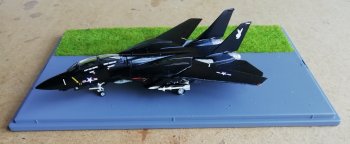
The first F-14 to wear the black livery carried the Bureau Number 159853 and was painted with a water based matt black during the exchange ceremony during which its predecessor was retired. BuNo 159853 was eventually decommissioned in 1992.
The last black Tomcat was F-14D Buno 164604 which carried the bunny even when the VX-4 merged with VX-5 to create the VX-9. 164604 flew its last sortie on 2 July 2004 to NAS Oceana. and now resides as a gate guard repainted in the VF-103 “Jolly Rogers” paint scheme. All the remaining rabbit head tail codes were removed from naval aircraft shortly thereafter due to changing political tides within the Navy.
All Black designated Vandy-1 jets now reside in the desert bone yards of Arizona at Davis-Mothan AFB where they will eventually be scrapped. Their glossy black shade was FS 17038, with a black FS 37038 anti-glare panels in-front and behind the canopy .
,