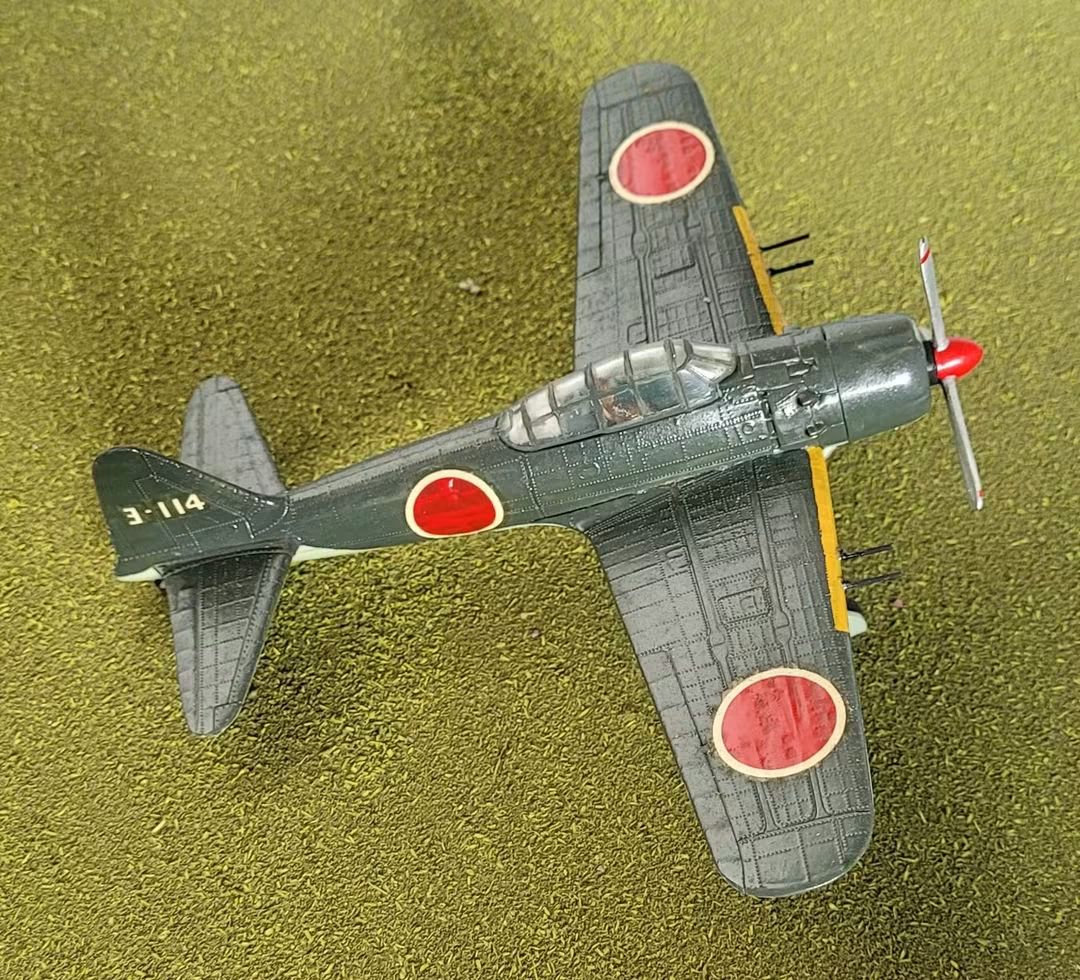
From August 1943, Mitsubishi worked with the Imperial Japanese Navy to introduce the A6M5 version of the Zero which had an improved dive speed due to a reduced span and area wing covered in a heavier gauge of metal skin. Engine efficiency was also boosted with new exhausts around the cowling, the windscreen had a sheet of armoured glass behind it and the fuel tanks had an automatic fire extinguishing system. Later A6M5 variants had dive bombing capability and were fitted with four large calibre machine guns.


As the fastest climbing Japanese fighter of World War II to see quantity production, the Nakajima Ki-44 Shoki (Demon) defended the Japanese home islands against American Boeing B-29 bombers – the design sacrificing agility for speed.
The Ki-44 and Ki-43 Hayabusa were developed at roughly the same time but with the Ki-44 being given a 1250 bhp Nakajima Ha-41 engine – the most powerful available – allowing it to reach 13 000 feet in less than five minutes with a top speed of 373 mph.
First flown in 1940, the Shoki entered IJN service in September 1942, armed with four 0.5 inch machine guns in the wings. However, its higher landing speeds and lack of agility made it initially unpopular with pilots although later variants had even more powerful engines (bringing to speed closer to that of the Ki-46, Mitsubishi’s twin engine reconnaissance aircraft) and a mixture of canon options.
The aircraft modelled is a Ki-43-IIb in the markings of the Shinten (air superiority) unit of the 47th sentai (squadron) which made suicidal ramming attacks on B-29s bombing Tokyo in November 1944.
In the Allied nomenclature, the Nakajima Ki-44 became the Tojo – named after Hideki Tojo who was Japanese Prime Minister from 1941 to 1944 and would be hanged for war crimes and crimes against peace in 1948.
