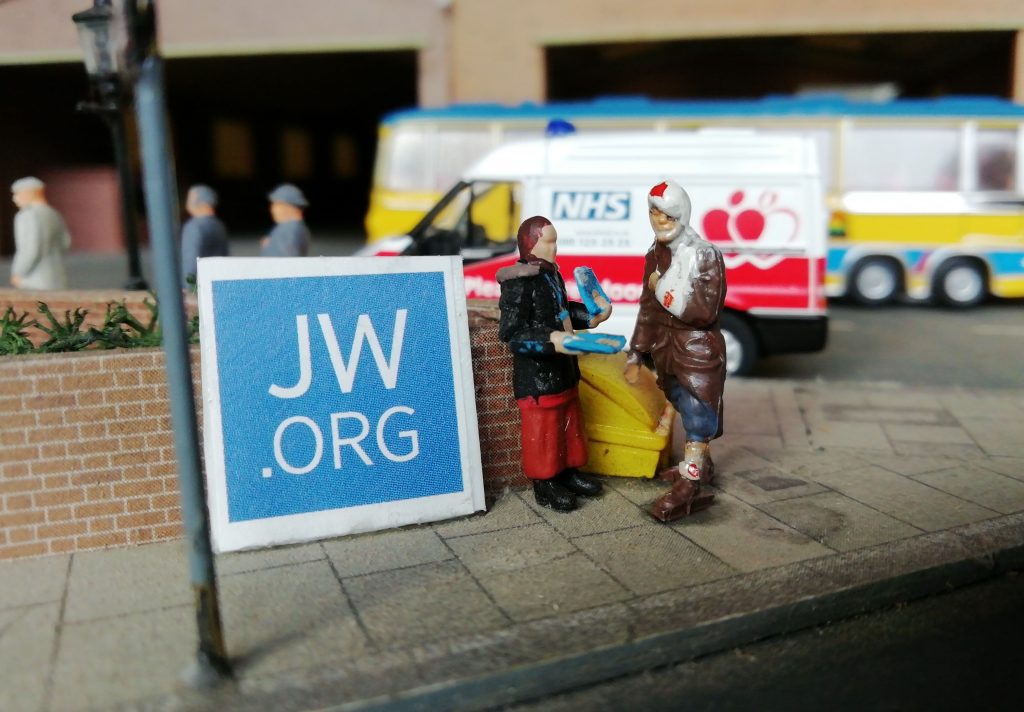
After a year off, Ming Ing was very kindly been invited back to the model tent at the Model Steam Road Vehicle Society Rally in Tewkesbury on Saturday 22 and Sunday 23 June 2019. However, due to the 2019 Rally being cancelled, Ming Ing was then set to appear at Tewkesbury on 20 and 21 June 2020. Sadly this event had to be cancelled due to the Covid pandemic, after which the MSRVS began to hold steam-up weekends rather than tradition rallies with model tents.
Nonetheless, Ming Ing is ready to entertain again under the new , apparently more acceptable, branding of YORKGATE with new vehicles and scenic vignettes such as the hospital outpatient (adapted from an Airfix World War One French soldier) and Jehovah’s Witness pictured above.
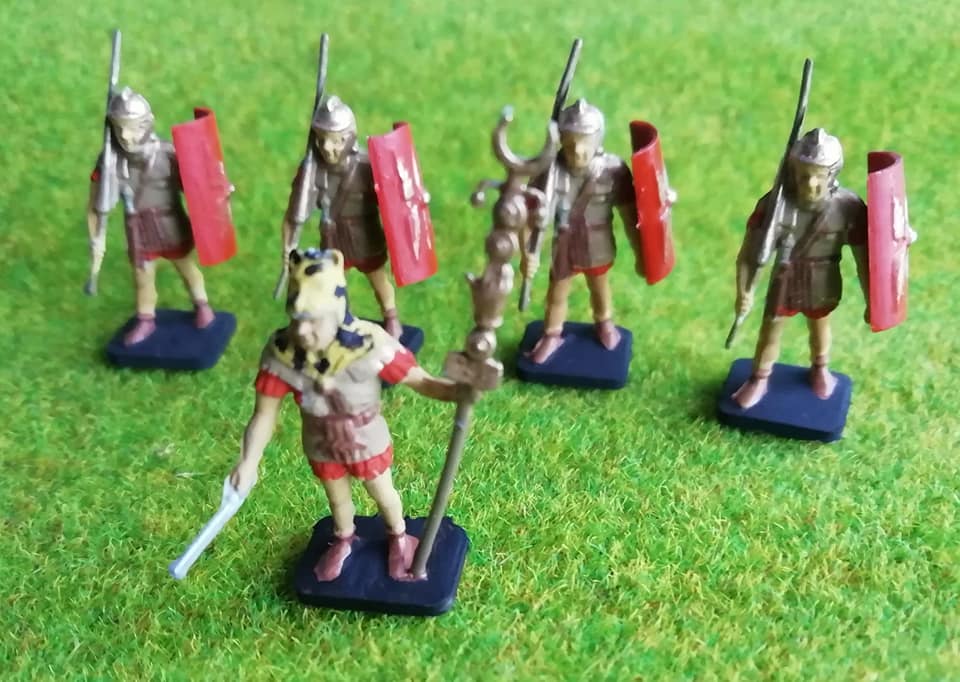
In addition, 2019 marked a number of anniversaries – not least 50 years since the first Moon landings. And as many towns and cities now have annual history festivals – including the Jorvik Viking Festival – I thought that it was time for Ming Ing to Get Back too. In this case complete with Roman re enactors.
York, as discussed in the original introduction to Ming Ing , has a rich history, starting with the foundation of Roman Eboracum in about AD 71 when the 5,000 men of the Ninth Legion marched from Lincoln and set up camp.
More than a quarter of a century had passed from the Romans establishing a province in southern Britain to their arrival in York. Northern England at the time was however largely populated by the Brigantes, a loose confederation of Celtic tribal groups.

Their Queen, Cartimandua, favoured working with the Romans, unlike her estranged husband Venutius. According to the first-century historian Tacitus, when they separated Venutius first took up arms against the Queen and then against her Roman protectors. These skirmishes led to the Romans building fortifications on the frontier between their province and Brigantes, including a fort near Rotherham.
When Cartimandua took her husband’s former armour bearer as her lover, the conflicts escalated. The queen was captured by Venutius’s forces and only rescued after fierce fighting in AD69 .It was time for the invaders to impose their authority on the troublesome northerners, and in around AD71, the Roman Governor of Britain Quintus Petilius Cerealis led his troops northwards from Lincoln to invade the lands of the Brigantes.
The Ninth Legion would most likely have found before them little more than meadow land, but also the ideal spot to launch attacks against Brigantian resistance in the North York Moors and the Pennine valleys. The site might also have lain on the boundary between the Brigantes and the Parisi, another tribe who lived to the East – making it a sort of neutral territory from which to supervise the natives.
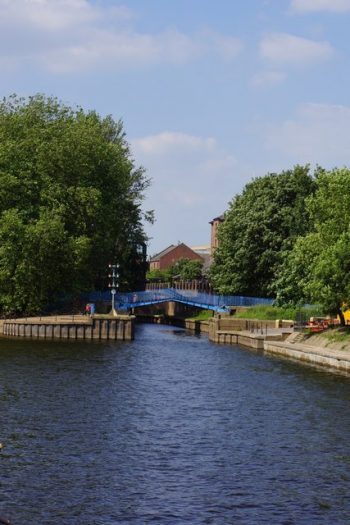
The confluence of the Rivers Foss and Ouse gave York an obvious strategic appeal. Men and supplies could be transported from the North Sea to the settlement via the Ouse while Eboracum also sat on a ridge which the Romans used it as their main approach to the city. This route is still largely followed by the A64, today while the plateau which would have been more prominent in Roman times when rivers were as much as three metres lower than they are today.
The Roman world was governed from wherever the Emperor was located. York was priviledged to be the heart of the Roman empire in two periods, about 100 years apart. Remarkably, both times the Emperor died in the city and both times a battle for succession began there.
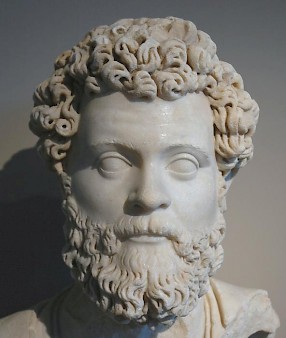
The first time was when the emperor Septimius Severus lived in York between 208-11. Having restored stability to the empire after a period of civil war, he came to Eboracum to lead campaigns against the Caledonians who had been attacking Roman targets in the north of Britain.
Severus, known as the African Emperor because he was born in what is now Libya, was over 60 when he arrived in York. He came with a huge retinue of civil servants and soldiers, including the Praetorian Guard – an elite force who were the emperor’s bodyguards.
Severus brought with him his wife Julia Domna and their sons Caracalla and Geta. In 198 Caracalla had been declared co-emperor, a status also bestowed on Geta, in York, 11 years later.
Severus died in York on 2 February 211. This was a moment of enormous significance as Emperors were considered halfway between men and gods, and he was given a suitably lavish send-off. Soldiers threw gifts as the late emperor’s body clad in military garb was consumed by the flames of the funeral pyre.
It is said that on his death bed Severus advised his sons to treat the army well and ignore everyone else. Caracalla and Geta, as co-emperors, returned to Rome shortly after their father’s death. Their subsequent rivalry had a bloody end: Caracalla had his brother assassinated.
Caracalla named Eboracum as the capital of upper Britain (Britannia Inferior) when the country was divided into two provinces, and this is probably what led to the city being granted the highest status of Roman city, that of Colonia.
Constantine came to Britain with his father, the emperor Constantius, in 305. Constantius died in July the following year in York.
The system of succession at the time demanded that another Caesar should become emperor but the soldiers in York immediately proclaimed Constantine their leader. It proved to be a pivotal moment in history. He is known as Constantine the Great for very good reasons.
After nearly 80 years, and three generations of political fragmentation, Constantine united the whole of the Roman Empire under one ruler. By 324 he had extended his power and was sole emperor, restoring stability and security to the Roman world.
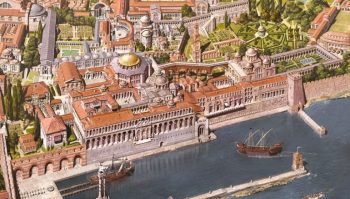
Constantine also abandoned Rome as the most important city in the empire, building a new capital modestly named Constantinople (now Istanbul). In the next two centuries, Rome and Italy became vulnerable to barbarian invasions. The much more easily defensible Constantinople lasted for another thousand years.
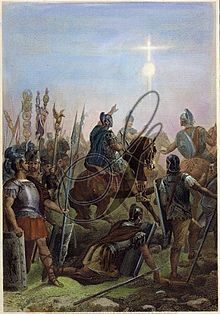
Finally, and perhaps most famously, Constantine’s strong support for Christianity had an incalculable impact on European history. He is said to have been converted to the faith in AD 312, although this has not been corroborated.
At the time only around ten per cent of the Roman empire’s population was Christian. The majority of the ruling elite worshipped the old gods of Rome. Constantine was the first emperor to allow Christians to worship freely, helping to unite and promote the faith. He went on to instigate the celebration of the birth of Christ we call Christmas.
In 314, a year after Constantine’s edict on religious tolerance, Eboracum had its first Bishop. Along with the Bishop’s of Londinium (London) and Lindum (Lincoln), he attended the Christian Council at Arles.
Constantine didn’t stay long in York, establishing Trier as his base for his campaigns against the Germans perhaps a year after his succession. However his place in York’s history was already very firmly sealed.
The Roman legions served from the Roman Republic days of the 3rd century BC to the nadir period of the Roman Empire in the 4th century AD.
Generally, all Roman men aging between 17 and 46 were liable for military service – though, the peak age for enlistment tended to be skewed towards the early 20’s age group. Each legionary had to claim his origo (origin) from a city or at least a town. However, in spite of such claims, the vast majority of the legionaries came from a rural background.
Rural folks were considered to be more hardy with higher levels of endurance. Moreover, they were also considered to be more dependable with their simplistic character, given their (presumed) unfamiliarity with the sleazy side of urban life.
In some cases, the romanticizing of country life was stretched to such a degree that even mutinies in the army were squarely blamed on ‘soft’ city-bred recruits.
After being selected for the army, the young man (usually in his late teens or early twenties) had to go through a period called probatio. During this time, both his character and medical condition was heavily scrutinized by enlisting officers. Any ‘immoral’ recruits such as thieves were also banished from the army.
A Roman legionary was not always a Roman citizen due to the civil wars that plagued the Roman realm during the end of the Republic era. For example, Julius Caesar raised the legio V Alaudae from the native Gauls and later naturalized their citizenship. Even during the tumultuous period of the latter part of 1st century BC, Marc Antony didn’t have access to the major recruitment grounds of Italy. As a desperate solution, he started filling his army ranks (consisting of around 23 legions) from the native population of the eastern provinces Syria and Egypt.
Roman citizenship was thus not a requirement, but a status that was conferred upon the Roman legionary during his time of enlistment. However slaves were barred soldiery – though they might have been inducted as supporting units inside a legion used for menial works.
Moreover, while the legionaries were supposed to be volunteers who joined the army, many of them were simply conscripted into the legions – due to the requirement of higher manpower during the civil wars and the later Augustan period.
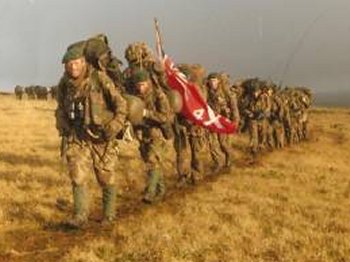
The green recruits who were successfully enlisted as legionaries had to go through a training period of 4 months. During this time, each soldier was given the unenviable task of marching 29 km (18 miles) in five hours with regular steps, and then 35 km (21.7 miles) in five hours with faster steps – all the while carrying a backpack that weighed 45 lbs (20.5 kg). This weight was intentionally allotted for increasing the endurance level of a Roman legionary and thus added to the overall weight of the panoply worn by the soldiers in their full gear (the weight of the lorica segmentata armor alone might have gone beyond 20 lbs). As expected, the ‘slowpokes’ were severely beaten by centurions and officers with their staffs. Interestingly enough, many of the similar ‘regimens’ are preserved through our modern military cultures
In any case, after the strenuous marching scope was perfected by the legionaries, they were then drilled in battlefield maneuvers (including the hollow square, wedge, and the famed testudo formations) and signaling. Finally, they were trained in weapons handling and in some cases also swimming. Interestingly, the faux swords and shields used in practices were made of wood and wicker, but they weighed twice the mass of their actual counterparts – so as to acclimatize the Roman legionary with fatigue and weariness that could happen in the heat of the battle.
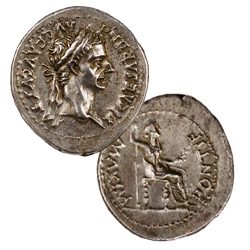
In 13 BC Emperor Augustus formalized the length of service of a Roman legionary to 16 years. But even after 16 years of service, the legionary was expected to join the vexillum veteranorum or unit of veterans for four more years. However, by 6 AD, the initial length of service was increased to 20 years, and it was complemented by the praemia militare (or discharge bonus), a lump sum that was increased to 12,000 sesterces (or 3,000 denarii). And by the middle of 1st century AD, the service was further extended to 25 years.
These protocols were rarely followed in time of war with some men fighting under their legions for over three to four decades. Such chaotic measures frequently resulted in mutinies.
Other than the lump sum of praemia militare, a basic Roman legionary was paid 900 sesterces per year (paid in three installments). This pay scale remained the same till at least 80 AD, in spite of presumed inflation.
However, the pay differed for the various units in a legion, with under-officers and specialists being paid one-and-a-half or twice the basic pay grade. And this pay was only a nominal value from which various deductions were made for food, equipment, attire and even burial fees consumed by the legionary. Some veterans were also given worthless parcels of land instead of the praemia militare.
However, many potential recruits were still attracted by the prospect of booty when conducting wars against richer opponents. Many soldiers tended to strip the dead as the very first act after achieving victory.
It was a Roman custom to make a trophy from arms taken from the enemy and sometimes included enemy corpses and heads that were piked atop raised platforms.
Beyond discipline and training, one of the crucial reasons for the effectiveness of a Roman legionary was his sense of fraternity within a century (made of 80 men). A century (centuria) was further divided into ten contubernium (or ‘tent group’, each consisting of eight members). who fought, dined and rested together. The contubernium were also expected to cook their own meals and eat them together (while the cost of food was deducted from their salaries).

Balancing such cameraderie however was the prospect of brutal punishment. Most notorious was the practice of decimation, usually reserved for instances of insubordination, cowardice, conspiracy, murderous intent on fellow soldiers, participation in espionage activities, desertion or faking illness avoid battle.
Decimation entailed choosing at random every tenth man from a cohort (approximately 480 men) to be put to death with each unlucky man – regardless of his rank, reputation or even his involvement in the actual transgression or revolt – being stoned or clubbed to death by his remaining comrades-in-arms.
The remaining soldiers were then sometimes forced to make their quarters outside the main army camp and given diets of barley which were obviously harder to digest than the usual rations of wheat.
If a soldier was severely injured though and couldn’t continue further with his military tenure, he was given a missio causaria or medical discharge that was equivalent to honorable discharge or honesta missio. This, in turn, equated to a societal status that was higher than ordinary civilians, which made the discharged legionary exempt from taxes and other civic duties.
The soldiers who truly made a Roman military unit self-sufficient were the immunes, a group of highly trained specialists attached to each legion. Ranging from doctors, engineers to architects, these men were exempt from the hard labor duties of the rank-and-file soldiers, while also earning more than them.
The traditional shield of the Roman legionaries was the scutum. And while the standard scutum of 1st century BC was an oval-shaped shield that weighed around 10 kg (22 lbs), its shape was transformed to a curved rectangular board during the Augustan period. This change drastically reduced the weight of the shield to 7.5 kg or 16 lbs (with later specimens probably weighing even less at 5.5 kg). And as can be gathered from the transference of this weight, the shield was held by a horizontal grip with a straight arm posture.
In fact, while the rectangular scutum, roughly measuring 102 cm x 63 cm, did a good job of covering the torso of the Roman legionary, its crucial advantage lied in its offensive capacity. To that end, the legionaries slammed into their opponents with the full weight of the shield, while its prominent boss was used to violently push away and then topple the enemy. The other incredible offensive arm was the pilum, a two metre long iron tipped javelin.
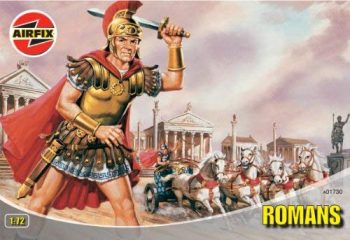
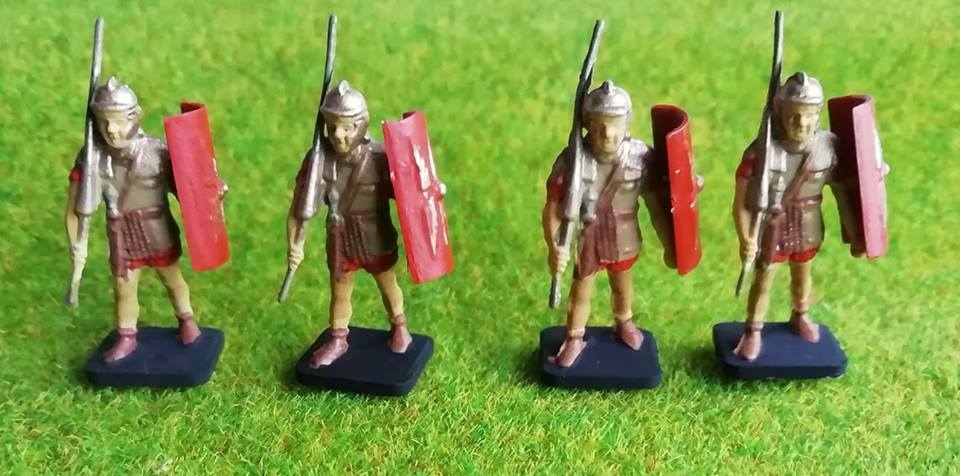
Along with the matching Ancient Britains, the Romans – moulded in 1967 – were the only foray that Airfix made into figures from ancient history.
The choice of opponents might suggest a date in the middle of the first century AD for these soldiers. Airfix themselves described the men’s armour as ‘…leather and metal reinforced tunic…’, and say this was ‘…familiar Roman garb…’, though today we know that this is not the case. The cuirass is largely without detail, though there is some suggestion that it is a muscle cuirass. It extends below the waist, and underneath it the leather pteruges (strips) of the garment underneath can be seen, as they can at the shoulders. While such items are depicted, they seem to be very few in number and therefore not the norm. The helmet is also poorly defined, but seems to be in the Imperial Gallic style with a ridge over the brow, cheek guards, a wide neck guard and a reinforcing ridge along the skull. Such helmets would be appropriate for the first two centuries AD, with reinforcing strips mostly seen after the Dacian wars during the reign of Trajan (though there should also be reinforcement across the skull). With poor detail it cannot be positively identified, though the brow ridge has been done more like a peak and is not authentic.
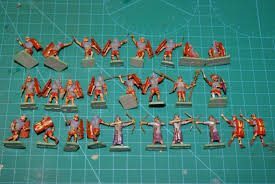
The men’s sword would be the short gladius, though again the sculpting is quite basic in this set. Some wear this from a belt whilst others have a baldric over the left shoulder, but all have it on their right hip. None have been given a dagger, which should be on the left hip.
The shields are of the curved rectangular type established by the mid first century AD. They fix on the figures using a peg on the arm, but this method means the shield actually stays some distance away from the arm itself, which looks odd. The design on the shield is generic early Imperial, but not specifically identifiable. In reality such shields were held by a bar behind the boss, not strapped to the horizontal arm as suggested by these figures.
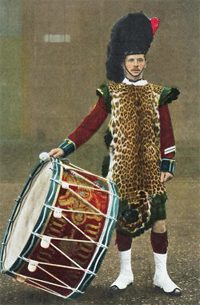
The signifer – or standard bearer – is holding the signum in his left hand and a sword in his right (for which he has no scabbard). The signum contains all the right sort of elements, but they are not necessarily placed correctly on the pole. He wears an animal pelt as was common, though this amounts to no more than a hood rather than a full pelt. The animal was often a bear, though Airfix say this one is a puma – a creature native to America and therefore unknown to the Romans. I actually painted my “puma” as a leopard, a skin still worn by military drummers today and a animal well known to the Romans.


