The Spanish Civil War ended on 1 April 1939. Nationalist General Francisco Franco became dictator thanks to the intervention of his German and Italian allies. But in doing so, Germany in particular prepared to lose an even greater conflict. This article is based on captions written for a display of model aircraft at the Jet Age Museum, Staverton, Gloucestershire to mark the 80th anniversary of the end of this sometimes neglected yet historically important conflict.

On 17 July 1936 Franco and other Generals launched a coup against Spain’s Republican government. But with Spain’s navy and air force staying loyal to the elected regime in Madrid, Franco needed outside help to bring his own troops across the Straits of Gibraltar from Spanish Morocco. This was achieved between July and October 1936 with the first ever military airlift by German Junker 52 (pictured above) and Italian Savoia Marchetti SM 81transport aircraft.
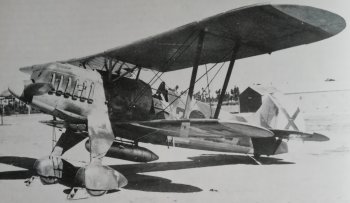
As both France and Soviet Russia sent aircraft, tanks and other aid to the Republican government, German dictator Adolf Hitler sent his Luftwaffe’s Condor Legion to assist Franco’s Nationalist forces. Although the Soviet Polikarpov I-16 monoplane proved to be superior to the German Heinkel He-51 biplane fighter (pictured above), the Condor Legion had better pilots and tactics.
These included bombing Republican fighter aircraft while they were on the ground refuelling between missions and developing the “finger four” formation of fighter aircraft to supercede the closer groupings that had developed in World War One. Still used by air forces today, a finger four comprises two pairs of aircraft with a wingman trailing behind his leader. The technique was pioneered by Lieutenant Werner Molders who became the leading German ace of the Spanish Civil War.
The conflict in Spain also saw the use of bombs containing poison gas ( by the Italians at Barcelona on 18 March 1938) and the dropping of “flambos” – oil and petrol based incendiary and fragmentation bombs – the ancestor of napalm. On 26 April 1937 the Condor Legion used terror bombing for the first time against the population of the northern Spanish town of Guernica, with fighter aircraft strafing civilians as they fled. This inspired many artists to record their horror at the atrocity, including Pablo Picasso’s famous painting “Guernica”, a copy of which now hangs in the United Nations in New York to remind delegates of the horrors of war.
Air support proved particularly effective when Nationalist troops had to attack Republican strongholds in remote mountainous areas but the Luftwaffe left Spain with the belief that fast, well armed bombers could defend themselves against enemy fighters during daylight attacks. And that victory could be achieved with close support aircraft rather than strategic bombers.

In his book “Mein Kampf”, Adolf Hitler had identified the USSR as a more likely target for conquest than France or Britain. And after the Luftwaffe had been formally revealed on 1 March 1935 – in defiance of the 1919 Treaty of Versailles – work began on a long range “Ural Bomber” to strike Soviet industry.
Ironically, the German government of the 1920s had relied on a base at Lipetsk in the USSR to secretly train its military pilots. These would go on to fly what were euphemistically described as fast mail carrying and sports aeroplanes. Between 1933 and 1935, such aircraft were financed to the tune of 3 billion Reichsmarks by the Reichsbank via a number of apparently civilian training organisations. From 4 000 in 1933, the number of skilled workers in the German aircraft industry rose to 20 000 in February 1934 and to 72 000 by June 1935.
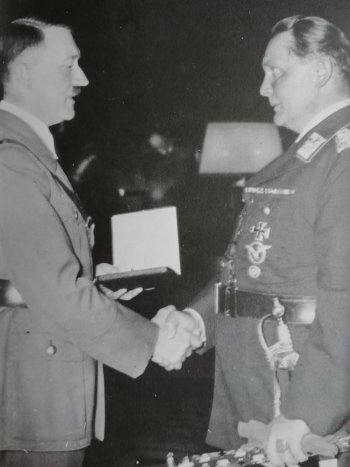
However, Hitler (above, left) also asked his Luftwaffe chief Hermann Goering about the number of bombers available rather than types. The result was the abandonment of the Junkers Ju 89 and Dornier Do 19 (pictured above) four engine strategic bomber prototypes in 1937 in favour of many more twin engine medium types and the dive bombers which had first seen combat in Spain. These would also make Germany’s scarce supplies of oil and metal stretch further.
Added to this, infighting between senior officers and departments hindered the development of radar, jet engines and rockets and left the Luftwaffe on the eve of World War 2 without bombs larger than 1 000lb, accurate bombsights or large numbers of experienced trained pilots.
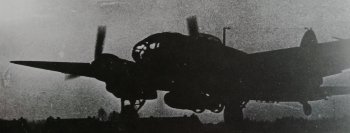
Despite the Heinkel He 111 (pictured above) and Messerschmitt Bf 109 being advanced aircraft for the late 1930s, their development did not keep pace with eventual Allied refinements in such aircraft as the Supermarine Spitfire and Gloster built Hawker Hurricane. Even the promising Junkers JU 88 design was compromised by the desire for it to act as a dive as well as conventional bomber. Similarly, Nazi blitzkrieg tactics met their match in the integrated air defence system of RAF Fighter Command during the 1940 Battle of Britain.
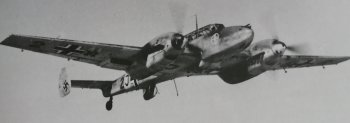
The Me 109 lacked the range to successfully escort slower bomber aircraft across the English Channel beyond London and the twin engine Me 110 (pictured) proved to be vulnerable to single engine eight gun fighters despite their success across Western Europe and Scandinavia.
Worse still, the 1941 invasion of the USSR had to be attempted with close support aircraft but no strategic four engined bombers. Had Operation Barbarossa started just two weeks earlier it might just have succeeded but due to Junkers 52 transport aircraft being diverted to the invasion of Greece the dash to Moscow eventually ground to a halt in the Russian winter. In the west meanwhile, slow Focke-Wulf Fw 200 Condor airliners had to be adapted for use against allied shipping in the Atlantic.
The models selected for the display are described in more detail below:
SAVOIA-MARCHETTI SM 79
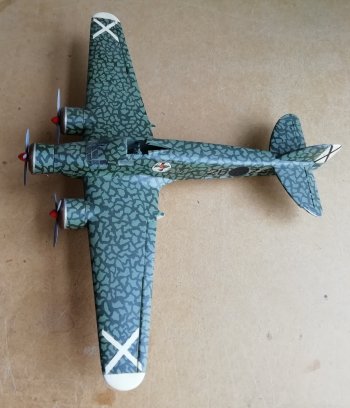
Probably the best known Italian Fascist aircraft, the tri motor SM 79 Sparviero (“Sparrowhawk”) first flew in 1934 and was at one time the fastest medium bomber in the World. The Spanish Civil War was its first taste of combat and this model wears black Nationalist crosses on the white background of its rudder. Although a successful torpedo bomber in World War 2, the SM 79 met its match in the Gloster Gladiator during the air battles over Malta.
As well as aircraft, Italy’s contribution to the Nationalist side in the Spanish Civil War included the Corpo Truppe Voluntare equipped with armoured cars and tanks ( some equipped with flame throwers) and submarines which sank Soviet and Spanish ships. However, the financial cost of the Fascist intervention was high and impaired Italy’s fighting potential during World War 2.
JUNKERS JU 86
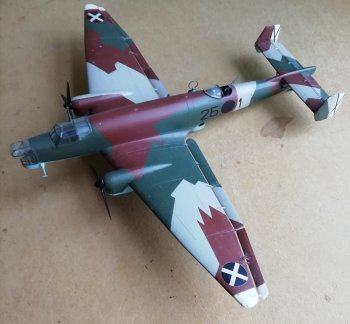
Also taking to the air for the first time in 1934, the Ju 86 was the first large Junkers aircraft to feature smooth rather than corrugated skinning. It was also designed around the Junkers Jumo 205 diesel engine, which although heavy was more economical than petrol equivalents. The two stroke opposed piston 205 was also an ancestor of the Deltic engine later used in patrol boats and railway locomotives. Although the Jumo 205 diesel engines were found to be too delicate for combat use in Spain, they were developed into the turbocharged Jumo 207A-1 which powered the prototype Ju 86P in January 1940. Featuring longer wings and a pressurised cabin for a crew of two, the Ju 86P could fly above 39 000 feet. Forty older Ju 86s were modified as bomber or photo reconnaissance variants of the Ju 86P but despite the British Westland Welkin and Soviet Yakovlev Yak 9PD being developed specifically to counter the threat that it posed the first high altitude Ju 86 was shot down at 49 000 feet over Egypt by a modified Spitfire V in August 1942.
DORNIER DO 17
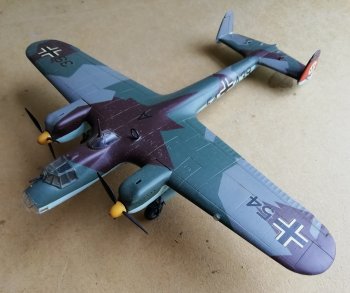
Often compared to the Handley Page Hampden, Dornier’s 1934 vintage twin fin “Flying Pencil” was noted for its long range but was disliked by some operators as needing more maintenance per flying hour than equivalent medium bombers. It also saw service for the first time in Spain, replacing Heinkel He 46 and 70 aircraft, but was replaced itself by the Heinkel He 111. The Nazi contribution to Nationalist ground forces eventually included four companies of tanks and 88mm anti-aircraft guns which proved lethal against Republican vehicles.
HENSCHEL HS 123
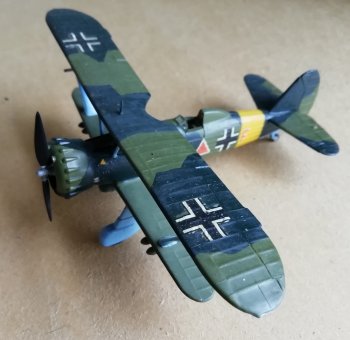
Henschel was a railway locomotive manufacturer before 1933 but like Gotha, ATG and shipbuilder Blohm und Voss was encouraged to move into aircraft production to equip the rapidly growing Luftwaffe. Similarly, existing aircraft manufacturers such as Dornier, Heinkel, Fieseler, Arado, Messerschmitt and Junkers were given new government contracts. The HS 123 was a sturdy sesquiplane which proved successful in Spain despite its limited bomb load and range. It was replaced in Spain by the Junker Ju 87 Stuka monoplane dive bomber.
MESSERSCHMITT BF 109
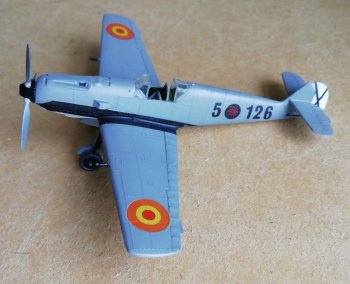
This captured BF 109 E-1 wears red Republican roundels . Like the Spitfire, the Me 109 was produced before during and after World War 2 and although not always as fast or agile as its Supermarine rival it could climb, dive and loop more easily, partly due to its direct injection engine. First flown in 1935, it first saw combat in Spain in 1937.
The Bf 109 “Emil” was fitted with a Daimler Benz DB 601A engine in place of the earlier Jumo 210, requiring the radiators to be moved to the underside of the wing and the oil cooler in the nose under a small streamlined duct.
The Me Bf 109 was partially replaced later in the war by the radial engined Focke Wulf Fw 190, although production of this very capable aircraft was held back by Allied bombing raids on its assembly shops and the factories producing its engines
PANZERKAMPFWAGEN 1
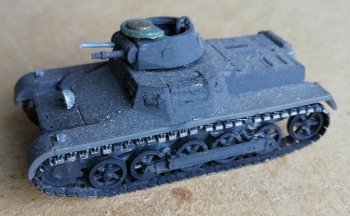
The Panzer – short for Panzerkampfwagen, or armoured fighting vehicle – 1 was also known by its German ordnance inventory designation SdKfz 101. It was designed in 1932 and mass production began in 1934. The petrol engined Panzer 1 was only intended as a training tank to re-introduce the concept of mobile armoured warfare to the German army after such vehicles had been forbidden by the 1919 Treaty of Versailles. Experiences with the twin machine gun armed armed Panzer 1 in the Spanish Civil War helped shape the Blitzkreig tactics used by Germany against Poland and France in 1940.
The first foreign tanks arrived in Spain on 15 October 1936 with 50 Soviet T-26 being delivered to the Republican cause. These were more than matched in number by the first of 122 Panzer 1s which arrived a few days later for the Nationalists and would join the ground formations of Germany’s Condor Legion.
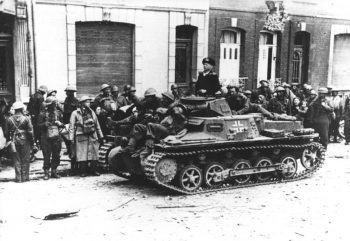
The first tank battle of the Spanish Civil War came in October 1936 during a Republican counter attack against Nationalist forces approaching Madrid through Torrejon de Velasco. This battle also marked the first use of improvised Molotov Cocktails against tanks but despite this, poor communications on the Republican side led to the defeat of their T-26s. However, Panzer 1s met their match a few days later when they engaged the Republican Commune de Paris Battalion equipped with Soviet BA-10 armoured cars. The 45-millimetre gun in the BA-10 was more than sufficient to knock out the poorly armoured Panzer I – designed for infantry suppression at best – at ranges below 500 metres. Later in the Civil War, Nationalist forces preferred to use captured T-26 tanks due to their better armour and firepower and this experience helped shape the development of more deadly German Panzers II and III. However, despite their design limitations and mechanical shortcomings, Panzer Is would still play a part in the early stages of World War II where radio communication, speed and deployment in large numbers would overcome both Polish anti-tank guns and better armed French tanks.
KRUPP 88MM ANTI AIRCRAFT AND TANK GUN

The “88” was the best known of all German guns in the Second World War, being capable of destroying any tank then in service. It was introduced as an anti-aircraft weapon but had a maximum horizontal range of 16 200 yards (14 815 metres) and an effective vertical range of 25 000 feet (7 620 metres) It could fire either a 20 lb (9 kg) high explosive or a 21 lb (9.52 kg) armour piercing shell at a rate of fire exceeding 15 rounds a minute. In Spain the Condor Legion made extensive use of the 8.8 cm Flak 18 in the Spanish Civil War, where its usefulness as an anti-tank weapon and general artillery piece exceeded its role as an anti-aircraft gun.
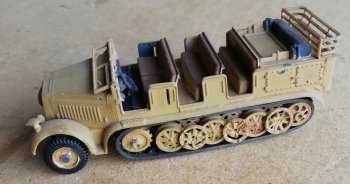
From 1938, the 88mm Krupp gun was often paired with the Krauss-Maffei built Sd Kfz 7 eight ton half track. Although widely featured in Nazi propaganda to suggest that the entire Wehrmacht was highly mechanized, Maybach-engined Sd Kfz 7s eventually only equipped Panzer and Panzergrenadier (mechanized infantry) units while other artillery was often still hauled by horses. Sd Kfz 7s could tow an eight ton load at 30 mph on roads or 18 mph cross country with a crew of 12.