
The idea for my Rhinehaven diorama really started during the summer of 2023 when in the Gloucestershire Steam Extravaganza model tent hosted a splendid 1/32 scale model of a Krupp K5 gun made of Meccano.
I then remembered that the late Ron Brooks had given me his 1/72 scale Hasegawa models of both the Krupp K5 gun Leopold and Morser Karl on its railway bogies.
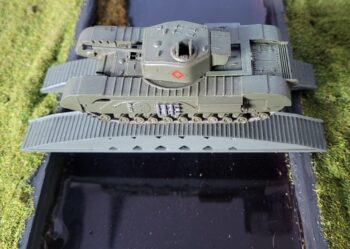
At the same time, my collection of Churchill tanks moved to a new home on my Millbrook diorama, thereby leaving behind an empty display box built by the late Robin Kilminster measuring just under 2 feet long by 6 inches high and and 13 inches deep.
Laying down the plinths for both the big artillery pieces made me realise that the spare box would also have room enough for them to be on different levels (always a more attractive approach than two vehicles on the same level). In fact there would also be enough room for a quayside and sufficient canal width for the Langley Models resin Rhine barge kindly gifted to me by Alan Postlethwaite.
The quayside itself was then used to showcase Ron Brooks’ King Tiger tanks and his Mercedes Benz G4 staff car. I also realised that there was room for a shortened version of the Airfix/Dapol dockside crane. This is arguably one of most obscure offerings in the 00 scale railway range as not every layout has a dockside and since the introduction of shipping containers this type of crane is much less used.
Hasegawa built the two big guns to exactly 1/72 scale rather than thinking of their use on 00 gauge railways – hence the need to keep them on their own tracks. However, these could be easily replaced by 00 gauge track modules in the future.
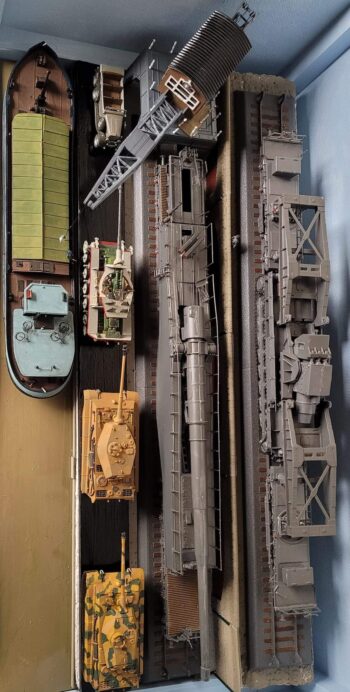
The Krupp K5 gun modelled on the lower dockside track here can trace its ancestry to railway mounted artillery used by the Confederate army in 1862 during the American Civil War.
However, railway guns were to come of age in the European war of 1914 to 1918.
The Paris-Geschütz, or the “Kaiser Wilhelm Geschütz” (Emporer William Gun), was used from March to August 1918 and was the largest piece of artillery used during the Great War
As a military weapon however the Krupp built canon was not a great success. The payload was minuscule, the barrel had to be regularly replaced, and the accuracy was only good enough for city-sized targets. However, the German objective was to build a psychological weapon to attack the morale of the Parisians; not to destroy the city itself.
Designed and operated by the German Navy, the Paris Gun was capable of firing shells from locations as far as 131km from Paris. Some seven 210mm guns were made using bored-out 380mm naval guns, each fitted with special 40 metre long inserted barrels. However with only two railway-gun mountings actually available just three of the guns were ever in use at any one time, fired from the Forest of Coucy.
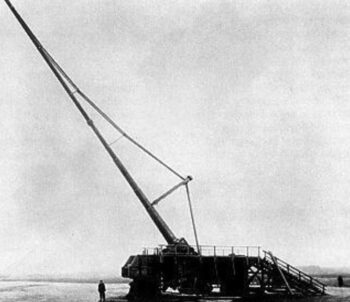
Such was the rapid wear and tear of firing its 120kg shells, each requiring a 180kg powder charge, that the gun’s lining required reboring after approximately 20 shots. Indeed, after every firing the succeeding shell needed to be of slightly greater width. Once fired, a shell took 170 seconds to reach Paris, rising as high as 40 km above the earth into the stratosphere.
An undoubted sensation when first deployed – at 7.18am on 21 March 1918 – the appearance of heavy shells in Paris caused initial and widespread alarm among its inhabitants. Parisians believed that they were being bombed by a new type of high altitude Zeppelin because neither the sound of an aeroplane nor of a gun could be heard.
For all its power the gun had little actual effect on the course of the war, with just 367 shells fired between March and August – a figure disputed by the French who cited 320, of which 183 landed within the city’s boundaries. Casualties of the gun’s use ran to 256 deaths and 620 wounded, with 88 killed and 68 wounded on Good Friday 1918 alone when a shell landed on the church of St. Sepulchre, causing its collapse while a service was in progress.
The Paris Gun was nevertheless a notable propaganda success at home in Germany. The Allies searched in vain for the guns during the German retreat of August 1918 onwards and after the Armistice but in vain. No example of the Paris Gun has been located then or since although U.S. forces located one of the gun’s spare mountings.
When Germany re-armed under Nazi leadership from 1933, the designs of “Max” and “Langer Max” (“Long Max”; the heaviest German railway guns of 380 mm calibre) formed the basis for such new types as the 240 mm “Theodor Bruno” ( range 20 km ), 283 mm calibre 21.539 m long K5 ( range 62 km and modelled here ) , 380 mm “Siegfried” K ( range 55.7 km ) and 800mm “Dora” ( range 47 km ).
The K5 was designed to be used as a coastal defence gun, often being hidden inside a tunnel against air attacks when not in use. Design work began in 1934 with eight trial examples being built by the end of February 1940 and 25 production variants by 1945.
The two six-axle bogies had an axle loading of 18 tons and would form a train with ammunition, stores, personnel and equipment vehicles. A 40-ton diesel locomotive would haul the rake, which would carry about 113 shells.
Maximum gun elevation was 50 degrees, muzzle velocity 1 120 metres/second, firing rate 8 shells per hour – or 7 minutes 30 seconds between shells.
Not only was the slow rate of fire a weakness of this and other railway guns but the K5 required heavy duty railway lines to travel on and either curved track or a special turntable to allow the gun to traverse to aim at a target.
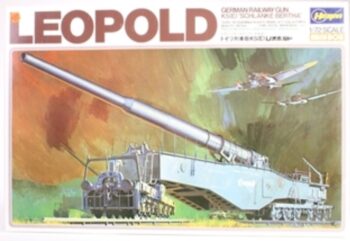
Two K5 guns, named Robert and Leopold by German crews, were shipped to Italy to help counter the Allied landing at the town of Anzio in February 1944.
The Allied soldiers stuck on the beach nicknamed the two German guns “Anzio Annie” and “Anzio Express” due to the express train-like sound the shells generated. On 18 May 1944 the guns fired off their remaining ammunition and then escaped along the coastal railroad into the rail yard in Civitavecchia, in preparation for evacuation. This proved impossible and the crews attampted to put the guns beyond use.
Of the two, Leopold was only slightly damaged and after capture by the US Army was taken to the Aberdeen Proving Range Museum, Maryland, and is now preserved at Fort Lee, Virginia.
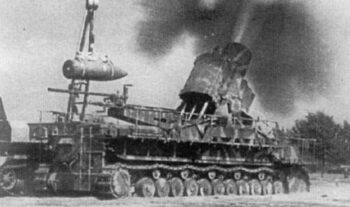
The Karl-Gerät” (040/041) (In German literally “Karl-device”), also known as Mörser Karl, on the high level track, was a self-propelled siege mortar (Mörser) designed and built by Rheinmetall.
Its heaviest munition was a 60 cm (24 in) diameter, 2,170 kg (4,780 lb) shell, and the range for its lightest shell (after mortar modification) of 1,250 kg (2,760 lb) was just over 10 km (6.2 miles).
Each gun had to be accompanied by a crane, a two-piece heavy transport set of rail bogies, and several modified tanks – munitionspanzers – to carry shells.
Seven mortars were built, six of which saw wide use between 1941 and 1945. They were employed attacking the Soviet fortresses of Brest-Litovsk and Sevastopol as well as Polish resistance fighters in Warsaw, in the Battle of the Bulge, and to try to destroy the Ludendorff Bridge during the Battle of Remagen.
One Karl-Gerät survives in a Russian museum and the remainder were scrapped after the war.
Rheinmetall proposed this super-heavy howitzer in March 1936 to attack the Maginot Line.
Their initial concept was for a weapon that would be transported by several tracked vehicles and assembled on site, but the lengthy preparation time drove them to change it to a self-propelled weapon in January 1937.
German Artillery General Karl Becker was involved in the development of the high ground pressure vehicle and was named after him.
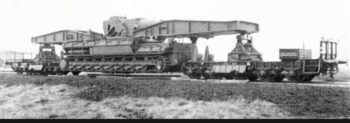
Seven Karl-Gerät howitzers were manufactured. The first six had the nicknames “Adam” (later “Baldur”), “Eva” (later “Wotan”), “Thor”, “Odin”, “Loki”, and “Ziu”; the seventh, the research and test weapon (Versuchs-Gerät), had no name. Delivery of the six production vehicles took place from November 1940 to August 1941.
In May 1942, 54 cm (21 in) Gerät 041 barrels were ordered for the six vehicles. At a conference with Adolf Hitler in March 1943 it was stated that the first longer-barrelled Gerät 041 would be delivered by June 1943, and the third, by mid-August. Only three of the Gerät 041 barrels were actually completed.
Twenty-two Panzer IV Ausf. D, E and F chassis were modified with a superstructure capable of carrying four shells that replaced the turret and outfitted with a crane as Munitionsschlepper für Karl-Gerät ammunition transporters/loaders. Two or three of these Munitionsschlepper were assigned to each weapon.
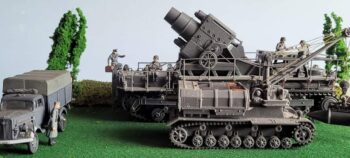
As it happens, Ron Brooks also left me his model of a Morser Karl on tracks along with a Munitionspanzer IV, which I managed to incorporate into another diorama for next to nothing!
The base (and perspex box) came from the late Robin Kilminster and the soldiers and Opel Blitz lorry were donations to Jet Age Museum.
The embankment at the back was made from a bit of old picture framing covered in paint and flock powder and the trees were just a few from a pack acquired from the Usk Show for only £1.20.
In the early 1930s, the German company Opel AG produced a light and fast truck called Blitz, capable of carrying a large quantity of equipment (theoretically 3,100 kilograms of load) in spite of its low mass.
The German army was impressed by the performance of this vehicle and ordered many examples.A four wheel drive version was introduced from 1937 and found to be reliable even when driven over long distances on poor roads in extreme weather conditions.
From 1937, models with four-wheel drive were also produced and delivered to the German Army. Nearly 82,000 units were built between 1937 and 1944. Because Opel was part of General Motors, the advancing Allies found that it was easy to repair captured Opel Blitz lorries using GM or Bedford parts.
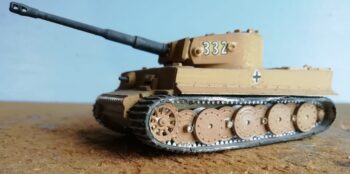
Having built a diorama box to showcase Morser Karl and Krupp K5 guns as well as Alan Postlethwaite’s Rhine barge, I realised that the quayside could be used for Ron Brooks’ cutaway King Tiger and other examples showing the difference between the so called Porsche and Henschel turrets – more of which later.
The Tiger II was a development of the Tiger I, pictured above.
Although only 1 360 of the 55 ton Panzer VI Tiger I were built, being armed with the deadly 88mm gun they proved a serious challenge to Allied Churchills, Comets and Shermans. However, they could be knocked out by British 17 pounder guns and Hawker Typhoon aircraft.
Production began in 1942 although one design fault was the very low geared turret traverse – making the 88mm gun slow to bear on a target. In fact the first Tiger to be captured intact by the British – on 21 April 1943 near Tunis – was the now-preserved 131, hit by three six pounder solid shots from Churchill tanks which disabled the traverse and elevation of the gun.
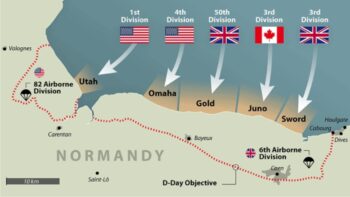
Tiger II or ‘Konigstiger’ (King Tiger) was first used during the Normandy campaign in 1944 and was the most powerful tank on the battlefield at that time.
Known variously as the Tiger Ausf. B, Tiger II, King Tiger or Königstiger (the British also referred to it as the ‘Royal Tiger’), 489 Tiger IIs, were produced at the Henschel assembly plant, between January 1944 and March 1945.
However, despite lacking in numbers, and being prone to mechanical and mobility issues based on its size and weight, the Tiger IIs combination of devastating firepower and thick sloped armour plate, made it a formidable adversary for Allied forces on the rare occasions it was encountered on the battlefield.
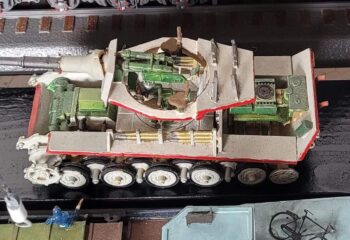
Ron’s sectioned model was, I believe, inspired by an article in the 1975 Airfix Annual which showed that a 1/76 Tiger could be presented in sectioned form just as well as a 1/35 model to show off such inner features as the rear engine, front gearbox, torsion bar suspension and gun breech.
Both turrets used on the Tiger II were designed and built by the Krupp company. So why are they so often called the ‘Porsche’ and ‘Henschel’ turrets?
Put simply, the answers can be found in the tank’s early design.
The earliest work on a heavy tank armed with the 88mm KwK 43 gun was carried out by the Porsche company. The resulting design was known to the company as the Typ 180 and to the German Army as VK.45.02(P).
Ferdinand Porsche, the company’s chief designer, developed several versions of this design, each powered by a different engine or engines. His aim, or perhaps obsession is a better term, was to build a vehicle with the highest automotive performance possible. However his designs proved unreliable and none of his VK.45.02(P) variants entered production.
Rival firm Henschel began designing a KwK 43 armed tank in October 1942. Their hull design, originally known as VK.45.03, was approved for production as the Tiger II.

Krupp had been given a contract to design and build turrets for the VK.45.02(P) – the Porsche version, pictured above. They completed fifty, and, as there were now no Porsche hulls to fit them to, delivered them to Henschel. These became the Tiger IIs with the curved front turret.
Later Tiger IIs were fitted with the simpler flat fronted turret, also designed by Krupp. Replacing one type of turret with the other could be done, but it required significant work and it’s unclear how often it actually happened.
Although inaccurate, there is a logic to the common names. The ‘Porsche turret’ is so named because it was intended for (but never fitted to) a tank hull designed by Porsche, and the ‘Henschel turret’ because it was fitted to a hull designed by that firm.
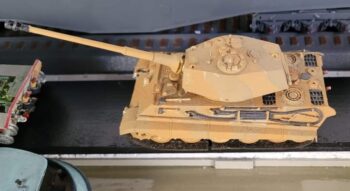
It might be better to call the turret fitted to the green and buff tank on the right of the diorama Pre-Production (curved front) and those on the two tone buff and sectioned models as Production (flat front) turrets.
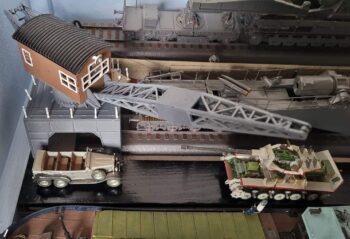
The Dapol C030 Dockside Crane was a 1959 vintage Airfix moulding but still fitted together well. The dark brown of the cabin was Revell SM381 with Humbrol 176 Neutral Grey used for parts of the steelwork and Humbrol 110 Natural Wood for the deck outside the cab door. Rigging of the safety rails was with black cotton with a Ratio 451 ladder top hoop added to help the driver on and off the moulded ladder.
Black cotton was also used for the cables to raise the jib and hook. These were rigged using photos on the Internet as a guide as the instruction leaflet suggests something totally different and more suited to using the completed item as a toy rather than a static model.
The crane was an often fiddly model, with parts that are best painted on the sprue, but one that is satisfying as it is far less modelled than the Dapol engine shed, for example.
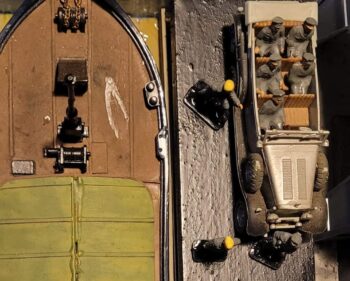
To complete the quayside scene on the Morser Karl/Krupp K5 diorama I wanted to include Ron Brooks’ model of the Mercedes Benz G4 staff car as it would be out of place in a battle scene.
Unfortunately, Ron told me that someone had stolen his standing Hitler figure and the driver and other seated Nazis have gone AWOL as well.
However, Facebook reader David Porte of Essex came to the rescue with a set of five seated figures, now painted and installed in Ron Brooks’ Mercedes Benz.
54 almost identical six wheel Mercedes Benz G4 cars were built from 1934, each powered by a 100 bhp five litre eight cylinder inline M24 engine. Able to carry seven passengers in comfort, the four back wheels were powered while the front pair steered. However, despite its off road capability the G4 had a top speed of only 42 mph and was too expensive for mass production for the German army.
Hard roofed versions were produced, but an open G4 with bullet proof glass and armour plate was Adolf Hitler’s parade car of choice and can be seen in many TV and film documentaries covering the years 1934 to 1945.