2022 marks the Platinum Jubilee of Her Majesty Queen Elizabeth II and in tribute a model display was created at Jet Age Museum, Gloucestershire, to celebrate just some of the many aeronautical achievements of her seventy year reign, both in Britain and her Commonwealth.
In spite of international competition, the aircraft of the Queen have been successfully exported during a time when Britain lost most of its geographical Empire but extended its cultural reach, joined and then left the European Union but also played a major role in many international aerospace programmes.
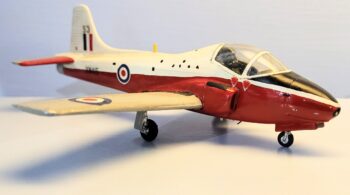
The 1/72 scale models on display included the Hunting Percival Jet Provost and its successor the BAC Strikemaster.
In 1960 English Electric merged with Vickers and Bristol Aircraft to form the British Aircraft Corporation and Warton, Lancashire, continued as a centre of excellence producing both all-British flying machines and those resulting from international collaboration.
The British Aircraft Corporation 167 Strikemaster was based on the Jet Provost T5, itself a much refined version of the earlier Jet Provost T3 and T4 basic trainers which in turn sprang from the Hunting Percival Provost piston engined trainer. Hunting Percival Aircraft had also become part of the British Aircraft Corporation – by way of Vickers – and its design office had originated the BAC 1-11 twin jet airliner, originally known as the H107.
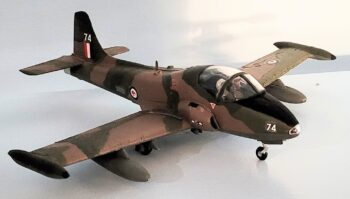
110 Jet Provost T5s were delivered to the RAF and served with the Royal Air Force College at Cranwell and the Central Flying School at Little Rissington, Gloucestershire. The 167 Strikemaster featured an uprated Rolls Royce Viper 20 turbojet of 3 140 lb static thrust, pressurised cockpit and a 3 000 lb carrying capacity on its four underwing pylons. Strikemasters have been exported to eight countries, including New Zealand where they were known as “Blunties”.

The next featured aircraft in chronological order was the record breaking Fairey Delta 2, described in more detail here, while having a more immediate effect on British military operations was the de Havilland Sea Vixen.
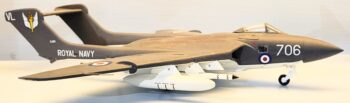
The De Havilland Sea Vixen has a special place in British aviation history as both the last British designed fighter to be catapulted from an aircraft carrier and as the last of a line of De Havilland twin boom fighters dating back to the First World War.
Indeed, De Havilland’s pusher propeller DH2 helped found what became the Gloster Aircraft Company and the life of Gloster’s final fighter design, the delta winged Javelin, was entwined with that of the Sea Vixen.
Indeed, had the Royal Air Force not selected the Gloster GA5 Javelin prototype – first flown on 26 November 1951 – to replace its Armstrong-Whitworth built Meteor Night Fighters then twin boom swept wing aircraft made in Hatfeld might have been in service with both Royal Navy and RAF, just as both services had operated the earlier straight winged Vampire and Venom.
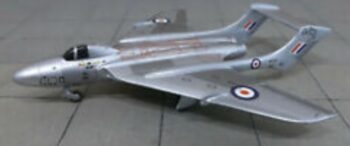
As it was, the Navy only came back to the DH 110 idea after an advanced swept wing single fuselage Sea Venom variant was cancelled. Luckily for them, De Havilland had continued work on two prototypes ordered by the RAF as an insurance against the GA5 project failing, the first of which – WG 236 – first flew with John Cunningham at the controls on 26 September 1951. This aircraft would fly supersonically with John Derry and observer Tony Richards on board on 9 April 1952 and, tragically, shed its wings and crashed on 6 September 1952 at the Farnborough Air Show. As well as Derry and Richards, 27 spectators were killed and a further 63 injured in Britain’s worst ever air show calamity.
Following the loss of WG 236, the second prototype – WG 240, first flown on 25 July 1952 – was strengthened and redesigned before undertaking carrier landing trials and the first Sea Vixen Fighter All Weather Mark 1 was delivered to 700 Naval Air Squadron in November 1957.
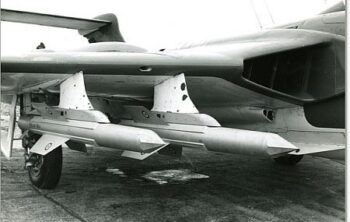
As well as four infra-red Firestreak air-to-air missiles, these early Sea Vixens were armed with unguided rockets in pop-out boxes instead of guns although a more obvious feature was the offset fighter style canopy for the pilot ( similar to later marks of English Electric Canberra ) and the observer’s position to the right but lower down in the aircraft. This soon became known as the coal-hole because of the almost total lack of a view out of it, and it was not a popular arrangement.
The Sea Vixen attracted much interest from many NATO countries and even Sea Venom customer Australia although, like the Gloster Javelin, a thin wing version supersonic in level flight was cancelled in 1956 just before the infamous Duncan Sandys Defence White Paper of 1957.

What did survive to join the fleet in 1963 however was the Sea Vixen FAW2, recognisable by larger tail booms that extended over the front of the wing’s leading edge. These booms were to house both Electronic Counter Measures equipment and additional fuel capacity while armament was upgraded to Red Top missiles ( capable of attacking from a range of angles rather than the rear -approach Firestreak ) and the Bullpup air-to-ground munition. The latter, which was also carried by Supermarine Scimitar and Blackburn Buccaneer aircraft, required the launching aircraft to fly alongside it to the target thus negating any benefit of being a stand-off weapon. The Sea Vixen FAW2 also featured a one-piece pilot’s canopy and – on later examples – bulged observer’s hatch with a frangible window for easier escape by ejector seat.
Despite the work of Sea Vixens – and Scimitars – from HMS Victorious deterring President Kassem of Iraq from invading Kuwait in 1961 and the subsequent role of British carrier aircraft in Tanganyika in 1964, Rhodesia in 1966 and the withdrawal from Aden in 1967 the 1966 Defence White Paper ( this time put forward by a Labour government ) cancelled the hoped for new CVA-01 flat top just as the RAF’s TSR2 had been axed two years before.
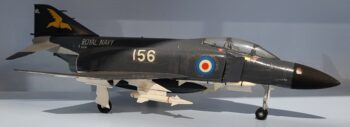
This decision, combined with the introduction of the McDonell Douglas Phantom II to the Fleet Air Arm, caused the last Sea Vixen Naval Air Squadron to be disbanded in 1972 despite there being years of life left in the airframes. By this time however, many of the Sea Vixen’s systems were becoming outdated, in particular the radar which lacked the “look down” capacity to detect intruders approaching fast at wavetop height.
Before their departure however Sea Vixens were used by two Royal Naval aerobatic teams – Fred’s Five and Simon’s Sircus -the latter being named after Lt. Cdr. Simon Idiens. Despite giving only 40 displays, Simon’s Sircus is regarded by many as one of the best air display teams ever.
After retirement from Naval service, several Sea Vixens were modified to D.3 missile target drone standard but as they were then considered too expensive to be destroyed in such a casual manner and ended up being used to train drone pilots in the techniques of flying an aircraft by remote control. The D.3 conversion process itself turned out to be more expensive than expected, so only five or so D.3 conversions went ahead and an even smaller number of aircraft were converted to TT.2 target tug standard.
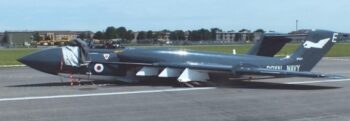
Thankfully one of the D.3s – now registered as G-CVIX – survived to become a regular airshow performer – and the most complex civilian-operated type on the UK register until Vulcan XH558 was returned to the air. Unfortunately in 2017 G-CVIX became unserviceable after a wheels up landing.
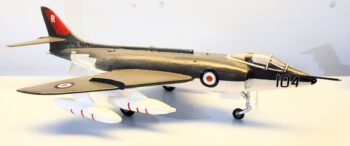
This 1/72 scale Vickers Supermarine Scimitar was built from the Magna Models kit by member David West.
This naval attack jet traces its development back to the experimental Vickers Supermarine Type 508 and 529 which were large twin-engine fighters that had unusually thin unswept wings and V-tails. Initially conceived for ‘undercarraige-less belly landings’ on aircraft carriers, the concept was soon abandoned as unworkable and further developments returned to the conventional arrangement.
A third experimental aircraft was ordered as the Vickers Supermarine Type 525, being significantly modified with swept wings and more conventional tail surfaces. The Vickers Supermarine Type 525 (VX138) was flown for the first time on 24th April 1954.
The Vickers Supermarine Type 525 was designed against Specification N.113D whilst the production aircraft (later to be named the Vickers Supermarine Type 544 Scimitar) included the adoption of a powered boundary layer control system to reduce landing speeds for carrier operation.
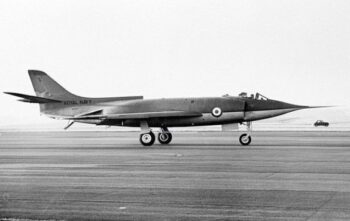
The first Vickers Supermarine Scimitar pre-production prototype (WT854) was flown on 24th January 1956 with the following aircraft evolving through a number of changes such as a stronger airframe and improved aerodynamics.
The final production designs featured a dog tooth leading edge and an anhedral tailplane to improve transonic handling and manoeuvre characteristics. The first true production Scimitar flew on 11th January 1957 and production numbers comprised the single Type 525, three pre-production Scimitar and 76 production Scimitar F.1.
During its operation aboard naval carriers, the aircraft was found to be quite large and a number of onboard accidents occurred during its fairly short period of service (over 50% of the aircraft were lost).
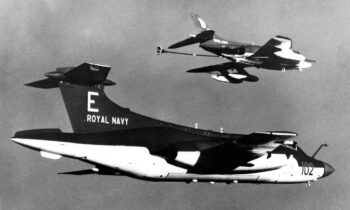
That said however, a number of important lessons were learnt from the Vickers Supermarine Scimitar including the importance of its true multi-role capability. With the introduction of the Blackburn Buccaneer, the Vickers Supermarine Scimitar was reduced to the role of a mid-air refuelling tanker, allowing the Blackburn Buccaneer to take off with an heavy bomb-load, offset by a lower initial fuel load.
The Vickers Supermarine Scimitar eventually retired in 1969, after a brief spell in a training role with the Fleet Requirement Unit at Hurn, Dorset.
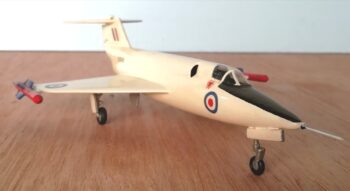
The mixed jet and rocket powered Saunders Roe SR53 is fully described here while the penultimate version of the Gloster Meteor was the U16.
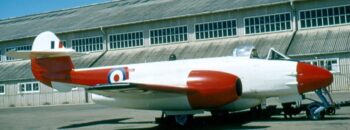
When the Royal Air Force commenced retirement of the Meteor F.4 fighter it looked at converting a number to target drones to help develop ground and air-launched guided missiles. It was decided to convert a number to be used as expendable targets that could be tested to destruction. Up to this stage the conversion of Fairey Fireflys to U-8 and U-9 configuration had been used but their performance was not similar to fast Soviet jet-powered fighters and bombers and development of the Meteor F.4 proceeded in order to provide an aircraft with much higher performance.
A Meteor T-7 was initially converted and fitted with autopilot and equipment for the proposed U-16, a conversion of the Meteor F-8, the T-7 carrying out trials at the Royal Aircraft Establishment (RAE) Farnborough in Hampshire. Subsequently a contract was received by Flight Refuelling Limited of Tarrant Rushton to convert aircraft to this configuration, some 94 being converted, commencing in 1955. The first U-15 conversion was flown on 11 March 1955.
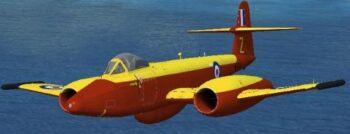
Conversion involved fitting additional radio equipment, a fully automatic pilot, a remote control system that could be used to control the aircraft from the ground, and wingtip camera pods which could be ejected automatically by radio command just before the missile impacted the aircraft. These aircraft could be piloted, or be entirely remotely controlled, or could carry a non-pilot observer. Records indicate a total of 130 F.4s was converted.
A total of 61 was delivered to the Woomera Weapons Research Establishment in South Australia between 1958 and 1963, the first un-manned flight there being made on 7 May 1957 when a drone was destroyed by a Fireflash missile. Another 20 aircraft were delivered to the RAF unit at Llanbedr in North Wales, the first flight there being made over Cardigan Bay on 17 July 1958. A few were also attached to No 728B Squadron of the Royal Navy (RN) at Hal Far air base in Malta.
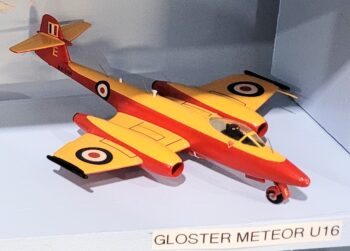
As time went by the number of U-15 survivors diminished and, as the F-8 was being retired, a number of these had similar conversions undertaken, becoming the U-16. Subsequently the U-21 was developed, also based on the F-8 fighter, this model having the electronic telemetry equipment of the U-16 but with a lengthened nose. Work on this model commencing at Flight Refuelling Limited in 1962. The U-21 were aircraft converted in the United Kingdom, and U-21A were Australian conversions. All were fitted with ventral fuel tanks and Mk 3 Ampor pods. The colour scheme was red and white, although this varied.
In Australia Fairey Aviation at Bankstown, NSW obtained kit parts provided by Flight Refuelling Limited and 15 aircraft were converted using ex RAAF aircraft. One of these was shipped back to the United Kingdom in July 1971 and converted to U-16 configuration, continuing in service until 11 October 2004, at which time RAF Llanbedr closed.
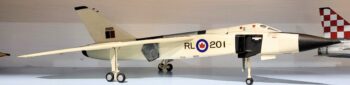
As well as the United Kingdom, Her Majesty Queen Elizabeth II is also monarch of the Dominion of Canada, the most technically advanced product of which was the Avro Canada CF-105 Arrow.
In the early years of the Cold War, Canada decided to design and build the most advanced fighter aircraft in the world.
Canada is well known for its rugged bush planes, capable of rough landings and hair-raising take-offs in the wilderness. From the late 1930s, the North American country had also started to manufacture British-designed planes for the Allied war effort. Many of these planes were iconic wartime designs like the Hawker Hurricane fighter and Avro Lancaster bomber.
Ambitious Canadian politicians and engineers weren’t satisfied with this. They decided to forge a world-leading aircraft manufacturing industry out of the factories and skilled workforce built up during the war. Tired of manufacturing aircraft designed by others, this new generation of Canadian leaders were determined to produce Canadian designs. Avro Aircraft, the Canadian airplane maker created after the war, was the company that would deliver their dream.
Freed from the set ways-of-thinking of Avro’s more established rivals, the firm’s engineers were able to work on revolutionary jet fighters, commercial airliners, flying saucers and even a space plane. They placed Canada at the technological cutting edge of the new Jet Age.
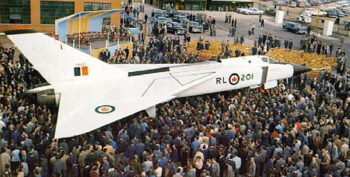
Then came the Arrow. On 4 October 1957, 14,000 people watched a large hangar on the outskirts of Toronto open to reveal a beautiful, large, white, delta-wing aircraft. The plane was the Avro Arrow interceptor. A third longer and broader than today’s Eurofighter Typhoon, the Arrow could fly close to Mach 2.0 (1,500 mph, or the maximum speed of Concorde), and had the potential to fly even faster. It was Canada’s Can$250m (US$1,58bn today) bid to become an aviation superpower.
The project was genuinely ground-breaking. Avro’s engineers had been allowed to build a record-breaker without compromise. But Canadians would soon discover that the supersonic age had made aviation projects so expensive that only a handful of countries could carry them out – and Canada, unfortunately, wasn’t one of them.

The advert for Avro Aircraft celebrating the “first 50 years of powered flight in Canada 1909–1959” had only just been printed when on “Black Friday”, 20 February 1959, the loudspeaker of the Avro Aircraft factory on the outskirts of Toronto crackled to life. Thousands of workers heard the company president announce “that f—— prick in Ottawa” (the newly elected Canadian prime minister John Diefenbaker) had cancelled the entire Arrow programme. Later that day, 14,500 skilled men and women lost their jobs. Many of these engineers joined the brain-drain to the United States. The “Avro group” of 32 engineers playing critical roles in Nasa’s Apollo programme, which – ironically – beat the Soviets in the race to land a man on the moon.
In so doing, these engineers challenged notions of what small countries like Canada could achieve in the hi-tech industries of the day, even if convincing politicians to stump up the cash for them was an altogether trickier business.
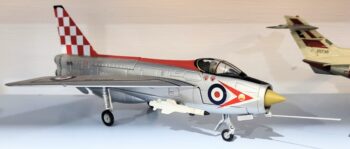
This Corgi Aviation Archive 1/72 scale diecast model represented English Electric Lightning F3 XR719 in 56 Squadron
The English Electric Lightning stemmed from a 1947 requirement for a fighter capable of unprecedented performance. English Electric’s design was so radical at the time that the Royal Aircraft Establishment took exception to some parts of it. They went so far as to award Shorts with a contract to put together an aircraft to show English Electric just what parts of their design were wrong.
The Short SB.5, which could have its wing sweep and tailplane position varied between flights, first flew on 2 December 1952 and by early 1954, the trials had confirmed EE’s choice of low tailplane and mainplane sweep angle.
The first prototype – designated the P.1 and powered by two vertically integrated Sapphire engines – took to the air on 4 August 1954, piloted by Roland Beamont . During its third flight – on 11 August 1954- the P1 became the first British aircraft to exceeded Mach 1 in level flight.
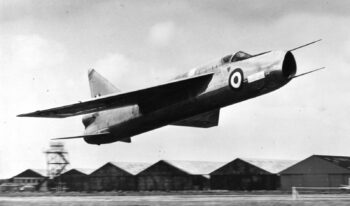
The second prototype, the P.1A (a P.1. with twin 30mm cannon and later a bulged belly fuel tank), took to the air on 18 July 1955 and was displayed at that year’s Farnborough show. The P.1s, while recognisably Lightning ancestors, had a number of differences in appearance. Most obviously they had yet to receive a radar holding nose cone and the nose intake was egg-shaped rather than round. No ventral fuel tanks were fitted to start with and the vertical tail was substantially smaller.
English Electric were by now working on a possible production variant, the P.1B. This had a ventral fuel tank, Ferranti AI-23 radar, raised cockpit and Avon engines. Armament had improved with the inclusion of a ventral pack to take either two more cannon, two retractable rocket packs or two Firestreak infra-red homing missiles.
The vertical tail was increased in size from the fourth P.1B onwards, after some slight directional stability problems had been found when flying at high speeds.
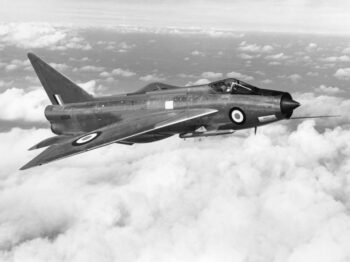
In fact, the P.1B was a very different aircraft to the P.1 and P.1A; so much so that EE had some worries that the government could cancel this ‘new’ project if EE presented it as such. Accordingly, the designation for this new variant was merely P.1B, which made it at least sound like a minor modification instead of a major advance.
In late 1956 an order for 20 of these aircraft was placed so that testing of every aspect of the new fighter could be accelerated. EE’s decision on the P.1B designation may very well have saved the project, because the 1957 Duncan Sandys Defence White Paper cancelled almost every advanced aircraft project in development, but left the P.1 alone.
While the P.1 had survived the Defence White Paper, export prospects practically disappeared. In later months, the government even went so far as to sabotage English Electric’s own efforts to sell the aircraft to Germany – after frustrating and fruitless attempts to sell the aircraft to the Luftwaffe, EE discovered a government representative was actually telling the Germans not to buy the aircraft!
On the 4 April 1957 the first P.1B flew and also exceeded Mach 1 without using reheat. In July, the world jet air speed record (then at Mach 1.72) had been broken. Flight testing was not without its mishaps; problems with the canopy release mechanism resulted in no less than three in-flight losses of the canopy. The pilots involved were lucky to survive (one canopy self-jettison occurred at supersonic speed, making the pilot, de Villiers, the fastest open-cockpit pilot in the world). Some amusement in the press was caused by these failures; Punch printed a cartoon showing the P.1 with rope wrapped around the fuselage and canopy with a caption of “Had a little trouble losing cockpit canopies, but I think we’ve mastered it.”
With performance of the aircraft better than predicted, EE designed new wings with a kinked and cambered leading edge which gave better subsonic performance and a little more available space to store fuel in. These were flown on the P.1B but EE did not want to proceed with the new wings until they were absolutely sure of their usefulness, and official indifference led to the new wings not entering production until many years later.
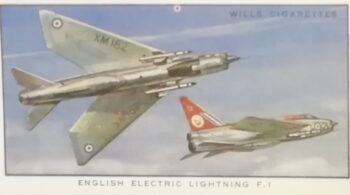
In October 1958, the RAF officially named their new aircraft Lightning and one month later, using minimum afterburner, the Lightning attained Mach 2.0.
The initial requirement did not actually specify Mach 2 performance, but EE had seen that it was possible and the Lockheed F-104 programme was also progressing towards Mach 2 . Roland Beamont later stated that the Lightning’s performance at Mach 2 was much superior to the F-104, with less noise and vibration and better controllability.
A planned Double Scorpion rocket mounted in the rear of belly tank of the P.1B was cancelled as the aircraft’s new Rolls Royce Avon engines were found to give enough extra performance to render the rockets pointless. Besides, the space lost to the rocket and its fuel would have meant even less room for jet fuel, and the Lightning was short enough of that as it was.
Late 1959 saw the RAF finally getting their hands on some Lightnings to trial. The Lightning F.1 differed very little from the P.1B except that the ventral fuel tank now had a small fin, the main vertical tail was enlarged.
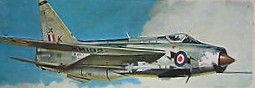
Lightning F1s entered service with 74 squadron at Coltishall in 1960, and the F.1A followed on, entering service with 56 and 111 squadrons at Wattisham. The only difference of note was that the F.1A (seen above in 111 Squadron markings) had attachment points for an in-flight refuelling probe – the Lightning’s limited fuel capacity meant that interception missions were almost limited to the area of the airfield otherwise!
Variable afterburners made their appearance in the F.2 variant, while the F.3 had some more major changes – improved AI-23B radar, more powerful Avon engines, a larger square-topped fin, cannon armament removed, Red Top (as opposed to Firestreak) missile capability and auxiliary overwing fuel tanks.
Although very much a pilot’s aeroplane, the Lightning was much more complex than the Hawker Hunter it replaced. Despite this, it was to continue in RAF service until June 1988 when finally supplanted by the air defence variant of the Panavia Tornado.
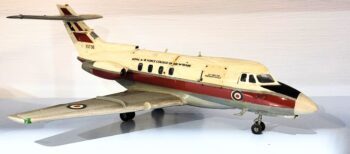
The original box art for the kit of Hawker Siddeley Dominie XS736 was painted by Roy Cross in 1968 with this particular set of decals being made available in the 1970s.
When the real de Havilland designed aircraft powered by twin Viper gas turbines entered service with the RAF in 1965 it was primarily to be used for training V-Force navigators at No 1 ANS, RAF Stradishall.
To this end the crew compartment had 4 rearwards facing seats, 2 at the rear bulkhead for the students and 2 on the port side of the aircraft (the forward of which was supplied with a Morse key for the training of AEOs/AEOps) – hence the 6 windows on the port side.
On the starboard side (visible in the picture) was the dinghy pack (below the side escape hatch) and forward of this was the radio rack, the elsan and the LOX pot – hence the 4 windows on the starboard side. The ‘cut here’ area was above the elsan/LOX pot.

The aircraft was fitted with the Ecko190 weather radar, DECCA area navigation, Vulcan Mk1 type Doppler feeding a GPI, single DME, single VOR (in the cockpit) and a pair of ‘steam driven’ (manually operated) ADFs (commonly referred to as the ‘Coffee Grinders’). At a latter stage a TANS (Tactical Air Navigation System, ie an air data computer) was also fitted.
During the 1970’s the training role altered so as to to teach low level Radar Navigation. The Ecko190 radar was less than perfect for this, and with the increasing training of Tornado navigators through the 1980’s/90’s, a decision was taken to update the radar and navigation suites to include colour radar optimised for low level, forwards facing seats, touch sensitive screens and side-stick controllers for both the student and the Staff navigators, as well as a Vulcan Mk2 Doppler (hence the large square antenna on the forward wing root fairing).
As a result, from 1992 onwards, 11 aircraft were dispatched to Marshalls at Cambridge for refitting, the first being delivered to Cranwell in early 1996. The new equipment comprised a derivative of the Thompson ‘Sea Searcher’ radar and a new navigation suite comprising digital TACAN, twin digital VOR/DME and a ‘proper’ digital ADF; as well as a CRT Nav display and a ‘proper’ RMI for the pilot, and a 9″ monochrome radar display with associated controller for the PA (Pilot’s Assistant).
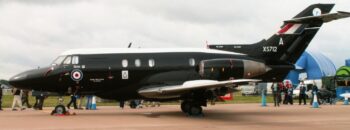
There is a claim in Bill Gunston’s book that the first aircraft to be delivered was XS728 ‘E’. This may be true in terms of the initial acceptance trials at Boscombe, but the first aircraft to be delivered to the Dominie Squadron at RAFC Cranwell (later 55(R) Sqn from June 1997) was XS712 ‘A’ in March 1996, with the Sqn pilots carrying out 2 CONVEX sorties each during that month. The second aircraft to be delivered was XS730 ‘H’ which performed the CA release of the new navigation kit on 15 April 1996.
The refitted aircraft were never termed T Mk2 but stayed as T Mk1 because the airframe hadn’t changed significantly. They were initially referred to as the post DAU aircraft (Dominie Avionics Upgrade).
The later aircraft had a longer radome than before (there are claims around that this was 12″ longer, but the Aircrew Manual stated 9″) and were very different internally. Working from the rear forward were 2 seats at the rear bulkhead, the port one being fitted with the Morse key, then on the port side was the new radio rack and forward of this the Staff Navigator’s station – hence the loss of 2 windows. On the starboard side was the dinghy pack as before, and forward of this the Student Navigator’s station. The original starboard side radio rack was removed (although a much smaller one replaced it at floor level) as was the elsan, however the LOX pot retained its original position. Hence the now 6 windows on the starboard side of the aircraft.
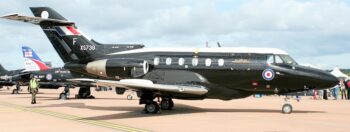
The first black Dominie was XS739 ‘F’ in the Spring of 1997 complete with a Playboy Bunny on the fin.
As the new aircraft came on line the 7 spare airframes were delivered to RAF Cosford for use as Ground Instructional Trainers – the the other airframes, XS732 ‘B’ and XS714 ‘P’ had already been declared scrap (‘B’ in 1992 and ‘P’ in 1994) owing to airframe fatigue and extensive associated cracking.
XS736 ‘S’ was the only aircraft to sport the blue fuselage band (denoting the RAF College, Cranwell) and was scrapped in 2007.
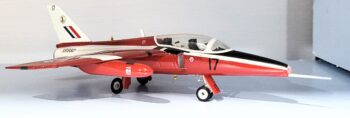
Although strongly associated with Gloucestershire through RAF Little Rissington’s Central Flying School and the RAF Kemble based Red Arrows, the Folland Gnat was also the last design of William Edward Willoughby “Teddy” Petter CBE, born in 1908 as the son of Sir Ernest Petter, one of the founders of Westland Aircraft of which he later became Technical Director in 1935. In this post he designed the Whirlwind and Welkin twin engined fighters as well as the single engined Westland Lysander army co-operation aircraft.
Petter left Westland in December 1944, after wanting to take over aircraft production as well as design, and moved to English Electric where he created the revolutionary Canberra bomber based on an idea by Westland’s Chief Engineer, Arthur Davenport.
Petter also began work on the supersonic Lightning but left English Electric in 1950 over both his desire to be in charge of design as well as production and his increasing doubts over the size and cost of the next generation of fighter aircraft.
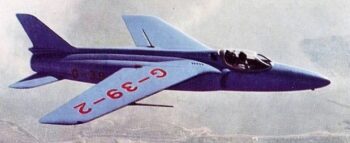
With English Electric Lightning development continuing under his former assistant Freddie Page, 1951 saw Petter joined Folland Aircraft, founded from the remains of British Marine Aircraft in 1937 by Henry P. Folland, former Chief Designer for the Gloster Aircraft Company.
The prototype Gnat fighter, fitted with a Bristol Orpheus engine, flew for the first time on 18 July 1955 and was was ordered by Finland, where the Gnat was found to need a great deal of ground maintenance, Yugoslavia, where two evaluation aircraft were dispatched by rail, and India – where it proved to be a formidable opponent for Pakistan’s Canadair Sabres in the wars of 1965 and 1971. Although faster to altitude and harder to see than the Sabres, control and hydraulic system issues were addressed before the Gnat began licensed production by Hindustan Aircraft as the Ajeet (“Unconquerable”).
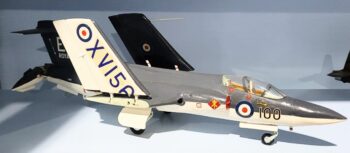
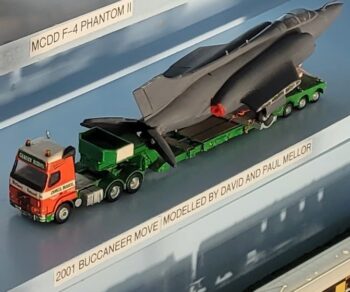
The folded wing Blackburn Buccaneer is the S1 variant with Bristol Siddeley Gyron Junior engines and smaller intakes while the Charles Russell lorry load modelled by the Mellor Brothers is the S2 with the larger intakes of the Rolls Royce Spey.
A fuller appreciation of the sole Blackburn jet aeroplane can be found here
Although this 1/76 scale Frog / Hasegawa model purports to represent a McDonnell Douglas Phantom II F-4K of the Royal Navy it is more firmly based on the UN /USMC F-4J. As such it has the exhaust nozzles and rear fuselage built around the General Electric J79 turbofan rather than the Rolls Royce Spey and is equipped with Bullpup missiles which the British Phantoms never carried.
The United Kingdom was the first export customer for the Phantom II and the only nation outside the USA to fly them from aircraft carriers.
A deeper article on the British Phantoms can be found here.
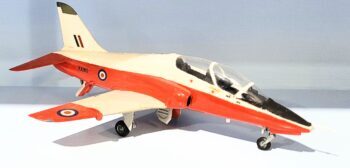
In 1977 Hawker Siddeley Aviation – which had previously absorbed the Gloster Aircraft Company – merged with the British Aircraft Corporation to become British Aerospace (BAe), renamed BAe Systems in 1999 after a further merger with Marconi Electronic Systems. This further concentration of Britain’s aircraft industry yielded more work for the former English Electric airfield at Warton, Lancashire, and – with the appearance of the Hawk single engined twin-seat jet trainer in 1974 – forged links with the former Blackburn Aircraft base at Brough, Yorkshire.
In 1964 the Royal Air Force specified a requirement (Air Staff Target (AST) 362) for a new fast jet trainer to replace the Folland Gnat. The SEPECAT Jaguar was originally intended for this role, but it was soon realised that it would be too complex an aircraft for fast jet training and only a small number of two-seat versions were purchased.
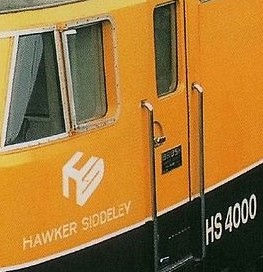
Accordingly, in 1968, a year after Hawker Siddeley member Brush built locomotive HS4000 ‘Kestrel’, Hawker Siddeley Aviation began studies for a simpler subsonic aircraft, initially as special project (SP) 117. This project was funded by the company as a private venture, in anticipation of possible RAF interest, and the design was conceived of as having tandem seating and a combat capability in addition to training, as it was felt the latter would improve export sales potential.
In 1969 the project was first renamed P.1182, then HS.1182. By the end of the year Hawker Siddeley Aviation had submitted a proposal to the Ministry of Defence based on the design concept, and in early 1970 the RAF issued Air Staff Target (AST) 397 which formalised the requirement for new trainers of this type. The RAF selected the HS.1182 for their requirement on 1 October 1971 and the principal contract, for 175 aircraft, was signed in March 1972.
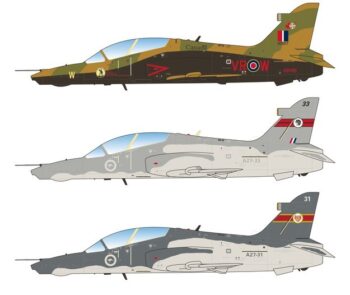
The new trainer was named “Hawk” – breaking an RAF tradition of University themed titles – and first flew on 21 August 1974. It is still in production with over 900 Hawks sold to 18 customers around the world. Indeed, despite being ordered off the drawing board – a rare phenomenon among modern warplanes – the Hawk is now recognised as Britain’s most successful jet aircraft.
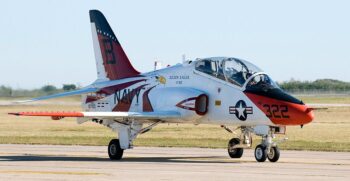
That achievement notwithstanding, the McDonnell Douglas T-45 Goshawk – developed from the BAe Hawk – is now the standard carrier training jet for the US Navy.
The Hawk is characterised by a low-mounted swept cantilever monoplane wing and is powered by a non-augmented two-spool Rolls Royce Turbomeca Adour turbofan fitted to the aft fuselage and fed by air inlets above the roots of the wings. The stepped cockpit, allowing the instructor in the rear seat a good forward view, was an innovation subsequently adopted by many other training aircraft.
The low-positioned one-piece wing was designed to allow a wide landing gear track and to enable easier maintenance access. The wing is fitted with wide-span, double-slotted, trailing-edge flaps for low-speed performance. Integral to the wing is 836 litre (184 imperial gallon) fuel tank and room for the retractable main landing gear legs. Designed to take a +8/-4 g load, the original requirement was for two stores hardpoints but Hawker Siddeley designed the Hawk with four hardpoints.
The fuselage design was led by the need to get a height differential between the two tandem cockpits. This enabled increased visibility for the instructor in the rear seat. Each cockpit is fitted with a Martin-Baker Mk 10B zero-zero rocket assisted ejection seat. The centre fuselage has an 823 litre (181 Imperial Gallon) flexible fuel tank. A ram air turbine is fitted just in front of the single fin as well as a gas turbine auxiliary power unit above the engine. The nose landing gear leg retracts forward.
The Hawk was designed to be manoeuvrable and can reach Mach 0.88 in level flight, and Mach 1.15 in a dive, thus allowing trainees to experience transonic flight before advancing to a supersonic trainer.
The The Hawk entered RAF service in April 1976, replacing the Folland Gnat and Hawker Hunter. Hawk T1 (Trainer Mark 1) was the original version used by the RAF and deliveries commencing in November 1976 with 176 being ordered.
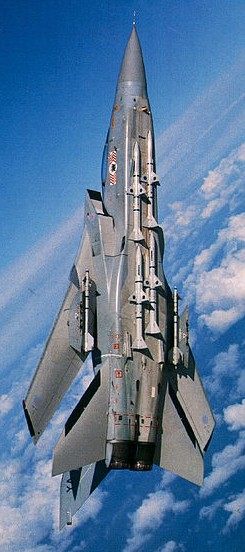
In RAF service the Hawk can be fitted with a 30mm Aden canon in a centreline pod and Sidewinder air-to-air missiles under the wings. From 1983 to 1986, Hawks so fitted were given the designation T1A and in the event of war would have worked with Panavia Tornados, whose Foxhunter airborne search radar sets would have vectored non-radar-fitted Hawk T1As – flown by instructor pilots – against enemy targets.
With the collapse of the Soviet Union in the 1990s Hawks are no longer tasked with this role although they have played aggressors in simulated air combat with Tornado ADVs.
The Hawk subsequently replaced the English Electric Canberra as a target tug while the Royal Navy acquired a dozen Hawk T1/1As from the RAF, for use as aerial targets for the training of ships’ gunners and radar operators.
Eighty Hawk T1/1A aircraft have been upgraded under the Fuselage Replacement Programme (FRP), which involves the replacement of the aft, centre and rear fuselage sections, using new build sections derived from the export Mk. 60 version of the Hawk.
In 2009, the RAF began receiving the first Hawk T2 aircraft, which will replace the T1 in the advanced trainer role, although the most famous RAF operator of the Hawk is the Red Arrows aerobatic team, which adopted the plane in late1979.
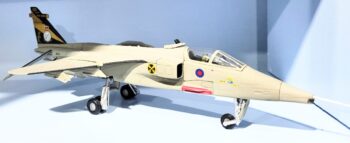
Corgi die cast model AA35403 represented SEPECAT Jaguar XX117 marked for the 90th anniversary of RAF 16 Squadron.
The Jaguar was a collaborative venture between the British Aircraft Corporation and Dassault-Bregut who formed the international company SEPECAT to manufacture 400 Jaguars: 200 for the RAF and 200 for the French Air Force.
The finished product owed much to the French Bregut 121 design and was powered by two Rolls Royce Turbomeca Adour engines, each producing 6 950 lb thrust, which yielded a speed of 840 mph at 1 000′ altitude. As well as being fitted with the advanced Navigation and Weapon Aiming Sub System (NAVWASS) the Jaguar also had a laser ranger and marked target seeker as well as pilot’s head-up display.
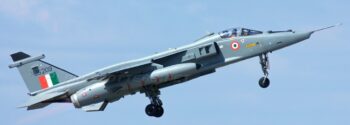
Jaguars were also sold to the air forces of India, Ecuador, Nigeria and Oman. The RAF received 165 Jaguar GR1s and 35 Jaguar T2 two-seat advanced operational trainers. The first French built Jaguar flew in September 1968 and the first British built Jaguar in October 1969.
The first Jaguars were delivered to 226 OCU at Lossiemouth in September 1973 and the first operational squadron was 54, which became fully operational at RAF Coltishall on 9 August 1974, closely followed by 6 Squadron on 6 November 1974.
With the introduction of the Tornado and the subsequent conversion of the Germany based Jaguar squadrons, the requirement for such a large OCU disappeared and during the latter 1980s the OCU gradually became the size it is today. Despite being a training squadron, the OCU prided itself on its continuing links with the front line. Whenever possible instructors benefited from major exercises with the operational squadrons and OCU pilots were involved in all operations including the 1991 Gulf War. The Jaguar display was traditionally an OCU task and continued every year since its inception in 1974. The pilot regularly completed over 40 displays per season, which were viewed internationally by approximately 5 million people.
One of the major changes in the OCUs history came after the decision to reduce the number of front line Tornado squadrons and allocate their number to the OCUs as reserve squadrons. On 24 June 1994 226 OCU became 16 Reserve Squadron and moved from Lossiemouth to Coltishall.
16 Squadron was originally formed with Bleriot aircraft on 10 Feb 1915 at St Omer, France, and subsequently became known as The Saints. The Squadron’s main role in World War 1 was reconaissance and artillery spotting and the badge “Two Keys in Saltire” symbolises unlocking the enemy’s secrets, the gold by day and the black by night. The motto Operta Aperta is Latin for “Hidden things are revealed.”
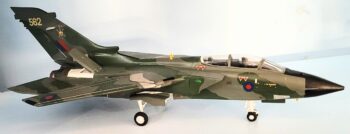
The first multi nation collaborative European military aircraft project, Tornado was developed by Panavia Aircraft GmbH, a company established by the three partner nations — the United Kingdom, Germany, and Italy—to create a multirole combat aircraft designed to take on the likes of the Russian MiG-29 and SU-27.
Nicknamed “Tonka”, it was developed in three main variants: the IDS (Interdiction and Strike) fighter bomber, the ECR (Electronic Combat and Reconnaissance), and the ADV (Air Defense Variant) fighter.
The pressure was on to deliver something truly groundbreaking with the Tornado. To bring about that aerial revolution, the designers turned to some new technologies.
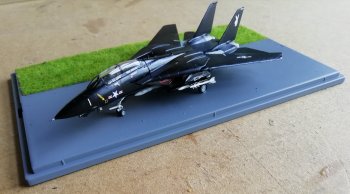
The first eye-catching feature was the wings. Much like the American F-14 Tomcat, the Tornado used a variable geometry configuration with wings swept fully forward for more lift during takeoff and a swept-back for better airflow at cruising speeds.
A formidable and lethal ground attack aircraft needs to have great vision, and so the Tornado included a navigation/attack Doppler radar kit that simultaneously scans for targets and conducts fully automated terrain-following for low-level flight.
Tornado also featured reverse thrust buckets that gave it excellent low-speed handling and landing abilities, stopping in less than 2,500 feet.
Because it was designed to fight during a nuclear war with limited reliance on electronics, the Tornado was in a lot of ways a blast from the past, an analogue plane in an increasingly digital age.
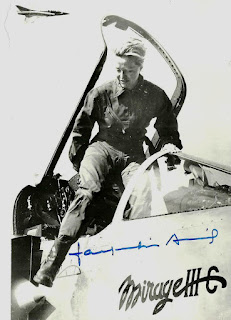
Its mechanical nature and the fact it rarely flew without two external fuel tanks meant some pilots found the 28-ton aircraft harder to handle than some of its contemporaries like the F-16 and French Mirage.
Also, despite the RAF deploying an interceptor variant designed to patrol the North Sea against Soviet bombers, it was never designed to be a dogfighter and was comparatively difficult to turn.
The RAF’s final GR.4 upgrade provided the Tornado with better electronics and avionics making it supremely suited to a new role as a guided missile carrier.
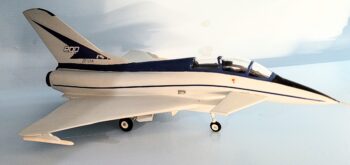
And finally, as Knight of the Realm Trevor McDonald used to say, is a 1/72 scale Pegasus model of ZF534, the sole British Aerospace Experimental Aircraft Programme (EAP) airframe.
ZF534 was built as an advanced technology demonstrator. Originally it was to be a tri-national undertaking but both German and Italian Governments pulled out of the project. British Aerospace with help from Italian and German suppliers continued the programme alone.
EAP was fitted with computer controls screens replace dials in the cockpit and it featured an unusual delta-canard configuration. It was rolled out in April 1986 and made its first flight later that year. In 1987 it made its 100th flight at the Paris Air Show.
The programme was a huge success and many of the features pioneered by EAP including the wing layout were later refined for the Eurofighter Typhoon. Having made its last flight in 1991 the aircraft spent time at Loughborough University as a training aid before coming to the RAF Museum at Cosford in 2012.