
As a retirement gift for Charlie Haigh, a friend who was a production engineer for the Tamworth based company, I was asked to create a diorama featuring Reliant cars.
Fortunately, two of their most iconic types – the four wheeled Scimitar GTE SE5 and three wheeled Regal Supervan are available in 1/76 scale from Oxford Diecast, as was a previous purchase, 76BD020: the Bedford OX articulated flatbed in British Railways livery.

This was bought as an accessory for my Canal Bridge Yard diorama – and was packaged in a medium sized jewel case which could also accommodate two cars.
The first task in converting 76BD020’s jewel case to a two car diorama was cutting off the ferrule mountings for the screws which held the Bedford lorry down. The black base could then be sanded flat and painted grey to represent a concrete hard standing.
One further option would have been a wall at the back to give context to the diorama, perhaps as a Reliant dealership or even the Tamworth factory itself. However, to maximise the visibility and available light on the diorama I chose to put the high wall at one end and support it with a long low wall and a lean-to shed.
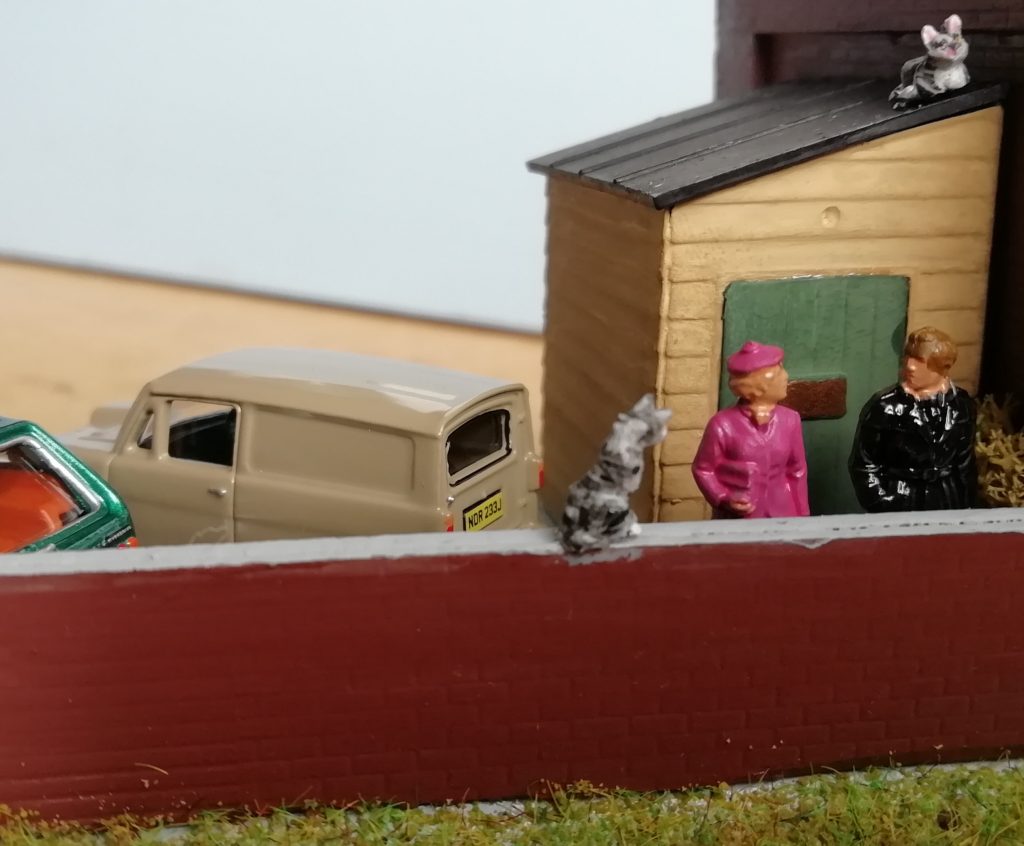
This could indeed have been one part of a corner of a factory or a car dealership (albeit more the Arthur Daley end of the market than the manufacturer franchised steel and glass kind) Or alternatively a corner of a car park overlooking a sports ground, railway line, allotments, or even the stub of a seaside pier – depending on the distant background used in photographs.
In this case, I only had to put a sky board on the sand-buff MDF of my desk to create the big sky and distant ebbing tide of somewhere like Burnham on Sea or Weston Super Mare. You could almost expect Sir John Betjeman to wander into shot and complain that the cars were only present because the town had lost its branch railway!
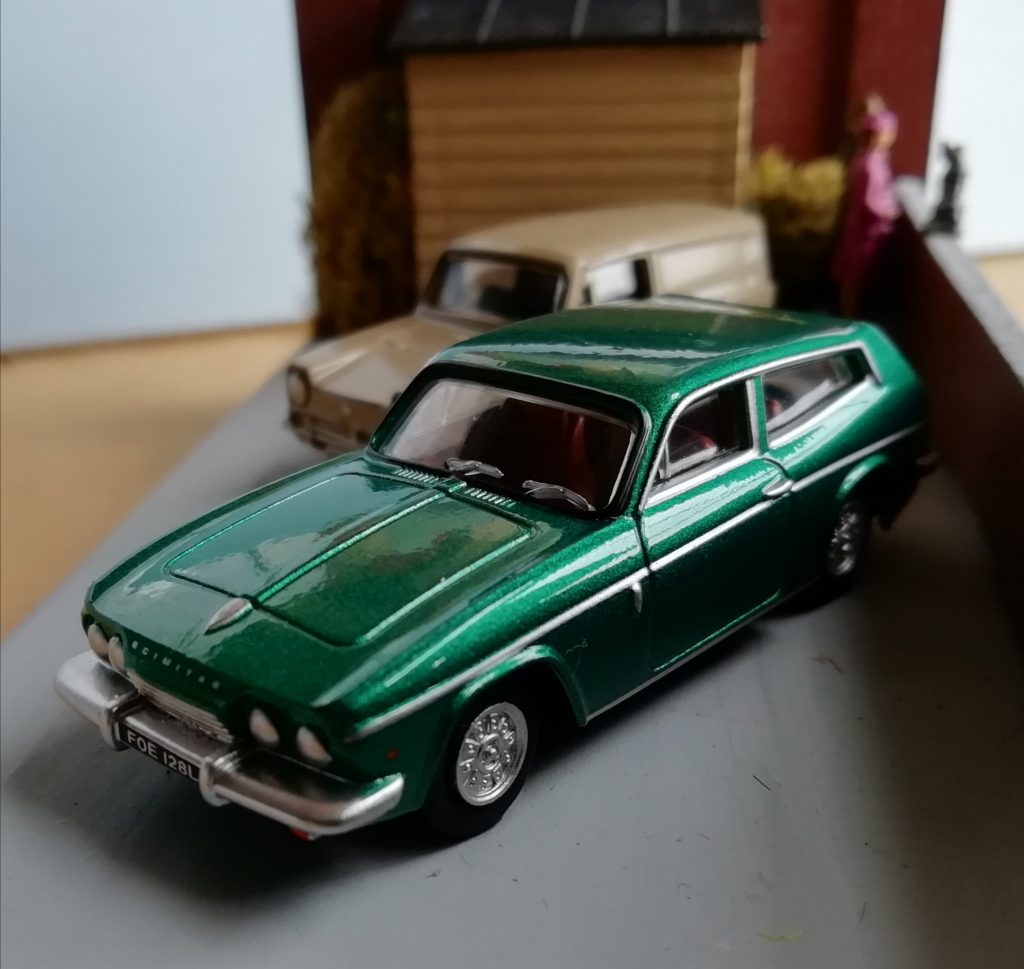
In fact the cars themselves span a watershed in British motoring history. The Metallic Tudor Green Scimitar GTE SE5 (76RS005) has the Birmingham registration FOE 128L in silver on black while the Honey Beige Regal Supervan (76REL004) is Exeter registered as NDR 233J in black on a white front and yellow rear numberplate.
British car registrations ran from 1 January to 31 December until 1967 when the registration year began on 1 August. As a result the J suffix covered August 1970 to July 1971 while the L suffix August 1972 to July 1973.
From 1968, modern style reflective number plates (white at the front and yellow at the rear with black characters) became optional and then compulsory for all vehicles manufactured after 1 January 1973.
Subsequently, this requirement was modified by the Finance Act 2014, to allow any vehicles registered within the ‘historic vehicles’ tax class to use the older style pre-1973 black number plates. This rule applies on a 40-year exemption basis, and rolls forward automatically each year on 1 April to include vehicles manufactured before 1 January 40 years ago.
Many buses delivered to London Transport between 1973 and the mid-1980s also continued to bear white-on-black plates.
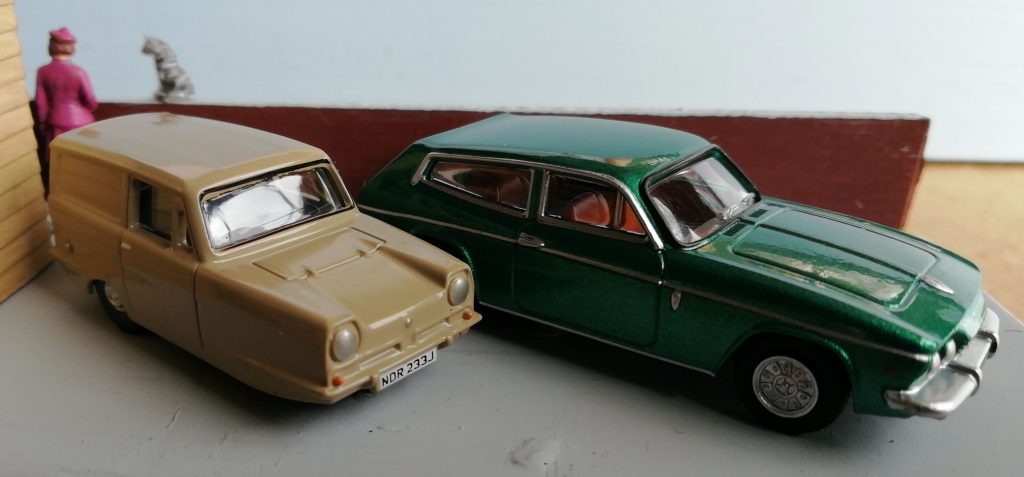
FOE 128L, as represented by 76RS005, would thus have been built between August and December 1972 and so one of the last new cars with the old style plates while the more humble NDR 233J, the basis of 76REL004, was one of the first with modern reflective plates as an option but almost the last of its marque to be built.
The registering and licensing of new cars was centralised in 1974 with the establishment of the DVLC, now DVLA in Swansea
Created by Tom Karen of Ogle Design, the Reliant Scimitar – in its GTE SE5 and further tuned SE5A formats – was one of the most iconic cars of the late 1960s and early 1970s. It was based on the 1964 vintage Scimitar SE4 coupe and first hit the road in 1968.
Each of the sporty two door shooting brakes was built with a fibreglass body mounted on a steel box frame chassis. The speed, performance and appearance of the Scimitar made it was an instant success.
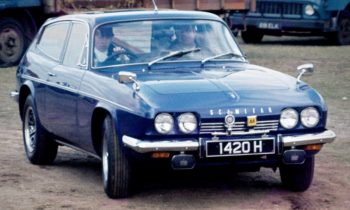
Selling at just over £1700, an Air Force blue example was even presented by the 14th and 20th King’s Hussars to HRH The Princess Anne, who became their new Colonel in Chief in 1969. The manual transmission Overdrive Scimitar had the registration 1420H, which had previously been carried by a milk float in Bermondsey, London. It was a gift for her 20th birthday in August 1970 but was handed over closer to Christmas in November that year.
1420H also featured the cap badge of the 14th/20th; a Prussian Eagle awarded to The 14th Light Dragoons by Crown Princess Frederica of Prussia in 1798.
The Scimitar SE5/SE5a ceased production in 1975 when it was succeeded by an even more high end model, the SE6. HRH Princess Anne later transferred the registration 1420H to eight successive SE6s.

The 700cc Reliant Regal – and its companion car the Reliant Robin – meanwhile enjoy a special place in UK popular culture, appearing in TV and film productions and at public events, including the London 2012 Olympics.
The Reliant Regal Supervan was a light-commercial version of the original 3-wheeler Reliant Regal with a side-hinged rear door. The marque was manufactured between 1953-1973, yielding a 60mph top speed with best hill climbing gear being reverse.
Arguably the most famous Reliant Regal was the bright yellow example featured between 1981 and 2003 in the BBC TV comedy “Only Fools and Horses”
Writer John Sullivan chose the Regal not only because its fibreglass body would stand up to being parked outside Peckham’s Nelson Mandela House (really a block of flats in Ealing) but because Rodney “Plonker” Trotter believed that he, older brother Del Boy and Grandad believed that every part of their lives had something missing. In this case a wheel!
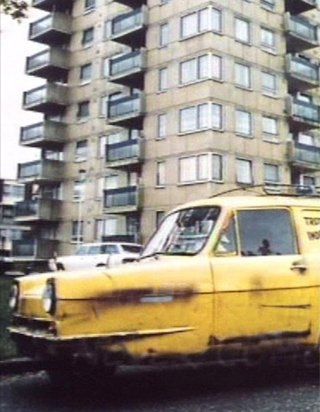
However, Reliant did not just make three wheeled vans because they could. Under UK law, a three wheeled vehicle weighing less than 7 cwt (355.6 kg) is considered a “tricycle” and can be driven on a full (class A) motorcycle licence. It is therefore lighter and more economical than a “proper” four wheeled van.
Yellow was chosen to make the Regal stand out in night scenes and, as much filming was done on public roads, the first example – hired from Action Cars of Harrow – had to be roadworthy.
In the end, ten different Regal Supervans were supplied to the BBC with the same specifications as it was cheaper to “Trotterise” a new vehicle than get the old one through its MOT. Each one retained the back door and side panel lettering of the original.
In the Third Series of Only Fools and Horses, the van registration of DHV 938D was revealed, purportedly making it a London vehicle from 1966, although in fact being a show plate. In earlier episodes the white on black plate read APL 911H, making it a Surrey van registered between 1 August 1969 and 31 July 1970.
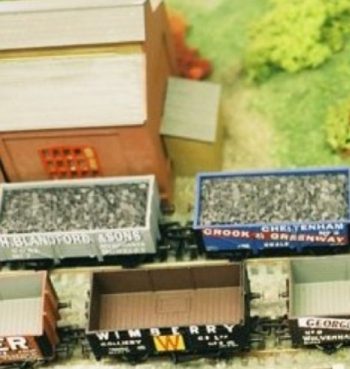
Once I had decided to only restrict vision from one end of the diorama rather than along the back, I found that a low brick wall could be created by glueing two lengths brick embossed plastic card with the smooth sides together. The top edge of this could then be painted light grey to represent concrete coping and the finished wall used to support the larger end brickwork.
This was made by cutting down a leftover back wall from the Dapol (originally Airfix) Engine Shed kit before backing it with a similar sized piece of black plastic card. This added strength to the structure on the bevelled edge of the plinth, covered the moulded profile of the back wall and opening the possibility of adding the Reliant logo.
Rather than leave the back wall with a simple pair of double doors, I covered the moulded doorway with the components of the lean-to wooden shed that also appear as an option on the sprue.
This, I felt, gave the scene a more intimate and rustic character – especially with the addition of lichen bushes and Peco PSG 35 self adhesive grass tufts – and also offered a vantage point to one of the 4mm resin cats obtained from the excellent Penduke Models.
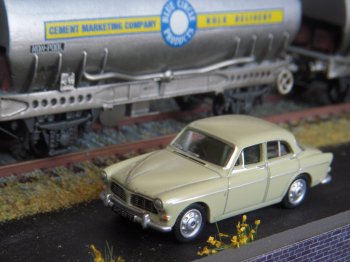
In all, I think that I achieved my aim of not just sticking two Reliant cars in a box but giving them an atmospheric, possibly ambiguous background: a screen on to which all sorts of imagination can be projected. Once again, as with the case with my Volvo Amazon shot against a Cemflo wagon on Canal Bridge Yard, the inspiration was the Reader’s Digest format magazine Drive which my father used to regularly receive as an Automobile Association member. Sadly I no longer have these, but reviews were always accompanied by the cars in question in interesting surroundings. Not necessarily the beautiful people and places of the aspirational advertising but, for sake of argument, a Victoria signal box or a field full of gliders. And in the case of the Regal and the Scimitar, I do like tabby beside the seaside.